Marcus Reed had one hand resting on the roof of his silver sedan and the other holding a folded courthouse receipt when the tow truck entered the county annex parking lot. It came around the corner too quickly, its diesel engine rattling beneath a spinning amber light, even though no stranded or illegally parked vehicle waited for assistance. The truck slowed only after its driver saw Deputy Brent Cavanaugh standing beside Marcus’s door with his ticket book already open. From the way both men looked at the sedan, Marcus understood that the decision had been made before anyone had spoken to him.
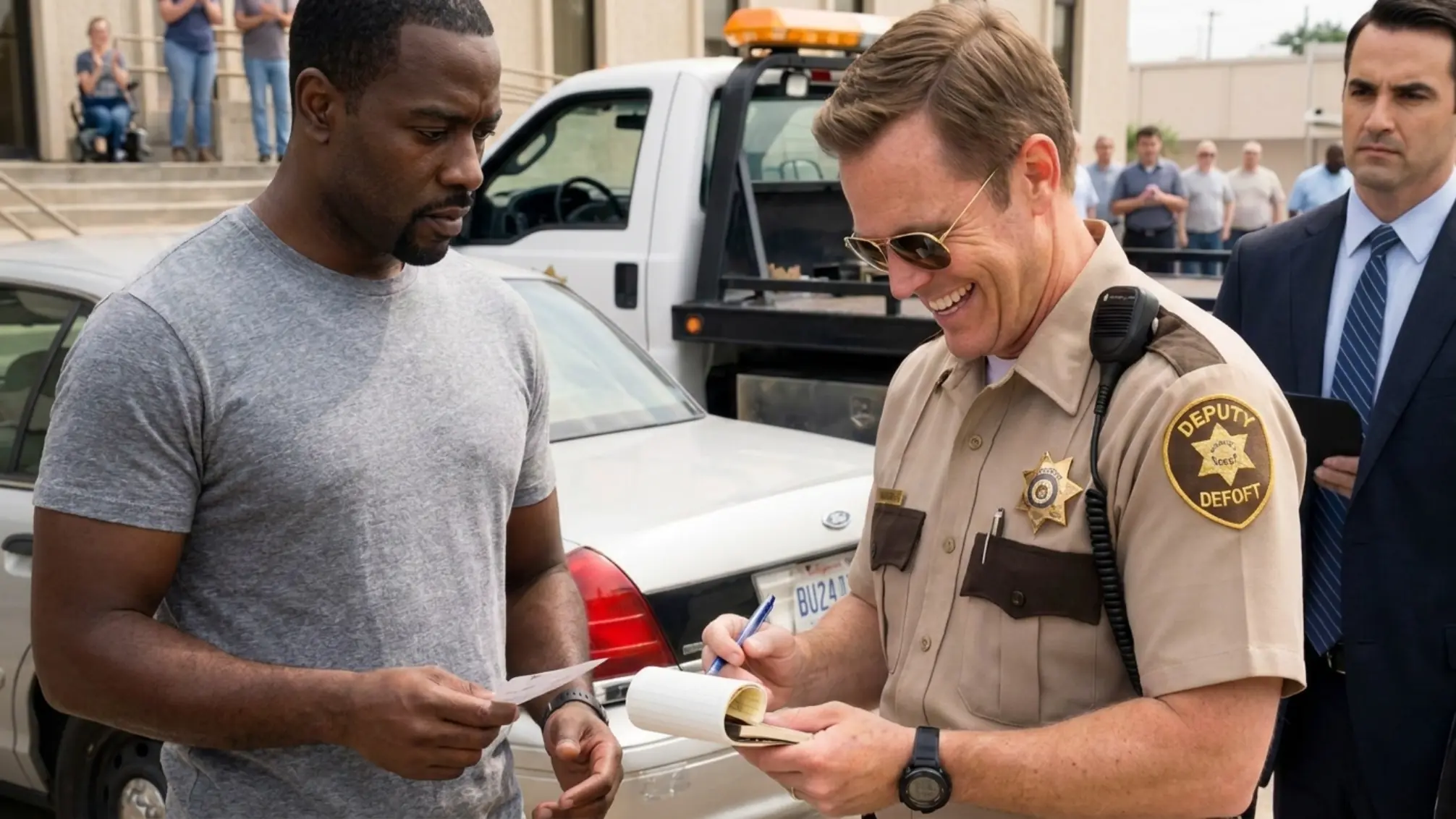
“You need to step away from the vehicle,” Cavanaugh said.
Marcus looked down at the painted white lines around his tires. His sedan sat perfectly inside the designated visitor space, six feet from the curb and directly beneath a faded sign reading PUBLIC PARKING—TWO-HOUR LIMIT. The receipt in his hand showed that he had entered the courthouse annex twenty-three minutes earlier, and the clerk had stamped it to confirm his appointment.
“For what reason is it being towed?” Marcus asked.
Cavanaugh did not look at the sign or the receipt. He was thirty-nine, lean and broad across the shoulders, with short light-brown hair beneath his campaign hat and mirrored sunglasses hiding his eyes. His tan uniform was pressed sharply enough to suggest pride, but the mocking curve of his mouth suggested something else.
“Obstruction,” he answered.
Marcus glanced toward the fire lane beside the courthouse entrance. It lay nearly twenty yards away, clearly marked by red paint and metal signs. His car blocked neither the lane nor the pedestrian walkway.
“Obstruction of what?”
“County business.”
Marcus remained calm. “Could you identify the specific county business being obstructed?”
The deputy tapped his pen against the ticket book. “You were told not to leave the vehicle here.”
“No, sir. I parked, entered the records office, filed my documents, and came back outside. The clerk validated the space.”
Marcus extended the receipt.
Cavanaugh glanced at it for less than a second. “That doesn’t matter now.”
But details mattered to Marcus. Details were often the only things that remained honest when someone in authority began changing his story. A warning could become a citation, a citation could become an arrest report, and a quiet question could be rewritten as aggressive resistance by the time paperwork reached a supervisor.
Marcus had learned that lesson long before that morning.
The tow truck stopped behind the sedan. Its driver, a heavyset white man with a red beard and grease-stained coveralls, climbed from the cab carrying a yellow towing order clipped to a board. He did not ask the deputy which vehicle was involved.
He walked directly toward Marcus’s car.
“Silver Carson sedan,” the driver read aloud. “Virginia plate ending in seven-four-two.”
Marcus looked from the paper to Cavanaugh. “When did you call him?”
The deputy’s pen stopped moving.
Near the annex doors, a woman carrying court files slowed down. A county employee wearing a plastic identification badge paused beside the steps. Two men loading equipment into a maintenance van stopped to watch.
Cavanaugh shifted closer. “You don’t need to concern yourself with when I made the call.”
“I’m concerned because he arrived with my license plate already written on the order.”
The tow driver’s expression tightened.
Marcus continued. “That means someone selected my vehicle before you claimed it was obstructing anything.”
Cavanaugh lowered his ticket book. “Step away from the car.”
Marcus held up the receipt. “This space was validated ten minutes ago.”
“That paper means nothing now.”
“It means the county authorized me to park here.”
The deputy moved until only a few inches separated them. “Keep arguing and I’ll tow you with the car.”
Several witnesses reacted audibly.
Marcus met Cavanaugh’s hidden eyes without stepping back. “Then keep writing, Deputy. The FBI agents behind you came for more than my keys.”
Cavanaugh smiled at first.
Then he saw the tow driver looking past him.
Three black government SUVs had entered the lot without flashing lights or sirens. They stopped in a quiet line near the courthouse steps, and six men and women in dark suits climbed out. None drew a weapon. None hurried.
They simply walked forward with the unmistakable focus of people who already knew exactly whom they had come to see.
Cavanaugh turned slowly.
At the front of the group was Special Agent Elena Brooks, a forty-four-year-old Black woman with closely braided hair, a charcoal suit, and a federal credential displayed beside her jacket. Two agents followed with evidence bags and body cameras already activated.
Cavanaugh forced a laugh. “Is there some kind of federal hearing today?”
Brooks stopped several feet away. “Deputy Brent Cavanaugh?”
“Yes.”
“Step away from Mr. Reed’s vehicle.”
Cavanaugh looked at Marcus, and the confidence in his face began to fracture.
“You know him?”
Brooks did not answer immediately. Her gaze moved to the ticket book, the prewritten towing order, and the truck positioned behind the sedan.
“I know enough to repeat myself,” she said. “Step away.”
Cavanaugh obeyed, but only by a single pace. “I’m conducting a lawful vehicle removal.”
“Based on what violation?”
“Obstruction of county business.”
Brooks looked at the white parking lines and the public-parking sign. “What business?”
“That information is part of an active county matter.”
Marcus unfolded his receipt and handed it to her. “The records clerk validated my parking at ten forty-two. The tow truck arrived at eleven-oh-five with my plate already listed.”
Brooks examined the stamp.
She then faced the driver. “Who gave you that order?”
The man shifted his weight. “County dispatch.”
“Name?”
“I don’t know. It came through the company system.”
“Show me.”
The driver glanced toward Cavanaugh.
That single movement said more than an answer would have.
Brooks raised one hand, and another agent stepped toward the truck. “Preserve the dispatch terminal, dash camera, towing documents, and all communications from this morning.”
The driver backed toward his cab. “You can’t search company property without a warrant.”
Agent Brooks removed a folded document from her jacket. “We have one.”
The color drained from his face.
Cavanaugh looked toward the courthouse entrance, where more employees and visitors had gathered. Some held phones openly now. He lowered his voice.
“Whatever you think this is, you’re interfering with local authority.”
Brooks tilted her head. “We are investigating local authority.”
The words silenced the parking lot.
Marcus rested both hands where everyone could see them. He had spent eight months waiting for this moment, though he had never expected it to begin with his own vehicle. He was not an FBI agent, despite what Cavanaugh now appeared to suspect. He was a senior auditor with the Department of Justice’s Office of Inspector General, assigned to review suspicious vehicle seizures connected to county law enforcement.
His presence at the courthouse annex was not accidental.
Neither was the silver sedan.
For nearly two years, residents had filed complaints about cars disappearing from legal parking spaces near government buildings. The official reports described fire-lane violations, expired meters, abandoned vehicles, or obstruction of emergency access. Yet photographs, receipts, and surveillance recordings frequently contradicted the reports.
The same towing company appeared in nearly every complaint.
So did Deputy Brent Cavanaugh.
Many victims never challenged the seizure. Recovering a vehicle required hundreds of dollars in towing and storage charges, and each additional day increased the cost. People without money lost cars they needed for employment, medical appointments, and childcare.
Those who complained were threatened with citations or arrest.
Those who hired attorneys discovered that the original towing photographs had disappeared.
Marcus had spent months examining the paperwork. The pattern was obvious, but proving coordination required catching the participants while they believed they controlled the scene.
That morning, he had entered the courthouse annex carrying a sealed request for records connected to thirty-seven disputed tows. His vehicle had been registered under his own name, but an internal alert falsely labeled it as belonging to a defendant with unpaid county fees.
Someone inside the annex had accessed the filing.
Eleven minutes later, the tow company received Marcus’s plate number.
Cavanaugh had arrived three minutes after that.
Marcus looked at the deputy. “You knew which car to target before I returned.”
Cavanaugh’s jaw tightened. “I don’t know anything about your investigation.”
“I didn’t mention an investigation.”
The deputy realized his mistake.
Agent Brooks stepped closer. “Hand me your radio and department phone.”
“No.”
“This is a federal evidence-preservation order.”
“I need to contact my supervisor.”
“You may contact counsel after surrendering the devices.”
Cavanaugh placed one hand protectively over the phone clipped to his belt. “I’m not giving you county property.”
Brooks’s tone hardened. “Deputy, do not turn a records seizure into an obstruction arrest.”
The county employee near the steps began walking toward them. He was a thin man in his fifties with silver hair and a blue badge identifying him as Leonard Price, assistant director of courthouse operations.
“What is happening here?” Price demanded.
Cavanaugh appeared relieved. “These agents are interfering with an authorized tow.”
Price looked directly at Marcus, then at the receipt in Brooks’s hand. His expression changed too quickly.
Marcus noticed.
“So you know why his car was being removed?” Brooks asked.
Price straightened his tie. “I assume the deputy observed a violation.”
“You were watching from the steps before the tow truck arrived.”
“I was returning from lunch.”
“It is eleven fifteen in the morning.”
Price glanced toward the annex doors.
Agent Brooks shifted slightly, blocking the clearest path inside.
Marcus studied him. “You approved the county’s vehicle-removal contract.”
“That is public information.”
“You also supervise the parking database.”
“I supervise dozens of systems.”
“Including the one used to place a false enforcement alert on my license plate.”
Price’s face hardened. “I have no idea who you are.”
Marcus reached inside his jacket slowly and displayed his government credential.
“Marcus Reed, Department of Justice Office of Inspector General.”
The tow driver muttered a curse.
Cavanaugh looked at him sharply, as though the driver’s fear were a greater betrayal than any evidence the agents possessed.
Price recovered first. “If this is an official audit, you should have contacted my office.”
“We did,” Marcus said. “Three records requests disappeared after reaching your office.”
“I never saw them.”
“You personally signed the internal rejection notices.”
Price turned toward the courthouse. “I will retrieve the relevant files.”
Brooks raised her hand. “No one enters the building until our digital team secures the records office.”
“You cannot close a county annex.”
“The magistrate who signed our warrants disagrees.”
As if summoned by her words, another federal vehicle entered the lot. Digital-forensics specialists stepped out carrying sealed equipment cases. Behind them came two representatives from the state attorney general’s office.
The crowd near the steps grew silent.
Cavanaugh removed his sunglasses. His eyes moved constantly now—toward the exits, the agents, the tow truck, and Price.
Marcus had seen the look before. It belonged to someone calculating whether escape remained possible.
“You should sit down,” Marcus told him.
Cavanaugh gave a humorless smile. “You think you’ve already won?”
“I think innocent people lost their cars because you assumed no one would compare the reports.”
“You don’t know why those vehicles were taken.”
“I know a nurse’s car was towed while she testified in a domestic-violence hearing. Your report claimed it blocked an ambulance lane, but courthouse video showed it parked where mine is now.”
Cavanaugh said nothing.
“I know a retired teacher lost his truck after refusing to pay a cash fee. Your photograph showed a red curb, but forensic analysis proved the paint had been added digitally.”
The tow driver looked toward him in alarm.
Marcus continued. “I know a single mother paid eight hundred dollars to recover a car you claimed had been abandoned, even though her validated parking receipt showed she had been inside the building for forty minutes.”
“That was the towing company’s fee,” Cavanaugh said.
“You received part of it.”
The deputy stepped forward. “You had better be careful.”
Agent Brooks moved between them. “Threatening a federal investigator in front of six agents is a poor strategic choice.”
Cavanaugh pointed at Marcus. “He set me up.”
Marcus remained calm. “I parked legally.”
“You came here knowing what would happen.”
“I suspected what might happen. You decided to prove it.”
The deputy suddenly tore the department phone from his belt and hurled it toward the pavement.
An agent caught his wrist before he could release it.
Cavanaugh swung with his free hand.
The parking lot exploded into movement.
Two agents forced him against the rear door of his patrol car. He struggled violently, driving one shoulder backward and reaching toward his holstered weapon. Agent Brooks seized his forearm while another agent removed the pistol.
“Stop resisting,” she ordered.
The phrase carried a bitter irony that several witnesses understood immediately.
Cavanaugh continued fighting until cold steel closed around his wrists.
The tow driver backed away.
“You stay where you are,” Brooks told him.
“I only drive the truck.”
“You arrived with a prewritten order linked to a false database alert.”
“I do what dispatch sends.”
“Then you can explain why your company paid Deputy Cavanaugh’s mortgage through a consulting business owned by his brother.”
The man’s mouth fell open.
Marcus looked toward Leonard Price.
The courthouse administrator had disappeared.
“He’s gone,” Marcus said.
Brooks turned toward the steps.
The annex doors were swinging shut.
Two agents ran forward, but the electronic locks engaged before they arrived. Inside the glass lobby, Price hurried toward the records corridor carrying a small black bag.
“He’s going for the servers,” Marcus said.
Brooks spoke into her radio. “Rear team, intercept Price. Protect the evidence room.”
A fire alarm began ringing inside the annex.
Employees near the entrance shouted as red lights flashed behind the glass. Sprinklers activated on the first floor, pouring water across desks and filing cabinets.
Price had triggered the building’s emergency system.
“He’s trying to destroy paper records,” Marcus said.
Smoke appeared near the records-office ceiling.
Brooks ordered the agents to break the glass.
A federal officer struck the door with a heavy entry tool. The first impact cracked it; the second shattered the panel. Agents rushed inside while courthouse employees evacuated through a side exit.
Marcus started after them.
Brooks caught his arm. “You’re not tactical.”
“The contract files are in the basement archive. If Price reaches them—”
“My team will handle it.”
“He changed the storage codes last month. I know the sequence from the audit logs.”
Brooks studied him for a moment, then handed him a respirator. “Stay behind me.”
They entered the annex through smoke and falling water.
The lobby floor was already flooding. Alarms screamed overhead while people moved toward the exits. Agents swept the corridor as Marcus led Brooks toward the stairwell.
They found the basement door open.
A trail of wet footprints crossed the concrete floor toward the archive room. Inside, metal cabinets stood open and documents lay scattered everywhere. Price knelt beside an industrial shredder, feeding entire folders into its blades.
“Step away from the machine,” Brooks ordered.
Price turned.
He held a small pistol in one hand.
Marcus stopped.
“You have no idea what those files will do,” Price said.
“They will show what you did,” Marcus answered.
“They will destroy the county.”
“No. You did that.”
Price pointed the weapon at the nearest shelf. Several plastic fuel containers sat beneath it, their caps already removed. The sharp smell of gasoline filled the room.
Brooks raised her pistol. “Put the gun down.”
“If I cannot control the records, no one gets them.”
Marcus looked at the folders scattered around the shredder. One bore the name MERCY HOUSE DOMESTIC SHELTER. Another listed vehicle plates belonging to witnesses, jurors, and defendants.
The towing operation had been larger than they realized.
It was not merely a money-making scheme.
Price and Cavanaugh had used illegal seizures to intimidate people connected to county cases. Witnesses who refused to change statements found their vehicles gone. Defendants who could not pay were pressured into signing unfavorable agreements. Cars belonging to women seeking protective orders were seized while they sat inside the courthouse.
The towing fees were profitable, but control had been the real purpose.
“You targeted witnesses,” Marcus said.
Price’s grip tightened on the pistol. “Some people needed encouragement to cooperate.”
“You stranded abuse victims outside the courthouse.”
“They should have made better choices.”
The coldness of the answer erased any doubt Marcus still held.
Brooks took one careful step. “Last warning. Drop the weapon.”
Price moved the pistol toward the fuel containers.
Marcus seized a rolling archive ladder and shoved it across the floor. The metal frame struck Price’s knees, throwing him sideways. His gun discharged into the ceiling.
Brooks crossed the room before he could recover.
She drove his wrist against the concrete and kicked the weapon away. Two agents entered, extinguished the spreading sparks, and secured Price in handcuffs.
Marcus shut off the shredder.
A folder protruded halfway from its blades.
Inside were payment records, vehicle lists, and handwritten instructions assigning specific cars to Cavanaugh and other deputies. Several pages included dates, victim names, and percentages of towing fees distributed among county employees.
One line bore Marcus’s plate number.
Beside it was a handwritten note:
FEDERAL AUDITOR—REMOVE VEHICLE, DELAY SUBJECT, SEARCH FOR RECORDS REQUEST.
The tow had never been intended merely to inconvenience him.
Cavanaugh had planned to detain Marcus while someone searched the sedan for copies of the investigation files.
Agent Brooks read the note. “They knew exactly who you were.”
Marcus looked toward the ceiling, where water continued dripping from the activated sprinklers.
“Someone warned them before I arrived.”
The conspiracy reached beyond Price and Cavanaugh.
For the next seventy-two hours, federal and state investigators searched the annex, towing company, sheriff’s substation, and several private homes. They recovered altered reports, unreported cash, falsified photographs, and thousands of messages discussing targeted vehicle seizures.
Cavanaugh had received payments for at least eighty-one tows.
Price had used the parking database to identify vehicles belonging to vulnerable courthouse visitors. The towing company inflated storage charges and sold cars at auction when owners could not pay quickly enough.
Three additional deputies and two county clerks were arrested.
The sheriff announced that he had known nothing about the operation, but emails later showed his office had received repeated complaints. Whether he had participated directly remained under investigation, but his decision to ignore the warnings ended his career.
The courthouse parking lot reopened a week later.
The faded public-parking sign was replaced. Independent cameras were installed, and no vehicle could be removed without photographs, supervisor approval, and a digital record accessible to the owner.
More importantly, the county created a restitution fund for victims.
Some recovered cars that had not yet been sold. Others received compensation, though money could not restore jobs lost when people had no transportation or erase the fear created by a deputy appearing beside a legally parked vehicle.
Marcus attended Cavanaugh’s preliminary hearing six months later.
The former deputy entered the courtroom without his uniform. He looked smaller in a plain jail jumpsuit, though the anger in his face remained unchanged.
His attorney argued that Marcus had provoked the incident by using himself as part of a federal operation.
Marcus answered from the witness stand.
“I parked inside a public space and asked why my car was being taken.”
“You knew agents were nearby.”
“I knew lawful conduct should survive observation.”
“You wanted Deputy Cavanaugh to make a mistake.”
“No. I gave him an opportunity to make a lawful decision.”
The attorney paused.
Marcus continued. “He could have read the receipt. He could have checked the sign. He could have canceled the tow. Instead, he threatened me because he believed his badge would make his version more powerful than the facts.”
Cavanaugh stared at the table.
The businessman who had witnessed the confrontation also testified. So did the records clerk who validated Marcus’s receipt and the nurse whose car had been seized during her protective-order hearing.
The evidence became overwhelming.
Cavanaugh eventually pleaded guilty to conspiracy, extortion, evidence tampering, unlawful seizure, and obstruction of a federal investigation. Leonard Price accepted a separate plea after admitting that the county towing program had been used to influence witnesses and generate illegal payments.
The tow company lost its license and was ordered to surrender its fleet.
On the morning Cavanaugh was sentenced, Marcus returned to the county annex in the same silver sedan. He parked beneath the new public sign, placed the transmission in park, and sat quietly for a moment.
The metal bore no permanent damage from the attempted tow.
Yet Marcus remembered the deputy’s grin, the prewritten order, and the threat to tow him with his car. Cavanaugh had believed the scene was ordinary because he had done it before. He expected witnesses to remain silent, paperwork to disappear, and the owner to pay whatever amount was demanded.
Marcus stepped out carrying another folded document.
Agent Brooks waited near the courthouse steps.
“You kept the car,” she said.
“It was never the problem.”
She smiled. “The county invited you to speak at the reform hearing.”
“I know.”
“Nervous?”
“I would rather audit a thousand towing records.”
They walked toward the entrance together.
Near the parking space, a small plaque had been installed at the request of victims who testified during the investigation. It did not mention Marcus or the FBI.
It read:
PUBLIC AUTHORITY DOES NOT REPLACE PUBLIC ACCOUNTABILITY.
Marcus paused beside it.
The people harmed by the scheme had not possessed federal credentials or teams of agents waiting nearby. Most had faced the deputy alone, carrying receipts no one agreed to read. The investigation mattered not because Marcus’s car had been saved, but because future drivers might no longer need powerful connections to prove that the truth was visible.
On the day of the confrontation, Cavanaugh had stood beside the silver sedan believing the ending had already been written.
The tow truck was present.
The order was prepared.
The man before him was supposed to surrender.
Then federal agents walked up behind him, and the deputy finally discovered what every person he had targeted already knew:
A badge could delay the truth.
It could frighten witnesses, alter reports, and make an illegal order appear official.
But it could not keep the truth buried forever.