“Are you deaf or stupid? This entrance isn’t for people like you.”
The words echoed between the towering marble columns of the federal courthouse in downtown Atlanta just before eight-thirty on a Tuesday morning.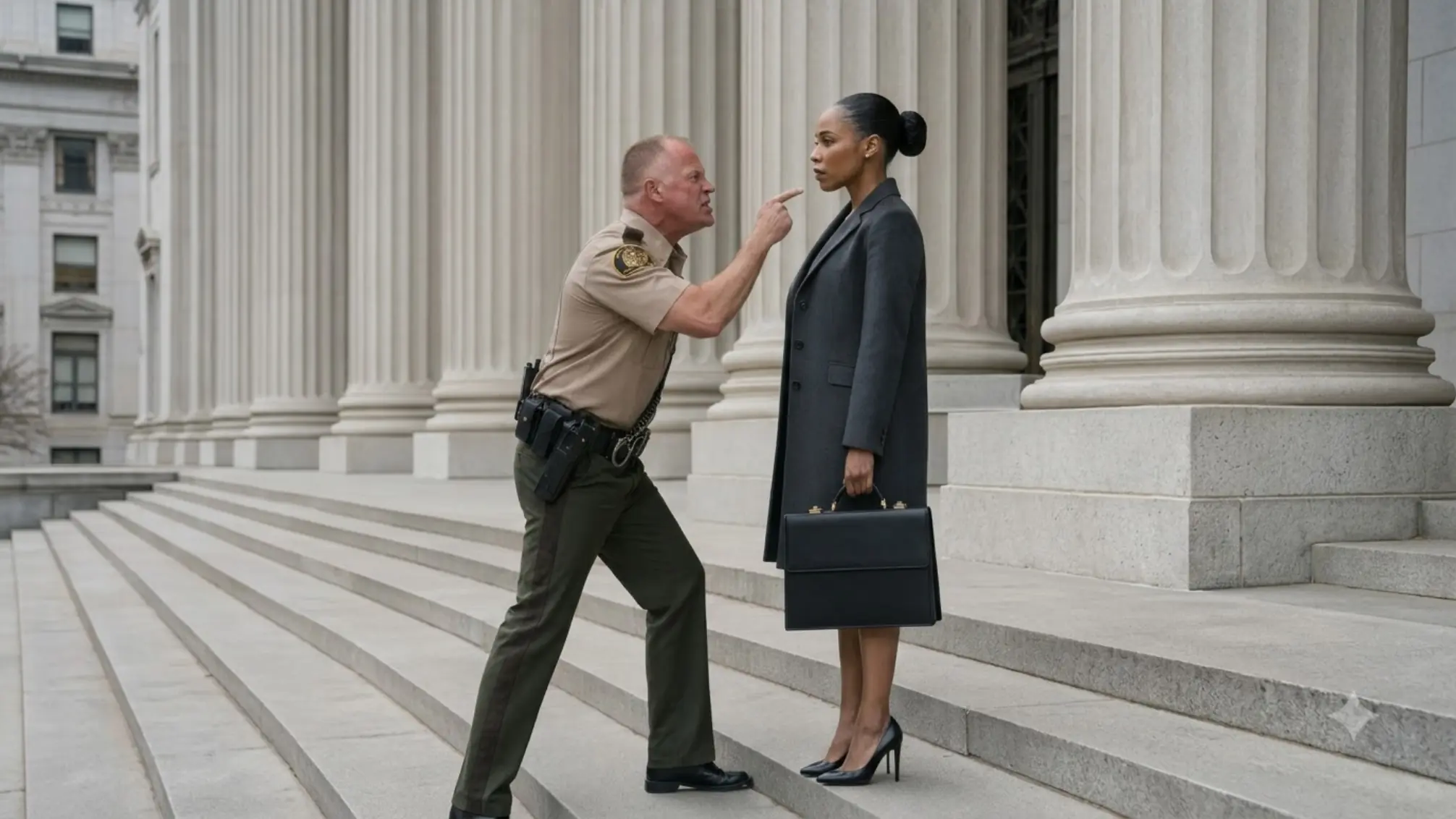
The woman standing on the steps did not move.
Her name was Judge Simone Whitaker.
Forty-two years old. Federal judge. Former civil-rights attorney. Fifteen years of courtroom experience. And that morning, she was scheduled to preside over one of the most closely watched police-brutality hearings in Georgia.
But Deputy Frank Mercer knew none of that.
What he saw was a Black woman carrying a black leather briefcase toward a secured entrance he believed belonged to judges, prosecutors, senior court officials, and people whose importance he could recognize on sight.
Simone wore a charcoal-gray tailored overcoat over a black dress, pearl earrings, polished heels, and her hair pulled into a sleek low bun. Her posture was straight and controlled.
Mercer stood three steps below her in a tan sheriff’s uniform and dark-green trousers, one hand resting near his duty belt.
He jabbed a finger toward her face.
“I told you twice. Public entrance is around the corner.”
Simone looked toward the small bronze sign beside the doors.
JUDICIAL AND AUTHORIZED PERSONNEL.
Then she looked back at him.
“I heard you.”
“Then move.”
“I’m authorized.”
Mercer laughed.
“You people always have an explanation.”
That phrase changed something in her expression.
Not anger.
Attention.
Simone had spent enough years in courtrooms to know when a person was about to become useful evidence against himself.
She asked quietly, “What do you mean by ‘you people’?”
Mercer stepped closer.
“You know exactly what I mean.”
Behind the glass doors, a court security officer glanced toward them.
Simone noticed.
Mercer did not.
“I have business inside,” she said.
“So does everyone.”
“My business begins upstairs in less than thirty minutes.”
“Then you should’ve gotten here earlier and used the proper entrance.”
Simone lifted her briefcase slightly.
“This is the proper entrance.”
Mercer’s face reddened.
“One more word and I’ll drag you off these steps myself.”
She held his stare.
“Perfect.”
His eyebrows tightened.
“Perfect?”
“Then explain it from the witness stand when I call your case in ten minutes.”
For half a second, Mercer appeared confused.
Then he laughed again.
“Your case?”
Simone did not answer.
Mercer reached toward her arm.
That was when the courthouse door opened.
“Deputy.”
The voice came from behind him.
Mercer turned.
Court Security Supervisor Daniel Price stood in the doorway wearing a navy suit and federal credential clipped to his belt.
His expression was unreadable.
“Step away from her.”
Mercer pointed toward Simone.
“She’s refusing to use the public entrance.”
Price looked at Simone.
Then at Mercer.
“Do you know who she is?”
Mercer rolled his eyes.
“She says she belongs upstairs.”
Price’s face tightened.
“She does.”
Mercer hesitated.
Price stepped down.
“Judge Whitaker, I apologize.”
The world around Frank Mercer seemed to stop.
He looked at Simone.
Then Price.
Then back to Simone.
“Judge?”
Simone gave him no satisfaction.
She simply picked up her briefcase.
“Good morning, Mr. Price.”
“Good morning, Your Honor.”
Mercer’s face drained.
The title landed harder than any accusation.
Your Honor.
Two courthouse employees standing inside had heard everything.
So had a deputy at the security desk.
Mercer opened his mouth.
Simone walked past him.
He turned quickly.
“Wait.”
She stopped.
“This was a misunderstanding.”
She looked over her shoulder.
“No.”
Mercer swallowed.
“I didn’t know who you were.”
Simone’s expression remained calm.
“That is exactly why it wasn’t a misunderstanding.”
Then she entered the courthouse.
Frank Mercer remained on the steps.
For the first time that morning, he seemed to understand what he had actually done.
Unfortunately for him, the consequences were only beginning.
The case on Simone Whitaker’s docket was titled Carter v. Fulton Ridge County Sheriff’s Department.
On paper, it concerned one man.
Twenty-nine-year-old Marcus Carter, an electrician who alleged that three deputies had stopped him outside a convenience store, ordered him against a wall, and used unnecessary force after he questioned why he was being detained.
But the hearing had become much larger.
Marcus’s attorneys had uncovered eleven previous complaints involving some of the same deputies.
Several contained similar language.
“Failed to comply.”
“Became argumentative.”
“Displayed aggressive body language.”
“Officer safety concerns.”
Yet body-camera footage in multiple incidents told a more complicated story.
People asking questions.
People requesting badge numbers.
People objecting to searches.
People being treated as threats because they did not become immediately submissive.
The sheriff’s department argued that the similarities proved nothing.
Marcus’s attorneys argued they showed a culture.
Judge Whitaker was scheduled to decide whether attorneys could obtain internal disciplinary records that the county had fought for months to keep sealed.
Frank Mercer had been assigned to courthouse security because several members of his department were attending.
He was not a defendant.
Not yet.
But his name appeared in two internal complaints contained in documents Judge Whitaker had reviewed the previous evening.
She had not memorized every name.
That was why she had not recognized him on the steps.
Now she did.
At 9:02, Simone entered Courtroom 4B.
“All rise.”
Everyone stood.
County lawyers.
Civil-rights attorneys.
Journalists.
Sheriff’s officials.
Deputies.
Marcus Carter and his wife.
Then Frank Mercer entered through the rear doors.
He stopped when he saw her.
Simone noticed but said nothing.
She sat.
“Please be seated.”
The hearing began.
For forty minutes, neither side mentioned the confrontation outside.
Simone focused entirely on the case.
The county argued that releasing personnel records would unfairly prejudice deputies.
Marcus’s attorney, Rachel Levin, argued that the department had ignored repeated complaints and failed to investigate patterns.
“We are not asking the court to assume every complaint is true,” Rachel said. “We are asking the court to allow us to determine whether supervisors noticed the same warning signs repeatedly and chose not to act.”
County attorney Martin Shaw stood.
“Your Honor, plaintiffs are trying to turn isolated incidents into a conspiracy.”
Simone looked toward him.
“Is eleven isolated?”
Shaw paused.
“The number alone doesn’t establish misconduct.”
“No.”
Simone folded her hands.
“But it can justify examination.”
Shaw sat down.
Then Rachel introduced body-camera footage from Marcus Carter’s arrest.
The courtroom monitor turned on.
Marcus appeared beside his truck.
An officer said, “Hands on the hood.”
Marcus obeyed.
Then he asked, “Can you tell me why I’m being detained?”
The deputy immediately answered, “Stop arguing.”
Marcus said, “I’m not arguing. I’m asking.”
Within seconds, another deputy forced his arms behind him.
Someone in the courtroom shifted uncomfortably.
Simone watched the footage twice.
Then she requested the written incident report.
It described Marcus as “verbally combative.”
She looked at the screen.
Then at the document.
“Where is the combativeness?”
County counsel responded carefully.
“Tone may not translate fully on video.”
Rachel nearly smiled.
Simone did not.
At the rear of the courtroom, Frank Mercer stared at the floor.
The language sounded familiar because he had used it hundreds of times.
Argumentative.
Uncooperative.
Suspicious.
Disrespectful.
Words broad enough to turn ordinary disagreement into justification.
Then Rachel said something Mercer had not expected.
“Your Honor, we received new information this morning regarding an interaction involving another department member.”
Shaw immediately stood.
“Objection. If counsel is referring to courthouse gossip—”
Simone raised one hand.
“Sit down, Mr. Shaw.”
He did.
Rachel continued.
“I was approached by a courthouse employee who witnessed an interaction at the judicial entrance.”
Simone’s expression changed slightly.
“Ms. Levin.”
“Yes, Your Honor?”
“This court will not allow an incident involving me personally to be used as evidence in the matter presently before me without appropriate procedure.”
Rachel nodded.
“Understood.”
Simone continued.
“I am directing the clerk to preserve exterior courthouse security footage and requesting that courthouse security generate an incident report. I will also notify the chief judge regarding whether my continued involvement creates an appearance issue.”
The room became silent.
Shaw looked toward the sheriff.
Mercer closed his eyes.
Simone looked at neither of them.
“This case will proceed today only on issues already briefed.”
Then she turned back to the personnel records.
“Regarding plaintiff’s motion, the court finds sufficient basis for limited discovery.”
Rachel sat straighter.
The sheriff’s face hardened.
Simone continued.
“The records concerning prior complaints involving the named officers will be produced under protective order.”
That single ruling changed the entire case.
Three days later, Judge Whitaker formally recused herself from further proceedings involving any evidence connected to her own courthouse encounter.
A different federal judge inherited the case.
But the courthouse incident continued independently.
Security video showed the confrontation clearly.
Mercer blocking Simone.
Pointing inches from her face.
Stepping aggressively toward her.
Witness statements matched.
The courthouse microphone did not capture every word, but one nearby officer had heard the beginning.
Are you deaf or stupid? This entrance isn’t for people like you.
Internal Affairs opened an investigation.
Mercer insisted race had nothing to do with it.
“She refused instructions.”
Investigators asked what instruction she had legally been required to follow.
Mercer said she looked like a member of the public.
They asked why.
He could not provide an answer that improved his situation.
Then investigators discovered the deeper problem.
Mercer had been the subject of six civilian complaints in four years.
Two involved Black attorneys entering restricted government buildings.
One involved a Hispanic investigator carrying a county badge that Mercer allegedly refused to examine until another officer intervened.
Three involved motorists who claimed Mercer became aggressive after they questioned searches.
Most complaints had been closed as “unsubstantiated.”
Now investigators reopened them.
A former courthouse clerk named Angela Ruiz received a call.
She remembered Mercer immediately.
Two years earlier, she had been carrying evidence boxes through an employee entrance when he demanded she prove she worked there.
She displayed her badge.
He told her badges could be fake.
A white colleague walked through seconds later without being stopped.
Angela had filed a complaint.
Nothing happened.
Until now.
Another complaint came from defense attorney Terrence Bailey, a Black man who said Mercer once told him defendants entered through another door.
Terrence had answered, “I’m counsel.”
Mercer supposedly laughed.
Internal Affairs had classified the encounter as a misunderstanding.
Now Terrence was interviewed again.
“It wasn’t a misunderstanding,” he said. “He saw what he expected to see.”
That sentence eventually appeared in the investigative report.
Meanwhile, the Carter case accelerated.
Once internal disciplinary files were produced, Marcus’s attorneys discovered that supervisors had repeatedly flagged the same group of deputies for escalating routine encounters.
One training memo warned that some personnel were treating “verbal challenge” as physical resistance.
Another supervisor wrote that several deputies needed retraining on the distinction between “noncompliance” and “protected questioning.”
The recommendation had never been implemented.
Why?
Budget.
Scheduling.
Administrative priorities.
Excuses accumulated.
Then a deposition revealed something worse.
A former training lieutenant admitted senior command had worried that documenting repeated retraining could become “discoverable” in civil lawsuits.
The implication was devastating.
The department had not merely failed to see the problem.
Some people may have understood it and preferred not to create paperwork proving they understood it.
The case reached local news.
Then national outlets.
Judge Whitaker said nothing publicly.
She continued hearing unrelated cases.
Every morning she entered through the same judicial doorway.
Frank Mercer was no longer stationed there.
He had been reassigned pending investigation.
Six weeks after the confrontation, he was called to Internal Affairs for a final interview.
He entered still believing he might receive a suspension.
Instead, investigators placed a thick file on the table.
Six reopened complaints.
Three new witness statements.
Courthouse video.
Training records.
And an email Mercer had sent another deputy after the courthouse incident.
Turns out she was some federal judge. How was I supposed to know?
The investigator pointed to the sentence.
“That’s the problem, Deputy.”
Mercer stared.
“What?”
“You still think knowing who she was should have changed how you treated her.”
Mercer looked away.
The investigator continued.
“She wasn’t entitled to dignity because she was a judge.”
Silence.
“She was entitled to it because she was standing on courthouse steps doing nothing wrong.”
Mercer’s face hardened.
“You’re making me the villain because everybody’s scared of bad press.”
“No.”
The investigator closed the file.
“We’re asking why the department ignored this pattern for years.”
Mercer understood then.
This was bigger than his job.
The investigation had reached supervisors.
Training policies.
Complaint review procedures.
Command decisions.
His mistake had opened a door people higher than him desperately wanted closed.
Three months later, the sheriff’s department announced major reforms.
Civilian complaints would receive independent review when they alleged discrimination or retaliatory enforcement.
Supervisors would automatically examine body-camera footage when reports described a person as “combative,” “aggressive,” or “uncooperative” without an accompanying criminal act.
Courthouse personnel received new credential-verification procedures designed to eliminate appearance-based assumptions.
Several supervisors were reassigned.
One commander retired early.
Frank Mercer was terminated after investigators concluded he had repeatedly violated conduct rules and provided misleading statements during complaint reviews.
He appealed.
He lost.
But the biggest consequences came inside federal court.
The Carter case settled for $3.8 million, along with mandatory outside monitoring of the department’s detention and use-of-force practices.
Marcus Carter received compensation.
But when reporters asked whether money made him feel vindicated, he shook his head.
“I wanted them to admit I wasn’t dangerous because I asked a question.”
That became the line people remembered.
Nearly six months after the morning confrontation, Simone Whitaker attended a public legal ethics forum at Emory University.
A student asked about the courthouse incident.
“Did you feel powerful when the deputy learned you were a federal judge?”
Simone considered the question.
“No.”
The room went quiet.
“I felt disturbed.”
The student waited.
Simone continued.
“Because his behavior changed only after someone told him my title.”
She leaned slightly toward the microphone.
“That means the system worked for me because I possessed authority recognizable to the system.”
She paused.
“What frightened me was thinking about everyone who doesn’t.”
No applause came immediately.
People were still processing it.
Then another student asked, “Were you angry?”
“Yes.”
“Did you want revenge?”
Simone smiled faintly.
“No.”
She looked across the lecture hall.
“Revenge would have been making the incident about one deputy embarrassing one judge.”
Her expression became serious.
“Accountability meant asking whether his behavior was part of something larger.”
That answer traveled online.
Millions eventually watched the clip.
But Simone returned to work the next morning as usual.
At 8:17, she walked up the courthouse steps carrying the same black briefcase.
The marble columns rose above her.
A new deputy stood near the judicial entrance.
Young.
Nervous.
He saw Simone approaching.
“Good morning, ma’am.”
“Good morning.”
He glanced toward her credential.
“May I see your identification?”
Simone stopped.
Then smiled.
“Of course.”
She opened her briefcase and showed it.
The deputy checked the photograph.
“Thank you, Judge Whitaker.”
“You’re welcome.”
He opened the door.
Nothing dramatic happened.
That was the point.
No assumptions.
No insults.
No special exemption.
A request.
Verification.
Respect.
Procedure.
Exactly how it should have happened the first time.
Simone entered the courthouse.
A year later, Marcus Carter happened to see her in the hallway.
His lawsuit had ended months earlier.
He was wearing an electrician’s uniform and carrying paperwork related to a different matter.
He stopped.
“Judge Whitaker?”
Simone turned.
“Mr. Carter.”
“I never got to thank you.”
“You don’t need to.”
“I think I do.”
She shook her head.
“The evidence mattered. Your attorneys did the work.”
Marcus smiled.
“Maybe.”
Then his expression became serious.
“But I heard about what happened outside.”
Simone nodded.
Marcus said, “They finally believed someone.”
The sentence hit her harder than she expected.
Not because it was entirely true.
But because she understood what he meant.
Simone looked at him.
“They should have believed the evidence before it happened to someone with a title.”
Marcus nodded.
“Exactly.”
They shook hands.
Then went in opposite directions.
Frank Mercer disappeared from public attention.
No dramatic arrest.
No screaming confrontation.
No spectacular downfall.
His name became one paragraph inside a much larger reform report.
That seemed appropriate.
Because the story had never truly been about destroying one deputy.
It was about a question.
How many people had walked away from encounters like Simone’s with nobody important standing behind the glass doors?
How many had been labeled difficult because they asked for an explanation?
How many complaint files had been closed because a badge automatically carried more credibility than the person describing what happened?
The federal monitoring report issued eighteen months later showed measurable change.
Complaints involving discourteous conduct declined.
Body-camera compliance increased.
Vehicle searches decreased while evidence recovery rates remained stable.
Supervisors documented interventions earlier.
Not perfection.
Progress.
For Simone, that mattered more than Mercer’s termination.
One evening after court, she stood outside the same entrance waiting for her driver.
The sun reflected against the marble.
Daniel Price stepped outside.
“Long day?”
“Very.”
He smiled.
“You know, every time I see you standing here, I remember that morning.”
“So do I.”
“Still angry?”
Simone looked toward the steps where Mercer had stood pointing at her.
“Less.”
Price waited.
She continued.
“I think about what he said.”
“This entrance isn’t for people like you?”
“Yes.”
Price shook his head.
Simone looked at the massive doors.
“The interesting thing is that he was right about one part.”
Price frowned.
“Which part?”
“This entrance shouldn’t be reserved for people who look important.”
She adjusted the handle of her briefcase.
“It should be for people authorized to use it. Nothing more.”
A car pulled toward the curb.
Simone started down the steps.
Price called after her.
“Good night, Your Honor.”
She turned.
“Good night.”
Then she walked away.
The courthouse remained behind her, enormous and imposing, a building designed to represent the idea that law stood above personalities.
That morning months earlier, one deputy had looked at Simone Whitaker and decided she did not belong near those doors.
Ten minutes later, he learned she was the woman entrusted to interpret the law inside them.
But that was never the real reversal.
The real reversal came afterward.
When Simone refused to make the lesson about her title.
Because whether she had been a federal judge, a lawyer, a witness, a clerk, a defendant’s mother, or simply a woman who had taken the wrong staircase, the standard should have remained the same.
Ask.
Verify.
Respect.
Do not turn suspicion into authority simply because a person does not look like the image you expected.
Frank Mercer had looked at Simone and asked himself:
Who does she think she is?
The investigation forced an entire department to confront a better question.
Who gave us the right to decide who belongs before we even know who they are?