Dr. Harlan Voss entered Mercy General Hospital’s trauma department at 7:14 on Monday morning as though every polished floor tile had been installed for him personally. His charcoal suit fit with architectural precision, his black silk tie probably cost more than most nurses earned in a week, and two hospital-board escorts moved behind him like silent bodyguards. A cluster of anxious residents followed several feet farther back, already trained to stay close enough to hear him but far enough away to avoid becoming his next target.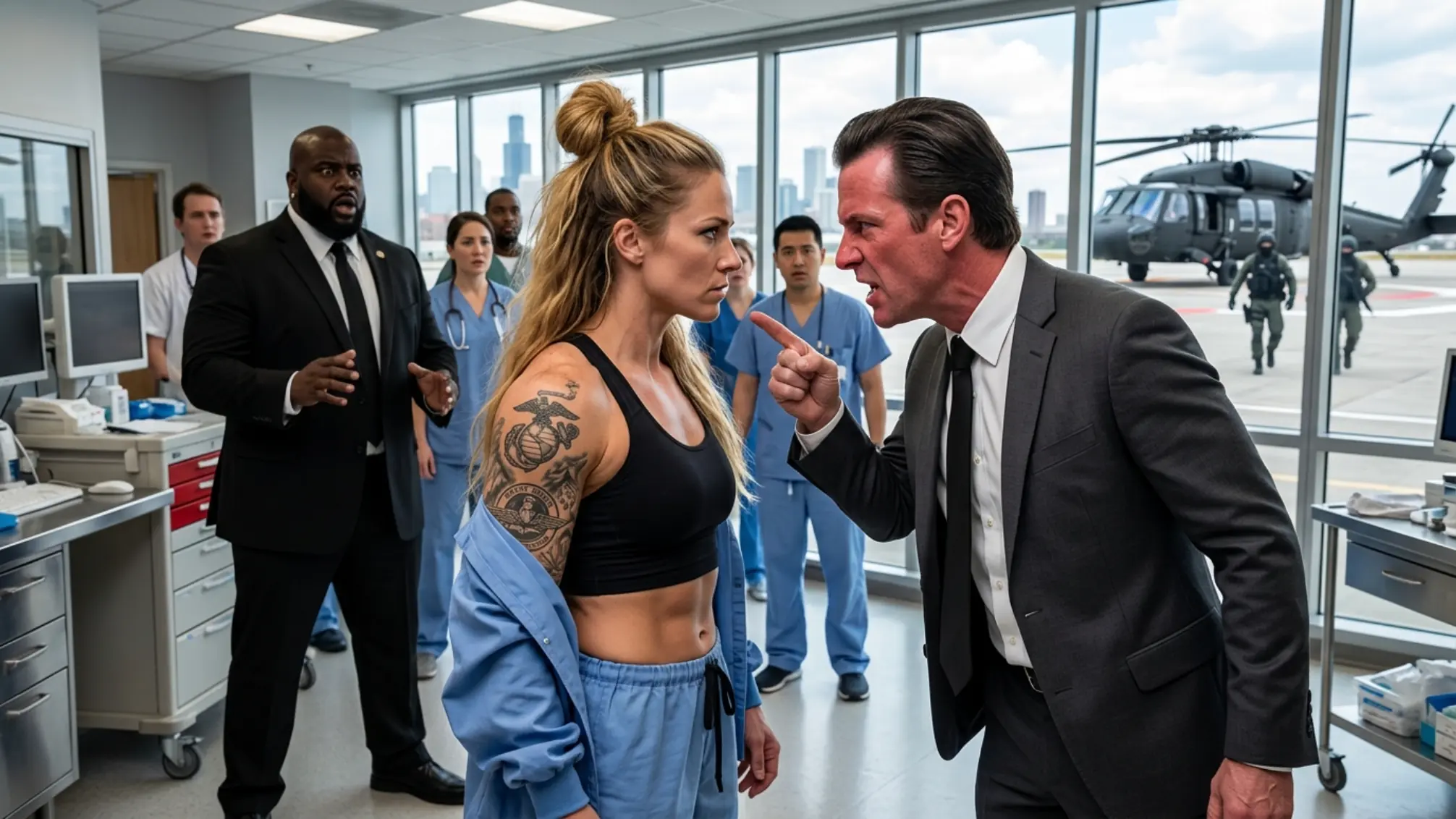
During his first four days as chief of medical operations, Harlan had made one thing clear: he did not enter a department to understand it. He entered to establish control. Staff members survived his inspections by smiling, agreeing, and promising immediate corrections before he had finished explaining what he believed they had done wrong.
Lexie Cain had no interest in surviving that way.
She sat at the trauma intake desk finishing a medication-reconciliation chart while Harlan crossed the bright glass-walled department toward her. Lexie was thirty-four, athletic and striking, with fair skin, sharp blue-gray eyes, sculpted cheekbones, and golden-blonde hair twisted into a loose high bun. Her pale-blue scrub jacket rested open over a fitted black compression top, giving her arms the freedom she needed whenever the department went from quiet to catastrophic without warning.
Harlan stopped directly across the desk.
“You.”
Lexie did not look up immediately. She checked the final prescription against the pharmacy warning, added her initials, and placed the completed chart in the proper tray. An unfinished medication review could become a dangerous error, and no expensive suit was important enough to make her abandon it halfway through.
Only then did she raise her eyes.
“Dr. Voss.”
His expression tightened at the calm recognition in her voice.
“You’re the charge nurse?”
“Charge nurse and trauma intake coordinator. Lexie Cain.”
Harlan threw a printed report onto the desk.
“I reviewed last night’s intake logs. Three documentation delays, two deviations from triage protocol, and one medication warning left unresolved for forty-seven minutes. I want the responsible staff identified and a corrective-action plan on my desk before noon.”
Lexie glanced down at the report.
She recognized every timestamp.
Between 2:17 and 3:04 that morning, an eleven-patient highway pileup had overwhelmed the trauma department. Two nurses had already been pulled upstairs to support the intensive-care unit. Lexie’s remaining team had moved between blood loss, collapsed lungs, head injuries, and one child whose pulse disappeared twice before sunrise.
The delays existed on paper.
So did the eleven living patients.
“The documentation gaps happened during a mass-casualty intake,” Lexie said. “We had eleven critical arrivals and inadequate staffing. I made both triage decisions personally, and both patients survived.”
Harlan’s jaw shifted.
“The medication alert?”
“Our pharmacist was managing two life-threatening interactions in the ICU. The delay was documented and resolved. I submitted a staffing-adequacy request at four this morning.”
“I didn’t ask for a narrative.”
“You asked what happened.”
“I asked who is responsible.”
“I am.”
Several nurses looked toward her.
Harlan studied Lexie as though he had finally found the resistance he had been expecting. He placed both palms against the counter and leaned closer, lowering his voice without making it less public.
“Let me explain something, Ms. Cain. I did not come to Mercy General to hear excuses disguised as professional judgment.”
“Neither did I.”
The residents behind him went very still.
Harlan smiled, though nothing warm entered his eyes.
“I need compliance, accurate records, and discipline. What I do not need is a clinic nurse who thinks her instincts outrank hospital protocol.”
The words landed across the trauma department.
Clinic nurse.
He used the title not as a description but as a weapon—something small enough to place Lexie beneath him and simple enough to erase every decision she had made during the night.
A young nurse near Bay Two lowered her gaze. One of the residents stared at the floor. Even the broad security escort behind Lexie looked uncomfortable.
Lexie placed her pen on the desk.
Then she stood.
Her scrub jacket slipped from her right shoulder as she came around the counter. Beneath it, a large black-and-gray tattoo covered the curve of her deltoid: an eagle above a globe and anchor, the letters USMC, and the unmistakable markings of Force Recon service.
Harlan’s eyes dropped toward the ink.
Lexie stopped inches from him.
“I earned my judgment in places you will never go,” she said quietly. “I triaged casualties under fire without enough blood, medication, equipment, or time.”
Harlan straightened.
“One tattoo does not put you above me.”
“No. The work behind it means you should know what you’re pointing at before you threaten my team.”
His face darkened.
“You are still an employee in my hospital.”
“And those were still eleven human beings, not late entries on a spreadsheet.”
Harlan lifted one finger toward her face.
“Do not confuse battlefield improvisation with modern medical standards.”
Lexie’s expression became colder.
“I don’t confuse them. I understand both. That’s why every person from last night reached definitive care alive.”
“You disregarded procedure.”
“I prioritized survival.”
“You will follow the chain of command.”
“I do—when the person above me understands what happened before deciding who to blame.”
For one dangerous second, the confrontation seemed ready to cross from professional hostility into something physical. Harlan’s finger remained inches from Lexie’s eyes. Her hands stayed relaxed at her sides, but the black-suited security escort behind her watched with the stunned awareness that she was not intimidated by proximity, power, or threats.
Then the sound of rotor blades filled the department.
Every face turned toward the floor-to-ceiling windows.
A black military helicopter descended onto Mercy General’s emergency helipad with controlled precision. Wind whipped across the roof, flattening loose debris and shaking the glass. The aircraft carried no hospital logo and almost no visible identification beyond a small designation number near the tail.
Harlan looked from the helicopter to Lexie.
“What is that?”
Her phone vibrated on the desk.
Lexie read the message.
Something changed in her expression—not fear or surprise, but recognition. It was the look of a person hearing a door from an old life open behind her.
She pulled her scrub jacket back over her shoulder.
“I recommend you stay out of Bay Three for the next twenty minutes.”
Harlan laughed in disbelief.
“You don’t issue recommendations to me.”
The helicopter door opened.
Three people in dark tactical clothing stepped onto the helipad. They did not run. They moved with compressed purpose, each step deliberate, their attention fixed on the hospital doors.
The leader was a broad-shouldered man in his early fifties with close-cropped silver hair and the posture of someone who had spent decades making entire rooms straighten when he entered them. No insignia appeared on his jacket, yet the two people flanking him communicated his rank through their positioning alone.
The glass doors opened.
The three tactical figures entered the trauma bay.
The silver-haired man saw Lexie.
Relief broke across his otherwise severe face.
“Cain.”
Lexie nodded once. “Colonel Merritt.”
The entire department froze again.
Colonel David Merritt crossed the floor and offered his hand. Lexie took it, but instead of releasing her immediately, he placed his other hand over their clasped fingers.
The gesture conveyed something more powerful than rank.
Debt.
“We need your help,” Merritt said.
“What happened?”
“Extraction casualty. Compromised airway, possible cervical injury, penetrating trauma. Our field medic stabilized what he could, but the patient deteriorated during transport.”
“Who cleared the roof landing?”
“Your chief of surgery and federal operations.”
Lexie glanced toward Harlan.
He stood beside the desk with his finger finally lowered.
“Give me ninety seconds,” she told Merritt.
The colonel nodded.
Lexie reached for the duty handoff board and began transferring responsibilities to her second nurse with crisp efficiency. She explained the status of each active patient, outstanding laboratory results, medication concerns, and staffing gaps without wasting a word.
Merritt watched her work.
Then his attention moved toward Harlan.
“You’re administration?”
Harlan straightened his suit.
“Dr. Harlan Voss, chief of medical operations.”
Merritt studied him for a moment.
“Commander Cain served three combat deployments with Second Force Reconnaissance Company.”
Harlan glanced toward Lexie.
“She was the senior medical officer during two classified operations whose locations I will not discuss in a civilian hospital,” Merritt continued. “She held a field commission and a security clearance most officers spend entire careers pursuing.”
One of Harlan’s board escorts took a small step backward.
“When Commander Cain left active duty,” Merritt said, “we spent four months trying to persuade her to stay.”
He paused.
“We are still trying.”
Harlan said nothing.
Merritt looked toward the report lying on the desk.
“Whatever she told you about her abilities, she was probably being modest.”
Lexie completed the handoff and pulled on gloves.
She stopped in front of Harlan one final time.
“I’ll give you the corrective-action plan by noon.”
His eyes narrowed.
“It will show that the team operated within acceptable standards for an eleven-patient mass-casualty event under the staffing conditions we had. It will also include the resource request that would prevent the delays you identified.”
She tilted her head.
“If you read it instead of looking for someone to punish, it may answer every question you brought in here.”
Harlan’s face flushed.
“You are taking an unscheduled military patient into my department without authorization.”
“The chief of surgery authorized it.”
“I’m chief of medical operations.”
“And the patient is losing his airway while you’re protecting your title.”
The words cut through the room.
Merritt stepped toward Harlan.
The security escort behind the doctor immediately stiffened, but Merritt did not need to raise his voice or threaten anyone.
“Doctor, right now you have two choices. You can help Commander Cain save a life, or you can remain exactly where you are and avoid becoming another obstacle she has to work around.”
Harlan stared at him.
Lexie turned away.
“What have we got?” she asked as she and Merritt headed toward Bay Three.
“Male, thirty-seven. Blast exposure followed by vehicle rollover. Field airway partially secured. Blood pressure falling during final approach.”
“Any medication allergies?”
“Unknown.”
“Blood type?”
“O positive.”
“Neurological response?”
“Declining.”
Lexie pushed through the doors.
“Activate massive-transfusion protocol. Call respiratory therapy, neurosurgery, vascular, and radiology. Tell them this is not a drill.”
The tactical team followed.
The Bay Three doors closed behind them.
For several seconds, the trauma department remained silent.
Then work resumed.
Harlan stood alone beside the intake desk with the printed report still in his hand. He looked toward the door through which Lexie had disappeared, then at the nurses returning to their patients.
A resident named Thomas Hale approached cautiously.
“Dr. Voss?”
Harlan looked at him.
“Was there something else?”
“The morning surgical review begins in ten minutes.”
“Cancel it.”
Thomas blinked.
“Sir?”
“Reschedule it for this afternoon.”
Harlan picked up the eleven-patient intake log. This time, he read beyond the timestamps. He saw the mechanism of each injury, the treatment decisions, and the staffing notes. One patient had arrived without a detectable radial pulse. Another had suffered internal bleeding. A third had required an emergency chest decompression before a physician became available.
Lexie’s initials appeared beside every life-critical intervention.
The documentation delays suddenly looked different.
Not harmless.
But understandable.
Harlan walked toward the nurses’ station.
“Who submitted the staffing request?”
The young nurse beside the monitor hesitated. “Commander—Ms. Cain did.”
“When?”
“Four-oh-three this morning.”
“Was administration notified during the mass-casualty event?”
“Yes.”
“Who answered?”
“Night operations said no additional nurses were available.”
“Did they document that?”
She pulled up the electronic record.
“There.”
Harlan read the message.
The hospital had known the department was understaffed and had declined to move personnel. Then he had arrived hours later and blamed the people who remained.
His authority did not feel smaller.
It felt heavier.
Inside Bay Three, the patient was dying.
Lexie cut away the remaining clothing while the trauma team connected monitors. Blood pressure had fallen to sixty-eight over forty. The airway tube placed in the field was leaking, and swelling around the neck made replacement dangerous.
“Who performed the field airway?” she asked.
A tactical medic stepped forward. “I did.”
“What happened?”
“Vehicle rolled after the blast. He struck the frame. I had limited access.”
“You kept him alive during transport. That was the goal.”
The medic nodded, visibly relieved.
Lexie placed two fingers against the patient’s neck.
“Possible expanding hematoma. Prepare for surgical airway.”
A civilian resident hesitated.
“We should wait for the attending.”
“He has less time than the attending needs to arrive.”
Colonel Merritt stood near the wall.
“Cain?”
She never looked away from the patient.
“I can do it.”
The resident reached for the surgical tray.
Lexie’s voice sharpened.
“Not that blade. Number eleven. Suction ready. Respiratory, stay on my left. Nobody moves the cervical support unless I call it.”
The room obeyed.
She worked without drama.
Her hands remained precise as the monitor alarms accelerated. She made the incision, controlled the bleeding, identified the membrane, and established a new airway before the patient’s oxygen level fell past recovery.
The monitor slowly improved.
“Airway secured,” respiratory therapy said.
Lexie moved immediately to the next problem.
“Pressure is still dropping. Ultrasound.”
The scan revealed internal bleeding.
“Activate operating room two. He needs vascular control now.”
The chief of surgery arrived as the team prepared to move.
He examined the airway, then looked at Lexie.
“You performed this?”
“Yes.”
“It’s clean.”
“It needed to be.”
They rushed the patient toward surgery.
Merritt remained behind for a moment.
“You still miss it?” he asked.
Lexie removed her bloody gloves.
“Some parts.”
“We could use you.”
“You always say that.”
“Because it remains true.”
She looked through the glass toward the nurses handling the morning rush.
“They need me too.”
Merritt followed her gaze.
“Different battlefield.”
“Same responsibility.”
The colonel nodded.
“You saved another one.”
“The medic saved him first.”
“You always redirect credit.”
“Because teams keep people alive.”
Merritt looked toward Harlan standing outside the bay doors.
“Does he understand that?”
“He might eventually.”
Lexie returned to the intake desk at eleven forty-eight.
Harlan was waiting.
The printed report had been replaced by a cup of untouched coffee and the staffing request displayed on a computer screen.
“How is the patient?” he asked.
“In surgery. Stable enough to have a chance.”
Harlan nodded.
“Your corrective plan?”
Lexie placed a document on the desk.
“Completed.”
He opened it.
The first pages reconstructed the mass-casualty timeline. The remaining sections detailed staffing shortages, response limitations, documentation sequencing, pharmacy coverage, and recommended resources.
Harlan read the executive summary.
“You wrote this already?”
“I started at four-thirty.”
“After the pileup?”
“Before you arrived.”
He looked at her.
“You anticipated review.”
“I anticipated responsibility.”
The distinction made him uncomfortable.
Harlan closed the folder.
“I owe you an apology.”
Lexie’s expression did not soften immediately.
“You owe the entire team one.”
He looked toward the nurses.
“Yes.”
Several staff members noticed him standing there but quickly returned to work. Four days of arrogance had taught them not to expect sudden humility.
Harlan cleared his throat.
“May I speak to everyone?”
Lexie folded her arms.
“It’s your hospital.”
The answer reminded him of his own words.
Harlan stepped into the center of the trauma department.
“Everyone, stop for one moment.”
The department quieted.
He looked around at nurses, residents, technicians, and support staff.
“This morning I reviewed incomplete information and reached conclusions before understanding the circumstances behind it. I treated documentation delays as evidence of poor performance without accounting for the eleven-patient emergency, the staffing shortage, or the clinical outcomes.”
No one moved.
“I also spoke disrespectfully to Ms. Cain and diminished her professional judgment in front of her team.”
Lexie watched without expression.
“That was wrong.”
One of the nurses blinked in surprise.
Harlan continued.
“The staffing request will receive immediate review. Until then, administration will arrange additional overnight coverage and on-call pharmacy support during surge events.”
He stopped.
“I expect accountability from every department. That includes mine.”
The silence afterward felt different from the earlier one.
Not fear.
Evaluation.
The staff were deciding whether his words would become action.
Lexie understood that one apology did not repair a culture. Harlan’s instincts had been exposed too clearly. He would have to prove that this moment changed more than his language.
Still, admitting fault in front of everyone he had tried to command was a beginning.
Later that afternoon, the chief executive called Harlan to an emergency meeting. Board members had already heard about the confrontation, the helicopter, and Colonel Merritt’s assessment of Lexie. The chief executive did not care that Harlan had failed to recognize a former special-operations commander.
He cared that Harlan had reviewed a mass-casualty event without reading the complete record.
“You were hired to strengthen the hospital,” the chief executive said. “Not terrorize it.”
Harlan left the meeting with a formal warning and mandatory leadership oversight.
For the first time in years, family influence could not protect him from consequence.
Over the following month, Mercy General changed gradually.
The overnight trauma team received two additional nurses during high-risk periods. Pharmacy established a direct emergency line. Documentation rules were revised so life-saving care during mass-casualty events remained the priority while delayed charting followed a clear recovery procedure.
Harlan attended the implementation meetings.
At first, staff expected him to dominate them.
Instead, he asked questions.
“What did you need that night?”
“What slowed you down?”
“What could administration have changed before the first ambulance arrived?”
The questions sounded awkward in his mouth, like words from a language he had never practiced. Lexie answered them plainly and refused to reward him merely for behaving professionally.
One evening, he found her outside Bay Three after a difficult shift.
“The military patient survived,” he said.
“I heard.”
“He asked about you.”
“I’ll visit when he’s stable.”
Harlan leaned against the wall.
“I’ve been thinking about what you said.”
“That could be dangerous.”
A small smile appeared despite himself.
“The best leaders ask how they can help before asking who to blame.”
“Did the sentence offend you?”
“Yes.”
“Good.”
He nodded.
“My previous hospitals rewarded certainty.”
“Certainty can be useful.”
“I confused it with leadership.”
Lexie looked at him.
“That’s common.”
“Were your military commanders different?”
“The best ones were. The worst ones thought rank made information unnecessary.”
“And what happened to them?”
“People stopped telling them the truth.”
Harlan absorbed that.
“Is that what happened here?”
“On your second day, a resident watched you enter an incorrect medication order and waited three minutes before correcting you because he was afraid.”
His face changed.
“Who?”
“The name isn’t the lesson.”
“Was the patient harmed?”
“No.”
“Because someone finally spoke.”
“Yes.”
Harlan looked through the glass at the busy department.
“I built silence.”
“In four days.”
The directness hurt, but she did not soften it.
“Can it be repaired?”
“Yes.”
“How?”
“Make speaking safer than hiding.”
He nodded slowly.
Then he left without defending himself.
Six months later, Mercy General conducted a citywide mass-casualty drill involving emergency services, law enforcement, and military medical observers. Colonel Merritt attended as an adviser.
He found Lexie coordinating intake beneath a temporary command canopy outside the hospital. Her commands were short, calm, and clear. Civilian teams and military medics moved within the same structure without confusion.
Harlan stood beside administration reviewing staffing capacity.
Merritt approached him.
“You’re still here.”
Harlan looked toward Lexie.
“So is she.”
“Did you learn anything?”
“That she was being modest.”
Merritt almost smiled.
Harlan continued.
“I also learned the department did not need me to become less demanding. It needed me to become more informed.”
“That sounds expensive.”
“It cost me my certainty.”
“Cheaper than losing a patient.”
They watched Lexie redirect an incoming team.
Harlan nodded.
“I called her just a clinic nurse.”
Merritt’s expression hardened slightly.
“I heard.”
“She could have humiliated me.”
“She did.”
“No. She corrected me. There’s a difference.”
The colonel considered him again.
“Maybe you’re learning.”
After the drill, Lexie returned to the trauma desk and found a small framed photograph waiting beside her monitor. It showed the black helicopter on Mercy General’s helipad that morning, rotor blades blurred against the glass.
A note rested beneath it.
For Bay Three. The door is always open. — Merritt
Lexie smiled and placed it beside the staffing protocols.
She never framed her Force Recon tattoo or displayed medals in the department. Her history belonged to her, not to anyone who needed proof before respecting her.
Most patients knew her only as Nurse Cain.
That title was enough.
She did not need commanders, classified missions, or a military helicopter to make her judgment valuable. Those things merely exposed how foolish it had been for Harlan Voss to dismiss her before asking what she knew.
The helicopter landed for a former commander.
But the people who benefited most from her courage were the patients who never learned she had been anything except the beautiful nurse standing beside them when survival became uncertain.
And after that morning, no one at Mercy General ever used the words just a nurse around Lexie Cain again.