The blizzard swallowed the road before noon.
By three o’clock, the whole stretch of northern Wyoming looked like the world had been erased and redrawn in white.
Snow blew sideways across the highway, thick as smoke, sharp as broken glass, driven by a wind that pushed against trucks, bent fence posts, and made every mile feel like a warning.
Twelve-year-old Noah Reed should have been home.
He should have been in the tiny apartment above Mrs. Pruitt’s laundromat, sitting at the kitchen table with his little sister, Grace, pretending not to hate canned soup for dinner.
Instead, he was on an old bicycle with a crooked front wheel, chasing a white delivery truck into the storm.
His fingers had stopped hurting ten minutes ago.
That frightened him more than the pain had.
His hands were clamped around the handlebars, stiff and numb inside gloves too thin for this weather. His jeans were soaked from the knees down. Snow had crusted over his eyelashes, and every breath scraped his throat like he was swallowing ice.
But ahead of him, through the violent blur of snow and dying daylight, he could still see the truck’s red taillights.
Two small red dots.
Two burning eyes.
He could not lose them.
Grace was in that truck.
Grace, who was seven years old and still slept with a stuffed rabbit named Captain Buttons.
Grace, who believed every bird was carrying secret messages.
Grace, who had a laugh that made Noah remember what their mother sounded like before sickness took her voice away.
Grace, who had looked at him through the passenger window of that truck with her palm pressed against the glass.
Confused.
Scared.
Waiting for him to do what he had always promised he would do.
Find her.
Noah pedaled harder.
His legs burned. His lungs screamed. The bicycle slipped and wobbled beneath him, but he kept going.
He had no phone.
No money.
No adult who would believe him fast enough.
Only the memory of the man who had come to their apartment two hours earlier.
The man had worn a gray work jacket with a stitched logo on the chest. He had a clipboard, a plastic ID badge, and a smile so clean it felt fake.
“County relocation service,” he had said.
His voice had been calm, almost gentle.
Noah had known immediately something was wrong.
Their social worker, Mr. Alvarez, always called first. He never arrived without his worn brown bag and peppermint candies. He never spoke in that smooth, rehearsed way, as if reading lines from a script.
The man said there had been an emergency placement.
He said their current apartment had been marked unsafe because of heating problems.
He said Grace had to come first because there was limited room in the transport vehicle.
Noah stood in the doorway.
“Call Mr. Alvarez,” he said.
The man smiled.
“We already did.”
“Then call him again.”
Grace had been standing behind Noah, holding Captain Buttons under one arm.
“Noah?” she whispered.
The man looked past Noah toward her.
“There’s a little room waiting for you, Grace,” he said softly. “Pink curtains. A nightlight. A shelf for your rabbit.”
Grace’s eyes widened.
Noah stepped in front of her.
“She’s not going with you.”
That was when the man’s smile disappeared.
Not slowly.
Not naturally.
It simply vanished.
He put one large hand on Noah’s shoulder and pushed him aside with such sudden strength that Noah stumbled into the wall. Before Noah could recover, the man had Grace by the wrist.
Grace cried out once.
“Noah!”
Then the door slammed between them.
The lock clicked.
Noah threw himself against it, shouting, kicking, screaming her name.
By the time he got out through the back window and down the rusted fire escape, the white truck was pulling away from the curb.
Grace’s face appeared in the passenger window.
Small.
Pale.
Terrified.
Noah ran for his bicycle.
Now the city was gone behind him.
The road had narrowed.
The storm had deepened.
And the truck was turning off the highway toward a lonely gas station at the edge of a frozen stretch of farmland.
PINE RIDGE FUEL & FOOD
The sign flickered in the blizzard, half-buried in blowing snow.
Noah’s bicycle hit a patch of ice near the entrance.
The front wheel twisted sideways.
He fell hard.
His shoulder struck the pavement. His knee tore open through his jeans. For one breathless second, he lay there on the frozen ground while snow beat against his face.
A quiet thought came to him.
Stay down.
Just for a minute.
Just rest.
But then he saw the truck again.
It had pulled around the side of the gas station, near the diesel pumps. Attached behind it was a long white trailer with no markings except a faded blue stripe along the side.
Noah pushed himself up.
Pain flashed through his knee.
He ignored it.
He staggered toward the station door.
Inside, warm air hit him so suddenly that he nearly collapsed.
The store smelled of burnt coffee, old hot dogs turning beneath heat lamps, windshield fluid, and cheap pine cleaner. A young clerk stood behind the counter, watching a weather report on a small television.
He turned when Noah stumbled in.
“Kid?”
Noah tried to speak, but his teeth were chattering too hard.
The clerk rushed around the counter.
“You’re freezing. Where are your parents?”
Noah pointed toward the side window.
“The truck,” he managed. “My sister. He took my sister.”
The clerk’s name tag read: EDDIE.
Eddie looked at the truck.
Then back at Noah.
His face changed.
“You mean that driver?”
Noah nodded.
Eddie swallowed.
“He came in five minutes ago. Bought coffee. Asked if the back road toward Casper was still open.”
“He has Grace,” Noah said. “He lied. He said he was from the county.”
Eddie’s eyes flicked toward the phone behind the counter.
“I’ll call 911.”
Noah shook his head violently.
“He’ll leave before they get here.”
“Kid, you need police.”
“I need someone now.”
Eddie opened his mouth to answer.
Then the station windows began to rattle.
At first, Noah thought it was the wind.
But the sound grew deeper.
He turned.
Through the storm, lights appeared.
Motorcycle headlights.
Not one.
Not two.
Dozens.
They came slowly through the blizzard, moving in a tight formation, engines rumbling low beneath the howl of the wind. Their tires cut through slush and snow as they rolled into the station lot, one after another.
The riders wore heavy leather, winter gear, patched vests, scarves pulled high against the cold. Snow gathered on their shoulders and helmets. Some had long beards frozen at the edges. Some were women with hard eyes and calm faces.
They looked dangerous.
They looked like something the storm itself had delivered.
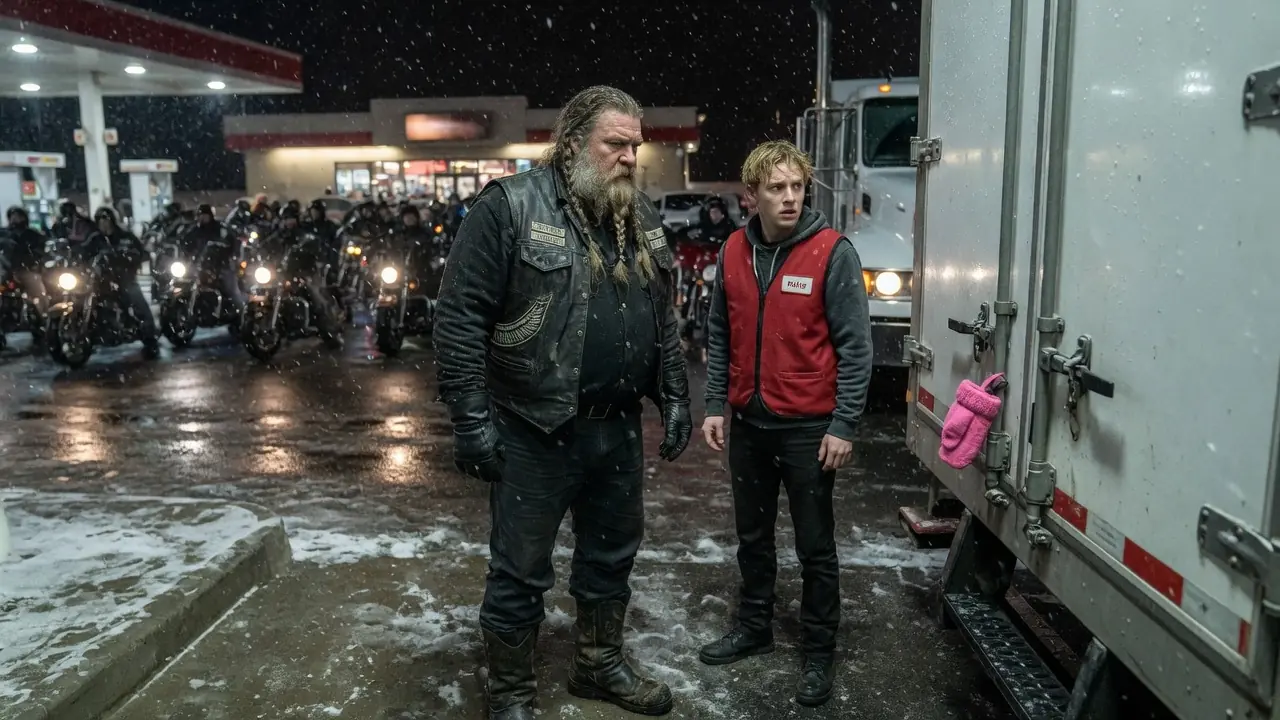
At the center of the group rode a huge man on a charcoal motorcycle with a dented gas tank and high handlebars. He was broad through the chest, thick-necked, with a gray beard tied in one braid and hands so large they made the grips look small.
On the back of his vest was a patch.
A silver wing wrapped around a wrench.
IRON HALO MC
Noah froze.
He knew that symbol.
Not from television.
Not from rumors.
From a photograph hidden in a shoebox beneath his bed.
His father had worn that patch once.
Noah’s father, Micah Reed, had died when Noah was six, hit by a drunk driver on a winter road outside Cheyenne. Noah remembered his father in pieces: a deep laugh, warm hands, the smell of gasoline and peppermint gum, a voice telling him, “You take care of your sister, little man. That’s your first job.”
After the funeral, men on motorcycles had come.
Noah remembered them standing in a line beside the cemetery road, engines silent, heads bowed. One of them, a big man with a gray beard just starting then, had knelt in front of Noah and pressed something into his palm.
A small metal pin shaped like a wing.
“You ever get in trouble that the world won’t answer,” the man had said, “you find the Iron Halo. You hear me? Your daddy rode with us. That means you never stand alone.”
Noah had not understood.
He understood now.
He ran outside.
Eddie shouted behind him.
“Kid, wait!”
But Noah was already in the snow again, limping across the lot toward the riders.
A biker near the pumps turned first.
“Hey,” he barked. “Get inside before you freeze.”
Noah ignored him.
He went straight toward the huge man in the center.
The man had just cut his engine and was removing his gloves. He watched Noah approach with narrowed eyes.
Noah stopped three feet away, shaking so badly he could barely stand.
“Sir,” he said.
The big man looked down at him.
“You lost?”
“No.” Noah pointed toward the white truck. “That man took my sister.”
The bikers around him went still.
The big man did not move.
“What did you say?”
Noah’s voice cracked.
“He came to our apartment. He said he was from the county. He took Grace. She’s seven. I followed him from town.”
A lean rider with a scar along his chin stepped forward.
“Could be a custody thing.”
Noah reached into his jacket with numb fingers.
It took three tries to pull out the photograph.
He held it up.
“My dad told me to find you.”
The big man looked at the photo.
For a moment, nothing happened.
Then his face changed completely.
The photograph showed Micah Reed at twenty-eight, grinning beside a motorcycle, one arm around a younger Noah and the other holding baby Grace. On his vest collar, clearly visible, was the Iron Halo wing pin.
The big man reached out slowly and took the photo.
His breath left him like someone had punched him.
“Micah.”
The scarred rider stared.
“No.”
The big man looked from the photograph to Noah’s face.
Then he saw it.
The same stubborn jaw.
The same dark eyes.
The same deep crease between the brows when fear tried to become anger.
“Micah Reed was your father?”
Noah nodded.
“My name is Noah. My sister is Grace. He took her. Please.”
The big man lowered himself to one knee in the snow.
He was still enormous, even kneeling.
“My name is Amos,” he said. “Your dad called me Preacher.”
Noah’s eyes widened.
“I remember you.”
Amos’s face tightened with grief.
“I remember you too, little man.”
Behind him, the other riders removed helmets, shifted closer, looked at Noah with new understanding.
Amos placed one hand on Noah’s shoulder.
“Listen to me. Your father was my brother. Not by blood. By road. By oath. By every mile we rode side by side.”
His voice lowered into something solid.
“If that man has your sister, then he has taken from us.”
Noah’s breath shook.
“Can you get her back?”
Amos looked toward the white trailer.
“Yes.”
Not maybe.
Not we’ll try.
Yes.
He stood.
The air around him changed.
He was no longer just a stranded rider in a blizzard.
He became command.
He turned toward the Iron Halo.
“This is Micah Reed’s son,” he said, his voice carrying over the storm. “His daughter is in that truck.”
Every rider heard.
Every rider understood.
Engines cut off one by one until the station lot fell into a heavy silence.
Amos pointed to the store.
“Rhea, get the boy warm. Check his hands and knee. Eddie, call 911 and tell them we have a possible kidnapping at Pine Ridge Fuel. Give the plate. Tell them to send state police and ambulances.”
Eddie, who had followed to the doorway, nodded quickly.
“Yes, sir.”
A woman with short silver hair and a medical bag stepped toward Noah.
“I’m Rhea,” she said. “Come with me.”
“No,” Noah said. “I’m not leaving her.”
Amos bent toward him.
“You already did the impossible. You followed her through a blizzard. Now you let us do our part.”
Noah looked at the trailer.
“What if he drives away?”
A rider near the truck stood up from where he had been crouching by the front wheel.
“He won’t,” the rider called. “Not unless he can drive without valve stems.”
Amos gave him a sharp look.
The rider shrugged.
“Road safety issue.”
Noah almost laughed.
Almost.
Rhea guided him inside.
She wrapped him in a thick leather jacket that smelled like smoke and cold air. She sat him behind the counter and worked off his frozen gloves gently, checking each finger. Eddie put hot chocolate in front of him with both hands shaking.
Outside, the Iron Halo moved.
Noah watched through the glass.
They did not rush the truck.
They did not shout.
They spread across the lot with strange discipline, forming a wide perimeter. Some stood near the road. Some stood near the pumps. Others moved behind the trailer and along the sides.
No one touched the driver.
No one opened the trailer.
Not yet.
Amos walked toward the cab with two riders beside him: the scarred man and a tall woman with a long braid.
The truck driver saw them coming.
His door opened suddenly.
He stepped down into the snow.
He was bigger than Noah remembered. Tall, heavy, with a clean-shaven face and pale eyes. His blue uniform jacket said NORTH STAR COLD FREIGHT.
His expression was angry until he realized how many bikers were watching him.
Then the anger stiffened into caution.
“What is this?” he demanded.
Amos stopped several feet away.
“We need to see inside your trailer.”
The driver laughed once.
“No, you don’t.”
“There’s a child inside.”
The driver’s eyes flicked toward the store.
Just once.
But Amos saw it.
The braided woman saw it too.
“No child,” the driver said. “Frozen goods. Medical transport. You people need to move before I call the police.”
“They’re already on the way,” Amos said.
That unsettled him.
Only for a second.
Then he sneered.
“Good. Then I’ll tell them a gang is harassing a working driver.”
Amos took one step closer.
“Open the trailer.”
“I don’t have the key.”
The scarred biker gave a quiet laugh.
The driver glared at him.
“What’s funny?”
“You said that too fast.”
The driver’s hand moved toward his pocket.
Every rider nearby shifted.
Not aggressively.
Just enough.
The driver froze.
Amos’s voice remained calm.
“Do not make a stupid decision in front of witnesses.”
The driver looked around.
A hundred eyes watched him.
Eddie watched from the window with the phone to his ear.
Noah watched with both hands around the hot chocolate, barely breathing.
The driver’s face twitched.
Then came the sound.
A small thump from inside the trailer.
Then another.
Not loud.
But in that silent lot, it might as well have been thunder.
Noah stood so fast the cup fell from his hands.
“Grace!”
He ran for the door, but Rhea caught him.
“Wait.”
“No, that’s her!”
Amos heard it too.
The driver’s face had gone pale.
Amos extended one hand.
“The key.”
“I told you—”
The braided woman moved so fast Noah barely saw it.
She stepped forward, grabbed the chain around the driver’s neck, and pulled a small silver key from beneath his shirt.
The driver grabbed her wrist.
That was his mistake.
The scarred biker seized the man’s arm and twisted it behind his back, not violently, but with enough force to make him drop to one knee.
Amos’s voice snapped like ice breaking.
“Hold him. Do not hurt him.”
The scarred biker held him still.
The braided woman handed Amos the key.
Amos walked to the back of the trailer.
The whole lot seemed to hold its breath.
He put the key into the lock.
Turned it.
The heavy latch released with a metallic crack.
Amos grabbed the handle and lifted.
The trailer door rolled up.
Cold air poured out, sharper than the blizzard.
For a second, the inside was completely dark.
Then someone switched on a flashlight.
Noah saw rows of crates.
Insulated containers.
Blankets.
And, near the front corner, three children huddled together on the metal floor.
Grace was one of them.
Her cheeks were wet.
Her lips were pale.
Captain Buttons was clutched against her chest.
“Noah!” she cried.
Rhea let him go.
Noah ran.
He slipped once, caught himself, and reached the trailer just as Grace stumbled into Amos’s arms.
Amos lowered her gently to the ground.
Noah grabbed her.
She was freezing.
So small.
So real.
“I found you,” he sobbed into her hair. “I found you.”
Grace clung to him with all her strength.
“I knew you would.”
Behind them, riders lifted the other two children out, wrapping them in jackets and blankets. One was a boy about nine. The other was a girl no older than five. Both were too frightened to speak.
Rhea and two medically trained riders brought all three children into the store.
Noah refused to let go of Grace.
No one asked him to.
The police arrived twelve minutes later.
Three cruisers first.
Then two ambulances.
Then a state police SUV.
They found the white truck disabled, the driver restrained with zip ties, and over a hundred bikers standing calmly in the snow like a wall built by winter itself.
The lead trooper, a woman named Sergeant Helen Ward, stepped out with one hand on her belt.
“What happened here?”
Amos walked forward slowly, hands visible.
“Kidnapping,” he said. “At least three children. One suspect detained. No injuries caused by us. We have witnesses, video, license plate, and the boy who followed him here.”
Sergeant Ward looked toward the store window.
Noah stood inside, Grace wrapped in a blanket against his side.
The trooper’s expression changed.
She turned to the driver, who had begun shouting.
“They attacked me! They sabotaged my truck! I’m a delivery driver!”
Eddie came out holding his phone.
“I have the 911 call. I have the boy’s statement. I saw the driver come in. He asked about back roads.”
The braided woman handed over the key.
“This was around his neck.”
Amos handed over the photograph of Micah Reed, then another item.
A small notebook they had found in the cab’s side pocket.
Names.
Dates.
Addresses.
Children’s ages.
Sergeant Ward read one page.
Her face hardened.
“Get him in a cruiser.”
The driver started begging then.
Not for forgiveness.
Not because he was sorry.
Because men like him only understood consequences when consequences finally touched them.
“I was just transportation,” he shouted. “I don’t know anything. They gave me names. They gave me cash.”
Sergeant Ward looked at Amos.
“You heard that?”
Amos nodded.
“So did everyone else.”
A rider near the pumps raised his phone.
“Recorded.”
The trooper almost smiled.
Almost.
The children were checked by paramedics in the store.
Grace had mild hypothermia and bruises on her wrist from where the man had held her too tightly. The other two children were identified as missing from neighboring counties.
One had been missing for two days.
The little girl had been missing since morning.
Their families were called.
The gas station became a place of crying, blankets, flashing lights, statements, and hot chocolate.
Noah sat on the floor with Grace asleep against him.
Amos lowered himself onto an overturned milk crate nearby.
For a long time, neither spoke.
Then Noah asked, “Did my dad really ride with you?”
Amos looked at him.
“Yes.”
“Was he good?”
Amos’s mouth tightened.
“He was one of the best men I ever knew.”
Noah looked down at Grace.
“People don’t talk about him much.”
“Sometimes grief makes adults quiet when children need stories.”
Noah nodded like he understood that too well.
Amos reached into his vest and removed something from an inner pocket.
It was a small iron wing pin.
Old.
Scratched.
Carefully kept.
“This was your father’s prospect pin,” Amos said. “He gave it back when you were born. Said he had a new road now. Said his family came first.”
Noah stared.
Amos placed the pin in his hand.
“He asked me to keep it until you were old enough to understand what it meant.”
Noah closed his fingers around it.
“What does it mean?”
“It means a man is measured by what he protects, not what he owns.”
Noah looked at Grace.
“I protected her.”
“Yes,” Amos said. “You did.”
When Mr. Alvarez, the real social worker, arrived, he nearly collapsed with relief.
He had been calling police since discovering the forged transfer order. The agency’s system had been breached. Names and addresses had been stolen. The man in the truck was part of a larger operation.
Sergeant Ward was already moving.
State police contacted federal agents.
Roadblocks went up.
The notebook became evidence.
The driver, terrified now, began talking before midnight.
Names.
Routes.
Drop locations.
A warehouse outside Billings.
A false foster placement network.
The blizzard that should have hidden the crime had trapped it instead.
By dawn, six more children were recovered from a rural property two counties over.
Three adults were arrested.
Then five more.
The news would later say it began with an anonymous tip, a brave child, and a motorcycle club that refused to drive past trouble.
But Noah knew the truth was simpler.
He had been freezing.
He had been desperate.
He had found the men his father told him to find.
And they had kept their promise.
Two days later, Noah and Grace were released from the hospital into emergency care with Mrs. Pruitt, who had cried so hard when she saw them that Grace patted her arm and said, “It’s okay, we got rescued by motorcycle angels.”
Mrs. Pruitt looked at Noah.
“Motorcycle angels?”
Noah nodded.
“With beards.”
For the first time in days, everyone laughed.
A week later, the Iron Halo came to see them.
Not all hundred.
Just Amos, Rhea, the scarred rider whose name was Cutter, and the braided woman, Jo.
They arrived in two trucks instead of motorcycles because snow still covered the streets.
Grace ran to Amos before Noah could stop her.
He caught her carefully, as if she weighed less than a promise.
“I drew you something,” she said.
She handed him a picture of a giant man with wings standing beside a motorcycle. Around him were children wearing blankets and smiling.
At the top, in Grace’s careful handwriting, were the words:
THANK YOU FOR FINDING US
Amos stared at the drawing for a long time.
Then he cleared his throat.
“Best picture I ever got.”
Grace beamed.
Noah watched him tuck it into his vest like it was made of gold.
Jo brought groceries.
Rhea brought winter coats.
Cutter brought a new bicycle.
Noah stood speechless.
The bike was not fancy.
But it was sturdy.
Blue frame.
Good tires.
Working brakes.
Cutter scratched the back of his neck.
“Figured if you’re going to chase criminals through blizzards, you need better equipment.”
Rhea smacked his arm.
“Don’t encourage that.”
Noah touched the handlebars.
“Thank you.”
Cutter looked away.
“Yeah. Well.”
Amos sat with Noah at the small kitchen table while Grace showed Jo every stuffed animal she owned.
“There’s going to be a hearing,” Amos said.
Noah stiffened.
“Are they going to separate us?”
“No.”
“You don’t know that.”
“I do,” Amos said. “Because we got lawyers now. Good ones. Mr. Alvarez is doing everything right, and the club is helping with legal fees.”
Noah stared at him.
“You can do that?”
“We can do more than ride loud.”
Noah looked down at his hands.
“I don’t want to lose her.”
“You won’t.”
“What if the system says we have to?”
Amos leaned forward.
“Then the system will have to explain itself in front of a judge, a lawyer, a social worker, and every Iron Halo rider who can fit in a courthouse hallway.”
Noah almost smiled.
“That’s a lot.”
“It’s meant to be.”
The hearing happened in February.
The courthouse in Cheyenne had never seen anything like it.
Iron Halo riders filled the sidewalk outside, silent and orderly, holding signs that said:
KEEP NOAH AND GRACE TOGETHER
PROTECT FOSTER CHILDREN
FIX THE SYSTEM THAT FAILED THEM
They did not block doors.
They did not shout.
They simply stood.
Inside, Mr. Alvarez testified that Noah and Grace had been targeted because their records had been exposed through a hacked placement system. He admitted the agency had failed to protect them. He also argued that separating them after the trauma would cause further harm.
Mrs. Pruitt offered to become their long-term foster guardian.
“I’ve watched those children grow up above my laundromat,” she told the judge. “They are not case numbers. They are my family.”
Noah held Grace’s hand so tightly his fingers ached.
When the judge ruled that they would remain together in Mrs. Pruitt’s care while a permanent guardianship plan was developed, Grace burst into tears.
Noah did not.
Not until Amos put one hand on his shoulder outside the courtroom and said, “Your dad would be proud.”
Then Noah cried like the twelve-year-old boy he still was.
Spring came slowly.
Snow melted into mud.
The highway reopened fully.
Pine Ridge Fuel became famous for a while, though Eddie hated interviews and kept telling reporters, “I just made hot chocolate.”
The white trailer was hauled away as evidence.
The gas station replaced the flickering sign.
And on the wall near the coffee machine, Eddie hung a framed photo of Noah, Grace, and the Iron Halo standing together after the courthouse hearing.
Under it, he placed a small handwritten note:
DON’T IGNORE A CHILD WHO SAYS SOMETHING IS WRONG.
The Iron Halo did not disappear from Noah and Grace’s lives.
They became a strange, steady presence.
Rhea took Grace to medical appointments.
Jo taught her how to braid leather bracelets.
Cutter fixed Mrs. Pruitt’s laundromat dryers for free and pretended it was because he “hated inefficient machines,” not because he liked helping.
Amos visited every Sunday afternoon.
At first, he came for coffee.
Then dinner.
Then birthdays.
By summer, Grace had started calling him Uncle Amos.
Noah waited longer.
He was careful with names.
Careful with trust.
But one evening in July, while Amos helped him repair the new bicycle’s chain, Noah asked, “Did my dad ever mess up?”
Amos chuckled.
“Constantly.”
Noah looked surprised.
“Really?”
“Micah once rode seventy miles in the wrong direction because he refused to admit Jo was better at maps.”
From the porch, Jo shouted, “I heard that.”
“You were meant to,” Amos called back.
Noah laughed.
It felt good.
Then his face grew serious.
“I’m scared I’ll forget him.”
Amos wiped grease from his hands.
“Then we tell stories until you remember.”
“What if the stories run out?”
“They won’t.”
Noah looked at him.
“Uncle Amos?”
Amos went still.
Noah pretended to focus on the chain.
“Can you tell me another one?”
Amos’s voice was rough when he answered.
“Yeah, kid. I can tell you another one.”
A year after the blizzard, the Iron Halo organized the first Winglight Ride.
It started at Pine Ridge Fuel.
Over two hundred riders came.
Not just from Wyoming.
Montana.
Colorado.
South Dakota.
Nebraska.
They rode for missing children, for foster kids, for broken systems that needed witnesses, for families who had been told to wait when waiting was dangerous.
Noah and Grace rode in the lead truck with Mrs. Pruitt.
Amos rode beside them.
At the gas station, Eddie handed out free hot chocolate until he ran out of cups.
Sergeant Ward spoke briefly.
“So many crimes survive because no one listens,” she said. “That night, a boy refused to stop. A clerk listened. A motorcycle club acted with discipline. And children came home. That is what community is supposed to do.”
Then Noah was asked to speak.
He stood on a small platform someone had built from wooden pallets.
Grace stood beside him, holding Captain Buttons.
Noah looked at the crowd of riders, police officers, social workers, reporters, and families. His hands shook, but not from cold this time.
“My sister was taken,” he said. “I was scared. I didn’t know what to do, so I followed. I thought if I lost the truck, I lost her.”
He looked at Amos.
“My dad told me once that if trouble got too big, I should find the Iron Halo. I didn’t know if that was real. I thought maybe it was just something adults say to make kids feel safe.”
A few riders lowered their heads.
“But it was real,” Noah continued. “They were real. And they didn’t ask if helping us was convenient. They didn’t ask if we could pay. They didn’t ask if it was their problem.”
His voice cracked.
“They just came.”
Grace leaned into his side.
Noah took a breath.
“So I want to say this. If a kid tells you they’re scared, listen. If somebody asks for help, don’t wait until it’s easy. And if you think you’re too small to save someone, you’re wrong. I was small. I was freezing. I was terrified.”
He looked at his sister.
“But I was her brother. So I kept going.”
No one clapped at first.
The silence was too full.
Then Amos put two fingers to his lips and whistled.
The whole crowd erupted.
Grace laughed.
Noah cried.
And somewhere inside that thunder of applause and engines, he felt his father near him.
Not as a ghost.
As a memory with wheels beneath it.
A promise still moving.
Years later, people would tell the story in different ways.
Some would make it sound like a legend.
A boy rode through a blizzard.
A hundred bikers came out of the storm.
A stolen girl was pulled from a frozen trailer.
A whole criminal network fell because one child refused to give up.
Those things were true.
But they were not the heart of it.
The heart of it was smaller.
A boy saw his sister taken and decided she was worth chasing.
A gas station clerk believed him.
A biker remembered an old promise.
A club chose discipline over rage.
A frightened little girl learned that the world still had people willing to come for her.
Years after the storm, Noah kept the iron wing pin in a small wooden box beside his bed.
Not because he wanted to become his father.
Not because he wanted to become Amos.
But because it reminded him of what Amos had told him the night after the hearing.
“A person is measured by what they protect.”
Noah protected Grace.
The Iron Halo protected them both.
And together, in the worst storm northern Wyoming had seen in twenty years, they proved something the world forgets too easily.
Sometimes help does not arrive wearing uniforms.
Sometimes it does not arrive quietly.
Sometimes it comes rolling through snow on a hundred motorcycles, carrying old promises, old grief, and a love fierce enough to turn strangers into family.
And sometimes, when a child stands in the cold and says, “Please help me,” the right people still answer.
Not tomorrow.
Not after paperwork.
Not when it is convenient.
Now.
Because somewhere in that storm, a little girl is waiting.
And somebody has to keep riding until she comes home.