A freezing afternoon in the Midwest.
An old clubhouse shook with the sound of idling Harleys.
And an eleven-year-old boy knelt in motor oil, staring at something that made his hands go cold.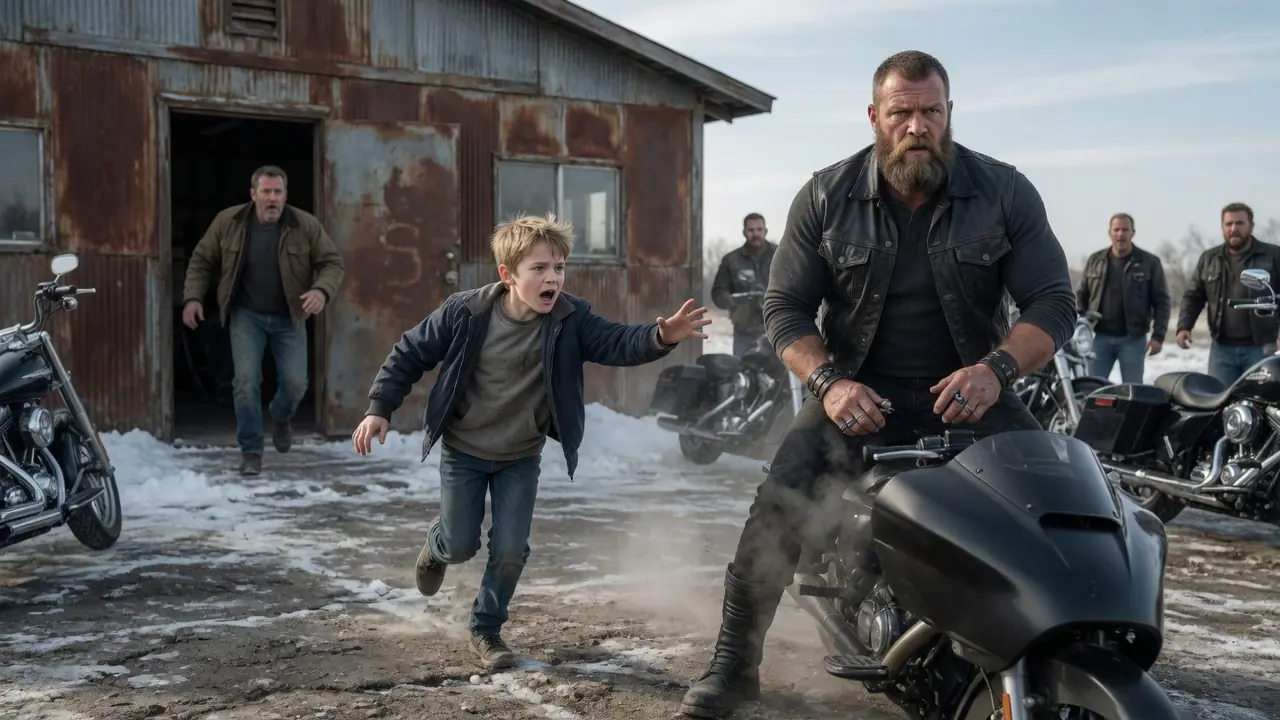
Green fluid was dripping from a brake line that had been sliced clean through.
Someone inside this brotherhood had just tried to kill one of their own.
And the man who was seconds away from riding to his death did not even know it yet.
This story would test everything people thought they knew about loyalty, family, and who the real enemy was when the walls started closing in.
The first thing to understand about the Iron Veil Motorcycle Club was that it did not advertise.
No website.
No social media page with grinning bikers posing next to chrome.
The clubhouse sat fourteen miles outside Carver Falls, Illinois, down a county road the township had stopped plowing three winters earlier.
The building itself was a converted grain warehouse, with corrugated steel walls stained by rust, a flat roof that leaked in four places, and a parking lot made of cracked asphalt and frozen mud.
In the dead of February, with the wind cutting sideways off the prairie, the place looked like a structure the world had already forgotten about.
That was exactly how the men inside preferred it.
Cal Rowan pulled his truck into the lot at 2:15 in the afternoon, killed the engine, and sat there for a moment with his hands still on the wheel.
His knuckles were scarred and slightly swollen from years of mechanical work, not fighting, though people always assumed otherwise.
He was forty-three years old and looked fifty.
Deep lines cut into his forehead.
His jaw clenched even when he slept.
His eyes were the color of creek water in November, gray-green and flat, like they had stopped reflecting anything bright a long time ago.
He wore a canvas jacket over a thermal shirt that had been washed so many times the collar was fraying.
His Iron Veil cut hung on a hook behind the passenger seat.
He had not put it on yet.
In the seat beside him, his son Jace sat with his knees pulled up and a paperback novel balanced on his thigh.
The boy was eleven, thin, with hair the color of wet sand, cut short and uneven because Cal did it himself with kitchen scissors every six weeks.
Jace had his mother’s mouth, slightly downturned at the corners, and his father’s silence.
He did not talk much, not because he was shy, but because he had learned early that most conversations in his world were not really conversations.
They were warnings.
Negotiations.
Or the tense quiet that came right before something broke.
“You want to wait in the truck?” Cal asked.
Jace shook his head.
“It’s cold in there.”
“It’s cold out here, too.”
Cal studied his son for a second longer than necessary.
Then he nodded once.
He reached behind the seat, grabbed his cut, and pulled it on.
The leather was cracked along the left shoulder where he had gone down on gravel two summers earlier.
He had never patched it.
Some of the brothers gave him grief about that.
Cal did not care.
They walked across the lot together, Jace half a step behind, his sneakers crunching on frozen gravel.
The boy carried a small backpack with the novel, a spiral notebook, two pencils, and a granola bar that was probably stale.
This was his survival kit for clubhouse days, days when Cal had business that could not wait and no one else to watch his kid.
Jace’s mother had left when he was four.
Not died.
Left.
She packed a bag while Cal was working a double shift at the fabrication shop and drove south toward a man she had been talking to online for five months.
Cal came home to an empty apartment and a boy sitting on the kitchen floor, eating dry cereal from a plastic bag.
He did not talk about her.
Jace did not ask.
Inside, the clubhouse smelled the way it always did.
Coffee that had been on the burner too long.
Motor oil.
Damp leather.
The faint chemical bite of solvent.
The main room was a wide-open space with a concrete floor, mismatched chairs, a long wooden table scarred with cigarette burns, and a bar along the back wall that had not served alcohol in over a year.
The club’s president, Wade Sutter, had made that call after two members got into a brawl that ended with one of them needing twelve stitches above his eye.
No booze in the clubhouse during business hours.
After hours, what a man did on his own was his own problem.
Wade was sitting at the head of the table when Cal and Jace came in.
He was fifty-eight, with a shaved head and a beard going white in patches.
His forearms were thick and covered with faded tattoos.
Unit insignia.
Dates.
A name nobody asked about.
He had done two tours in a war most people his age only remembered from news footage.
He never talked about what happened over there, but sometimes, in the middle of a conversation, his eyes would go somewhere else for a second.
Just a flicker.
Then he would come back, and his voice would be a little quieter.
Anyone paying attention knew not to push.
“Cal,” Wade said, lifting his chin in greeting.
His eyes moved to Jace.
“Hey, kid. There’s hot chocolate in the back if you want it.”
Jace looked at his dad.
Cal gave a small nod.
The boy slipped his backpack off one shoulder and headed toward the small kitchen area behind the bar, moving with the careful, practiced invisibility of a child who had learned how to exist in adult spaces without attracting attention.
Three other members were already inside.
Rhett Voss leaned against the wall near the front door, arms crossed, his cut stretched tight across wide shoulders.
Rhett was the club’s enforcer, not by official title, because the Iron Veil did not use titles the way bigger clubs did, but by mutual understanding.
He was thirty-six, built like a man who had spent his twenties doing manual labor and his thirties maintaining it through sheer stubbornness.
He had a temper that ran hot and fast, and a voice that could fill a room without rising above conversational volume.
His boots were always clean.
His bike was always immaculate.
His emotional range, according to most people who knew him, ran from irritated to furious, with brief stopovers at tolerant.
But Cal had seen him once, three years earlier, sitting alone in the parking lot at midnight after a fellow veteran in the next county took his own life.
Rhett had been sitting on the ground with his back against his Harley, his head in his hands, completely still.
Cal had walked past without saying a word.
Neither of them ever mentioned it.
Next to the table sat Elias Kane, a quieter presence.
He was forty-one, lean, with deep-set eyes that seemed to be perpetually calculating something.
He had joined the club five years earlier after a divorce that left him sleeping in his truck for three months.
The brotherhood had given him a roof, a purpose, and a reason to keep waking up in the morning.
He was grateful in the way broken men are grateful, silently, with a kind of desperation underneath that he never let anyone see.
Lately, though, something had shifted.
He was thinner.
Quieter, which for Elias was saying something.
He smoked more than he used to and laughed less.
There was a new tension in his shoulders that had not been there six months before.
Nobody had asked him about it.
In this world, you did not ask.
You waited.
And if a man wanted to talk, he would talk.
If he did not, you watched him carefully and hoped you caught the signs before something went wrong.
The fourth man was Boon Ratliff, the club’s treasurer and unofficial historian.
He was fifty, with reading glasses he was embarrassed about, and a memory for dates and details that bordered on obsessive.
He kept the books, managed the club’s legitimate income from a small motorcycle repair operation, and maintained the records Wade insisted on.
Meeting minutes.
Financial reports.
Membership logs.
Boon believed in paper trails the way some men believed in luck.
He thought they kept you honest.
Wade waited until Cal took a seat.
Then he leaned forward with his elbows on the table.
“We’ve got a problem with the county. They’re talking about rezoning this stretch of road. If that goes through, this building falls under commercial property codes, which means inspections, permits, and about forty thousand dollars in upgrades we don’t have.”
“How solid is the information?” Boon asked, already pulling a notebook from his jacket pocket.
“Solid enough. Councilman’s office sent a letter. Boon’s got copies.”
The conversation moved into logistics.
Zoning laws.
Legal options.
The possibility of hiring an attorney the club could not afford.
Cal listened but did not contribute much.
His mind was on Jace.
It was always on Jace.
The boy was in the kitchen area now, sitting on an overturned milk crate with his novel open on his knees.
But Cal could tell he was not reading.
Jace was watching.
His eyes moved around the room the way they always did, tracking, cataloging, noting things most people missed.
It was a habit the boy had developed young, and it unsettled Cal sometimes, because it meant his son had learned to survive by observation rather than trust.
That was a skill born from instability.
No matter how hard Cal tried to give the kid something solid, the damage from those early years, the disappearing mother, the rotating babysitters, the nights spent in the back seat of Cal’s truck while he worked late, had already set the foundation.
Rhett pushed off the wall and stretched.
“I’m heading out. Got to run to Henderson’s before they close. Need a fuel line for the Sportster.”
“Take the main road,” Wade said without looking up. “County’s been salting the back routes, and it’s tearing up the undercoats.”
Rhett grunted in acknowledgment and headed for the door.
He pulled on his gloves, zipped his jacket to his throat, and pushed through the heavy metal door into the cold.
Nobody was watching Jace when the boy set down his book and stood.
Nobody noticed him slip through the side door that led to the gravel strip where the bikes were parked.
It was not unusual for Jace to wander outside.
The clubhouse was isolated enough that there was nowhere dangerous to go, and the men had long since stopped worrying about the kid being near the motorcycles.
He knew not to touch.
He had been taught that rule the way other children were taught not to run near a swimming pool.
But Jace was not interested in touching anything.
He was interested in the color green.
He had noticed it from inside through the small window above the kitchen sink.
A bright spot on the ground beneath one of the bikes.
Emerald green, vivid against the gray-brown gravel.
It had caught his eye the way a wrong note catches a musician’s ear.
Not alarming at first.
Just off.
Different.
Out of place in a landscape of oil black and rust and winter dirt.
He crouched beside Rhett’s Harley.
The bike was a 2004 Road King, meticulously maintained, with chrome so clean it reflected the overcast sky.
Underneath, near the front wheel, a small puddle had formed.
Green.
Not oil green.
Not antifreeze green.
This was something else, brighter, almost chemical.
Jace knew the color because Cal had shown him once years before in the shop.
Brake fluid.
It came in a bottle with a red cap, thinner than antifreeze, with a sharper smell.
Cal had held the bottle up and said, “If you ever see this on the ground under a bike, you tell me. Immediately. Don’t wait. Don’t think about it. Just tell me.”
He had not explained why.
He had not needed to.
The gravity in his voice had been enough.
Jace looked at the puddle.
Then he looked up at the brake line running along the front fork.
Even in the flat gray light, he could see it.
A clean cut.
Not wear.
Not age.
Not a crack from the cold.
A slice.
Deliberate.
Precise.
The fluid was weeping from the wound like something alive and bleeding.
His stomach dropped, the kind of drop that comes before conscious thought, before language, before fear has a name.
His body understood before his brain did.
He stood up and ran.
Rhett was thirty feet away, one leg already swinging over the saddle of a loaner bike he sometimes used for short runs when he did not want to put miles on the Road King.
But today, he changed his mind.
He was walking back toward his Harley, keys already in his hand, muttering about the cold and wanting the heavier machine for the highway.
Jace hit him at full speed.
Not physically.
The boy weighed maybe seventy-five pounds.
But with his voice, which cracked the frozen air like a gunshot.
“Rhett, stop! Don’t ride it!”
Rhett froze.
Not because the words made immediate sense, but because of the sound.
The raw, shaking urgency in an eleven-year-old’s voice that was usually so quiet you forgot he was in the room.
“What?”
“Your bike. The brake line. It’s cut. There’s fluid on the ground. Don’t ride it.”
Rhett stared at the boy for two full seconds.
Then he turned and walked to his Harley without a word.
He crouched.
He looked.
And Cal, who had heard Jace’s shout through the side door, was already coming outside, moving fast, his face tight with a fear he had not felt since the night he found his apartment empty.
What they found changed everything.
The cut was surgical, made with a blade sharp enough to slice through braided hydraulic hose without leaving ragged edges.
This was not vandalism.
This was not a prank.
This was an execution attempt disguised as mechanical failure.
If Rhett had ridden that bike onto the highway at speed and needed to brake hard on a downhill curve or at a busy intersection, the lever would have gone loose, and nothing would have happened.
No stopping power.
No control.
Just momentum, asphalt, and physics.
Rhett stood up slowly.
His face was unreadable, but his hands were shaking.
Not from the cold.
His voice was low, controlled.
The kind of controlled that precedes explosions.
Cal looked at him.
“Everybody left by ten. Boon locked up.”
“Then who was here after that?”
Silence.
The wind cut across the lot, sharp enough to make their eyes water.
Jace stood behind his father, one hand gripping the back of Cal’s jacket, his face pale, his breathing fast.
Inside, the conversation that followed was the ugliest thing Jace had ever witnessed.
He sat in the corner on his milk crate, knees pulled to his chest, and watched the men he had known his entire life turn on each other with a speed that made his stomach hurt.
Wade stood at the head of the table, his jaw working, his eyes dark.
“Somebody cut Rhett’s brake line. Somebody who had access to this lot, who knew which bike was his, and who knew how to do it clean.”
“That narrows it to about twelve people,” Boon said quietly.
“It narrows it to us,” Rhett said.
He was standing again, pacing, his boots heavy on the concrete.
“Nobody from outside gets in here without us knowing. The gate’s chained. The cameras—”
“The cameras have been down for two weeks,” Elias said from his chair.
His voice was flat, tired.
“I filed the repair request. Nobody followed up.”
Every head turned toward Elias.
The silence that followed was heavy enough to have weight.
“I’m not saying anything,” Rhett said, but his eyes stayed on Elias for a beat too long.
“Then don’t,” Elias said.
He did not look up.
He was staring at his hands, which rested on the table, fingers slightly curled.
There was something in his posture Cal recognized.
The slow collapse of a man who was running out of reasons to sit upright.
Wade raised his hand.
“Nobody’s accusing anybody in this room. Not yet. But we need to think about who else had access in the last forty-eight hours.”
Then Boon said the name that changed the temperature in the room by ten degrees.
“Dane Holloway.”
The silence that followed was not the kind where people were thinking.
It was the kind where people were deciding.
Deciding whether to speak.
Deciding whether to agree.
Deciding whether to light a match or let it burn on its own.
Dane Holloway had been a full member of the Iron Veil for seven years before everything went sideways.
He was thirty-nine, quiet, competent, and universally respected until four months ago, when a dispute over club finances turned personal.
Dane had questioned Wade’s decision to use club funds for the legal defense of a member arrested on assault charges, charges Dane believed were legitimate.
The argument escalated over three meetings.
It grew bitter.
It ended with a vote.
Dane lost.
He did not take it well.
Words were said, the kind that do not get unsaid.
Within a week, Dane turned in his cut and walked out.
No farewell.
No explanation beyond what had already been shouted across the table.
He simply stopped existing in their world.
But he still lived twelve miles away.
He still knew the clubhouse layout.
He still had the skills.
And he had a reason, whether real or imagined, to want someone in the Iron Veil to hurt.
“Dane wouldn’t do this,” Cal said.
“Dane’s got every reason to do this,” Rhett shot back.
“Having a reason isn’t the same as doing it.”
“Don’t lecture me about reasons, Cal. Somebody tried to put me in the ground today. I want to know who.”
“We all want to know who,” Wade said, his voice carrying the weight of a man who had held this group together through worse and was not sure he could do it again. “But we don’t move on suspicion. We never have. We’re not starting now.”
But even as he said it, Cal could see the fracture forming.
It ran through the room like a crack in ice, invisible until you put weight on it, and by then it was too late.
Rhett wanted blood.
Boon wanted answers.
Elias wanted to disappear.
And Wade wanted to believe that the family he had built over fifteen years was not about to eat itself alive.
Jace watched all of it.
He watched the way Rhett’s jaw tightened every time Dane’s name was mentioned.
He watched the way Elias flinched when anyone looked at him too long.
He watched the way his father’s hands stayed flat on the table, steady, while everything around him shook.
And he noticed something none of the men noticed because they were too busy being afraid and angry to see it.
Elias’s boots.
The left one had a smear of something dark along the sole.
Not oil.
Not mud.
Something thicker.
And when Jace looked at the floor near the side door, the door that led to the gravel strip where the bikes were parked, he saw a faint track, the same dark substance leading from inside the clubhouse to outside, then curving left away from the bikes toward the storage garage at the back of the property.
A building nobody had opened in weeks.
The boy said nothing.
He sat on his crate, opened his notebook, and wrote down three words in small, careful handwriting.
Elias.
Garage.
Why?
Outside, the sky was getting darker.
The temperature was dropping.
Somewhere out on the empty highway, a truck horn sounded and faded into nothing.
Inside the Iron Veil clubhouse, eleven-year-old Jace Rowan held a secret that was either going to save this family or tear it apart.
He did not know which one yet.
He looked at his father.
Cal’s face was carved from stone.
His eyes were on Wade, who was speaking in a low voice about security protocols and perimeter checks and things that sounded like plans but felt like prayers.
And Jace understood with the quiet certainty of a child who had been watching adults fail his entire life that the men in this room were looking in the wrong direction.
The enemy was not twelve miles away.
The enemy was already inside.
Jace did not sleep that night.
He lay in his narrow bed in the apartment above Cal’s garage, a two-room unit with thin walls, a space heater that clicked every forty seconds, and a window that faced the empty lot behind the building where stray cats gathered around a dumpster.
The ceiling had a water stain shaped like a hand.
Jace had spent enough sleepless nights staring at it that the shape had become a kind of companion, something constant in a world that never stopped shifting.
He kept seeing the brake line.
The clean slice.
The emerald fluid on gray gravel.
And he kept seeing Elias’s boots.
That dark smear along the left sole.
The track on the floor leading toward the storage garage.
He had written it down.
Three words in his notebook.
But writing it down and saying it out loud were two different countries separated by a border he did not know how to cross.
His father was downstairs.
Jace could hear him.
Not moving.
Not talking on the phone.
Just existing in that heavy way Cal had when something was eating at him.
The apartment was so small that silence had texture.
Cal’s silence tonight felt like concrete.
At 6:15 in the morning, before the sun had fully committed to showing up, Cal drove Jace to Mrs. Tierney’s house three blocks from the elementary school.
Mrs. Tierney was seventy-two, partially deaf in her left ear, and charged Cal forty dollars a week to watch Jace before and after school.
She made pancakes that were always slightly burned on one side and kept a television tuned to game shows at a volume that could be heard from the sidewalk.
Jace liked her.
She did not ask questions.
She did not try to be his mother.
She just existed nearby.
And that was enough.
“I’ll pick you up at four,” Cal said through the truck window.
“Okay,” Jace said.
The boy stopped on the porch steps and turned back.
Cal looked at him.
“What you did yesterday with Rhett’s bike,” Cal said.
His jaw worked for a moment.
The words seemed to cost him something.
“That was good. You did good.”
Jace nodded.
He wanted to say more.
He wanted to tell his father about the boots, the track on the floor, the storage garage.
But Cal’s face was already closing the way it did when he was about to drive somewhere that mattered.
And the moment passed the way moments always passed in this family, quickly and without enough air.
Cal did not go to work.
He called the fabrication shop at 6:30 and told his foreman he needed a personal day.
His foreman, a man named Doug, had known Cal for nine years and did not ask why.
The tone was enough.
Instead, Cal drove to the clubhouse.
The lot was empty except for Wade’s truck and Boon’s Honda Accord, which looked almost comically out of place next to the heavy bikes and weathered pickups that usually filled the space.
The morning was bitter cold.
Cal’s breath came in thick white plumes as he crossed the lot, his boots leaving dark impressions in the frost.
Inside, Wade and Boon were at the table.
Coffee.
Paperwork.
The kind of grim administrative silence that follows a crisis.
The boring, essential work of documenting what happened, when, and what came next.
Wade looked like he had not slept either.
The skin under his eyes was the color of old bruises.
“Sit down,” Wade said.
Cal sat.
“I’ve been on the phone with Mason Sullivan from the downstate chapter. Told them what happened. They’re sending two guys up to help with perimeter security until we figure this out.”
“Good.”
“That’s not why I called you here early.”
Cal waited.
He knew the rhythm of Wade’s conversations, the slow approach, the circling, the careful placement of words like a man setting charges.
Wade slid a piece of paper across the table.
It was a printout from a social media page, a blurry photo of Dane Holloway standing outside a bar in Winslow, the next town over.
The timestamp was from six days earlier.
In the photo, Dane was talking to a man Cal did not recognize.
Heavy build.
Beard.
A cut that was too far away to read, but the colors were wrong.
Not Iron Veil.
Boon found this last night,” Wade said.
Cal looked at the photo, then at Boon.
Boon took off his reading glasses and rubbed the bridge of his nose.
“I went through Dane’s public profiles. Most of it is nothing. Fishing photos. His dog. But this one stood out. That’s a Cobalt Reaper cut.”
The name landed in the room like a dropped engine block.
The Cobalt Reapers operated out of Winslow and ran territory that overlapped with the Iron Veil on two county roads.
They were not enemies in the traditional sense.
There had never been open conflict.
But the relationship survived on distance and mutual avoidance.
The Reapers had a reputation for being transactional.
They did not start wars, but they were more than willing to profit from someone else’s.
“One photo doesn’t mean anything,” Cal said.
“One photo means he’s talking to people he shouldn’t be talking to four months after he walked out on us.”
Wade’s voice was level, but his eyes were not.
“I don’t want to believe it either, Cal. But if Dane cut a deal with the Reapers, if he traded information about our operations, our schedules, our security gaps, then the brake line makes sense. Hit our enforcer, disrupt our response, create chaos.”
“That’s a lot of if.”
“It is. But Rhett’s already made up his mind, and you know how that goes. Once he locks in, he doesn’t unlock.”
Cal knew.
He had watched Rhett go after a man in Decar two years earlier over a debt that turned out to be a misunderstanding.
By the time the truth surfaced, bridges had been burned that could not be rebuilt.
Rhett operated on certainty the way other people operated on oxygen.
He needed it.
Craved it.
When the world got ambiguous, he manufactured his own version of clarity just to keep breathing.
“Where’s Rhett now?” Cal asked.
“That’s the other thing I need to tell you.”
Wade leaned back in his chair.
The wood creaked.
“He left the clubhouse at midnight. Took his truck. I called him four times. No answer.”
The silence that followed was the kind that fills a room the way water fills a sinking boat.
Slowly, then all at once.
“You think he went after Dane?” Cal said.
It was not a question.
“I think Rhett spent the last twelve hours imagining what would have happened if that boy hadn’t caught the brake line. And I think a man who spends twelve hours imagining his own death isn’t going to sit still and wait for a committee to make a decision.”
Cal stood up.
His chair scraped the concrete floor with a sound like a short scream.
“I’ll find him.”
“Cal.”
Wade’s voice stopped him at the door.
“If Rhett has already made contact with Dane, this gets complicated fast. The kind of complicated that doesn’t come back from.”
“I know.”
“Do you? Because the last time this club lost control of a situation, we buried a man. I’m not doing that again.”
Cal met Wade’s eyes.
The old man’s gaze was steady, but underneath the steadiness, there was something Cal had never seen there before.
Not fear exactly.
Exhaustion.
The particular kind of exhaustion that comes from holding something together for so long that your hands have forgotten how to let go, even when they are bleeding.
“I’ll bring him back,” Cal said.
Then he walked out into the cold, not entirely sure he believed his own words.
He tried Rhett’s phone from the truck.
Straight to voicemail.
He tried again.
Same thing.
Then he sat in the cab with the engine running and the heater pushing lukewarm air against his face.
He thought about where Rhett would go.
Not Dane’s house.
Rhett was volatile, but he was not stupid.
He would not confront an ex-member at his residence in broad daylight.
That was the kind of thing that generated police reports and restraining orders.
Rhett would want information first.
He would want confirmation.
And for Rhett, confirming meant going to the source of the rumor rather than the subject of it.
Cal put the truck in gear and headed toward Winslow.
The drive took forty minutes.
The highway was mostly empty.
A few semis.
A county sheriff’s cruiser parked on the median with its lights off.
And a stretch of flat land so featureless that the horizon looked like a line drawn with a ruler.
Cal drove with the radio off.
He did not like music when he was thinking.
Sound cluttered his head, and right now his head needed to be clean.
He found Rhett’s truck in the parking lot of a diner called Rosie’s on the south end of Winslow’s main drag.
The diner was the kind of place that served eggs and coffee twenty-four hours a day and asked no questions about why a man with bloodshot eyes and clenched fists was sitting alone in a corner booth at seven in the morning.
Cal parked two spots away and went inside.
Rhett was in the last booth, his back to the wall, a cup of coffee in front of him that he had not touched.
His jacket was zipped to his throat.
His eyes were red-rimmed and focused on something in the middle distance that was not in the room.
Cal slid into the opposite seat without asking permission.
The vinyl creaked under his weight.
“Wade sent you,” Rhett said.
“Wade told me where you weren’t. I figured out where you were on my own.”
“Impressive detective work.”
“Don’t do that.”
“Do what?”
“The sarcasm thing. The deflection. I’ve known you for eleven years, Rhett. I can hear when you’re scared, even when you’re pretending you’re angry.”
Rhett’s eyes snapped to Cal’s face for a second.
Something raw flickered across his expression.
Something young, wounded, and furious.
Then it was gone, replaced by the hard mask he wore like a second skin.
“I’m not scared.”
“Then why are you sitting in a diner in Winslow at seven in the morning instead of at the clubhouse where you belong?”
Rhett did not answer immediately.
He wrapped both hands around the coffee cup.
Cal noticed his knuckles were white, not from gripping the cup, but from holding himself still.
“I drove past Dane’s place last night,” Rhett said quietly. “Just drove past. Didn’t stop. His truck was in the driveway. Lights were on. I could see him through the kitchen window. He was eating dinner alone like it was any other night.”
“And?”
“And I sat in my truck across the street for forty-five minutes and thought about what it would feel like to walk up to that door and ask him why he tried to kill me. Then I thought about what I would do if he said he didn’t. And I realized I didn’t have a plan for that answer.”
Cal let that sit.
The diner was quiet.
Just the hiss of a griddle and the low murmur of a television mounted above the counter, showing morning news with the sound nearly off.
“You don’t know it was him,” Cal said.
“Don’t I?”
“No, you don’t. You know someone cut your brake line. You know Dane left the club angry. You know he was seen talking to a Reaper. And you know none of those things, individually or together, prove he did it.”
“Cal, who else would—”
“I don’t know. That’s the point. We don’t know. Moving on what we don’t know is how people end up destroyed.”
Rhett stared at him for a long time.
Then he laughed.
A short, harsh sound that had nothing to do with humor.
“You sound like Wade.”
“There are worse things to sound like.”
“Yeah. Like a dead man on a highway because his brakes didn’t work.”
The words hung between them.
Cal did not flinch, but he felt them.
He thought about Jace, the boy kneeling in the gravel, his voice cracking the cold air like glass.
If his son had not been there, if his son had not been paying attention, if his son had been a normal eleven-year-old reading his book instead of watching the world with those flat, careful eyes, Rhett might already be dead.
“We need to talk to Dane,” Cal said. “Properly. Not with fists, not with threats. A conversation.”
“And say what? Hey, buddy, did you try to murder me? Pass the salt.”
“We say what happened. We watch how he responds. We go from there.”
Rhett shook his head slowly.
“You always want to believe the best in people, Cal. That’s your problem.”
“No. My problem is that I’ve seen what happens when this club convicts someone without evidence. You were there for the Morrison thing. You remember how that ended.”
The Morrison thing.
The words sucked the remaining air out of the booth.
Three years earlier, a member named Pete Morrison had been accused of stealing from the club’s repair fund.
The evidence was circumstantial.
Irregular receipts.
An unexplained cash withdrawal.
Morrison’s gambling problem, which everyone knew about but nobody had confronted.
The club voted to expel him.
Morrison denied it.
Denied it with tears in his eyes and his voice breaking.
Nobody listened.
He was out within forty-eight hours.
Two months later, Boon discovered an accounting error that explained the discrepancy.
The money had never been stolen.
It had been double-entered by Boon himself during a week when he was sick with the flu and working on painkillers that made his vision blur.
They tried to bring Morrison back.
He would not come.
He had moved to Indiana, changed his number, and severed every connection.
Cal heard later through a friend of a friend that Morrison had started drinking again after nine years sober.
The guilt of that, the specific particular guilt of watching a man’s life come apart because you were too impatient to be certain, lived in the Iron Veil like a stain that would not come out no matter how many times you scrubbed.
Rhett looked down at his coffee.
Something shifted in his jaw.
When he spoke again, his voice was different.
Quieter.
Stripped of bravado.
Almost human.
“I keep thinking about the angle of the cut,” he said. “Whoever did it knew exactly where to slice. That wasn’t rage. That was patience.”
“Dane’s a patient man.”
“So is half the county.”
Cal waited.
He could feel Rhett circling something, approaching a thought the way you approach a wounded animal.
Slowly.
Sideways.
Ready to pull back.
“Elias has been off,” Rhett said finally.
Cal’s chest tightened.
“Off how?”
“You’ve seen him. Lost weight. Barely talks. The camera thing? He filed that repair request, and nobody followed up. That’s not like us. That’s not like him. Elias used to be the guy who followed up on everything. Remember when the roof leaked and he called the roofer six times in one week? Now he can’t get a security camera fixed.”
“People go through things.”
“Yeah, they do. And sometimes the things they go through make them do other things.”
Cal wanted to argue.
He wanted to defend Elias the way he defended Dane, because that was what he did.
He stood in front of the men in this brotherhood and refused to let suspicion become certainty without proof.
But Jace’s notebook flashed through his mind.
Three words in a child’s handwriting.
Elias.
Garage.
Why?
His son had seen something, too.
And his son did not see things that were not there.
“We don’t know anything about Elias,” Cal said, and his voice sounded less convincing than he intended. “We don’t know anything about anyone right now. That’s the whole damn problem.”
They sat in silence for a while.
The waitress came by and refilled Rhett’s untouched coffee without comment.
The television cycled through weather reports.
Another cold front moving in.
Temperatures dropping into the single digits by Thursday.
Wind chill warnings for six counties.
Outside the window, Winslow’s main street was waking up in slow motion.
A woman in a heavy coat walked a dog.
A delivery truck backed into an alley.
The world moved on, indifferent to the fact that inside this diner, two men were trying to decide whether their family was worth saving or already too broken to hold.
Cal drove back to Carver Falls alone.
Rhett stayed in Winslow.
“I need an hour,” he had said, which meant he needed the drive home to arrange his face before seeing Wade.
Cal understood.
Some men needed distance the way others needed noise.
Rhett was the kind who burned hot in company and went cold in solitude, and he had been running hot for eighteen hours straight.
He needed to cool down before he did something that could not be taken back.
Back at the clubhouse, Cal found something he did not expect.
Elias Kane’s truck was in the lot.
It was ten in the morning, and Elias did not usually show up until afternoon.
He worked nights at a warehouse on the other side of the county, loading and unloading freight.
A job that left his shoulders permanently hunched and his hands rough as sandpaper.
Being here this early meant he had either skipped work or had not gone home after his shift.
Cal walked inside.
The main room was empty.
Coffee pot cold.
Wade’s jacket gone.
He had left at some point.
The building felt hollowed out, the way a house feels after an argument when everyone has retreated to separate rooms.
Cal heard the sound from the back.
Not loud.
A rhythmic metallic tapping.
Like someone knocking a wrench against a pipe without purpose.
Just to make noise.
Just to fill the quiet with something besides his own thoughts.
Cal walked down the narrow hallway that led past the bathroom and the storage closet to the back door.
The door was propped open with a cinder block.
Beyond it, the gravel strip extended toward the storage garage, a separate structure smaller than the main building, with a rolling metal door raised about three feet.
Not enough to walk through standing up.
Enough to crawl under.
Elias was inside.
Cal could see his boots.
The same boots Jace had noticed, though Cal did not know that yet.
They were visible beneath the partially raised door, pointed outward as if Elias was sitting on the floor with his back against something.
Cal ducked under the door and straightened up.
The garage was dim and cold.
It smelled like old motor oil, cardboard, and something vaguely chemical Cal could not identify.
Metal shelving lined the walls, stacked with parts bins, old tires, and boxes of supplies that had not been inventoried in months.
A single work light hung from a hook on the ceiling, its bulb weak and yellow, casting shadows that made the space feel smaller than it was.
Elias was sitting on the concrete floor with his back against a toolbox.
His jacket was off.
His flannel shirt was untucked.
In his right hand, he held a socket wrench, which he was tapping absently against the floor.
The sound Cal had followed.
His eyes were open but not focused.
They were aimed at the far wall, at nothing, at a point in space that existed only for him.
“Elias.”
No response.
Tap.
Tap.
Tap.
“Elias.”
The tapping stopped.
Elias’s eyes moved slowly, like a man waking from anesthesia.
He looked at Cal the way a person looks at someone they have forgotten is real.
“Cal.”
His voice was a croak, dry and papery.
“What time is it?”
“After ten. Have you been here all night?”
Elias did not answer.
He looked at the wrench in his hand as if he did not know how it had gotten there.
Then he set it on the floor beside him with a careful deliberation that made Cal’s skin prickle.
“I need to tell you something,” Elias said.
Cal crouched down, not sitting.
He kept his weight on the balls of his feet, ready to move if he needed to.
An instinct he did not examine.
“Tell me.”
“I didn’t fix the cameras.”
“I know.”
“No. You know I filed the request and it didn’t get done. That’s what I said in the meeting. But that’s not what happened.”
Elias’s voice was fracturing.
Small cracks appeared between syllables like ice on a river in early spring.
“I didn’t file the request. I said I did, but I didn’t.”
The garage got colder.
Or it felt like it did.
“Why?”
“Because I didn’t want them to see.”
“See what?”
Elias closed his eyes.
His head tilted back against the toolbox.
His Adam’s apple moved once, twice.
When he spoke again, his voice was barely above a whisper.
“I’ve been coming here at night after my shifts for weeks. I sit in here, and I just sit. I don’t do anything. I just sit in the dark and try to remember what it felt like to not be this tired. I couldn’t have the cameras showing that. Wade would ask questions. Rhett would think I was unstable. You’d all look at me the way you’re looking at me right now.”
Cal’s expression had not changed, but his heart was hammering against his ribs like a fist on a locked door.
“Elias, listen to me. When you come here at night, is it just this garage? Do you go near the bikes?”
“No.”
“Did you touch Rhett’s Harley any night? Any time?”
Elias’s eyes opened.
Something terrible moved across his face.
Recognition.
Understanding.
The precise moment when a man realizes what his actions look like from the outside.
“You think I did it?”
“I’m asking.”
“I didn’t, Cal. I swear I didn’t touch his bike. I didn’t touch anyone’s bike. I come here to sit in the dark because it’s the only place I can be where nobody needs anything from me. That’s all. That’s all it is.”
Cal stared at him.
Eleven years of reading men’s faces.
Eleven years of learning the difference between a lie and a truth that sounds like a lie because the person telling it is too broken to make it sound clean.
Elias’s eyes were wet, but he was not crying.
He seemed past crying.
Past the point where tears were an available response.
His body was a shell someone had hollowed out and forgotten to refill.
“When’s the last time you slept?” Cal asked. “Really slept?”
Elias’s mouth trembled.
Just the corner.
A micro-movement a less attentive man would have missed.
“I don’t remember.”
Cal sat down.
Not crouching anymore.
He put his back against the wall across from Elias and stretched his legs out on the cold concrete.
He did not say anything for a long time.
The silence between them was not the aggressive silence of the clubhouse meeting or the loaded silence of the diner.
It was the silence of two men sitting in a dark room because neither one of them knew what else to do.
“The cuts on Rhett’s brake line were made with a sharp blade,” Cal said eventually. “Clean. Deliberate. Someone who knew what they were doing. But you’re not a mechanic, Elias. You’ve never worked on bikes. You load boxes at a warehouse.”
“I know.”
“So even if you were out here every night, you couldn’t have done it. Not like that.”
“But they won’t see it that way.”
“No, they won’t.”
And there it was.
The real problem laid bare on the cold floor of a storage garage.
Elias’s midnight visits had nothing to do with the sabotage, but his lie about the cameras, the lie told to protect his own fragile privacy, had created the exact security gap someone else had exploited.
The cameras were down because Elias needed them to be down.
And because they were down, whoever actually cut Rhett’s brake line had done it without being seen.
Elias’s shame had opened the door.
Someone had walked through it.
Cal’s phone buzzed in his pocket.
He pulled it out.
A text from Wade.
Three words that rewired every circuit in his brain.
Dane’s in hospital.
Cal was on his feet before the phone went dark.
He looked at Elias, who was watching him with the hollow intensity of a man who knew he was about to be left alone again.
“Stay here. Don’t talk to anyone. Don’t leave.”
“Cal—”
“I mean it, Elias. Not Rhett. Not Boon. Nobody. I’ll be back.”
Cal drove to the county hospital in twenty-two minutes, breaking the speed limit on every stretch.
The parking lot was half full.
He found Wade’s truck near the emergency entrance and Wade himself standing outside the sliding glass doors with his hands in his jacket pockets and his breath coming in white bursts.
“What happened?”
“Nothing happened to him. He works here.”
Cal’s brain stuttered.
“What?”
“Dane Holloway is a paramedic. Has been for three months. He finished his EMT certification last year and got hired at County General. Nights. Double shifts. He’s been working sixty-hour weeks since October.”
Cal stood very still.
The automatic doors slid open and closed behind Wade as people moved in and out, and the cold air mixed with the warm antiseptic breath of the hospital in a way that made everything feel unstable.
“The night the brake line was cut,” Cal said slowly. “Where was he?”
“Here. I pulled his schedule. I walked into the ER and asked to speak to a supervisor. Told her I was a family friend trying to plan a surprise party, which is the dumbest lie I’ve ever told, but she bought it. Dane worked a double that night. Six p.m. to six a.m. Twelve hours. Logged in. Logged out. Multiple witnesses. Patient records with his name on them.”
“He was saving people’s lives,” Cal said, “while we were planning to destroy his.”
The words hit Cal like a physical force.
He leaned against the wall beside the entrance and put his hand over his eyes.
Not crying.
Just suddenly unable to look at the world for a second.
The weight of it.
The accusation.
The certainty.
The self-righteous conviction that Dane was the enemy.
It collapsed inward like a condemned building.
And in its absence, there was nothing but dust and the horrible clarity of a mistake that had almost been made.
“Rhett,” Cal said, dropping his hand. “Rhett was in Winslow this morning. He drove past Dane’s house last night.”
“I know. I talked to him twenty minutes ago. Told him what I found.”
Wade’s face was unreadable, but his voice carried something Cal had never heard in it before.
A brittleness, like porcelain held together by habit alone.
“He didn’t say anything. Just hung up.”
Cal looked at the hospital doors.
Through the glass, he could see the emergency waiting room.
Plastic chairs.
A television on mute.
A woman holding a sleeping child.
A man with a bandaged hand.
And somewhere beyond that, behind doors Cal could not see through, Dane Holloway was working.
Inserting IVs.
Taking vitals.
Holding a stranger’s hand while they waited for test results.
Being useful.
Being necessary.
Being everything the Iron Veil had refused to see in him.
Cal’s phone buzzed again.
Not Wade this time.
An unknown number.
He answered.
“Cal Rowan.”
A woman’s voice came through.
Professional, tense.
“This is Mrs. Tierney. I’m sorry to bother you, but Jace didn’t come to school today.”
The ground shifted.
Every thought in Cal’s head—Dane, Elias, Rhett, the brake line, the club—fell away like scenery dropping off a stage.
“What do you mean he didn’t come to school?”
“I walked him to the bus stop at 7:45. The bus came. He got on. But the school just called me. He’s not there. He was marked absent for every class.”
Cal’s vision narrowed.
The parking lot.
The hospital.
Wade’s voice asking what was wrong.
All of it compressed into a single point of white-hot terror that began in his chest and radiated outward until his hands were shaking and his mouth was dry.
His son got on the bus.
His son did not arrive at school.
And somewhere between those two facts, the only thing in Cal Rowan’s world that actually mattered had disappeared.
Cal Rowan did not remember hanging up the phone.
He did not remember crossing the parking lot.
He did not remember Wade grabbing his arm or the words Wade said or the sound of his own voice, which must have said something because Wade’s face changed.
It shifted from concern to something deeper, something that looked like a man watching a building come down in real time.
Cal was in his truck.
The engine was running.
His hands were on the wheel, and they were shaking so badly the steering column vibrated.
The hospital parking lot blurred through the windshield.
Not rain.
Not snow.
Just his vision coming apart at the seams like a photograph dissolving in water.
Jace got on the bus.
Jace did not get to school.
Between those two points was a gap.
Maybe fifteen minutes.
Maybe twenty.
Inside that gap was every nightmare Cal had ever swallowed.
Every fear he had buried under work and routine.
And the careful architecture of a life designed to keep his son safe.
All of it useless.
All of it a lie he had told himself while the world did what it always did to people like him.
Wade was at the passenger window, knocking.
Cal unlocked the door without looking.
Wade climbed in, pulled the door shut, and did not say anything for three seconds.
Three seconds that felt like open-heart surgery without anesthesia.
“Talk to me,” Wade said.
“Jace is gone.”
“Gone how?”
“Got on the school bus this morning. Never arrived. School called Mrs. Tierney. She called me.”
Wade processed this the way he processed everything, behind his eyes, in a place where emotion got filtered through forty years of crisis management before it reached his face.
But his hand moved to the dashboard.
His fingers pressed against the vinyl.
Cal saw the pressure in his knuckles.
The old man was scared.
“Could he have gotten off at the wrong stop? Wandered off?”
“Jace doesn’t wander. He doesn’t do anything without a reason.”
“Then there’s a reason.”
Cal pulled out of the lot.
He did not know where he was driving.
His body was making decisions his brain had not approved.
Turning left.
Accelerating.
Following a route that seemed to be assembling itself in real time from instinct and desperation.
Wade was on his phone, calling Boon, telling him to get to the school, talk to the bus driver, check the route.
His voice was calm and operational.
Cal hated him for it and was grateful for it in equal measure.
“I’m calling the police,” Cal said.
“Wait.”
“Don’t tell me to wait, Wade. My son—”
“I know. Listen to me. If we call the police right now, the first thing they do is come to the clubhouse. They see the cut brake line, they see a motorcycle club in crisis, they start asking questions that have nothing to do with Jace and everything to do with us. And while they’re asking those questions, time passes. You understand what I’m saying?”
Cal understood.
He hated it, but he understood.
The world did not look at men like them and see fathers.
It saw leather cuts and criminal histories and associations.
The police would spend an hour building a profile before they spent a minute looking for an eleven-year-old boy.
“Thirty minutes,” Cal said, his voice sounding like something pulled from a drain. “We have thirty minutes to find him ourselves. Then I call.”
“That’s enough. Boon’s heading to the school. I’ll get Rhett.”
“Rhett’s in Winslow.”
“Not anymore. He called me while you were on the phone with Mrs. Tierney. He’s on his way back. He sounded different.”
Cal did not ask what different meant.
He did not have room for anything except the image of his son, thin, quiet, careful Jace, stepping onto a yellow school bus with his backpack and his novel and his spiral notebook, then ceasing to exist.
He drove the bus route.
He knew it because he had driven it twice when Jace first started riding, following the bus at a distance, making sure the stops were safe, the intersections monitored, the neighborhood stable enough.
It was a seventeen-minute route that wound through the south end of Carver Falls, past a strip mall, through a residential area of small houses with chain-link fences, and up a hill to the elementary school.
There were six stops.
Jace’s was the second.
Cal drove slowly.
His eyes moved across every sidewalk, every alley, every gap between buildings.
The cold had emptied the streets.
A few cars in driveways.
A dog behind a fence.
A mailman making rounds with his collar up and his head down.
No boy.
No backpack.
No sign that his son had ever been part of this landscape.
At the fourth stop, a corner near an abandoned laundromat, Cal pulled over.
Something had caught his peripheral vision.
Not Jace.
Something else.
A piece of paper caught against the base of a streetlight, fluttering in the wind.
He got out and picked it up.
A page torn from a spiral notebook.
The kind Jace carried.
The handwriting was his son’s.
Small.
Careful.
Pressing hard enough to leave grooves in the paper.
Three lines.
Man in gray truck watching clubhouse Tuesday night.
License plate starts KV7.
Following him.
Cal read it three times.
Each reading stripped away another layer of whatever was holding him together.
His son had not been taken.
His son had gotten off the bus on purpose.
He had seen something.
Or known something.
Instead of telling anyone, he had gone after it himself because that was what Jace did.
He watched.
He cataloged.
He solved problems adults were too angry, too scared, or too blind to see.
And now he was out there alone, following a stranger in a gray truck, armed with nothing but a notebook and the quiet conviction that nobody else was going to get this right.
“He’s tracking someone,” Cal said, getting back in the truck.
He handed Wade the note.
Wade read it.
His face did not change, but his breathing did.
A slight hitch.
A half-second pause between inhale and exhale.
Cal caught it because he was listening for it.
“KV7,” Wade repeated. “Do we know this plate?”
“No.”
“A gray truck at the clubhouse Tuesday night. That’s the night the brake line was cut.”
“I know.”
“Your boy saw a truck that night.”
“He didn’t say anything. He wrote it down. He writes everything down.”
“Cal. That kid’s been keeping a record none of us knew about.”
Cal pulled away from the curb and accelerated.
His mind was doing two things simultaneously.
The animal part, the father part, was screaming, running blind through every worst-case scenario evolution had programmed into his nervous system.
But the other part, the part that had kept him alive through a difficult youth, through lean years, through the slow grind of single fatherhood, was working.
Calculating.
Following the thread.
Jace had gotten off at the fourth stop, which meant whatever he had seen or wherever he was going was in that direction.
South of the school.
Away from the residential neighborhoods.
Toward the industrial fringe of Carver Falls, the zone of warehouses, scrapyards, and small repair shops that operated in the gray area between legal and not quite.
Cal’s phone rang.
Boon.
“I talked to the bus driver,” Boon said.
His voice was tight, clipped.
“She remembers Jace. Said he was sitting near the back. She noticed because he usually sits in the front. She said he was looking out the window the entire time, like he was watching for something. Then at the Millfield and Fourth stop, stop four, he got up and asked to get off. She told him it wasn’t his stop. He said he forgot something at home and his dad was picking him up. She let him off.”
“He lied.”
“He’s eleven, and his dad’s a biker, and he needed off the bus. He did what he had to do.”
Cal gripped the phone.
His jaw ached from clenching.
“Boon, I need you to do something. Run a partial plate. KV7. Gray truck. Probably a pickup. Probably domestic make.”
“I’m not a cop, Cal.”
“You know people. The DMV clerk in Winslow owes you for the transmission work. Call her.”
Silence on the line.
Then Boon’s voice, quieter.
“Give me twenty minutes.”
Cal hung up and drove south.
Wade sat beside him, silent now, his phone in his lap, his eyes scanning the road with the methodical patience of a man who had spent decades looking for things other people did not want found.
They searched for eighteen minutes along the industrial strip.
Past loading docks.
Fenced lots.
Buildings with no signs.
Metal doors.
Security cameras that may or may not have been working.
The wind picked up.
Clouds thickened overhead, pressing down on the town like a hand on a chest.
The temperature dropped another three degrees, and Cal thought about Jace’s jacket.
A thin windbreaker.
Not heavy enough for this kind of cold.
He thought about the boy’s sneakers on frozen pavement.
He thought about the granola bar in the backpack and whether it was stale.
Then Wade pointed.
“There.”
A gray truck was parked behind a chain-link fence in front of a corrugated metal building that had once been a machine shop.
The truck was a Ford F-150, maybe ten years old, with mud on the wheel wells and a toolbox in the bed.
The front plate was partially obscured by dried mud, but the back plate was visible.
KV7-4812.
Cal parked across the street.
Every nerve in his body told him to go.
Cross the street.
Jump the fence.
Kick down the door.
Find his son.
But Wade’s hand was on his arm, and Wade’s voice was in his ear, steady as a heartbeat.
“Look first. Then move.”
Cal looked.
The building had one visible entrance.
A metal door on the left side, partially open.
No windows on this face.
A security light mounted above the door, turned off despite the overcast sky.
No other vehicles in the lot.
No sound from inside that he could hear over the wind.
“I’m going,” Cal said.
“I’m coming with you.”
“No. If something goes wrong, someone needs to call the police for real this time.”
Wade’s hand tightened on Cal’s arm, then released.
The old man’s eyes were bright and hard.
“Two minutes. If you’re not back or I don’t hear from you, I’m calling everyone. Police. Fire. Every brother I can reach.”
Cal crossed the street.
The fence had a gate that was chained but not locked.
The padlock was hanging open, looped through the chain like someone had been in a hurry or planned to come back.
He pushed through, his boots crunching on frozen mud, and approached the door.
The smell hit him first.
Motor oil.
Solvent.
Something else.
Brake fluid.
That same sharp, faintly sweet chemical bite.
It was stronger here, concentrated, as if someone had been working with large quantities in a closed space.
He pushed the door open with his shoulder and stepped inside.
The shop was larger than it looked from outside.
One main room, maybe forty by sixty feet, with a concrete floor stained dark by decades of grease and fluid.
Metal shelving along the walls, cluttered with parts and tools.
A hydraulic lift in the center, empty, its arms raised like the skeleton of something mechanical.
Fluorescent tubes overhead.
Two of them lit, the rest dark, creating alternating bands of sickly light and deep shadow.
And against the far wall, sitting on a wooden crate with his backpack at his feet and his notebook open on his knees, was Jace.
Cal’s knees almost buckled.
The relief hit him like a wave.
Physical.
Violent.
Disorienting.
His son was alive.
His son was sitting upright.
His son was looking at him with those flat, careful eyes that held an expression Cal had never seen on the boy’s face before.
Not fear.
Not defiance.
Something older.
Something that looked like the grim, tired resignation of a person who had found exactly what he was looking for and wished he had not.
“Jace.”
Cal’s voice cracked.
He crossed the room in six strides and dropped to his knees in front of the crate.
His hands went to the boy’s shoulders, gripping, feeling for injury, for anything wrong, for evidence that the world had touched his son in ways that could not be fixed.
Jace was cold.
His windbreaker was inadequate.
His nose was red, his lips slightly blue, and his hands wrapped around his notebook were trembling.
“Are you hurt?”
“No.”
“Are you alone now?”
“I am. He left about ten minutes ago.”
“Who left?”
Jace turned his notebook around.
Cal looked at the page.
What he saw made the floor tilt.
The boy had drawn a diagram.
Simple.
Precise.
The kind of thing a child draws when he does not have the vocabulary to explain something complex, but has the intelligence to map it.
It showed the clubhouse at the top.
An arrow leading to the storage garage.
Another arrow leading from the garage to this building, the machine shop.
At the bottom, two names connected by a line.
The first name was a man Jace had labeled gray truck man.
Beneath it, in smaller letters, he had written a description.
Tall. Thin. Beard. Walks with limp. Smells like cigarettes. Leather jacket with a patch. Cobalt blue circle with a gear inside it. Cobalt Reapers patch.
The second name hit Cal like a fist to the sternum.
Elias.
Not connected by an arrow that suggested conspiracy.
Connected by something worse.
A dotted line, the kind Jace used in his notebook to indicate uncertainty.
A maybe.
A question.
Beside it, in the margin, the boy had written:
Gray truck man was inside our garage. Used same door Elias uses. Knew the cameras were off.
Cal stared at the page.
His son had done in two days what a room full of grown men had not managed.
He had traced the sabotage not to Dane, not to some vague external enemy, but to a specific intrusion point that only worked because Elias’s nightly visits had created a blind spot.
The Cobalt Reapers had not guessed that the cameras were down.
They had known.
Someone had told them.
“Jace,” Cal said, his voice barely above a whisper. “How did you find this place?”
“I wrote down the truck’s plate when I saw it Tuesday night through the kitchen window at the clubhouse. I was getting water. I saw it park across the road, and a man walk toward the back of the property. Toward the garage. I didn’t tell you because I wasn’t sure it meant anything.”
The boy’s voice was steady, but his hands shook harder.
“Then after the brake line, I remembered. So I looked up the plate.”
“How?”
“Boon’s laptop. He left it on the table yesterday, and it was still logged into the county record search he uses for club finances. I typed in the partial plate and got three results. One was registered to an address on Fulton Road. Here.”
Cal’s mind was splitting.
Half of it was raging at himself for not seeing what his son had seen, at the situation for existing, at the universe for putting an eleven-year-old in the position of doing investigative work that could have gotten him killed.
The other half was staring at his boy with something that went beyond pride into a territory he did not have a name for.
Awe, maybe.
The terrible awe of watching your child become something you never intended them to become because the world gave them no other choice.
“You should not have come here alone. You understand that?”
“Yes.”
“You could have been—”
“I know. But you were all looking at Dane, and Dane didn’t do it. Nobody was going to look anywhere else until they had already ruined him.”
The words were so precise, so calibrated, that Cal physically flinched.
His son was not just observant.
His son understood the dynamics of the brotherhood better than half its members.
He had seen the Morrison trajectory forming.
The rush to judgment.
The convenient scapegoat.
The irreversible damage.
And he had decided, with the terrifying logic of a child who had been let down by adults enough times to stop waiting for them, to fix it himself.
Cal pulled Jace against his chest.
The boy’s body was rigid at first, the stiffness of someone who was not used to being held.
Then slowly, incrementally, he softened.
His face pressed into his father’s jacket.
His hands came up and gripped the fabric.
He did not cry, but he shook.
Cal held him and shook, too.
For thirty seconds, the machine shop disappeared.
There was nothing but the two of them in the cold, breathing.
Then Cal’s phone rang.
Boon.
His voice was different now.
Not tight.
Urgent.
The verbal equivalent of a man running.
“Cal. I got the plate. KV7-4812 registered to a Marcus Webb. You know that name?”
“No.”
“You should. He’s a sergeant-at-arms for the Cobalt Reapers. Or he was. I’m getting conflicting information. Some people say he’s active. Some say he went rogue six months ago. Either way, he’s connected to them. And Cal, there’s something else. I pulled his employment history through the county database. Three years ago, before he joined the Reapers, Marcus Webb worked at Holston Freight.”
Holston Freight.
The warehouse where Elias worked nights.
The connection snapped into place like a bone breaking in reverse.
Sudden.
Violent.
Clarifying.
Elias and Marcus Webb had worked at the same warehouse.
They knew each other.
Which meant Elias’s nightly visits to the storage garage, his lie about the cameras, his deterioration over the past six months, none of it was coincidence.
It was pressure.
Someone had been working on Elias.
Leaning on him.
Using whatever leverage they had.
Debt.
Blackmail.
Fear.
The slow exploitation of a man already buckling under the weight of his own isolation.
Elias had not cut the brake line.
But Elias had been manipulated into creating the conditions that allowed it to happen, and he might not even fully understand what he had been part of.
Cal looked at Jace.
The boy was watching him with those eyes.
Reading.
Cataloging.
Understanding.
“We need to go,” Cal said. “Now.”
He carried Jace’s backpack and walked the boy out of the shop, across the lot, through the gate.
Wade was standing outside the truck.
When he saw Jace, the old man’s composure fractured for the first and only time Cal had ever witnessed.
His eyes closed.
His head dropped.
One hand came up and covered his mouth.
His shoulders moved once.
A single convulsive shudder that lasted less than a second before he locked it down and became Wade Sutter again.
“Get in,” Cal said. “Both of you. I’ll explain on the way.”
He drove back to the clubhouse at speed, talking as he went.
The connection between Marcus Webb and Elias.
The warehouse.
The cameras.
The gray truck at the property Tuesday night.
All of it mapped and documented by an eleven-year-old with a spiral notebook and the kind of desperate bravery no child should ever need.
Wade listened without interrupting.
When Cal finished, the old man was quiet for a long time.
Then he said the thing Cal already knew but had not been willing to say out loud.
“This wasn’t about Rhett. Rhett was a target of opportunity. If the brake line worked, it would have created chaos, investigations, internal blame. Exactly what happened. While we were eating each other alive, somebody was getting access to our property. The question is what they were actually after.”
“The repair shop,” Cal said. “The legitimate business. Boon handles the books, the client list, the contracts, the county permits. If the Reapers got their hands on our commercial records, they could undercut every contract we have. Push us out of the territory without firing a shot.”
“That’s a long game.”
“Webb’s a patient man,” Jace said.
He described the brake line cut the same way.
Not rage.
Patience.
Jace was in the back seat, his backpack on his lap, his notebook closed.
He was staring out the window at the gray landscape scrolling past.
For a moment, he looked exactly like what he was.
A tired, cold eleven-year-old boy who wanted to go home.
Not the investigator.
Not the observer.
Just a kid with blue lips and a stale granola bar who had skipped school and was probably going to be in trouble.
Cal watched him in the rearview mirror and felt something shift in his chest.
A recalibration.
A tectonic adjustment in the landscape of his understanding.
He had spent eleven years trying to protect his son from the world, and the world had responded by turning his son into someone who protected others.
The irony was so sharp it drew blood.
They arrived at the clubhouse to find Rhett’s truck already in the lot.
Beside it was Elias’s truck.
Beside that, another truck Cal had never seen before.
Black.
Clean.
No mud.
No plates.
Cal stopped the truck.
His hand moved to the center console where he kept a heavy flashlight.
Not a weapon.
But close enough.
“Stay here,” he told Jace.
“Dad—”
“Stay here, Jace. Wade, watch him.”
He crossed the lot alone.
The clubhouse door was closed.
From inside, he could hear voices.
Not shouting.
Tense.
The compressed energy of a conversation happening at the edge of control.
He pushed the door open.
Rhett was standing in the center of the room.
Elias was sitting in a chair near the wall, his head down, his hands clasped between his knees.
Across the table, sitting with his legs crossed and a cigarette burning between his fingers despite the no-smoking rule Wade had implemented years ago, was a man Cal had never met.
He was tall, thin, with a beard going gray at the edges.
He wore a leather jacket, and on the left breast, visible even in the dim light of the clubhouse, was a patch.
Cobalt blue circle.
Silver gear in the center.
Cobalt Reapers.
“Close the door,” the man said.
His voice was calm, almost friendly, the way a man’s voice gets when he is holding all the cards and knows it.
Cal did not close the door.
He looked at Rhett, whose face was a battlefield of fury and restraint.
Then at Elias, who would not look up.
“Who are you?” Cal said.
“My name is Cole Maddox. I’m president of the Cobalt Reapers, and I’m here because one of my guys went off the reservation and almost got somebody killed. I’d rather clean that up myself than wait for your people to come looking for mine.”
The room was silent except for the buzz of the overhead fluorescent and the distant sound of wind against the metal walls.
Cal stepped inside.
He did not close the door.
He did not sit down.
“Talk,” he said.
Maddox took a drag from his cigarette.
The ember flared orange in the flat light.
“Marcus Webb. My former sergeant-at-arms. I say former because I stripped his patch two weeks ago when I found out he’d been running a side operation without club authorization.”
Rhett’s hands closed into fists.
Maddox continued.
“Webb had this theory, his word, not mine, that if he could destabilize your club from inside, he could take over your repair contracts and funnel the income through a shell company he set up with his cousin. Ambitious plan. Stupid plan. The kind of plan that gets people hurt and clubs burned.”
“He cut my brake line,” Rhett said.
The words were flat, stripped of everything except the fact itself.
“He did. And I’m not here to make excuses for that. I’m here because I found out forty-eight hours ago and I’ve been trying to locate Webb before this turned into something neither of our clubs could walk away from.”
Cal looked at Elias.
The man had not moved.
His head was still down.
His fingers were white where they pressed together.
“What about him?” Cal said, tilting his head toward Elias.
Maddox exhaled smoke toward the ceiling.
“Webb worked with your boy at Holston Freight three years back. Recognized him as Iron Veil. Started a friendship, or what looked like one. Your boy was already struggling. I don’t know the details. That’s your business. But Webb saw the cracks and worked them. Got him talking about the clubhouse, the schedule, the security setup.”
Maddox’s voice lowered slightly.
“Your man didn’t sell you out. He got harvested inch by inch over months by a guy who specializes in finding the weakest point and pressing until it gives.”
Elias made a sound.
Small.
Involuntary.
The sound a man makes when he hears the worst thing about himself spoken aloud by a stranger and cannot deny it because it is true.
Cal crossed the room and stood in front of Elias.
He did not crouch.
He did not soften his posture.
He looked down at the man, his brother, his club member, his responsibility, and felt something that was not anger and was not pity, but occupied the space between them like a bruise that had not finished forming.
“Look at me.”
Elias raised his head.
His eyes were destroyed.
Red-rimmed.
Hollow.
The eyes of a man who had been drowning in shallow water for months and never called for help because he did not believe anyone would come.
“Did you know what he was going to do? The brake line. Did you know?”
“No.”
Elias’s voice broke on the word.
“I didn’t know. I swear I didn’t know. He told me he just needed to get some tools he’d left in the garage. That’s what he said. Tools. He asked me when the cameras were usually down, and I told him they were always down because I’d never filed the report. I didn’t think. I didn’t—”
He stopped.
His mouth kept moving, but nothing came out.
His hands unclenched, and his arms hung at his sides like ropes.
Cal stood there, the weight of it pressing against his shoulders.
The full architecture of the disaster was now visible.
Every load-bearing wall.
Every stress fracture.
Every point of failure that could have been caught if anyone had been paying attention.
If anyone had looked at Elias, truly looked at him six months ago and said, Are you okay?
If anyone had waited for the real answer instead of accepting the first one.
If anyone had noticed that a man was disappearing inside himself and bothered to pull him back before someone else used that disappearance as a weapon.
Outside, through the open door, Cal could see his truck.
In the back seat, a small shape.
Jace watching through the window, his notebook in his lap, his eyes catching everything.
His eleven-year-old son had seen what a room full of grown men had missed.
And the cost of that failure was standing in front of him, broken and shaking, wearing an Iron Veil cut he no longer felt he deserved.
Maddox stubbed out his cigarette on the edge of the table.
Wade would have lost his mind over that, but Wade was in the truck with Jace, and right now the table did not matter.
Nothing in this room mattered except the next sentence and the one after that, and the terrible question of what these men were going to do with the truth now that they had it.
“Webb’s still out there,” Maddox said. “He knows your boy was at the shop on Fulton Road. He has a scanner. He would have heard chatter, seen movement. If he thinks the kid can identify him, he’s got a reason to make sure that doesn’t happen.”
The temperature in the room dropped.
Not literally, but something changed in the air.
A chemical shift.
A thinning of oxygen.
A collective tightening of every muscle in every body present.
Cal turned to Maddox, and the look on his face was something even Rhett, who had known Cal for eleven years and thought he had seen every version of the man, had never witnessed.
It was not anger.
Anger was too small.
It was the expression of a father who had just been told his child was in the crosshairs of a dangerous man.
In that moment, every rule, every code, every moral architecture Cal had built over a lifetime of trying to be better than his worst impulses became secondary.
Because the only thing that mattered now was the boy in the back seat of that truck and what Cal Rowan was willing to become to keep him alive.
“Where?” Cal said.
The single word filled the room the way a gunshot fills a canyon.
“Where is Marcus Webb right now?”
Maddox did not answer immediately.
He reached into his jacket slowly, deliberately, the way a man moves when he knows every eye in the room is watching his hands.
He pulled out a phone and set it on the table, screen up.
A map application was open.
A blue dot pulsed on a road Cal did not recognize.
“I put a tracker on his truck three days ago,” Maddox said. “When I stripped his patch, I knew he wouldn’t go quiet. Webb’s not the going-quiet type. He’s the type who burns everything on his way out and convinces himself the fire was someone else’s fault.”
Cal looked at the screen.
The blue dot was stationary, positioned on a road south of Winslow, near a cluster of industrial buildings.
A salvage yard, maybe.
A body shop.
The kind of place that existed in the margins between legal commerce and everything else.
“How current is this?” Cal asked.
“Real time. He’s been there since this morning. It’s a property his cousin owns. The same cousin who set up the shell company. Webb’s been using it as a base of operations since I cut him loose.”
Rhett stepped forward.
His boots were heavy on the concrete.
“Then let’s go.”
“Hold on,” Cal said.
“Hold on for what, Cal? This guy tried to kill me. He manipulated Elias. He’s been inside our property, and now he might be coming for your kid. What exactly are we holding on for?”
“For a plan that doesn’t end with someone in a prison cell or a casket.”
The words landed hard.
Rhett’s jaw tightened, the muscles working beneath the skin like something trying to break free, but he did not move.
Something in Cal’s voice, the absolute, unshakable control of a man who was terrified and channeling every ounce of that terror into precision, held him in place.
Cal turned to Maddox.
“Why are you here? Really? You didn’t drive to a rival club’s territory to deliver bad news out of the goodness of your heart. What do you want?”
Maddox smiled.
It was not a warm smile.
It was the smile of a man who respected the question because it proved the person asking was not stupid.
“I want this contained. Webb went rogue. He acted without authorization. Used Reaper resources for a personal play and put both our clubs at risk. If your people come after mine because of what one guy did, I’ve got a war I can’t afford. If my people find out I knew and didn’t act, I’ve got a mutiny I can’t survive. So, yeah, I want this handled clean tonight before it metastasizes into something that swallows both of us.”
“Clean how?”
“We confront Webb together. Both clubs. He sees his own president standing next to the people he tried to destroy, and he understands there’s no angle left to play. No club backing him. No allies. No exit strategy. He folds or he runs. Either way, he’s done.”
“And if he doesn’t fold or run?”
Maddox’s eyes went flat.
“Then we make it clear that the alternative is worse.”
Cal looked at Wade, who had come inside while Maddox was talking.
The old man stood near the door with Jace behind him.
Cal had told the boy to stay in the truck, but Jace had followed Wade in.
Cal did not have the energy to fight that battle right now.
Wade’s face was a mask of calculation, the expression of a man running scenarios at a speed that would exhaust a computer.
“It’s a risk,” Wade said, “walking into another club’s internal mess. If this goes sideways, we’re exposed.”
“We’re already exposed,” Cal said. “Webb’s been inside our security for weeks. He knows our layout, our schedules, our vulnerabilities. Sitting here, waiting for him to make the next move isn’t caution. It’s surrender.”
Wade studied him.
Then his eyes moved to Jace, standing small and silent in the doorway, his notebook clutched against his chest like a shield made of paper.
The old man’s expression shifted.
Something ancient and protective moving beneath the surface.
The same instinct Cal felt, filtered through an additional decade of watching young men get hurt because older men moved too slowly.
“We go,” Wade said. “But on our terms. No weapons beyond what we carry for the road. No violence unless violence comes to us first. And the boy stays here.”
“The boy stays with Mrs. Tierney,” Cal said. “I’m taking him there now. Rhett, Boon, get the bikes ready. Wade, call the downstate guys. Tell them to meet us at the junction on Route Nine in ninety minutes.”
“I don’t need downstate,” Rhett said.
“This isn’t about what you need. It’s about making sure Webb sees enough leather and chrome that fighting becomes a math problem he can’t solve. We’re not going there to hurt him. We’re going there to end his options.”
Cal crossed the room, took Jace by the shoulder, and walked him outside.
The sky had gone the color of wet cement.
The temperature was still dropping.
Their breath hung in the air between them like speech bubbles emptied of words.
At the truck, Cal opened the passenger door and waited for Jace to climb in.
The boy did so slowly, his movement stiff from cold and from the adrenaline crash that was finally catching up with him.
Cal reached behind the seat and pulled out a heavy wool blanket he kept there for emergencies.
The kind of emergencies that happen when you live in a place where winter can kill you if your truck breaks down on the wrong stretch of road.
He draped it over his son’s shoulders.
“I need you to listen to me,” Cal said.
Jace looked at him.
His eyes were red.
Not from crying, but from exhaustion, from cold, from the particular strain of holding yourself together when everything around you is pulling apart.
“You did something today that was brave and stupid and necessary and wrong. All of those things at the same time. Do you understand that?”
“Yes.”
“You can’t do it again. You’re eleven years old. You’re not a detective. You’re not a soldier. You’re not—”
Cal’s voice caught.
He pressed his fist against his mouth for a second, then lowered it.
“You’re my son. I can’t do what I need to do tonight if I’m worried about where you are. So you’re going to Mrs. Tierney’s, and you’re going to stay there. You’re going to eat her burned pancakes and watch her game shows, and you’re not going to leave that house until I come get you. Can you do that for me?”
Jace’s lip trembled.
Just once.
A micro-movement that contained an ocean of things the boy did not know how to say and might never learn to say, because the language of fear and love and need had been beaten out of his vocabulary by years of watching adults fail and learning to compensate in silence.
“What if you don’t come back?”
The question hit Cal like a blade between the ribs.
Clean.
Precise.
The kind of cut that does not bleed immediately.
It waits, lets you think you are fine, then opens.
“I’m coming back.”
“Mom said that, too.”
The silence that followed was the loudest thing Cal had ever heard.
Louder than Harleys.
Louder than arguments in the clubhouse.
Louder than the sound of a woman’s car pulling out of a driveway seven years earlier while he stood at the window holding a boy who was too young to understand what leaving meant, but old enough to feel it.
Cal crouched beside the truck, so his face was level with his son’s.
He put both hands on Jace’s knees and held them there, steady and warm, the most solid thing he could offer in a world built on shifting ground.
“Your mother left because she wanted to. I’m leaving because I have to. And I’m coming back because there is nothing on this earth, nothing, Jace, that could stop me from coming back to you. Not a man, not a club, not a storm, nothing. Do you hear me?”
Jace nodded.
His chin dipped, came back up, and his eyes were wet now.
Finally.
Reluctantly.
As if the tears had been waiting behind a dam that his eleven-year-old architecture could no longer support.
Cal pressed his forehead against his son’s for three seconds.
Then he stood up, closed the door, and drove to Mrs. Tierney’s in a silence so thick it felt like driving through water.
He dropped Jace off.
Mrs. Tierney took one look at Cal’s face and did not ask a single question.
She put her hand on Jace’s back and guided him inside.
The last thing Cal saw before the door closed was his son looking back at him through the screen.
Small.
Still watching.
Always watching.
Cal drove back to the clubhouse.
The lot had changed.
Rhett’s Harley was running, the exhaust sending white plumes into the freezing air.
Boon was on his bike beside it, his reading glasses replaced with riding goggles that made him look both older and more serious.
Wade’s Road King sat warming at the end of the row.
Two additional bikes had arrived.
The downstate riders, a pair of men Cal knew as Garrett and Lyle, both in their forties, both quiet, both built like men who had spent their lives doing physical work and carrying invisible weight, were parked near the gate.
Maddox was standing beside a black pickup that Cal now recognized as the plateless truck from earlier.
Beside him stood a Reaper member Cal had not met.
Younger, maybe thirty, with close-cropped hair and eyes that moved constantly, scanning the lot the way a combat veteran scans a room upon entry.
Force of habit.
Survival instinct.
The kind of alertness that never fully turns off.
“That’s Pike,” Maddox said, nodding toward the younger man. “He’s with me. Just him. I don’t want Webb thinking I brought an army. I want him thinking I brought a verdict.”
Cal pulled his cut from behind the seat and put it on.
The leather was cold against his shoulders.
He zipped his jacket over it, mounted his bike, a 2001 Softail with more miles on it than most cars see in two lifetimes, and kicked the engine to life.
The sound filled the lot.
It was joined by the others until the air itself vibrated with the collective rumble of six Harleys and Maddox’s truck.
For a moment, Cal felt something he had not felt in days.
Not safety.
Not confidence.
Something more elemental.
The sensation of moving forward instead of standing still.
Of riding toward a problem instead of waiting for it to arrive.
They rode south in formation, Cal and Wade at the front, Rhett and Boon behind them, Garrett and Lyle at the rear.
Maddox’s truck followed at a distance, headlights cutting through the early dusk like searchlights.
The sky was bruising, purple and black at the horizon, the last light of day retreating westward as if it wanted no part of what was about to happen.
The temperature had dropped below twenty degrees, and the wind hit their faces like a slap made of ice.
But none of them adjusted their speed.
You did not slow down for weather.
You did not slow down for pain.
You rode through it, arrived on the other side, and whatever was waiting for you there, you met it with your engine still hot and your eyes open.
The ride to the salvage yard took forty-seven minutes.
They pulled off the main road onto a gravel access lane that wound through a stretch of dead farmland, frozen furrows and empty fields, and a tree line in the distance that looked like a wall of dark bone against the sky.
The salvage yard appeared around a bend.
A chain-link perimeter topped with razor wire.
A gate standing open.
Beyond it, a landscape of crushed vehicles stacked three and four high, rusted metal sculptures arranged in rows, like the remains of a mechanical civilization that had collapsed under its own weight.
The main building was a cinder block structure at the center of the yard, with a corrugated metal roof and two garage bays, one of which was open.
Light spilled from inside.
Harsh fluorescent light, the kind that makes everything look exposed and slightly sick.
A gray truck was parked near the entrance.
The blue dot on Maddox’s tracker.
Webb’s truck.
They killed their engines at the gate.
The sudden absence of sound was almost physical.
A vacuum filled immediately with wind, the creak of stacked metal shifting in the cold, and a dog barking somewhere far away.
Cal dismounted and stood beside his bike.
His legs ached from the cold ride.
His hands were stiff inside his gloves.
His heart was beating at a pace he recognized from years ago, from situations he had promised himself he would never be in again.
Maddox pulled his truck alongside and got out.
Pike followed.
The Reapers president looked at the building, then at Cal.
Something passed between them that was not trust.
It was too early for trust.
But it was closer to alignment.
Two men on opposite sides of a line, both looking at the same problem, both understanding that the problem was bigger than their differences.
“Let me go first,” Maddox said.
“No,” Cal said.
“He’s my guy.”
“He was your guy. Right now, he’s the man who almost killed one of mine and might be coming for my son. I’m going in. You can be beside me or behind me. Your choice.”
Maddox studied Cal for a beat.
Then he nodded once sharply, the nod of a man who recognizes something in another man that he does not want to argue with.
They walked across the yard together.
Cal and Maddox in front.
Rhett two steps behind, his shoulders wide, his hands at his sides, every muscle in his body coiled with the controlled tension of a man who had been waiting for this moment for three days and was now channeling every ounce of rage into the discipline of not exploding.
Wade walked to Cal’s left, slightly back, his presence steady and anchoring the way a foundation anchors a building, invisible until someone tries to remove it.
Boon, Garrett, Lyle, and Pike formed a loose semicircle behind them.
Their boots crunched on frozen gravel and broken glass.
The sound echoed off the stacked cars, multiplied, became something larger than the sum of its parts.
By the time they reached the open garage bay, the sound alone was an announcement.
Deliberate.
Unhurried.
Inevitable.
Marcus Webb was inside.
He stood at a workbench with his back to the entrance, doing something with a box of parts.
Sorting.
Organizing.
The mundane mechanical work of a man who believed he still had time.
He was tall, as Jace had described.
Thin.
Beard going gray.
He wore a leather jacket with no patches.
Maddox had stripped them.
His work boots had steel toes.
A cigarette burned in an ashtray beside him.
The air smelled like grease, solder, and the particular staleness of a space where a man had been living alone for too long.
He heard them.
Cal saw the moment it registered.
A slight stiffening of the shoulders.
A pause in the motion of his hands.
The almost imperceptible tilt of his head as his ears processed the sound of multiple boots on gravel and his brain calculated the implications.
He did not turn around immediately.
He finished what he was doing with the part in his hand, set it down precisely in its designated spot, and then turned.
His face was interesting.
Not the face of a man caught off guard.
The face of a man who had been expecting this.
Maybe not today.
Maybe not in this configuration.
But eventually.
Inevitably.
The way all men who play dangerous games eventually expect the game to end.
His eyes swept the group.
Cal.
Maddox.
Rhett.
Wade.
The others.
His expression settled into something that looked almost like amusement, though the amusement did not reach his eyes.
“Cole,” he said, addressing Maddox. “Brought company.”
“You made company necessary, Marcus.”
Webb’s eyes moved to Cal.
They lingered.
Then to Rhett.
They lingered longer.
“You’re the one with the Road King,” Webb said to Rhett.
Not a question.
A confirmation.
The casual acknowledgment of a man reviewing his own handiwork.
Rhett did not speak.
His body spoke for him.
A half step forward, arrested, contained.
The physical equivalent of a sentence that starts with a threat and stops itself before the period.
“You cut my brake line,” Rhett said.
His voice was so low it was almost subvocal, a frequency felt more than heard.
“I did.”
The admission came without flinching.
Without apology.
Without the defensive architecture most men build around their worst actions.
Webb said it the way someone would say he had turned off a light switch.
A fact completed.
Done.
“You could have killed me.”
“That was the idea.”
Rhett moved fast.
Faster than a man his size should move.
The explosive acceleration of muscle and fury that had been compressed for days finally released.
Cal caught him.
Both arms around Rhett’s chest.
His feet sliding on the concrete floor.
His weight barely sufficient to slow the momentum.
Wade was there, too, one hand on Rhett’s shoulder, his voice in Rhett’s ear, low and steady, the voice of a man who had talked men down from worse ledges than this.
“Not like this,” Cal said through clenched teeth, his arms burning with the effort of holding Rhett back. “Not like this, Rhett. Not today.”
Rhett’s chest heaved against Cal’s grip.
His breathing was ragged, short, harsh bursts that sounded like an engine misfiring.
His eyes were locked on Webb with an intensity Cal could feel radiating through the man’s body like heat from a furnace.
“He just said he tried to kill me.”
“I know.”
“He said that was the idea.”
“I know. And he said it in front of seven witnesses who will remember every word. He’s done, Rhett. It’s over. Don’t give him the satisfaction of making you into something you’ll hate tomorrow.”
The words landed somewhere in the machinery of Rhett’s rage.
Not immediately.
The engine was still running hot, the inertia still carrying forward.
But something caught.
A gear engaged.
A brake applied.
Rhett stopped pushing.
He did not relax.
His body remained rigid, a structure held together by tension rather than ease.
But he stopped moving forward.
And in that cessation was something that looked, from the right angle, like a choice.
Cal released him slowly.
The way you release something you are not entirely sure will not explode.
Maddox stepped forward.
He stood directly in front of Webb, close enough that their breath mingled in the cold air.
The Reapers president was shorter than Webb by two inches, but the difference in authority between them was a canyon.
“Here’s what’s going to happen, Marcus. You’re done in this territory. Done with the Reapers. Done with whatever scheme you were running through your cousin’s company. You’re going to get in your truck, and you’re going to drive, and you’re not going to stop until you’re in a state where nobody in this room has ever been. You’re going to do it tonight.”
Webb laughed.
Short.
Dry.
The laugh of a man testing the structural integrity of his own bravado.
“Or what?”
“Or I make a phone call to every chapter president I know, and I know most of them, Marcus. I tell them what you did. Not just the brake line. The unsanctioned operation. The theft of club resources. The manipulation of a vulnerable man for personal gain. By tomorrow morning, you won’t be able to walk into a bar, a shop, or a gas station in six states without someone knowing your name and your history.”
Maddox leaned closer.
“You’ll be a ghost. Not the scary kind. The kind nobody helps. The kind nobody sees.”
The smile on Webb’s face died.
Not all at once.
It eroded feature by feature, the way confidence erodes when it meets a reality it cannot charm or intimidate.
His eyes moved across the room again.
Cal.
Rhett.
Wade.
The downstate riders.
Pike, his former brother, now standing with the people he tried to destroy.
The math was visible on his face.
The calculation.
The search for an angle.
The slow realization that there was none.
“The kid,” Webb said.
Cal’s entire body went rigid.
“The one at the Fulton Road shop. Your son.”
Cal did not answer.
The silence he produced was more threatening than any words.
“Smart kid,” Webb said. “I saw him on the camera at the shop, sitting there with his notebook like he was doing homework. I wasn’t going to—”
“Don’t.”
Cal said one word.
The temperature of it was absolute zero.
“Don’t say his name. Don’t describe him. Don’t think about him. You walk out of this room, and my son ceases to exist in your memory. If I hear from anyone, through any channel, at any distance, that you’ve mentioned him, looked for him, or thought about him loud enough for someone else to hear, I will find you. And the version of me that arrives will not be the version standing here right now practicing restraint.”
The room was silent.
Even the wind outside seemed to pause.
Webb looked at Cal for a long time.
Something happened in his eyes.
A recalibration.
A recognition.
He was seeing, perhaps for the first time, the difference between a man who is dangerous because he enjoys it and a man who is dangerous because he has something worth protecting.
The first kind is predictable.
The second kind is not.
“Okay,” Webb said quietly.
“Okay what?” Maddox said.
“Okay, I’m leaving. Tonight.”
“Tonight.”
Webb reached for his jacket on the workbench.
His cigarette had burned down to the filter in the ashtray, a perfect cylinder of ash that held its shape through some minor miracle of physics.
He zipped the jacket, patted his pockets for keys, phone, wallet, and walked toward the door.
The semicircle of men parted to let him through.
Not wide.
Just enough.
He had to turn sideways to pass between Garrett and Lyle, and the proximity was deliberate, a final wordless reminder that the space he occupied in this world had been reduced to the minimum necessary for passage.
His boots crunched on gravel.
The truck door opened.
The engine started, a sound that seemed small and insufficient after the collective thunder of six Harleys.
Headlights swept across the yard, illuminating rows of crushed vehicles in a pale wash of light.
Then the truck moved through the gate, down the gravel lane, onto the road.
The taillights shrank.
Dimmed.
Became pinpoints.
Became nothing.
Gone.
The men stood in the yard.
Nobody spoke.
The adrenaline was metabolizing.
Cal could feel it in his own body.
The chemical aftermath of sustained crisis.
The leaden heaviness that replaces hypervigilance when the threat withdraws.
His hands were trembling.
Not from cold.
From the slow release of everything he had been holding since Jace’s voice cracked the air outside the clubhouse two days earlier.
Maddox turned to Cal.
The Reapers president looked tired.
Not the performative fatigue of a man seeking sympathy.
The genuine exhaustion of someone who had spent days managing a crisis that threatened to consume his entire world.
“This doesn’t make us friends,” Maddox said.
“I know.”
“But it makes us something. I’m not sure what the word is.”
“The word is accountable,” Wade said from behind Cal.
His voice was quiet, but it carried the weight of a man who had been thinking about this longer than anyone else in the yard.
“We’re accountable to each other now. Not because we chose it. Because a rogue member and a cut brake line and an eleven-year-old boy with a notebook forced us into it. The question is whether we’re smart enough to keep it.”
Maddox looked at Wade.
Something moved behind his eyes.
Respect maybe.
Or the recognition of a man who had been leading long enough to know wisdom when he heard it, even from a rival.
“Your boy,” Maddox said to Cal. “He’s something. I’ve got guys in my club who’ve been riding twenty years and couldn’t have put together what that kid put together in two days.”
Cal did not respond.
He was thinking about Jace at Mrs. Tierney’s house, sitting on a couch that smelled like old fabric softener, watching a game show, eating a burned pancake.
Alive.
Safe.
Still watching the world with those flat, careful eyes.
Then Rhett’s phone rang.
The sound was jarring, a standard ringtone that felt almost obscene in the quiet aftermath.
Rhett pulled it from his jacket and answered.
Cal watched his face.
The change was instant and total.
Blood draining from weathered skin.
Eyes widening.
Jaw loosening in a way Cal had never seen on a man who kept his jaw permanently clenched.
“Where?” Rhett said.
Then, “How long?”
Then, “I’m coming.”
He hung up and looked at Cal.
His voice, when it came, was stripped of everything.
Rage.
Bravado.
Control.
What was left was raw and human and terrified.
“Elias. He collapsed in the storage garage. Boon found him on the floor. He’s not responding. Ambulance is fifteen minutes out.”
Cal was already moving toward his bike.
The cold hit his face like a wall.
The engine roared to life beneath him.
And as he tore out of the salvage yard with Rhett beside him, the frozen highway stretching ahead like a scar across the earth, one thought consumed everything else.
The brotherhood had just survived a threat from outside, only to face the one danger no amount of leather and chrome and collective fury could fight.
The enemy they had been chasing was gone.
But the brother they had been failing was dying, alone on a concrete floor in a dark garage where he had been slowly disappearing for months.
While every man who called him family looked the other way.
They found Elias on the floor of the storage garage exactly where Cal had left him hours earlier.
He was lying on his side, his body curled inward like a man trying to protect organs that had already failed him.
His skin was the color of candle wax.
His lips were blue-gray.
One hand was extended toward the rolling metal door, fingers slightly curled, as if he had tried to crawl toward it before his body stopped cooperating.
The socket wrench he had been tapping against the floor was still beside him, resting near his hip, the last object he touched before the world went sideways.
Boon was kneeling beside him.
Boon’s hands, the hands of a man who balanced books and kept records and believed in the orderly documentation of human events, were shaking as they pressed against Elias’s neck, searching for a pulse the way a man searches a dark room for a light switch he is not sure exists.
“He’s breathing,” Boon said when Cal ducked under the garage door. “Shallow, but he’s breathing. I found him maybe four minutes ago. I called 911 first, then Rhett.”
Cal dropped to his knees beside Elias.
The concrete was so cold it burned through his jeans.
He put his hand on Elias’s forehead.
The skin was clammy and cool.
Beneath it, Cal could feel a faint tremor.
Not shivering.
Something deeper.
The body’s internal system struggling to maintain operations that a conscious mind had stopped supervising.
“Elias.”
Cal’s voice was firm, but not loud.
The voice you use when you are trying to reach someone drifting.
“Elias, can you hear me?”
No response.
Elias’s eyelids fluttered.
A moth-wing movement that suggested consciousness had not fully departed, but had retreated to a place where it could not be easily summoned.
Rhett came through the door behind Cal.
His boots hit the concrete and stopped.
For three full seconds, the club’s enforcer, the man who had spent the last seventy-two hours burning with a fury that had nearly consumed him, stood absolutely still, looking at the crumpled form of a brother he had silently suspected, silently blamed, silently convicted in the tribunal of his own fear.
Whatever Rhett saw on that floor, it killed something in him.
Cal could hear it.
A small internal sound like a rope snapping under strain.
Not audible to anyone else.
But Cal knew Rhett’s architecture well enough to recognize when a load-bearing wall gave way.
Rhett knelt.
He pulled off his leather gloves and placed his bare hand on Elias’s shoulder.
The gesture was so careful, so deliberately gentle that it looked wrong on a man his size, like watching a bulldozer handle a bird’s egg.
But the wrongness of it was what made it real.
“How long has he been like this?” Rhett asked.
His voice had none of the edge, none of the controlled fury, none of the righteous certainty that had defined him for days.
What was left sounded like a man waking up from a bad dream and realizing the damage he did while sleeping.
“I don’t know,” Boon said. “Could be an hour, could be more. I came to check on him because Cal said to keep an eye on him, and I didn’t. Not right away. I got busy with— It doesn’t matter what I got busy with. I should have come sooner.”
“We all should have come sooner,” Cal said.
Not an accusation.
A fact.
A shared indictment delivered without anger because anger was the wrong tool for this particular wound.
The ambulance arrived in eleven minutes.
Cal heard it before he saw it.
The siren cut through the frozen air, growing louder, splitting the silence of the empty highway with the mechanical urgency of a system designed to respond to crises humans create and then cannot handle alone.
The paramedics came through the gate.
Cal stepped back to give them room and watched two strangers in uniforms assess his brother with efficient, focused competence.
Then the second ambulance unit arrived.
The paramedic who stepped out of it was Dane Holloway.
The world contracted.
Cal felt it.
The sudden collapse of space, the way the universe occasionally arranges events with a precision so brutal it feels intentional.
Dane was in his uniform, dark blue, with reflective strips on the shoulders and a stethoscope around his neck.
His hair was shorter than Cal remembered.
There were new lines around his eyes, the kind that come from night shifts and fluorescent lighting, and the chronic low-grade exhaustion of a man who chose to help strangers instead of nursing his own wounds.
Dane saw Cal.
He saw Rhett.
He saw the Iron Veil cuts.
And he did not hesitate.
Not for a second.
He crossed the garage with the focused momentum of a man who had separated his personal history from his professional purpose so completely that the two could not touch each other.
He knelt beside Elias and went to work.
His hands moved with certainty, checking airways, assessing responsiveness, speaking to his partner in clipped medical shorthand civilians could not parse.
He started an IV with the practiced economy of someone who had done it a thousand times in the back of a moving vehicle.
He placed an oxygen mask over Elias’s face and adjusted the flow.
He called out numbers.
Blood pressure.
Pulse.
Oxygen saturation.
His voice was steady, clean, entirely devoid of the bitterness he had every right to carry.
Rhett watched all of it.
He stood against the wall with his arms crossed, not in his usual posture of defiance, but in the posture of a man holding himself together because if he uncrossed his arms, he was not sure what his body would do.
His eyes followed Dane’s hands the way you watch someone perform a miracle.
Not with disbelief.
With the agonizing awareness that the miracle is being performed by someone you tried to destroy.
They loaded Elias onto a stretcher.
As they carried him toward the ambulance, Dane paused.
He looked at Cal.
The look lasted two seconds, long enough to communicate something, short enough to deny that anything had been communicated.
Then he climbed into the ambulance beside Elias.
The doors closed.
The siren started.
The vehicle pulled away, carrying one member of the Iron Veil who had almost died from neglect, saved by another member who had been exiled from the brotherhood for asking the wrong questions at the wrong time.
Cal stood in the empty garage.
The overhead light buzzed.
The socket wrench lay on the floor where Elias had dropped it.
A faint smell of brake fluid lingered in the cold air.
The same chemical ghost that had started all of this three days earlier when an eleven-year-old boy noticed a color that did not belong.
Wade appeared beside him.
The old man looked every one of his fifty-eight years.
His face was weathered and drawn, and his eyes held the particular sadness of a leader who understands that every failure in his organization is ultimately his failure.
“He’s going to make it,” Wade said.
Not a prediction.
A decision.
The kind of statement a man makes when the alternative is unthinkable, and he is choosing to reject it through sheer force of will.
“He’d better,” Cal said.
They drove to the hospital, all of them.
Rhett.
Boon.
Wade.
Cal.
They rode their bikes through the frozen night, through air so cold it felt like breathing glass, down highways that were empty and dark and indifferent to the small human drama unfolding beneath their asphalt skin.
They parked in a row outside the emergency entrance.
Four Harleys side by side, chrome catching the fluorescent glare of the hospital lights.
They walked inside together, leather cuts and road-worn faces, carrying the particular heaviness of men who are about to learn whether their mistakes have permanent consequences.
The waiting room was quiet.
A television mounted in the corner showed a weather forecast.
More cold.
More wind.
More of the same.
A vending machine hummed against the far wall.
The chairs were plastic and uncomfortable, designed for short waits, not the kind of marathon vigil that the next several hours would become.
Rhett sat apart from the others.
Not far.
Three chairs away.
But the distance was deliberate.
He leaned forward with his elbows on his knees and his head down, and he stayed like that for a long time.
Cal watched him from across the room and recognized the posture.
He had seen it once before, three years ago in the parking lot after the veteran in the next county died.
Rhett in the same position.
Head down.
Shoulders curved inward.
The big man making himself small because the thing he was carrying was too heavy to hold upright.
Two hours passed.
A doctor came out, young, tired, professional in the way young doctors are professional, with a competence that had not yet been softened by decades of delivering bad news.
She told them Elias was stable.
Severe exhaustion.
Dehydration.
Malnutrition.
A heart that had been running on fumes for weeks and finally stalled.
She used words like monitoring and observation and rest.
Behind the clinical language, Cal heard what she was not saying.
That Elias Kane had been dying slowly in plain sight, surrounded by people who called themselves his brothers, and nobody had noticed until his body made the decision his pride would not let him make.
“Can we see him?” Wade asked.
“One at a time. He’s conscious, but weak.”
Wade went first.
He was in the room for twelve minutes.
When he came out, his eyes were red, but his face was composed.
He said nothing to anyone.
He simply sat down, folded his hands in his lap, and stared at the floor.
Cal went next.
The room was small and aggressively lit.
Monitors beeped in steady rhythms.
Elias lay in the bed with an IV in his arm and an oxygen cannula in his nose, and he looked, for the first time in months, like the pressure had been released.
Not healthy.
Not restored.
But lighter.
The terrible tension that had lived in his shoulders and jaw and the set of his eyes was gone, replaced by the slack vulnerability of a man who had finally, involuntarily, stopped fighting gravity.
“Hey,” Elias said.
His voice was a whisper.
Cal pulled a chair beside the bed and sat down.
He did not say anything for a moment.
He just looked at the man in the bed and let the silence be what it was.
Not the weaponized silence of the clubhouse.
Not the loaded silence of the diner.
The simple human silence of two men who had run out of pretenses.
“I should have said something,” Elias said. “Months ago. About how I was feeling. About Webb. About all of it.”
“Yeah,” Cal said. “You should have.”
“I thought I could handle it.”
“That’s what everyone thinks right up until they can’t.”
Elias’s eyes drifted to the ceiling.
The fluorescent light reflected off the moisture gathering there.
“Is Dane—”
“Dane was your paramedic tonight. He treated you. He probably saved your life.”
Elias closed his eyes.
His chest rose and fell in a rhythm that was slower than it should have been, but steady.
When he spoke again, his voice was barely audible.
“We almost destroyed him.”
“We did destroy him,” Cal said. “We just got lucky that he’s the kind of man who doesn’t let destruction be the last word.”
Cal sat with Elias for another ten minutes.
They did not talk much.
There was not much left to say.
The important things had been said, not in words, but in the accumulated weight of three days that had tested every bond in the brotherhood and found most of them fraying.
What mattered now was not conversation.
It was presence.
The act of sitting beside someone and not leaving.
The most basic form of loyalty, stripped of all the performative elements.
The cuts.
The rides.
The meetings.
The votes.
Reduced to its essential core.
I am here.
You are not alone.
When Cal left the room, Rhett was standing in the hallway.
He had been waiting.
His face was a landscape of something Cal had never seen there before.
Not anger.
Not bravado.
Not the manufactured toughness Rhett wore like armor.
This was naked.
Uncertain.
A man standing at the edge of something he was not sure he knew how to do.
“My turn?” Rhett asked.
“Your turn.”
Rhett went in.
The door closed.
Cal leaned against the hallway wall and listened.
He could not hear words.
Just the murmur of Rhett’s voice, low and unsteady.
Then silence.
Then a sound that might have been Rhett clearing his throat, or might have been something else entirely.
Something a man like Rhett would never allow himself to do in public, but might, in the privacy of a hospital room with only a broken brother as witness, finally permit.
Cal walked to the end of the hallway.
Through a window, he could see the parking lot.
Four Harleys in a row.
Snow had begun to fall.
Light.
Hesitant.
The first flakes of a system that would blanket the county by morning.
The flakes caught the hospital lights and glittered briefly before settling on chrome and leather and frozen asphalt.
His phone buzzed.
Mrs. Tierney.
A text message.
She had learned to text three years earlier and used it sparingly, always in complete sentences with proper punctuation because she was from a generation that believed communication should have standards.
Jace is asleep on the couch. He ate two helpings of soup and asked me to tell you he’s sorry. He wouldn’t say what for. I told him sorry is for when you’ve done something wrong, and he said maybe it was both wrong and right at the same time. Smart kid. Drive safe.
Cal read the message twice.
Then he put his phone away and closed his eyes.
The hallway was quiet.
The hospital hummed around him.
Machines and systems and people doing the work of keeping other people alive.
For a moment, standing alone against a cinder block wall under fluorescent lights, Cal Rowan felt something he had not felt in a long time.
Not relief.
Not peace.
Something more tentative.
The sensation that the worst was over and what came next, while uncertain, might be bearable.
The next morning, Cal picked up Jace from Mrs. Tierney’s.
The boy came out of the house carrying his backpack and notebook, his hair mussed from sleep, his eyes clearer than they had been in days.
He got in the truck, buckled his seat belt, and looked at his father with an expression that was equal parts question and answer.
Asking if everything was okay while already suspecting it was not.
Not entirely.
Not yet.
“Elias is in the hospital,” Cal said. “He’s going to be all right. It’ll take time, but he’s going to be all right.”
“The man with the gray truck?”
“Gone.”
Jace nodded.
He looked out the windshield at the snow-covered street, at a world transformed overnight into something white and quiet and temporarily clean.
Then he said, in a voice so small it almost disappeared in the truck’s cabin, “I shouldn’t have gone alone.”
“No, you shouldn’t have.”
“But I was right about Dane. About the truck. About all of it.”
“You were right about all of it. And you could have been right about all of it while also telling me first. Being right doesn’t protect you, Jace. Being right doesn’t keep you warm or safe or alive. People can be right and dead at the same time.”
The boy absorbed this.
Cal could see him processing it, turning the idea over the way he turned everything over, examining it from multiple angles, testing its structural integrity.
Then Jace said something Cal would remember for the rest of his life.
“You can’t ask me to stop watching, Dad. It’s the only thing I’m good at.”
Cal pulled the truck over.
He turned off the engine.
The street was silent.
Snow muffled the early morning stillness, the world holding its breath.
He turned to his son and saw with painful clarity the child his boy was, the man he was becoming, and the distance between those two things, which was closing faster than Cal could bear.
“You’re good at a lot of things,” Cal said. “You’re good at reading. You’re good at being quiet when quiet is needed. You’re good at noticing things. But you’re also eleven. And being eleven means you get to be wrong sometimes. You get to miss things. You get to let the adults be adults, even when the adults are doing a lousy job. That’s not your weight to carry.”
“It was, though. This time it was.”
Cal could not argue.
Because the boy was right.
Again.
Still.
Always.
The adults had been doing a lousy job.
They had looked at Dane and seen a convenient villain.
They had looked at Elias and seen nothing at all.
They had let fear and anger blind them to the obvious.
An eleven-year-old with a spiral notebook had seen through all of it with a clarity that should have been humbling and was, in fact, devastating.
“Next time,” Cal said, “you come to me first. Not after. Not during. Before. Deal?”
“Deal.”
Cal extended his hand.
Jace looked at it.
A formal gesture.
An adult gesture.
The kind of thing you do with someone you are entering a contract with.
A faint smile crossed his face.
Not a big smile.
Not a grin.
The shadow of a smile, brief and tentative, the first one Cal had seen in three days.
The boy shook his father’s hand with a grip stronger than Cal expected.
They drove to the clubhouse.
The lot had been plowed.
Wade must have arranged it.
The building looked different under a layer of snow.
Cleaner.
The rust and the grime and the years of hard use were hidden beneath a white blanket that made the place look almost like what it was supposed to be.
A home.
Not a beautiful one.
Not a comfortable one.
But a place where men came when they had nowhere else to go and were met, however imperfectly, with something that resembled belonging.
Inside, Boon was at the table with his notebook and reading glasses, doing what Boon always did.
Documenting.
Recording.
Keeping the record that held the club accountable to its own history.
Wade was in his chair at the head of the table, a cup of coffee in front of him, his face carrying the quiet exhaustion of a man who had slept two hours and considered it sufficient.
Garrett and Lyle from the downstate chapter were still there, sitting near the bar, drinking coffee from paper cups and talking in low voices.
At the far end of the table, in a chair that had been empty for four months, sat Dane Holloway.
He was still in his paramedic uniform.
He had not gone home.
After his shift, after treating Elias, after saving a man who belonged to the brotherhood that had cast him out, he had driven to the clubhouse and let himself in with a key nobody had thought to take back.
He sat with a cup of coffee, untouched, his hands wrapped around it for warmth, his eyes carrying the particular weariness of a man who had spent the night saving lives and arrived at the place where his own life had been broken.
Nobody was talking.
The silence in the room was different from any silence Cal had experienced in this building.
It was not tense.
It was not angry.
It was not the loaded quiet of men about to explode.
It was the silence of a family sitting in the wreckage of something they had built, assessing the damage, not yet sure what could be salvaged, but unwilling to walk away without trying.
Wade spoke first.
His voice was rough, stripped down to its foundation.
“Dane, I owe you an apology. Not the kind that comes with an explanation or an excuse. The kind that just sits there and admits it was wrong. We were wrong. I was wrong.”
Dane looked at his coffee.
His thumb moved against the ceramic, a small repetitive motion, the gesture of a man feeling something too large for his body and needing to express it through the smallest possible movement.
“I’m not here for an apology,” Dane said. “I’m here because Elias needed help, and I was the paramedic on call. That’s it. That’s why I came.”
“But you stayed.”
Dane looked up.
His eyes met Wade’s.
In that exchange, something passed between them.
Not forgiveness.
Not reconciliation.
Nothing so clean or simple.
Something more honest.
The acknowledgment that damage had been done, that it could not be undone, and that the only option left was to build something in the space where the damage lived.
Not over it.
Not around it.
In it.
Using the wreckage as material.
“I stayed because this is still my coffee,” Dane said.
The faintest trace of a smile crossed his face.
Dry.
Tired.
The smile of a man who had survived the worst thing his family ever did to him and discovered that survival did not require hatred.
“Nobody else makes it strong enough.”
Rhett arrived twenty minutes later, straight from the hospital.
He came through the door, saw Dane, and stopped.
The two men looked at each other across the length of the clubhouse.
The enforcer and the exile.
The accuser and the accused.
Two men standing on opposite sides of a wound that had taken four months to stop bleeding and might never fully heal.
Rhett crossed the room.
He stood in front of Dane.
His hands were at his sides.
His jaw was tight, but not in the old way.
Not with anger.
Not with the manufactured certainty that had nearly cost them everything.
Tight with effort.
The effort of doing something that went against every instinct in his body, every habit he had built over thirty-six years of protecting himself by never admitting fault.
“You saved Elias,” Rhett said.
“I did my job.”
“You did more than your job. You showed up for a club that threw you away. And before that, before any of this, I was ready to blame you for something you didn’t do. I drove past your house. I sat outside in the dark and thought about confronting you. About hurting you. And the whole time, you were across town putting IVs in strangers and keeping people alive.”
Rhett’s voice cracked.
Not dramatically.
A hairline fracture visible only if you were close enough to hear the slight change in frequency, the way a note wavers when the instrument carrying it is under too much strain.
“I’m sorry,” Rhett said.
Two words.
They cost him everything.
Cal could see the price on his face.
The dismantling of a persona that had served as armor for decades.
The voluntary exposure of something soft and damaged underneath.
Dane looked at Rhett for a long time.
Then he extended his hand.
Not in anger.
Not in absolution.
In something more practical.
The handshake of two men who had been through something terrible and were choosing not to pretend it had not happened, but to acknowledge it and keep moving.
Rhett took his hand.
They gripped once.
Firm.
Brief.
Then it was done.
Not fixed.
Not healed.
Done in the way a conversation is done, complete in its present form, open to continuation.
The beginning of something rather than the end of something.
Jace sat on his milk crate in the corner, notebook on his knees, pencil in his hand.
He was not writing.
He was watching, as he always watched.
But something in his posture was different.
Looser.
The tight, vigilant tension that had lived in his small body for days had eased.
Not completely.
But enough.
Enough that he looked like a kid again.
Not an investigator.
Not a protector.
Just a boy sitting in a room full of grown men who were, for the first time in a long time, acting like the adults they were supposed to be.
Cal brought him a cup of hot chocolate from the back kitchen.
Jace wrapped both hands around it and drank slowly, and the warmth spread across his face in a flush of color that replaced the pallor of the last three days.
“How’s the book?” Cal asked, nodding at the paperback sticking out of the backpack.
“I haven’t read it in a while.”
“Maybe tonight.”
“Maybe.”
Outside, the snow continued to fall.
The Harleys in the lot accumulated a thin white layer that softened their lines and made them look like sculptures.
Powerful shapes at rest.
Waiting for the road.
Patient in the way machines are patient.
The sky was low and gray and absolute, the kind of Midwestern sky that makes the world feel small and contained.
If you are in the right frame of mind, safe.
Not safe from danger.
Safe from pretense.
A landscape too flat and too cold for anything that is not honest.
In the days that followed, things moved slowly.
Elias stayed in the hospital for a week.
Members visited in rotation, never making a production of it, never overwhelming him with attention.
Just showing up.
Sitting.
Being present.
Boon brought him crossword puzzles.
Rhett brought him a pair of wool socks because the hospital floors were cold.
Wade brought nothing and said little, but sat beside the bed for an hour every evening with a consistency that said more than any gift or speech.
When Elias was released, Cal drove him home.
Not to the garage.
To a small apartment Wade had found through a contact.
A one-bedroom above a hardware store on Carver Falls’ main street, with a working heater and a window that faced east, so the morning light came in clean and direct.
It was not much.
It was enough.
A starting point, which is all any man needs when he has spent months at an ending.
Dane did not rejoin the Iron Veil.
Not officially.
The cut did not go back on.
But he started coming to the clubhouse on Sunday mornings, when the coffee was fresh and business had not started.
He would sit at the table and talk with Wade about nothing in particular.
The weather.
The county zoning issue that was still unresolved.
The motorcycle he was thinking about buying.
Ordinary conversations.
The kind that build a bridge one plank at a time without blueprints, without ceremony, without the pressure of trying to reconstruct something destroyed.
Something new instead.
Built from different materials, stronger at the joints because the builders knew where the old structure had failed.
Maddox kept his word.
A meeting was arranged.
Neutral ground.
A diner halfway between Carver Falls and Winslow on a Saturday morning when the place was half empty and the only witnesses were a waitress who had seen everything and a cook who did not care.
Cal and Wade sat across from Maddox and Pike.
Over coffee and eggs nobody particularly wanted, they established what Wade had called accountability.
Not an alliance.
Not a friendship.
An agreement that certain lines existed, that those lines would be respected, and that the next time a Marcus Webb emerged from either side, the response would be collective rather than adversarial.
It was not written down.
It did not need to be.
The handshake between Wade and Maddox was enough.
The handshake of two old men who had been leading long enough to know that trust is not a feeling.
It is a practice.
On the first Saturday of March, when the temperature climbed above freezing for the first time in six weeks, the Iron Veil rode.
Not for business.
Not for a mission.
Not because there was somewhere to go or something to do.
They rode because that was what they were.
Riders.
Road-born.
People who processed the world better at sixty miles per hour than sitting still.
The formation was loose.
Wade at the front, his Road King eating highway.
Cal behind him.
Rhett to the right.
Boon wobbling slightly because he had never been the strongest rider and never pretended otherwise.
Garrett and Lyle from downstate, who had stayed an extra two weeks because nobody had asked them to leave.
And at the back, on a borrowed Sportster that was too big for him and that he rode with the careful concentration of a man relearning something he had forgotten he loved, was Elias.
Thinner than before.
Still carrying shadows behind his eyes.
But upright.
Moving.
Riding into a wind that was cold, but no longer cruel, through a landscape that was brown and flat and empty.
And in its emptiness, full of room.
Jace sat behind Cal, his arms around his father’s waist, his face tucked against the back of Cal’s leather cut.
The wind pulled at his hair and stung his eyes and filled his ears with the collective thunder of six engines.
He closed his eyes against it.
Not in fear.
Not in exhaustion.
In something that felt, for the first time in his eleven years, like the absence of vigilance.
The world was still broken.
The men around him were still damaged.
The road ahead was still uncertain, pocked with ice and salt and the residue of a hard winter that had not finished leaving.
But for now, for this stretch of highway, for this hour, for this singular and unrepeatable moment, nobody needed watching.
Nobody was hiding.
Nobody was falling apart.
The convoy moved through open country beneath a sky that was beginning, reluctantly, to show its first pale suggestion of blue.
The engines spoke in a language older than words.
A language of vibration and heat and forward motion.
A language of men who had come through something dark and survived, not because they were strong, but because they were willing to be weak in front of each other.
Because one of them had the courage to admit he was drowning.
Because another had the courage to apologize.
Because a paramedic saved the life of a man whose club had exiled him.
Because two rival presidents sat down over bad coffee and chose accountability over war.
Because an eleven-year-old boy with a spiral notebook saw what a room full of grown men could not.
And the grown men were at last humble enough to let that change them.
The road stretched ahead, flat, empty, endless in the way only Midwest highways are endless.
Not with the drama of mountains or coastlines.
But with the quiet promise of distance.
Of space.
Of room to become something you have not been yet.
Cal felt his son’s arms tighten around his waist.
He put one hand briefly over the boy’s clasped fingers.
A gesture so small nobody in the formation saw it.
A private communication between father and son, conducted in the language of pressure and warmth and the unspoken agreement that whatever came next, they would face it the way they faced everything.
Together.
Watching.
Riding forward.
The engines faded into the distance.
The highway absorbed them.
And the world, cold, flawed, stubbornly beautiful, kept turning.