“Don’t eat that.”
She didn’t whisper it. She didn’t ask. She screamed it, one small hand slamming the counter so hard the coffee cups rattled, and every single person in that diner stopped breathing at the exact same moment.
The man with the fork halfway to his mouth went completely still. Not because of the noise, but because of her eyes.
She was looking straight at him like she already knew what was coming, and she was terrified it was too late.
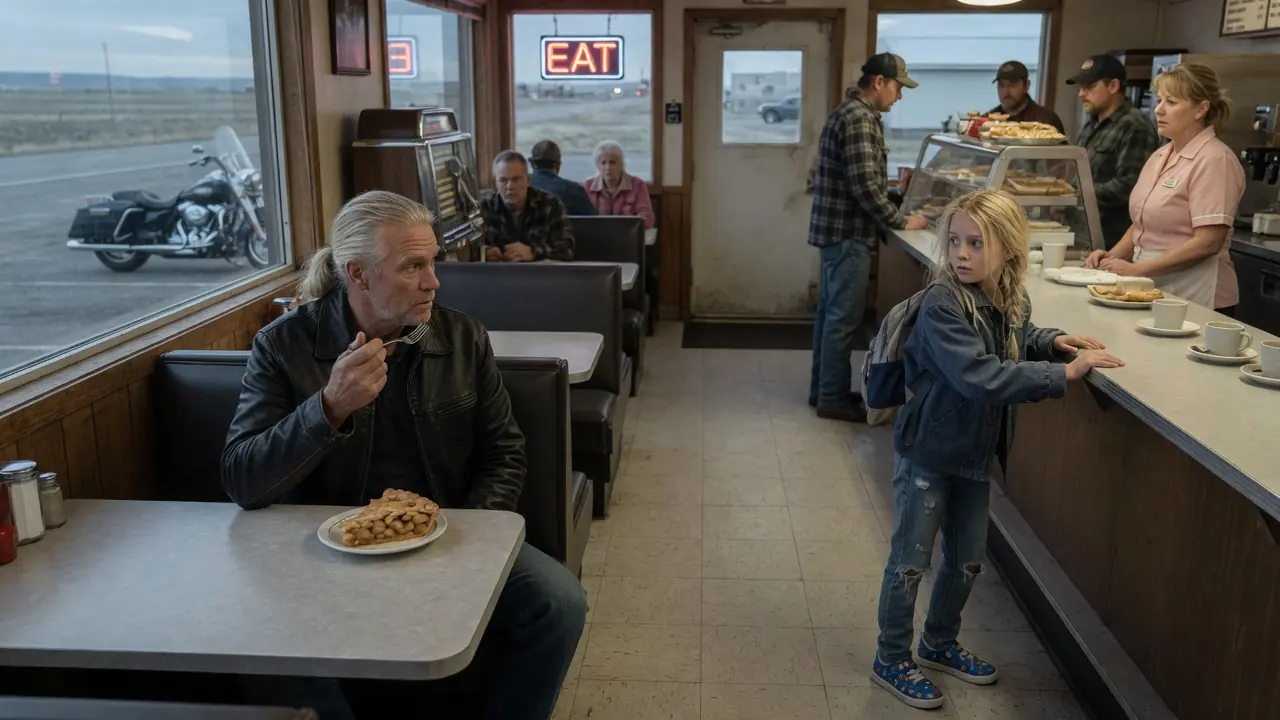
The diner had no name worth remembering. It sat alone on the edge of Route 20 in rural Wyoming, like something the highway had coughed up and forgotten.
A low, flat building with a buzzing neon sign that read “EAT” in letters so faded they were more suggestion than invitation.
The parking lot was cracked asphalt and dried weeds. Two pickup trucks, one rusted sedan, and a motorcycle that didn’t belong to any of them.
A 2019 Harley-Davidson Road King. Matte black. No chrome except for the exhaust pipes, which gleamed like the only honest thing about the man who rode it.
Jack Lawson, though nobody in that diner knew his name yet, took the corner booth without asking.
Back wall. Clear sight line to the front door, the side exit, and both windows.
Old habit. The kind that keeps a man alive when other habits have tried their best to kill him.
He was fifty-three years old and looked it in all the right ways. Broad shoulders carrying weight that wasn’t fat so much as history. A chin like a ledge. Blonde hair gone silver at the temples, pulled back, nothing fancy. Two days of stubble.
Eyes the color of weathered denim. Blue, but worn down, washed out, like they’d seen too much sun and too much darkness, and somewhere along the way had learned to tell the difference between the two without needing to think about it.
His leather jacket was plain black. No patches. No insignia.
He’d earned the right to wear the full colors of the Hells Angels for eleven years, and he’d left without asking anyone’s permission, which was either the bravest thing he’d ever done or the stupidest, depending on who you asked.
He didn’t wear patches anymore. He didn’t need people to know who he was.
The right people already knew.
The waitress, mid-forties, tired but kind, name tag said Donna, came over with a pot of coffee before he’d even settled in.
“Just passing through?” she asked, not suspicious, just making conversation.
Wyoming people did that. They weren’t nosy. They were neighborly. There was a difference.
“Yeah,” Ryder said.
His voice was low, unhurried, the kind of voice that had learned years ago that the less you said, the more people listened.
“Just passing through.”
“Kitchen closes in forty minutes. Daily special’s the meatloaf, but between you and me,” she leaned in slightly, “the apple pie is what you came for. Baked fresh this morning. Earl does it right.”
“Earl the cook?”
“Earl the cook,” she smiled. “Twenty-two years. Man could make pie in his sleep. Probably does.”
Ryder almost smiled back. Almost.
“Pie sounds good. Coffee, too.”
“Coming right up, hon.”
He watched the room while he waited. Force of habit. Reading people the way other men read menus.
Three truckers at the counter, not together, but comfortable with each other the way men become when they eat at the same place every week for years.
An older couple in the far booth, the kind of married where they don’t need to talk anymore, just sit and exist together, which Ryder used to think was boring and now thought sounded like the best thing in the world.
A young mother with a toddler who kept dropping a spoon on purpose and laughing every time she picked it up.
Normal. All of it completely, unremarkably normal.
He exhaled.
Donna came back with coffee and a generous slice of apple pie. Golden brown crust, dusted with cinnamon sugar, still faintly warm.
She set it down with a fork and a small container of vanilla ice cream on the side, unsolicited.
“On the house,” she said. “You look like you should have it. You’ve had a long ride.”
He had.
Three days, nine hundred miles, and a reason he wasn’t going to share with anyone.
“Thank you,” he said, and he meant it.
He picked up the fork.
“Eat all of it.”
“Don’t eat that.”
The scream came from his left, from the counter, three stools down, and it hit the room like a gunshot.
Every head turned.
Ryder’s hand froze. The fork hovered.
His body had already done the math before his brain caught up. Threat assessment. Exit distance. Hands visible. No weapons drawn.
But his eyes landed on the source, and everything recalculated instantly.
A little girl, maybe eight years old, maybe nine. Small and slight, with a long blonde braid that had come half undone and a face that was pale as paper.
She was wearing a blue jacket two sizes too big, jeans with a hole at the knee, and sneakers that had cartoon rockets on them. The kind of shoes a kid picks out herself because she thinks they’re the coolest thing in the world.
She had both hands flat on the counter. Her knuckles were white, and she was staring directly at him.
Not at the pie. Not at Donna. Not at the room.
At him.
The whole diner was holding its breath.
The truckers had half turned on their stools. The older couple was frozen. Even the toddler had stopped dropping the spoon.
The little girl’s eyes were wide and wet. Not crying, not quite, but filled with something that was either pure terror or pure determination, and Ryder couldn’t yet tell which one it was.
“He put something in it,” she said.
Her voice had dropped from the scream to a whisper, but in the dead silence of the diner, it was somehow louder.
“For you.”
Nobody moved.
Ryder set the fork down very slowly.
“Who did?” he said.
His voice was calm, deliberately, carefully calm, the way you speak to a frightened animal or a frightened child, which in his experience amounted to the same thing.
She blinked. Then she glanced toward the kitchen just for a second, just a flicker, and looked back at him.
Ryder was already sliding out of the booth.
“So.”
Donna stepped back without being asked.
Something in the way this man moved, not fast, not threatening, just certain, made people get out of his path without quite knowing why they were doing it.
He walked past the counter, past the little girl, and pushed open the kitchen door.
Earl was a big man, not as big as Ryder, but big enough to think it mattered, with a gray beard and flour on his apron and the particular expression of a man who had just done something he could not undo.
He knew.
The second Ryder walked in, he knew.
His eyes gave it away completely. Not fear exactly, but the specific kind of guilt that floods a face when the thing you did catches up to you before you expected it to.
“Hey, you can’t come back here.”
“What’s in the pie?” Ryder said.
“I don’t know what you’re talking about, buddy.”
“Earl.”
Ryder said it quietly, just the name, but the way he said it, with the full weight of fifty-three years and zero patience behind it, made Earl stop talking and start breathing very carefully.
“I’m going to ask you one more time, and I need you to understand something.”
He stepped closer. Not rushing. Not threatening with his body. Just filling the space the way big men with absolute certainty do.
“I’m not going to hurt you,” Ryder said. “I don’t hurt people who tell the truth. That’s not who I am. But I need the truth right now, and I need it fast.”
Earl stared at him for three long seconds. Then the man’s whole body deflated like something structural had just given way inside him.
“Powdered,” Earl said, his voice barely above a whisper. “It’s powdered. Mixed into the cinnamon. Just enough to…”
He stopped, swallowed.
“They said it’d look natural. Heart attack. Older guy on a motorcycle.”
He stopped again. His eyes went to the floor.
“God, I’m sorry. I’m so sorry. I needed the money. My wife is…”
“How much?”
“Fifteen hundred cash up front.”
Fifteen hundred dollars.
That was what his life was worth to somebody.
Fifteen hundred and a slice of pie.
“Who paid you?”
Earl shook his head.
“I don’t know him, I swear. He came in two days ago, showed me your picture, said you’d come through here, said you always stopped at diners on Route 20.”
He looked up.
“How did he know that?”
Ryder didn’t answer that. He was already thinking three steps ahead.
“Did he give you a name?”
“No, but he paid with a card just once for the coffee he ordered. I wrote it down.”
Earl’s hands were shaking as he pulled a folded napkin from his apron pocket.
“I don’t know why I wrote it down. I think maybe I…”
“You wanted a way out,” Ryder said, not unkindly. “In case your conscience got louder than the money.”
Earl nodded slowly, eyes wet.
“Yeah. Yeah, maybe that’s it.”
Ryder took the napkin.
One name written in shaky ballpoint.
V. Salazar.
His jaw went tight. Just for a second. Just one second where the control slipped and something cold and very old moved through him.
Then it was gone.
Lockdown. Buried.
He folded the napkin and put it in his jacket pocket.
“Call the police,” he told Earl quietly. “Tell them everything. All of it. You understand me? All of it.”
Earl nodded, already reaching for his phone.
Ryder walked back into the diner.
The room had barely moved.
Donna was standing by the counter, arms crossed, watching the kitchen door with the expression of someone deciding whether or not to be afraid.
The truckers were still half turned. The older couple had their hands joined on the table now, like they’d reached for each other without thinking.
The little girl was still on the stool.
She was watching Ryder with the same fixed, direct gaze she’d had before, except now it was different. The terror was still there, but something else had settled in behind it.
Something that looked almost like relief.
Ryder crouched down in front of her so they were eye level.
He’d learned years ago when you’re a big man and you want someone small to trust you, you make yourself small first.
“What’s your name?” he asked.
She hesitated.
“Lily.”
“Okay, Lily. My name’s Jack.”
He watched her face.
“How did you know about the pie?”
She chewed her bottom lip.
“I saw him,” she said. “The man who talked to the cook. I was outside by the window. He was talking to the cook, and he had a little bag, like a sandwich bag, and he was showing him what to put in.”
She paused.
“You waited how long?”
“Two days.”
Ryder stared at her.
“Also, where did you sleep?”
She looked at her sneakers, the ones with the rockets.
“In the shed out back. There’s blankets in there, and Donna left a sandwich by the door last night, but I don’t think she knew I was there.”
From three feet away, Donna made a small, sharp sound that was half gasp and half curse at herself.
Ryder kept his eyes on Lily.
“Why did you wait for me specifically? How did you know it was me?”
And here it was.
Here was the moment where the whole thing tilted.
Lily reached into the front pocket of her oversized jacket and pulled out a photograph.
Small. Worn at the edges. Creased down the middle like it had been folded and unfolded a hundred times.
She held it out to him.
He took it.
It was a photo of him, younger, maybe thirty, thirty-two, standing beside a bike in front of a gas station somewhere warm.
He remembered the jacket. He remembered the bike. He didn’t remember the photo being taken, but he remembered the person who must have taken it.
He could feel it starting somewhere low in his chest, that particular ache that only one thing in the world had ever produced.
“Where did you get this?” he asked.
His voice was still controlled. He was very, very good at controlled.
“My mom,” Lily said. “She gave it to me before I left. She told me to find you.”
The girl’s voice faltered slightly. She straightened.
“She said you’d know what to do.”
“Your mom.”
He turned the photo over.
Nothing on the back.
“What’s her name?”
Lily looked at him with those steady, serious eyes.
“She said to tell you that part last,” the girl said quietly. “She said if I told you right away, you might not listen.”
Ryder sat back on his heels.
A fifty-three-year-old former outlaw with more road behind him than most people could imagine, and a child who had waited two days in a storage shed to save his life was now explaining to him the strategic communication plan her mother had put in place.
He almost laughed.
He didn’t, but it was close.
“Smart woman,” he said.
“Yes,” Lily agreed. “She was.”
Was.
That word landed differently than all the others.
Not is.
Was.
He kept his face very still.
The front door opened.
Two men walked in.
Ryder knew within half a second.
Not locals. Not truckers. Not travelers.
The way they moved, scanning the room before they were even fully through the door, one peeling left, one staying right, covering angles, it was trained. It was deliberate.
And the slight bulge under the left arm of the taller one wasn’t a phone.
They hadn’t spotted him yet. He was still crouched in front of Lily, below their sightline.
He had maybe four seconds before they did.
He stood up slowly, naturally, like a man just finishing a conversation, and turned his body so he was facing the window, not the door.
“Lily,” he said very quietly. “Don’t turn around. Don’t look toward the door. Can you do that?”
She went still.
“Yes.”
“Good. I need you to count to five in your head. Then I need you to walk to the bathroom. It’s at the back on the left. You go straight there. You go inside. You lock the door, and you don’t open it for anyone except me. You say my name back to me.”
“Jack,” she said.
Same tone. Same steadiness.
This kid was something else entirely.
“Good. Start counting.”
He turned.
The taller man had already found him.
Their eyes met across the diner, and in that instant, both men understood the exact shape of the situation was all wrong.
Who knew what. Who was armed. Who was between them and the target.
Ryder moved first. Not toward the door. Not toward the men.
He shifted sideways one long step, putting the counter between himself and the line of sight from the right-hand man, while his left hand closed on the back of a barstool without seeming to reach for it at all.
It was the kind of casual, inevitable movement that comes from thirty years of reading rooms and bodies in the space between intention and action.
“You boys want coffee?” Donna said, because she was the kind of woman who met trouble with routine.
Neither man answered her.
The taller one, close-cropped hair, maybe forty, the kind of lean that comes from discipline rather than genetics, took one step forward and said very quietly, “Mr. Lawson, nobody needs to get hurt here.”
“I agree completely,” Ryder said.
Then he threw the stool through the window.
Not at them.
Through the side window three feet to his left.
The crash of glass was so sudden and loud that every person in the diner flinched, including both men, and in the two seconds of pure instinctive reaction that followed, Ryder was already through the kitchen door.
Earl was still on the phone.
He looked up.
“Back door,” Ryder said. “Now.”
“Where?”
Earl pointed.
Ryder went.
The alley behind the diner was narrow and smelled like grease and old cardboard.
He came out moving fast, one hand already reaching for his keys, calculating the angle back to his bike, the time it would take the two men to recover, cover the diner floor, and clear the kitchen.
He stopped.
Lily was standing outside the bathroom window, which was apparently small enough for an eight-year-old to climb through and large enough for Ryder to feel briefly humbled by the fact that he hadn’t thought of that.
She had her backpack on and her arms crossed, and her expression said, “I told you I could handle it,” without any words being required.
Ryder stared at her for one full second.
“You were supposed to wait inside.”
“The window was open,” she said. “And I’m faster than I look.”
He exhaled hard through his nose.
Then he grabbed her hand. Not rough. Just firm and definite.
And they were moving.
His bike was at the side of the building. He could hear voices through the broken window, the men already in the diner, already pushing through.
Maybe sixty seconds. Maybe less.
He got to the Harley, threw a leg over, and started the engine.
The sound of it was a deep, rolling thunder that the Wyoming wind grabbed and tossed wide.
He looked at Lily.
“You ever been on a motorcycle?”
“No.”
“First time for everything. Get on and hold onto my jacket. Don’t let go. If you let go, I’ll know. You understand?”
“Yes, Jack.”
He still wasn’t used to the way she said his name like she’d been practicing it.
She climbed on. Her small hands gripped the back of his jacket. He felt her weight settle lighter than he expected, lighter than it should have been for the size of what she was carrying.
He pulled out.
Smooth. Controlled. No burning rubber. Nothing that drew attention.
Just a man and a girl pulling onto Route 20, heading west into the late afternoon.
A hundred yards down the road, he checked his mirror.
The two men came out the front door of the diner.
One was on his phone immediately.
The other watched the road.
Ryder kept his speed steady. Legal. Invisible.
They hadn’t gotten the plate. He was almost certain of it.
He drove for fifteen minutes before either of them spoke.
Then Lily said from behind him, “My mom said you were stubborn.”
She wasn’t wrong.
“She also said you were brave, but that you didn’t know it.”
He didn’t have an answer to that, so he drove.
The questions had already started building in the back of his mind. The ones he hadn’t asked yet because there hadn’t been time, and the ones he hadn’t asked yet because he wasn’t sure he was ready for the answers.
Why was she watching him?
Why hadn’t she been afraid?
How long had she been tracking his road, and who helped her plan it?
And underneath all of it, the one that pressed the hardest, the one that had been pressing since the moment she said was instead of is.
What happened to her mother, and why, out of every person in the world, every cop, every relative, every shelter and church and social worker, why did she send this child across hundreds of miles of open country to find him?
He didn’t know yet, but he knew this.
The name on that napkin, Salazar, wasn’t a coincidence.
And the two men in that diner weren’t a coincidence either.
Something had been set in motion. Something larger than a hit on a retired biker. Something with more pieces than he could see yet.
And somewhere out there, someone was sitting very still, watching all those pieces move, waiting for the moment they’d served their purpose.
He gripped the handlebars a little tighter.
Lily’s hands tightened on his jacket at the same moment. Not because she was scared, he thought, but because she felt the shift in him.
The way children sometimes do. The way people do when they’ve been paying close attention for a very long time.
“Jack,” she said over the wind.
“Yeah.”
“Are we safe?”
He thought about lying.
He’d been very good at lying for most of his life. It was a survival skill he’d perfected the way other men perfected pool shots or card games.
But something about the question, the directness of the way she was trusting him enough to even ask, made the lie impossible before it formed.
“Not yet,” he said. “But we will be.”
She didn’t argue with that. She didn’t ask anything else.
She just held on.
And the highway opened up ahead of them, wide and gray and full of everything that was coming.
They drove for forty minutes before Ryder pulled off the highway.
Not because he was tired. Not because he was lost.
He pulled off because the back of his neck had been prickling for the last fifteen miles, and he’d learned a long time ago that when the back of your neck prickles, you stop and you think before the thinking becomes too late.
He cut the engine at a small gas station outside of town, barely large enough to have a name.
Two pumps. A payphone that probably hadn’t worked since 2003. A single light buzzing overhead.
He got off the bike and stood still for a moment, listening to the engine tick as it cooled, listening to the wind, listening to the nothing.
Lily climbed off behind him. She stretched her arms without being dramatic about it, rolled her neck once, and stood beside him like she’d done this a hundred times.
“You’re checking to see if they followed us,” she said.
“Yeah.”
“Did they?”
“Not yet.”
She nodded, filed that away, and said nothing else.
He looked down at her. The light overhead caught her face, the hollows under her eyes, the way her cheeks were slightly sunken, the particular look of a child who hadn’t eaten enough in recent days and was working very hard not to show it.
“When did you last eat?” he asked.
“The sandwich. The one the waitress left.”
“When was that?”
She thought about it.
“Yesterday morning.”
Something moved through his chest.
He didn’t name it.
He walked to the gas station door, went inside, and came back four minutes later with two bottles of water, a ham sandwich wrapped in plastic, a bag of pretzels, and a chocolate bar that he’d added at the last second without quite deciding to.
He handed everything to her.
She took it without making a big deal of it. She opened the sandwich and ate with the focused efficiency of someone who understood that food was fuel and fuel was survival.
He watched her for a moment, then looked back at the road.
“You’re not going to eat?” she asked.
“I’m fine.”
“You haven’t eaten either.”
He glanced at her sideways.
She broke the chocolate bar exactly in half and held one half out to him.
He took it because arguing with her already felt like an exercise in futility, and they’d known each other less than two hours.
They stood there in the buzzing light, a fifty-three-year-old former outlaw biker and an eight-year-old girl who had somehow managed to save his life, eating chocolate in silence.
And for just a moment, the whole world was quiet.
Then Ryder said, “Talk to me, Lily.”
She looked up.
“About your mom, about how you got here, all of it.”
He met her eyes.
“I need to understand what I’m dealing with. Can you do that?”
She chewed, swallowed, took a breath, and started talking.
Her mother’s name, she said, was Emily. Emily Carter.
She was thirty-four years old, would have been thirty-five in March, and she’d lived in Laramie for the last nine years, ever since she moved from Colorado to take a nursing job at a small hospital on the edge of the city.
She liked plants. She grew tomatoes on the fire escape even though the landlord said not to.
She made the best grilled cheese in the world, Lily said, and she said it with the kind of absolute conviction that only children and people who’ve lost things can produce.
She also said it in the past tense.
Every single time.
Ryder listened without interrupting.
Three months ago, Lily continued, things changed. Her mother started getting phone calls she’d take in the other room. Started checking the locks twice before bed when she never used to check them at all. Started keeping a bag packed in the closet that Lily wasn’t supposed to know about, but did, because children always know about the bags in the closet.
“Did she tell you what was wrong?” Ryder asked.
“Not at first. She kept saying it was nothing, that she was just being careful.”
Lily paused.
“But then one night, I woke up, and she was sitting at the kitchen table, and she was crying. And she never cried. Not ever. Not even when she broke her wrist that one time.”
She said this like a broken wrist was the established high-water mark of things worth crying about.
“So I went and sat with her, and she didn’t tell me to go back to bed. She just looked at me for a long time, and then she said, ‘Lily, do you trust me?’”
“What did you say?”
“I said, ‘Yes, obviously.’”
She looked at him like this was the stupidest possible question.
“She was my mom.”
He almost smiled. Didn’t.
“And then what?”
“She told me about you.”
The wind moved across the road. Something loose rattled on the gas station roof.
Ryder kept his face neutral, kept his breathing even, kept everything locked down tight the way he always did when the ground started to shift under him.
“What did she tell you?” he asked.
Lily looked at the half-eaten sandwich in her hand. She was choosing her words carefully. He could see it, the deliberateness of it, the way a child looks when they’ve been given something adult to carry and are determined to carry it right.
“She said she’d known you a long time ago, when she was young. She said you were different than what people said about you. She said…”
She stopped.
“She said you were the only person she’d ever met who she was completely sure would do the right thing when it cost them something.”
The silence after that was the loudest thing Ryder had heard in years.
He turned away from her, put both hands on the side of the bike just for something to hold on to.
Twenty-two years.
He had walked away from Emily Carter twenty-two years ago because he’d been twenty-one kinds of stupid and believed that the life he was living had no room in it for someone clean and good.
He’d believed, with the absolute certainty of a man who has been telling himself a convenient story for so long he’s forgotten it’s a story, that the kindest thing he could do for her was go.
She’d let him.
She’d never called. Never written.
He checked for the first year, the particular masochistic checking of a man who is simultaneously hoping and afraid of hope.
And then he’d stopped because surviving required a certain amount of forward momentum, and you can’t move forward if you keep turning around.
And all that time, all twenty-two years, she’d held onto a photograph.
He breathed out slowly through his nose and turned back around.
“How did she die, Lily?”
The girl looked at him steadily.
“They said it was her heart.”
“What do you say?”
“I say my mom was thirty-four years old, and she ran a 5K last Thanksgiving, and she had her cholesterol checked in October, and the doctor said she was perfect.”
Her jaw was set. Her eyes were dry.
She had already cried for this, he realized. She had already done that part somewhere on the road between Laramie and here, alone.
Now she was on the other side of it, where the grief had been converted into something harder and more functional.
“I say somebody did it to her, and I say she knew they were going to.”
Ryder went very still.
“Why do you think she knew?”
“Because of the letter.”
“What letter?”
Lily set down the sandwich, unzipped her backpack, and reached into the inside pocket, the small one, the one with the zipper that you’d only find if you knew it was there.
She pulled out an envelope, white, sealed, his name written on the front in handwriting he didn’t recognize, but somehow still felt like recognition, the particular shock of seeing something from a person you thought was only a memory.
Jack Lawson.
No address.
Just his name.
“She wrote it three weeks before she died,” Lily said. “She made me promise not to give it to anyone except you. Not a police officer. Not a neighbor. You.”
She held it out.
“She was very specific.”
He looked at the envelope for a moment without taking it.
Then he took it.
He didn’t open it. Not yet.
He wasn’t ready yet, and he’d learned that there are moments in life where you only get one chance to receive something. And if you receive it too quickly, too carelessly, you lose part of what it contains.
He folded the envelope once and put it inside his jacket against his chest. Not in the pocket. Against the skin.
Lily watched him do it without comment.
“Okay,” he said. His voice was rougher than usual. “Okay.”
He cleared his throat.
“You said she sent you to find me specifically. She give you anything else? Instructions? A route?”
“She had a map, a real one. Paper, not a phone.”
Lily reached into the backpack again and produced a folded road map of Wyoming with a line drawn on it in red pen.
Route 20 was highlighted. Several diner stops were circled. One of them was the diner they’d just fled.
“She said you always drove Route 20 when you came through Wyoming. She said you had a thing about diners.”
“How did she know my route?”
Lily hesitated.
That hesitation, that half-second pause, told him more than the answer was going to.
“She said someone told her,” Lily said carefully. “Someone who’d been watching you.”
And that was when the shape of it changed.
He’d been thinking about this as a hit job. Professional. Calculated. Someone from his past who wanted him dead and had paid Earl the cook fifteen hundred dollars to make it happen quietly.
Victor Salazar’s name was on the napkin, and Salazar was a name he knew, and that should have been explanation enough.
But Emily Carter had known his route before the assassination attempt. She’d sent her daughter with a pre-drawn map. She’d been watching him, or someone had been watching him on her behalf before she died.
Which meant one of two things.
Either Emily had been in contact with the people who wanted him dead, or the people who wanted him dead were the same people who had killed Emily Carter.
Both of those possibilities opened into something much darker than a professional hit.
Both of them suggested something organized, long-term, patient.
He folded the map and put it in his jacket beside the letter.
“Did your mother ever mention a name?” he said. “A man named Salazar or Cain?”
Lily thought.
“No, I… Then wait. She mentioned someone, but not like that. She mentioned someone when she thought I was asleep.”
She frowned, working at the memory.
“She was on the phone. She said, ‘He has no idea how deep this goes.’ And then she said a name.”
She paused.
“Marcus.”
The name landed in his stomach like a stone into deep water.
Marcus Cain.
He’d known Cain for fifteen years. Known him the way you know a man you’ve worked beside long enough to understand exactly where his loyalties end and his appetite begins.
Cain had been the treasurer for a chapter up in Montana.
The kind of man who smiled with his whole face and kept a knife behind the smile. The kind of man who called you brother and meant it, right up until the moment it cost him something.
Three years ago, Ryder had found discrepancies.
Not minor ones. Not the kind of bookkeeping error you let slide and forget about.
Cain had been skimming from the funds that went to families of members who died. Men who’d lived and died by a code whose widows and children were supposed to be taken care of by that code.
And Marcus Cain had been taking from those families for years.
Ryder had exposed him.
Not to law enforcement. That wasn’t how it worked.
He’d brought it to the chapter leadership, laid the numbers out, and let the weight of what Cain had done do the work.
Cain had walked away with his life, which was more than he deserved and more than most people in that world would have allowed.
He’d also walked away promising nothing.
No threats. No posturing.
Just silence.
The calm, deliberate silence of a man who is not done, but who is willing to wait.
Apparently, the wait was over.
“Lily,” Ryder said, “I need to make a call. Stay right here. Don’t go anywhere. Don’t talk to anyone.”
He looked at her hard.
“I mean it.”
“I know,” she said. “I’ll be right here.”
He walked to the corner of the lot, as far from the light as the space allowed, and pulled out his phone.
Cheap flip phone. Burner. Changed every six weeks.
Another habit.
He dialed from memory.
Three rings.
“Yeah.”
The voice on the other end was gravel and cigarettes. The voice of a man named Dex, who had ridden with the Angels for twelve years before a knee injury and a very persuasive wife had retired him to a garage in Casper.
“It’s Ryder.”
A pause.
“It’s been a minute.”
“I need something.”
“You always need something when you call from an unknown number at 8:47 a.m.”
A pause. The sound of movement.
“8:47 at night.”
“Victor Salazar. Where is he?”
A longer pause. Different quality. Not hesitation, but the careful quiet of someone deciding how much they know and how much they’re going to say.
“That name,” Dex said slowly, “is not a name I expected to hear come out of your mouth.”
“Where is he, Dex?”
“Last I heard, Salazar was working cleanup for Cain. That was about eight months ago. Why are you…”
Another pause.
Then flatly, “Someone tried to take you out.”
“Pie at a diner off Route 20.”
Dex exhaled long and hard.
“Sloppy.”
“Intentionally. It was supposed to look natural.”
Ryder kept his voice low, even.
“There were also two men. Professional. Coordinated. They came in right after. The pie was a backup. Or I was meant to survive the pie long enough to get into the open. Either way, it was layered. This wasn’t impulsive.”
He watched the road. Nothing moving.
“And there’s a girl.”
Silence.
“A child,” Ryder said. “Eight years old. Her mother sent her to find me before she died.”
He paused.
“Emily Carter. Laramie. They’re saying heart failure.”
The silence from Dex had a new texture now.
It was the silence of a man who had just understood something that he wished he hadn’t.
“Ryder.” His voice had dropped. “I need you to listen to me very carefully. Are you listening?”
“I’m listening.”
“Salazar doesn’t work freelance. He hasn’t for years. He’s Cain’s man. Completely.”
Dex paused.
“And Cain has been very, very quiet for the last eighteen months. The kind of quiet that means he’s been building something.”
“Building what?”
“I don’t know exactly, but I know he’s been collecting names. People who could hurt him. People who know things. And Ryder…”
Another pause.
“He’s not just trying to eliminate a threat. You understand what I’m saying? This isn’t just about you.”
“Emily Carter,” Ryder said.
It wasn’t a question.
“If she knew something, if she had something, and if she tried to use it, they used the same method. Made it look natural.”
His jaw was tight enough to ache.
“She was thirty-four years old and healthy, and they killed her, and they made it look like her heart.”
“My God.”
Dex said it quietly, with genuine weight behind it.
“How many others?”
“I don’t know. I genuinely don’t know. But if I had to guess…”
He stopped himself.
“Then you need to get somewhere safe. Not a motel. Not anywhere you’d normally go. You need to disappear for a day, two days, until you figure out how much you’re dealing with.”
“I’ve got a child with me.”
“I know you just said that.”
“I mean she makes disappearing complicated.”
“Does she have anyone? Family? Someone who can…”
“She was sent to me for a reason,” Ryder said. “Which means she’s safer with me than she is anywhere else right now, which I am choosing not to think too hard about.”
From across the lot, he could see Lily sitting on the bike’s foot peg, eating the last of the pretzels.
She had her backpack in her lap. She was watching the road with the same careful attention he’d been trained to give roads, checking for headlights, tracking movement.
“Eight years old.”
He pulled his focus back.
“Dex, Cain’s operation. Is there paper on it? Anything that could be leveraged?”
A long pause.
“There might be,” Dex said. “But getting to it would mean getting closer than you want to be right now.”
“I’m already closer than I want to be.”
He watched the road.
“I’m going to need two days. Can you keep your ears open?”
“I’ve been keeping my ears open for thirty years. Don’t insult me.”
A beat.
“Watch the girl, Ryder.”
“I know.”
“No, I mean…”
Dex’s voice dropped to something different. Something that made Ryder stop moving for a second.
“If Cain knows she was sent to find you, if he’s been watching this play out, she’s not just a witness anymore. She’s leverage.”
He hadn’t let himself think that yet.
He let himself think it now, felt the full weight of it drop into the pit of his stomach.
And then he set it aside because letting it sit there would slow him down.
“I hear you,” he said. “Call me from a different number.”
He ended the call and stood in the dark for three seconds, breathing through the calculation.
Then he walked back to the bike.
Lily looked up.
“Bad news?”
“Working on it.”
“That means yes.”
She slid off the foot peg and stood up, backpack on.
“Ready.”
He hadn’t asked her to be ready.
She just was.
“What do we do?”
He looked at her, the small, serious, brave, exhausting child who had eaten two days’ worth of concern and still managed to save his life today.
And he felt something shift behind his ribs.
Not softening. Nothing so simple as that.
More like the rearrangement of priorities. Like the moment when you realize the map you’ve been using is for the wrong territory.
“We drive,” he said. “And while we drive, you’re going to tell me everything. Every single thing your mother told you. Every name she mentioned. Every phone call you heard. Everything.”
He looked at her steadily.
“Even the things you think don’t matter. Especially those. Okay?”
She looked back at him with the same level steadiness.
“Can I ask you something first?”
“Yeah.”
“The letter.”
She glanced at his jacket where it was.
“Did she…”
She stopped. Tried again.
“Was she important to you a long time ago?”
He stood there in the buzzing light for a moment.
“Yeah,” he said finally. “She was.”
Lily nodded once.
She didn’t ask anything else.
She climbed back on the bike, repositioned her hands on his jacket, and held on.
He started the engine.
And somewhere out ahead of them in the dark, in the distance, the thing that Emily Carter had known about, the thing she had died for knowing, was still waiting to be found.
They rode into the night.
They rode for an hour before Lily spoke again.
Not because she had nothing to say. Ryder was already learning that Lily Carter always had something to say.
But because she was organizing it first. He could feel it in the slight tension in her hands on his jacket. The particular quality of her silence. The way she was working through something the same way her mother probably had.
Methodically. Without rushing.
When she finally spoke, she spoke directly into the wind and trusted it to carry her voice back to him.
“Her name was Claire,” Lily said. “She was my mom’s friend. She worked at the same hospital. She’s the one who started it.”
“Started what?”
“The thing they found. The records.”
He eased back on the throttle slightly. Not slowing down enough to matter. Just enough to hear better.
“Keep going.”
“Mom said Claire found something wrong in the billing system. Numbers that didn’t line up. Money going places it wasn’t supposed to go.”
She paused.
“Claire thought it was a mistake at first. She brought it to the hospital administrator. And then two weeks later, Claire quit. Except Mom said Claire didn’t quit. She was pushed out. She moved to Nebraska. She sold her apartment in three days, and she moved to Nebraska, and she stopped answering her phone.”
Another pause.
“Mom said that’s when she started to understand that it wasn’t a mistake.”
Ryder turned this over carefully.
A hospital in Laramie. Billing irregularities. A woman who found something and disappeared to Nebraska within a week.
The kind of quiet, efficient erasure that takes organization to pull off. Not the organization of a hospital administrator covering petty fraud, but something with more muscle behind it.
Marcus Cain had spent his life in organizations that understood muscle.
“Did your mother copy anything?” he asked. “Documents, records.”
“Yes,” Lily said. “That’s why they killed her.”
She said it flat and certain, the way children sometimes deliver the most devastating truths without the cushioning that adults wrap around terrible things because they’ve learned to fear them.
Lily had already moved past the fear of the truth.
She was living inside it now, navigating by it.
“Where are the copies?” he asked.
“I don’t know exactly. She hid them. She told me there was a place and that you’d know it when you read the letter.”
She tightened her grip slightly.
“She said you were the only person she trusted to know what to do with them.”
The letter, still folded against his chest, still unopened.
He’d been avoiding it the way you avoid the last page of something that matters. Not because you don’t want to know, but because knowing means it’s real.
He pulled off at the first motel he’d seen in thirty miles.
A small independent place, the kind that takes cash and doesn’t ask questions, the kind that has a vending machine in the hall and bedspreads in a color that time has rendered unidentifiable.
He paid for one room, two beds, cash. The man at the desk barely looked up.
He locked the door, checked the window, checked the lock again, and moved the chair against the door.
Not because it would stop anyone serious, but because it would give him a second of warning, and a second was sometimes everything.
Lily sat on the edge of the far bed, backpack in her lap, and watched him work through the room without saying anything.
Then she said, “Are you going to read it now?”
He sat down on the other bed, reached inside his jacket, and pulled out the envelope.
His name in her handwriting.
Jack Lawson.
The letters were careful. She’d written it slowly, deliberately, like she wanted to get it right.
He opened it.
The letter was two pages, handwritten on both sides of each page, the handwriting neat at the top and gradually tightening as it went.
The handwriting of someone who had a lot to say and was running out of space and time simultaneously.
He read it once fast.
Then he went back to the beginning and read it again slowly this time.
Lily watched his face. She didn’t ask.
When he finished, he folded the pages, put them back in the envelope, and sat very still for a moment.
Emily Carter had been running her own investigation for six months before she died.
She hadn’t gone to the police for reasons the letter explained clearly, with the specific detail of someone who had done the research.
The irregularities in the hospital billing system were connected to a larger money laundering network.
A network that had, over the course of four years, processed somewhere in the vicinity of eleven million dollars through medical billing codes, insurance claims, and dummy supplier contracts.
A network with connections to at least two law enforcement officers in Laramie, which was why she hadn’t gone to the police.
The name at the center of it: Marcus Cain.
Not directly. Never directly. Cain was too careful for that.
But through three shell companies, two of which Emily had traced back to a holding company registered in Nevada that listed a familiar name as its registered agent.
She had everything.
Names. Account numbers. Document trails.
She’d copied it all, and she’d hidden it. Not at her apartment. Not at the hospital. Not anywhere obvious.
She’d hidden it somewhere that required knowing both her and Ryder to find. Somewhere she’d referenced in the letter with coordinates and a description that only meant something if you knew the specific summer she was referring to.
And Ryder knew exactly what summer she meant because he’d been there.
He looked up.
“She built a case,” he told Lily. His voice was steady. “A real one. Everything Cain needed to go away for a very long time.”
Lily’s eyes were fixed on his face.
“Did she say where she put it?”
“Yeah.”
He paused.
“Colorado. There’s a place she found when she was nineteen, before I knew her.”
He folded the letter back into his jacket.
“I know it because she took me there once, the summer before I left.”
He stopped.
“She said it was the only place that ever felt completely hers. Completely safe.”
“She hid the evidence there,” Lily said.
“Yes.”
Lily was quiet for a moment.
“Then she thought about this for a long time. All of it. She planned every piece.”
“She did.”
“She knew she wasn’t going to make it.”
It wasn’t a question.
Her voice was very controlled.
She knew before she died that they were going to get to her, and she still put everything in place first.
“Yeah,” Ryder said. “That’s exactly what she did.”
Lily looked at the middle distance for a moment.
When she looked back at him, her eyes were wet, but her jaw was set, and her expression was the most adult thing he’d seen on a child’s face in his entire life.
“She loved me,” Lily said. “She loved me so much that she spent her last months making sure I’d be okay after.”
A breath.
“Not trying to survive. Trying to make sure I’d be okay.”
“Yes,” he said.
He didn’t look away from her.
“Okay.”
She wiped her eyes with the back of her hand. Once. Efficient. Done.
“Then we go to Colorado.”
“We go to Colorado,” he confirmed.
She lay down on the bed without another word, backpack still on one arm, sneakers still on, and was asleep in under four minutes with the completeness that only children can achieve, that total surrender to unconsciousness, as if sleep is a country they can enter instantly, no passport required.
Ryder sat in the dark and did not sleep.
He was thinking about Colorado.
He was thinking about the two men from the diner and whether they had a plate now, and whether Dex’s network was moving fast enough to matter.
He was thinking about Marcus Cain sitting somewhere comfortable, patient, certain that the pieces were all going the right way.
And he was thinking about Emily Carter.
Thirty-four years old, running on borrowed time and fully aware of it, making every minute count in the most practical and heartbreaking way possible.
He thought about the last time he’d seen her face, in person, not in a photograph. The way she looked at him when he said he was leaving. Not angry. Not devastated. Just very still, very clear, the way a person looks when they have already understood something before you finish saying it.
He told himself for twenty-two years that leaving her was the right call, that he was protecting her from the version of himself that existed then.
He hadn’t protected her at all.
He pressed the heels of his hands into his eyes, breathed, and let the guilt be there without letting it move into the driver’s seat, because guilt in the driver’s seat gets people killed, and he needed to stay sharp.
His phone buzzed.
Dex.
Text message.
They have your plate. Cain’s people found it from a contact at a state trooper’s office. Told you he had reach. Change vehicles. Now.
He stared at the message for three seconds.
Then he stood up, put on his jacket, and walked out to the parking lot.
The motel had eight cars in it. He stood and looked at them, not planning to steal one, not yet, not with a child involved, but running contingencies the way his brain always ran contingencies.
And then he went back inside, sat down, picked up the phone again, and called the only other person he could think of.
Three rings.
A woman’s voice, low and careful.
“Yeah.”
“Rita, it’s Ryder.”
A pause.
Rita Voss had been married to a man named Bobby Voss, who’d ridden with the Angels for nine years before dying in an accident outside Cheyenne that might or might not have been an accident.
She’d never asked Ryder to find out which one it was.
She just kept living, fierce and practical, in the small house outside Rawlins that Bobby had bought when they were young and hopeful.
“You sound like trouble,” she said.
“I need a favor.”
“You always need a favor.”
But her voice wasn’t hard.
“What kind?”
“I need a vehicle. Something untraceable. Not hot, not stolen, just something not connected to me.”
A pause.
“I’ve got an old truck in the barn. Belongs to my cousin. He left it here two summers ago, hasn’t asked for it back. Plates are current. He registered it under his wife’s maiden name.”
A pause.
“You want to tell me why?”
“Not over the phone.”
“Then you want to tell me if there’s a child involved.”
He stopped.
“Someone told you,” he said.
“Nobody told me anything. But you said something untraceable, which means you’re running. And Ryder, I have known you for fifteen years, and I have never once heard you ask for something untraceable while running. You’ve always run on your own.”
Her voice dropped.
“So if you’re not running on your own, I want to know who you’ve got with you.”
He exhaled.
“Eight years old. Her name is Lily. Her mother sent her to me before she died.”
Rita was quiet for a long moment.
“Then get here by morning.”
He didn’t ask how she knew he was close enough for that.
Rita always knew distances the way certain women who’ve spent their lives waiting for men to come home develop a particular sense for proximity.
“Thank you,” he said.
“Don’t thank me. Just get the little girl somewhere safe.”
She paused.
“And Ryder, be careful. Cain’s been making calls. Bobby’s old friends have been getting questions about you, about where you travel, where you stop.”
Her voice got careful.
“This is bigger than a grudge. You understand what I’m saying? This isn’t just about you.”
“I know,” he said. “Emily Carter found out how big.”
Another pause, longer this time.
“Is she gone?”
“Gone. Three weeks ago.”
He heard Rita exhale.
“God rest her. Get here, Ryder. Get here safe.”
He hung up and looked at the door to the room.
Through the thin wall, he could hear nothing.
Lily was sleeping. The deep sleep of pure exhaustion.
And he stood in the cold for another minute, watching the road, watching the dark, watching the specific quality of the night that usually told him whether something was moving in it.
Nothing moving. Not yet.
He went back inside, sat in the chair by the door, and was prepared to stay awake until morning.
He made it about ninety minutes before his body made a different decision, and he dropped into the light, watchful half-sleep of a man who has spent enough years in dangerous places to rest without ever fully going under.
The part of his brain that tracked exits and sounds and the subtle wrongness of things that don’t belong stayed running the whole time.
At 3:47 a.m., it fired.
A sound. Parking lot.
Not a car. Something lighter.
Footsteps careful and deliberate. The kind that were trying very hard to be nothing.
Ryder was on his feet before his eyes fully opened.
He crossed the room in two steps, checked the window at an angle, never straight on, never silhouetting yourself, and saw him.
One man standing by the motorcycle, looking at the plate. Phone in hand. Already dialing.
Not moving to enter. Just confirming.
A spotter.
Which meant there was someone else receiving that call.
Which meant he had, at best, fifteen minutes.
He turned.
“Lily.”
Firm. Clear. No urgency yet. Not because there wasn’t urgency, but because waking a child in panic burns time you don’t have.
“Lily, wake up. We need to go. Right now.”
She sat up immediately.
No groggy questions. No disorientation.
Her eyes were clear in under two seconds.
“How many?”
He almost said one, and then stopped himself because she’d earned the real answer.
“One outside. More coming. We have maybe fifteen minutes.”
She was standing, backpack on, sneakers tied. He didn’t even see her tie them before the sentence was finished.
“Out the bathroom window?” she asked.
He looked at her.
“I know,” she said. “I did it at the diner. It works.”
He went to the bathroom, checked the window. Small but manageable. For her immediately, for him with effort.
He went first this time, dropped to the ground, turned back, and she came through headfirst with practiced efficiency.
They moved along the back of the motel, away from the parking lot, away from the spotter.
The landscape was open. Open in the way only Wyoming is open, where there’s nothing between you and the horizon except cold air and the dark.
No bike.
They couldn’t take the bike.
The spotter was standing on the plate, and even if they got to it, the sound would announce them and the plate would end them.
He took her hand, and they walked, fast and quiet, away from the road, parallel to it, using the dark the way you use cover when cover is all you have.
She matched his pace without complaint.
Her hand in his was small, and her grip was solid.
They walked for twenty minutes.
At some point behind them, he could hear the sound of a vehicle pulling into the motel lot, moving fast.
A door. Voices too far to make out words, but the urgency was audible even at a distance.
He kept walking.
By the time the first gray light was starting to separate the sky from the ground, they were two and a half miles from the motel, and his phone was ringing.
Unknown number.
He answered it.
“Ryder.”
Not Dex. Not Rita.
A voice he placed after half a second with the particular unpleasantness of remembering something you’d been glad to forget.
“I think it’s time we talked.”
The voice of Marcus Cain.
Ryder stopped walking.
Lily looked up at him, saw his face go very still.
“Funny,” Ryder said, keeping his voice completely level. “I was thinking the same thing.”
“You’ve got something that belongs to me,” Cain said. “Or more accurately, you’ve got someone who has something that belongs to me. You understand the distinction?”
“I understand you think there’s a distinction.”
“I’m a reasonable man, Ryder. I always have been. You know that.”
“I know you rob dead men’s families and call it accounting. I know what kind of reasonable you are.”
A pause.
“The girl doesn’t need to be part of this. She’s a child. Whatever her mother told her, she doesn’t understand the full picture. You give me what Emily took, and this ends. Clean. The girl goes to a family services office. She gets placed somewhere good. She grows up fine.”
A pause.
“Nobody else has to die.”
The word nobody landed with deliberate weight.
“That an implied threat or an explicit one?” Ryder said.
“It’s an invitation to be smart for once instead of righteous.”
Cain’s voice had that particular texture of a man who believes he is offering something generous.
“You were always too attached to the idea of doing the right thing. It cost you. It’s going to cost you more.”
“Marcus,” Ryder said it slowly. “Listen to me very carefully. The woman you killed, she was smarter than you. She planned for exactly this conversation. You don’t have what you think you have, and I don’t have what you think I have, and the things you actually need to be worried about are already in motion.”
He paused.
“You should look into your Nevada holding company. I think you’ll find it’s had some unexpected interest.”
The silence on the other end was a different quality now.
“You’re bluffing,” Cain said, but there was something underneath that. Not quite uncertainty, but its first cousin.
“Maybe,” Ryder said. “You want to find out?”
He ended the call.
Lily was watching him.
“Was that him?”
“Yes.”
“What did he want?”
“Same thing he’s always wanted. He wants the problem to go away quietly.”
Ryder looked at the sky. Light growing slow but definite.
“He’s not going to get that.”
“What do we do now?”
He thought about Rita’s truck waiting in a barn outside Rawlins.
He thought about Colorado, about a place Emily Carter had called hers, where she’d hidden everything she’d spent her last months building.
He thought about Cain on the other end of a phone, recalibrating. Not retreating, not yet, but weighing things the way dangerous men weigh things when the math shifts unexpectedly.
He thought about Lily, eight years old, hand still in his grip, still solid.
“We keep moving,” he said. “And we get to Colorado before he figures out that’s where we’re going.”
She nodded. No hesitation.
“Okay.”
They walked toward the rising light, the two of them, and behind them, the sound of Cain’s world beginning very slowly, very surely to crack.
Rita Voss met them at the end of her gravel driveway with a thermos of coffee and the expression of a woman who had seen enough hard mornings to stop being surprised by them.
She was sixty-one years old, with silver hair cut short and practical. And she looked at Ryder the way women who’ve buried husbands too early look at men who are still walking around, with a mixture of relief and the particular understanding that walking around doesn’t mean safe.
Then she looked at Lily.
Something in Rita’s face shifted.
Not dramatically. Rita was not a dramatic woman.
But something behind her eyes moved the way the surface of water moves when something stirs beneath it.
“Come inside,” she said.
Just that.
The kitchen smelled like coffee and biscuits and the particular warmth of a house that has been lived in by a person who cares about living in it.
Rita put a plate in front of Lily without asking, and Lily ate with the same focused efficiency Ryder had already come to recognize.
Not grateful. Not ungrateful. Just practical. Just fuel.
And Rita watched her with eyes that were doing a great deal of quiet calculating.
“Truck’s in the barn,” Rita told Ryder. “Keys are in it. Tank’s full.”
She poured coffee into two mugs, pushed one across the table toward him.
“Cousin’s name is Dale Ferris. His wife’s maiden name is Moorcroft. That’s what’s on the registration. You need to know that if you get stopped.”
“I won’t get stopped.”
“You said that last time when you called me from a county jail in Utah.”
“That was different.”
“It’s always different.”
She sat down, looked at him directly.
“Tell me what you’re walking into.”
He told her.
Not everything. Not the letter. Not Colorado. Not the specific shape of what Emily had built.
But enough.
Cain’s name. The network. The two officers in Laramie who were in Cain’s pocket, which meant the local law was not an option.
The evidence that existed, that was reachable, that could end this if they could get to it first.
Rita listened without interrupting, which was one of the things he had always respected most about her.
She had the quality, rare in anyone and rarer still in people who had been through what she’d been through, of listening to the whole thing before deciding what she thought about it.
When he finished, she was quiet for a moment.
Then she looked at Lily.
“Your mama was a brave woman.”
Lily met her gaze.
“I know.”
“Did she know it was going to go the way it went?”
“Yes,” Lily said. “And she planned for it.”
Rita nodded slowly. She looked back at Ryder.
“The men Cain sent, how close are they?”
“Close enough that I want to be in Colorado before noon.”
“Then stop drinking that coffee and go.”
She stood, picked up Lily’s empty plate, put it in the sink, and turned back.
“Ryder.”
Her voice dropped just slightly.
“Whatever’s in Colorado, once you have it, you need someone outside the chain to receive it. Someone Cain can’t reach.”
“I know. I’m working on that.”
“Work faster.”
She paused.
“Bobby trusted a man named Garrett. Federal level. The kind who doesn’t share his case files with local law.”
She pulled a card from the kitchen drawer. Just a plain card, handwritten number on the back.
“Bobby kept this for the same reason Emily kept her files. In case the day came.”
She set it on the table.
“The day came.”
He picked up the card, looked at it, and put it in his jacket.
“You should have given this to someone years ago,” he said.
“I should have done a lot of things years ago.”
She looked at him steadily.
“So should you.”
He didn’t argue with that.
He stood, pushed the chair in, and looked at Lily.
“You ready?”
She was already standing, backpack on.
She looked at Rita.
“Thank you for breakfast.”
“Thank you for saving this stubborn man’s life,” Rita said.
And her voice on that sentence was gentle in a way that made the air in the kitchen feel different for a moment. Softer. More breakable.
“Your mama raised you right.”
Lily’s jaw tightened, held.
“I know,” she said again. “I’m going to make sure it counted.”
Rita walked them to the barn.
She stood in the doorway and watched them back the truck out.
A ten-year-old Ford F-150, dark blue, unremarkable, the kind of truck that is invisible on Wyoming roads because it is indistinguishable from the other ten thousand trucks on Wyoming roads.
Ryder pulled to the end of the drive, stopped, and looked back.
Rita raised one hand. He raised his.
Then they were on the road south toward Colorado, and she was behind them getting smaller, and he didn’t look back again because looking back had never once helped him.
Lily had the road map open on her knees.
Emily’s red pen line ended at the Wyoming-Colorado border.
She hadn’t marked the destination in Colorado, which made sense, which was exactly the kind of careful thinking her mother had applied to every piece of this.
If someone found the map, they’d know the direction, but not the place.
The place was in the letter, and only Ryder knew what it meant.
“Tell me more about the month before she died,” Ryder said.
They’d been driving for twenty minutes, highway smooth, traffic light.
“What was her routine? Did anything change?”
Lily thought.
“She stopped going to her book club. She said she was tired, but she never got tired. She started walking Lily, the neighbor’s dog, I mean, every morning at 6:00, which she never did before. And she started sending me to school early. Like, way early. Twenty minutes before I needed to be there.”
Ryder processed that.
The book club, a crowded place, unpredictable timing, hard to control. She stopped going.
The morning walks, consistent time, consistent route. The kind of deliberate pattern that lets you notice when something in the pattern changes. When something follows.
And sending Lily to school early, getting her out of the house before whatever Emily was working on started.
She had been running surveillance on herself, checking for a tail, living inside her own investigation.
“She knew they were watching her apartment,” Ryder said. “That’s why she kept things off-site.”
“She called someone every Tuesday at exactly 10:15 from a gas station payphone,” Lily said. “I know because she took me once. She said she needed to make a call and her phone was broken. But her phone wasn’t broken.”
She paused.
“She was calling someone she didn’t want tracked.”
“Did you hear who?”
“No. She took me to the snack machine while she called.”
A pause.
“She gave me three dollars for chips.”
He almost smiled again.
Emily Carter, running a one-woman counter-surveillance operation, bribing her daughter with snack money.
“She was extraordinary,” he said.
And he said it quietly, mostly to himself.
“She was my mom,” Lily said.
As if that was the more important fact. As if the extraordinary part was secondary.
He let that sit.
An hour south of Rawlins, his new burner phone buzzed.
Dex again.
Text came.
Moved two more people into Wyoming overnight. Also, and this is important, there’s a third party. Not Cain’s people. Feds. Someone opened a wire on Cain six weeks ago. You are not alone in this fight. Do not reach out to local law.
He read it twice.
Federal wire on Cain, six weeks ago, which meant before Emily died, someone in the federal system had already started building toward Cain from the other direction.
Emily’s death hadn’t gone unnoticed at the federal level, or maybe it had drawn them in, made the thing concrete enough to act on.
Rita’s card in his jacket. The name Garrett. Bobby Voss keeping that number for the day it was needed.
The day had come.
“Lily,” he said, “your mother’s Tuesday calls, do you know how long she’d been making them?”
“Since before Christmas. Maybe since November.”
November.
Six weeks before a federal wire went active on Cain.
He didn’t believe in coincidences. Hadn’t believed in them since the late nineties, when believing in coincidences had nearly gotten him killed three separate times.
The Tuesday calls. The federal investigation. The timing.
These were connected.
Emily Carter hadn’t just been running a solo investigation. She’d been feeding information to someone.
Someone federal. Someone careful. Someone who had been building a case in parallel.
The woman had been running an intelligence operation out of a gas station payphone in Laramie, Wyoming, and nobody had known.
His phone buzzed again.
Different number this time.
Rita.
One text.
Black SUV came past my property twenty minutes after you left. Slow pass. They didn’t stop. Go fast.
He went fast.
The Colorado border came up in another hour, the landscape shifting almost imperceptibly. Something in the quality of the light. The angle of the hills.
Lily had fallen into a half doze in the passenger seat, head against the window, map still loosely held in both hands.
He let her sleep.
She’d been running on reserves for days, and the reserves were not unlimited, even in kids who seemed like they might be.
He was running calculations constantly.
Colorado. The place Emily had described in the letter. A specific location he hadn’t thought about in over two decades. A place he hadn’t needed to think about because he’d sealed off that whole section of his life and left it undisturbed.
A climbing spot. Rocky and remote. She’d found it as a teenager, called it hers.
A shelf of rock with a small overhang and a cavity in the wall behind it, where she used to leave notes when she was eighteen and thought being the kind of person who left notes in rock walls was romantic.
Where a woman, thirty-four years old and running out of time, had put everything that mattered.
He had maybe four hours before Cain’s people triangulated the direction.
Maybe less if Cain was sharper than he’d given him credit for.
He needed to be in, out, and moving toward something final before that window closed.
He pulled onto a secondary road and stopped.
Lily stirred.
“We there?” she asked.
“Almost. I need to make a call first.”
He picked up the card Rita had given him and looked at the number on the back.
“Lily, I want to be straight with you about what I’m about to call on.”
She turned to face him fully.
She did this, gave her full attention completely, the way children do when they haven’t yet learned the adult habit of half listening.
“There’s a federal agent,” he said. “Someone who’s been building a case against Cain independently. I think your mother was feeding him information. If I call this number and I’m right, then what your mother put in that rock becomes evidence in a federal case. It becomes untouchable. Cain goes away, not because I handled it, but because the law handles it the right way.”
He paused.
“But it also means the next twenty-four hours are going to move fast and get complicated.”
“And if you’re wrong,” she said, “about the agent?”
“Then I’ve given our location to someone connected to Cain, and we have about forty minutes.”
She considered this with a seriousness that was almost uncomfortable to witness.
“Then, is the card from someone you trust?”
“From someone Bobby Voss trusted. And Bobby Voss was a man whose judgment I respected.”
“Was Bobby Rita’s husband?”
“Yes.”
“She misses him,” Lily said. “I could see it. The way she looked at you like she was glad you were alive. People look like that when they’ve lost someone and they keep waiting to lose someone else.”
She paused.
“I look like that now, I think.”
He held the card and made the call.
Two rings.
A man’s voice, measured and alert in the way of someone accustomed to calls from unknown numbers at all hours.
“Garrett.”
“My name is Jack Lawson. I was given this number by Rita Voss. Her husband was Bobby. You know the name?”
A pause, short.
“I know the name.”
“Then you know I wouldn’t be calling unless it was serious.”
“Mr. Lawson,” a very brief pause, “I know your name also. I’ve been hoping someone would call this number for about six weeks.”
The air in the truck changed.
“Emily Carter,” Ryder said.
“Emily Carter,” Garrett confirmed. “She was the bravest source I’ve worked in twenty years. She contacted us in November. We were building toward a filing when…”
He stopped.
“When she died, we lost contact. We didn’t know if she’d been able to get her documentation to safety or if Cain had found it.”
“She got it to safety,” Ryder said. “I know where it is.”
The silence on Garrett’s end was the silence of someone trying very hard to remain professionally composed.
“How far away are you?” Garrett asked.
“About ninety minutes from the location. Two to three hours from you, depending where you are.”
“I’m in Denver.”
Quick. Decisive.
“I can have a team at the location in…”
“No team,” Ryder said immediately. “Not yet. Cain has reach into local law. I don’t know how far up that goes. I don’t know who’s clean and who isn’t. I go in alone, I retrieve the documentation, and I bring it to you directly. In person. Then you move.”
“That’s not standard procedure.”
“Your standard procedure got Emily Carter killed,” Ryder said.
Not harshly. Just true.
“She was feeding you everything she had, and she died anyway. So we’re doing this my way, which means I control the handoff, and you control everything that comes after. That’s the deal.”
A long pause.
“The little girl,” Garrett said. “Emily’s daughter. Is she with you?”
“Yes.”
“Is she safe?”
He looked at Lily.
She was watching him steadily, tracking his side of the conversation the way she tracked everything, carefully, completely.
“She’s with me,” he said, “which is the closest thing to safe she’s got right now.”
“All right.”
Garrett’s voice shifted. Not softer, but more direct. The voice of a man making a decision that goes on record.
“Mr. Lawson, you retrieve the documentation. You call me from a phone I can’t lose, and you bring it to me in Denver. In the meantime, I’m going to make some calls that will make it very expensive for Cain to move pieces around in the next few hours.”
“Do that,” Ryder said.
“And Mr. Lawson,” a pause, “Emily told me about you in our second conversation. She said if she couldn’t finish it herself, she would find a way to get it to you.”
He paused.
“She said, and I’m quoting her, ‘He doesn’t know it yet, but he’s been ready for something like this his whole life.’”
Ryder said nothing for a moment.
“I’ll call you from Denver,” he said, and hung up.
He sat there with the phone in his hand.
Lily was quiet, reading his face.
“She talked about you to the federal agent,” Lily said.
It wasn’t a question.
“Yeah.”
“She believed in you,” Lily said, “a lot. More than you believe in yourself. I could tell that from the letter even before you read it. Just the way she said your name when she was telling me about you.”
A pause.
“Like it was a word she’d kept somewhere safe.”
He started the truck.
The road into the mountains came with switchbacks and pine smell and the specific feeling of altitude changing, the way the air thins gradually and your body knows it before your mind does.
He drove carefully, watching mirrors, watching the few cars that appeared and fell away behind them.
Nothing consistent. Nobody holding pace.
Cain’s people were still in Wyoming, probably. Still searching a motel room. Still checking cameras. Still running a plate that was parked in a field three miles from Rita’s property because Ryder had left the bike deliberately visible and locked, a decoy for spotters who were looking for a motorcycle and hadn’t been told to look for a blue truck.
That bought time.
Not much, but enough.
He pulled off the main road at a marker he’d memorized from the letter’s coordinates, parked the truck behind a stand of trees that would hide it from passing traffic, and turned to Lily.
“I need you to stay in the truck,” he said. “Lock doors. Lie down across the back seat if you see any vehicle slow down.”
He looked at her hard.
“I mean it this time.”
She looked back at him.
“How long?”
“Forty-five minutes. An hour at most.”
“And if it’s more than an hour?”
“Call this number.”
He wrote Garrett’s number on the inside cover of the road map.
“Tell him Ryder sent you. Tell him the name Cain. He’ll do the rest.”
She took the map, looked at the number, memorized it.
He could see her doing it, lips slightly moving.
Then she looked up.
“Don’t get hurt,” she said. “I’m serious. I have already had one person die on me recently, and I’m not interested in making it a pattern.”
The thing behind his ribs rearranged itself again.
“I’ll be back,” he said.
He got out of the truck.
She locked the doors immediately. He heard the click, and he turned toward the mountain and started walking.
The climb was twenty minutes.
His knees knew it. His lungs knew it. His body registered every year of hard living between the last time he’d been near a place like this and now.
But his mind was somewhere else entirely.
His mind was twenty-two years back, following a nineteen-year-old girl up this same slope, watching her move through the landscape like she owned it. Like she’d made a private treaty with the rocks and the trees and they were honoring it.
He found the overhang.
The cavity behind it was still there. Smaller than he remembered, or he was larger. Probably both.
He reached in.
His hand closed on something hard and sealed.
A waterproof case. The kind hikers use for documents. Small. Black. Latched shut.
He pulled it out and held it.
Inside this case was everything Emily Carter had built in six months of careful, methodical, terrified, courageous work.
Everything she had built knowing it might not save her, but believing it would be enough if the right person found it. If the right person carried it forward.
She’d bet her daughter’s future on Ryder being that person.
He stood on the mountain with the case in his hands and the wind off the peaks, and the specific weight of being trusted by someone who had known you well enough to know what you were capable of even when you didn’t.
He’d spent thirty years believing he was the kind of man who destroyed things.
It had been, on multiple occasions, a self-fulfilling prophecy.
Emily Carter had believed something different.
He put the case under his arm and started back down the mountain.
His jaw was set, and his eyes were clear, and something that might have been called purpose had settled into his body the way it hadn’t settled in a very long time.
Not since he was young enough to still believe that what he did with his life was going to add up to something.
The truck came into view.
He could see the top of Lily’s head in the back seat. She’d done exactly what he said, lying low, watching from the window line.
She saw him coming and sat up.
He reached the truck. She unlocked the door before he touched the handle.
He got in and put the case on the seat between them.
She looked at it, then at him.
“That’s it?” she said.
“That’s it.”
She looked at it for another moment.
“Everything she did. Everything she risked. It’s in that little case.”
Her voice was very controlled.
“Yes.”
She reached out and put her hand flat on the top of the case. Just for a second. Just briefly.
Like a goodbye or a recognition or something that didn’t have a word but needed to be done anyway.
Then she pulled her hand back and looked forward.
“Denver,” she said.
“Denver,” he confirmed.
He started the truck.
They had what Cain was willing to kill for. They had a federal agent waiting, a case that was about to become something unstoppable, and four hours of road between them and the moment when Marcus Cain’s carefully constructed world stopped being something he controlled and started being something that fell.
The truck moved south.
Below them, somewhere in the connected web of Cain’s operation, phone calls were being made. Positions were being recalculated.
The first quiet tremors of something coming apart were beginning to travel through the structure of everything he’d built.
And Ryder drove.
The case between them. The girl beside him. The letter still folded against his chest like a compass point that had finally, after twenty-two years, found north.
The first hour south of the mountain was quiet in the way that feels borrowed. The kind of quiet that knows it’s temporary and doesn’t pretend otherwise.
Ryder drove with both hands on the wheel and his eyes moving between the road ahead and the mirrors behind with the steady rhythm of a man who has learned that danger rarely announces itself from the front.
The waterproof case sat on the seat between him and Lily.
She had her hand resting near it. Not on it. Just near it, the way you stay close to something that belongs to someone you loved.
His phone buzzed.
Dex.
He picked it up.
“Talk to me.”
“Cain’s people lost you in Wyoming,” Dex said.
And he didn’t sound relieved about it, which told Ryder the next part was going to cost him something.
“But Ryder, Cain made a call forty minutes ago to someone inside the Colorado State Patrol. Whatever route you’re on, assume it’s compromised within the hour.”
“How good is your source on that?”
“Good enough that I’m telling you to get off the highway right now.”
He was already moving to the right lane.
“Secondary roads add two hours to Denver.”
“Secondary roads keep you breathing.”
A pause.
“And Ryder, Cain knows about the girl. Specifically. Someone talked either from the motel or from somewhere earlier. He knows you have Emily’s daughter, and he knows she has access to whatever Emily built. He’s repositioned this as a custody issue.”
“What does that mean?”
“It means he’s called in a report to Wyoming Child Services claiming the girl is with an unrelated adult without consent. He’s trying to generate a legitimate law enforcement reason to stop you.”
Dex’s voice was tight.
“He’s not stupid. He can’t send his own people after you on a federal road without risk. But if a state trooper pulls you over for a custody welfare check…”
“He gets access through the front door,” Ryder said. “With paperwork and badges.”
“Yes.”
He exhaled through his nose.
“How long before that report generates active patrols?”
“You have maybe forty minutes before it’s in the system and circulated. Maybe less.”
“I’ll call you from Denver.”
He hung up.
Lily had heard enough.
She was sitting straight, reading his face.
“Cain called Child Services on us.”
“He’s creative,” Ryder said. “I’ll give him that.”
“Can they actually stop us?”
“They can try.”
He took the next exit, a small two-lane county road that angled southeast through ranch land.
No cameras. No patrol presence. Two hours longer, minimum.
He pushed the truck to the upper edge of what the speed limit would forgive and kept it there.
“We’re switching routes. You’re going to navigate.”
She opened the map without being asked, found their position from the last road sign she’d clocked, and traced an alternate southeast path with her finger.
“This road connects to 34. 34 takes us to I-25 south of Fort Collins. We can pick up the interstate there, closer to Denver.”
He glanced at the map.
She was right.
Completely right.
“Where did you learn to read maps?” he asked.
“Mom taught me.”
She didn’t look up.
“She said phones die and maps don’t.”
Emily Carter teaching her eight-year-old daughter to navigate by paper map because Emily Carter thought ahead. Because Emily Carter prepared for contingencies the way other people made grocery lists.
Practically. Without drama. As a simple matter of love made functional.
He pushed harder on the gas.
They drove in concentrated silence for twenty minutes, Lily calling turns quietly and precisely, Ryder executing them without question.
The ranch land moved past them. The sky was enormous and pale blue and completely indifferent to everything happening beneath it.
Then Lily said without looking up from the map, “Can I ask you something personal?”
“Yeah.”
“Do you regret leaving her twenty-two years ago?”
He thought about giving her a careful answer.
He thought about the various ways you can reframe regret into something more manageable. Lessons learned. Different paths. The unknowability of alternate outcomes.
He’d used every one of those frameworks on himself at various points over the past two decades.
“Every day,” he said. “Since the day I did it.”
Lily nodded slowly.
“She didn’t hate you for it. She told me that specifically. She said, ‘He left because he thought it was the right thing, and he was wrong, but he meant it right.’”
She paused.
“She said that matters. The meaning of it.”
He kept his eyes on the road.
“She also said,” Lily continued carefully, “that she never told you about me because she didn’t want you to come back for the wrong reason. She didn’t want obligation. She wanted…”
She stopped, thought about the word.
“She wanted the version of you that came back because you chose to, not because you had to.”
The truck held the road. The road held the miles. Ryder held himself very still inside the moving of both.
“The letter,” he said finally, “the end of it. Did she tell you what she wrote?”
“No. She sealed it before she gave it to me.”
Lily looked at him.
“What did she say?”
At the end, he had read those last two paragraphs eleven times in his mind since the motel room.
He knew them word for word now, the way you know things that have cut themselves permanently into you.
“She said she didn’t send you to me because she had no one else,” he said.
His voice was rougher than he wanted it to be.
“She said she had other options. She listed them. People who would have taken you without question.”
He paused.
“She sent you to me because she believed you deserve someone who would choose to be changed by you. Not someone who would just absorb you into a life that was already finished.”
He stopped. Cleared his throat once.
“She said, ‘Lily deserves someone who has something left to become. And so do you, Jack. You just don’t know it yet.’”
The silence in the truck after that was the most complete silence he had experienced in years.
Not empty. Full. Overfull. The kind of silence that has too much in it to move around.
Lily stared at the map for a long moment.
When she looked up, her eyes were wet and her jaw was exactly like her mother’s, except decided. Not going to break.
“Okay,” she said.
Her voice was barely audible, then stronger.
“Okay.”
She looked back at the map.
“Left in half a mile.”
He turned the left.
They reached the I-25 on-ramp south of Fort Collins with thirty-three minutes to spare before Dex’s timeline would have put patrol alerts in the system.
Ryder merged onto the interstate, settled into traffic, enough cars around them to be invisible, not so many that movement was restricted, and breathed for the first time in two hours like a man who had just realized he’d been holding his breath.
His phone rang.
Unknown number.
He answered it.
“Mr. Lawson.”
Cain’s voice. Calm. Almost conversational. The particular calm of a man who has decided to try one more hand before the table closes.
“I know where you’re going. I know who you called, and I want you to understand something before you make a decision you can’t reverse.”
“I’m listening,” Ryder said.
He kept his voice flat. Neutral.
“That agent you spoke to this morning, Garrett, he’s been building this case for six weeks, which means he has six weeks of work. Preliminary. Circumstantial.”
A pause.
“What you’re carrying gives him everything he needs to make it terminal. You hand that over, I’m finished. Genuinely finished. I know that.”
Another pause, and this was the one where the texture changed, where the performance of calm started to show its seams.
“But here’s what you don’t know. I have an arrangement with two people in the Denver field office. Not Garrett. His colleagues. If Garrett moves on me, they move on him. His career ends. His case gets buried. The documentation gets challenged on chain of custody grounds and sits in legal review for three years while my lawyers do what my lawyers do.”
Ryder said nothing.
“I’m not threatening you,” Cain said. “I’m being honest with you, which I think you’ll appreciate more than the alternative.”
“So what do you want, Marcus?”
“I want the case. You give it to me directly, not through intermediaries, no games, and I walk away from you permanently. The girl gets placed with a family I’ve already identified. Good people. Nothing wrong with them. She grows up safe and normal. And this whole chapter closes.”
His voice dropped slightly.
“You get to ride west and live the rest of your life without looking in the mirror every day.”
Ryder looked at the road.
He looked at the case on the seat beside him.
He looked at Lily, who was watching him with the absolute stillness of someone who has learned that still is what you need to be when everything depends on the next few seconds.
“Can I ask you something, Marcus?”
“Go ahead.”
“The families. Bobby Voss. The others you took from after their husbands and fathers died. Did you think about them when you were doing it?”
A pause.
“That’s not relevant to…”
“It’s relevant to me.”
His voice stayed flat.
“Did you think about them?”
A longer pause.
And in that pause, Ryder heard the answer, which was no, and had always been no, and would always be no, which was the only answer that mattered.
“You should take the deal,” Cain said.
“Here’s what’s going to happen instead,” Ryder said. “I’m going to deliver what I’m carrying to Garrett in the next two hours. You’re going to spend whatever time you have left between now and his filing trying to decide which of the two Denver colleagues you trust more, because one of them is going to cut a deal before the other one. And when this is done, Emily Carter’s name is going to be on whatever record gets built from her work.”
He paused.
“Not buried. Not redacted. Her name and what she did. That’s non-negotiable. That’s the only part of this I care about personally. Make sure you understand that.”
Silence.
“You’re making a mistake,” Cain said.
“I’ve made a lot of them,” Ryder said. “This isn’t one of them.”
He ended the call.
Lily was still watching him.
He kept his eyes on the road.
“He offered you a deal,” she said.
“Yes.”
“You didn’t take it.”
“No.”
She was quiet for a moment.
Then, “Good.”
Just that.
With the full, uncomplicated certainty of a child who has not yet learned to qualify the things she knows are right.
They reached Denver at 2:14 in the afternoon.
Garrett met them in a federal building parking structure, third level, northeast corner, which he’d specified because the cameras covered it and the location was documented, and everyone who needed to know what happened next would know exactly what happened next.
He was a compact man in his mid-fifties with the specific look of a career federal agent. Not hard exactly, but dense, compacted, the look of someone who has spent decades pressing a great deal of weight into a small space and learned to carry it without showing the effort.
He looked at Ryder first, then at Lily.
Something moved briefly across his composed face. Not sentimentality, but recognition. The look of a man seeing the conclusion of a story he’s been close to for six weeks without knowing how it ended.
“Emily’s daughter,” he said.
“Lily Carter,” Lily said.
She stepped forward and held out her hand with the formality of someone who has been told that handshakes matter.
“My mom talked to you.”
Garrett shook her hand.
“She did. She was… yes, she talked to me.”
He looked at the case in Ryder’s hand.
“Is that everything?”
Ryder held it out.
“Her documentation. Eleven months of work. Account numbers, shell company trails, names, dates, transaction records.”
He paused.
“She cross-referenced the billing codes to specific dates and matched them to dummy supplier invoices. It’s complete. You won’t need to build around it. It stands on its own.”
Garrett took the case.
He held it with both hands. Not reverently, but carefully, the way you hold something that has cost more than it should have cost.
“She told me she had someone,” Garrett said. “When I asked her once what her contingency was if something happened before we were ready to move. She said she had someone who would finish it.”
He looked at Ryder directly.
“She didn’t tell me who. She just said, ‘He’s the most capable person I’ve ever known, and he has no idea.’”
Ryder said nothing.
“Cain called two of my colleagues this afternoon,” Garrett said. “Both of them came to me within the hour. Independently. Neither of them knew about the other.”
A slight compression of his mouth, as close as this man came to satisfaction.
“Both of them are now cooperating. Whatever leverage Cain thought he had in this building, he doesn’t have it anymore.”
He paused.
“We’ll be filing within seventy-two hours. Once we file, his network collapses from the inside. These things always do.”
“Emily’s name,” Ryder said.
“On the record. The filing will cite her as a confidential informant who provided critical documentation at personal risk. There will be a commendation in the case file.”
He met Ryder’s eyes.
“That’s a promise. Not a bureaucratic one. A personal one.”
Ryder nodded once.
Garrett looked at Lily again.
“As for you, there are going to be some official processes. Child services, placement, the legal…”
“She’s with me,” Ryder said.
The words came out before he’d decided to say them, which told him he’d already decided somewhere back on that mountain, or in Rita’s kitchen, or on the stretch of highway where Lily had navigated him out of a patrol trap with a paper map and her mother’s teaching.
He’d decided and just hadn’t caught up to the deciding yet.
Garrett looked at him carefully.
“Mr. Lawson, your background.”
“I know my background,” Ryder said. “I also know that Emily Carter spent the last months of her life making sure this child ended up with me specifically. Not a good family. Not a safe placement. Me.”
He held Garrett’s gaze.
“She made her choice. I’m making mine.”
Garrett was quiet for a moment.
Then he looked at Lily.
“What do you want?”
Lily didn’t hesitate. She didn’t look at Ryder first for confirmation.
She just looked at Garrett and said, “I want to stay with Jack.”
The parking structure held the quiet of that for a moment.
“There are channels,” Garrett said finally. “Legal channels. Formal ones. It won’t be quick, and it won’t be easy.”
He paused.
“But I can make some calls. People who handle these situations and handle them right.”
He looked at Ryder.
“You’ll have to do things you’ve probably never done. Paperwork. Home visits. Background checks you won’t enjoy.”
“I’ll do them,” Ryder said. “All of them. Every single one.”
Garrett held his gaze for three seconds.
Then he gave the smallest possible nod, the nod of a man who has seen enough of the world to know when something is real and when it isn’t, and has just decided which category this fell into.
He shook Ryder’s hand. He said he’d be in touch within twenty-four hours.
He walked back toward the building entrance, the waterproof case under his arm, and Ryder watched him go and felt something shift and settle inside him.
The particular settling of a thing that has been unresolved for a very long time, finally finding the place it was always supposed to land.
He looked down at Lily.
She was looking up at him.
“What happens now?” she asked.
He thought about the road west.
He thought about the apartment he’d been living in for the last three years, that contained exactly a bed, a kitchen table, two chairs, and nothing on the walls.
He thought about the specific emptiness of a life built entirely for moving through and never for staying. The life of a man who had confused forward momentum with purpose for thirty years and was only now beginning to understand the difference.
He thought about Emily Carter at nineteen years old on a mountain, calling it hers. Believing that a place could be yours. Believing that things could belong to you and you to them.
He crouched down.
“I’ve got a place in New Mexico,” he said. “Small. Needs work.”
He looked at her directly.
“It’s got a yard. Don’t have anything in it right now.”
“Tomatoes,” Lily said immediately.
He blinked.
“Mom grew tomatoes,” she said. “On the fire escape. The landlord hated it.”
A pause.
“I want to grow them in an actual yard.”
He stood up and breathed once, deep. The kind of breath that settles something.
“We’ll get tomatoes,” he said.
She nodded, satisfied.
As if this was the logical conclusion of everything that had preceded it.
The poison, and the diner, and the mountain, and the case, and the federal building, and all three thousand miles of everything in between.
As if tomatoes in a yard in New Mexico was where all of it had always been going, and only the adults had been too distracted to see it.
She took his hand.
Not because she was scared. Not because she needed steadying.
Simply because she chose to.
They walked toward the truck.
The road back to New Mexico was long. He knew that.
He knew the paperwork Garrett had mentioned would be worse than the road, and the home visits worse than the paperwork.
And somewhere in the process, there would be a moment where someone looked at his history and made it very difficult, and he would have to stand there and be accountable for every year of the man he’d been before he was ready to be the man he was now.
He knew all of it.
He also knew this.
Emily Carter had looked at that same history, had known every chapter of it, and had decided it didn’t define the ending.
She’d been right about a great many things.
He was betting, for the first time in his life, on something that mattered in a direction he’d never bet before.
That she was right about this, too.
The truck pulled out of the parking structure into the Denver afternoon.
Lily had the map open on her knees out of habit, even though she knew the road, even though they both knew the route.
She traced it with one finger, the long southwest line from Denver down through New Mexico, past the high desert and the red rock and the open sky that goes all the way to the horizon without apologizing for how far it goes.
“Long drive,” she said.
“Yeah,” Ryder said.
“That’s okay,” she said. “I’m good at long drives now.”
And Jack Lawson, who had spent thirty years riding away from everything that mattered, who had confused damage with destiny and motion with meaning, who had left the only woman who ever truly knew him because he believed broken men had no business being in the lives of good people, drove south into the afternoon with Emily Carter’s daughter beside him.
He understood, finally and then without reservation, that the broken part was never the whole story.
It was just the part that came before the choosing.
And he had chosen.
That was the beginning of everything.