“Don’t go to Miller Bridge!”
The scream cut through the winter road like a blade.
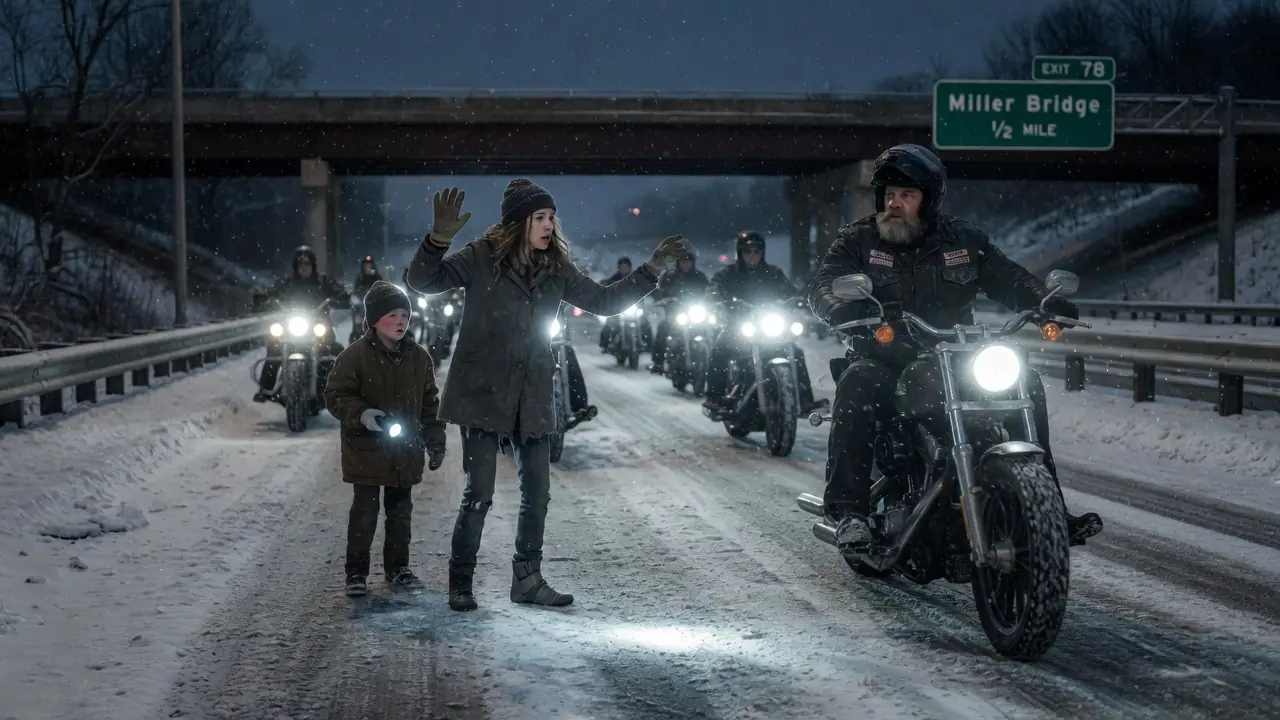
Ten motorcycles roared along the deserted highway outside Pittsburgh, their headlights carving bright tunnels through the falling snow.
The riders wore black leather jackets, heavy boots, and the red-and-white patch that made most people step aside before asking questions.
They were Hells Angels, riding home after a Christmas charity run, their saddlebags still smelling faintly of wrapped toys, canned food, and cold highway air.
The girl came out of nowhere.
She burst from the darkness beneath an overpass, slipping on the icy shoulder and waving both arms as if she had already accepted that the road might take her. Behind her, a smaller boy stumbled through the snow, clutching a cracked flashlight with both hands.
The lead biker hit the brakes so hard his back tire slid sideways. The nine riders behind him fanned out with practiced control, engines growling, snow flying beneath their wheels.
The girl stood frozen in the center of the road.
She could not have been more than sixteen.
Her coat was too thin, her jeans were torn at one knee, and one of her shoes had duct tape wrapped around the toe. Her dark hair was tucked badly under a knit hat, and her face was pale from cold, but her eyes were wild and burning with terror.
The little boy stopped a few steps behind her.
He looked about ten.
His cheeks were red from the freezing wind, and his fingers were wrapped around the flashlight so tightly that his knuckles looked white. The weak beam shook across the bikers’ headlights.
The lead rider lifted his visor.
His name was Caleb Mercer, though almost everyone called him Bear. He was fifty-one years old, broad-shouldered, gray-bearded, and built like a man who had spent his whole life being difficult to move. The other riders respected him because he did not waste words, and because when he did speak, he usually meant exactly what he said.
“Kid,” Bear called over the engines, “you trying to get yourself killed?”
The girl shook her head hard.
“No,” she gasped. “I’m trying to stop you.”
The bikers exchanged looks.
A younger rider named Diesel killed his engine first, then the others followed. The sudden silence made the falling snow seem louder. Only the ticking of cooling engines and the children’s ragged breathing filled the road.
Bear dismounted slowly.
He kept his hands visible, not because he feared the children, but because he recognized the look in the girl’s eyes. That was not ordinary fear. That was the fear of someone who had seen something real and run before her courage could change its mind.
“What’s your name?” Bear asked.
The girl looked over her shoulder toward the overpass.
“Lily.”
“Lily what?”
“Lily Reed.”
Bear looked at the little boy.
“And him?”
“My brother. Mason.”
Mason stepped closer to Lily, half hiding behind her coat.
Bear stepped closer, carefully.
“All right, Lily Reed. Tell me why you ran in front of ten bikes in a snowstorm with your little brother behind you.”
Lily swallowed hard.
“Because if you keep going, you’ll hit Miller Bridge in two miles. There are men waiting there. Two vans, one flatbed truck, and a chain stretched low across the road.”
Several bikers stiffened.
Diesel looked toward the dark highway ahead.
“A chain?”
Mason nodded quickly before Lily could answer.
“They put it between the guardrails,” he said, his voice shaking. “Not high. Wheel height. They said if the first two bikes go down, the rest will scatter, and then they can blame everything on you.”
Bear’s expression changed.
Not fear.
Focus.
“What do you mean, blame everything?”
Lily’s lips trembled.
She looked from Bear to the other riders, then back toward the overpass again.
“They’re not just trying to stop you,” she whispered. “They’re trying to make you look guilty.”
A rider named Bishop stepped forward.
Bishop was lean, quiet, and always watching. He had been a mechanic, a locksmith, and half a dozen other things before the club, and nobody in the chapter knew exactly which of his old skills were legal. He crouched down slightly so he was closer to Mason’s height.
“Guilty of what?”
Mason looked at Lily.
Lily tightened her hand around his shoulder.
“The stolen clinic money,” she said. “The missing supply truck. The fire at the warehouse. All of it.”
The words fell into the snow-heavy silence.
Bear glanced at Bishop.
Bishop’s jaw moved once.
For three weeks, local news had been full of stories about a missing donation truck loaded with medical supplies, winter coats, blankets, and food intended for low-income clinics and shelter kitchens across the city. A warehouse tied to the same charity network had burned two nights later. Officials blamed unknown criminal elements, and some news stations hinted that biker groups had been seen near the area.
Bear had ignored it at first.
People blamed bikers for bad weather if it suited them.
But now two homeless children stood in the road with frozen hands and details they should not have known.
“We heard them talking under the bridge. They don’t know we sleep there. They said your ride would come through after nine because you always take Route 19 back from the toy run. They said people would believe it because of the patches.”
Diesel cursed under his breath.
Bear lifted one hand without looking back.
Diesel went quiet.
“How many men?” Bear asked.
“Six at the bridge,” Lily said. “Maybe more in the warehouse yard.”
“Armed?”
Lily hesitated.
Mason answered in a small voice.
“I heard metal when they got out. And one of them said nobody fires unless the bikers turn around.”
The riders went still.
The snow fell harder.
Lily wiped her nose on her sleeve and looked at Bear with desperate urgency.
“You can’t go that way. Please. I know people probably think we’re just street kids making up stories, but we’re not lying. I swear we’re not lying.”
Bear studied her for a long moment.
Most people would have dismissed Lily and Mason Reed.
A homeless teenage girl in a torn coat.
A little boy with a broken flashlight.
Two runaway-looking kids shouting about traps and powerful men.
Frightened children with no proof in their hands.
But Bear had lived long enough to know the difference between drama and warning. Lily’s eyes were not asking for attention. They were begging not to be responsible for ten men dying because no one believed her.
Bear turned to Bishop.
“Lights off. Bikes into the old service pullout.”
Diesel looked at him.
“You believe them?”
Bear did not take his eyes off Lily and Mason.
“I believe their fear.”
Within minutes, the ten motorcycles were rolled silently off the highway and hidden behind a line of bare winter trees near an abandoned service road. The riders worked without unnecessary noise, their big bodies moving with surprising discipline.
Lily watched them with wide eyes, as if she had expected them to argue, laugh, or leave her and Mason behind.
Bear came back to her.
“Show us where you heard them.”
Lily shook her head.
“No bikes. Engines carry under the concrete.”
“We walk.”
Mason looked at the ten men.
“Under the bridge is tight.”
Bear glanced at the others.
“Then breathe smaller.”
For the first time, a tiny crack of disbelief crossed Mason’s face.
It almost looked like the beginning of a smile.
Then it vanished.
Lily took Mason’s hand and led them beneath the overpass.
The path dropped through weeds stiff with frost, past broken concrete, rusted shopping carts, and old graffiti half-buried beneath snow. The highway above rumbled faintly whenever a distant truck passed, but down below, the world became colder and quieter.
The bridge supports rose like gray pillars, their bases crowded with trash, torn tarps, and pieces of cardboard flattened into sleeping mats.
Lily moved with the familiarity of someone navigating a bedroom.
Mason followed close behind her, shining the weak flashlight along the ground so none of the bikers stepped on broken glass.
They slipped between two concrete walls and ducked behind a stack of old pallets. There, hidden from the road by shadow and hanging plastic sheeting, was their shelter.
A thin blanket.
Two cans of food.
A cracked backpack.
A flashlight.
A notebook.
A small stuffed dinosaur with one missing eye.
And a plastic bag tied around something square.
Bear stopped at the entrance.
The other bikers stopped behind him.
Lily suddenly looked ashamed.
“It’s not much,” she muttered.
Bear looked at the blanket, the frozen ground, Mason’s shaking hands, the careful way Lily had arranged the little they owned.
“No,” Bear said quietly. “It’s yours.”
That answer struck Lily harder than pity would have.
She looked away fast.
Bishop crouched near the wall and pointed to the plastic bag.
“That what you wanted to show us?”
Mason nodded.
He untied the bag with numb fingers and pulled out an old tablet, a folded map, and a bundle of papers wrapped in freezer plastic. The tablet’s screen was cracked, but it still turned on when Lily pressed the button.
She swiped through a folder of photos and videos.
The first video showed a warehouse loading bay at night.
Three men moved boxes from a truck into an unmarked van.
The second showed a man in a long coat speaking to another man near a black SUV.
The third was shaky, filmed from behind metal stairs, but the audio was clear enough.
“After the ride. Put the chain up at Miller Bridge. Leave two crates with the club stickers nearby. News will eat it alive.”
A rider behind Bear muttered, “Club stickers?”
Mason reached into the backpack and pulled out a sheet of cheap printed decals.
Red-and-white wings.
Misspelled.
Bad copies of their patch.
Diesel took one and stared at it with disgust.
“They were going to plant these?”
Lily nodded.
“They already planted some at the warehouse after the fire. Mason saw them.”
Bear’s face hardened.
“Who are they?”
Lily pointed at the man in the long coat on the video.
“Frank Ellison. He owns Ellison Freight and half the empty buildings near the river.”
Bishop’s eyes sharpened.
“City council donor Ellison?”
Lily nodded again.
“And the other man?”
Lily’s voice went quieter.
“Gavin Rusk. He runs the Mercy Harbor Foundation.”
Bear knew that name too.
Mercy Harbor had collected millions in donations for clinics, winter kitchens, and temporary housing. Their billboards were everywhere, full of smiling children and clean blankets. If Lily was telling the truth, the charity that claimed to feed the poor had been stealing from them.
Bear looked at the girl.
“How did you get this?”
Lily hugged the tablet against her chest.
“Our mom.”
The words changed her.
Her voice became smaller, not less brave, but younger.
“Our mom worked nights cleaning offices at Mercy Harbor. She said things didn’t add up. Trucks came in full and left empty, but the clinics said they never got supplies. She found invoices with fake signatures. She took pictures.”
“What happened to her?” Bear asked.
Lily’s eyes filled, but she blinked the tears back hard.
“She disappeared nine days ago.”
Mason pressed his face into Lily’s sleeve.
Nobody spoke.
Lily looked down at the tablet.
“She told us if anything happened, I should take Mason, take the tablet, and hide. She said to find a lawyer or a reporter, but nobody listens to kids like us. The shelter turned us away because it was full. A man at the bus station tried to take our backpack. So we came back here because this is where we knew how to disappear.”
Bear’s jaw tightened.
“What’s your mother’s name?”
“Rebecca Reed.”
Bishop looked at Bear.
“I remember that name.”
Bear did too.
Rebecca Reed had come to one of their charity rides three years earlier with two children who loved motorcycles but were too shy to get close. She had brought homemade cookies because she said her kids wanted to thank them for donating coats to their school.
Bear remembered lifting a little boy in a dinosaur hat onto his parked bike and telling him not to touch the throttle.
He looked at Mason again.
“You were smaller then.”
Mason stared at him.
“You remember?”
“You had a blue hat. Dinosaur on it.”
Mason’s face cracked.
For one second, he looked exactly ten, cold, scared, and starving for any proof that the world had not forgotten him completely.
“My mom said you were a good man,” Mason whispered. “She said if trouble ever got too big, find Bear.”
The riders behind Bear went silent.
Bear looked away for half a breath because the words hit harder than he expected.
Then he turned back.
“Your mom was right to send you.”
Lily’s chin trembled.
“You’ll help?”
Bear crouched in front of her and Mason.
“We already are.”
Bishop stood and looked toward the road above.
“If the trap is at Miller Bridge, we need eyes on it before they realize the convoy stopped.”
Bear nodded.
“Lily, Mason, is there a way to see the bridge without using the road?”
Mason wiped his face quickly and pointed past the concrete supports.
“Storm drain path. It runs behind the old rail bed. Comes out above the bridge.”
Diesel looked at the narrow opening.
“We are not all fitting through that.”
Mason glanced at his broad shoulders.
“No.”
Bear chose four men: Bishop, Diesel, Smoke, and Little John, whose nickname made no sense because he was nearly six-foot-seven. The others stayed near the hidden bikes, watching the road and guarding the children’s shelter.
Bear went with Lily and Mason.
Mason moved first.
He slipped through the drain path like a shadow.
Lily followed behind him, keeping one hand on the back of his coat.
The men followed with much less grace.
The tunnel smelled of wet concrete, rust, and old leaves. Water trickled somewhere beneath the ice, and the low ceiling forced even Bear to bend. Mason led them without hesitation, pausing only when the path forked, then choosing left toward a faint ribbon of cold air.
After several minutes, they emerged behind a screen of dead brush above Miller Bridge.
Below them, the road curved between two rock cuts before crossing the narrow river. At first, it looked empty. Then Bear saw the dark shapes tucked beneath the far trees.
Two vans.
One flatbed truck.
A chain stretched low across the road, dark enough to vanish in the snow.
Six men waited near the vehicles, their faces hidden beneath hats and scarves. One smoked beside the guardrail. Another checked his watch. A third stood near a crate marked with cheap Hells Angels stickers.
Diesel’s hands curled into fists.
Bear touched his arm.
“No.”
Diesel glared.
“They were going to drop us.”
“And now they won’t.”
Bishop already had his phone out, recording.
The men below began talking loudly enough for the wind to carry pieces upward.
“Where are they?”
“They should have hit the bridge by now.”
“Maybe snow slowed them.”
“Ellison said no delays. Once they go down, we call it in. Stickers, crates, truck report, everything lines up.”
Another man laughed.
“Bikers make perfect villains. Nobody asks questions.”
Mason flinched.
Lily pulled him closer.
Bear saw it.
He leaned close to both of them.
“You did good.”
Lily whispered, “They said the same thing about our mom. That nobody would ask questions about a cleaner with overdue rent and two kids.”
Bear felt something cold and furious settle deep in his chest.
“People will ask now.”
Bishop sent the video to a secure contact, then another, then another. The club had learned long ago not to trust only one channel when powerful men were involved.
One copy went to their attorney.
One went to a state investigator who owed Bishop a favor from a case years earlier.
One went to Nora Vance, an investigative reporter at the Pittsburgh Ledger, who had been digging into Mercy Harbor Foundation for months.
Nora called Bishop within ninety seconds.
He answered in a whisper.
“You seeing this?”
Her voice came sharp through the phone.
“I’m seeing it. Are you live?”
“Yes.”
“Keep recording. State investigators are already looking at Mercy Harbor. This is enough to move tonight.”
Bear looked at the men below.
“How long?”
“Hold position. Do not engage unless you have to.”
Bear almost smiled at that.
“Wasn’t planning to.”
Lily looked up at him, surprised.
“You’re not going down there?”
Bear shook his head.
“We’re not the story they get to write.”
The girl absorbed that.
For a moment, Bear wondered how many adults had used Lily’s anger against her, how many had expected a homeless teenage girl to explode so they could blame her for the mess they made. Tonight, the bikers would not give Ellison that gift.
They waited in the snow.
Ten minutes.
Fifteen.
Twenty.
The men at the bridge grew restless.
One talked into a radio.
Another kicked the crate.
A third walked toward the chain and looked down the empty road, confused.
Then headlights appeared from the far side.
Not motorcycles.
Three black state vehicles.
Two unmarked SUVs.
A news van behind them, lights off but camera already visible through the windshield.
The men at the bridge scattered too late.
The scene below erupted into motion, but not the kind Ellison had planned. Officers surrounded the vehicles. Men shouted. Hands rose. Cameras recorded everything.
The chain.
The planted stickers.
The crates.
The vans.
The men who had been waiting to make ten bikers into the perfect excuse.
Mason watched from the ridge, shaking.
Bear placed a hand gently on his shoulder.
“It’s over.”
Mason did not answer.
His eyes were fixed on the road below.
“No,” Lily said quietly. “That was just the trap.”
Bear looked at her.
“What else?”
Lily turned toward the old warehouse district beyond the bridge.
“Our mom isn’t dead.”
The words hit Bear like a hammer.
“How do you know?”
Mason pulled a folded piece of paper from inside his coat.
It was damp at the edges from snow, but the writing was still readable.
A note.
Two words and an address.
Still breathing.
Below it was a warehouse number.
“I found this under our blanket two nights ago,” Mason said. “Someone left it while Lily was looking for food. I think it was one of Mom’s friends from Mercy Harbor. They were too scared to talk to us.”
Bishop read the address.
“That’s Ellison’s cold storage building.”
Lily nodded.
“They keep records there. Maybe people too.”
Bear looked toward the bridge, where the first stage of the plan had just collapsed.
Then he looked back at the children.
Lily’s face was pale, but her eyes were no longer wild.
They were steady now.
“Please,” she said. “We warned you. You said you’d help. We need our mom.”
Bear did not hesitate.
“We get her.”
They did not charge blindly into the warehouse.
Bear refused to let the night become the kind of story Ellison wanted.
Instead, Bishop called Nora again. Nora called the state investigator on scene. The investigator, now holding enough evidence to act, redirected units toward the cold storage building.
The bikers moved too, not as attackers, but as witnesses who knew the service roads, blind spots, and back lots better than any official convoy.
Lily rode behind Bear.
Mason rode behind Bishop.
Bear wrapped Lily in an extra vest first and gave her gloves from his own saddlebag. Bishop did the same for Mason. The children’s arms were thin and careful around the bikers’ waists, as if they were afraid they had no right to hold on.
Bear told Lily once, over his shoulder, “Hold tight, kid.”
Lily did.
The cold storage building sat near the river, a long gray structure with broken upper windows and loading docks crusted with ice. Its sign had been painted over twice, but old letters still showed beneath the newer paint. A single light burned over the side door.
By the time Bear arrived with the chapter, state vehicles were already blocking the main entrance. Nora’s news van stopped across the street. Investigators moved with purpose, carrying files, cameras, radios, and the authority of people who finally had enough proof to stop asking permission.
Lily slid off the bike and stumbled.
Bear caught her arm.
“You stay behind me.”
“I need to see.”
“You will. Behind me.”
For once, Lily did not argue.
The side door opened from inside.
A woman stepped out wearing a gray coat too thin for the weather, escorted by two investigators. Her hair was tangled. Her face was pale. But she was standing.
Mason made a sound that was barely human.
“Mom.”
Rebecca Reed turned.
For one awful second, she seemed not to believe what she was seeing.
Then her face broke open.
“Mason. Lily.”
The children ran.
Bear let them go.
Rebecca dropped to her knees in the snow as Mason crashed into her arms first, then Lily fell beside them, gripping her mother so tightly that all three nearly toppled over. Rebecca’s hands moved over Mason’s head, Lily’s face, their shoulders, their coats, checking that they were real, that they were whole, that the children she had told to run had somehow found their way back.
“I told you to hide,” she sobbed.
“We did,” Lily cried. “We hid. Then we found Bear.”
Rebecca looked up through tears.
Her eyes found the bikers.
Then Bear.
For a moment, all the strength she had used to survive seemed to leave her face.
“Thank you,” she whispered.
Bear removed his gloves slowly.
“No, ma’am,” he said. “Your kids saved us first.”
The truth came out over the next forty-eight hours.
Not all at once.
Powerful secrets rarely fall cleanly.
But they fell.
Mercy Harbor Foundation had been taking donations meant for clinics, shelters, and food kitchens, then quietly selling much of the inventory through Ellison Freight. Fake records covered the missing supplies. Fake signatures made it appear the deliveries had been received.
When Rebecca Reed discovered the pattern, she copied files, photos, and payment ledgers onto the tablet and tried to contact a reporter.
Ellison’s people found out.
They took her from the parking garage after a late shift and held her inside the cold storage building, pressuring her to reveal where she had hidden the files. She refused.
While they searched for Lily and Mason, the children slept under the bridge with the one thing Ellison needed most.
Then Ellison’s people created a backup plan.
Blame the bikers.
Stage an ambush.
Plant fake patches.
Connect the Hells Angels to the missing truck, the warehouse fire, and the stolen supply network.
By the time the news broke, the story was bigger than anyone expected.
Not because of the bikers.
Not because of Ellison.
Because the faces at the center of it all were a sixteen-year-old homeless girl and her ten-year-old brother who had run into a snowy road and shouted the truth before ten men rode into a trap.
Lily hated the cameras.
Mason hated them even more.
They stood beside their mother at the state building two days later, wearing clothes Bear’s chapter had bought them from a store that did not smell like donation bins. Lily’s hair had been washed, her cut lip cleaned, her taped shoe replaced by winter boots that fit. Mason kept one hand wrapped in Rebecca’s coat like the world might take her again if he let go.
Nora Vance asked Lily only one question on camera.
“Why did you warn them?”
Lily looked at Bear, who stood behind the crowd with his arms folded.
Then she looked back at Nora.
“Because my mom said if trouble got too big, find Bear,” she said. “And because nobody should get blamed just because people already expect them to be bad.”
That answer aired that evening.
By morning, it had been shared across the country.
People argued about the Hells Angels online, as people always did. Some still saw only the patches. Some saw the bikers standing between two children and the powerful men who had tried to use them.
But in Pittsburgh, things were simpler.
Ten riders had listened when others might have dismissed a homeless teenage girl and her little brother. Because they listened, people got their food, coats, medicine, and shelter funds back.
Mercy Harbor collapsed.
Frank Ellison was arrested, along with several executives and warehouse managers.
The missing supplies were recovered from three storage sites.
The city reopened investigations into contracts no one had questioned before.
But none of that mattered to Lily and Mason as much as the small apartment Rebecca received through an emergency housing program funded by recovered charity money.
It had two bedrooms.
A working heater.
A kitchen window.
A lock that made a solid sound when turned.
On the first night there, Mason stood in his empty room and did not speak for a long time.
Lily stood beside him, watching carefully.
“You okay?” she asked.
Mason nodded.
Then shook his head.
Then began to cry.
Lily crossed the room and wrapped him in her arms.
“We slept under a bridge,” he whispered. “I thought Mom was gone.”
“I know.”
“I thought nobody would believe us.”
Lily held him tighter.
“But they did.”
“No,” Mason said, crying harder. “They did.”
Rebecca stood in the doorway, one hand pressed over her mouth.
Then she crossed the room and pulled both of her children into her arms.
The first visitors came the next afternoon.
Not reporters.
Not officials.
Ten motorcycles rolled into the apartment parking lot with engines low and respectful. Neighbors peeked through blinds. Children came to windows. Bear parked in front, removed his helmet, and lifted a grocery bag from his saddlebag.
Mason opened the door before they knocked.
“You found us.”
Bear looked amused.
“You sent us the address.”
“Oh. Right.”
The riders came bearing groceries, blankets, a toolbox, a lamp, a used television, and a small wooden desk Bishop had found and repaired overnight. Diesel carried a box of books because he said kids needed something to do besides nearly get bikers killed. Smoke brought a set of cookware. Little John brought a plant that looked too delicate in his enormous hands.
Rebecca cried quietly in the kitchen.
Bear pretended not to notice.
Lily followed the bikers from room to room, watching them assemble furniture, fix a loose cabinet door, hang curtains, and argue over whether the couch should face the window or the wall. Mason stayed beside Bishop, asking questions about every tool in the box.
It was the first time in weeks either child had heard adult voices fill a room without fear attached to them.
When Bear finished tightening the desk legs, Lily stood beside him.
“Can I ask you something?”
Bear looked down.
“Sure.”
“Were you scared that night?”
Bear considered lying.
Then chose not to.
“Yes.”
Lily seemed surprised.
“But you’re Bear.”
“That doesn’t stop fear. It just means I’ve learned not to let fear do the thinking.”
Lily absorbed that carefully.
“I was scared too.”
“I know.”
“I almost didn’t run into the road.”
Bear looked at her.
“What made you do it?”
Lily looked toward the kitchen where her mother was laughing weakly at something Diesel had said, and Mason was trying to help Bishop screw a loose shelf into the wall.
“I thought if I didn’t, I’d be just like everyone who didn’t help my mom.”
Bear was silent for a moment.
Then he placed one heavy hand on Lily’s shoulder.
“You’re nothing like them.”
Weeks passed.
Then months.
Lily and Mason returned to school.
At first, Lily hated it.
She hated the questions, the whispers, the way teachers spoke gently as if she might break if they used normal voices. She hated that some kids treated her like a hero while others made jokes about bikers and bridges. She hated sitting indoors under bright lights after learning how to sleep with one eye open.
Mason hated it for different reasons.
He hated being watched.
He hated when people called him brave.
He hated when the heater clicked on too loudly because it reminded him of men walking under the bridge.
But they went.
Rebecca went back to work too, not at Mercy Harbor, but with Nora Vance’s help, she found a job at a legitimate community legal center that supported whistleblowers and workers afraid to speak.
She still had nightmares.
Lily heard her sometimes through the wall.
On those nights, Lily would get up, make tea, and sit with her mother until the shaking passed. Sometimes Mason came too, dragging his blanket behind him, and all three of them sat together in the kitchen without pretending the fear was gone.
Bear’s chapter kept showing up.
Not too often.
Not in a way that made them feel watched.
But enough.
On Saturdays, Bear taught Lily and Mason basic motorcycle maintenance at the club’s garage. Bishop taught them how to change a lock, fix a hinge, and read a map without relying on a phone. Diesel taught Mason how to throw a football badly, then blamed the ball. Smoke taught Lily how to cook chili in quantities that made no sense for three people.
Rebecca watched cautiously at first.
Then less cautiously.
One afternoon, she stood in the garage while Mason laughed at something Diesel said, his face open and bright in a way she had not seen since before everything happened. Lily was beside Bear, learning how to check a chain, her brow furrowed with concentration.
Bear stood beside Rebecca.
“They’re good kids,” he said.
“They had to be brave too young.”
Bear nodded.
“That happens.”
“I don’t want them thinking danger is the only way to matter.”
“They won’t.”
“How do you know?”
Bear looked at Lily and Mason.
“Because we’re going to teach them maintenance.”
Rebecca looked confused.
Bear almost smiled.
“Build. Repair. Keep things running. That’s a better lesson than fighting.”
Rebecca looked at him for a long time.
“People don’t expect that from men wearing your patch.”
“No,” Bear said. “They don’t.”
“Does that bother you?”
“Sometimes.”
“What do you do about it?”
Bear looked toward the children again.
“Try not to become what they already decided I was.”
A year after the night on Route 19, the city opened the Mercy Harbor Community Kitchen in the restored warehouse district.
Not under the old foundation’s name.
That name was gone.
The new center was run by a board that included shelter workers, clinic staff, neighborhood pastors, former whistleblowers, and people who had once needed the services themselves. Its first floor held a food kitchen. The second floor held legal aid offices. The old loading bay became a winter supply distribution center.
At the dedication ceremony, Nora Vance spoke first.
Then Rebecca.
Then the mayor, who wisely kept his speech short because everyone knew the city had ignored too much for too long.
Finally, Lily was asked to say a few words.
She did not want to.
Bear told her she did not have to.
Rebecca told her the same.
But Lily looked at the crowd, at the families waiting beside boxes of winter coats, at the volunteers carrying soup bowls, at the reporters with their cameras, at the ten bikers standing near the back in clean jackets and uncomfortable silence.
Then she stepped to the microphone.
“My name is Lily Reed,” she said.
Her voice shook.
She stopped.
The room waited.
She looked at Mason, standing beside Rebecca.
Then she looked at Bear.
Bear nodded once.
Lily took a breath.
“A year ago, my little brother and I were sleeping under a bridge. We had a tablet full of proof, but we didn’t know how to make anyone listen. I thought being homeless meant people looked through you until you became part of the concrete.”
A few people in the crowd wiped their eyes.
“My mom told us to find help, but I didn’t know who would believe us. Then I saw ten bikers coming down the road, and I remembered something she said. She said, ‘Not every person who looks frightening is cruel, and not every person who looks respectable is good.’”
Bear lowered his eyes.
Lily continued.
“So I ran. Mason ran after me. We screamed. We almost fell in front of them because we were scared, but they stopped. And when we told them there was a trap ahead, they believed us.”
Her voice grew steadier.
“That is why this place matters. Because sometimes people do not need a miracle. They need one person to stop and believe them before it is too late.”
The room was silent.
Lily looked toward her mother.
Rebecca was crying.
“But this place should not only be for people after everything falls apart. It should be for people before that. Before the bridge. Before the cold. Before a kid thinks the only safe place to sleep is where nobody can see them.”
The applause began softly.
Then rose.
Lily stepped back from the microphone, embarrassed and overwhelmed.
Bear was waiting near the side wall.
The girl walked straight to him.
Bear opened one arm.
Lily leaned in, trying to act like she was only accepting a quick hug.
She stayed longer than that.
Mason joined them a second later, pressing himself into Bear’s side.
Bear looked down at both of them and said nothing.
That winter, Lily and Mason no longer slept under the bridge.
No child did, if the new outreach team could help it.
The service path where they had once hidden became part of the city’s winter patrol route. The spot beneath the overpass where their blanket had been was cleared and cleaned, but Bear made sure one thing remained.
On the concrete wall, someone painted a small mural.
A girl holding out one hand.
A little boy holding a flashlight.
Ten motorcycle headlights in the snow.
And above them, the words:
BELIEVE THE WARNING BEFORE THE TRAP.
Lily and Mason visited the mural once with their mother.
They stood in front of it for a long time.
Rebecca touched Lily’s shoulder.
“What are you thinking?”
Lily looked at the painted girl.
“That I looked smaller than that.”
Rebecca’s eyes softened.
“You were never small.”
“I was scared.”
“Brave people usually are.”
Mason looked up at the mural.
“Do you think Dad would have believed us?”
Their father had died when Mason was little, and his memories of him were mostly photographs and stories.
Rebecca swallowed.
“Yes,” she said. “He would have.”
Mason nodded.
Then he looked down the road where the bikes had appeared that night.
“I’m glad Bear did.”
Years later, people would tell the story in different ways.
Some made it bigger.
Some made it louder.
Some turned it into a legend about ten Hells Angels riding into a trap and two homeless children who saved them from a hidden ambush. Others focused on the scandal, the corrupt charity, the stolen supplies, the warehouse, the planted evidence, and the powerful men who thought two children under a bridge could not hurt them.
Lily remembered it differently.
She remembered cold.
She remembered Mason’s hand in hers.
She remembered the weak flashlight shaking against the snow.
She remembered running into the road, certain she might be ignored, cursed at, or worse.
She remembered Bear’s voice asking her name.
She remembered the first adult in nine days who looked at her and believed every word.
That was the part that changed her.
Not the headlines.
Not the arrests.
Not the speeches.
Belief.
The kind that arrives before proof is convenient.
The kind that says frightened children still deserve to be heard.
Lily Reed grew taller.
Her taped shoe became a story she hated hearing and secretly kept close.
She learned engines from Bear, locks from Bishop, cooking from Smoke, and stubbornness from her mother. She finished school, then trained as a community outreach worker, spending winter nights finding people in the places where the city forgot to look. She carried gloves, granola bars, bus passes, and a flashlight with strong batteries.
Mason grew too.
He became quieter than most boys his age, but not broken. He learned to fix radios, patch tires, repair heaters, and remember roads. He kept the old cracked flashlight on a shelf in his bedroom, even after Bear bought him three better ones.
Every December, Lily and Mason joined the same charity ride.
Not on their own bikes at first.
For years, they rode behind Bear and Bishop.
Then, when Lily was old enough, she rode beside Bear.
Mason followed years later.
And every time they passed Miller Bridge, the whole line slowed.
Ten bikes.
Then twenty.
Then more.
Lily always looked toward the ridge where she and Mason had watched the trap fall apart. She would remember the girl she had been, the fear in her throat, the snow in her shoes, her little brother running behind her, and the choice that had changed everything.
One night, Bear rode beside her and lifted his chin toward the bridge.
“You ever regret running into the road?”
Lily looked ahead, where the headlights stretched across the winter highway like a line of fire.
“No,” she said.
Bear nodded.
“Good.”
Lily glanced at him.
“You ever regret believing us?”
Bear’s answer came without hesitation.
“Kid, believing you two was the smartest thing I ever did.”
Lily smiled.
The road opened before them.
Snow began to fall, light at first, then steady.
The engines rolled deep through the cold, not like thunder, not like warning, but like proof that some stories do not end under bridges.
Some stories begin there, when one frightened girl refuses to stay invisible, when her little brother holds the light, and when ten men everyone feared choose to listen.
Because sometimes a trap is not only a chain across a road.
Sometimes it is the lie that no one will believe you.
And sometimes all it takes to break that trap is one voice in the snow shouting the truth before it is too late.