The ground shook.
Fifty motorcycles surrounded a tiny diner in Tennessee all at once.
Inside, an eighteen-year-old waitress stood cornered against the kitchen door by a man who said she had until midnight to pay a debt that was never even hers.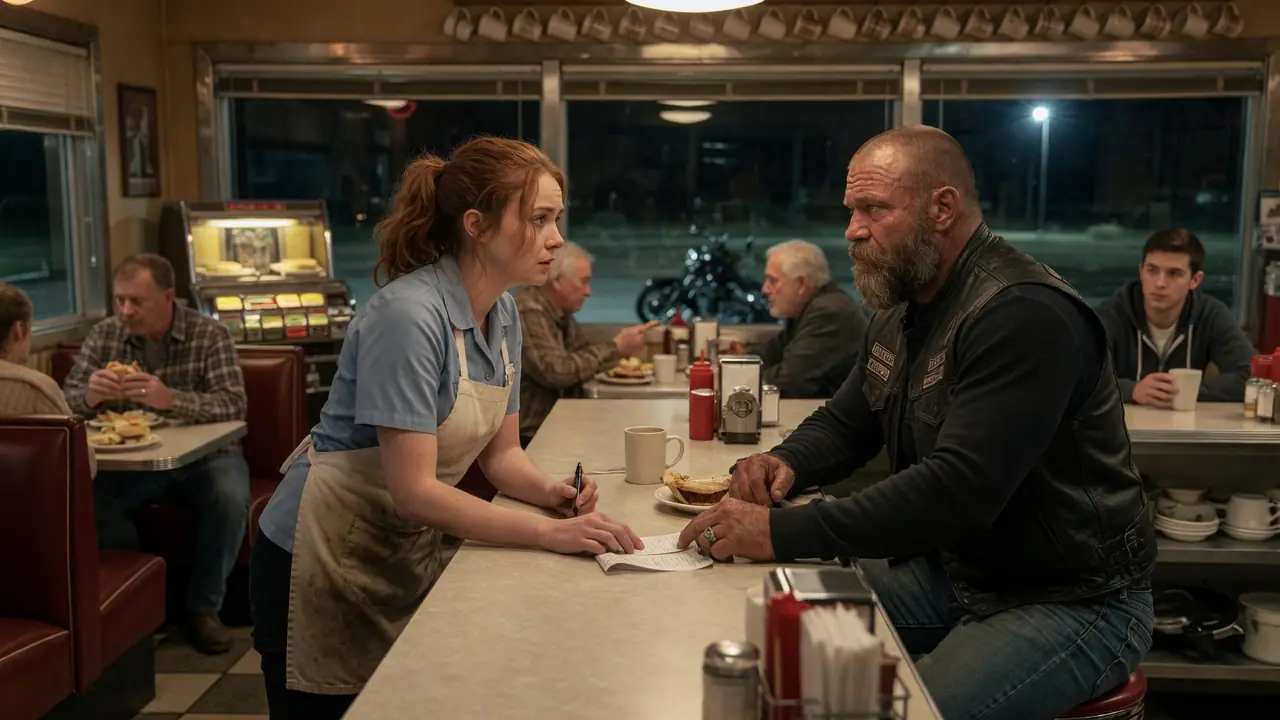
No phone.
No backup.
No way out.
So she did the only thing she could think of.
She grabbed a grease-stained receipt, picked up a pen, and with her hand shaking so hard she could barely write, she scribbled two words.
Then she folded the paper and slipped it to a stranger at the counter.
A stranger wearing a black leather jacket with an Iron Shield MC patch on his chest.
She had no idea who he was.
No idea what he would do.
No idea that seventeen minutes later, the ground outside would begin to shake.
And the man threatening her had no idea either.
Not until the headlights hit the window.
Two words.
That was all she wrote.
And those two words set something in motion that nobody in Malone’s Corner Diner would ever forget.
This was Malone’s Corner Diner.
And this was the night everything changed.
Sarah Malone had not moved in four minutes.
Her back was pressed against the kitchen door. Both hands were flat against the cold metal behind her. Darius Voss stood three feet away, close enough that she could smell his expensive cologne, close enough that she could see the exact moment his patience ran out.
He leaned in.
“You think I’m playing with you, Sarah?”
She did not answer.
Her throat had closed. Her apron was still on. Her order pad was still in her pocket. Her eyes kept moving to the clock above the pie display.
11:44 p.m.
Sixteen minutes left.
“That number doesn’t change,” Darius said, quiet, almost gentle.
Which was worse than if he had shouted.
“Fourteen thousand dollars tonight, or I start making calls. And trust me,” he tilted his head, “you do not want me to make those calls.”
Sarah’s hands shook behind her back.
The diner was empty. The last customer had left twenty minutes ago. The cook had clocked out at eleven. It was just her, just him, and sixteen minutes on a clock that felt like it was moving faster than any clock had a right to move.
She had no phone.
Darius had made sure of that. Casually, almost politely, he had asked her to leave it on the counter when he came in.
“Just so we can talk without interruptions,” he had said.
She had been too scared to say no.
Now her phone sat beside the register, close enough to see, too far to reach.
She thought about Lily.
Seven years old.
Asleep right now at Mrs. Parker’s apartment three miles away, probably curled under the purple blanket their father bought her before he got sick. Lily would wake up in the morning asking where Sarah was. She would ask if there was cereal. She would ask if Sarah had fixed the loose button on her school sweater.
Sarah was only eighteen, but every morning, Lily looked at her like she was the whole world.
Think.
Think.
Think.
Then she saw him.
Marcus “Bolt” Haywood was sitting at the far end of the counter.
She had almost forgotten he was there.
He had come in forty minutes earlier, coffee and pie, the same as every Tuesday. Quiet man. Always left a good tip. Always wore the same black leather jacket with the Iron Shield MC patch on the left chest and a larger motorcycle club insignia on the back.
Most people who came into Malone’s Corner Diner saw that jacket and looked away.
Sarah had never been afraid of it.
In almost a year of Tuesday nights, Marcus Haywood had never been anything but kind to her. He did not stare. He did not ask too many questions. He always said please. He always said thank you. He never complained when the coffee was old. He tipped more than the bill required, but never in a way that made her feel bought.
Right now, he was the only person in the world who could help her.
Darius had his back partly turned to the counter. He was looking at his watch.
Sarah moved slowly, naturally, like she was just reaching for the receipt book out of habit.
She tore off a blank slip, picked up the pen, and with her hand shaking so badly the letters came out jagged and uneven, she wrote two words.
Save me.
She stared at the words for half a second.
They looked too small for the terror inside her.
Too small for six months of pressure, fear, unpaid bills, legal threats, and nights spent pretending not to cry so Lily would not wake up scared.
But they were all she had.
She folded the paper once, walked to the counter, and set it face down in front of Marcus with his check.
The most normal thing in the world.
A waitress dropping a bill.
Her eyes met his for exactly one second.
That was enough.
Marcus did not open the note at the counter. He left two twenty-dollar bills under his coffee cup, twice what he owed, the same as always.
Then he picked up the folded receipt and walked to the door without changing his pace.
The little bell above it rang when he pushed it open.
Darius did not even turn around.
The cold November air hit Marcus the moment he stepped outside.
He unfolded the paper under the parking lot light, read it, then read it again.
Two words.
He looked back through the window.
Sarah was still there.
Darius Voss was still there.
And the clock behind the counter read 11:46.
Marcus reached into his jacket pocket, pulled out his phone, and called a number he had not needed to call in almost eight months.
It rang twice.
“King.”
Raymond “King” Decker’s voice came through low and steady.
“Bolt, what have you got?”
“Malone’s Corner. A girl’s in trouble right now.”
Three seconds of silence.
“How old?”
“Eighteen, maybe. Too young to be standing alone against this.”
“How many?”
“One man. But she’s alone.”
“We’ll be there in fifteen.”
The call lasted eleven seconds.
What happened in the next seventeen minutes was something nobody who was there that night would ever fully be able to explain.
Because it was not organized the way someone organizes a meeting, a rally, or a formal response.
There were no official alerts.
No emergency broadcast.
Just a chain of phone calls.
King to his officers.
Officers to their brothers.
Brothers to anyone close enough to ride.
A message passed from phone to phone across the dark streets of Nashville like fire jumping from one dry branch to the next.
Girl in trouble.
Malone’s Corner.
Now.
That was all it took.
Men left their dinner tables. Women pulled on jackets in the middle of conversations. Engines turned over in garages, driveways, and parking lots across three different neighborhoods.
Nobody asked for more details.
Nobody said, “Let me think about it.”
Nobody said, “Can it wait until tomorrow?”
They just rode.
Inside the diner, Darius checked his watch again.
“Two minutes, Sarah.”
She was back behind the counter now, both hands flat on the surface, staring at him.
And something had shifted in her face.
Something small but real.
She was not shaking anymore.
She did not know why.
Maybe it was because she had done the only thing she could do. Maybe it was because somewhere in the back of her mind, past the fear, the exhaustion, and the fourteen-thousand-dollar number that had been crushing her chest for six months, she had decided to trust a stranger in a leather jacket.
Then the windows lit up.
All of them.
At once.
White light poured through every pane of glass in Malone’s Corner Diner, from the big front windows to the narrow one above the sink, turning the whole interior pale and sharp and strange.
The coffee cups rattled on their hooks.
The overhead light flickered.
The old jukebox in the corner hummed like it was thinking about waking up.
Darius turned around.
Fifty motorcycles sat arranged in a perfect arc across the entire parking lot.
Engines running.
Headlights on.
Riders sitting completely still.
Arms crossed.
Eyes forward.
Not one of them speaking.
Just present.
Just there.
Darius said nothing.
For a long moment, he simply stood at the window and looked out at what was looking back at him.
Then, slowly, the way a man moves when he is trying very hard not to show that his legs have gone unsteady, he took one step back from the glass.
Outside, King Decker cut his engine.
One by one, like a single organism responding to one signal, forty-nine engines went silent after his.
The sudden quiet was enormous.
King stepped off his bike, walked to the entrance of the diner, and pushed the door open.
The bell rang.
Cheerful.
Absurd.
Perfectly ordinary.
He looked at Darius Voss the way a man looks at something small he has found in an unexpected place.
Then he said quietly, the way you say something when you only intend to say it once.
“I think it’s time for you to go.”
Darius picked up his folder.
He straightened his jacket.
He walked to the door without a word and stepped outside.
Fifty pairs of eyes followed him to his car.
Not one person moved.
Not one person spoke.
They watched him back out.
They watched his taillights disappear down the two-lane road into the dark.
Then, from somewhere in that formation, someone started to clap.
Inside the diner, Sarah Malone sat down on the floor behind the counter, her back against the cabinet below the coffee machine.
She pulled her knees to her chest and cried.
Not from sadness.
Not from fear.
But from the particular relief of a person who had been holding something unbearable for a very long time and had finally, finally been allowed to put it down.
The bell rang one more time.
King stepped back inside, looked down at her, and said, “You want some coffee, kid?”
But here is what you do not know yet.
You do not know who Sarah Malone really was.
You do not know how an eighteen-year-old girl ended up running a diner that should have belonged to adults.
You do not know where that fourteen-thousand-dollar debt came from, or why it had her name on it when she had never signed a single piece of paper.
You do not know what Darius Voss had been doing to her for six months before that night.
And you do not know why Marcus Haywood, a man who came in every Tuesday for coffee and pie, noticed something in Sarah’s eyes long before she ever wrote those two words.
To understand all of that, we have to go back.
Back to the beginning.
Back to a morning six months earlier, when Sarah Malone’s life was already hard and was about to get so much harder.
Six months earlier, at 5:45 in the morning, the alarm went off.
Sarah Malone was already awake.
She had been awake since four, lying in the dark and staring at the ceiling of the small two-bedroom apartment on Clement Street, doing the math in her head the way she did every morning.
Rent, eight hundred forty dollars, due in eleven days.
Electric bill, one hundred twelve dollars.
Lily’s school supplies, which she had been putting off for two weeks already.
The transmission on her car had been making a sound since October that she did not want to think about.
And her bank account sat at three hundred seventeen dollars.
She got up, made coffee, and packed Lily’s lunch.
Peanut butter and banana.
Same as every day because it was what Lily asked for, and also because the ingredients were cheap, and Sarah had learned a long time ago that those two things did not always line up, so she held on to it when they did.
She braided Lily’s hair while her little sister was still half asleep, walked her three blocks to the school bus stop, and watched the bus pull away.
Then she went to work.
Malone’s Corner Diner had belonged to their father.
Patrick Malone had opened it in 1989 with twelve thousand dollars saved over seven years of working double shifts at a highway rest stop.
He had built it into something real.
Not fancy.
Never fancy.
But real.
The kind of place where truckers knew they would get a hot meal and a straight answer if they asked for directions.
Where regulars had their own mugs on a hook behind the counter.
Where Patrick knew everybody’s name, everybody’s order, and most of their problems.
He had left it to Sarah and Lily when he died two years ago.
Cancer.
Seven months from diagnosis to the end.
Long enough for fear.
Short enough for disbelief.
Sarah was sixteen when he passed, and Lily was five.
Their mother had left before the funeral flowers dried.
Some people disappeared loudly, with slammed doors and screaming.
Their mother disappeared softly.
She took two suitcases, most of the emergency cash, and the old silver necklace Patrick had given her on their tenth anniversary. She left a note on the kitchen table saying she was not built for this kind of life.
Sarah had read the note once.
Then she folded it in half and put it in the trash.
After that, there was only the diner.
The apartment.
Lily.
School.
Bills.
The kind of responsibility that does not ask whether you are old enough before it lands on your shoulders.
Because Sarah had been under eighteen when Patrick died, the diner had been placed in a temporary trust until she became legal age. Patrick’s old friend, a retired accountant named Mr. Harlan, helped keep the paperwork alive. But day by day, shift by shift, Sarah was the one who opened the doors, counted the register, paid the suppliers, scheduled the cook, cleaned the coffee machine, and made sure the place did not collapse.
At eighteen, the diner was officially hers.
That should have felt like freedom.
Instead, it felt like someone had handed her a house already burning and called it inheritance.
What Patrick had not left her, what nobody had told her about until it was too late, was the debt.
Her mother’s name was Denise Malone.
For years, Denise had been careless with money in the way some people are careless with matches.
Credit cards.
Payday loans.
Promises to pay people back next Friday.
Small lies that became large holes.
After Patrick died, Denise had apparently used Sarah’s information to file a short-lived catering business under the Malone name. Sarah had never seen the forms. She had never signed anything. She had never agreed to a loan.
But her name was there.
Forged in ink.
Attached to a debt that had passed through three companies before landing in the hands of Voss Recovery Solutions.
Sarah’s lawyer, a tired man named Harold who worked out of a strip mall office and charged her two hundred dollars an hour she did not have, explained it to her three times, and she still did not fully understand the mechanism.
Something about fraudulent registration.
Something about assumed liability.
Something about the way debt collectors count on people being too broke to fight.
What she understood was the number.
Fourteen thousand two hundred twenty dollars.
And the man who came to collect it.
Darius Voss first walked into Malone’s Corner Diner on a Wednesday morning in May.
Sarah had been behind the counter when he came in.
She remembered thinking he was overdressed for the neighborhood.
Charcoal suit.
No tie.
Shoes that cost more than her monthly rent.
He sat at the counter, ordered black coffee, and left a twenty for a three-dollar cup.
Then he slid a business card across the counter.
“I believe we have some things to discuss, Ms. Malone.”
She read the card.
Then read it again.
Voss Recovery Solutions.
Something cold moved through her chest.
“I think there’s been a mistake,” she said.
Darius smiled.
The kind of smile that had probably worked on a lot of frightened people in a lot of difficult conversations.
Patient.
Almost sympathetic.
“There’s no mistake. I understand this is a surprise. Take a few days, look over the documentation. I’ll come back Thursday.”
He came back Thursday.
And the Thursday after that.
And the one after that.
Each visit, he was polite.
Each visit, he brought paperwork.
Each visit, the number stayed exactly the same while the window for paying it without additional fees and penalties got a little smaller.
Sarah called Harold.
Harold reviewed the documents.
Harold charged her four hundred dollars and told her the debt appeared to be enforceable on paper, but that she likely had grounds to challenge it if she was willing to go to court, which would cost significantly more than four hundred dollars and take anywhere from eight to eighteen months.
She did not have eight to eighteen months.
She did not have significantly more than four hundred dollars.
She had Lily.
She had a diner.
She had school textbooks shoved into a backpack behind the counter because she was trying to finish her senior year through evening classes and online assignments.
She had rent due.
By September, Darius had stopped being polite.
Not dramatically.
Not all at once.
It was gradual, the way a temperature drops in autumn, degree by degree, until one morning you step outside and realize it is genuinely cold and cannot remember exactly when that happened.
His visits became less predictable.
Sometimes morning.
Sometimes just before closing.
He started staying longer.
Started letting silences stretch in ways that felt deliberate.
Started saying things that were not quite threats, but were not quite not threats either.
“I’d hate for this to affect your business, Sarah. People talk. A place like this runs on reputation, doesn’t it?”
“Lily’s in second grade now, right? Time goes so fast.”
That last one, the one about Lily, changed something in Sarah permanently.
She looked at him across the counter and felt a rage so clean and complete it almost surprised her.
But she said nothing.
Because she was alone.
Because he was between her and the door.
Because she had a seven-year-old little sister three miles away who needed Sarah to come home.
So she said nothing.
She had gotten very good at saying nothing.
October became November.
Sarah worked doubles when she could get them. She picked up a weekend catering job through a friend. She sold her father’s record collection, forty years of carefully chosen vinyl, his pride and joy, to a shop on Broadway for eight hundred dollars.
She deposited every cent.
She got the number down to fourteen thousand two hundred twenty dollars.
But Darius kept adding fees.
Processing fees.
Late fees.
Administrative fees.
Fees she had never agreed to, and Harold said were almost certainly illegal, but proving that would require more time and money than she had.
The number never moved.
She started sleeping badly.
Started losing weight she did not have to lose.
Started jumping at sounds in the diner late at night.
The settling of the building.
A car backfiring on the road outside.
The jukebox humming to itself in the corner.
And through all of it, through every impossible Tuesday, Thursday, and Saturday, she opened the diner, made the coffee, braided Lily’s hair, packed the peanut butter and banana sandwich, and watched the school bus pull away.
Because that was what you did.
You kept going.
You kept the thing running that your father had built with his hands, his years, and his twelve thousand dollars.
You did not let a man in an expensive suit take it from you.
You just kept going until the Tuesday night in November when Darius Voss came in forty minutes before closing and told her he was done waiting.
He set his folder on the counter, sat down across from her, and for the first time, the very first time in six months of visits, he dropped the polished voice entirely.
What was underneath it was worse.
“Tonight, Sarah. Fourteen thousand. Tonight, or I start the process that takes this building.”
She had looked at the door.
He had looked at the door, too.
“Don’t,” he said simply.
And she had not.
She had asked the cook to clock out early.
She had watched the last customer pay and leave.
She had let Darius walk her phone to the counter and set it there between them like a small surrender.
Then she had stood behind the counter in the empty diner with sixteen minutes left on the clock and no idea what to do, until she looked up and saw Marcus Haywood at the far end of the counter.
Still there.
Quiet as always.
Coffee going cold in front of him.
And something in his eyes, something careful and steady, told her he already knew something was wrong.
That was the thing about people who had seen real trouble in their lives.
They recognized it in other people.
They did not have to be told.
They did not need an explanation.
They just knew.
Marcus “Bolt” Haywood had spent eleven years in the United States Marine Corps.
Two tours overseas.
He had come home to Nashville in 2009 with a knee that did not work right anymore and a particular sensitivity to the atmosphere of a room.
The way the air changes when someone in it is afraid.
He had felt it the moment Darius Voss walked into Malone’s Corner Diner.
So he stayed.
And when Sarah Malone set that folded receipt in front of him, when their eyes met for exactly one second, he understood everything he needed to understand.
Two words on a piece of paper.
An eighteen-year-old girl who had been holding everything together alone for longer than anyone should have to.
He walked out of that diner.
And he made a phone call.
That single eleven-second conversation was where everything truly began.
There is a moment in every impossible situation when a person stops waiting to be saved and decides to do something.
It does not always look heroic.
It does not come with music or clarity or a sudden surge of courage.
Most of the time, it looks like a trembling hand reaching for a pen.
Most of the time, it looks like desperation wearing the costume of a decision.
For Sarah Malone, that moment came at 11:43 p.m.
Sixteen minutes left on the clock.
She had been running the options in her head for the past twenty minutes. The way you do when you are trapped, not dramatically trapped, not movie trapped, but the quiet, suffocating kind of trapped where every exit is blocked not by locks and chains, but by consequences you cannot afford.
She could scream.
There was nobody to hear it. The road outside was empty. The neighboring businesses had been closed for hours.
She could run.
Darius was between her and the front door, and she had learned three visits ago that he was faster than he looked.
Even if she made it outside, to where?
Her phone was on the counter, six feet away from her and six feet away from him.
She could call his bluff.
Tell him to go ahead, make his calls, start his process.
Except Harold had told her clearly enough that she had memorized the exact words.
“If he initiates a lien on the property, Sarah, you will not be able to stop it without an injunction, and an injunction takes time you may not have.”
Time she did not have.
Fourteen thousand dollars she did not have.
A lawyer she could not afford.
A little sister who needed medicine, food, school supplies, and someone to keep pretending the world was stable.
Every exit was blocked.
Then she looked up.
Marcus Haywood was still at the counter.
He had not moved.
His coffee was long cold.
The pie plate in front of him had been empty for forty minutes.
Any other night, Sarah would have asked if he wanted anything else, dropped his check, and moved on.
That was the rhythm of the job.
The comfortable, predictable rhythm she had been living inside since her father died.
Tonight, she looked at him and saw something different.
He was not reading his phone.
He was not looking out the window.
He was sitting with both hands wrapped around his coffee cup, perfectly still, his eyes moving slowly between Sarah and Darius Voss with the quiet, unhurried attention of a man who was doing math of his own.
He knew.
She did not know how.
She had not said a word to him since Darius had come in. She had been careful, so careful, not to let anything show on her face, not to make eye contact with anyone, not to do anything that might make Darius feel cornered or provoked.
But Marcus knew anyway.
In that moment, in the space of a single breath, Sarah Malone made the only decision she had left.
She moved slowly.
The way you move when someone dangerous is in the room and sudden motion is a risk.
She stepped to the register and reached for the receipt book sitting beside it, the small green pad she had been pulling tickets from since she was fourteen and helping her father after school.
She tore off a blank slip from the bottom and picked up the pen.
Her hand was shaking.
She had not realized how badly until she tried to write.
The first letter came out wrong, too big, tilting sideways. She pressed the pen harder against the paper and steadied her wrist against the counter.
Two words.
Save me.
She stared at them for half a second.
They looked small.
They looked almost embarrassingly small for everything she was trying to say.
For the six months of fear and sleepless nights and impossible math.
For the father she missed.
For the mother who had left.
For Lily asleep in someone else’s apartment.
For the diner that smelled like coffee, old wood, and every memory she had left of home.
But they were the only two words that mattered.
She folded the paper once and picked up the check she had already written out for Marcus forty minutes earlier.
Coffee, three dollars and fifty cents.
She held both together in her hand, took a breath, and walked to the counter.
She set the check and the folded receipt in front of Marcus without looking at him.
The most normal thing in the world.
A waitress dropping a bill at the end of a shift.
She had done it thousands of times.
But her hand, just for a fraction of a second, pressed the folded paper flat against the counter.
Not sliding it toward him.
Holding it there.
Deliberate.
Then she looked up.
Their eyes met.
One second, maybe less.
It was enough.
She saw it happen, the shift in his face.
Something that had been watchful became certain.
He glanced down at the folded paper, back up at her, then, so slightly that Darius Voss, standing eight feet away with his back partially turned, would never have caught it, Marcus nodded once.
Sarah walked back behind the counter.
She picked up a cloth and started wiping down the surface, the thing she did at the end of every shift.
Automatic.
Ordinary.
Unremarkable.
Her heart was hammering so hard she was certain Darius could hear it.
He did not look up from his watch.
Marcus Haywood left two twenty-dollar bills under his coffee cup, same as every Tuesday, twice what he owed, because Patrick Malone had built something real in this neighborhood and Marcus had always respected that.
He stood up, picked up the folded receipt from the counter, pulled on his jacket, and walked to the door.
The little bell above it rang.
Darius Voss did not turn around.
The cold hit Marcus the moment the door closed behind him.
November in Nashville had teeth that year. A sharp, cutting kind of cold that came off the Cumberland River and found every gap in your jacket.
He walked three steps from the entrance, stopped under the parking lot light, and unfolded the paper.
He read it.
Two words.
He looked back through the window.
Through the glass, he could see the diner clearly.
The fluorescent lights.
The counter.
The coffee cups on their hooks.
The old jukebox in the corner.
He could see Sarah behind the counter, cloth in hand, wiping the same six inches of surface over and over.
He could see Darius Voss standing with his folder, checking his watch.
The particular posture of a man who believes he has already won.
Marcus had been in rooms like that.
Not in diners in Tennessee, but in places considerably farther from home, in situations considerably more dangerous than a debt collector in a charcoal suit.
But the architecture of it was the same.
The same imbalance of power.
The same person using size, authority, and manufactured inevitability to make another person feel like there was no way out.
He had spent eleven years learning what to do about that.
He reached into his jacket pocket, pulled out his phone, and called a number he knew by heart.
Raymond “King” Decker picked up on the second ring.
“Bolt, what have you got?”
Not a question.
King never made it a question.
In twenty-three years of leading Iron Shield MC, through two relocations, a federal audit, four funerals, and one very complicated situation in Memphis that nobody talked about anymore, he had learned that when one of his people called after eleven at night, the situation was already past the point of questions.
“Malone’s Corner,” Marcus said. “Girl’s in trouble right now. One man, but she’s alone and he’s got her cornered.”
“How old?”
“Eighteen.”
“How long?”
Marcus looked through the window, then checked his own watch.
“Fifteen minutes, maybe less.”
Three seconds of silence.
The kind of silence that is not empty.
It is a man running numbers, checking positions, thinking about who was where and how fast they could move.
“We’ll be there,” King said.
The call lasted eleven seconds.
Marcus hung up and looked at the phone in his hand for a moment.
Then he walked back to his bike, swung his leg over, and sat down to wait.
He was not going anywhere.
What happened in the next seventeen minutes spread the way fire spreads.
Not from one central point outward, but jumping, leaping, catching wherever the conditions were right.
King called his road captain, Danny “Gage” Merritt.
Gage called the three chapter officers closest to him.
Each officer sent a message to their segment of the club’s private channel.
Not a long message.
Not an explanation.
Just the address and two words of their own.
Girl.
Now.
That was the entirety of the ask.
Here is what you need to understand about that.
Because it matters, and because it says something true about the kind of people these were beneath the leather, the patches, and the reputation that made strangers cross to the other side of the street when they saw them coming.
Not one person asked for more information.
Not one person said, “Let me see if I can make it.”
Not one person replied with a question about who she was, what had happened, or whether it was really their problem to deal with.
A girl needed help.
Right now.
At an address twelve minutes away.
That was sufficient.
Danny “Gage” Merritt was in the middle of dinner when the message came.
He pushed back from the table, kissed his wife on the top of her head, and was on his bike in four minutes.
Carol Reyes Sandoval, the only woman officer in Iron Shield MC, a fifteen-year member and former EMT, was on a video call with her sister in Phoenix.
She said, “I have to go,” and hung up without explanation.
Her sister had been married to a club member for nine years and understood that “I have to go” meant exactly that.
Tommy Briggs, sixty-four years old with an arthritic left hand, had been in bed since ten.
He read the message, got up, got dressed, and got on his bike.
Fifty people.
Seventeen minutes.
On a Tuesday night in November.
Because someone who had never met them, an eighteen-year-old girl with flour on her apron and a seven-year-old sister three miles away, had written two words on a piece of paper and trusted a stranger with the only weapon she had left.
Inside the diner, Darius Voss looked at his watch.
“Two minutes, Sarah.”
She was behind the counter, both hands flat on the surface, looking at him.
And the shaking, the shaking that had been with her for six months, that had woken her at four in the morning and followed her through double shifts, lawyers’ offices, evening classes, and impossible math, had stopped.
She did not know why.
Maybe because she had done the thing.
The only thing.
And whatever happened next was no longer entirely in her hands.
Maybe because somewhere in the cold Nashville night, she had chosen to believe that two words were enough.
Then the windows lit up.
King Decker heard the diner before he saw it.
The sign above the entrance had one buzzing letter, the M in Malone’s flickering against the dark like a small, defiant thing that had not given up yet.
He filed that away without knowing why.
He cut his engine.
Behind him, one by one, without a word spoken, forty-nine engines went quiet after his.
The silence that replaced them was immediate and total.
The November night settled over the parking lot like something solid.
No instructions had been given for the formation.
None were needed.
These were people who had learned to read each other across long distances and difficult circumstances.
They fanned out in a perfect arc around the building.
Every angle covered.
Every exit visible.
The way water finds the shape of whatever it fills.
Not a blockade.
Something more powerful than a blockade.
A witness.
King sat for a moment on his bike and looked through the diner windows.
He could see the counter.
The coffee cups on their hooks.
The old jukebox in the corner.
He could see a man in a charcoal suit standing with his back to the glass, folder under his arm.
And he could see, behind the counter, both hands flat on the surface, chin up, a girl who was not shaking anymore.
He had seen that posture before.
On people who had made a decision and were waiting to find out if it had been the right one.
He swung his leg off the bike.
The cold air was sharp, coming off the Cumberland. King walked slowly across the parking lot, the bad knee making its usual complaint, the gravel crunching under his boots in the silence.
He could feel fifty pairs of eyes tracking with him.
Not nervous.
Just present.
Just there.
He pushed the door open.
The little bell above it rang.
The first thing King registered was the smell.
Coffee.
Old grease.
Something sweet from the pie case.
The particular layered smell of a diner that had been open a long time and absorbed the history of everyone who had ever sat in it.
The second thing he registered was Darius Voss turning from the window to face him.
King had looked at a lot of men in a lot of difficult moments.
He had learned to read them the way you learn to read weather, not from any single sign, but from the combination of small things.
The way Darius held his folder.
The way his weight shifted.
The way his eyes moved from King’s face to the jacket to the window and back again, doing the calculation men do when they suddenly understand the room has changed.
Darius was afraid.
He was hiding it well.
But not well enough.
King looked past him to Sarah.
She was still behind the counter, still standing straight.
But something in her face had shifted the moment the door opened.
Not relief, exactly.
Not yet.
More like the particular quality of a breath held so long that the lungs have forgotten what it feels like to be full.
King gave her the smallest nod.
Then he turned back to Darius.
“I think it’s time for you to go.”
Eight words.
Delivered without volume, without aggression.
The way you state something that has already been decided and requires only acknowledgment, not debate.
Darius held his ground for a moment.
King gave him credit for that.
It takes a certain discipline to hold your ground when fifty people are sitting in a parking lot looking through the windows at you.
“This is a private matter,” Darius said.
His voice was steady.
“Not anymore,” King said.
What happened next lasted perhaps ninety seconds.
Darius Voss was not a man who folded easily.
He had built a career on not folding, on holding positions past the point where most people would have walked away, on understanding that in the business of collecting what people owed, the person who stayed longest usually won.
But there is a version of staying longest that requires a certain set of conditions.
It requires the other person to be alone.
It requires them to have no options.
It requires the walls to be close and the exits to be theoretical.
None of those conditions existed anymore.
He looked at King.
King looked back at him with the particular patience of a man who had waited out much harder things than this and was perfectly prepared to wait as long as necessary.
Darius looked at Sarah.
Sarah looked back at him.
She had both hands flat on the counter.
She was not shaking anymore.
And she did not look away.
Not this time.
Not ever again.
He looked at the window one final time.
At the parking lot.
At the fifty people sitting on their bikes in the cold Nashville night, people who had ridden here from their dinner tables, garages, and beds for a girl they had never met.
He tucked the folder more firmly under his arm, straightened his jacket, and walked to the door.
The bell rang when he pushed it open.
He stepped out into the cold, the headlights, and the absolute silence of fifty people watching him cross the parking lot to his car.
A dark sedan was parked at the far edge of the lot.
He had chosen that spot deliberately when he arrived, Sarah realized, far from the road and hard to block.
He had planned his exit the way he planned everything.
He had not planned this.
He unlocked the car and got in.
The engine turned over, expensive and quiet, the sound of a vehicle that cost more than Sarah made in a year.
He reversed out of the space slowly.
Carefully.
With the exaggerated carefulness of a man aware that fifty pairs of eyes were tracking every inch of his movement.
He pulled to the exit of the parking lot and paused for one moment.
One long, deliberate moment, his brake lights held red against the dark.
Then he turned and drove away.
His taillights got smaller and smaller on the two-lane road until they disappeared entirely into the Tennessee night.
And he did not come back.
From somewhere in the middle of the formation, nobody ever figured out exactly who started it, someone began to clap.
Slow at first.
Single claps spaced apart the way applause begins when people are not sure yet if it is appropriate.
Then faster.
Then both hands.
Then the person next to them.
Then the next.
Until all fifty people in that parking lot were clapping.
Some of them stood on their foot pegs.
Some whistled.
One of them, Tommy Briggs, sixty-four years old, arthritic left hand, who had gotten out of bed for this, let out a sound somewhere between a laugh and a cheer that carried clear across the empty road.
Inside the diner, Sarah heard it.
Then her legs stopped working.
Not dramatically.
Not a collapse.
Just a quiet, complete withdrawal of all structural support, the way a building settles after a long tension is released.
She sat down on the floor behind the counter, back against the cabinet below the coffee machine, knees pulled to her chest, apron still on, order pad still in her pocket.
And she cried.
The particular cry of someone who has been holding something unbearable for so long that the release of it is almost physical.
A full-body unclenching.
Months of four-in-the-morning math, sold vinyl records, Harold’s two-hundred-dollar explanations, Darius Voss’s careful, deliberate smile, and the fear of failing Lily all leaving her at once.
She cried for the diner her father had built.
She cried for the debt that had never been hers.
She cried for the childhood that had ended too early.
She cried for Lily, three miles away asleep, waiting for her big sister to come home.
She cried because fifty strangers had gotten out of bed on a Tuesday night in November for a girl they did not know.
Because a man named Marcus Haywood had stayed at the counter when he could have left.
Because two words on a grease-stained receipt had been enough.
She had not known until that moment that she had believed they would not be.
The bell rang.
King Decker stepped back inside.
He looked down at her, this eighteen-year-old girl on the floor behind the counter of her father’s diner, crying in her apron, and his expression did not change in any way that was visible.
But something in his eyes did.
Something quiet and certain and very old.
He walked to the coffee machine, poured two cups without asking, set one on the floor beside her, and lowered himself slowly, carefully, the bad knee making its usual complaint, until he was sitting on the floor too, his back against the counter beside her.
He wrapped both hands around his cup and looked straight ahead.
For a long moment, he said nothing.
Then he asked, “Your dad built this place?”
Sarah wiped her face with the back of her hand.
“1989.”
King nodded slowly.
“Good bones,” he said. “You can tell.”
She laughed.
It came out broken and surprised, the kind of laugh that lives right next to tears and sometimes comes out by accident.
She pressed her hand over her mouth.
King almost smiled.
They sat there on the floor of Malone’s Corner Diner, a sixty-one-year-old Marine veteran and an eighteen-year-old waitress, drinking bad coffee at midnight while fifty motorcycle engines slowly came back to life outside.
The sign above the door buzzed with its broken letter.
The old jukebox hummed to itself in the corner.
Outside, Marcus Haywood sat on his bike and watched the parking lot empty out, rider by rider, pair by pair, headlights pulling back onto the two-lane road and disappearing into the dark.
He was the last one there.
He looked through the window one final time.
He saw Sarah on the floor.
He saw King beside her.
He nodded to himself, started his engine, and rode home.
But here is what nobody in that parking lot knew yet.
They thought it was over.
They thought Darius Voss had been scared off, and he had.
They thought Sarah Malone could go pick up Lily, open her diner in the morning, and begin the long process of putting that night behind her.
What they did not know was what Darius Voss did when he got back to his office at 12:37 that morning.
What he typed into his computer.
What he filed.
And what arrived at Malone’s Corner Diner three days later in a white envelope with a Tennessee State Court seal in the upper left corner.
The fight, the real fight, was just beginning.
And this time, Sarah Malone would not be facing it alone.
The white envelope arrived on a Friday morning.
Sarah was behind the counter when the mail slot clicked.
She was pouring coffee for a regular, old Mr. Hensley in booth three, the same as every Friday since 2011.
She heard the sound, looked up, and saw the corner of a white envelope on the doormat.
She finished pouring the coffee, set the pot down, and walked to the door.
Tennessee State Court seal.
Upper left corner.
Her name, Sarah Malone, typed in the small, precise font of official documents generated by systems that do not know or care about the person whose life they are about to complicate.
She stood there for a moment with the envelope in her hand.
Then she went to the back office, sat down at her father’s old desk, and opened it.
Darius Voss had filed for a property lien.
Harold explained it to her that afternoon in his strip mall office, with the same tired voice, the same careful language designed to be accurate without being cruel, and the same two-hundred-dollar-an-hour clock running in the background.
A lien on the building.
On Malone’s Corner Diner.
On the thing her father had built with twelve thousand dollars and seven years of double shifts.
If it went through, and Harold said there was a real possibility it would go through, she would lose the diner.
Not immediately.
Not without a fight.
But the process had begun, and processes like that had momentum of their own.
Stopping them required exactly the things she did not have.
Money.
Time.
Legal representation she could sustain.
She thanked Harold, drove back to the diner, opened for the dinner shift, made the coffee, took the orders, and smiled at Mr. Hensley when he came back for pie.
She did not call anyone.
She did not have to.
Marcus Haywood came in that Tuesday, same time, same stool, same coffee and pie.
He looked at her face when she set his cup down and said quietly, not making a thing of it, “What happened?”
Again, not really a question.
She told him about the envelope.
About the lien.
About Harold and the two-hundred-dollar clock.
About the momentum of processes.
She told him in the same flat, factual voice she had learned to use for difficult things.
The voice that kept you functional when the alternative was not.
Marcus listened, wrapped both hands around his cup, and nodded slowly when she finished.
“Can I make a call?” he said.
She almost laughed.
“You can make a call,” she said.
King connected her with a lawyer.
Not Harold.
A different lawyer.
A woman named Patricia O’Shea, who worked out of a proper office downtown and had spent fourteen years specializing in predatory debt collection practices.
When King explained the situation, Patricia agreed to take Sarah’s case pro bono.
No upfront cost.
No clock ticking on the wall.
No tired man telling an eighteen-year-old girl that justice was available if she could afford it.
Patricia reviewed Darius Voss’s documentation in forty-eight hours, called Sarah on a Wednesday evening, and told her in a voice considerably less tired than Harold’s that the business registration filed under Sarah’s name had been fraudulent.
That her signature on the liability clause had been forged.
That the loan had been taken out by her mother through shell paperwork after Patrick Malone’s death.
That Voss Recovery Solutions had a documented history of this particular practice across three states.
And that they were not just going to fight the lien.
They were going to sue.
The case took four months.
December was the hardest.
Not because of the legal process. Patricia was handling that with a competence Sarah had never experienced from anyone who worked on her behalf.
December was hard because December is expensive when you are raising a seven-year-old sister who still believes in magic.
Sarah worked every shift she could get. She kept the numbers in her head the way she always had.
Rent.
Electric.
Lily’s school supplies.
Food.
Gas.
The car.
She made it work the way she always made it work.
But there was one Tuesday in January when she almost broke.
It was after closing.
She was sitting at the counter alone, receipts from the day spread out in front of her, and the numbers just did not add up.
Not by much.
But by enough.
She sat there for a long time in the quiet of the empty diner, looking at her father’s name above the door, and she thought, maybe it was too much.
Maybe she should let it go.
Then the door opened.
Tommy Briggs walked in.
Sixty-four years old, arthritic left hand, and two sizes too large for the doorframe.
He set a Tupperware container on the counter in front of her.
“My wife’s beef stew,” he said. “She always makes too much.”
Then he sat down on the stool without asking if it was okay.
“Bad night?” he said.
“Bad month,” Sarah said.
Tommy nodded and looked around the diner slowly, the way old people look at rooms they have come to respect.
“Your dad used to let me eat here on credit,” he said. “1993. I was going through something. He never once made me feel like a charity case.”
Sarah did not say anything.
“Just telling you,” Tommy said, “in case you were thinking about what this place is worth.”
He left twenty dollars under his coffee cup, same as always, and drove home.
Sarah did not let go.
Iron Shield MC showed up in ways she had not expected and could not have asked for.
Danny “Gage” Merritt, King’s road captain, turned out to own a contracting business and fixed the broken letter on her sign one Saturday morning without mentioning it.
He simply arrived with a ladder and the right bulb and had it done before the lunch rush.
Carol Reyes Sandoval, the former EMT, came in twice a week and sat at the counter doing her paperwork, not for any stated reason, just present, just there, in the way that presence itself is sometimes the thing that matters most.
Tommy Briggs came in every Thursday for waffles and left the kind of tip that made a real difference on a slow week.
Marcus Haywood kept coming every Tuesday.
Same stool.
Same coffee.
Same pie.
Nobody made it a production.
Nobody expected gratitude.
They just came back again and again through the long, cold winter.
They came back because that was what you did.
In March, Patricia O’Shea stood up in a Tennessee courtroom and presented four years of documented evidence against Voss Recovery Solutions.
Forged signatures.
Fraudulent business registrations.
Debt transfer practices that violated fair debt collection rules across three states.
Fourteen other individuals, most of them women, most of them in financial situations similar to Sarah’s, had been targeted by the same methods.
Darius Voss did not attend the hearing in person.
His company settled.
The lien was dissolved.
The fraudulent debt was expunged from Sarah’s record entirely.
Every dollar.
Every fee.
Every penalty Darius had added over six months of visits.
Voss Recovery Solutions paid a civil penalty.
Their operating license in Tennessee was suspended pending a full audit.
Patricia called Sarah at 7:43 in the morning to tell her.
Sarah was behind the counter.
She had just put the coffee on.
The diner was not open yet.
Just her in the quiet before the day started, the way she liked it best.
She sat down on the same floor she had sat on in November, her back against the same cabinet.
And she cried again.
But differently this time.
The November tears had been release.
These were something else.
These were the tears of a person who had been told that the thing she feared was real, had actually been real, and had fought it anyway.
And won.
She called King.
He picked up on the second ring.
“It’s over,” she said.
A pause.
Then King said, “No. It’s just starting.”
He was right.
In April, Iron Shield MC formally launched what they called the Guardian Shift Program, a community initiative connecting local motorcycle clubs across Tennessee with small business owners and service workers who needed support navigating predatory financial practices.
Legal referrals.
A network of vetted attorneys willing to take cases pro bono or on contingency.
A rapid response system for situations like the one at Malone’s Corner.
Within six months, Guardian Shift had chapters in four cities.
Within a year, the story, Sarah’s story, the Tuesday night in November, the fifty motorcycles in the parking lot, had been covered by three national outlets and had prompted a state legislative inquiry into debt collection practices targeting small businesses and young heirs.
Sarah was asked to testify.
She drove to Nashville in her car. The transmission had finally been fixed, donated labor from a club member who ran an auto shop on Charlotte Avenue.
She wore her good blazer and brought her notes.
She sat in front of a panel of state legislators and told them about the math she had done every morning at four.
About Harold and his two-hundred-dollar clock.
About a man who had looked at her little sister’s school year like it was a detail to file away.
She told it the way she had learned to tell it.
Flat.
Factual.
Precise.
The voice that kept you functional.
Halfway through, she stopped, looked at the panel, and spoke off her prepared notes, off script, in the voice she used for things that actually mattered.
“My father built his diner with twelve thousand dollars and seven years of double shifts. He taught me that a place is only as good as the people it takes care of. I almost lost that place, not because I failed it, but because a system I didn’t understand was designed to make sure I would.”
She paused.
“I was eighteen. I was trying to raise my little sister, finish school, keep my father’s diner alive, and fight a debt I never signed for. I’m here because fifty strangers showed up on a Tuesday night so I could be. Please make sure the next girl does not have to wait for fifty motorcycles.”
The room was very quiet.
That night, after the case was won, Sarah picked Lily up from school herself.
She did not usually get to do the afternoon pickup. The diner hours did not allow for it.
But that day she was there, standing at the school gate when the bell rang.
Lily came through the doors in her yellow backpack, scanning the crowd the way children do.
Then she saw Sarah.
She ran.
Sarah caught her and held her.
Lily was seven years old, and she smelled like crayons and something slightly sticky that Sarah decided not to investigate.
She was solid and warm and real in a way that nothing else that day had been.
“Why are you here?” Lily asked into her shoulder.
“Because I wanted to be,” Sarah said.
They walked home.
Lily talked about a project involving volcanoes, a disagreement with a classmate named Bryson, and a song she had learned that she was going to sing right now whether Sarah was ready or not.
Sarah listened to all of it.
That night, after Lily was asleep, Sarah sat in the doorway of her little sister’s room for a long time, just watching.
The small chest rising and falling.
The yellow backpack hanging on its hook by the door.
The nightlight casting its familiar circle on the wall.
She thought about the receipt.
The pen.
The two words.
She thought about everything those two words had cost her and everything they had given back.
And she thought, not for the first time, but more clearly than ever before, that the bravest thing she had ever done was not the testimony in the courtroom, not the six months of keeping the diner open, not even the night with the headlights and fifty motorcycles.
The bravest thing she had ever done was pick up that pen and trust that someone would answer.
There is something worth sitting with at the end of this story.
Not the lawsuit.
Not the legislative hearing.
Not the Guardian Shift Program, though all of those things mattered.
What is worth sitting with is smaller than any of that.
It is an eighteen-year-old girl at 11:43 p.m. with no phone, no options, and sixteen minutes left on a clock, reaching for a pen, writing two words on a piece of paper, and deciding, in the face of everything that said it would not be enough, to trust a stranger anyway.
That decision cost her nothing but courage.
And it changed everything.
We talk a lot about community.
We use the word until it loses its shape.
But community is not an abstraction.
It is not a concept, a value, or a talking point.
Community is Marcus Haywood staying at the counter when he could have left.
It is King Decker sitting on the floor of a diner at midnight drinking bad coffee.
It is Tommy Briggs getting out of bed.
It is fifty people who never asked why, because the only thing they needed to know was that someone needed them.
Look around you.
Not for the dramatic moments.
Not for the Tuesday nights with fifty motorcycles.
Look for the person wiping down the same six inches of counter over and over.
The one doing the math at four in the morning.
The one holding everything together so carefully that you might not notice anything is wrong.
Notice anyway.
You might be the stranger someone is brave enough to trust.
And two words, just two, might be all it takes.
Sarah Malone still opens Malone’s Corner Diner every morning.
The coffee is still hot.
The pie is still real.
The letter M on the sign outside has not flickered once since Danny Gage fixed it that Saturday morning with a ladder and the right bulb.
Lily is older now.
Old enough to help refill napkin holders after school.
Old enough to ask questions about their father.
Old enough to understand that Sarah was never supposed to carry so much alone.
And every Tuesday night, a man named Marcus Haywood still comes in.
Same stool.
Same coffee.
Same pie.
Some things do not need to change.
But some things did change.
Sarah finished school.
The diner survived.
The debt disappeared.
Darius Voss lost the power he had built on other people’s fear.
And an eighteen-year-old girl who once thought she had no way out learned that asking for help was not weakness.
It was the first step toward freedom.
On the wall behind the counter, beside a black-and-white photograph of Patrick Malone standing proudly in front of the diner in 1989, Sarah keeps a small framed receipt.
Most customers assume it is an old bill from the diner’s opening day.
It is not.
It is the grease-stained slip of paper she handed to Marcus Haywood on the night everything changed.
The ink has faded slightly, but the two words are still readable.
Save me.
People sometimes ask why she keeps it there.
Sarah always gives the same answer.
“Because it reminds me that no one should have to be brave in silence.”
Then she pours the coffee, slides pie onto plates, and keeps the diner running.
Not because life became easy.
But because the building has good bones.
Her father built it that way.
And because one night, when she was eighteen years old and cornered with no phone, no backup, and no way out, fifty motorcycles arrived to prove that sometimes the smallest note can shake the whole ground.