Evelyn Brooks was eighty-two years old when she walked into Sterling Crown Bank in downtown Chicago with a worn leather purse under one arm and a paper envelope pressed against her chest. The lobby around her shone with black marble, gold lettering, glass walls, fresh flowers, and soft lights that made every surface look expensive. A giant sign behind the front desk read STERLING CROWN BANK, and beneath it, employees moved with polished smiles and perfect posture. Evelyn stood near the entrance for a moment, blinking at the brightness, as if she had stepped into a building built from another life.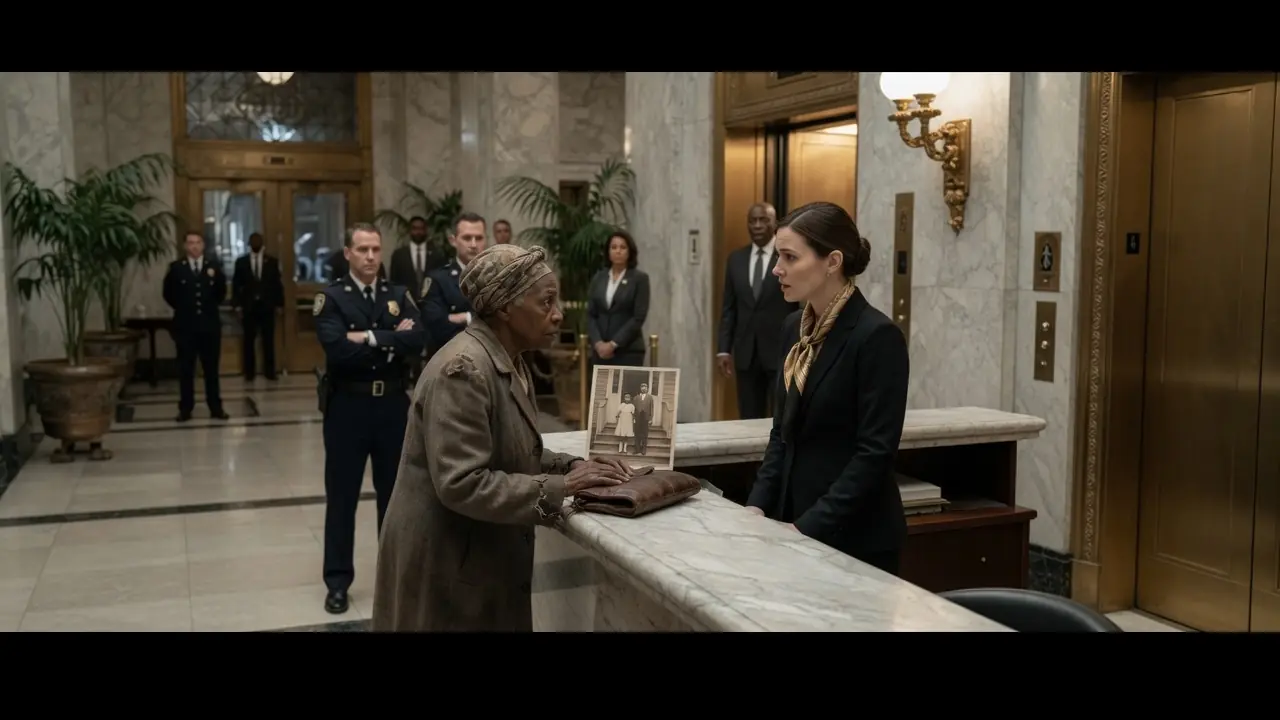
She wore a faded brown church coat, a patterned headwrap, black shoes scuffed at the toes, and thin gloves that had been mended twice at the fingers. Her walk was slow, not because she was lost, but because her knees hurt after the long bus ride from the South Side. In her purse was a folded photograph of a little boy in front of a tiny apartment building, wearing a crooked tie and holding a school certificate. That boy was now Marcus Brooks, founder and owner of Sterling Crown Bank.
Evelyn had not told Marcus she was coming. She knew he would have sent a car, a driver, maybe even a young assistant with a tablet and a schedule. But that morning, she wanted to come the way she had lived most of her life, on her own feet, carrying what mattered with both hands. It was Marcus’s fiftieth birthday, and inside the envelope was the letter his father had written before he died.
At the front counter, a white American receptionist named Claire Whitman looked up from her computer and immediately frowned. Claire wore a fitted black suit, a gold silk scarf, and the kind of neat smile that appeared only for people she considered worth welcoming. Her eyes moved over Evelyn’s coat, her old purse, her shoes, and the grocery-store bag folded inside her pocket. By the time Evelyn reached the counter, Claire had already decided she was a problem.
“Can I help you?” Claire asked, but her voice did not sound like help.
Evelyn smiled politely. “Good morning, baby. I’m here to see Mr. Marcus Brooks.”
Claire’s eyebrows lifted. “Do you have an appointment?”
“No, ma’am,” Evelyn said. “But he’ll want to see me.”
Claire’s mouth tightened. “Mr. Brooks is not available for walk-ins.”
Evelyn nodded gently, as if she understood rules even when they were placed between people. “Just call upstairs and tell him Evelyn Brooks is here.”
Claire stared at her for a second, then gave a short laugh. It was not loud, but it was sharp enough for the young teller beside her to look down at her keyboard. “Ma’am, this is the executive banking floor. People can’t just come in and claim they know the owner.”
Evelyn’s smile faded a little. “I didn’t say I know him. I said I came to see him.”
Claire leaned forward, lowering her voice in a way that somehow made the insult clearer. “You don’t belong on this floor, ma’am.”
The lobby seemed to grow quieter around them. A man in a gray suit slowed near the coffee station, pretending to check his phone. Two women in business dresses glanced toward Evelyn, then away, uncomfortable but silent. Evelyn kept both hands on the counter and breathed through the sting.
“I came to see my son, Marcus,” she said.
Claire’s expression hardened. “The owner isn’t your son.”
Before Evelyn could answer, two white American security guards stepped closer from the side of the lobby. The first was Daniel Pike, broad-shouldered, red-faced, and wearing a black uniform with a gold badge. The second was Eric Lawson, younger and taller, with his arms folded across his chest. They positioned themselves behind Evelyn as if an eighty-two-year-old woman with trembling hands might become dangerous.
Daniel Pike looked at Claire. “Everything okay here?”
Claire did not take her eyes off Evelyn. “This woman is claiming she’s here to see Mr. Brooks.”
Daniel looked Evelyn up and down. “Do you have business with the bank?”
“Yes,” Evelyn said softly. “My business is with my son.”
Eric gave a small, mocking breath through his nose. “The owner isn’t your son. Step away.”
Evelyn turned slowly and looked at him. “Young man, I changed that owner’s diapers before your mama ever knew your name.”
A teller behind the counter covered her mouth. Claire’s cheeks flushed with annoyance, not shame. Daniel stepped closer, his polished shoes nearly touching the hem of Evelyn’s coat.
“Ma’am,” he said coldly, “this lobby is for clients and scheduled visitors. You can’t come in here making scenes.”
Evelyn looked around the shining lobby. “I haven’t raised my voice.”
“You’re disturbing staff.”
“No,” Evelyn said, her voice firmer now. “I’m disturbing what you assumed.”
Claire’s eyes narrowed. “That’s enough.”
She reached for the phone, but not to call Marcus. Evelyn saw the button she pressed, saw the way the guards straightened, saw the practiced rhythm of people removing someone without ever asking the right question. Her heart began to pound, not from fear of them exactly, but from the old ache of being looked through. She had spent her whole life cleaning offices, cooking meals, raising children, and surviving grief, only to be treated like dirt on marble because her coat was old.
Daniel gestured toward the entrance. “Let’s go.”
Evelyn did not move. “Call my son.”
Claire’s voice turned icy. “Mr. Brooks does not have mothers wandering in off the street.”
The words hit Evelyn harder than she expected. She did not cry, but her eyes grew wet. She reached into her purse with slow hands, and both guards immediately stiffened.
“Hands where I can see them,” Eric snapped.
Evelyn froze. The lobby froze with her.
Then she slowly removed the old photograph and placed it on the marble counter. In the picture, a younger Evelyn stood on a cracked apartment stoop beside a little Black boy in a secondhand blazer. The boy held a paper that read Citywide Math Champion, and Evelyn had one hand on his shoulder, smiling with a pride so bright it seemed to survive the decades. On the back, in faded blue ink, Marcus had written: Mama, one day I’ll build you a bank where nobody can tell us no.
Claire glanced at the photo and looked away too quickly. “Anyone can bring an old picture.”
Evelyn stared at her. “That child ate oatmeal for dinner five nights a week because I was saving for his school shoes. That child slept in my lap during night shifts while I cleaned offices downtown. That child promised me he would build something decent if the world ever gave him a door.”
Daniel shifted, but Eric still looked unconvinced. “Ma’am, stop embarrassing yourself.”
At that exact moment, the private elevator at the back of the lobby opened.
Marcus Brooks stepped out surrounded by three executives, his assistant, and two board members visiting from New York. He was tall, sharply dressed in a navy suit, with silver at his temples and a phone in his hand. He was speaking quickly about a loan expansion program, but his words stopped the second he saw the scene at the front desk. His mother stood at the counter, surrounded by guards.
For one heartbeat, Marcus did not move. Then his face changed in a way none of his employees had ever seen. The calm billionaire owner vanished, and in his place stood the son of a woman being humiliated in his own lobby.
“What is going on?” Marcus said.
Claire spun around, startled. “Mr. Brooks, I was just handling a lobby issue.”
Marcus walked forward slowly. “A lobby issue?”
Daniel lowered his arm. Eric took one step back.
Evelyn turned toward the voice, and the strength she had been holding finally trembled. “Marcus.”
The whole lobby heard it. Not Mr. Brooks. Not sir. Marcus.
Marcus moved faster then, crossing the marble floor until he stood beside her. He looked at the guards, then at Claire, then at the old photograph lying on the counter. His jaw tightened so hard that his assistant took a step back.
“That woman is my mother,” Marcus said.
No one spoke.
Claire’s face went white. Daniel stared at the floor. Eric blinked as if his mind was trying to rebuild the last five minutes into something less terrible.
Marcus turned to the guards. “Why are two security officers surrounding my mother?”
Daniel swallowed. “Sir, we didn’t know she was—”
Marcus cut him off. “Did you ask?”
Daniel’s mouth opened, then closed.
Marcus turned to Claire. “Did you call my office?”
Claire’s voice shook. “She didn’t have an appointment.”
“That was not my question.”
“No,” Claire whispered.
Evelyn touched Marcus’s sleeve. “Son, don’t shout.”
Marcus looked down at her, and the fury in his face softened with pain. “Mama, did they touch you?”
“No.”
“Did they threaten you?”
She did not answer quickly enough.
Marcus looked back at the staff. “Clear the lobby desk.”
Claire’s eyes widened. “Sir?”
“Now.”
The young teller beside Claire stepped away immediately. Claire remained frozen for half a second, then moved aside. Marcus helped Evelyn to the nearest chair, but she resisted sitting until he sat beside her. Wealthy clients, staff members, executives, and security guards watched in silence as the owner of Sterling Crown Bank knelt slightly in front of an elderly woman in a faded brown coat and took her gloved hands in his.
“You should have called me,” Marcus said quietly.
Evelyn gave him a tired smile. “If I called, you would have sent a car.”
“I would have sent three.”
“That’s why I didn’t call.”
Despite himself, Marcus almost laughed, but the sound broke before it formed. “Mama…”
She reached into her purse and pulled out the envelope. “I came because it’s your birthday.”
His eyes lowered to it. “What is that?”
“Your father’s letter.”
Marcus went still.
“He wrote it the week before he died,” Evelyn said. “I kept waiting for the right time. Then I thought, maybe at eighty-two, I should stop waiting for perfect days.”
Marcus took the envelope with both hands. Around them, the lobby remained frozen, every person aware they were witnessing something more private than they deserved to see. Claire stood behind the desk with tears in her eyes, though no one knew whether they came from shame or fear. Daniel and Eric stood near the side wall, suddenly much smaller without authority wrapped around them.
Marcus looked at his assistant. “Cancel my next meeting.”
His assistant nodded. “Yes, sir.”
“And call HR, legal, and branch operations to the executive conference room in fifteen minutes.”
Claire flinched.
Evelyn squeezed his hand. “Marcus, don’t ruin people in anger.”
He looked at her. “Mama, they were going to throw you out.”
“But don’t become cruel because they were.”
That sentence struck the lobby harder than Marcus’s anger had. Evelyn Brooks had been insulted, doubted, surrounded, and threatened, yet she was the one reminding her son to stay human. Marcus bowed his head for a moment, and when he lifted it again, his voice was quieter but colder.
“I won’t be cruel,” he said. “I’ll be clear.”
He stood and faced the lobby. “Everyone who witnessed this will remain available for statements. No recordings are to be deleted. Security footage from every camera in this lobby is to be preserved immediately.”
Claire whispered, “Mr. Brooks, I am so sorry.”
Marcus looked at her. “You are sorry because you know who she is now.”
Claire began to cry. “That’s not fair.”
“No,” Marcus said. “What happened before you knew who she was was not fair.”
Evelyn closed her eyes, but she did not stop him.
Marcus turned toward Daniel and Eric. “You saw an elderly woman. You saw a Black woman. You saw old clothes. You saw no appointment. And instead of verifying her name, you built a story that made removal feel reasonable.”
Daniel’s voice was low. “Sir, we followed protocol.”
Marcus shook his head. “Protocol begins with identification. Bias begins with assumption.”
The words settled over the bank like judgment.
Fifteen minutes later, Evelyn sat in the executive conference room with a cup of tea warming her hands while Marcus stood at the window, trying to control his breathing. The room overlooked downtown Chicago, all glass towers and moving cars, but Evelyn looked only at her son. He was powerful now, richer than anyone in their family had ever imagined, but at that moment he looked like the little boy who used to hide report cards under his pillow until she promised she was proud before seeing the grade.
“You built a beautiful bank,” Evelyn said.
Marcus did not turn around. “Did I?”
“Yes.”
“My own mother couldn’t walk through the lobby.”
“That doesn’t mean the building isn’t beautiful. It means somebody forgot what it was for.”
Marcus turned then. “I forgot.”
She frowned. “No, you didn’t.”
“Mama, I put my name on the wall, hired people with perfect resumes, built private elevators and marble counters, and somehow created a place where you looked like you didn’t belong.”
Evelyn studied him. “You built the building. They showed you the crack.”
Marcus looked toward the closed conference room door, where HR and legal were waiting outside. “A crack like that can run through the whole foundation.”
“Then fix the foundation.”
He sat across from her. “You make it sound simple.”
“It’s not simple,” Evelyn said. “But neither was raising you.”
That made him smile faintly through the pain.
She slid the envelope toward him. “Read your father’s letter.”
Marcus looked at it for a long moment before opening it. His father, Elijah Brooks, had died when Marcus was nineteen, before the first business plan, before the first investor meeting, before the bank became anything but a dream spoken over a kitchen table. The handwriting on the page was shaky but familiar.
Marcus read silently at first. Then his eyes filled.
My son, if your mother gives you this, it means you have lived long enough to build something I prayed you would. Do not build a place that only respects polished shoes. Your mother cleaned marble floors nobody thanked her for. Remember that every grand room is held up by people others pretend not to see.
Marcus stopped reading and pressed the letter to his mouth.
Evelyn looked down at her tea. “He knew you’d become something.”
“He knew you were the reason,” Marcus said.
She shook her head. “We both were.”
By afternoon, Sterling Crown Bank had changed in ways employees could feel before any memo arrived. Claire Whitman was placed on administrative leave pending investigation. Daniel Pike and Eric Lawson were removed from lobby duty while legal reviewed the incident and past complaints. Meredith from HR, who had worked quietly for years without much power, was asked to lead a full audit of front-desk and security interactions across every branch.
Marcus did not stop there. He ordered mandatory changes to visitor verification procedures, created an escalation rule requiring staff to verify identity before removal, and opened a confidential reporting channel for clients and employees who had experienced discriminatory treatment. He also asked for three years of security incident data, broken down by age, race, gender, and outcome. The numbers that came back weeks later made several executives uncomfortable, which told Marcus the numbers were doing their job.
That evening, however, before the reports and meetings and consequences, Marcus took his mother through the bank himself. He walked slowly beside her as she leaned on his arm. Employees stood when they passed, some out of respect, some out of fear, and some because they finally understood who she was. Evelyn did not look proud of their sudden politeness.
Near the lobby wall, Marcus stopped beneath the gold Sterling Crown logo. “This should have had your name on it.”
Evelyn laughed softly. “Child, I don’t need my name on a wall.”
“I do.”
She looked up at him. “Why?”
“So nobody forgets.”
A month later, the lobby changed again. Not the marble, not the lights, not the flowers. A new framed photograph appeared beside the main entrance, showing a young Evelyn Brooks standing beside little Marcus on the apartment stoop, the same photograph she had placed on the counter. Beneath it was a brass plaque.
Evelyn Brooks Lobby.
For every person who deserves respect before recognition.
Some clients thought it was a nice tribute. Employees knew it was more than that. It was a warning, a memory, and a promise fixed to the wall where assumptions had once stood guard.
Claire eventually sent a written apology. It was careful, formal, and probably reviewed by a lawyer, but Evelyn read it anyway. Daniel Pike never returned to the bank. Eric Lawson requested a meeting with Marcus months later and admitted he had treated visitors differently when they looked poor, elderly, or out of place.
Marcus listened, then said, “The question is not whether you feel guilty. The question is whether guilt has taught you to see people.”
Eric had no quick answer.
Evelyn visited the bank again three months later. This time she wore the same brown coat. Marcus had offered to buy her a new one, and she had told him there was nothing wrong with a coat that still kept wind out. She walked through the front doors without calling ahead, her purse under one arm, her shoes still scuffed, her headwrap tied carefully.
The new receptionist looked up, smiled warmly, and stood. “Good morning, Mrs. Brooks.”
Evelyn smiled back. “Good morning, baby.”
No guards moved toward her. No one asked whether she belonged. No one told her the owner could not be her son.
Marcus came down himself, not because anyone called in panic, but because he had asked to be told whenever his mother arrived. He stepped out of the elevator and saw her standing under the plaque, looking at the photograph of the young woman she used to be. For a second, he simply watched her.
She had carried him through hunger, rent notices, secondhand clothes, and nights when she cleaned buildings owned by men who never learned her name. She had believed in him before investors did, before executives did, before he believed in himself. And somehow, the bank he built had almost turned her away.
Marcus walked to her side. “Mama.”
She touched the frame gently. “Your father would fuss at you for making all this noise over me.”
“He would agree with the plaque.”
“Yes,” she said, smiling. “He would like that part.”
They stood together in the lobby while people moved quietly around them. The marble still shone. The gold letters still gleamed. The bank still looked like money, power, and success. But now, at its entrance, there was proof that all of it had begun with an old photograph, a mother’s sacrifice, and a promise made by a little boy who had once dreamed of building a place where nobody could tell them no.
Years later, people still told the story of the day an elderly Black woman walked into Sterling Crown Bank and was nearly escorted out by employees who did not know she was the owner’s mother. Some told it like a revenge story. Some told it like a lesson in customer service. Some told it like a warning about judging people by clothes, age, and skin before asking their name.
Marcus told it differently.
He said his mother came to give him a letter, and instead, she gave his company a mirror. She showed him that a bank could have marble floors and still be poor in dignity. She reminded him that respect given only after status is revealed is not respect at all.
And Evelyn Brooks, who had once stood trembling at the counter while strangers told her she did not belong, kept visiting whenever she pleased.
Because the building was her son’s.
But the lesson was hers.