Walter Harlan had not opened the north grain silo since October of 1979. For forty-four years, it stood at the edge of his Kansas farm like a rusted metal tomb, its corrugated walls silver-gray from weather, its hinges stiff with dust, its narrow wooden door sealed with two padlocks and one promise. Neighbors had asked about it when they were younger, then stopped asking when Walter’s face made it clear the answer would not come. By the time he turned eighty-two, most people in Ford County simply called it “the old farmer’s locked silo” and treated it like another sad mystery on land that had outlived its best season.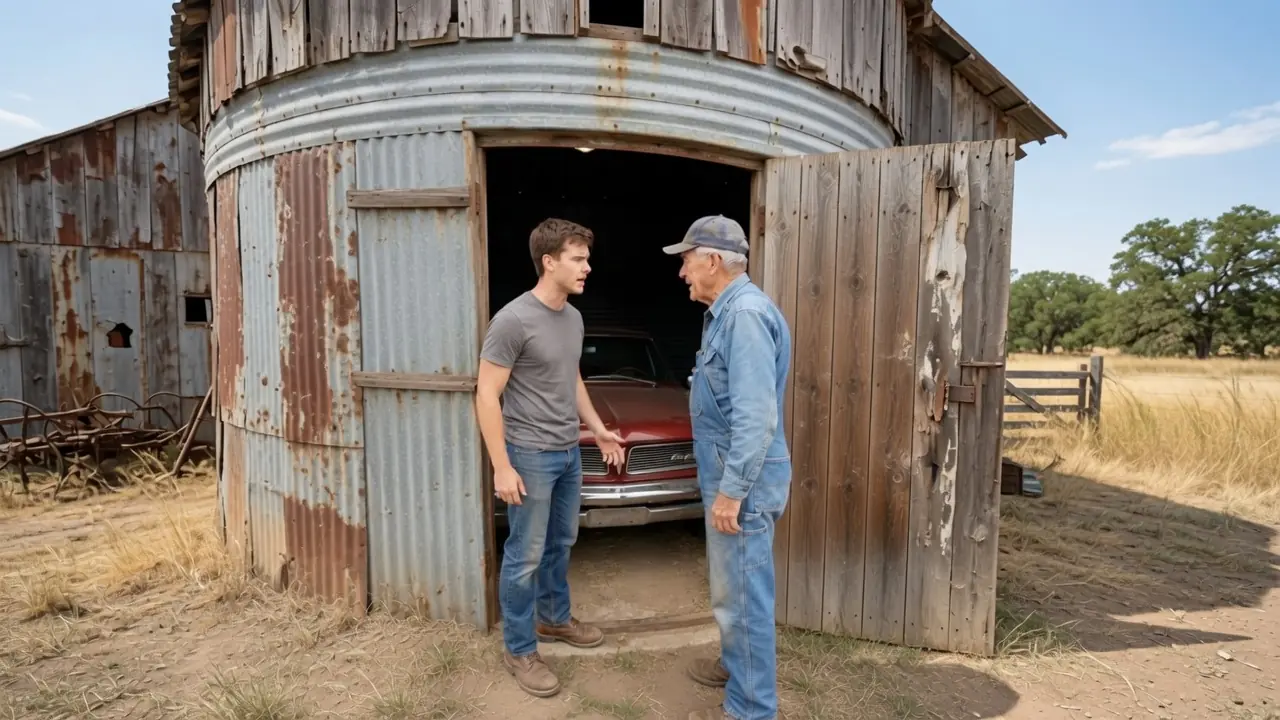
That afternoon, the sky was the color of cold ash, and wind moved across the harvested fields with a dry whisper. Walter walked toward the silo slowly, wearing denim overalls, a faded blue work shirt, and the black cap his late wife had once bought him at the county fair. His right hand held an old brass key. His left hand trembled against the wooden walking stick he pretended not to need.
Beside him, Mason Harlan carried a folder of sale papers under one arm and impatience in every step. Mason was Walter’s nephew, forty-one years old, clean-shaven, practical, and tired of watching the farm sink under unpaid taxes, broken fences, and machinery older than he was. He had driven from Wichita three times that month to convince Walter to sign the auction agreement. Each time, Walter had refused until the north silo was opened.
“You’re losing the farm because you keep guarding old junk instead of selling what’s left,” Mason said, his voice sharp against the wind. “The auctioneer needs a full inventory, Uncle Walter. We can’t keep pretending this place is still 1979.”
Walter stopped at the silo door and looked at the padlock. “That car is not junk.”
Mason frowned. “Car?”
Walter slid the key into the first lock with fingers that shook harder than the cold could explain. The metal resisted, then turned with a rough click that sounded too loud across the empty yard. He opened the second lock, removed the chain, and rested one palm against the door as if touching the shoulder of a ghost. “It’s the last place your aunt was ever happy.”
Mason’s anger faltered. “Aunt Evelyn?”
Walter did not answer. He pulled the door slowly, and the hinges screamed after forty-four years of silence. Dust rolled out of the dark opening in a gray breath, carrying the smell of old metal, dry grain, rubber, and time. Mason stepped closer, squinting into the darkness.
At first, he saw only shadow. Then the shape appeared. A long hood. A chrome grille. Two round headlights, one catching the weak daylight like an eye opening after decades asleep. As Walter dragged the door wider, the front of a deep red 1963 Pontiac Grand Prix emerged from the dark, its paint dulled by dust but still smooth beneath it, its chrome almost untouched, its tires low but not ruined.
Mason stared. “You locked a mint Pontiac in here for forty-four years… with the keys still inside?”
Walter stepped into the doorway, blocking him. His face had changed completely. The stubborn old farmer was gone, replaced by a man standing at the edge of the worst night of his life. “Because the night she left, she told me to hide it until the truth came looking for us.”
Mason looked from Walter to the car. “What truth?”
Walter swallowed. For a long moment, the only sound was wind scraping loose grass against the silo wall. Then he reached inside, felt along the doorframe, and found the old pull cord for the single hanging bulb. When he tugged it, the bulb flickered once, twice, and finally burned weak yellow above the Pontiac.
Inside, the car looked impossible. Dust covered the windshield in a soft gray veil, but the red body was nearly perfect. The seats were cream-colored vinyl, cracked only slightly along the edges. A small dried flower hung from the rearview mirror, brittle and brown after all these years.
Mason stepped over the threshold despite himself. “How is this even here?”
Walter moved slowly beside the driver’s door. “I drove it in at 2:16 in the morning on October 11th, 1979.”
“You remember the time?”
“I remember every minute of that night.”
Mason looked through the driver’s window. The keys still hung from the ignition, a small silver key ring holding a Pontiac key, a house key, and a tiny brass tag shaped like a sunflower. There was something on the passenger seat, too, barely visible beneath a yellowed cloth. Mason reached toward the door handle.
Walter caught his wrist with surprising strength. “Don’t touch it yet.”
Mason pulled back. “Uncle Walter, what happened?”
Walter’s eyes stayed on the car. “Everyone said Evelyn ran away.”
“That’s what Dad always said. He said she couldn’t stand farm life anymore.”
Walter gave a quiet laugh, but there was no humor in it. “Your father said many things that made life easier for him.”
Mason stiffened. His father, Gerald Harlan, had died five years earlier, leaving behind debts, secrets, and a reputation that depended on nobody looking too closely. He had always spoken of Evelyn with bitterness, calling her dramatic, restless, ungrateful. As a child, Mason had believed him because children believe the loudest adult in the room.
Walter wiped a hand over the dusty roof of the Pontiac. A clean red streak appeared beneath his palm. “Evelyn loved this car. She bought it used with money she saved from working at the grain office before we married. Everyone said a farmer’s wife didn’t need a car like that. She said a farmer’s wife still deserved something beautiful.”
Mason could almost see her then, though he had only known her from faded photographs. Evelyn Harlan had been young, dark-haired, smiling in a sleeveless summer dress beside the same red Pontiac. In every photo, Walter stood near her like a man still shocked happiness had chosen his house. Then, after 1979, the photographs stopped.
“What does the car have to do with her leaving?” Mason asked.
Walter leaned against the fender. “She didn’t leave because she stopped loving me. She left because she found out your father was stealing from the farm accounts.”
Mason’s mouth tightened. “My dad?”
“Yes.”
“That’s a serious thing to say about a dead man.”
“It was a serious thing to live beside.”
Walter opened the driver’s door at last. The rubber seal gave way with a soft crack. The interior smelled like old vinyl, dust, and faintly, impossibly, of the lavender sachets Evelyn used to tuck under the seats. Walter stood still, one hand on the open door, as though he expected a voice to come from inside.
“Your father was younger than me,” Walter said. “Restless. Smart enough to make money disappear and charming enough to convince people he had found more. He started with feed invoices, then equipment deposits, then loans taken against acreage he didn’t own. Evelyn found copies hidden in his desk at your grandparents’ house.”
Mason shook his head slowly. “Why didn’t she go to the sheriff?”
“She tried.”
“What happened?”
Walter’s face hardened. “Gerald got there first.”
The words dropped into the silo like stones. Mason looked at the keys hanging from the ignition, then at the cloth-covered object on the passenger seat. His father had been a county commissioner for years, connected to bankers, deputies, auctioneers, and men who shook hands in parking lots. Mason had always thought of that as influence. Now, for the first time, he wondered what influence had buried.
Walter reached into the car and lifted the yellowed cloth. Beneath it sat a leather satchel, stiff with age but intact. He did not open it. He simply held it against his chest and closed his eyes.
“That was hers,” he said. “She put everything in there. Bank copies. Letters. A ledger. Names.”
Mason whispered, “Why hide it in the car?”
“Because Gerald searched the house that night.”
Walter’s voice had gone distant. The silo around them seemed to fall away, and suddenly it was 1979 again. Rain had hammered the farmhouse windows. Evelyn had come in from town soaked through, clutching the satchel, her face pale not from fear alone but from certainty. She had told Walter they had to leave before Gerald arrived.
“He threatened her?” Mason asked.
Walter nodded. “He told her no one would believe a woman with no children, no family nearby, and a husband everyone thought was too quiet to defend her. He said if she accused him, he’d make sure the farm was taken and I was blamed for everything.”
Mason’s throat tightened. “And you believed him?”
“I believed he had enough friends to make it possible.”
“What did Evelyn want to do?”
“She wanted to drive to Topeka and give the documents to a state investigator she had contacted by letter. She had an appointment the next morning.” Walter looked at the Pontiac. “She packed the satchel. She put the keys in the ignition. Then Gerald’s truck came up the lane.”
The old farmer’s hands shook around the leather bag. Mason no longer saw a stubborn man guarding a secret. He saw an eighty-two-year-old husband still standing in the doorway of one terrible night, unable to move forward because the woman he loved had never come home.
“What happened next?” Mason asked softly.
Walter took a breath that sounded painful. “I told her to hide in the pantry while I talked to him. She said no. She said if we kept waiting for safe, safe would never come. Then she kissed me and told me to get the car out of sight if she couldn’t.”
Mason’s eyes flicked to the Pontiac. “If she couldn’t?”
“She knew Gerald had followed her from town. She knew he’d be looking for the satchel first, the car second.” Walter opened his eyes. “So she gave me one job.”
“To hide the car.”
Walter nodded. “She said, ‘If I don’t make it back by sunrise, lock the Pontiac somewhere nobody thinks to look. Leave the keys. Leave the satchel. Someday the truth will come looking.’”
Mason stepped back, overwhelmed. “Where did she go?”
“To meet the investigator early.” Walter’s voice broke. “She never reached him.”
For years, the official story had been simple: Evelyn Harlan left her husband in the night and vanished by choice. Her suitcase was gone, a little cash was missing, and no body was found. Gerald helped spread the story with practiced sadness, telling neighbors she had always wanted more than dust and wheat and an old farmhouse. Walter had not denied it loudly enough because the satchel was hidden, Gerald was watching, and fear had wrapped his throat like wire.
“I thought if I waited, someone would come,” Walter said. “Someone from Topeka. Someone looking for the documents. Someone who knew Evelyn had written. But no one came.”
“So you kept the car locked away.”
“For forty-four years.”
Mason looked at him, anger rising now, but it was confused anger, tangled with pity. “Why didn’t you tell someone later? After Gerald got old? After people changed?”
Walter’s eyes filled. “Because by then I had waited too long, and shame becomes another lock if you give it enough years.”
The sentence silenced Mason completely.
Walter finally opened the satchel. Inside were folded papers wrapped in oilcloth, a small notebook, several bank documents, and a sealed envelope addressed in Evelyn’s handwriting. The ink had faded but remained readable. On the front, it said: To Walter, if the truth takes longer than I can.
Walter’s mouth trembled. He touched the envelope but did not open it.
Mason reached gently. “Do you want me to?”
Walter shook his head. “No. I owe her the courage to read it myself.”
He opened the envelope with careful fingers. The paper inside was thin and yellowed. Walter unfolded it, and Mason stood beside him beneath the weak bulb while the old farmer read the words his wife had left before disappearing into the rain.
My dearest Walter, if you are reading this, then I did not come home when I promised. Do not blame yourself. You always thought love meant standing in front of me, but tonight I need you to stand behind the truth.
Gerald is not only stealing from us. He is stealing from half the county through false equipment loans and grain contracts. The proof is in the satchel. I gave copies to Mr. Daniel Reeves in Topeka, but if those copies disappear, this bag is the only thing left.
Hide the car. Leave the keys inside. One day someone will need to know I did not run because I was unhappy. I ran because I was trying to save what Gerald would have destroyed.
Walter stopped reading. His shoulders shook once, then again. He pressed the letter to his chest and bent over as if grief had finally found the weakness age had made in him. Mason stood beside him, unable to speak.
“I let them call her faithless,” Walter whispered. “I let them say she left me.”
Mason’s own eyes burned. “You were afraid.”
“I was a coward.”
“No,” Mason said, more sharply than he expected. “A coward wouldn’t have kept the proof safe for forty-four years.”
Walter looked at him then. The words seemed to surprise him. Maybe no one had defended him from himself in a very long time.
Mason picked up the ledger. He opened it carefully and found columns of names, dates, equipment deposits, land parcels, loan numbers, and initials. Some names belonged to families still farming nearby. Some belonged to dead men whose grandchildren now wondered why their farms had slipped away in the early 1980s. Mason saw his father’s initials again and again.
Then he saw something that made his stomach drop.
“Mason?” Walter asked.
Mason turned the ledger toward him. “My mother’s maiden name is here.”
Walter stared at the page. “What?”
“Parker. Ellen Parker. That was Mom’s family farm before Dad married her.” Mason’s voice turned hollow. “He always said her parents lost it because they couldn’t manage debt.”
Walter closed his eyes. “Gerald took from everyone.”
The silo seemed smaller now, the air heavier. The Pontiac no longer looked like a hidden treasure. It looked like a witness that had been waiting in the dark with evidence in its passenger seat and keys in the ignition, ready to drive the truth back into daylight.
Mason pulled out his phone. “We need a lawyer.”
Walter looked at him, startled. “You believe me?”
Mason looked at the ledger, the letter, the satchel, the car, and the broken old man beside him. Then he thought of his father’s polished stories, his mother’s quiet sadness, and every time Gerald had dismissed Walter as strange, weak, and stuck in the past.
“Yes,” Mason said. “I believe Evelyn.”
By evening, the farm was no longer quiet. Mason called a lawyer in Dodge City, then a retired state investigator whose name appeared in one of Evelyn’s letters. The investigator was ninety now, living with his daughter, but when Mason read him the name Daniel Reeves, the old man went silent for so long Mason thought the call had dropped. Then the man said, “I waited for that woman in Topeka. She never arrived.”
The next morning, the lawyer came to the farm with a camera, gloves, archival folders, and a seriousness that made Walter stand a little straighter. They photographed the Pontiac exactly as it had been found, keys still in the ignition, satchel on the passenger seat, dust untouched except where Walter had opened the door. They documented the silo, the locks, the papers, and Evelyn’s letter. Mason canceled the auction.
News traveled through Ford County by sundown. At first, people came because they heard about the car. A mint 1963 Pontiac Grand Prix hidden in a grain silo for forty-four years was the kind of story people wanted to see with their own eyes. Men who had once laughed at Walter’s locked silo now stood at the edge of the yard, whispering about paint condition, mileage, and value.
Then they heard about the satchel.
The whispers changed.
Three days later, families began calling Mason. A widow from Cimarron recognized her husband’s name in the ledger. A retired mechanic remembered Gerald pushing strange paperwork through the old county bank. A former deputy admitted there had been rumors after Evelyn disappeared, but nobody wanted trouble with Gerald Harlan. Piece by piece, the story that had protected him began to collapse.
Walter did not enjoy it. Mason noticed that first. The old man did not stand proudly beside the car or speak to visitors like a man finally proven right. He sat on the porch with Evelyn’s letter folded in his shirt pocket, watching people arrive too late to defend her.
One afternoon, Mason found him in the silo, sitting on an overturned bucket beside the Pontiac. The door was open now, daylight touching the red hood for the first time in decades. Walter had polished a small section of chrome with a rag, and it shone like a memory refusing to fade.
“She should have been the one to open this door,” Walter said.
Mason leaned against the frame. “Maybe she did.”
Walter looked at him.
“You kept it locked,” Mason said. “But her letter opened it.”
The old farmer’s eyes filled. He looked at the steering wheel, the keys, the dried flower on the mirror. “I never took them out.”
“Why?”
“Because she left them there.” Walter reached through the open window and touched the key ring gently. “And because part of me thought if I left everything exactly the way she told me, she might still come home to finish what she started.”
Mason swallowed hard. “Uncle Walter…”
“I know,” Walter said. “Old men can be foolish.”
“No. Old men can be faithful.”
The Pontiac was eventually removed from the silo by a professional crew, though Walter insisted on being there for every inch of it. As the car rolled into daylight, dust slid from the body in soft sheets. The red paint glowed beneath, muted but alive. Neighbors stood in silence as if watching a coffin and a crown at once.
When the engine was inspected, the mechanic found it preserved better than expected. The fuel system was ruined, the seals were tired, and the tires had to be replaced, but the car was restorable. A collector offered Walter a large sum within a week. Mason expected him to accept, because the farm still needed money and the offer could solve several problems at once.
Walter refused.
“It isn’t for sale,” he said.
Mason did not argue. The car had never been an asset. It was a promise with wheels.
The legal investigation did not bring Gerald Harlan to court because Gerald was dead, and many records had vanished long ago. But it did bring correction. Families who had carried shame over lost farms learned they had been cheated. Old liens were reexamined. A historical complaint was filed, and a local paper printed Evelyn’s name not as a runaway wife, but as the woman who tried to expose one of the largest rural fraud schemes in the county’s history.
The article arrived on Walter’s porch one Sunday morning. Mason brought it inside and placed it on the kitchen table. Walter read the headline three times.
Evelyn Harlan’s Hidden Evidence Rewrites 44-Year-Old Farm Scandal.
He did not speak for a long while. Then he folded the paper carefully and set it beside her photograph on the shelf. “There,” he whispered. “They know you didn’t leave because you stopped loving me.”
Mason looked away, giving him privacy.
In the months that followed, the farm changed in ways neither man expected. Mason stopped pushing the auction and started helping repair fences. He drove from Wichita on weekends, first out of obligation, then out of something that felt like repentance. He had spent years believing Walter was a stubborn old man trapped in grief. Now he understood Walter had been guarding the only clean truth his family had left.
The Pontiac sat in the barn under a soft cover while a restoration mechanic worked on it slowly. Walter came out every morning to check the progress. Sometimes he told Mason stories about Evelyn: how she raced a thunderstorm home and won, how she sang Patsy Cline off-key, how she said red was not a color but a decision. The stories made her less like a mystery and more like a woman who had once filled the farm with noise and light.
One clear spring day, nearly six months after the silo opened, the mechanic called Walter to the barn. “Try it,” he said, handing him the key.
Walter stared at the key in his palm. For forty-four years, it had hung in the ignition untouched. Now it felt heavier than metal. Mason stood nearby, holding his breath.
Walter slid into the driver’s seat with slow, careful movements. For a moment, he simply sat there, hands on the wheel, eyes closed. Then he turned the key.
The engine coughed once. Twice. Then the 1963 Pontiac Grand Prix came alive with a deep, uneven rumble that filled the barn and rolled out across the yard. Walter covered his mouth with one hand. Mason laughed once, then realized he was crying.
Walter looked toward the passenger seat. “Hear that, Ev?”
The car idled like something waking from a long sleep.
That afternoon, Walter drove the Pontiac down the gravel road for the first time since 1979. Mason sat beside him, the windows cracked, the Kansas wind moving through the car. They passed the wheat fields, the old mailbox, the ditch where sunflowers grew wild in summer. Walter kept both hands on the wheel, his cap low, his eyes wet but clear.
At the end of the road, he stopped by the cemetery. Evelyn’s name had never been placed on a stone because no body had ever been found, but Walter had kept a small marker near his family plot all the same. For decades, it had said only Evelyn Harlan, beloved wife. Now, Mason had arranged for a new line to be added.
She carried the truth when no one would listen.
Walter stood before the stone, the Pontiac parked behind him, red paint bright under the sun. “I’m sorry it took me so long,” he said.
Mason stood a few steps back, silent.
Walter touched the folded letter in his pocket. “But I kept the keys where you left them.”
The wind moved softly through the cemetery grass.
Years later, people still came by the Harlan farm to ask about the Pontiac in the silo. Some wanted to hear about the car itself, the mileage, the engine, the paint, the miracle of its preservation. Mason would tell them those things if they asked. But Walter, while he lived, always told a different story.
He told them about Evelyn.
He told them that a car can be more than chrome and rubber. It can be a hiding place, a witness, a promise, and sometimes the only room in the world where the truth survives. He told them that silence can protect a secret, but it can also punish the innocent if it lasts too long.
And when visitors asked why the keys had been left in the ignition for forty-four years, Walter would look toward the fields, then toward the red Pontiac resting in the barn.
“Because she told me someday the truth would need to drive itself home,” he would say.
And in the end, it did.