Twenty years ago, on a cold November afternoon in Columbus, Ohio, a young girl sat crying at a bus stop with both hands wrapped around a worn little backpack.
Her name was Emily Carter. She was twelve years old, though hardship had already taught her to sit still like someone much older.
Her coat was too thin for the weather, the zipper was broken halfway up, and the sleeves stopped above her wrists.
Every time the wind moved through the bus station, she tucked her hands deeper under her arms and tried not to shiver too noticeably.
People walked past her without stopping.
Men in work boots stepped around her backpack. A woman in a red scarf glanced at Emily’s wet face and looked away quickly, as if tears were something contagious. A college boy with headphones nearly bumped into her knees, muttered sorry, and kept walking. The station was full of movement, but none of that movement came toward her.
Emily had been sitting on the same bench for almost an hour.
Above her, the departure board clicked and changed. Buses left for Dayton, Toledo, Cleveland, Cincinnati, and smaller towns whose names meant nothing to her. The smell of diesel, wet wool, vending machine coffee, and cold pavement filled the air. Every time the door opened, a blast of winter wind pushed through the station and made her eyes water more than they already were.
She pressed one hand into her pocket and counted the money again.
Three dollars and seventy-five cents.
She needed sixteen dollars.
The ticket to Ashville, where her little brother Lucas had been placed with a foster family two months earlier, cost sixteen dollars. Emily had called the house from a pay phone the night before using the last of a phone card given to her by a school counselor. Lucas had answered in a whisper.
“Emmy?” he had said.
That one word had broken something inside her.
Lucas was seven. He had asthma, a crooked front tooth, and the habit of sleeping with one sock on and one sock missing. He hated thunder, peas, and being left alone. Their mother had died the year before after a long illness, and their father had disappeared long before that. After their mother’s death, Emily and Lucas had been separated because no foster placement in the county could take them together.
Adults had said it was temporary.
Adults said many things.
Emily had not seen Lucas in six weeks.
On the phone, his voice had sounded small.
“They said maybe you forgot me,” Lucas whispered.
Emily had pressed her forehead against the cold metal side of the pay phone and swallowed hard.
“I didn’t forget you,” she said. “I would never forget you.”
“Then why didn’t you come?”
She had no answer that would not hurt him more.
Because I do not have a car.
Because nobody wants to drive me.
Because bus tickets cost money.
Because being a child means adults can move you around and call it care.
“I’ll come tomorrow,” she said.
She did not know how.
But she promised.
That was why she was at the bus station that afternoon with three dollars and seventy-five cents, a backpack with one sandwich inside, and a hope that had started to feel foolish.
She had tried asking at the ticket counter if there was a children’s discount. The woman behind the glass shook her head without looking unkind, only tired.
“Not for that route, honey.”
Emily had asked if she could ride and pay the rest later.
The woman’s face softened then, but not enough to change anything.
“I’m sorry.”
So Emily returned to the bench.
She told herself not to cry because crying did not buy tickets. But the harder she tried to stop, the more her throat hurt. Finally, she bent over her backpack and cried into her sleeves, quietly enough that she hoped no one would notice.
But someone did.
Thomas Bennett had come to the station that day with twenty-two dollars in his wallet, a folded newspaper under his arm, and no plan to become important in anyone’s life.
He was forty-eight years old then, though the gray in his beard made him look older. He worked maintenance at St. Anne’s Medical Center, fixing leaky faucets, replacing light fixtures, oiling squeaky doors, and doing the kind of necessary work people only noticed when it was not done. He wore a dark work jacket with his name stitched over the pocket and carried a lunch pail dented on one side.
Thomas had not had an easy life, but he had made peace with the shape of it.
His wife, Marlene, had died five years earlier. They had never had children, though they had wanted them badly for a long time. After Marlene was gone, Thomas’s small apartment grew too quiet, so he filled his days with work, church, and small errands for neighbors who called him Mr. Bennett even when he told them Thomas was fine.
He was at the bus station because his older sister in Dayton had asked him to visit for Thanksgiving. He had planned to buy a ticket for the next morning, but when he entered the station and saw Emily crying on the bench, his steps slowed.
He watched for a few seconds.
Not in suspicion.
In recognition.
Thomas knew that kind of crying.
The quiet kind.
The kind a person does when they have already asked for help somewhere and been told no.
He walked past her at first, because strangers had rules around sorrow. You could not just sit beside a child without thinking about how it might look. You could not step into someone’s pain and assume you had the right.
But then Emily wiped her face with the back of her hand and whispered to herself, “I promised him.”
Thomas stopped.
He turned around.
The station kept moving around them. Announcements echoed overhead. A baby cried somewhere near the vending machines. A man laughed too loudly into a pay phone.
Thomas walked back to the bench and sat down, leaving enough space between himself and the girl not to frighten her.
For a moment, he said nothing.
Then, gently, he asked, “Why are you crying?”
Emily stiffened and wiped her face quickly.
“I’m not.”
Thomas looked straight ahead, not at her, giving her room to lie with dignity if she needed to.
“All right,” he said. “Then why are your sleeves wet?”
That startled a tiny laugh out of her, though it vanished almost immediately.
She looked at him from the corner of her eye.
“You don’t know me.”
“No,” Thomas said. “I don’t.”
“Then why do you care?”
He considered that.
“Because you are crying in a bus station, and most folks are walking like they don’t see you. I know what it feels like not to be seen.”
Emily looked down at her backpack.
For a few seconds, she fought herself. Trust was dangerous, especially for a child who had learned that adults could promise safety and still lose you in paperwork. But there was something about Thomas’s voice. It was not sweet. It was not eager. It was steady.
“I need to visit my little brother,” she said. “But I don’t have enough money for the ticket.”
Thomas turned his head slightly.
“How old is your brother?”
“Seven.”
“What’s his name?”
“Lucas.”
“Where is he?”
“Ashville.”
Thomas nodded slowly.
“You have family there?”
Emily’s mouth tightened.
“No. A foster house.”
Thomas understood enough not to ask too many questions.
“How much is the ticket?”
“Sixteen dollars.”
“How much do you have?”
She hesitated, embarrassed.
“Three dollars and seventy-five cents.”
Thomas looked at her small hand gripping the coins as if she might protect them by force if necessary.
He had planned to use his money for his own ticket to Dayton, but his sister would understand if he came later. She would complain first, because that was her way, then feed him twice as much when he arrived.
Thomas stood.
“Come on.”
Emily pulled back.
“What?”
“Ticket counter is over there.”
Her eyes widened.
“No. I wasn’t asking you to pay.”
“I know.”
“I can’t pay you back.”
“I didn’t ask.”
She stared at him with open disbelief.
Thomas smiled faintly.
“You coming, or do you want to keep freezing on that bench?”
Emily rose slowly, still holding her backpack close.
They walked to the ticket counter together. The same woman behind the glass looked from Thomas to Emily.
“One ticket to Ashville,” Thomas said. “For the young lady.”
The woman looked at Emily, then at Thomas, and something in her expression softened again. This time, there was something she could do. She printed the ticket, slid it through the opening, and Thomas paid with a ten and six ones.
Emily took the ticket like it might disappear if she held it too loosely.
She stared at the printed words.
Columbus to Ashville.
Departure: 3:40 p.m.
Her throat closed.
When they returned to the bench, she looked at Thomas with tears still clinging to her lashes.
“Why would you help a stranger?”
Thomas sat back down beside her.
For a moment, he seemed to look beyond the bus station, beyond the people, beyond the cold afternoon.
“Because years ago,” he said, “someone helped me when I needed it most. I promised myself I’d do the same for others.”
Emily waited.
Thomas rubbed his thumb along the dent in his lunch pail.
“I was seventeen,” he said. “My father had thrown me out. I had six dollars, no coat, and more pride than sense. A man named Samuel Price found me sleeping behind a church in Cincinnati. He gave me breakfast, a place to wash, and enough money for a room for one week. He didn’t make a speech. Didn’t ask me to prove I deserved help. He just said, ‘One day, when life lets you, pass it on.’”
Emily held the ticket tighter.
“Did you ever see him again?”
“No,” Thomas said. “But I never forgot him.”
The bus to Ashville was called fifteen minutes later.
Emily stood, suddenly nervous.
Thomas rose too.
“You got your sandwich?” he asked.
She nodded.
“You know who’s meeting you?”
“I can walk from the stop. I know the address.”
Thomas did not like that answer, but he also understood that children in difficult circumstances often knew routes and risks adults preferred not to imagine.
He reached into his lunch pail and pulled out a small paper bag.
“Take this too.”
“What is it?”
“Apple. Two cookies. Nothing fancy.”
Emily accepted it, blinking fast.
At the bus door, she turned back.
Thomas stood a few feet away, hands in his jacket pockets.
“One day,” Emily said, voice trembling, “I’ll pay you back.”
Thomas laughed softly.
Not unkindly.
He simply believed, as adults often do, that children make promises because promises help them survive the moment.
“You just take care of your brother,” he said.
“I mean it.”
“I believe you.”
He did not, not really.
But he smiled as if he did.
Emily climbed onto the bus and pressed her face to the window. Thomas lifted one hand. She lifted the ticket in hers, like proof that a miracle had happened.
Then the bus pulled away.
For Thomas, life continued.
He bought his ticket to Dayton the next day. He spent Thanksgiving with his sister. He returned to work at St. Anne’s Medical Center and repaired a water heater that broke in the basement. He carried groceries for Mrs. Alvarez upstairs. He sang quietly in church. He lived his small, steady life.
But sometimes, when he passed the Columbus bus station, he thought of the girl with the worn backpack.
He wondered if she had found her brother.
He wondered if she had been safe.
He wondered if she remembered him.
Emily never forgot.
That bus ride to Ashville became one of the dividing lines of her life.
Before the ticket, she believed the world was made of closed doors, busy adults, and rules that could separate a sister from her brother without asking how either child would sleep afterward.
After the ticket, she could not say the world was kind.
But she knew one person in it had been.
She reached Ashville just before dusk and walked eleven blocks to the foster house where Lucas lived. The foster mother, Mrs. Hanley, looked shocked when she opened the door and found Emily standing there with wind-burned cheeks and a bus ticket still clenched in her fist.
Lucas ran from the hallway.
“Emmy!”
He crashed into her so hard she nearly fell backward.
For the next three hours, they sat side by side on the living room floor, whispering, playing cards, and eating the cookies Thomas had packed. Emily gave Lucas the bigger one. Lucas asked where she got them.
“A man at the bus station,” she said.
“Was he nice?”
Emily looked down at the cookie crumbs in her palm.
“Yes,” she said. “He was.”
That visit did not fix everything.
Life rarely changes that easily.
Emily and Lucas remained separated for another year. There were court dates, social workers, missed calls, school changes, and nights when Emily cried silently into a pillow so no one would hear. But she kept fighting. She asked questions adults found inconvenient. She wrote down names and numbers. She learned which teachers cared, which offices returned calls, and which promises needed to be repeated in front of witnesses.
At fourteen, Emily began helping younger children in her foster home with homework.
At sixteen, she worked weekends at a grocery store.
At seventeen, she earned a scholarship to a private high school program for low-income students.
At eighteen, she gained partial custody visitation rights with Lucas through the help of a legal aid attorney who told her, “You have the heart of a lawyer, but kinder.”
That sentence stayed with her.
Emily went to college in Cleveland, then law school in Michigan, then returned to Ohio as a family law attorney. She built her career representing children in custody cases, foster care disputes, and adoption proceedings. She became known for remembering names, reading every file, and speaking calmly in court even when everyone else in the room wanted to turn a child’s life into paperwork.
She never became rich in the way some lawyers did.
She chose too many cases that paid too little.
But she became successful, respected, and financially secure. She wore tailored suits now. She owned a reliable car. She had an office with her name on the door.
Emily Carter, Attorney at Law.
The first thing she bought for that office was not art, not a new desk, not a leather chair.
It was a frame.
Inside it, she placed the old bus ticket.
Columbus to Ashville.
The ink had faded, but she could still read the date.
Every time a client sat across from her and apologized for not having enough money, Emily looked at that ticket and remembered Thomas Bennett.
She had searched for him once, years earlier.
But she knew only his first name and the patch on his jacket.
Thomas.
St. Anne’s Medical Center.
By the time she had the courage to call St. Anne’s, the person in human resources said they could not release employee information. She left her name and number, but no one called back. Life moved forward. Cases piled up. Lucas graduated high school and joined a union apprenticeship. Emily kept the ticket in the frame and carried the promise quietly.
One day, I’ll pay you back.
Twenty years passed.
Then, on a rainy afternoon in April, Emily walked into Riverside Mercy Hospital in Columbus to visit a teenage client recovering from surgery after a car accident. She was thirty-two now, confident in the way earned confidence looks different from arrogance. Her hair was pulled into a neat bun, her navy coat was still damp from the rain, and she carried a leather folder tucked under one arm.
She had just finished speaking with a nurse when she saw an elderly man sitting alone in the hallway near the billing office.
He was hunched forward in a wheelchair, one hand resting on a cane, the other holding a stack of papers. His hair was white now. His beard was thinner. His face had hollowed with age and illness. But something about the slope of his shoulders made Emily slow her steps.
She looked again.
The man lifted his head slightly when someone passed, then looked back down at the papers.
His hands trembled.
Emily’s chest tightened.
It could not be.
Twenty years was too long.
Memory could be making a shape from longing.
She walked closer.
The man’s work jacket was gone, of course. There was no stitched name, no lunch pail, no bus station bench. Just an elderly patient in a hospital hallway, weak, worried, and alone.
But then he rubbed his thumb over the corner of the papers in the same slow motion she remembered from the lunch pail dent.
Emily stopped.
“Excuse me,” she said softly.
The man looked up.
His eyes were cloudy with fatigue, but kind.
“Yes?”
Her mouth went dry.
“Are you Thomas Bennett?”
He blinked.
“I am.”
The hallway seemed to tilt beneath her.
For a moment, Emily was twelve again, cold, ashamed, holding three dollars and seventy-five cents in her pocket while the world walked past.
She sat down on the bench beside his wheelchair.
“My name is Emily Carter,” she said. “You probably don’t remember me.”
Thomas gave a tired smile.
“I’m sorry. My memory isn’t as good as it used to be.”
“That’s all right.”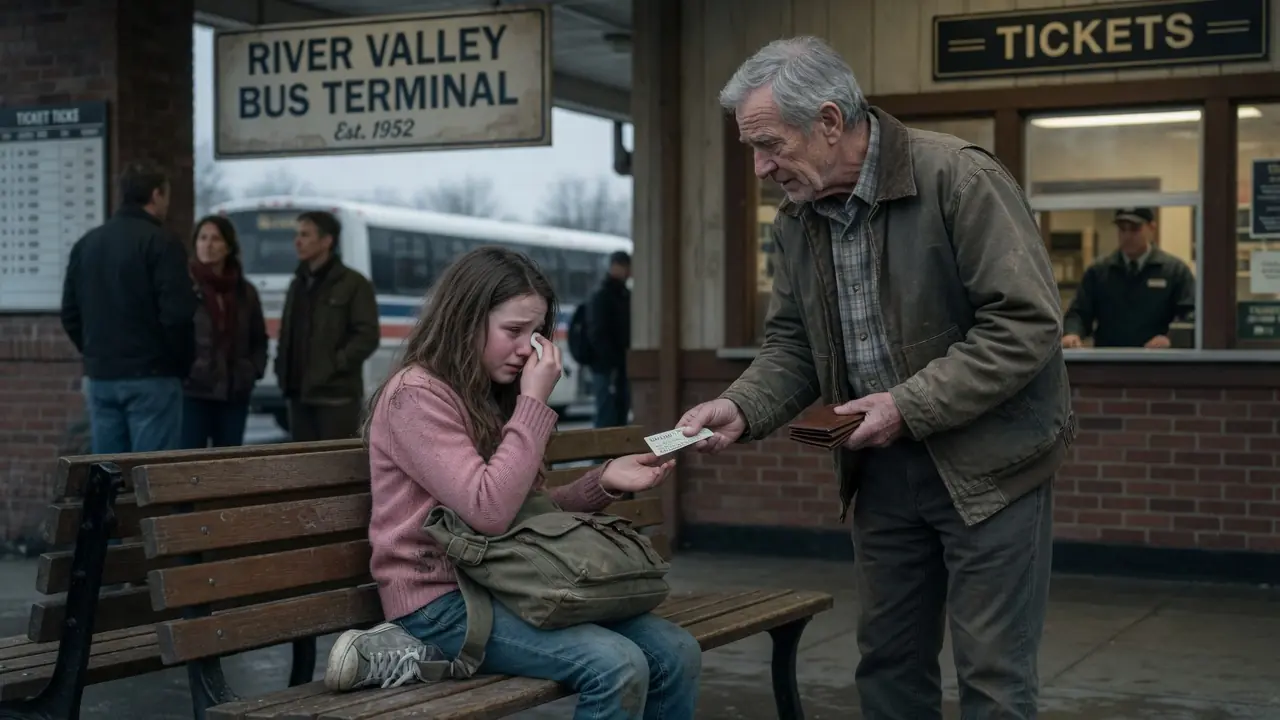
She looked at the papers in his hand.
“Do you remember a little girl at a bus stop?”
Thomas’s expression remained polite but uncertain.
Emily continued.
“Columbus station. November. Twenty years ago. She was trying to get to Ashville to see her little brother, but she didn’t have enough money for the ticket.”
The air changed.
Thomas stared at her.
His eyes searched her face, moving from the polished adult woman before him to a memory buried under years of ordinary days.
Emily smiled through tears.
“You bought her a ticket. And you gave her an apple and two cookies in a paper bag.”
Thomas’s mouth parted.
“No,” he whispered.
Emily nodded.
“Yes.”
His hand moved to his chest.
“You were the girl?”
“I was the girl.”
Thomas looked away, overwhelmed.
“My Lord,” he said softly. “You found your brother?”
“I did. It took time, but I did.”
“Is he all right?”
“He is. His name is Lucas. He’s married now. He has a little girl who steals everybody’s fries.”
A laugh broke out of Thomas, fragile but real.
Then his eyes filled.
“I wondered,” he said. “For years, sometimes, I wondered.”
Emily wiped her cheek.
“I never forgot you.”
Thomas looked down at the papers.
The joy on his face dimmed, and the worry returned.
Emily followed his gaze.
“Are those medical bills?”
He tried to fold the papers quickly, as if embarrassed.
“Nothing you need to trouble yourself with.”
“Mr. Bennett.”
“Thomas,” he corrected automatically, then smiled faintly. “Everybody calls me Thomas.”
“Thomas,” Emily said gently, “what’s going on?”
He hesitated.
Pride sat between them for a moment, old and stubborn.
Then exhaustion won.
“I have heart trouble,” he said. “Valve replacement, they tell me. I waited too long. Insurance covers some, not enough. I’ve been trying to figure out what can be delayed, what can be paid in pieces. Hospitals use polite words, but numbers don’t become kinder because someone prints them on good paper.”
Emily felt a sharp ache beneath her ribs.
“Do you have family with you?”
“My sister passed six years ago. My wife passed long before that.” He looked toward the hallway. “I had friends at church, but people get old. They move in with children. They die. They forget to answer phones. I don’t blame them.”
Emily heard the loneliness under the words.
Not self-pity.
Just fact.
Thomas had helped a crying child once and then gone on living a life so quiet that when he became the one in need, no crowd gathered around him.
Emily opened her folder.
Inside was not an envelope of cash yet. She had not expected this. But she had learned over years of law practice how to move quickly when something mattered. She took out a business card and placed it on the papers in his lap.
“I’m an attorney now,” she said.
Thomas looked at the card.
Emily Carter, Family Law and Child Advocacy.
His eyes softened.
“That suits you.”
“Because of you, in part.”
“No,” he said. “You did that.”
“You opened the road.”
He shook his head.
“I bought a bus ticket.”
“You bought me proof that someone could care without getting anything back.”
Thomas looked at her then, and the hallway around them seemed to disappear.
Emily stood.
“I need to make a few calls.”
“No,” Thomas said quickly. “You don’t owe me anything.”
She smiled.
“I know.”
He recognized the echo of his own words and stopped.
Emily spent the next three hours doing what she did best.
She gathered information.
She spoke to billing. She spoke to a patient advocate. She called a doctor she knew from a nonprofit medical board. She called Lucas and said, “I found him.” She contacted her bank, then the small charitable foundation she had created two years earlier to assist families in emergency custody and medical situations.
By evening, she had arranged the first payment. By the next morning, she had covered the remaining out-of-pocket cost for Thomas’s surgery and secured assistance for his recovery care after discharge.
But she wanted to tell him properly.
Not like a transaction.
Like a promise kept.
The next afternoon, she returned to Riverside Mercy with an envelope in her hand.
Thomas was in a quiet room by then, sitting near the window in a hospital gown, looking smaller than he had in the hallway. A tray of untouched food sat on the rolling table beside him.
He turned when she knocked.
“Emily.”
The way he said her name made her eyes burn.
As if she had always been someone worth remembering.
She walked in and sat beside him.
“I brought something.”
“If it’s hospital coffee, I refuse.”
She laughed.
“No.”
She handed him the envelope.
Thomas looked at it with suspicion.
“What is this?”
“Open it.”
His fingers were slow, so she helped him.
Inside was a letter from the hospital billing office confirming that his outstanding medical expenses related to the scheduled heart procedure had been paid in full or covered through arranged assistance. Beneath it was a note from Emily.
Thomas read the first line.
Then he stopped.
His hand began to shake.
“What is this?” he whispered.
Emily leaned forward.
“Twenty years ago, you bought me a bus ticket when nobody else would help.”
He stared at the letter.
“No.”
“Yes.”
“No, Emily. This is too much.”
“It felt like too much to me too,” she said. “At twelve years old, sixteen dollars might as well have been sixteen thousand. You gave it anyway.”
“That was different.”
“How?”
“You were a child.”
“And now you are the one sitting alone with papers you should not have to carry by yourself.”
Thomas’s eyes filled.
“I didn’t help you so you would repay me.”
“I know.”
“I never wanted that.”
“I know that too.”
“Then why?”
Emily reached into her coat pocket and took out a smaller envelope.
Inside was the bus ticket, carefully removed from its frame for the first time in years.
She handed it to him.
Thomas held it like a relic.
The faded date. The route. Columbus to Ashville.
His face crumpled.
“I kept it,” Emily said. “For twenty years. In my office. Every time I wanted to quit, every time a case got hard, every time I wondered whether helping one person mattered, I looked at that ticket.”
Thomas covered his mouth with one hand.
Emily’s voice broke.
“You told me someone helped you when you needed it most, and you promised to do the same for others.”
He nodded slowly.
“I remember.”
“I made the same promise that day.”
Thomas looked at her.
She smiled through tears.
“One day, I’ll pay you back.”
The words entered the room gently.
Then they broke him.
Thomas began to cry.
Not loudly.
Not dramatically.
But with the quiet surrender of a man who had spent his life giving what he could and never expected any of it to come home.
Emily took his hand.
“The little girl came back,” she whispered.
Thomas squeezed her fingers.
“And she kept her promise.”
His surgery took place two days later.
Emily stayed at the hospital with Lucas, who came as soon as he heard the full story. When Thomas woke after the procedure, groggy but alive, the first thing he saw was Emily on one side of the bed and Lucas on the other.
Lucas leaned down.
“You bought my sister a ticket to see me,” he said. “I don’t know if you understand what that did.”
Thomas blinked slowly.
“You were the brother?”
“I was.”
Lucas’s voice thickened.
“She came that night. I thought everybody forgot me. But she came.”
Thomas closed his eyes.
“Good,” he whispered. “Good.”
Recovery was slow.
Thomas hated needing help.
Emily understood that. She did not crowd him. She arranged what was necessary and let him keep what dignity he could. A church volunteer drove him home after discharge, but Emily and Lucas were there waiting with groceries, clean sheets, and a repaired porch light because Lucas was handy now and insisted on fixing something.
Thomas’s apartment was small and tidy. A photograph of Marlene stood on the bookshelf. A Bible lay open near the armchair. Beside it was an old lunch pail, dented on one side.
Emily stopped when she saw it.
Thomas noticed.
“Still have it,” he said.
She laughed softly.
“I remember that.”
“Held your cookies.”
“Yes, it did.”
Over the following months, Thomas became part of Emily’s life in a way neither of them had expected.
He came to her office once, walking slowly with a cane, and stood in front of the wall where she had placed the bus ticket back in its frame. Under it, she added a small brass plate.
Pass it on.
Thomas read the words and shook his head.
“You make a man sound better than he was.”
“No,” Emily said. “You were exactly as good as I needed you to be that day.”
He visited Lucas and his family for dinner. Lucas’s little girl, Sophie, climbed into his lap without permission and asked whether he was “the bus ticket grandpa.” Thomas laughed so hard he had to wipe his eyes.
“That’s me,” he said. “Bus Ticket Grandpa.”
Sophie accepted this as a proper title.
Every November, Emily and Thomas went to the Columbus bus station together.
The first time, Thomas complained.
“What are we doing here?”
“Keeping tradition.”
“I don’t have enough money to buy every crying child a ticket.”
“We’ll start with one.”
They sat on the bench where Emily thought they had met. It had been replaced years earlier, but the spot felt close enough. Emily brought coffee. Thomas brought cookies in a paper bag.
That year, they helped a young mother whose card had been declined while trying to reach Cincinnati with her toddler.
The next year, they helped a veteran get to Cleveland for a job interview.
The year after that, they quietly paid for three holiday tickets through the station’s assistance program.
Thomas would always pretend to grumble about Emily making a ceremony out of kindness.
But he came every year.
As Thomas grew older, his memory remained sharp in some ways and soft in others. He forgot appointments sometimes. He misplaced his glasses in the refrigerator once. He called Lucas “young man” for three years because he claimed names had started behaving badly in his head.
But he never forgot Emily.
And he never forgot the bus ticket.
One winter evening, nearly five years after she found him in the hospital hallway, Emily received a call from Thomas’s church pastor.
Thomas had passed away peacefully in his sleep.
He was eighty-three.
Emily sat at her kitchen table with the phone in her hand long after the call ended. Outside, snow fell softly over Cleveland. Lucas arrived an hour later with Sophie, now old enough to understand that Bus Ticket Grandpa would not be coming to dinner again.
At Thomas’s funeral, the church was fuller than Emily expected.
Neighbors came. Hospital workers came. Men from the maintenance department at St. Anne’s came, older now, carrying stories about Thomas fixing things without making anyone feel foolish for breaking them. A woman stood and said Thomas had once paid her electric bill anonymously. A young man said Thomas helped him get sober by taking him to meetings every Tuesday for six months.
Emily sat in the front pew holding the old lunch pail.
The pastor read a note Thomas had left for her.
Emily,
I used to think Samuel Price saved my life when he gave me breakfast and a room. Then I thought maybe I helped save yours with a bus ticket. But now I understand something better.
Kindness does not belong to the first person who gives it or the last person who receives it. It is a road. We step onto it when someone helps us, and if we are lucky, we spend the rest of our lives helping others find their way.
Thank you for finding me.
Thank you for keeping your promise.
Keep the ticket.
Keep passing it on.
Thomas
Emily cried then.
So did Lucas.
So did half the church.
Years later, Emily still kept the ticket in her office, though the frame had been replaced with one that protected the fading paper from light. Beside it sat a photograph of Thomas holding Sophie on his lap, both of them laughing, the old lunch pail resting on the floor beside his chair.
Clients often asked about the ticket.
Emily always told them the story.
Not because she wanted praise.
Because she wanted people to understand how small kindness can look when it begins.
A bus ticket.
An apple.
Two cookies.
A question asked gently on a cold afternoon.
And yet that small kindness had carried a twelve-year-old girl to her brother. It had given her a promise to live by. It had shaped the woman she became. It had returned twenty years later to a hospital hallway, where an elderly man sat alone with bills he could not pay and fear he was trying to hide.
The world often tells people that big changes require big power.
Emily knew better.
Sometimes, the road to a changed life begins with one stranger sitting beside a crying child and asking, “Why are you crying?”
Sometimes, the person you help disappears into the crowd, and you believe the story is over.
But love, mercy, and kindness have longer memories than people think.
Twenty years earlier, Thomas Bennett bought a little girl one bus ticket and expected nothing in return.
He thought he would never see her again.
He was wrong.
The little girl returned.
She kept her promise.
And because one man had once passed kindness forward, countless others found their way home.