Calvin Moore stepped onto the Number 19 Houston Metro bus with one hand wrapped around his wooden cane and the other holding his senior transit card. The morning heat was already heavy, pressing through the open bus doors and rising from the pavement at Fulton Park and Ride Station. At seventy-six years old, Calvin moved carefully, not because he wanted attention, but because his left hip had a way of reminding him of every year he had worked on concrete floors. All he wanted was a quiet ride across town to his doctor’s appointment.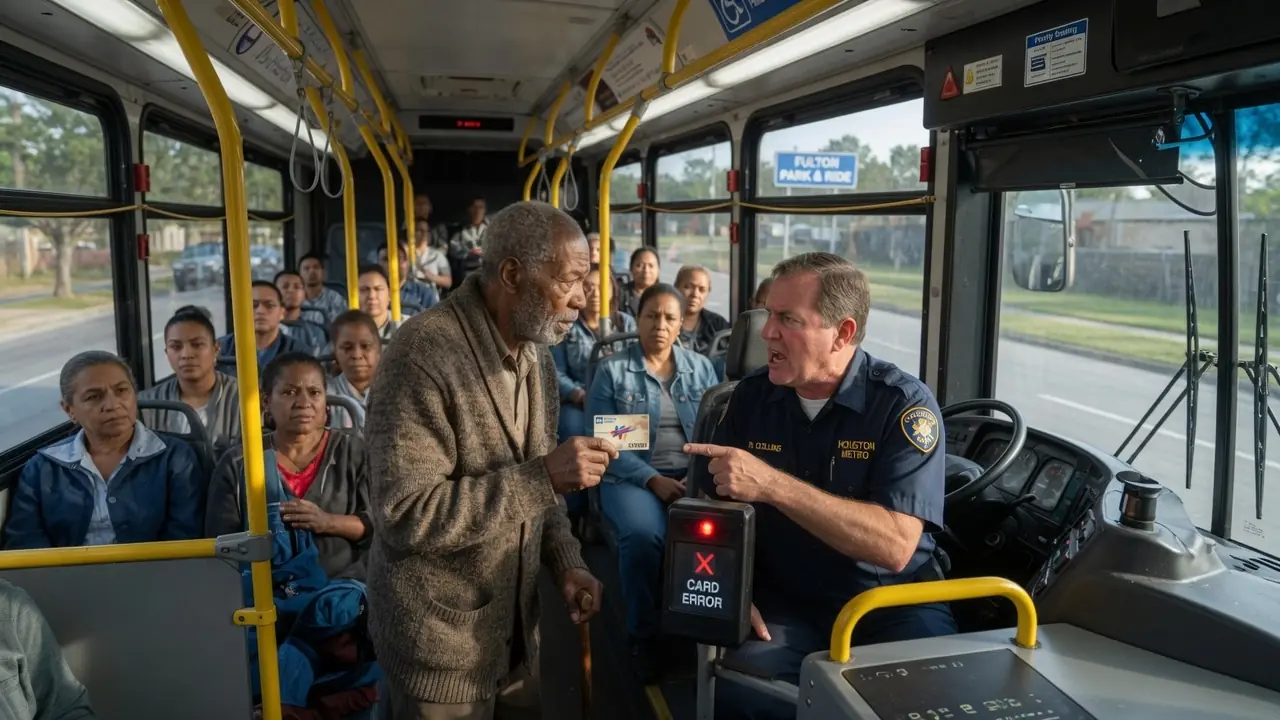
The bus smelled faintly of warm vinyl, engine air, and morning coffee from passengers heading to work. Yellow poles ran down the aisle, gray hand straps swung gently overhead, and the blue priority seating sign near the front reminded people to make space for seniors and riders with disabilities. Calvin had taken this route many times before, always at the same slow pace, always with the same small nod to the driver. He lifted his card toward the fare reader, expecting the usual beep.
Instead, the machine blinked red.
Calvin paused and tried again. The reader gave another red flash, sharper this time, as if scolding him. Behind him, a woman with a grocery bag shifted her weight, and a man in a work shirt looked at his watch. Calvin could feel the line forming behind his back, and that familiar embarrassment rose in his chest, the kind older people feel when a machine makes them look like the problem.
The driver twisted in his seat and frowned. His name tag read Randy Collins. He was a large, bald man in a dark blue Metro uniform, with a tired face and a voice already sharpened by irritation. “Sir, that doesn’t look right. Step aside. You’re holding up the line.”
Calvin looked at the card in his hand. “The card is valid,” he said calmly. “It was renewed last month. The machine might be having trouble.”
Randy leaned back with a frustrated sigh. “I don’t have time for this. If the card isn’t working, you need to pay cash. Exact change only.”
Calvin’s fingers tightened around the card. He had not brought cash because the senior card had worked every day that week. His appointment was important, and he had left early to avoid rushing. “Could we try it again?” he asked. “Or enter it manually? I’ve ridden this route many times.”
Randy’s voice rose. “Move aside, old man. If your card can’t work, maybe you’re too old to ride alone.”
The words struck Calvin harder than the red light on the machine. The front of the bus went quiet, but not quiet enough to feel safe. A young man with earbuds lowered one side and stared. A woman in the priority seat frowned, but she did not speak yet.
Calvin took a slow breath. He had been called many things in his life, but age made insults land differently. They did not just question your place; they questioned whether you still had one. “I’m only trying to get to a doctor’s appointment,” he said softly.
Randy tapped the fare box with two fingers. “Then pay like everybody else.”
“The card is my payment.”
“It isn’t working.”
“The machine isn’t working,” Calvin replied.
Randy pushed air through his nose and looked past him at the waiting passengers. “You hear that? It’s always the machine, never the passenger.” Then he pointed toward the open door. “Pay cash now, or get off before you waste everybody’s morning.”
Calvin felt his face grow hot. His hip ached from standing too long near the doorway, and his cane slipped slightly against the bus floor. He steadied himself on the yellow pole and looked down at the small blue senior card in his hand. It had his name printed on it, his photo in the corner, and an expiration date clearly showing it was valid.
“I don’t have exact change,” he said.
“Then step off.”
A few passengers murmured. The woman in the priority seat leaned forward. “Driver, maybe the reader is having trouble. It flashed red on mine earlier too.”
Randy turned sharply. “Ma’am, I’m handling it.”
“No,” she said, quieter now, but firm. “You’re embarrassing him.”
Randy ignored her and looked back at Calvin. “Last time. Off the bus.”
Calvin looked toward the aisle. Rows of faces stared back at him, some sympathetic, some uncomfortable, some pretending their phones had suddenly become very important. He had spent most of his life teaching his children not to make a scene, not to meet disrespect with more disrespect, not to let other people’s ugliness become their own. But standing there, with his card rejected and his dignity placed on trial, he wondered how much quiet a person was expected to carry.
“I have a right to ride,” Calvin said.
Randy leaned toward the door controls. “No. Step off, or I’ll call security and have you removed.”
That sentence made Calvin’s shoulders sink. He imagined missing his appointment, standing outside in the heat, trying to explain over the phone why he could not come. He imagined the other passengers remembering him only as the old man who held up the line. He began to turn toward the steps.
Then a calm voice came from the middle of the bus.
“Don’t call security, Randy. Call your supervisor.”
Everyone turned.
A tall man in a denim jacket stood from a seat halfway down the aisle. He wore a dark baseball cap, plain jeans, and work boots, nothing about him loud or threatening. But his posture carried authority, the kind that did not need shouting because it had already decided where it stood. His eyes moved from Randy to Calvin, then to the red card reader.
Randy scowled. “This isn’t your concern. Sit down.”
The man did not sit. “It became everyone’s concern when you humiliated a senior passenger over equipment that already glitched on my card.”
Randy’s jaw tightened. “You want to drive this bus?”
“No,” the man said calmly. “I want you to follow procedure.”
The bus grew still. Calvin stood near the fare reader, unsure whether to move forward or back. The man in the denim jacket stepped into the aisle, not rushing, not crowding anyone. “Sir,” he said to Calvin, “please come fully inside and take a seat. You belong here just like everyone else.”
Calvin hesitated. Those words, simple as they were, loosened something in his chest. The woman in the priority seat immediately slid over and patted the empty spot beside her. “Come sit here, sir.”
Randy slapped one hand against the steering wheel. “Nobody moves until this fare is settled.”
The man in the denim jacket looked at him. “The fare issue will be settled through the system review. Right now, you have an elderly passenger standing at the door in the heat because your reader failed.”
Randy’s face flushed red. “Who do you think you are?”
The man reached into his jacket pocket and pulled out an official badge. He held it up clearly enough for Randy, Calvin, and the front passengers to see. “Derek Lawson. Houston Metro Internal Compliance Inspector. I’ve been observing this route for quality control since the first stop.”
The entire bus went silent.
Randy stared at the badge, and the anger drained from his face so quickly that he seemed to shrink in the driver’s seat. “What do you mean?” he asked, his voice suddenly thinner.
Derek did not raise his voice. “I mean the camera above your seat recorded everything since the doors opened. It recorded the reader flashing red. It recorded Mr. Moore explaining that his card was valid. It recorded you calling him old, threatening security, and failing to follow the manual entry procedure.”
Calvin looked up at the small camera near the front of the bus. He had noticed it before, but never cared much about it. Now it felt like a witness that had not looked away.
Randy swallowed. “I was trying to keep the schedule.”
Derek stepped closer, still calm. “Schedules matter. Dignity matters more.”
A passenger near the back said, “That reader has been acting up all week.”
Another added, “He didn’t do anything wrong.”
The young man with earbuds lifted his phone. “I recorded part of it too.”
Randy turned toward the passengers, his expression caught between anger and fear. But the bus was no longer his audience. It had become a room full of witnesses. The same silence that had protected his cruelty now stood against him.
Derek turned to Calvin. “Mr. Moore, I’m sorry this happened. Please take the priority seat.”
Calvin moved slowly down the aisle, and this time nobody sighed. The woman in the front smiled gently as he sat beside her. His hip throbbed, but the relief was stronger. He looked at Derek and said, “Thank you.”
Derek nodded. “No thanks needed. Everyone deserves to be treated with dignity.”
Randy stared at the windshield, breathing hard. “Are we continuing the route or not?”
Derek’s eyes narrowed slightly. “You are not continuing anything until your supervisor arrives.”
Randy turned toward him. “You’re taking me off the route?”
“I’m documenting the incident and requesting relief supervision,” Derek said. “You raised your voice unnecessarily, failed to troubleshoot the equipment, threatened a senior passenger, and ignored another rider who reported the same machine issue. That is not how Houston Metro operates.”
The woman beside Calvin folded her hands in her lap. “Good.”
Randy heard it and looked away.
Derek spoke briefly into his phone, giving the route number, bus ID, location, and driver name. Then he moved to the front and addressed the passengers. “Ladies and gentlemen, thank you for your patience. We will be delayed for a short review, but the route will continue shortly.”
No one complained.
Calvin sat quietly, looking down at his senior card. His hand was still trembling slightly, but not from fear anymore. He hated that one small machine error had made him feel so exposed. At his age, he had learned that the world often demanded proof from people who had already spent a lifetime earning respect.
He had worked for thirty-eight years as a maintenance technician at a hospital, repairing equipment most patients never saw but depended on every day. He had raised three children, buried his wife, paid taxes, volunteered at church food drives, and helped neighbors fix porches after storms. Yet on that bus, with one red blink from a card reader, a younger man had decided Calvin was a burden. It hurt because it revealed how quickly a person could be reduced.
Derek came to sit across from him while they waited. “Mr. Moore, are you all right?”
Calvin gave a small nod. “I’ve had worse mornings.”
“That doesn’t make this one acceptable.”
Calvin looked at him then. Derek’s face was steady, but there was real concern behind his eyes. “Most people just look away,” Calvin said.
Derek glanced down the aisle at the passengers. “Sometimes people need one voice to remind them they have one too.”
A few minutes later, a Metro supervisor arrived in a white SUV. Her name was Angela Price, and she boarded with a tablet in one hand and a serious expression on her face. Randy immediately began explaining before she had even stepped past the fare box. “The passenger’s card failed, and I was trying to keep the line moving.”
Angela held up a hand. “I’ll review the recording.”
Randy stopped.
Derek gave her a concise report. Several passengers confirmed what happened, including the woman in the priority seat and the young man who had recorded part of the exchange. Calvin answered Angela’s questions quietly and showed her his senior card. She scanned it with a handheld device from her bag.
The device beeped green.
Angela looked at Randy. “The card is valid.”
Randy’s face tightened. “Then the reader must be faulty.”
“Yes,” Angela said. “Which means you should have followed faulty reader procedure.”
Randy said nothing.
Angela reviewed the bus camera footage on her tablet while standing near the fare box. The passengers waited in heavy silence. Calvin watched her face as she listened to Randy’s words from only minutes earlier. Move aside, old man. Maybe you’re too old to ride alone. Pay cash now, or get off.
Angela closed the tablet.
“Mr. Collins,” she said, “you are relieved of duty for the day pending full review.”
Randy stared at her. “You’re serious?”
“Very.”
“This is over one passenger?”
Angela’s face hardened. “No. This is over how you treated one passenger when you thought it did not matter.”
That line traveled through the bus with quiet force.
Randy gathered his bag without looking at anyone. As he stepped down from the bus, he avoided Calvin’s eyes. Calvin did not need an apology from him in that moment. He needed the system to say what Randy had done was wrong, and now it had.
Angela turned to Derek. “Can you take the bus to the transfer station? A replacement driver will meet there.”
Derek nodded. “Yes.”
He moved into the driver’s seat, adjusted the mirrors, and checked the fare reader. Angela placed a temporary notice over it: Reader out of service. Fares verified manually. Then she addressed the passengers with a professional apology and stepped off.
The doors closed.
For the first time that morning, the bus moved forward with a sense of peace. Derek guided it smoothly back into traffic, and nobody seemed in a hurry to complain about the delay. The woman beside Calvin introduced herself as Mrs. Alvarez. She told him she had seen the reader glitch twice that week and wished she had spoken up sooner.
“You spoke up today,” Calvin said.
She smiled sadly. “After someone else did first.”
“That still counts.”
The bus rolled through Houston streets, past gas stations, apartment buildings, shade trees, and morning traffic. Sunlight slipped through the windows and touched the yellow poles. Calvin leaned back in the priority seat and let his breathing settle. The appointment still waited across town, but the morning had already become something larger than a ride.
At the next stop, two passengers boarded. Derek explained the reader issue clearly and entered their fares manually. He spoke to each person with patience, even when one woman’s card took extra time to verify. Calvin watched him and felt something inside him ease. The procedure had always existed; Randy had simply chosen not to use it.
When Calvin’s stop approached, Derek called out warmly, “Mr. Moore, your stop is next.”
Calvin stood slowly, and Mrs. Alvarez offered him her arm until he found his balance. He walked to the front, cane tapping lightly against the floor. Derek opened the door and looked back at him.
“Take care of yourself, sir,” Derek said. “Safe travels.”
Calvin paused at the steps. “You did more than inspect a route today.”
Derek shook his head slightly. “I did my job.”
Calvin smiled. “Then keep doing it that way.”
He stepped down into the Houston heat. The air was still thick, the sidewalk still bright, and his hip still ached, but the day felt lighter than it had when he first climbed aboard. He stood for a moment and watched the bus pull away, carrying the witnesses of a small but important correction.
At the clinic, the nurse noticed he seemed tired and asked if the walk from the stop had been too much. Calvin almost said no, almost brushed the morning aside the way older people often do when they do not want to be treated like trouble. Instead, he told her what happened. By the time he finished, she had stopped typing and was listening fully.
“That was wrong,” she said.
“Yes,” Calvin replied. “But someone made it right.”
The story spread quietly over the next few days. A passenger posted a short clip online, not to mock Randy, but to praise the inspector and the elderly man who stayed calm. Local riders recognized the route. Some shared their own stories of being rushed, dismissed, or embarrassed when fare equipment failed. Houston Metro issued a brief statement confirming that a driver was under review and that faulty reader procedures would be reinforced.
Calvin’s grandchildren found the clip before he told them. His oldest granddaughter, Tasha, called him that evening with worry in her voice. “Granddad, why didn’t you tell us somebody tried to throw you off a bus?”
Calvin sat in his armchair, looking at the cane resting beside him. “Because by the time I got home, I was more grateful than angry.”
“You should be angry.”
“I was,” he said. “But anger is heavy. I do not carry what I do not need.”
His grandson Malik got on the phone next. “I would have yelled at that driver.”
Calvin chuckled softly. “I know you would have.”
“He deserved it.”
“Maybe,” Calvin said. “But sometimes a calm witness does more damage to wrongdoing than shouting ever could.”
A week later, Calvin received a letter from Houston Metro. It apologized formally for the incident and confirmed that his senior card was valid, the bus reader had malfunctioned, and the driver had violated service expectations. It also invited him to attend a listening session for senior and disabled riders. Calvin read the letter twice, then placed it in a folder with his transit card paperwork.
He almost ignored the invitation. He was tired, and a part of him wanted the whole thing to fade. But then he thought about the next elderly rider with no cash, the next person whose hands shook under a driver’s impatient glare, the next passenger who might step off a bus believing they had no right to stay. So he attended.
The listening session was held in a community room at a Metro office. Derek was there, along with Angela Price, several route supervisors, riders, and staff trainers. Calvin sat near the front and listened as people spoke about card errors, rushed boarding, confusion with fare machines, and the shame of being treated like a problem in public.
When it was his turn, Calvin stood with one hand on his cane. The room quieted.
“I am not here because one driver embarrassed me,” he said. “I am here because embarrassment can become a barrier. Some people stop riding after being treated that way. Some miss appointments. Some stop asking for help. Respect is not extra service. It is part of the ride.”
Derek looked down, moved by the words.
Calvin continued, “A bus is not just a vehicle. For many of us, it is the way we reach doctors, grocery stores, jobs, family, and dignity. When someone stands at that fare box, they are not standing there as a delay. They are standing there as a person trying to get somewhere.”
The room stayed silent for a moment after he finished. Then Angela thanked him and promised the training would include rider testimony, not just written policy. Calvin believed her because he saw in her face the seriousness of someone who had finally connected procedure to pain.
Months later, Calvin rode the Number 19 again. He stepped onto the bus with the same cane, the same careful movement, and the same senior card. A different driver greeted him with a nod. The reader beeped green on the first try.
“Good morning, sir,” the driver said. “Take your time.”
Calvin smiled faintly. “Thank you.”
He took the priority seat and looked out the window as the bus moved into traffic. Houston passed by in ordinary pieces: schoolchildren waiting at corners, workers in uniforms, mothers pushing strollers, elderly riders standing under stop signs, all of them carrying lives no machine could read. He thought of Randy, Derek, Angela, Mrs. Alvarez, and the moment the whole bus went silent.
The silence had mattered. It had been the sound of people realizing that one man’s humiliation was not entertainment, not inconvenience, not someone else’s problem. Then Derek’s calm voice had turned that silence into action.
Calvin reached into his pocket and touched the edge of his transit card. It was just plastic, a small thing tied to an account and a fare system. But that morning, it had become a test of whether a person’s dignity could survive a machine error and another man’s impatience.
It had.
Because one voice stood up.
And sometimes, on an ordinary bus under the Houston sun, one voice is enough to remind everyone that an old man with a cane is not a delay, not a problem, and not a burden.
He is a passenger.
He belongs.