Meanwhile, at the security checkpoint, Gary Patterson was escalating the situation, seemingly enjoying the authority he held over the elderly veteran.
“I am going to need you to step aside,” Patterson announced to James, his voice carrying across the terminal. “I am calling my supervisor to examine this false identification and the supposedly authentic military documents you claim to possess.”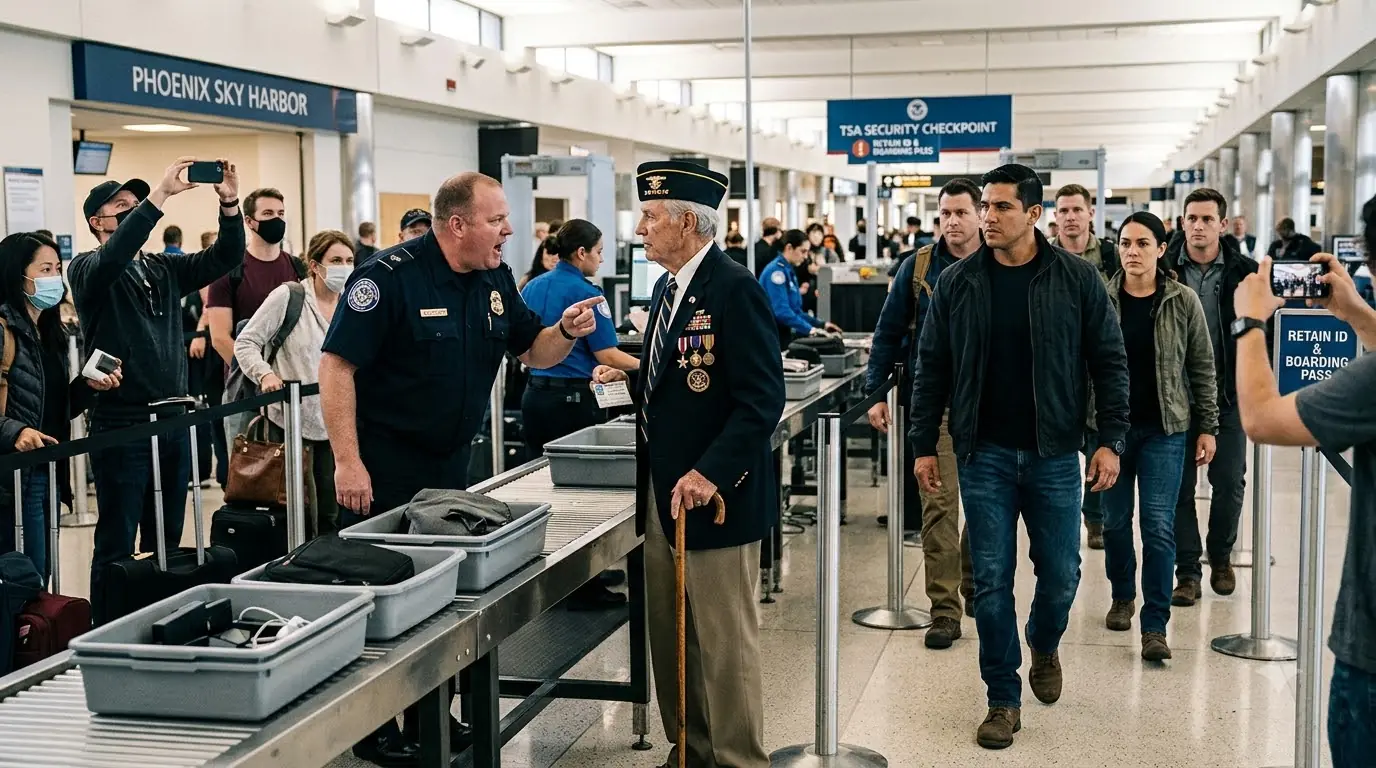
James felt his face burn with embarrassment as hundreds of travelers watched him being singled out and publicly humiliated. Security cameras recorded the interaction, passengers openly filmed with their phones, and he could already imagine the headlines accusing an elderly man of stolen valor inside an airport.
“Sir,” James said, keeping his voice controlled despite the storm of emotions inside him, “I understand that you are doing your job, but I am telling you the truth. I served my country for four decades, and I earned every medal and commendation I received through sacrifice and service in combat zones around the world.”
Patterson’s response was swift and cruel, delivered with the casual contempt of someone who had never faced the danger or sacrifice he was mocking.
“Save the speech for someone who believes you, old man. Real veterans do not need elaborate stories to prove themselves. If you were truly some kind of war hero, you would have better documentation than this questionable identification card that probably came from an online scam.”
When Patterson announced that he was calling another supervisor to examine the supposedly false identification, Master Chief Marcus Rodriguez made a decision that would change everything.
“Excuse me,” Rodriguez said.
He stepped out of line with the controlled movement of someone who had spent years operating in dangerous places. His voice carried the unmistakable authority of a man accustomed to being heard during situations where hesitation could cost lives.
“I could not help overhearing your conversation with this gentleman.”
Patterson looked up from James’s identification, visibly annoyed by the interruption and irritated that his display of authority was being questioned.
“Sir, return to your place in line. This security matter does not concern you, and I need you to mind your own business.”
Rodriguez smiled, but there was nothing friendly or accommodating in the expression.
Only minutes earlier, 78-year-old Colonel James Mitchell had approached the Transportation Security Administration checkpoint at Phoenix Sky Harbor International Airport with no idea that showing his military identification would lead to one of the most humiliating experiences of his postwar life.
The security supervisor had taken one look at the elderly man with the cane and immediately assumed that his military status was fraudulent. He loudly suggested that men James’s age frequently invented stories about medals and military service to receive special treatment.
What happened next would be captured on dozens of phones and eventually viewed by millions of people.
Six young men wearing ordinary civilian clothing had witnessed the entire exchange. They were not tourists, salesmen, or businessmen returning from a conference.
They were members of SEAL Team Seven returning from an overseas deployment.
They were about to remind everyone inside that terminal what military brotherhood truly meant.
The morning sun streamed through the windows of Phoenix Sky Harbor International Airport as travelers hurried through the terminal. It was shortly after seven in the morning, and the security checkpoint was crowded with business travelers, families, and vacationers heading across the country.
Among the crowd, Colonel James Mitchell moved with the measured pace of someone who depended on a polished wooden cane. Shrapnel wounds from Vietnam had caught up with his aging joints, and every long walk required patience.
He wore a navy blazer over khaki slacks and looked like any other elderly gentleman traveling to visit family.
Inside his wallet, however, was documentation connected to a military career spanning forty years. Among those papers was a worn copy of his Medal of Honor citation, awarded after he saved forty-three soldiers during a devastating ambush in Vietnam.
That day was important to James.
He was flying to Norfolk, Virginia, for his great-nephew’s Marine Corps commissioning ceremony. It was the first time in nearly a decade that he had felt strong enough to make such a demanding journey alone.
James had prepared carefully.
His medication was packed in labeled containers. His dress uniform had been sent ahead to Norfolk. His military identification, travel papers, and medical documentation were organized inside a small leather folder.
He had awakened before dawn, polished his shoes, straightened his blazer, and stood for several minutes in front of the photograph of his late wife.
“I will tell him you would have been proud,” he had whispered before leaving home.
At the airport, James joined the security line and waited patiently.
When he reached the front, he presented his military identification with the same crisp precision he had maintained throughout his career.
“Good morning,” he said. “I am traveling to Norfolk for a military ceremony.”
The first agent examined the identification routinely. Nothing about the exchange appeared unusual until Gary Patterson, the supervising officer nearby, noticed the military card and stepped closer.
Patterson had worked at the airport for twelve years. Over time, he had developed cynical assumptions about elderly travelers who claimed military status, especially those carrying old forms of identification or documents that did not resemble the newer cards he saw every day.
“Let me examine that,” Patterson called loudly.
The first agent handed him the identification.
Patterson studied it with exaggerated suspicion, turning it beneath the overhead light as though expecting the ink to disappear.
“This looks questionable.”
James waited.
“The photograph does not really look like you,” Patterson continued.
“Sir, I assure you that the identification is genuine. The photograph is several years old, and I served in the United States Army for forty years.”
Patterson gave a dismissive laugh.
“That is exactly what someone using false identification would say.”
His voice was loud enough for nearby travelers to hear.
“We see stolen-valor schemes all the time. You older men always tell the same story. Purple Heart, Bronze Star, secret missions, right? You think you can display a military card and receive special treatment.”
The accusation struck James like a physical blow.
Throughout his life, people had asked about his service. Some had thanked him. Others had been uncomfortable when they learned how much combat he had experienced.
Nobody had ever publicly accused him of pretending to be a veteran.
Dozens of travelers turned to watch. Several raised their phones and began recording.
James felt suddenly exposed beneath the bright airport lights.
He remembered standing before young soldiers in muddy uniforms, telling them that fear was natural but dignity was a choice. He remembered speaking to grieving families, accepting folded flags, and promising mothers that their sons had served with honor.
Now, at seventy-eight, he was being treated like a fraud because one man decided his age and appearance made him suspicious.
“As a matter of fact,” James said quietly, “I did receive several decorations, including one I would rather not have earned under the circumstances in which it was given.”
Patterson rolled his eyes theatrically, encouraged by the attention surrounding them.
“Of course you did.”
“I suppose you saved your entire unit too. Let me guess, Vietnam hero? That is a popular stolen-valor story. Next, you will tell me that you received the Medal of Honor or some other decoration.”
What Patterson did not know was that six men standing together in the civilian security line had been watching the exchange with increasing alarm and anger.
Their casual clothing concealed years of military discipline. Nothing about their appearance identified them as members of one of the most highly trained units in the United States military.
Master Chief Petty Officer Marcus Rodriguez noticed the confrontation first.
At thirty-four, Rodriguez was the senior enlisted member of the group. He had completed five overseas deployments and received a Silver Star for actions he was not permitted to discuss outside his unit.
Rodriguez was a Latino American from East Los Angeles. He had experienced his own share of suspicion and prejudice, and he recognized the expression of a man being unfairly targeted because someone had already decided what kind of person he must be.
“You seeing this?” Rodriguez whispered to the man beside him.
Chief Petty Officer David Chen followed his gaze.
Chen was a thirty-one-year-old Asian American from San Francisco who had completed four combat deployments and earned several decorations for actions in Iraq and Afghanistan.
“That is a real veteran being publicly disrespected by someone who has no idea what military service costs,” Chen replied.
His jaw tightened as Patterson continued humiliating James before hundreds of travelers.
The other four members of the team had also turned their attention toward the checkpoint.
Petty Officer First Class Robert Washington, a twenty-nine-year-old Black American from Detroit, had been checking messages on his phone when the confrontation began. Without speaking, he switched to camera mode and started recording.
Experience had taught Washington that injustice became easier to deny when nobody preserved the evidence.
Petty Officer First Class Kevin O’Sullivan, a twenty-eight-year-old Irish American from Boston, stood nearby with anger building behind his controlled expression.
Petty Officer Second Class Michael Thompson, a twenty-six-year-old white American from rural Montana, clenched his hands at his sides.
Petty Officer Second Class James Park, a twenty-five-year-old Korean American from Seattle, watched Patterson closely, already studying the identification card and procedural details from a distance.
“This is unacceptable,” Thompson whispered. “That man served his country, and Patterson is treating him like a criminal based on assumptions about his age.”
Rodriguez watched Patterson announce that he would summon another supervisor and investigate the elderly man’s supposedly false documentation.
That was when Rodriguez stepped out of line.
Patterson ordered him to return to his place.
Rodriguez’s expression remained calm.
“Actually, this concerns me very much.”
His voice carried across the checkpoint, and several nearby travelers stopped what they were doing.
“I am active-duty military, and so are the five men traveling with me. We have watched you publicly disrespect a fellow veteran for the past fifteen minutes, and we are not going to remain silent any longer.”
As if responding to an unspoken command, the other five SEALs stepped out of line.
They moved with the precise coordination developed through years of training together and formed a loose semicircle near the checkpoint.
They made no threatening gestures.
They raised no voices.
Their presence alone changed the atmosphere.
These were not ordinary passengers seeking attention. They carried themselves with the quiet discipline of men accustomed to responsibility, danger, and consequences.
Patterson’s confidence began to weaken.
The authority he had exercised so casually over an elderly traveler felt less impressive when confronted by six active-duty service members who immediately recognized the gravity of his behavior.
“Look, I do not know who you think you are,” Patterson said, though some of his earlier arrogance had disappeared. “I am doing my job. This man’s identification looks suspicious, and I have the right to question it.”
“I am Master Chief Petty Officer Marcus Rodriguez, United States Navy SEALs.”
Rodriguez removed his military identification with the same crisp precision James had displayed earlier.
“These men are my teammates. We have just returned from an overseas mission and are traveling home to see our families.”
He gestured toward James.
“Just like this gentleman is traveling to see his family.”
James watched the exchange with a mixture of amazement, relief, and gratitude. Someone was finally standing beside him.
David Chen stepped forward with his own identification in hand.
“Chief Petty Officer David Chen. I would like to examine the military identification you claim is fraudulent.”
Patterson drew the card closer to himself.
“That is not your responsibility.”
“I have completed military security checks in airports and installations across the world,” Chen said. “I know what authentic documentation looks like, including older identification formats issued to retired personnel.”
Patterson suddenly found himself surrounded, not physically trapped, but morally and procedurally cornered.
The confrontation had moved far beyond the simple display of authority he expected when he first challenged James.
“Now, wait a minute,” Patterson began.
“No,” Rodriguez said.
His voice dropped to a quiet level that carried more force than shouting.
“You wait.”
The terminal grew quieter around them.
“This man told you that he served his country. He told you that he earned his decorations through military service and sacrifice. Instead of verifying his documentation professionally and privately, you accused him of stolen valor in front of hundreds of people.”
Robert Washington stepped forward with his phone visible in his hand.
The recording continued.
“What is your full name, sir?”
Patterson looked at him.
“Why?”
“I want to spell it correctly when this video is reviewed.”
Patterson’s face paled as he understood the implication.
“You cannot record me without permission. This is a federal facility.”
“We are standing in a publicly accessible area,” Washington replied calmly. “You are a public employee performing official duties in front of passengers and security cameras.”
He held the phone steady.
“You are publicly humiliating a veteran. This interaction is being documented.”
By then, the confrontation had attracted a significant crowd.
Travelers gathered near the checkpoint, forming an unplanned audience. Many were filming, and the mood in the terminal had shifted from hurried indifference to moral outrage.
People began whispering among themselves.
A middle-aged woman near the front shook her head.
A man wearing a veteran’s cap moved closer, his expression severe.
Parents quietly explained to their children that the elderly man had served in Vietnam.
Kevin O’Sullivan turned toward James. His expression softened with the respect one service member showed another.
“Sir, what is your name and unit? We would like to know who we are standing beside.”
James straightened slightly.
“Colonel James Mitchell, retired. I served with the First Infantry Division in Vietnam and later commanded several units during a forty-year career in the United States Army.”
“When were you in Vietnam?” O’Sullivan asked.
“Three tours between 1968 and 1974.”
James’s gaze moved somewhere beyond the terminal.
“We lost many good men. We completed our mission and brought home as many as we could.”
Rodriguez recognized the restrained way James described his service.
Veterans who had lived through serious combat rarely spoke about it with the dramatic certainty of movies. They stated facts carefully, often reducing extraordinary actions to short sentences because the memories carried too much weight for performance.
“What decorations did you receive, sir?” Rodriguez asked.
From James’s bearing and the disciplined way he held himself, Rodriguez suspected the elderly man had distinguished himself under fire.
James hesitated.
It was not because he had forgotten or felt uncertain.
He had spent much of his postmilitary life avoiding that exact conversation. Mentioning his highest decoration often made people uncomfortable, skeptical, or excessively reverent.
James did not want strangers treating him like a monument.
He wanted to be treated like a man.
“I received the usual service decorations,” he said carefully, “including a Purple Heart for injuries sustained during my second tour.”
Michael Thompson stepped forward.
“Sir, with respect, the Master Chief asked which decorations you received. All of them.”
Thompson’s voice was gentle.
“We understand military honors. You do not need to minimize your service around us.”
James looked at the six men standing beside him.
Then he looked at the crowd recording the exchange.
These young warriors understood the cost of military service, the bonds created by danger, and the burden carried by those who returned when others did not.
They deserved the truth, even if speaking it made him uncomfortable.
“I received the Medal of Honor,” James said quietly.
The words barely carried above the ambient noise of the terminal.
“For actions during an ambush near the Cambodian border.”
The statement moved through the crowd like a physical force.
Whispers stopped.
People lowered their conversations.
Even agents processing passengers at nearby lanes paused.
The Medal of Honor was the nation’s highest military decoration, awarded for extraordinary heroism under combat conditions. Very few living Americans had received it.
Rodriguez’s expression changed immediately.
In fourteen years of military service, he had never met a Medal of Honor recipient in person.
Every SEAL around him straightened.
“Sir,” Rodriguez said, his voice filled with profound respect, “would you be willing to show us the citation?”
James looked toward Patterson, then back toward Rodriguez.
“I carry a copy.”
He reached carefully into his wallet and removed a folded document he had protected for more than fifty years.
His hands were weathered by age but remained steady as he unfolded the paper.
The document bore official seals and the signature of the President of the United States.
The paper had softened at the folds after decades of careful handling, but the words remained clear.
Rodriguez accepted the citation with the reverence normally reserved for sacred objects.
He looked toward James for permission.
The retired colonel nodded.
Rodriguez cleared his throat and began reading aloud.
His voice carried across the now-silent terminal.
“For conspicuous gallantry and intrepidity at the risk of his life above and beyond the call of duty while serving as a company commander with the First Infantry Division during combat operations against an armed enemy in the Republic of Vietnam.”
The crowd listened without movement.
“When his company was ambushed by a superior enemy force, Captain Mitchell repeatedly exposed himself to intense hostile fire to direct the evacuation of wounded soldiers and coordinate defensive positions.”
James lowered his eyes.
“Despite being wounded, he moved through the combat area to reach isolated soldiers, disabled three enemy machine-gun positions, and led a counterattack that saved the lives of forty-three American service members.”
Rodriguez’s voice tightened slightly.
“His extraordinary heroism and selfless devotion to duty were in keeping with the highest traditions of military service and reflected great credit upon himself, his unit, and the United States Army.”
When Rodriguez finished, the terminal remained completely silent.
The weight of James’s actions settled over everyone present.
Patterson stood motionless.
For the first time, he appeared to understand the magnitude of what he had done.
He had accused a Medal of Honor recipient, one of the country’s most highly decorated living veterans, of stolen valor before hundreds of witnesses and dozens of cameras.
James Park removed his phone and began searching official military records.
His fingers moved quickly.
Within moments, he found a verified entry.
“Colonel James Mitchell, Medal of Honor recipient, Vietnam.”
Park turned the screen toward Rodriguez and then toward the nearby travelers.
“Official record confirmed.”
He continued reading.
“Three Bronze Stars, two Silver Stars, Purple Heart with oak leaf clusters, Army Commendation Medal with valor device, and numerous service decorations across a forty-year career.”
Park looked toward Patterson.
“This man is exactly who he said he was.”
Patterson was now completely trapped by the consequences of his assumptions.
He stood before six Navy SEALs, an increasingly angry crowd, and a veteran whose service record had been verified in real time.
The situation had moved completely beyond his control.
Robert Washington was not finished.
As a Black American SEAL who had faced skepticism and discrimination during his own career, he understood the damage caused when people were judged by age, appearance, or assumptions about what they were capable of achieving.
“Mr. Patterson,” Washington said, his voice controlled but edged with authority, “I need to ask you something.”
Patterson looked toward him reluctantly.
“I want you to think carefully before answering.”
Washington gestured toward James.
“If this gentleman were younger, would you have questioned his identification with the same hostility and public humiliation?”
Patterson’s face reddened.
“That is not what this is about.”
“Is it not?”
Washington’s voice grew stronger.
“I have passed through this checkpoint many times. I have never seen a younger veteran’s military identification challenged in this manner.”
He stepped slightly closer, remaining well outside Patterson’s personal space.
“But an elderly veteran approaches, and suddenly you become convinced that his documentation must be false. You accuse him of stolen valor before conducting a professional verification.”
The question hung in the air.
Everyone watching understood what had happened.
An elderly veteran had been singled out because a security supervisor made assumptions based on age and appearance rather than evidence.
David Chen stepped forward.
“I am an Asian American who has served as a SEAL for nine years. My identification has been examined many times, but I have rarely been treated with this level of public hostility.”
He looked toward James.
“I have, however, watched elderly veterans be doubted, dismissed, and treated as though age somehow erases service.”
Chen returned his gaze to Patterson.
“Why do you think that happens?”
Patterson had no answer.
He expected to confront one elderly passenger and move on with his day, preserving his authority over the checkpoint.
Instead, he faced six active-duty service members, a crowd of angry travelers, and dozens of cameras preserving every word.
Another TSA supervisor finally arrived.
Her name was Angela Brooks, and the concern on her face deepened the moment she saw the crowd.
“What is happening here?”
Patterson tried to speak first.
“This passenger presented questionable identification, and these men interfered with an active security review.”
Rodriguez held up James’s verified documents.
“This passenger is Colonel James Mitchell, a retired United States Army officer and Medal of Honor recipient.”
Brooks’s expression changed immediately.
Rodriguez continued.
“Your supervisor publicly accused him of stolen valor without completing a professional verification. The interaction has been recorded from multiple angles.”
Brooks took the identification from Patterson and examined it.
She entered several numbers into the secure terminal beside the lane.
The confirmation returned almost immediately.
Her face hardened.
“This identification is valid.”
Patterson began speaking rapidly.
“The photograph looked different, and the documents appeared old. I was only trying to protect checkpoint integrity.”
“There are procedures for verifying older military identification,” Brooks replied. “None of them include publicly accusing a passenger of fraud.”
She turned toward James.
“Colonel Mitchell, I sincerely apologize for what occurred.”
James nodded once, but the pain remained visible in his face.
“I appreciate the apology.”
Brooks looked toward Patterson.
“Step away from the checkpoint. Report to the administrative office immediately.”
Patterson stared at her.
“You are removing me?”
“You are being relieved pending review.”
His mouth opened, but no words came.
The authority he had displayed so confidently only minutes earlier disappeared.
He handed James’s documents back to Brooks and walked away beneath the stares of passengers who had witnessed everything.
The crowd began applauding.
At first, the sound came from only a few people.
Then it spread throughout the terminal.
Travelers stood, clapped, and called out words of gratitude toward James.
The retired colonel looked overwhelmed.
He had spent decades avoiding public attention. Now hundreds of people were applauding because his most painful memories had been read aloud inside an airport.
The six SEALs remained near him, creating a quiet barrier between James and the crowd.
Rodriguez handed the Medal of Honor citation back carefully.
“Thank you for trusting us with this, sir.”
James folded the paper along its familiar lines.
“No. Thank you for stepping forward.”
His voice shook slightly.
“I was beginning to wonder whether anyone would.”
Rodriguez extended his hand.
James took it.
“You have family in the special operations community now,” Rodriguez said. “We take care of our own.”
The other SEALs introduced themselves formally.
“Chief Petty Officer David Chen.”
“Petty Officer First Class Robert Washington.”
“Petty Officer First Class Kevin O’Sullivan.”
“Petty Officer Second Class Michael Thompson.”
“Petty Officer Second Class James Park.”
James repeated each name, committing them to memory.
Old commanders remembered names.
It was one of the first lessons he had learned as a young officer.
Washington held up his phone.
“This recording will probably be seen by many people. Everyone will know what happened here.”
James looked uneasy.
“I never wanted fame.”
“This is not about fame,” Washington replied. “It is about accountability.”
James nodded slowly.
“Then tell the story correctly.”
“We will.”
After several minutes, Patterson returned under the supervision of Angela Brooks.
His earlier arrogance was gone.
He stood before James with his hands at his sides.
“Colonel Mitchell, I apologize.”
The words sounded difficult for him.
“I made assumptions about your identification and your service. I handled the situation improperly, and I publicly embarrassed you.”
James studied him.
Patterson continued.
“I understand that my conduct caused harm. I am sorry.”
The crowd waited.
James could have humiliated him in return.
He could have demanded that Patterson kneel, confess, or face the same mockery he had inflicted.
James had survived too much to confuse revenge with justice.
“When a veteran shows you military identification,” James said, “you are not looking at a shortcut through a line.”
Patterson listened.
“You are looking at a piece of a life that person gave to the country. Sometimes the photograph is old. Sometimes the hands holding it shake. Sometimes the person can no longer stand straight.”
James’s voice remained calm.
“But age does not erase service.”
Patterson lowered his eyes.
“No, sir.”
“Verify documents when necessary. That is your responsibility.”
James leaned on his cane.
“But do it with professionalism and dignity. Suspicion does not require cruelty.”
“Yes, sir.”
Rodriguez turned toward the crowd.
“This is Colonel James Mitchell.”
The applause faded as people listened.
“He saved forty-three American lives and received the nation’s highest military decoration.”
Rodriguez looked toward James.
“He should never have been forced to prove his humanity before being treated with respect.”
The applause returned, louder than before.
Several veterans in the crowd raised their hands in salute.
James responded automatically.
His back straightened, his cane held steady beside him, and for a moment the elderly traveler seemed to become the young officer he had once been.
The SEALs helped James complete the security process.
Angela Brooks personally opened a lane and ensured that his cane, medication, identification, and documents were handled carefully.
The six men refused to leave until James had cleared every stage.
O’Sullivan carried the small leather bag.
Thompson retrieved a bottle of water.
Chen contacted the airline to confirm the gate and boarding arrangements.
Park checked whether James required transportation through the terminal.
Washington continued documenting the official response.
Rodriguez walked beside James.
“Are you feeling all right, sir?”
“I have experienced worse mornings.”
Rodriguez smiled.
“I imagine you have.”
James glanced toward him.
“Do not allow that to become an excuse for ignoring smaller wrongs.”
Rodriguez’s expression became thoughtful.
“No, sir.”
“A man can survive a battlefield and still be wounded by humiliation.”
James looked toward the security checkpoint behind them.
“Different injuries, Master Chief. Both real.”
Rodriguez nodded.
“I understand.”
The group stopped near a quieter seating area.
Travelers approached one at a time to thank James.
A woman introduced her teenage son, who planned to enlist after graduation.
A veteran from the Gulf War shook James’s hand and quietly said, “Welcome home.”
An airline employee offered to move James into first class at no charge.
He initially refused.
“I purchased an ordinary seat, and an ordinary seat is sufficient.”
Rodriguez leaned closer.
“Sir, accept the seat. Consider it a tactical adjustment.”
James laughed for the first time that morning.
“Very well, Master Chief.”
Before departing for their own gate, the SEALs arranged themselves around James for a photograph.
The image showed seven service members from different generations, branches, backgrounds, and eras.
James stood in the center with one hand resting on his cane.
Rodriguez stood at his right.
Washington and Chen were beside him.
O’Sullivan, Thompson, and Park completed the group.
Nobody smiled dramatically.
The photograph captured something quieter and more powerful.
Recognition.
The photograph and video spread online before James’s aircraft left Phoenix.
Within hours, millions of people watched the checkpoint confrontation.
The footage showed Patterson loudly questioning James’s identity, the six SEALs stepping forward, Rodriguez reading the Medal of Honor citation, and the terminal applauding.
Public reaction was immediate.
Veterans shared stories of being doubted because their records were old or their bodies no longer resembled the people shown in military photographs.
Families described elderly relatives who stopped wearing medals because public skepticism became too painful.
Airport employees discussed the difference between necessary verification and public humiliation.
The video received more than fifteen million views during its first week.
The Transportation Security Administration opened a formal investigation.
Patterson was suspended immediately and later dismissed after investigators reviewed the recordings, witness statements, previous complaints, and checkpoint procedures.
The investigation found that he had violated agency standards by publicly accusing James of fraud before completing routine verification.
The agency issued a formal apology to Colonel Mitchell.
Senior defense officials also contacted him, acknowledging the humiliation he experienced while traveling to a military family ceremony.
New training materials were developed regarding the respectful verification of identification belonging to elderly veterans and retired military personnel.
Airport security officers across the country received updated guidance emphasizing that aging, disability, outdated photographs, and older documentation formats were not evidence of fraud.
James never asked for anyone to lose a career.
When reporters questioned him, he repeatedly returned to the same point.
“I did not want punishment for the sake of punishment. I wanted people to understand that authority without respect becomes abuse.”
His flight to Norfolk departed later that morning.
As the aircraft moved toward the runway, James looked through the window at the desert landscape and finally allowed himself to breathe.
The events at the checkpoint had exhausted him more deeply than he wanted to admit.
He removed his wallet and unfolded the Medal of Honor citation again.
The document carried memories he rarely permitted himself to revisit.
He saw young men lying behind broken earthworks.
He heard radio calls beneath gunfire.
He remembered dragging wounded soldiers toward cover while blood soaked through his own uniform.
He remembered the face of Sergeant Thomas Avery, who died before the evacuation helicopter arrived.
James never believed the medal belonged entirely to him.
It belonged to the forty-three soldiers who survived and to the men who did not.
The flight attendant approached quietly.
“Colonel Mitchell, is there anything you need?”
James folded the citation.
“No, thank you.”
She hesitated.
“My father served in Vietnam.”
James looked up.
“Did he come home?”
“Yes.”
“Then call him when you land.”
The flight attendant’s eyes filled.
“I will.”
When the aircraft arrived in Norfolk, James expected a wheelchair and perhaps one airline employee waiting near the gate.
Instead, he saw a crowd.
News of the airport confrontation had traveled faster than the flight.
Veterans, military families, active-duty service members, and local residents stood beyond the arrival area holding small flags and handmade signs.
Some saluted.
Others applauded.
James stopped at the doorway of the aircraft.
For several seconds, he could not move.
His great-nephew, Daniel Mitchell, stood at the front of the crowd in his Marine Corps dress uniform.
Daniel approached and saluted.
James returned the salute, his hand trembling slightly.
“Welcome to Norfolk, Colonel.”
James’s voice failed him at first.
Then he smiled.
“You look ready, Lieutenant.”
“Not yet, sir. The commissioning is tomorrow.”
“You were ready before they gave you the uniform.”
Daniel embraced him carefully.
“I saw the video.”
“I assumed you might.”
“I wanted to fly to Phoenix.”
“That would have caused unnecessary complications.”
Daniel laughed.
“You sound exactly like Grandmother described you.”
James looked toward the crowd.
“All these people came because of a misunderstanding at an airport?”
“They came because they learned who you are.”
James’s expression grew serious.
“They learned what happened to me. That is not the same as knowing who I am.”
Daniel nodded.
“Then let them know you.”
The following day, James attended the commissioning ceremony.
He wore his Army dress uniform for the first time in years.
The jacket had been altered to accommodate the changes age brought to his shoulders, but the medals remained in their proper positions.
The Medal of Honor hung at his collar.
As James entered the ceremonial hall, every active-duty service member present rose.
Daniel stood at attention near the front.
The commanding officer invited James to administer the oath.
James had not expected that honor.
He walked slowly toward his great-nephew with the cane in one hand and the oath card in the other.
Daniel raised his right hand.
James looked at the young man before beginning.
He saw echoes of relatives who had served before them, but he also saw someone standing at the beginning of his own life.
“Repeat after me.”
Daniel recited the oath clearly.
When it ended, James pinned the new officer’s insignia onto his uniform.
“Lead them well,” James whispered.
“I will try.”
“Do more than try.”
Daniel met his eyes.
“Yes, sir.”
The ceremony carried more meaning because millions of people now understood part of the cost behind the uniform.
The six SEALs remained in contact with James.
Rodriguez called several days later to make certain he had returned home safely.
Washington sent him the original video files and promised that none would be commercially licensed without James’s permission.
Chen helped review the new airport training guidance when officials requested military input.
O’Sullivan mailed James a SEAL Team Seven challenge coin.
Thompson sent a letter thanking him for reminding younger service members what humility looked like.
Park created a secure group conversation and named it “Mitchell’s Forty-Three.”
James objected to the name.
The team ignored him.
Over the following months, the relationship deepened.
The men called James for advice about leadership, retirement, grief, and the difficulties of returning home after deployment.
James listened more than he spoke.
When he answered, his advice was direct.
“Do not mistake silence for strength.”
“Learn the names of the people under your command.”
“Call your families before you become too busy.”
“Never allow rank to become an excuse for arrogance.”
“Remember that asking for help is not surrender.”
Rodriguez visited James during leave.
They sat together on the porch while the Arizona evening cooled around them.
James showed him old photographs from Vietnam, not the famous ones associated with the medal, but ordinary images of soldiers eating from metal trays, writing letters, laughing beside damaged vehicles, and pretending they were not afraid.
“These are the men the citation does not name,” James said.
Rodriguez studied the faces.
“The forty-three?”
“Some of them.”
James pointed toward a young soldier standing in the back row.
“That is Avery. He did not make it home.”
Another photograph showed James at twenty-two, thin and serious, with one arm around a radio operator.
“That boy was nineteen. His name was Michael Torres. He returned to Texas and became a school principal.”
James smiled faintly.
“He sent me a Christmas card every year until he died.”
Rodriguez looked toward the Medal of Honor case inside the house.
“How did you carry all of this for so long?”
“Imperfectly.”
James settled back into his chair.
“Anyone who tells you they carried war perfectly is either lying or has forgotten too much.”
Rodriguez remained silent.
James looked at him.
“You have your own ghosts.”
It was not a question.
Rodriguez nodded.
“One day, you will have to stop treating them like classified information.”
The Master Chief looked toward the darkening desert.
“I am not ready.”
“You do not need to be ready today.”
James’s voice softened.
“But do not wait fifty years.”
The airport incident changed James’s life in ways he never expected.
He began receiving invitations to military events, veterans’ organizations, leadership conferences, and schools.
At first, he declined almost all of them.
He had spent decades protecting his privacy.
Fame felt like another form of exposure.
Then letters began arriving.
An elderly Korean War veteran wrote that he had stopped carrying military identification because a clerk once accused him of using his father’s card.
A Vietnam nurse described being told that women had not served in dangerous conditions.
A former Marine with a disability explained that strangers regularly questioned how someone in a wheelchair could have been a combat veteran.
A widow wrote that her husband died believing the country had forgotten him.
James read every letter.
Eventually, he accepted an invitation to speak at a veterans’ gathering.
He walked onto the stage with his cane and stood before hundreds of service members and families.
“I did not come here to discuss a medal,” he began.
The room quieted.
“I came to discuss dignity.”
James told them about the airport, but he did not describe Patterson as a monster.
“Cruelty often begins with certainty,” he said. “A person decides they already understand someone else, and facts become inconvenient.”
He looked across the audience.
“Mr. Patterson saw an elderly man with a cane. He did not see the officer in the old photograph. He did not see the soldiers whose names I still remember. He did not see forty years of service.”
James paused.
“But I also learned something that morning.”
He spoke about the six SEALs stepping out of line.
“They did not know me. They did not know whether my story was true when they first moved forward.”
Rodriguez, Chen, Washington, O’Sullivan, Thompson, and Park sat together near the front.
“They only knew that a person was being humiliated without evidence and that remaining silent would make them participants.”
James looked toward them.
“That is brotherhood.”
The audience rose in applause.
James lifted one hand.
“Brotherhood is not applause. It is action when action costs something.”
He returned home after the event tired but peaceful.
For the first time in years, speaking about his service did not feel like reopening a wound.
It felt like allowing others to understand why the scar existed.
The airport returned to ordinary activity after the confrontation.
Lines formed.
Flights departed.
Announcements echoed across the terminal.
Travelers hurried toward gates, carrying their own worries and destinations.
The physical space returned to normal, but the lesson remained within the military community for years.
Six Navy SEALs had shown what brotherhood looked like when it crossed differences in rank, branch, race, age, and generation.
They reminded people that service did not become less meaningful when a veteran grew old.
Heroes were not defined by youth, physical strength, or the ability to stand without a cane.
They were defined by what they did when others needed them.
More than fifty years earlier, James Mitchell saved forty-three lives on a battlefield in Vietnam.
At Phoenix Sky Harbor International Airport, six younger warriors protected something equally important.
His dignity.
His honor.
His belief that those who wore the uniform would still recognize one another, even after time had changed their faces.