“Get out.”
The words cut through the Cedar Room like a knife across glass.
For a moment, no one moved.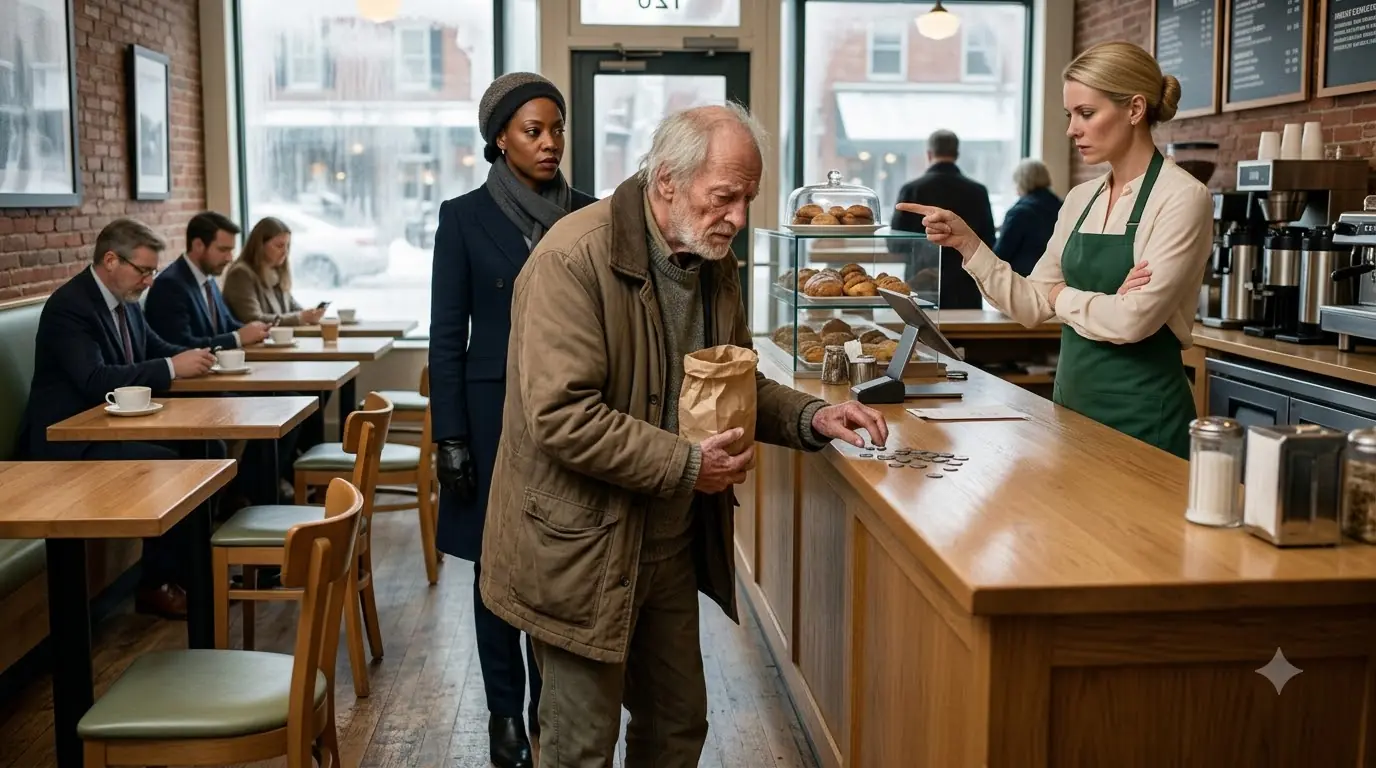
Coffee cups hovered halfway to lips. A spoon stopped circling inside a porcelain mug. At the window table, a man in a charcoal overcoat looked up from his laptop, then quickly looked back down, deciding in less than a second that whatever was happening at the counter was not his concern.
The elderly man standing near the register lowered his eyes.
His name was Goldwin Scott.
He was eighty-nine years old, though the winter had made him look older. His coat, once navy, had faded toward a tired gray. The elbows were thin, the collar curled, and the buttons did not all match. His shoes were polished with care but split near the soles, and one lace had been tied together where it had snapped. His hands, cracked and red from the cold, trembled above a small pile of coins on the counter.
Outside, Chicago was frozen under a brutal January wind. Snow from the night before had hardened along the curb, and a sharp rain had begun falling, turning sidewalks slick and black. People hurried past the cafe windows with their heads down, wrapped in scarves, protected by wool coats, gloves, and the privilege of somewhere warm to go.
Goldwin had no such place.
He had slept the previous night beneath the back awning of St. Mary’s Church, where the stone wall blocked some of the wind but none of the cold. His wife, Odette, had insisted she was fine under the shelter bench beside him, but he had heard her coughing before dawn. He had given her the thicker blanket and pretended he was not freezing.
By morning, his legs shook when he stood.
By noon, his stomach had been empty for more than a day.
By one o’clock, he walked into the Cedar Room because the smell of warm bread drifting through the door nearly brought him to tears.
The Cedar Room was not a soup kitchen.
Everyone knew that.
It was a polished downtown cafe tucked beneath a renovated office building, the kind of place where lawyers bought almond croissants, retired couples lingered over tea, and remote workers sat for hours beneath warm pendant lights, pretending a twelve-dollar latte was a reasonable business expense.
The walls were white oak and muted green. The tables were marble-topped. The pastries sat beneath glass domes like museum pieces. Everything was clean, quiet, intentional.
Goldwin did not fit.
He knew it the second he stepped inside.
The bell above the door rang with a soft chime, and several faces turned.
One woman moved her purse from the empty chair beside her into her lap.
A man in a navy suit pulled his wool coat closer to his side, though Goldwin was several feet away.
The young barista stopped wiping the counter.
Behind the register stood Angela Meyers, the cafe’s general manager.
Angela was in her early forties, with blonde hair twisted into a perfect bun and an apron so spotless it looked decorative. She ran the Cedar Room with strict precision. The staff feared her. The owner trusted her. The customers liked her because she remembered their drink orders, smiled at the right moments, and knew how to remove anything that disrupted the atmosphere.
To Angela, Goldwin was a disruption.
He approached the counter slowly, one hand pressed against the inside of his coat, where he had tucked the last of his coins into a folded napkin. He waited until the customer ahead of him left with a paper bag and a cappuccino.
Then he placed the coins on the counter.
They made a small, sad clinking sound.
“Good afternoon,” he said, his voice hoarse. “I was hoping for a sandwich. The cheapest one you have, if that’s all right.”
Angela looked down at the coins.
Then she looked at him.
Her smile tightened, polite on the surface and cold underneath.
“I’m sorry, sir. That is not enough.”
Goldwin nodded quickly.
“I know it may be short. I was wondering if maybe there was something older. Something from yesterday, maybe. Anything you were going to throw out.”
A few customers nearby heard him.
The silence deepened.
Angela’s eyes flicked toward the tables, then back to him.
“This is not that kind of establishment.”
Goldwin swallowed.
“I understand.”
“We serve paying customers here.”
“I am trying to pay,” he said softly.
Angela sighed, loud enough for the people nearest the counter to hear.
“Sir, please don’t make this uncomfortable for everyone.”
The words landed harder than the wind outside.
Goldwin felt heat rise in his face.
He reached for his coins with shaking fingers, but one nickel slipped off the counter, hit the floor, and spun beneath the register stand. He bent slowly to retrieve it, but his knees stiffened and his hand missed the coin twice.
No one moved to help.
Angela stared down at him.
“Sir,” she said, sharper now, “I am going to have to ask you to leave.”
Goldwin straightened with effort.
“I only need something small.”
“You need to go.”
“Please. My wife is outside near the church. She’s not well. I thought if I could bring her half a sandwich, maybe…”
Angela’s expression hardened.
“Get out.”
That was when the whole cafe heard.
That was when every person had a chance to become more than a spectator.
No one did.
Goldwin stood there, his shoulders folding inward.
He had heard cruelty before, but there was a special pain in being humiliated in warmth while the cold waited outside like a sentence.
“I’m sorry,” he whispered.
He gathered what coins he could and turned toward the door.
His hand had almost reached the handle when another voice cut across the room.
“Wait.”
The voice was calm.
Not loud.
Not begging.
Not uncertain.
But it carried.
Goldwin turned.
So did everyone else.
A Black woman sat alone at a small table near the center of the cafe. She had entered quietly ten minutes earlier, removed her gloves, ordered nothing, and watched.
Her name was Jazzy Russell.
She was forty-one years old, with smooth deep brown skin, sharp dark eyes, and hair pulled back neatly beneath a charcoal knit hat. She wore a tailored navy coat, black trousers, and leather boots polished to a soft shine. There was nothing flashy about her, but nothing small either. She carried herself like a woman who had spent years entering rooms where people underestimated her and had learned not to apologize for standing upright.
Her coffee had gone untouched.
Her gaze was fixed on Goldwin.
Then it moved to Angela.
Jazzy stood.
A subtle unease moved through the room.
Not fear exactly.
Recognition, perhaps.
The kind people feel when they realize someone has noticed what they hoped would pass unnoticed.
Jazzy walked toward the counter slowly, her gloves in one hand.
“Sir,” she said gently to Goldwin, “please don’t leave yet.”
Goldwin blinked at her.
“I don’t want trouble.”
“You didn’t make trouble.”
Angela crossed her arms.
“Ma’am, this does not concern you.”
Jazzy turned to her.
“It does now.”
The cafe seemed to grow even quieter.
Angela forced a thin smile.
“If you would like to place an order, I would be happy to help you.”
“I would like to place several orders,” Jazzy said. “But first, I would like to understand the policy that allows you to humiliate an elderly man for being hungry.”
Angela’s cheeks flushed.
“That is not what happened.”
“It is exactly what happened.”
“He did not have enough money.”
“He put money on your counter. You refused to touch it.”
“It was not enough for the menu.”
“Then you could have said that with dignity.”
Angela’s jaw tightened.
“We have standards here.”
Jazzy looked around the cafe, then back at her.
“Standards. That word does a lot of work when people don’t want to say what they really mean.”
A man near the window shifted in his chair.
Angela lowered her voice.
“People come here for a certain experience.”
“A hungry old man asking quietly for a sandwich ruined the experience?”
“He was making guests uncomfortable.”
“No,” Jazzy said. “Your cruelty made this room uncomfortable. He only made it honest.”
The barista behind Angela looked down quickly.
Goldwin stood frozen near the door, unsure whether to flee or stay.
Jazzy stepped closer to the counter and placed one hand over the coins Goldwin had left behind.
“Bring him a hot sandwich,” she said. “Soup as well. Coffee. And whatever pastry he wants.”
Angela’s eyes flashed.
“You cannot just come in here and dictate how I run this cafe.”
Jazzy reached into her coat and pulled out a business card.
She placed it on the counter beside the coins.
Angela looked down.
Her expression changed.
Jazzy Russell
Russell Community Hospitality Group
Founder and Managing Partner
Angela’s lips parted.
Jazzy spoke softly, but everyone near the counter heard.
“I had a meeting here today with your owner to discuss whether my firm would invest in expanding this brand into three more neighborhoods. I came early because I wanted to experience the cafe the way an ordinary customer would.”
Angela went pale.
Jazzy continued.
“I believe I have my answer.”
The room went completely still.
A chair scraped softly against the floor as someone turned to look.
The man with the laptop closed his screen halfway.
Angela tried to speak.
“Ms. Russell, I didn’t know…”
“That he mattered?”
Angela flinched.
Jazzy did not raise her voice.
“That is the problem.”
For the first time, Angela looked frightened.
“Please. If we could discuss this privately…”
“No,” Jazzy said. “You embarrassed him publicly. We can begin correcting it publicly.”
Angela’s mouth trembled once before she steadied it.
Jazzy turned to Goldwin.
“Sir, would you sit with me?”
Goldwin looked at her as if she had spoken in a language he had forgotten but once knew.
“I don’t want to be a burden.”
“You are not a burden.”
He looked at the counter, then at the silent room, then at Jazzy’s outstretched hand.
At last, he nodded.
She offered her arm.
He hesitated, then took it.
His fingers were cold and fragile against her sleeve.
They walked together to the table by the front window.
Every eye followed them.
Jazzy helped him into the chair with the same care she would have given a respected elder at a family table. Not pity. Not performance. Respect.
Then she returned to the counter.
Angela stood rigidly.
The barista, a young man named Leo, moved quickly.
“I’ll make the order,” he said, voice low.
Jazzy looked at him.
“Thank you.”
Angela whispered, “I’m sorry.”
Jazzy’s eyes stayed steady.
“Don’t waste an apology on me. Decide what kind of person you want to be after today.”
Angela lowered her eyes.
When Jazzy returned to the table, Goldwin was staring at his hands.
“I’m sorry,” he said.
“For what?”
“For all of this.”
“You didn’t do this.”
“I walked in.”
“Yes,” Jazzy said. “And you had every right to.”
He looked up at her.
His pale blue eyes were clouded at the edges, but not empty. There was a whole life behind them. Loss. Pride. Shame. A stubborn dignity that hunger had not fully stolen.
“You don’t know me,” he said quietly.
“No,” she said. “But I know what it looks like when people try to make someone disappear.”
He nodded slowly.
“That happen to you?”
“More than once.”
A faint, sad smile touched his mouth.
“Different road. Same weather.”
Jazzy’s expression softened.
“Something like that.”
Leo brought the food himself.
A turkey sandwich, toasted and cut in half. A bowl of hot soup. A black coffee. A blueberry scone on a small plate.
His hands shook slightly as he set everything down.
“I’m sorry, sir,” Leo said, unable to meet Goldwin’s eyes for long. “I should have helped.”
Goldwin looked at him.
Then he nodded.
“Maybe next time you will.”
Leo swallowed hard.
“Yes, sir.”
After he left, Goldwin stared at the food as if it might vanish.
“Eat while it’s hot,” Jazzy said gently.
He picked up half the sandwich. His hands trembled so badly that Jazzy pretended not to notice. He took one bite, then closed his eyes for a second.
Not because it was the best sandwich in the world.
Because it was warm.
Because it was food.
Because someone had allowed him to receive it without making him beg again.
For several minutes, Jazzy let him eat.
The cafe slowly resumed motion, but not comfort. Conversations returned in fragments. Some people looked ashamed. Others looked irritated that a quiet morning had become something they might have to think about later.
Jazzy did not care.
Goldwin finished half the sandwich before he spoke.
“My wife is outside near St. Mary’s.”
Jazzy looked toward the window.
“In this cold?”
“She does not like shelters. Says the noise makes her bones hurt.” He gave a small, tired shrug. “She was proud once. Still is, even when pride is all that’s left.”
“What’s her name?”
“Odette.”
The name stirred something in Jazzy, though she did not yet know why.
“Goldwin Scott,” he added. “That’s me.”
“Jazzy Russell.”
He looked at her for a long moment.
“That name…”
She waited.
He shook his head.
“Maybe I’m just old. Names echo.”
Jazzy’s fingers stilled around her coffee cup.
“Maybe.”
Goldwin took another sip of coffee.
“I had a son once,” he said.
The words seemed to surprise even him, as if they had escaped a room inside him that had been locked for years.
Jazzy did not interrupt.
“Roger,” he continued. “Roger Scott. He played piano by ear from the time he was seven. Loved music. Hated math. Could make a room laugh without trying.”
Jazzy’s breath caught.
Very slightly.
Goldwin did not notice.
“He volunteered at a community center,” he said. “Taught kids music. Odette thought he was wasting time. I thought he was becoming the man he was meant to be, but I didn’t say that loudly enough.”
Jazzy stared at him.
Roger Scott.
The name struck her with such force that the cafe blurred for a moment.
Roger.
Not a memory now.
A wound.
A voice.
A laugh in a community center hallway.
A young man carrying donated coats with snow melting in his hair.
A hand reaching for hers beneath a table.
Jazzy tightened her grip around her cup.
Goldwin kept speaking, unaware that every word was opening a door she had sealed shut nearly nineteen years earlier.
“He met a woman there,” Goldwin said. “A Black woman. Beautiful, from what little I saw. Strong. Odette did not approve.”
His voice thickened.
“She said it wasn’t about race. Said it was about class, upbringing, future. But I knew. A man knows when his wife is lying to the world and to herself.”
Jazzy looked down.
Goldwin’s voice grew rougher.
“Roger loved that woman. I could see it. Odette could too, and that made it worse. The more he loved her, the more she fought him. I should have stood beside him. Instead, I tried to keep peace.”
He gave a bitter little laugh.
“Peace. That word has covered many cowardly things.”
Jazzy’s eyes burned.
“What happened?”
Goldwin looked out the window.
“The night he left, Odette told him if he walked out, he should not come back. He walked out. Three days later, he was gone.”
His hand moved to his wrist.
Only then did Jazzy notice the watch.
A worn silver watch, scratched at the edges, the face slightly clouded but still ticking.
Her stomach dropped.
She knew that watch.
She had given it to Roger for his twenty-third birthday after saving for three months. She had bought it from a pawn shop, polished it herself, and engraved the side with a line only they understood.
For the man who always comes back.
Goldwin touched it gently.
“This was his. Hospital gave it to us with his things. I wear it because it’s all I have left.”
Jazzy’s throat tightened.
“May I see it?”
Goldwin looked surprised, but slowly unclasped it and handed it across the table.
Jazzy turned it over.
The engraving was faded, but still there.
For the man who always comes back.
She closed her eyes.
Goldwin leaned forward.
“You know this watch.”
Jazzy opened her eyes.
Tears had gathered despite her effort to hold them back.
“Yes.”
Goldwin’s face changed.
“Jazzy,” he whispered, as if the name finally found its place. “You’re her.”
She nodded.
“I’m the woman Roger loved.”
The cafe around them seemed to vanish.
Goldwin stared at her, his old face breaking open under the weight of recognition.
“Oh, Lord,” he whispered. “Oh, Jazzy.”
She covered her mouth.
“I didn’t know where you were. After the funeral, no one would speak to me. Odette looked at me like I had killed him. I was twenty-two, broke, grieving, and alone.”
Goldwin reached across the table with shaking hands.
“I am so sorry.”
Jazzy looked at him.
For years, she had imagined what she would say if she ever met Roger’s parents again. She had imagined anger. Accusation. A speech sharp enough to cut through every insult Odette had never quite said aloud.
But looking at Goldwin now, hungry, cold, ashamed, and broken by the same grief that had nearly destroyed her, Jazzy felt something else.
Not forgiveness yet.
But recognition.
“You lost him too,” she said.
Goldwin bowed his head.
“I lost him before he died. That is what I live with.”
Jazzy placed the watch back in his hands.
“He loved you,” she said. “Even when he was angry. He told me that.”
Goldwin’s face crumpled.
“He did?”
“Yes.”
Goldwin pressed the watch to his chest and began to cry.
Not quietly.
Not politely.
He cried like an old man who had been holding back a storm for nearly two decades and had finally found someone who knew the name of the rain.
Jazzy reached across the table and took his hand.
This time, he did not hesitate.
The next morning, Jazzy found Goldwin near the steps of St. Mary’s Church.
Odette sat nearby on a bench, wrapped in two thin blankets, her back straight despite the cold. She had always been that way, even in Jazzy’s memory. Upright. Controlled. Perfectly arranged. A woman who believed if she held her posture firmly enough, the world would obey her design.
Jazzy carried a paper bag with two containers of hot soup, two sandwiches, and fresh bread.
Goldwin saw her first.
His face softened with relief and fear.
Odette turned her head slowly.
The recognition was immediate.
Her face hardened.
“You,” Odette said.
Jazzy stopped a few feet away.
“Yes.”
Goldwin stood between them, anxious.
“Odette…”
Odette ignored him.
“You have no shame, coming here.”
Jazzy’s fingers tightened around the bag.
“I brought food.”
“I don’t want anything from you.”
“Then don’t take it.”
Odette’s eyes flashed.
“You took my son.”
The words hit their old target, but Jazzy was no longer twenty-two and alone in a cheap black dress after a funeral where no one would look at her.
“No,” Jazzy said. “I loved your son.”
Odette stood too quickly, swayed, then steadied herself.
“You filled his head with foolishness. He had a future.”
“He was my future too.”
Odette’s mouth tightened.
“He died because he walked away from the life we built for him.”
Jazzy stepped closer, her voice steady.
“He died because a truck lost control on an icy road. Not because he loved me.”
Goldwin closed his eyes.
Odette’s lips parted, but no words came.
Jazzy held out the bag.
“I did not come to fight you. I came because Goldwin said you were hungry.”
Odette looked at the bag.
Then at Jazzy.
Then, with a coldness that made Goldwin flinch, she took the bag and walked to the nearby trash bin.
She dropped it in.
The sound echoed in the bitter air.
Goldwin whispered, “Odette.”
Jazzy stared at the trash bin for a long moment.
Then she looked back at Odette.
“You think kindness fixes everything?” Odette asked, voice shaking now.
“No,” Jazzy said. “I think refusing it shows what grief has made of you.”
Odette flinched.
Jazzy did not stop.
“You hated me because it was easier than admitting Roger chose me freely. You blamed me because blaming a living woman was easier than grieving a dead son.”
Odette’s eyes shone with fury and something more fragile beneath it.
“You don’t know what I lost.”
“I lost him too.”
“You had no right.”
“To love him?”
“To pull him away.”
Jazzy’s voice broke, but did not weaken.
“He was not furniture in your house, Odette. He was a man. He had dreams, choices, a heart. And he gave that heart to me.”
Odette’s face twisted.
For a moment, Jazzy thought she might slap her.
Instead, the older woman sat back down slowly, as if the cold had finally reached her bones.
Goldwin stood helplessly between them.
Jazzy turned to him.
“I’ll come back tomorrow.”
Odette looked up sharply.
“Why?”
Jazzy met her eyes.
“Because I am not twenty-two anymore. And I will not let your cruelty decide who I become.”
She walked away before either of them could answer.
She did come back.
The next day.
And the day after that.
Sometimes Odette threw the food away.
Sometimes Goldwin accepted it while Odette looked in the opposite direction.
Sometimes Jazzy simply left a thermos of broth on the bench and walked away without saying a word.
Then, one afternoon, the temperature dropped below freezing and Goldwin called her in panic.
“She’s not moving right,” he said. “Jazzy, I think she’s sick.”
Jazzy found Odette behind the church, slumped against the stone wall, her lips pale, breath shallow, gloves missing.
All the anger in Jazzy went still.
Not gone.
Still.
Because a human being was freezing in front of her.
She knelt on the wet ground.
“Odette.”
The older woman’s eyes opened slowly.
“I don’t want your pity.”
“Good,” Jazzy said. “I didn’t bring any.”
She opened a thermos and poured broth into the lid.
“You need to drink.”
Odette turned her head away.
“Don’t be stubborn enough to die in an alley just to make a point.”
Goldwin made a sound that might have been a laugh and a sob at once.
Odette looked at Jazzy.
For the first time, there was no hatred in her eyes.
Only exhaustion.
Confusion.
A terrible emptiness.
She took the broth.
Her hand shook so badly that Jazzy steadied the cup without comment.
Odette drank.
They brought her to a church shelter first. A volunteer checked her temperature, gave her dry socks, and warned them she needed rest, warmth, and regular meals. Jazzy listened, then made a decision.
“You’re coming with me,” she said.
Odette stared at her.
“No.”
“Yes.”
Goldwin looked alarmed.
“Jazzy, you don’t have to…”
“I know what I have to do.”
Odette’s voice was hoarse.
“I will not be your charity case.”
Jazzy leaned closer.
“You will be my guest until you are strong enough to insult me standing up.”
For one stunned second, Goldwin looked like he might laugh.
Odette blinked.
Then she whispered, “You’re impossible.”
“I have been told that by better women.”
That was how Goldwin and Odette came to stay in Jazzy Russell’s apartment.
It was not a large apartment, but it was warm, clean, and full of quiet discipline. There were bookshelves along one wall, framed photographs in simple black frames, a small kitchen with herbs on the windowsill, and a piano tucked into the corner beneath a soft lamp.
Goldwin stopped when he saw it.
“Roger played.”
“I know,” Jazzy said.
Odette looked at the piano but said nothing.
The first days were cautious.
Jazzy left food outside the guest room door and did not knock.
Odette ate, though she never admitted hunger.
Goldwin tried to make himself useful. He folded towels, swept the kitchen, and repaired a loose cabinet hinge with a butter knife until Jazzy handed him a screwdriver.
At night, he and Jazzy sat in the living room while Odette rested.
Goldwin told stories about Roger.
Jazzy told others.
Between them, a fuller version of him returned.
Roger at ten, climbing a roof to touch a weathervane.
Roger at seventeen, burning cookies for a girl at school.
Roger at twenty-two, teaching children music at the community center.
Roger laughing after Jazzy gave him the watch.
Roger whispering, “One day, my parents will understand.”
Odette listened from behind the half-open bedroom door.
The fourth night, Jazzy found the piano bench pulled out slightly.
The fifth morning, the dust cover had been folded back.
The sixth evening, Odette stood near the piano while Jazzy washed dishes.
“He wrote songs,” Odette said.
Jazzy froze.
Then turned slowly.
“Yes.”
“I found one once. After he died. In his room.”
Jazzy dried her hands on a towel.
“What was it called?”
Odette’s voice was low.
“Jazzy’s Window.”
Jazzy closed her eyes.
She remembered that song. Roger had played it for her once in the community center basement, on an out-of-tune upright piano with three sticky keys.
“I thought he was being foolish,” Odette said.
Jazzy opened her eyes.
Odette was looking at the piano.
“I thought love had made him small.”
Her voice trembled.
“I was wrong.”
Neither woman moved.
Odette turned away before Jazzy could answer.
But she did not go back to the room.
She sat in the living room with Goldwin that night.
That was enough.
A week later, Jazzy’s son came home.
His name was Ryder Russell.
He was eighteen, tall and lean, with warm brown skin, dark curls, and Roger’s eyes so clearly that Goldwin dropped the orange he had been peeling when the boy walked through the door.
“Hey, Ma,” Ryder said, stepping inside with a backpack over one shoulder. “Professor canceled critique, so I came early.”
Jazzy smiled in a way Goldwin had never seen before.
Full.
Ungarded.
A mother’s smile.
“Lunch is almost ready.”
Ryder kissed her cheek, then noticed the two elderly people in the room.
“You must be Goldwin,” he said, offering a hand.
Goldwin stood slowly.
His face had gone pale.
“You look…”
Ryder smiled gently.
“Like my father?”
Goldwin gripped his hand.
“Yes.”
Odette had not moved.
She sat rigidly in the armchair, both hands folded over her lap.
Ryder approached her too.
“Hi,” he said. “I’m Ryder.”
Odette looked at his hand.
Then at his face.
The room held its breath.
Finally, she touched his fingers.
“Odette,” she whispered.
Lunch was quiet at first.
Ryder talked about his photography program, about his part-time job at the studio, about a professor who believed every portrait needed tension or it was just a face.
Goldwin watched him with wonder.
Odette watched him like a woman standing at the edge of a cliff, seeing both the fall and the view.
After lunch, Ryder rose to help clear dishes.
He carried a pot toward the fridge and called, without thinking, “Mom, where should I put this?”
The word changed the room.
Mom.
Goldwin closed his eyes.
Odette’s breath caught audibly.
Jazzy took the pot from Ryder and set it down.
Then she faced them.
“Yes,” she said before anyone asked. “He is Roger’s son.”
Goldwin sat down hard.
Ryder looked at him carefully.
“I knew about him,” Ryder said. “Mom told me everything she could. I knew he loved music. I knew he wanted to teach. I knew he was brave. I just didn’t know if anyone else would ever want to know me.”
Goldwin stood and crossed the room.
He placed both hands on Ryder’s shoulders and looked at him fully.
“I see him,” Goldwin whispered. “But I see you too.”
Then he pulled Ryder into his arms.
Ryder stiffened for one second, then hugged him back.
Odette stood.
Her face was white.
Jazzy watched her, ready for anger, denial, accusation.
But Odette only turned and walked down the hallway.
Her bedroom door closed softly.
No slam.
No words.
Just distance.
That night, Odette did not come out for dinner.
Jazzy did not force her.
Goldwin and Ryder sat together for hours. They looked through photos. Ryder asked about Roger’s childhood. Goldwin answered everything, even when the answers hurt.
At midnight, Jazzy stepped into the hallway and found Odette sitting on the floor outside the guest room, knees drawn up beneath her coat.
She looked smaller than Jazzy had ever seen her.
“He had a child,” Odette said.
“Yes.”
“And you raised him alone.”
“Yes.”
Odette covered her mouth.
“I hated you while you were raising my grandson.”
Jazzy leaned against the wall.
“Yes.”
The truth hung there.
No softening.
No rescue.
Odette cried then.
Not elegantly.
Not quietly.
She cried with her face in both hands, shoulders shaking, all the pride gone from her body.
“I lost everything,” she said. “And then I made sure I lost the rest.”
Jazzy crouched beside her.
For a long time, she said nothing.
Then Odette whispered, “Does he know I hated you?”
“He knows people are complicated.”
“That is generous.”
“He learned that from me.”
Odette gave a broken laugh through tears.
Jazzy sat beside her on the hallway floor.
Two women who had once stood on opposite sides of Roger’s life.
Two women who had both loved him.
Two women who had both lost years they would never get back.
“I don’t know how to fix this,” Odette said.
“You don’t fix it,” Jazzy replied. “You tell the truth. You stay. You do better tomorrow.”
Odette looked at her.
“Will he let me?”
“Ryder decides that.”
“And you?”
Jazzy looked down the hall toward the living room, where Goldwin’s soft laughter mixed with Ryder’s voice.
“I’m still deciding.”
Odette nodded.
“I deserve that.”
The next morning, Odette was at the kitchen table before everyone else.
When Ryder entered, she looked up.
Her hands trembled, but her voice was clear.
“Do you take honey in your tea?”
Ryder paused.
Then smiled slightly.
“Yes, ma’am.”
Odette picked up the honey jar and passed it to him.
It was not an apology.
Not yet.
But it was a beginning.
That afternoon, Goldwin took Ryder to Lincoln Park, where Roger had played as a child. Jazzy came too, and after a long hesitation, Odette joined them.
The air was cold but clear. Bare branches reached toward a pale sky. Ducks moved lazily across a pond half-rimmed with ice.
They stopped near a bench under an old tree.
Goldwin unclasped Roger’s silver watch from his wrist.
His hands shook.
“I kept this because I thought it was all I had left of him,” he said. “But it belongs to you now.”
Ryder looked at Jazzy.
She nodded.
He accepted the watch.
On the side, the engraving remained faint but readable.
For the man who always comes back.
Ryder slipped it onto his wrist.
It fit.
Odette made a sound and turned away, pressing a hand to her mouth.
Ryder looked at her.
“You can say it,” he said gently.
She turned back.
“Say what?”
“That you’re sorry.”
The words were not cruel.
They were honest.
Odette looked at him.
Then at Jazzy.
Then at Goldwin.
“I am sorry,” she whispered. “Not because I was wrong and now I am ashamed. I am sorry because my wrongness had a cost, and all of you paid it.”
Ryder’s eyes shone.
“I can’t give you the years.”
“I know.”
“I can’t make you my grandmother in one day.”
“I know.”
“But maybe you can start by telling me about him.”
Odette nodded, tears falling freely now.
“Yes. I can do that.”
And so she did.
She told him about Roger’s first piano recital, where he forgot the song and bowed anyway.
About how he hated peas.
About how he once rescued a pigeon with a broken wing and kept it in a laundry basket for three days.
About how he would hum when he was nervous.
About how, after meeting Jazzy, he came home one night smiling so brightly that Odette knew she had already lost the fight before she began it.
“I should have seen that as joy,” she said. “I saw it as danger.”
Jazzy stood nearby, listening.
Something inside her loosened.
Not fully.
But enough to breathe.
Months passed.
Goldwin and Odette did not return to sleeping outside.
Jazzy helped them find a small apartment in a senior housing community supported by one of her hospitality group’s charitable partners. She did not pay in a way that stripped their dignity. She helped them apply. She made calls. She used her network carefully, making sure they had choices.
Goldwin got a small keyboard.
Odette started attending grief counseling.
Ryder visited them every Sunday.
At first, Odette tried too hard. She brought him sweaters he did not need, asked too many questions, corrected his posture once and immediately apologized for it.
Ryder was patient, but not endlessly permissive.
“You don’t get to manage me,” he told her gently one Sunday.
Odette lowered her eyes.
“You’re right.”
Goldwin smiled from his chair.
“He has Roger’s tone when annoyed.”
Ryder looked offended.
“I’m not annoyed.”
“You are deeply annoyed,” Jazzy said from the doorway.
Ryder rolled his eyes.
For the first time, Odette laughed without stopping herself.
The Cedar Room changed too.
The owner called Jazzy personally after the incident and asked for advice.
She gave it.
Not politely.
Angela Meyers was suspended, then required to attend service and dignity training if she wished to remain. For three weeks, she volunteered at a church meal program as part of the process. At first, she resented it. Then she met a retired schoolteacher who had lost her apartment after medical debt, and something in Angela began to crack.
She eventually returned to the Cedar Room, not as general manager, but as assistant manager under Leo, the barista who had apologized.
On the first day back, Angela saw Goldwin walk in with Odette, Jazzy, and Ryder.
The room went still again.
But this silence was different.
Angela stepped out from behind the counter.
Her face was pale.
“Mr. Scott,” she said. “I owe you an apology.”
Goldwin looked at her.
Angela’s voice shook.
“I treated you with cruelty because I decided you did not matter. There is no excuse. I am sorry.”
Goldwin studied her for a long moment.
Then he said, “I hope you mean that.”
“I do.”
“I hope you remember it when someone easier to dismiss walks in.”
Angela swallowed.
“I will.”
Goldwin nodded.
“Then bring us four coffees. And one of those blueberry scones. My grandson likes them.”
Angela’s eyes flicked to Ryder, then softened.
“Yes, sir.”
They sat by the front window.
The same table.
This time, no one looked away.
Ryder took photographs that afternoon for his portrait series, Choices.
One portrait showed Goldwin’s hands wrapped around a coffee cup, Roger’s watch visible on Ryder’s wrist in the blurred foreground.
Another showed Odette looking through the window, not proud, not broken, simply human.
The final portrait showed Jazzy standing outside the Cedar Room, her reflection layered over the cafe interior, as if past and present had finally learned to occupy the same frame.
Ryder titled the series:
The People We Almost Lost.
It won a student exhibition award and later hung in the community center where Roger and Jazzy had first met.
At the opening, Jazzy stood beside Goldwin and Odette while Ryder spoke to a small crowd.
“My father died before I was born,” he said. “For a long time, he was a story my mother told me. Then one day, because she defended a hungry old man in a cafe, that story became a family.”
He looked at Goldwin.
“Truth does not always arrive gently.”
He looked at Odette.
“But when it arrives, we can choose whether to keep hiding or finally answer the door.”
Odette wiped her eyes.
Jazzy looked down.
Ryder smiled at his mother.
“My mother taught me that dignity is not something people give you. It is something they recognize, if they are wise. And if they are not wise, you stand anyway.”
The room applauded.
Goldwin clapped until his hands hurt.
That night, after everyone left, Jazzy stood alone before Roger’s photograph in the exhibit.
It was an old picture, one she had kept folded in a book for eighteen years. Roger was laughing, one hand raised to block the camera, the silver watch bright on his wrist.
Odette approached quietly.
“I remember that smile,” she said.
Jazzy did not turn.
“I do too.”
“I tried to make him smaller.”
“Yes.”
“I thought I was protecting him.”
“I know.”
“I was protecting myself.”
Jazzy looked at her then.
Odette’s face was lined with grief, but not guarded anymore.
“I cannot ask you to forgive me,” Odette said.
“No,” Jazzy replied. “You can’t.”
Odette nodded.
“But I can tell you this. I am grateful you loved him. I am grateful he had you. I am grateful Ryder exists because of that love.”
Jazzy’s eyes filled.
For a long moment, she said nothing.
Then she reached for Odette’s hand.
Not because everything was fixed.
Not because the past had been erased.
Because some bridges are not crossed in one step.
But this was one.
Years later, the story of the Cedar Room became one people told in different ways.
Some said it was about a rude cafe manager who learned humility.
Some said it was about a wealthy Black businesswoman who stood up when no one else would.
Some said it was about an old man finding his lost grandson because he asked for a sandwich on a freezing day.
Some said it was about a bitter old woman learning that hatred had cost her more than love ever could.
Jazzy never corrected them.
All of those things were true.
But to her, the story was simpler.
A hungry man walked into a cafe.
A room full of people decided he did not matter.
She decided he did.
That decision opened a door to a grief she thought she had buried, to a father who needed to speak his son’s name, to a mother who needed to face the truth, and to a son who finally received grandparents he had never known.
Goldwin lived three more years.
Warm years.
Years with Sunday dinners, piano music, coffee by the window, and Ryder’s photography prints filling the walls of his small apartment. He died in spring, with Odette holding one hand and Jazzy holding the other, while Ryder sat nearby wearing Roger’s watch.
At his memorial, Ryder played the piano.
Not perfectly.
But honestly.
Odette lived long enough to become softer than anyone expected. She volunteered at the community center once a week, teaching children to sew buttons and mend tears. She was still particular. Still sharp sometimes. But when a child made a mistake, she no longer corrected first.
She asked, “Are you all right?”
Angela remained at the Cedar Room for years.
Every winter, she kept a small sign near the register.
If you are hungry, please ask.
No one leaves cold.
The cafe owner worried at first that people would take advantage.
Some did.
Most did not.
Either way, no one starved at the door.
Jazzy continued building her hospitality group, but every employee orientation included the story of Goldwin Scott and the sandwich. Not as branding. Not as inspiration packaged neatly for slides.
As a warning.
A reminder.
A promise.
“Service is not the same as dignity,” Jazzy would tell every new manager. “Service can be trained. Dignity has to be chosen.”
And Ryder, wearing his father’s watch, grew into a photographer known for portraits of people others ignored. Shelter residents. Retired factory workers. Single mothers at bus stops. Children in after-school programs. Men and women whose faces carried entire histories beneath wrinkles, scars, tired eyes, and shy smiles.
His most famous photograph was not of a celebrity or politician.
It was of Jazzy sitting at the Cedar Room window, one hand around a coffee cup, looking toward the empty chair across from her.
The title was simple.
Where Someone Finally Sat Down.
Years after that freezing morning, Jazzy sometimes returned to the Cedar Room alone.
She would sit by the front window, order black coffee and a turkey sandwich, and look at the door.
The bell would ring.
People would come in.
Some wealthy.
Some tired.
Some polished.
Some worn.
And every time, the staff looked up.
Every time, they greeted the person who entered.
Not because they knew who mattered.
Because they had learned that everyone did.
On one such morning, snow falling softly beyond the window, a young employee brought Jazzy her coffee and said, “Ms. Russell, can I ask you something?”
Jazzy smiled.
“Yes.”
“Why do you still come here?”
She looked around the cafe.
At the counter where Goldwin had been humiliated.
At the table where he had told her about Roger.
At the window where Ryder had later photographed them.
At the door through which hunger, grief, shame, truth, and family had all entered on the same winter day.
Then she looked back at the young employee.
“Because this is where a man asked for a sandwich,” she said, “and life gave us back a family.”
The employee did not fully understand.
Not yet.
But someday, Jazzy thought, she might.
Outside, the snow continued to fall.
Inside, the cafe stayed warm.
And when an elderly woman in a worn brown coat stepped through the door a few minutes later, carrying a small bag and looking unsure if she belonged, the young employee walked around the counter immediately.
“Good morning,” she said gently. “Come in out of the cold. What can we get you?”
Jazzy watched from her table, hands folded around her coffee.
She thought of Roger.
Of Goldwin.
Of Odette.
Of Ryder.
Of all the ways love can be delayed, damaged, denied, and still find a way to return through the smallest possible door.
A sandwich.
A witness.
A single person willing to stand.
Sometimes that is how a family begins again.
Not with grand speeches.
Not with perfect forgiveness.
But with someone saying, in a room full of silence, “Wait. He matters.”
And because Jazzy Russell said it, everyone eventually learned that he did.