Beverly Edwards entered Ruth Ann's Roost just after 8:15 a.m., as she had every Saturday for the past five years.
The cool autumn air carried the scent of fresh bread and apple cider from the farmers' market down the street.
Sunlight filtered through the cafe windows, warming her cream-colored cardigan and highlighting the wrinkles around her eyes, each one a memory etched from decades of teaching. 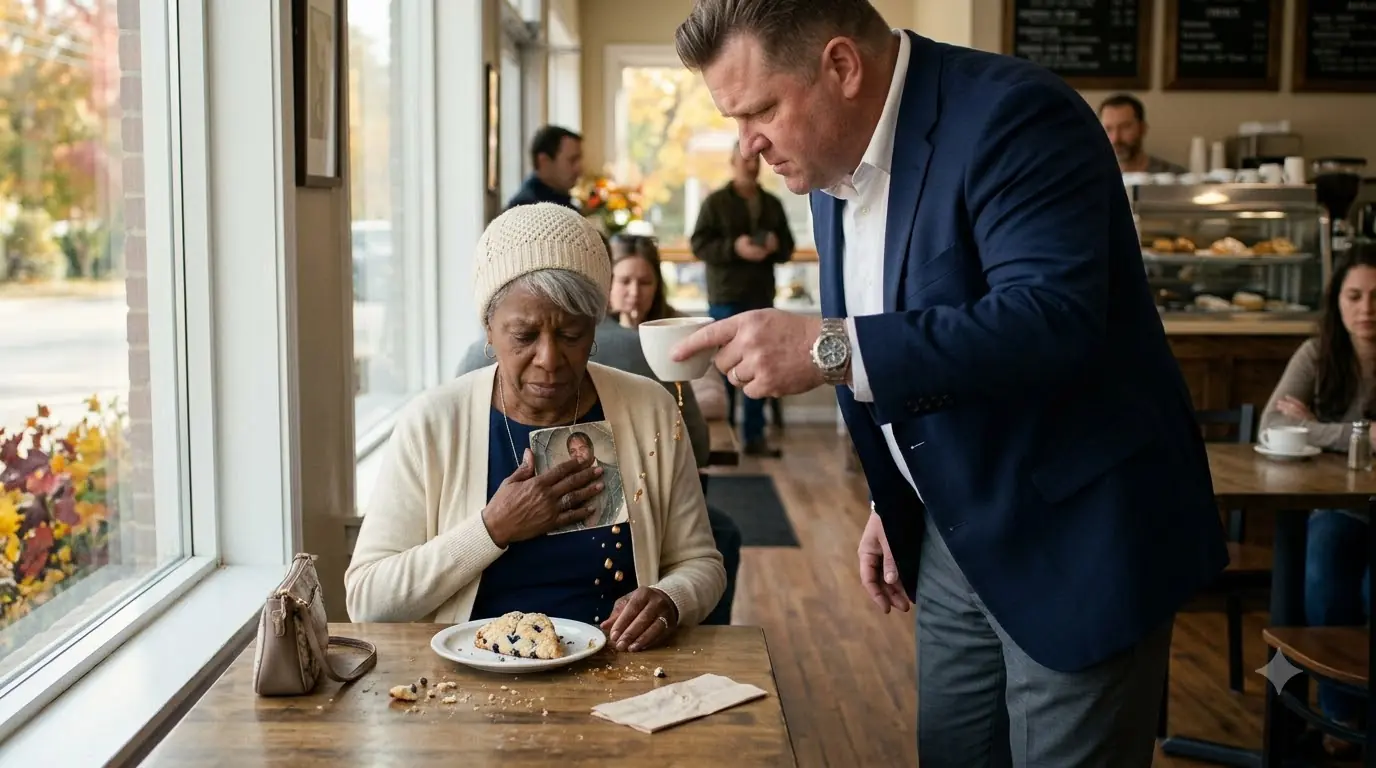
She took her usual seat by the window, unfolded a napkin across her lap, and set her scone on a small plate.
For a few peaceful minutes, the cafe hummed softly around her, the espresso machine hissing like a heartbeat. Beverly sipped her small decaf and enjoyed the familiar routine, unaware that the calm was about to be shattered.
A black Escalade pulled up outside and parked carelessly across two spaces. Craig Davenport stepped out, a man in his mid-forties wearing a tailored navy blazer and a silver watch, while talking loudly into his phone. He cut to the front of the line, ordered a complicated drink, and then walked to Beverly's table without asking or acknowledging her. He sat down across from her, setting his cup down hard enough to spill a few drops.
Beverly glanced up and offered a polite smile, but the man's eyes narrowed in contempt. A few crumbs from her scone had landed near his cup, and that was all it took. Craig's nostrils flared and his jaw tightened.
"Did you just touch my cup?" he demanded.
Beverly offered a soft apology, but it only fueled his anger. He wiped at the droplets with a napkin, then dropped it to the side of the table with exaggerated disgust. The cafe had gone quiet. Ruth Ann froze behind the counter, watching the confrontation unfold.
Craig's voice carried across the room, sharp and mocking. Beverly, sixty-eight, a retired schoolteacher and grandmother, remained seated with her hands folded calmly in her lap despite the venom pouring from him. He leaned closer, his cologne suffocating.
"Where are you even from?" he asked. "Because this isn't your kind of place."
Beverly's voice barely rose above a whisper. "I've lived here for forty-two years, sir."
Craig laughed cruelly, clearly intending to humiliate her. Crumbs from her scone caught his attention again.
"Are you an animal?" he spat.
Beverly's hand trembled as she reached for her napkin, but he waved her away. In one swift motion, he grabbed her coffee and poured it over her cardigan, soaking her from chest to skirt.
Shock froze her in place. The cafe was completely still. Patrons stared in silence while Ruth Ann called 911 with shaking hands.
Beverly held a small, cracked photograph of her late husband, James, against her chest. A single tear ran down her cheek.
"I just wanted my Saturday," she whispered.
Outside, Craig laughed into his phone, oblivious to the storm he had stirred.
Deputy Nathan Moore arrived six minutes later, but he approached Craig first. Craig quickly spun a story of provocation, painting Beverly as the aggressor. Moore nodded without scrutiny, leaving Beverly standing alone in the parking lot, coffee-stained and trembling.
Beverly reached for her phone and called her son.
"Brandon, I need you. I'm at Ruth Ann's."
She straightened and held on to the stained cardigan as she waited. Craig smirked, unaware that reinforcements were on the way.
A low rumble approached as a black Chevrolet Suburban pulled into the lot. Colonel Brandon Edwards emerged in an immaculate United States Army dress uniform, his boots striking the gravel with quiet precision. He walked straight to Beverly, ignoring Craig and the deputy, his presence commanding and calm.
Beverly softened at the sight of her son. He lifted her hand, felt the tremor in it, and held her for a brief moment. Craig's smirk faltered. Brandon's eyes remained fixed on his mother, his authority radiating without a raised voice.
Craig realized too late that he had misjudged the woman who had been sitting quietly in a cream cardigan. Beverly had endured. She had waited. Now justice was coming.
The atmosphere shifted, tension coiling like a spring about to release. Outside the cafe, the autumn sun caught the gold ribbons on Brandon's chest, and the silent promise of accountability lingered in the air.
Craig Davenport's confidence faltered as Brandon stood firmly between him and Beverly. Sunlight glinted from the Suburban's black paint, and every eye in the parking lot turned toward the confrontation. Nearby, Tiffany Davenport's face lost its carefully maintained composure. Her sunglasses slipped down her nose, revealing wide eyes.
Deputy Moore shuffled uncomfortably, realizing the balance of power had changed. Brandon spoke calmly, but with an authority that left no room for negotiation.
"Who threw coffee on my mother?"
His words carried across the lot, clear and precise, a command that demanded the truth. Craig stammered and tried to twist the story, but Brandon's steady gaze held him in place.
Ruth Ann stepped forward and recounted every detail, from Craig taking Beverly's table to the moment he poured the coffee over her. Witnesses nodded in confirmation. Brandon's presence brought order to the chaos, every movement calculated and every word deliberate.
A teenager recording the scene with her phone captured every second. Brandon's voice remained steady, his uniform immaculate and his ribbons reflecting the morning sun.
"This constitutes assault and battery under Virginia Code 18.2-57, with a potential hate crime enhancement under subsection C," he stated.
Craig paled, realizing the seriousness of what he faced. Brandon dialed a direct line rather than using the standard emergency channels. Within minutes, a senior officer arrived and reinforced the authority Brandon represented.
Sergeant Dwight Lawson, tall and silver-haired, greeted Brandon with a respectful nod, an acknowledgment between veterans forged through service. Lawson and Brandon coordinated while officers gathered statements, confirmed the video evidence, and established that Beverly was the victim.
Craig's bravado evaporated. He now faced real consequences. The parking lot had gone still, and the banjo music from the farmers market seemed distant and inconsequential.
Beverly still held her handbag and the stained photograph of James. She remained calm despite the tremor of fear in her hands. Brandon stayed at her side, his presence both shield and reassurance.
Craig was formally arrested, the cuffs clicking into place. Tiffany followed in stunned silence, clutching her designer handbag as the gathered crowd recorded every detail. Brandon guided Beverly back to his side and assured her that she was safe.
The parking lot, once tense and hostile, had become a stage of accountability. Every witness understood the gravity of the moment. The balance of power had finally been corrected.
Beverly, quiet and resolute, felt the first wave of relief. Her Saturday had been shattered, but her dignity had survived. As Craig and Tiffany were led away, Brandon made sure the teenager who had recorded the scene and the other witnesses remained safe, confirming that Beverly's voice had been amplified rather than drowned out.
Justice, delayed inside the cafe, had finally taken form. Brandon Edwards had restored order, respect, and the reminder that courage and preparation could overturn arrogance. Autumn wind scattered leaves across the lot as Beverly clutched James's photograph, her eyes reflecting gratitude and relief.
This small town, quiet for decades, had witnessed a turning point. Beverly's patience and resilience, paired with her son's authority, had altered the course of a morning that began with humiliation and pain.
The aftermath of the arrest settled over Ruth Ann's Roost like a heavy fog. Beverly sat on the wooden bench outside with Brandon beside her, his hand resting lightly on her shoulder. Warm sunlight touched her face, yet the coffee stain on her cardigan remained a constant reminder of the morning's humiliation.
There was also a growing sense of calm. The immediate storm had passed, and order had been restored. Nearby, Sergeant Lawson coordinated with Deputy Moore, reviewed body camera footage, and ensured that the sequence of events was fully documented.
Craig Davenport, subdued and cuffed, was escorted to the patrol car. His former arrogance had been stripped away and replaced by fear and uncertainty. Tiffany followed reluctantly, her handbag held tightly as she realized how publicly their disgrace had unfolded.
Brandon was already calculating the next steps. He intended to make sure the legal proceedings reinforced Beverly's dignity and safety rather than exposing her to further harm.
Inside the cafe, Ruth Ann carefully wiped the tables, her hands still shaking. Patrons whispered among themselves with a mixture of relief, awe, and lingering unease. Beverly's scone sat cold on its small plate, but she hardly noticed.
The photograph of James was safely tucked back inside her handbag. It felt like a talisman of resilience, a symbol of the life she had built and protected.
Brandon pulled out his phone and sent a series of messages to legal counsel, ensuring that the teenager's footage would be preserved. News of the incident was already spreading, and he knew it was essential that the truth about his mother's dignity and Craig's misconduct remained clear.
Beverly's eyes were tired and damp from tears, but they reflected trust in her son's careful, deliberate movements. She understood that justice required patience, planning, and presence of mind.
As the crowd thinned, the afternoon sun glinted from parked vehicles and cast long shadows across the lot. Banjo music from the farmers market drifted faintly through the air, a reminder that life continued around the edges of personal crisis.
Brandon gently reminded his mother to breathe and let some of the tension leave her body. Ruth Ann approached with a fresh decaf and a warm blueberry scone, setting them down with a quiet, reassuring smile.
Beverly wrapped both hands around the cup, drawing warmth and a small sense of normalcy from it. Despite the chaos, the familiar ritual reminded her of the life she had patiently built and protected.
Every witness and bystander had now acknowledged the wrong that had been done. In some small way, the community had participated in restoring equilibrium.
Beverly released a steadying sigh and scanned the lot, noticing the retreating figures of people who had once watched in silence. That day, silence had been broken, dignity restored, and the first steps toward accountability firmly established.
The morning would not be forgotten. Beverly and Brandon understood that its moral arc had bent toward justice, and that the effects would reach far beyond Ruth Ann's Roost.
By evening, Beverly and Brandon returned home under crisp autumn air. Her cardigan had dried stiffly, a muted reminder of the day's chaos, but her spirit remained intact. Brandon guided her inside, settled her with a fresh cup of tea, and draped a warm throw over her shoulders.
He replayed every angle of the incident in his mind, remembering each witness and every piece of evidence. Although the immediate danger had passed, he knew the aftermath required careful attention if there was to be real accountability.
Beverly held the cup tightly and let the warmth seep into her hands. It offered a small measure of comfort after the long day.
Brandon's phone buzzed constantly with updates from attorneys, local news outlets, and family friends who had witnessed or heard about the incident. The teenager's footage had gone viral, spreading through social media and igniting outrage over Beverly's public humiliation.
Brandon's plan was meticulous. He intended to ensure that legal channels reinforced the moral strength of their position.
Meanwhile, Beverly reflected on her life, on the years of teaching, the countless students she had guided, and the lessons of resilience she had imparted. Those lessons were now being reflected back to her through her son's decisive intervention.
The room was quiet except for the ticking of a clock and the distant hum of traffic. Brandon sat beside her, offering a silent presence that was both protective and grounding. They spoke little because every moment of silence carried layers of shared understanding and gratitude.
The next morning, the story appeared in local headlines, and reporters began requesting interviews. Beverly felt a mixture of apprehension and relief, knowing that her voice, long quiet, was finally being heard.
Brandon assured her they would navigate the attention carefully, preserve her dignity, and keep the facts clear. Together, they began mapping the steps for legal proceedings, a civil action, and the protection of every piece of evidence.
Despite the previous day's chaos, Beverly felt a new measure of empowerment. Her patience and composure had helped her survive a situation designed to humiliate her.
Outside, Collinsville continued its familiar rhythm. The farmers market hummed with activity, and banjo music drifted through the chatter of townspeople. Beverly's neighbors greeted her with smiles and small acknowledgments of solidarity.
Brandon reminded her that courage often required patience and the quiet assertion of one's presence. Beverly sipped her tea and felt gratitude not for the drama, but for the moments of kindness, clarity, and justice that had prevailed.
The day had become a turning point, proof that dignity and resilience could withstand humiliation, and that the bonds of family and moral authority could correct injustice even when others had remained passive. Brandon's steady gaze carried the promise that Beverly's voice, life, and story would not be silenced again.
Over the following days, Beverly adjusted to a new reality. Her cardigan was cleaned and freshly laundered, but the memory of the coffee and humiliation lingered like a shadow. Brandon remained close, ensuring that she had support and that every legal and public action was being managed.
The video continued to circulate widely. Thousands commented, shared it, and demanded accountability. Collinsville, a town usually quiet and insular, became the center of a conversation about respect, civility, and the protection of vulnerable people.
Beverly thought back to her decades of teaching, to the children she had guided and the lessons of patience, resilience, and moral courage she had tried to instill. Now, in her later years, she found herself living those lessons in public.
She had endured both the challenge and the vindication that came from meeting public humiliation with dignity. Brandon coordinated meetings with attorneys, journalists, and community leaders so that her story would be told accurately and without distortion.
He understood that the narrative could shape public perception and legal outcomes. Meanwhile, former students reached out with concern, support, and gratitude for the example Beverly had set.
Neighbors brought flowers, baked goods, and quiet words of encouragement. Beverly accepted the gestures without spectacle, grateful for the human connection that reaffirmed the lessons of her lifetime.
The legal team began filing motions, compiling evidence, and documenting a broader pattern of Craig Davenport's behavior. The case was no longer limited to what happened inside the cafe. Investigators began reviewing reports of intimidation and displacement connected to him throughout the town.
Brandon worked closely with the attorneys, providing moral support and strategic insight. His military experience had taught him to anticipate countermoves and preserve every fact before the opposition could distort it.
Beverly watched the public response and recognized that the surge of support had transformed a personal indignity into a catalyst for community awareness. Each day brought a gradual restoration of power and dignity.
She began to believe that a system guided by truth and courage could still counter arrogance and cruelty.
Evenings remained quiet, filled with tea and the comfort of routine. Brandon ensured that his mother rested, ate properly, and understood that the world had failed to diminish the legacy of patience, kindness, and moral integrity she had built.
The first steps of a broader movement were already forming, one that advocated respect, fairness, and accountability for people who wielded influence without conscience. Beverly understood that courage, resilience, and the support of family and community were powerful shields against injustice.
She also understood that the smallest actions could create profound change. A calm refusal to bow, a quiet endurance of humiliation, and a steady insistence on truth could become the beginning of something far larger.
By the middle of the week, Beverly's story had spread across Collinsville and beyond. Local reporters wanted interviews, neighbors continued to offer support, and her phone rang with well wishes from former students.
Brandon coordinated with the Virginia Civil Rights Legal Defense Fund, ensuring that the civil case against Craig Davenport was documented meticulously. The evidence included the cafe video, witness testimony, and accounts from former tenants who said Craig had used aggressive property acquisitions to displace them.
Beverly followed the proceedings quietly, sitting in a navy dress during interviews with her composure steady and reflective. She understood the growing significance of the case.
It was no longer only about spilled coffee or public humiliation. It now represented years of injustice experienced by people throughout the community.
Each day brought updates, messages from attorneys, and social media notifications tracking how far the story had spread. Beverly felt a mixture of relief, exhaustion, and cautious anticipation.
Brandon remained her anchor. He translated legal language, guided her responses, and ensured that media attention did not overwhelm her.
Outside, the town began to shift in subtle ways. Familiar faces greeted Beverly warmly, strangers nodded in recognition, and Ruth Ann's Roost gradually recovered its gentle Saturday rhythm.
Ruth Ann prepared Beverly's usual order and added a plate of extra scones. Even the teenager who had recorded the video stopped by, smiling quietly and reminding Beverly that courage could inspire action in others.
Brandon encouraged his mother to take moments of normalcy, to sit with tea and breathe. Each pause strengthened her resilience and prepared her for the legal proceedings ahead.
Beverly considered how patience, dignity, and moral courage had guided her throughout life. Those values now provided a framework for confronting public adversity.
She also noticed the community awakening around her. Neighbors, former students, and local officials were beginning to recognize the importance of standing against mistreatment and holding powerful individuals accountable.
In quiet moments, Beverly held the photograph of James and smiled softly. His steady, reliable presence remained a source of strength even after his death.
The photograph symbolized continuity, family, and the courage that would carry her through the challenges ahead. Brandon watched over her while his military experience shaped a calm, strategic approach to justice.
Together, mother and son prepared for trial. Their bond was fortified by shared purpose, mutual respect, and the belief that moral clarity could withstand even the most public and humiliating attacks.
As the sun set over Collinsville and bathed the streets in golden light, Beverly felt a quiet certainty. Dignity, patience, and steadfastness could triumph, setting the stage for justice and lasting change.
Trial preparations intensified during the following days. Beverly maintained her routine because it offered small, stabilizing moments amid legal meetings, witness interviews, and press inquiries.
Brandon coordinated with attorneys and journalists, ensuring that every piece of evidence was preserved and every detail recorded. The teenager's video, already viewed widely, was officially submitted as evidence.
Former tenants continued to come forward with firsthand accounts of Craig Davenport's intimidation and displacement tactics. Each statement reinforced the pattern underlying Beverly's civil action and showed that the assault in the cafe was part of broader conduct involving harassment and abuse of power.
Media coverage remained extensive, but Brandon shielded his mother from unnecessary intrusion. He translated documents, explained courtroom expectations, and reminded Beverly of her rights at every stage.
The community's support continued to grow. Neighbors offered flowers, letters, meals, and words of encouragement that reminded Beverly she did not stand alone.
On the eve of the trial, Beverly reflected on everything that had brought them there. She remembered the spilled coffee, Craig's cruel arrogance, the silence of bystanders, and the intervention that restored a sense of order.
Brandon reminded her that her dignity and composure had been as powerful as any legal argument. Beverly held James's photograph close and drew strength from his memory.
The courtroom would become a place where decades of resilience, civic responsibility, and moral courage stood against arrogance and privilege.
When the morning of the trial arrived, Beverly and Brandon entered the courthouse together. Brandon's military bearing, medals, and calm authority projected quiet confidence.
Beverly's presence carried dignity and strength. Her clothing was simple but immaculate, reflecting respect for the proceedings and the enduring steadiness of her character.
Reporters lined the back wall with cameras trained on every movement. The courtroom buzzed with tension and anticipation.
Brandon remained close to his mother, offering reassurance through a hand at her shoulder and his steady presence. Ruth Ann's testimony, the 911 call, the video, and witness statements had all been organized carefully.
The prosecution presented each piece of evidence methodically, exposing Craig's contradictions and aggressive conduct while emphasizing a pattern of intimidation. The defense attempted to minimize the event and describe it as a misunderstanding.
The accumulation of evidence left little room for doubt. Beverly remained composed throughout, observing the proceedings with calm clarity.
Her moral authority added weight to the truth without the need for theatrics. Brandon's strategic guidance helped ensure that every point was clearly made, reinforcing both the legal argument and the moral need for accountability.
As the jury prepared to deliberate, Beverly felt a mixture of relief and anticipation. The endurance of one woman, the support of her family, and the testimony of her community were about to converge in a decisive moment.
The jury deliberated for less than four hours. When the jurors returned, the courtroom fell into tense silence.
Beverly remained calm with her hands folded neatly in her lap while Brandon stood beside her, vigilant. The foreperson rose and read the verdict.
"Guilty of assault and battery with a hate crime enhancement."
Relief and quiet satisfaction settled over Beverly and Brandon, tempered by the gravity of what the verdict represented. Craig Davenport's attorney attempted to negotiate, but the evidence was overwhelming.
The judge addressed Craig directly and cited his deliberate humiliation of Beverly, the pattern of discriminatory behavior, and his attempt to manipulate law enforcement. The sentence was firm: eighteen months in county detention, five years of supervised probation, community service in communities affected by his conduct, mandatory racial sensitivity training, and restitution to Beverly Edwards.
The courtroom reacted quietly. Some people nodded in approval while others murmured among themselves.
Beverly showed no gloating or triumph. She remained steady, carrying only quiet dignity.
Brandon kept a protective hand near hers. Outside the courthouse, reporters gathered and asked for statements.
Beverly looked beyond the microphones and cameras while thinking of James and the long journey that had led to that moment. When she spoke, her voice was soft and steady.
"I feel like my husband would be proud of our son. I feel like maybe this town remembers now that everybody sitting in that cafe deserved to be there, including me."
The community, still absorbing the trial's outcome, began to understand the importance of standing against intimidation and injustice. Deputy Moore faced official review and retraining, and the county sheriff's office implemented new procedures for responding to reports involving discrimination or abuse.
Beverly's story inspired greater awareness and community vigilance. Brandon was invited to speak at the annual Collinsville Veterans Dinner.
He shared lessons about resilience and moral courage without dwelling on his own career or the trial. Instead, he spoke about his mother's dedication, strength, and composure as examples of everyday courage.
Beverly listened quietly and felt both pride and affirmation. Patience, dignity, and family solidarity had prevailed.
The town slowly resumed its familiar rhythm. The farmers market reopened as usual, the banjo player returned to his corner, and Ruth Ann opened the cafe promptly at 7:00 a.m.
Beverly continued her Saturday ritual at 8:15. She now wore a new cardigan from Brandon, her beaded glasses chain had been repaired, and she carried a renewed sense that her presence mattered.
Recognition from the community came in small but powerful forms. Neighbors smiled, children waved, and longtime patrons made room for her without treating her as a spectacle.
The photograph of James, once stained, was cleaned and safely displayed. It remained a symbol of the life they had built together.
Beverly used the restitution to establish the Edwards Family Scholarship for first-generation college students. The fund extended the effect of her experience into the future.
The first recipients were a barber's daughter and the teenager who had recorded the cafe incident. Beverly wrote each of them a personal letter.
"Your voice matters. Do not ever let anyone make you feel that it does not."
Those simple words captured the triumph of resilience, justice, and moral courage. Beverly's quiet strength had set a precedent, showing that dignity, patience, and truth could overcome cruelty.
Weeks after the verdict, Beverly returned to a quieter life, though the October morning remained vivid in her memory. Collinsville had begun to change, not overnight, but through small and meaningful acts.
Neighbors became more attentive, cafe patrons became more aware of one another, and the lesson of courage in the face of cruelty moved quietly through the town. Brandon remained involved in the civil proceedings and the administration of the scholarship fund.
Beverly took comfort in continuity. Her small decaf with cream, blueberry scone, and the sunlight streaming through Ruth Ann's windows gave her routine a renewed meaning.
She also felt an empowerment she had not known before. The cafe video continued to circulate and was used in educational discussions about civility, bystander responsibility, and standing against harassment.
Former students wrote to her and explained how her resilience had reminded them of lessons she once taught about patience, integrity, and moral courage. The scholarship fund began making a tangible difference, and the stories of its recipients became part of Beverly's continuing legacy.
In private moments, she held James's photograph and remembered the steadfastness he had shown throughout their life together. That memory continued to inform her own strength.
Brandon reminded her that courage could appear in small and consistent acts. It could mean maintaining composure, demanding respect calmly, and allowing truth to emerge through action rather than fury.
Collinsville's Saturday routine resumed, but the town carried a lasting mark from the incident. There was more awareness, a renewed commitment to support neighbors, and a recognition that silence in the face of injustice was no longer acceptable.
Beverly's formerly unassuming presence became a quiet symbol of moral authority. She demonstrated that patience, dignity, and resilience could reshape community values.
Brandon watched his mother's calm demeanor with pride. He understood that her influence extended far beyond the walls of Ruth Ann's Roost.
The story of that morning remained vivid, not as a story of victimization, but as a testament to family, courage, and community standing against wrongdoing. Beverly had endured, and through that endurance, the town and many beyond it were reminded that respect, decency, and justice were shared obligations.
As autumn leaves drifted through the streets, Beverly sat beside the window and watched the community move around her. She sipped her coffee and felt gratitude for the support, love, and lessons that had carried her through adversity.
She reflected on the balance between patience and assertiveness. Standing firm in the face of cruelty could inspire change, heal wounds, and build a legacy that outlasted any single act of injustice.
The days that followed brought quiet reflection for Beverly and Brandon. The legal battle had concluded, but its emotional and social effects continued to shape their lives.
Beverly maintained her Saturday visits to Ruth Ann's Roost and found comfort in the familiar ritual of decaf and a blueberry scone. Each small gesture now felt reinforced by a deeper sense of dignity and empowerment.
Brandon worked behind the scenes, coordinating the scholarship fund and monitoring how Beverly's story continued to affect the community. He also followed media coverage carefully so that the public narrative remained centered on his mother's resilience and moral authority.
Collinsville gradually absorbed the lessons of that morning. Bystanders began to speak against harassment, neighbors supported one another more openly, and small businesses felt the subtle protection of a community that had witnessed accountability firsthand.
Beverly often reflected on her years as a teacher and the values she had passed to generations of students. She realized that her life's work had prepared her for a public confrontation by strengthening her patience and moral courage.
Brandon encouraged her to speak about the experience as a lesson in dignity, restraint, and strategic action rather than as a story of victimization. Together, they engaged with journalists, educational programs, and community leaders so the experience could become a catalyst for awareness and dialogue.
Evenings remained calm, filled with tea and quiet conversation. Those private hours offered relief from public scrutiny and legal matters.
Beverly held James's photograph, traced the lines of his smile, and found strength in the continuity of family and memory. Brandon reminded her that courage often appeared not in loud defiance, but in deliberate action and the refusal to surrender dignity.
The town itself continued to transform. Each Saturday, Beverly noticed neighbors pausing to acknowledge her, former students waving from sidewalks, and gestures that reflected a cultural shift toward greater responsibility.
Her story became emblematic of how patience, resilience, and strategic action could confront injustice. Brandon's steady guidance and protective vigilance helped ensure that the lessons were preserved.
Beverly understood that standing firm, maintaining composure, and allowing truth to emerge through consistent action could create meaningful change. That change was not limited to her life but had begun to affect the wider community.
These moments of public and private reflection reinforced the value of moral courage, family support, and the ability of one person's steadfastness to inspire collective accountability.
As the weeks passed, Beverly and Brandon continued navigating the aftermath. The scholarship became a tangible extension of their values, allowing Beverly to invest in the future of Collinsville's youth.
Each Saturday morning, the familiar sights and smells of Ruth Ann's Roost brought comfort. Yet every interaction now held deeper significance because the community had begun internalizing lessons about dignity, accountability, and the courage to intervene.
Brandon remained a constant presence. He coordinated media inquiries, oversaw the scholarship, and ensured that the civil proceedings and restitution were handled correctly.
Beverly reflected on the quiet strength required to withstand public humiliation and how that endurance had become a catalyst for broader change. Former students, neighbors, and strangers continued reaching out to acknowledge her courage and the example she had set.
Media outlets referenced the cafe video as a case study in civility, moral courage, and bystander responsibility. The town's Saturday rhythm was subtly altered by a heightened awareness of how people treated one another.
Ruth Ann continued serving coffee and scones, each cup a symbol of routine and resilience. Beverly embraced those rituals with renewed strength.
Private evenings gave Beverly and Brandon space to discuss the continuing effect of her story, the scholarship, and the importance of building a community capable of recognizing and correcting injustice. Beverly often held James's photograph and drew comfort and inspiration from his memory.
Through it all, she came to understand that moral courage was not defined only by dramatic moments. It was also found in consistent integrity, the careful assertion of rights, and support offered by family and community.
The town reflected the influence of that single morning. Neighbors watched more attentively, children learned the importance of respect and advocacy, and accountability became a shared value.
Beverly's story had grown beyond one episode of humiliation. It had become a testament to endurance, family solidarity, and the power of principled action to inspire meaningful change.
Months later, Beverly found herself considering the lasting influence of that Saturday morning. Ruth Ann's Roost remained her sanctuary, where the aromas of coffee and baked goods blended with the warmth of routine.
Every sip and bite now carried the memory of resilience and the assurance that justice had been served. Brandon remained at her side, helping manage the scholarship and monitoring the remaining civil outcomes.
The first recipients of the Edwards Family Scholarship enrolled in college. Their families sent heartfelt messages of gratitude, and every success reinforced the value of Beverly's perseverance.
Holding James's photograph, Beverly recognized that the cafe incident had transcended her personal humiliation. It had become a symbol of moral authority and community consciousness.
Collinsville had internalized lessons about dignity, intervention, and accountability. Neighbors greeted her respectfully, students waved from the sidewalks, and local business owners incorporated the principle of standing against injustice into their community practices.
Beverly's story appeared in educational programs about civility, moral courage, and the duties of bystanders. She began participating in workshops and talks, speaking quietly but clearly about what she had endured and learned.
Evenings at home remained reflective. The weight of public attention softened in the intimacy of memories shared with Brandon.
He reminded her of the quiet power contained in patience, measured action, and resilience cultivated over a lifetime. The legal outcomes, public conversation, and media coverage had built a legacy extending far beyond Beverly's immediate circle.
Brandon's guidance ensured that her influence remained constructive. The lessons were preserved in the community and in the lives of the scholarship recipients.
As autumn returned, Beverly sat beside the cafe window and watched the world move with subtle changes informed by the courage she had shown. James's photograph rested safely inside her handbag, symbolizing enduring love and steadfastness.
Through patience, dignity, and unwavering composure, Beverly had turned public humiliation into a transformative experience for herself, her family, and her town. Collinsville's collective memory now included not only the injustice, but also the resilience and civic responsibility that followed.
Her quiet strength would continue influencing generations to come.
During the following months, Beverly and Brandon focused on consolidating the positive changes sparked by the incident. The Edwards Family Scholarship continued supporting first-generation college students and became a symbol of opportunity within Collinsville.
Each recipient carried lessons of resilience, dignity, and the importance of using one's voice. Their experiences reflected the values Beverly had modeled.
Brandon worked closely with community leaders so that both the scholarship and public discussions surrounding the cafe emphasized moral courage, civic responsibility, and social justice. Beverly embraced the continuing educational opportunities.
She participated in community forums, speaking engagements, and workshops. Her calm demeanor, combined with the story of her experience, made her a compelling example of how patience, courage, and strategic action could inspire widespread change.
Collinsville continued to evolve in subtle ways. Neighbors became more observant and supportive, students more mindful of civility, and small businesses increasingly aware of the ethical treatment of customers and tenants.
Beverly noticed these changes during her Saturday visits to Ruth Ann's Roost. Familiar faces welcomed her, strangers nodded respectfully, and younger people appeared to understand the importance of standing for what was right.
Evenings remained a time for tea, reflection, and quiet conversation with Brandon. Beverly held James's photograph close and drew strength from his memory and the love that had shaped her values.
The community, guided by the continuing effects of a single injustice, began internalizing lessons about accountability, respect, and the difference between action and silence. Beverly's experience became a living example of how resilience and dignity could shape not only individual lives, but an entire community.
Brandon observed his mother's composure and influence and knew that their efforts had laid a foundation for lasting ethical engagement throughout Collinsville. Her steady presence reminded others that integrity and courage could produce meaningful change.
Every day brought small victories. Children demonstrated kindness, neighbors intervened in minor conflicts, and the town slowly became more attentive to justice and human dignity.
Beverly understood that the morning's humiliation had catalyzed a broader movement of awareness and advocacy. Its influence extended far beyond her immediate circle and left a lasting mark on Collinsville.
By the following year, Beverly's story had become a touchstone in discussions of dignity, resilience, and moral courage throughout the town and beyond it. The scholarship fund was flourishing, and students shared their gratitude while inspiring others to advocate for change.
Beverly maintained her Saturday ritual at Ruth Ann's Roost. The familiar routine now carried the knowledge that her presence symbolized resilience and community integrity.
Brandon remained involved, balancing his career and family obligations with management of the scholarship and public engagement related to the incident. Beverly reflected on how a single humiliating act could inspire widespread awareness when met with courage, patience, and careful action.
Collinsville had become more conscientious. Neighbors supported one another more proactively, businesses were more mindful of ethical practices, and young people were increasingly aware of civility and moral responsibility.
Beverly continued holding James's photograph, every glance reminding her of the values and foundation that had guided her life. Brandon often told her that integrity could influence community norms, inspire young people, and reshape cultural expectations far beyond the original event.
The story of that October morning remained central to continuing discussions, not as a tale of victimization, but as an example of how quiet dignity and the careful assertion of rights could generate meaningful change.
Beverly's influence spread through scholarship recipients, former students, neighbors, and citizens who had witnessed or learned from her experience. She had transformed a personal indignity into a lasting contribution to her community.
The town carried subtle but visible changes, including increased engagement, greater awareness, and a collective understanding that respect and justice were shared responsibilities.
Beverly's continued presence and deliberate actions demonstrated that true strength could be found in patience, moral clarity, and the support of family and community. Through the scholarship, public speaking, and quiet guidance, her effect continued to grow.
Each Saturday morning, sunlight filtered through the cafe windows as she sipped her decaf and enjoyed a blueberry scone. She embodied both continuity and triumph, and her story remained imprinted on Collinsville's memory.
The culmination of Beverly Edwards's story arrived not with fanfare, but through reflection and enduring influence. The Edwards Family Scholarship continued empowering first-generation college students who carried forward lessons of dignity and courage.
Beverly's Saturday visits to Ruth Ann's Roost retained their comforting rhythm. Her small decaf, blueberry scone, and the warmth of routine kept her grounded.
Brandon remained at her side, helping the scholarship succeed and guiding her through public engagements. Collinsville had been changed in ways that were quiet but real.
Neighbors were more vigilant, students more conscientious, and the community more willing to stand against injustice. Beverly held James's photograph and found strength in his memory while reflecting on how patience and steadfastness could ripple outward.
Educational programs and workshops continued using her story to teach civic responsibility, ethical action, and the courage to intervene when witnessing wrongdoing. Beverly's life, once defined by quiet service and teaching, had become a beacon of principled action.
The memory of Craig Davenport's conduct and the viral video remained a stark contrast to Beverly's integrity and composure. Brandon's guidance ensured that his mother's dignity stayed protected and that the lessons of the incident were preserved for future generations.
On another Saturday morning, Beverly entered the cafe and was greeted warmly by neighbors, former students, and local shop owners. Ruth Ann had displayed a framed photograph of Beverly and Brandon from the Saturday following the incident.
A handwritten note beneath it read, "Everybody belongs here."
Beverly sipped her coffee and savored the quiet affirmation of community, courage, and justice. She reflected on the journey: humiliation met with patience, cruelty answered with steadfastness, and injustice confronted through family support and the legal system.
Her experience had transformed personal adversity into collective awareness. It illustrated that integrity, resilience, and moral courage could reshape lives and communities.
Beverly looked out the window with both hands folded around her cup.
"I just wanted my Saturday morning, baby," she whispered. "That's all."
Her eyes met Brandon's. He smiled and rested a hand on her shoulder.
Together, they had transformed a moment of public humiliation into a lasting legacy of dignity, justice, and empowerment.