The brisk autumn breeze brushed against Evelyn Monroe’s face as she stepped out of the cab and paused in front of the Monroe Regency Hotel.
The towering building rose above Fifth Avenue, its sleek glass exterior catching the late-afternoon light.
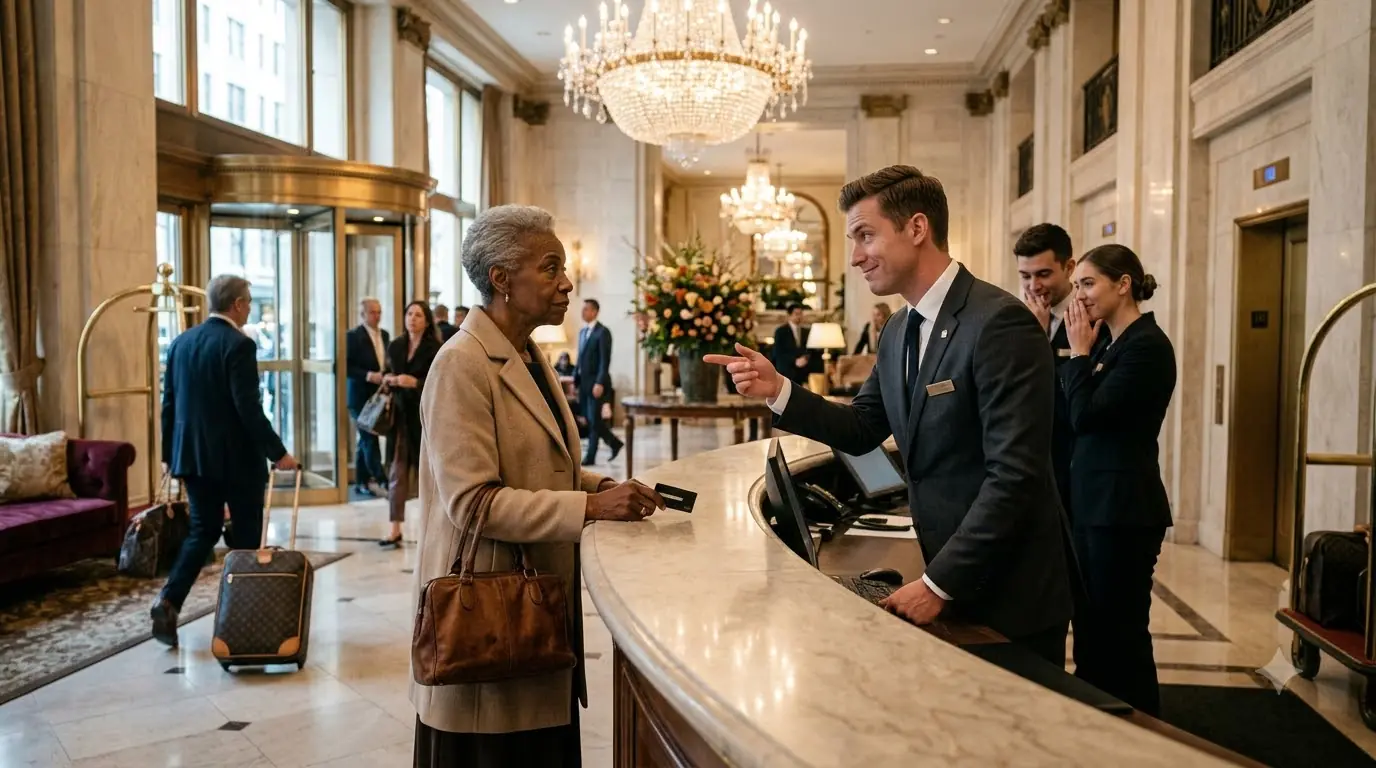
To most people, it was simply one of New York City’s most prestigious luxury hotels, a place of polished marble, crystal chandeliers, expensive suites, and carefully curated perfection.
To Evelyn, it was something else entirely.
It was the physical result of decades of sacrifice.
At seventy-four years old, Evelyn Monroe had spent most of her life building a hospitality empire from almost nothing. She had entered the business world during a time when women like her were often underestimated before they had even spoken. She had endured rejection, closed doors, dismissive meetings, biased assumptions, and executives who believed she lacked the background, connections, or status to compete with them.
She proved them wrong slowly.
Hotel by hotel.
Contract by contract.
Year by year.
The Monroe Regency had become the crown jewel of everything she had built.
Yet that afternoon, Evelyn had arrived without an executive car, assistants, security, photographers, or anyone waiting at the entrance to greet her.
She wanted anonymity.
Her coat was simple.
Her shoes were practical.
Her leather handbag was old but carefully maintained.
There was nothing about her appearance that suggested she controlled the company whose name was displayed above the entrance.
That was intentional.
Evelyn had always believed that executives experienced their businesses differently from ordinary customers. When senior leaders visited one of her hotels, managers polished every detail, staff stood straighter, and everyone suddenly remembered every company standard.
Evelyn wanted to know what happened when nobody knew she was watching.
So she walked through the revolving doors alone.
Inside, the grand lobby looked almost perfect.
A massive crystal chandelier scattered light across polished marble floors. Guests relaxed in velvet chairs while waiters moved between them carrying drinks. Bell staff rolled expensive luggage toward elevators. Reception employees wore immaculate uniforms.
Everything appeared elegant.
Efficient.
Controlled.
Evelyn crossed the lobby slowly.
Nobody greeted her.
At the concierge desk stood a young man named Andrew.
His uniform was perfectly pressed, his hair carefully styled, and his professional smile appeared the moment Evelyn approached.
But his eyes told a different story.
They moved from her modest coat to her handbag, then to her sensible shoes.
His expression changed almost imperceptibly.
“Can I help you, ma’am?”
The words were polite.
The tone was not.
Evelyn had spent decades hearing that tone.
It was the voice people used when they had already decided who deserved their full attention.
“Yes,” she said calmly. “I’d like to book a room.”
Andrew paused.
“This is a premium property.”
“I’m aware.”
“Our rooms begin at approximately twelve hundred dollars per night.”
Evelyn watched him.
He leaned slightly forward.
“Perhaps one of our sister properties nearby might be more comfortable for you.”
Evelyn said nothing for a moment.
Then she opened her handbag.
Andrew watched.
She removed a sleek black credit card and placed it on the marble counter.
“Please check your availability.”
Andrew’s practiced expression faltered.
Only briefly.
Then it returned.
“Of course.”
He turned toward his computer and began typing.
Deliberately slowly.
Behind him, two other employees were talking quietly.
Evelyn heard pieces of their conversation.
“Wrong place.”
“Probably didn’t check the rates.”
A restrained laugh followed.
Evelyn remained silent.
She had learned long ago that people revealed themselves most completely when they believed their behavior had no consequences.
Andrew eventually looked back at her.
“We have an entry-level suite available.”
His smile tightened.
“Nothing particularly special.”
“That will be fine.”
He processed the card.
A few moments later, he handed her the key.
“Enjoy your stay.”
Evelyn accepted it.
“Thank you.”
She turned and walked toward the elevators without giving him the reaction he seemed to expect.
The suite was beautiful.
Floor-to-ceiling windows overlooked Central Park. The bed was enormous, covered with crisp white linens. Artisanal chocolates sat on a small table beside a handwritten welcome card.
Evelyn hardly noticed any of it.
She placed her handbag beside the bed and stood at the window.
From that height, New York appeared almost peaceful.
But Andrew’s words remained in her mind.
Perhaps one of our sister properties might be more comfortable.
This was her hotel.
Her company.
Her standards.
And one of her own employees had looked at a paying guest and decided she probably did not belong.
Evelyn sat on the edge of the bed.
This was not the first time someone had underestimated her.
It probably would not be the last.
But this time was different.
She had built the Monroe Hotel Group around a principle that mattered deeply to her.
Luxury was not supposed to mean exclusion.
True hospitality meant making every legitimate guest feel respected from the moment they entered the building.
If the Monroe Regency had forgotten that, then somewhere along the way her company had drifted from the values that created it.
Evelyn opened her laptop.
She logged into the company’s internal management system.
As founder and CEO, she had access to guest reports, employee complaints, performance records, operational audits, and satisfaction surveys.
She began reading.
What she discovered troubled her far more than Andrew’s behavior.
One guest review said:
“Beautiful hotel, but certain staff members made me feel as if I had entered somewhere I was not supposed to be.”
Another read:
“The property is stunning. The service depends entirely on what they think of you when you walk through the door.”
There were complaints involving guests who had been redirected unnecessarily, ignored while other customers were helped first, or spoken to in condescending ways.
Several internal employee surveys suggested favoritism inside the hotel.
Some workers described supervisors giving the best assignments to employees they considered more suitable for wealthy guests.
Others mentioned managers ignoring complaints about biased treatment.
One comment remained in Evelyn’s mind.
“Management cares about appearance more than respect.”
She leaned back.
This was not one rude concierge.
It was a pattern.
Her phone buzzed.
Marcus Hale, her longtime executive assistant, was calling.
Evelyn answered.
“Ms. Monroe, is everything all right?”
“Yes.”