The rain had been falling over Millstone, Tennessee, since dawn, turning the sidewalks silver and the empty streets quiet. Inside a small, aging house at the end of Maple Road, seventy-four-year-old Ruth Bennett stood in front of her kitchen stove, staring at the last pot of soup she had.
It was thin soup.
 Mostly water, a few potatoes, half an onion, and the last pieces of chicken she had saved from Sunday. Her pantry was nearly empty. Her Social Security check would not arrive for three more days, and the little money she had left was folded carefully inside a coffee tin above the fridge.
Eight dollars.
That was all.
Still, Ruth whispered a short prayer before ladling the soup into a bowl.
“Thank you, Lord, for enough.”
She had learned to say that even when enough did not feel like enough.
Her husband, Walter, had been gone for six years. Their only son had moved away long ago and barely called. Most days, Ruth lived alone with the ticking kitchen clock, the wind against the windows, and old photographs that reminded her of a life that used to be full.
She sat down at the table, wrapped her thin hands around the warm bowl, and was about to take her first spoonful when she heard a sound outside.
At first, she thought it was thunder.
Then it came again.
A rough cough.
Ruth lifted her head.
Another cough followed, weaker this time.
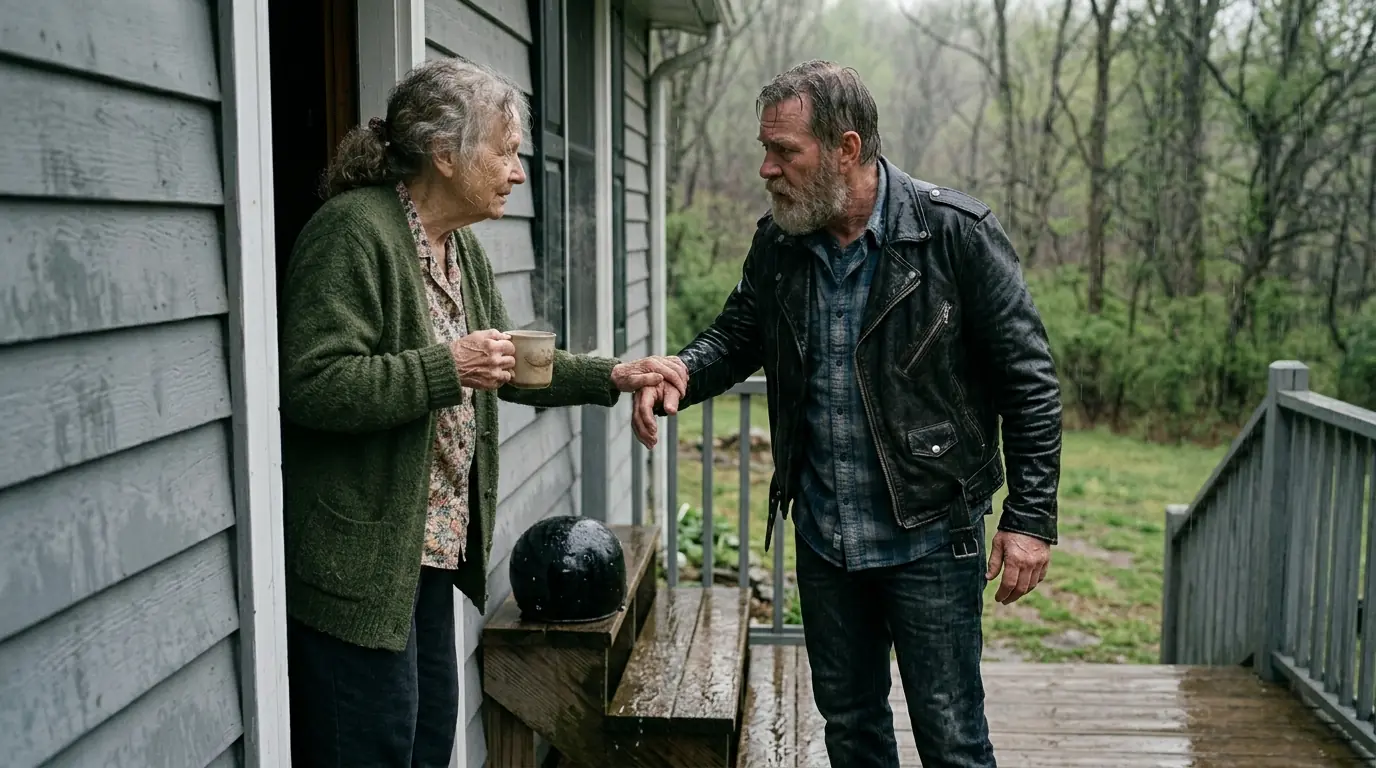
She pushed herself up from the chair and walked carefully to the front window. Through the rain, she saw an old man sitting beneath the narrow awning near her porch steps. He was soaked from head to toe, hunched over, one hand pressed against his chest.
Beside him was a battered motorcycle helmet.
Ruth’s heart tightened.
She opened the front door.
“Sir?” she called. “Are you all right?”
The man looked up slowly. His face was pale, his beard gray and wet, his breathing uneven.
“I’m sorry, ma’am,” he rasped. “I didn’t mean to come onto your porch. I just needed to sit down for a minute.”
Ruth stepped outside, ignoring the cold rain blowing across her slippers.
“You’re sick.”
“I’ll be fine.”
“No, you won’t. Come inside before you catch your death.”
The man tried to stand but nearly fell. Ruth moved faster than she thought she could, grabbing his arm and helping him through the doorway.
He was heavy, but weak.
She guided him to the kitchen chair and placed a towel around his shoulders. His hands trembled badly.
“What’s your name?” she asked.
“Frank,” he said. “Frank Doyle.”
Ruth touched his forehead and frowned. “You’re burning up.”
Frank gave a tired smile. “That’s what my son keeps telling me.”
“Where is your son?”
Frank looked away. “On the road. He rides with a motorcycle club. Good men, though people don’t always believe that.”
Ruth glanced at the helmet near the door.
Outside, rain rolled down the glass.
Frank coughed again, harder this time. Ruth quickly brought him a glass of water. He drank slowly, then closed his eyes as if the effort had exhausted him.
“You need food,” Ruth said.
“No, ma’am. I don’t want to take anything from you.”
Ruth looked at the single bowl of soup on the table.
Her last meal.
Then she looked at the sick man’s shaking hands.
“My Walter used to say hunger is louder when someone else has it,” she said softly.
She picked up the bowl and placed it in front of Frank.
“Eat.”
Frank stared at it. “Is this yours?”
“It’s ours now.”
His eyes grew wet.
“I can’t.”
“You can, and you will.”
Frank lifted the spoon with a trembling hand. He ate slowly at first, then with the quiet desperation of a man who had gone too long without warmth.
Ruth pretended not to notice when he finished every drop.
She made him tea with the last tea bag in the box. Then she found an old blanket and helped him settle on the couch.
Frank looked around the tiny house.
“You live alone?”
“Yes.”
“Family?”
Ruth hesitated. “Not nearby.”
Frank understood more than she said. Lonely people often did.
“My son’s name is Cole,” he said after a while. “Big beard, tattoos, leather vest. Looks like trouble if you judge too fast. But he’s got the softest heart of any man I know.”
Ruth smiled. “Then he was raised right.”
Frank’s eyes lowered.
“I wasn’t always right. I made mistakes. Drank too much when he was young. Disappeared too many nights. His mother died before I knew how to be the father he needed.”
The rain softened against the roof.
“But he still comes for me,” Frank continued. “Every time. Even when I don’t deserve it.”
Ruth sat in the chair across from him.
“Children remember pain,” she said. “But sometimes they remember love too, even if it came late.”
Frank looked at her, surprised by the kindness in her voice.
For the next hour, the little house felt less lonely.
Frank told Ruth about Cole’s motorcycle club, the Iron Saints. He said they repaired houses for veterans, delivered food during storms, and protected kids from dangerous homes when the system moved too slowly.
“People see the jackets and think they’re criminals,” Frank said. “But those men have carried more broken people to safety than most churches I’ve known.”
Ruth smiled faintly. “God uses all kinds of hands.”
By evening, Frank’s fever worsened.
Ruth finally called 911.
When the ambulance arrived, Frank tried to apologize again.
“I didn’t mean to bring trouble to your door.”
Ruth squeezed his hand. “You didn’t bring trouble. You brought company.”
Before they took him away, Frank reached weakly into his pocket and pulled out a small silver ring on a chain.
“If my son comes looking,” he whispered, “tell him I’m sorry I worried him.”
Ruth closed his hand around the chain.
“You can tell him yourself.”
Frank gave a tired laugh.
“Stubborn woman.”
“So I’ve been told.”
The ambulance pulled away into the rain.
Ruth stood on the porch until the lights disappeared.
Then she went back inside.
The kitchen felt colder now.
The empty pot sat on the stove. The bowl was clean. The tea box was empty.
Ruth opened the coffee tin and counted the eight dollars again, though she already knew the number.
Three days, she told herself.
She had survived harder things than three days.
The next morning, Ruth woke weak but determined. She made toast from the last two slices of bread and saved one for dinner. She did not tell anyone what had happened. There was no one to tell.
By the second day, her stomach ached from emptiness, but she kept busy. She swept the porch, watered the plant that was already dying, and wrote a grocery list she could not yet afford.
Milk.
Eggs.
Bread.
Soup bones.
Tea.
On the third day, just before noon, the sound came.
At first, Ruth thought it was distant thunder again.
But the sky was clear.
The rumble grew louder.
Deeper.
It rolled through Maple Road like an approaching storm made of engines.
Ruth stepped to the window.
Her breath caught.
Motorcycles.
Dozens of them.
Black bikes, chrome shining in the pale sunlight, rolled slowly down her street. Men and women in leather vests rode in formation. At the front was a tall biker with a gray-streaked beard, broad shoulders, and eyes fixed on Ruth’s house.
Neighbors came outside.
Curtains moved.
The motorcycles stopped in front of Ruth’s little home.
The engines shut off one by one until the street became silent.
Ruth stood frozen.
The tall biker removed his helmet and walked toward her porch.
He looked intimidating, but his eyes were red.
“Mrs. Bennett?” he asked.
Ruth opened the door carefully.
“Yes?”
The biker swallowed.
“My name is Cole Doyle. Frank Doyle is my father.”
Ruth’s face softened.
“How is he?”
Cole’s jaw trembled.
“He’s alive because of you.”
Ruth gripped the doorframe.
“He is?”
Cole nodded. “Pneumonia. Fever was high. Doctors said if he had stayed outside much longer, he might not have made it.”
Ruth closed her eyes for a moment.
“Thank God.”
Cole looked at her as though those two words had broken something inside him.
“He told me what you did,” he said. “Said you gave him your last meal.”
Ruth looked embarrassed. “It was just soup.”
“No, ma’am,” Cole said. “To him, it was life.”
Behind him, the other riders stood silently near their bikes. Some held grocery bags. Some held toolboxes. One woman held a bouquet of yellow flowers.
Ruth looked from face to face.
“I don’t understand.”
Cole turned and nodded.
The riders began moving.
They carried bags onto her porch. Bread, milk, eggs, meat, vegetables, canned goods, tea, coffee, medicine, blankets, cleaning supplies. More than Ruth had seen in her kitchen in years.
“Please,” Ruth whispered, overwhelmed. “This is too much.”
Cole shook his head. “No. It’s not enough.”
Two riders walked around the side of the house, checking the roof. Another knelt near the broken porch step. A woman named Marcy introduced herself and gently took Ruth’s hand.
“Ma’am, we heard your heater’s been giving you trouble.”
Ruth blinked. “How did you know that?”
Marcy smiled. “Frank notices things. Even sick.”
Cole looked down.
“My father said your house was colder than it should’ve been. He said your cupboard was almost empty. He said you gave without making him feel poor.”
Ruth’s eyes filled.
“I know what it feels like to be embarrassed by need,” she said.
Cole removed a folded paper from his vest pocket.
“My dad asked me to bring you this.”
Ruth took it with trembling hands.
The handwriting was shaky, but clear.
Dear Ruth,
You gave me soup when you had none to spare. You gave me warmth when your own house was cold. You gave me dignity when I felt like a burden.
I have not always been a good man. But for one rainy afternoon, you made me feel worthy of kindness.
My son and his brothers are coming. Let them help. Don’t be stubborn.
Your friend,
Frank
Ruth laughed through her tears.
“That man called me stubborn twice.”
Cole smiled. “He knows his kind.”
For the rest of the afternoon, the Iron Saints worked.
They fixed Ruth’s porch step.
They sealed the leaking window.
They replaced the old heater filter and arranged for a technician to come the next morning.
They filled her pantry.
They cleaned her gutters.
They repaired the loose railing Walter had meant to fix before he died.
Ruth tried to help, but every time she picked up something, someone gently took it from her.
“Sit down, Miss Ruth,” one biker said.
“I’ve been sitting for six years,” she replied.
The biker laughed and handed her a cup of fresh tea instead.
By sunset, Ruth’s house no longer looked forgotten.
It looked cared for.
Cole sat with her on the porch while the others loaded their tools.
“My father wants to see you when he gets stronger,” he said.
“I’d like that.”
“He also said you reminded him of my grandmother.”
Ruth smiled. “Was she stubborn too?”
“Worse.”
They both laughed.
Then Cole’s expression grew serious.
“I need to tell you something. My dad and I had an argument the morning he wandered off. I told him I was tired of saving him from himself. I said things I shouldn’t have said.”
Ruth waited.
“He left before I could apologize. When we couldn’t find him, I thought those words would be the last thing he ever heard from me.”
Ruth looked out at the quiet street.
“Then don’t waste the second chance.”
Cole nodded, his eyes wet.
“I won’t.”
A week later, Frank came back to Ruth’s house.
This time, he arrived in Cole’s truck, wrapped in a warm jacket, still pale but smiling. Cole helped him up the repaired porch steps.
Ruth opened the door before they knocked.
“Well,” she said, “look who survived.”
Frank grinned. “Couldn’t leave this world owing a woman for soup.”
Ruth hugged him gently.
From that day on, Ruth Bennett was no longer alone.
Every Sunday, at least three motorcycles stopped by her house. Sometimes Cole came with groceries. Sometimes Marcy came with flowers. Sometimes Frank came just to sit at the kitchen table and complain that Ruth’s tea was too weak.
The Iron Saints called her Miss Ruth.
She pretended to dislike the attention.
But every Sunday morning, she baked biscuits.
Months passed.
Winter came.
Then spring.
One afternoon, Cole arrived carrying a wooden sign. He and two other riders nailed it above Ruth’s porch.
Ruth stepped outside and read the words.
Miss Ruth’s House
No One Leaves Hungry
She covered her mouth.
“I can’t feed everyone,” she whispered.
Cole smiled. “You already did.”
Ruth shook her head. “I only fed one man.”
“No, ma’am,” Cole said. “You reminded all of us who we’re supposed to be.”
That summer, the Iron Saints began delivering meals from Ruth’s house every Saturday. Not because she had much money, but because the riders brought food, cooked, packed boxes, and carried them to the elderly, the sick, and the forgotten.
Ruth sat at the kitchen table labeling containers.
Frank peeled potatoes.
Cole washed dishes.
The house that had once echoed with loneliness filled with laughter, boots, engines, and the smell of soup.
One evening, Ruth stood on the porch watching the riders leave.
Frank sat beside her, his cane across his knees.
“You know,” he said, “that day I came here, I thought I was just looking for shelter.”
Ruth smiled. “And I thought I was just giving away my dinner.”
Frank looked at the sign above the porch.
“Turns out, God was building a family.”
Ruth’s eyes softened.
Down the road, the motorcycles disappeared into the sunset, their engines fading like thunder after a storm.
Ruth went back inside.
The pot on the stove was full.
The pantry shelves were full.
And for the first time in years, so was her heart.