“Who let someone’s grandmother serve champagne in my VIP lounge?”
The laughter rose around Table Seven like smoke. Crystal glasses trembled against the polished black surface, gold chips glittered beneath the chandelier light, and every wealthy guest in the private Monaco casino lounge turned to look at the elderly woman standing beside the roulette table. Madame Elena Ross stood very still in her black service dress and cream apron, a silver name tag pinned neatly over her heart, her white hair tucked into a low bun, and a tray of champagne balanced in both hands.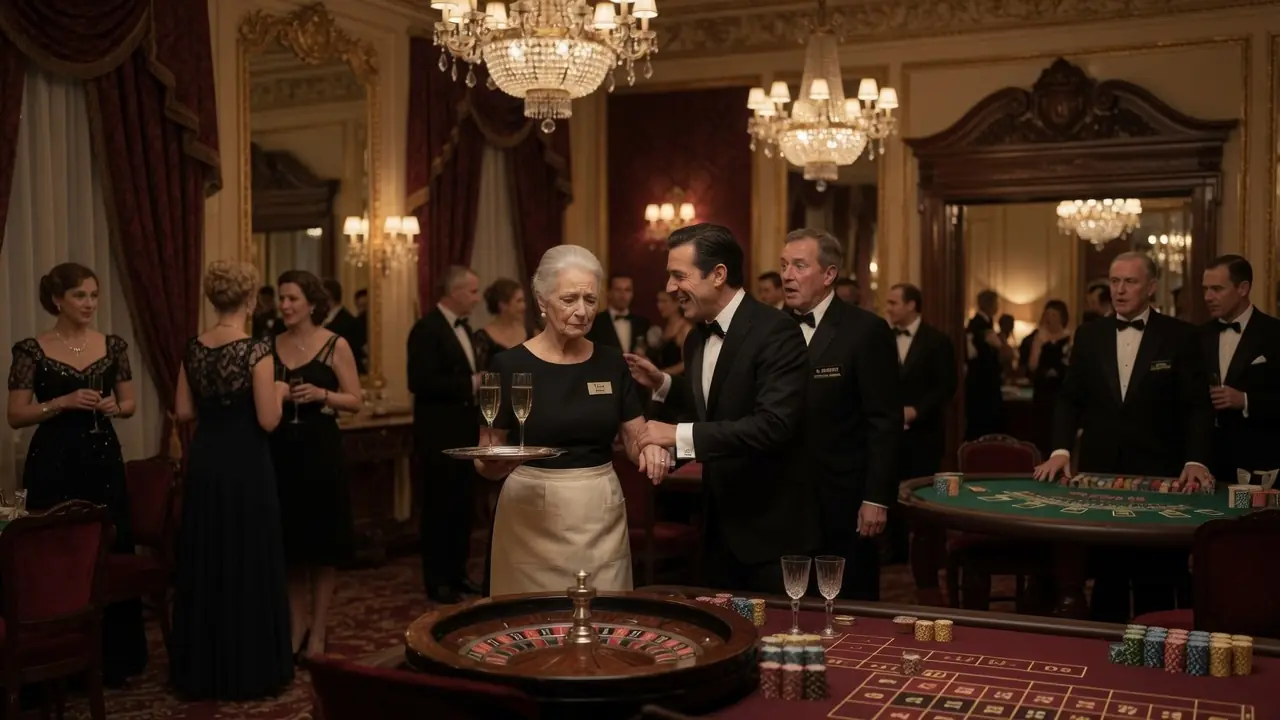
Julien Armand leaned back in his chair with a cruel smile. He was thirty-six, handsome in the way money often made careless men appear handsome, dressed in a black tuxedo with diamond cufflinks and a watch bright enough to catch every light in the room. His father had once held a partnership stake in the casino, and Julien walked through the place as if inheritance were the same as ownership. He looked Elena up and down, then lifted one finger toward her face.
“Smile wider, old woman,” he said. “People pay to feel young in this room, not to be reminded of a retirement home.”
A few men laughed. One woman covered her mouth with a jeweled hand, but her eyes showed amusement before shame. Elena lowered her gaze for a moment, not because she was weak, but because the words had found an old wound. She had heard worse in her lifetime, but somehow being mocked inside the casino she had built made the insult heavier.
“Please,” Elena said softly. “Do not speak to me that way.”
Julien’s smile sharpened. Her pain pleased him. Men like Julien loved to test how much humiliation a quiet person would swallow before making a sound. He reached for a blue chip, rolled it between his fingers, then flicked it toward her feet.
“There,” he said. “A tip. Pick it up nicely and maybe I’ll forget how depressing you look beside my table.”
The chip bounced once and landed near Elena’s shoe. Her fingers tightened around the tray. For one second, her eyes glistened under the chandelier, and the room might have seen the hurt if anyone had cared enough to look closely. But most of the guests only watched the spectacle, enjoying cruelty because they were not the ones standing beneath it.
Elena Ross was eighty years old. Her hands were thinner than they had once been, her steps slower, her back less forgiving after long hours on marble floors. But there was nothing small about the life behind her silence. Fifty-two years earlier, she had arrived in Monaco with one suitcase, a head for numbers, and a refusal to let powerful men decide how far she could climb.
She had begun as a cashier in a failing gaming hall near the harbor. She learned every table, every ledger, every habit of men who believed luck belonged to them. When the original owner died with debts hidden in three accounts, Elena exposed the theft, saved the staff from losing their jobs, and convinced investors to let her rebuild the place. Over decades, that little gaming hall became the Ross Royale Casino, one of the most elegant private casinos in Monaco.
But very few people knew her face now. Elena had stepped away from public life after her husband died and let executives manage the casino day to day. Her name remained on legal documents, private ledgers, and ownership records, but the public saw only polished managers, young hosts, wealthy heirs, and arrogant guests who believed the casino existed for their pleasure. Recently, complaints had reached her private office: staff humiliated, older employees pushed aside, servers touched, mocked, and threatened by VIPs.
So Elena returned in a uniform.
She wanted to see the truth without a boardroom performance. She wanted to know whether the house she built still protected the people who carried its trays, cleaned its tables, counted its chips, and smiled through other people’s bad manners. She expected disappointment. She did not expect to feel heartbreak.
Julien tapped his glass on the table. “Champagne, grandmother. Unless your hands are too tired.”
Elena lifted the bottle with careful grace and filled his glass without spilling a drop. The room smelled of expensive whiskey, velvet, cigar smoke from the terrace, and perfume that cost more than a week of wages for some of her staff. She heard soft laughter behind her. She felt it settle on her shoulders like dust.
Julien watched her pour. “You know, my father always said this casino had standards. Now they let anyone serve upstairs.” He leaned closer, his voice louder now. “Tell me, do they keep you here out of pity?”
Elena’s throat tightened. “I am here because I chose to be.”
“Chose?” Julien laughed. “At your age, choice is a generous word.”
That one hurt more than Elena expected. Not because she feared age, but because she had spent a lifetime proving that age did not erase worth. She thought of every worker over sixty quietly pushed into back rooms, every older woman called invisible, every experienced hand replaced by someone younger and less expensive. Her face remained calm, but inside, something old and tender bent under the insult.
“I have served this room longer than you have understood it,” she said.
Julien’s guests laughed louder, thinking she had made a small joke. Julien did not laugh. He disliked confidence in people he had already decided were beneath him.
He reached out suddenly and grabbed her wrist.
The tray tilted. Champagne trembled in the glasses. Elena inhaled sharply, not loudly enough to be called a scream, but enough for the nearest dealer to look up in alarm. Julien’s fingers tightened around her thin wrist as if he were proving something to the table.
“Don’t act wounded,” he said. “At your age, you should be grateful we still let you carry trays.”
The words struck Elena like a slap no hand had delivered. Her eyes lowered to his fingers pressing into her skin, and for a brief second, the room blurred. She saw herself at twenty-eight, being told by a banker that women did not understand gaming finance. She saw herself at forty, being told by a male investor to let him speak because the room would listen better. She saw herself at sixty-five, being congratulated for “still being useful.”
And now, at eighty, inside her own casino, a spoiled heir was holding her wrist and telling her to be grateful.
“Let go,” she said.
Julien smiled. “Or what?”
Elena looked up. The hurt was still there, but something colder had joined it. “You are making a mistake.”
“No,” Julien said, turning toward the table as if performing. “The mistake is letting staff forget who pays for the room.” He forced her wrist outward, not hard enough to injure, but enough to humiliate. “Smile for the guests.”
The laughter came again, though weaker now. A few guests shifted in their seats. One dealer looked toward the lounge entrance. A young waitress named Camille stood near the bar, her eyes wide with fear. She recognized Elena from the employee briefing that morning, but she had been ordered not to reveal her identity unless Elena requested it.
Julien noticed Camille staring and snapped, “What are you looking at? Get back to work.”
Elena turned her head slightly toward Camille. “No, child. Stay where you are.”
The softness in Elena’s voice made Camille’s eyes fill with tears. For weeks, Julien had been cruel to the staff, especially the older servers and young women who could not risk losing their jobs. He called it humor. Management had called it “VIP sensitivity.” Elena now understood exactly what that meant: cowardice dressed as policy.
Julien tightened his grip again. “You don’t give orders here.”
Elena looked at him, wounded but steady. “This room was built with more sacrifice than you will ever understand.”
Julien sneered. “Then sacrifice your pride too. You serve rich men now.”
At that moment, the lounge doors opened.
Henri Marchand, the casino’s general manager, rushed inside with two security officers behind him. He was a tall man in a midnight-blue suit, usually composed to the point of appearing carved from stone. But when he saw Julien Armand gripping Elena Ross by the wrist, every bit of color drained from his face.
“Let her go,” Henri said.
Julien rolled his eyes. “Henri, finally. Remove this woman from my table. She’s disturbing my guests.”
Henri took one step closer. “I said let her go now.”
Something in his voice silenced the table. Julien looked from Henri to Elena, then back again, irritated and confused. “Why are you speaking to me like that?”
Henri’s jaw tightened. “Because you are holding Madame Elena Ross.”
The name moved through the lounge like a dropped glass.
One guest whispered, “Ross?”
Another guest sat up straighter. Camille covered her mouth with both hands. The dealer stepped back from the roulette wheel as if the table itself had become dangerous.
Julien’s grip loosened.
Henri’s voice shook with outrage. “She is the owner of this casino.”
Julien released Elena’s wrist as if it had burned him. For a second, he simply stared, unable to arrange his face into anything useful. Then he looked at Elena’s service dress, her apron, her silver name tag, and finally her eyes.
“What do you mean she owns this casino?” Julien whispered, his face turning pale. “I just humiliated the woman who can erase my family’s name from the door?”
Elena slowly rubbed her wrist. The gesture was small, but everyone saw it. That was the power of silence after cruelty; it made even the smallest pain visible.
Julien stood too quickly, nearly knocking over his chair. “Madame Ross, I didn’t know.”
Elena looked at him with unbearable calm. “That is what cruel people always say when power introduces itself.”
His mouth opened, but no defense came.
“You did not know who I was,” Elena continued. “So you showed me who you are.”
Henri turned to security. “Escort Mr. Armand away from the table.”
Julien’s shock turned to panic. “Henri, don’t be absurd. My family has history here.”
Elena’s eyes sharpened. “Your family had privilege here. You mistook it for ownership.”
The guests were silent now. The same men who laughed moments earlier stared down at their chips. One woman removed her hand from her necklace and placed it in her lap like a guilty child. Nobody wanted to be remembered as part of the laughter, but silence had already signed their names.
Julien stepped toward Elena, lowering his voice. “Please. This can be handled privately.”
Elena’s face changed then. The hurt returned, deeper than anger. “Privately?” she asked. “You shamed me in front of the room. You mocked my age in front of the room. You grabbed my wrist in front of the room. You threw a chip at my feet and called it a tip in front of the room.”
Julien looked around, realizing every sentence was true.
“So no,” Elena said. “We will not hide your cruelty behind a velvet door.”
Henri gestured again, and security moved closer. Julien pulled away from them, desperate now. “Madame Ross, I apologize. Truly. I was joking.”
Elena tilted her head. “A joke requires someone human on the other side. You treated me like furniture with a pulse.”
Camille began crying quietly near the bar. Elena saw her and softened for the first time since the reveal. “Camille,” she said. “Come here.”
The young waitress hesitated, then walked forward. Her hands trembled. Elena reached for her gently, not forcing, only offering comfort. “Has he spoken to you this way before?”
Camille looked at Julien, then at Henri. Fear fought with truth on her face. Elena understood that fear. She had built a casino in rooms where men smiled with knives behind their teeth.
“You are safe,” Elena said. “Answer me.”
Camille nodded. “Yes, Madame.”
The room shifted again.
Henri closed his eyes briefly, ashamed. Elena looked at him. “You knew there were complaints.”
Henri swallowed. “We were investigating.”
“No,” Elena said. “You were delaying.”
The words hit him harder than any shouting would have. Henri had served the casino for twenty-one years, and Elena had trusted him. That trust cracked visibly between them. He bowed his head, not for ceremony, but because he could not meet her eyes.
Elena turned back to Julien. “How many employees did you humiliate before me?”
Julien’s arrogance flickered one last time. “This is being exaggerated.”
Elena stepped closer. Though she was eighty, though he towered over her, the room seemed to shrink around him. “Be careful,” she said softly. “Your next lie may cost more than your last insult.”
He went quiet.
Elena looked toward the guests at Table Seven. “And you all laughed.”
No one answered.
“One of you tossed a chip at my feet.”
A man with a red face stared at his glass. Elena pointed to him. “You.”
He flinched. “Madame Ross, I did not mean—”
“You meant to entertain yourself with someone else’s humiliation.”
The man lowered his eyes.
Elena looked across the table. “This casino was not built so rich men could practice being cruel. It was built because I believed elegance meant discipline, restraint, and respect. If wealth makes you forget the humanity of the person serving your glass, you are not refined. You are merely expensive.”
No one dared move.
Henri finally spoke. “Madame, what would you like done?”
Elena looked at Julien. “Cancel Mr. Armand’s membership permanently. Freeze all family privileges attached to his name pending legal review. Remove his private room access, his credit line, and his guest list.”
Julien staggered back. “You can’t do that.”
Elena’s voice turned ice-cold. “I own the house. I decide who enters.”
Security took Julien by the arms. This time he did not fight; he was too stunned. As they led him toward the door, he looked back once, not at Elena’s face, but at the table, the guests, the room, the life he thought was his by inheritance. It was already closing against him.
When he was gone, the lounge remained painfully silent.
Elena turned to the staff. “Service stops for this table.”
Several guests looked alarmed.
She continued, “Every employee in this room may take a paid break immediately. The guests will wait.”
Henri nodded quickly, signaling the staff. Dealers stepped away from tables. Waitresses lowered trays. Bartenders stopped pouring. For the first time in years, the VIP lounge paused not for a high roller, not for a celebrity, not for a prince, but for the dignity of the people working inside it.
Elena sat slowly in Julien’s empty chair.
The chair seemed different beneath her, not grander, but corrected. She looked at the chip still lying near where he had thrown it. Camille bent to pick it up, but Elena stopped her.
“No,” Elena said. “Leave it there.”
Camille froze.
“Let everyone look at it.”
The blue chip remained on the carpet like a small, ugly witness.
Henri approached carefully. “Madame Ross, I failed you.”
Elena did not answer immediately. She studied the lounge she had spent decades building. The velvet walls were still beautiful, the chandeliers still brilliant, the roulette wheel still polished, but now she could see the rot that beauty had concealed. A room could be decorated with wealth and still be poor in courage.
“You failed them first,” she said, looking at Camille and the other staff. “I came here dressed as one of them to see whether the house remembered its values. Tonight I learned it had taught some people to endure what it should have forbidden.”
Henri’s face tightened with shame. “I will resign if you ask.”
“I may ask,” Elena said. “But not tonight.”
He bowed his head.
“Tonight,” she continued, “you will gather every employee who has filed a complaint against a VIP and every manager who buried one. Tomorrow morning, we review them all.”
Henri nodded. “Yes, Madame.”
“And Camille receives a promotion to staff liaison during that review.”
Camille’s eyes widened. “Madame, I’m only a waitress.”
Elena looked at her gently. “So was I.”
Those three words changed the room more than any announcement. The staff looked at Elena as if seeing her not as an owner, not as a legend, but as proof that the uniform did not define the person wearing it. Camille pressed her lips together to keep from crying again.
The following morning, Ross Royale Casino closed its VIP lounge for the first time in twenty-seven years. Outside, reporters speculated about renovations, security incidents, and a banned heir. Inside, Elena sat at the head of a conference table with employee statements stacked in front of her. She read every one.
Some complaints were small on paper and enormous in memory. A guest snapping fingers in a server’s face. A host being called useless after refusing an improper request. An older dealer mocked for slow hands though his math was perfect. A bartender threatened for cutting off a drunk patron with a powerful surname.
Elena listened as staff spoke. Some cried. Some shook with anger. Some apologized before telling the truth, as if truth were an inconvenience they had caused. Elena stopped them every time.
“Do not apologize for pain someone else created,” she said.
By noon, three managers were suspended. By evening, the casino’s VIP conduct policy was rewritten. Membership privileges could now be revoked for humiliating staff, touching employees, threatening livelihoods, or using wealth as permission for cruelty. Every complaint would go to an independent review board with staff representation. No more quiet settlements. No more apologies without consequences.
Julien Armand tried to fight the ban. His attorneys sent letters citing family legacy, historic partnership rights, and reputational harm. Elena sent back copies of security footage, witness statements, and a single handwritten note.
Your reputation was harmed by your behavior, not by my memory.
The fight ended quickly after that.
A week later, Elena returned to the VIP lounge, not in the service dress, but in a charcoal silk suit with pearl earrings and her silver hair pinned exactly as before. The staff stood straighter when she entered, but she raised a hand. “Do not perform fear for me,” she said. “I have seen enough of that in this room.”
Camille approached with a nervous smile. “Good evening, Madame Ross.”
Elena smiled back. “Good evening, Camille.”
The blue chip Julien had thrown was now sealed in a small glass box near the staff entrance. Beneath it, a bronze plaque read: Respect is not optional in this house. Some guests thought it was decorative. The staff knew better.
Months passed, and the story spread quietly through Monaco. People told it as a shocking scandal at first: the arrogant heir, the elderly waitress, the reveal, the ban. But over time, the story changed. Staff from other hotels and casinos began sending letters to Elena. Older workers thanked her for saying age did not erase dignity. Younger servers thanked her for proving that uniforms did not make them powerless.
Elena kept every letter.
One evening, long after the scandal had cooled, she stood alone in the empty VIP lounge before opening. The chandeliers glowed above her, soft and gold. The roulette wheel waited in silence. The tables had been polished, the glasses aligned, the room restored to elegance.
Henri entered quietly behind her. He had not resigned, because Elena had decided a man who admitted failure and worked to repair it might still be useful. He had spent months rebuilding trust with the staff and taking orders from people he had once failed to protect. It had humbled him, and that was exactly what Elena intended.
“Madame,” he said, “Table Seven is reserved tonight.”
Elena looked toward the table where Julien had grabbed her wrist. For a moment, she felt the echo of his fingers, the sting of his words, the laughter around her. Her eyes grew sad, but she did not look away. Healing, she knew, was not pretending something had not hurt.
“Who reserved it?” she asked.
“Camille,” Henri said. “For the staff dinner after closing.”
Elena smiled softly. “Good.”
That night, after the final guest left, the staff gathered around Table Seven. Dealers, waitresses, bartenders, cleaners, cooks, hosts, security officers, and cashiers sat where only the wealthiest guests had once sat. Champagne was poured, but no one was ordered to smile. They laughed freely, not cruelly, and the room felt richer than it had in years.
Camille raised her glass. “To Madame Ross.”
Elena shook her head. “No. To every person who serves without surrendering their dignity.”
The staff repeated the toast.
Elena looked around the table, her heart full and aching at once. She thought of Julien’s insult, the chip at her feet, the laughter, and the way the room had changed when the truth arrived. She had been hurt that night; she would not deny it. But the hurt had exposed something the casino needed to see.
A house, she realized, is not proven by how it treats the powerful. Every casino knows how to flatter money. A house is proven by how it protects the person carrying the tray, the woman with tired hands, the old man dealing cards, the young waitress afraid to speak, and the elderly owner in an apron whom fools mistake for powerless.
Julien Armand had thought he was humiliating an old waitress.
Instead, he had revealed the weakness of every person who laughed, every manager who delayed, and every rule that protected wealth before dignity. He had grabbed the wrist of an eighty-year-old woman and told her she should be grateful to serve rich men. Then he learned the truth too late.
Madame Elena Ross did not just own the casino.
She owned the room, the rules, the roof over his arrogance, and the final word on who was welcome inside.