Evelyn Carter boarded Flight 716 with her late husband’s old leather wallet tucked inside her purse and a first-class ticket trembling between her fingers. At eighty-two, she moved slowly down the jet bridge, one hand on the rail, the other holding the boarding pass Charles had bought before he died. She wore a modest beige coat, soft gloves, small pearl earrings, and a blue church hat that had been carefully brushed before dawn. The flight was from Atlanta to Paris, the trip she and Charles had dreamed about for forty-seven years.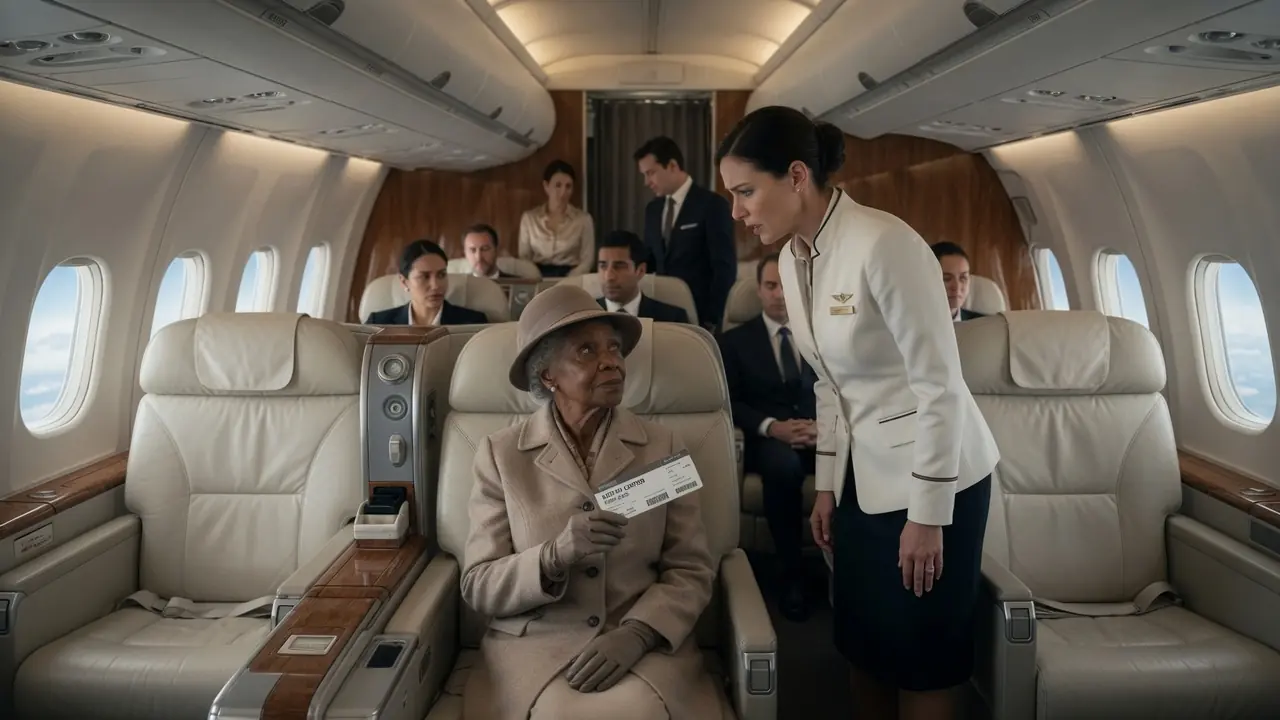
First class looked softer than any place Evelyn had ever sat in public. The seats were wide cream leather, each with its own lamp, polished side table, blanket, pillow, and glass waiting beside folded menus. Passengers in tailored clothes glanced up as she entered, then quickly returned to their phones, champagne, and quiet conversations. Evelyn paused at seat 2A, checked the number twice, and whispered, “We made it, Charles.”
Her husband had been gone six weeks. Before the cancer took his strength, he had placed the ticket in her hand and told her she had to go, even if he could not. They had saved for that trip the way some people save for houses, in coffee cans, bank envelopes, skipped dinners out, and years of saying maybe next spring. Charles had wanted to see the Eiffel Tower with her at sunset, but when he knew he would not live long enough, he paid for her seat anyway.
Evelyn lowered herself carefully into 2A and touched the armrest as if the seat might vanish if she moved too quickly. She placed her purse at her feet, smoothed her coat, and looked at the tiny glass of champagne on the side table. She did not drink it. She only stared at the bubbles and imagined Charles laughing softly, telling her not to act like she had never seen fancy before.
Across the aisle, a businessman in a navy suit watched her with open curiosity. Two seats behind, a blonde woman in a cream sweater leaned toward her husband and whispered something that made his eyes flick toward Evelyn’s shoes. Evelyn heard none of the words clearly, but she knew the tone. She had lived long enough to recognize when people were not speaking to her, but about her.
A flight attendant named Caroline Reed came down the aisle with a tablet pressed against her waist. She was white, polished, and severe, with her dark hair pulled into a tight bun and her uniform jacket fitted perfectly at the shoulders. She stopped beside Evelyn’s seat and looked down without smiling. Her eyes moved from Evelyn’s hat to her worn gloves to the old purse under the footrest.
“Ma’am,” Caroline said, “this is first class. Are you sure you belong here?”
Evelyn looked up slowly. “Yes, baby. This is my seat.”
Caroline’s mouth tightened at the word baby, as if kindness from an old woman had offended her more than disrespect would have. “May I see your boarding pass?” she asked. Her voice carried just far enough for nearby passengers to hear.
Evelyn lifted the ticket with a small smile. “Of course.”
Caroline took it between two fingers, barely touching the paper. She looked at the boarding pass, then at Evelyn again, as if the document had failed to support the story she wanted. “This says 2A,” she said.
“Yes, ma’am.”
Caroline glanced toward the front galley. “Did someone at the gate upgrade you by mistake?”
Evelyn blinked. “No. My husband bought it.”
The businessman across the aisle lowered his phone. Caroline’s face did not soften. Instead, she gave a small sigh, the kind people use when they believe patience is being wasted on someone beneath them.
“Ma’am,” she said, colder now, “first class isn’t a waiting room for people who got lost after cleaning it.”
The words froze Evelyn in place.
For a second, she could not breathe. She thought of all the offices she had cleaned in her younger years, all the bathrooms, conference rooms, and polished floors where white executives stepped around her mop without seeing her face. She had done honest work, hard work, work that helped feed her children and pay rent, and now this woman had turned that history into an insult. Evelyn’s fingers tightened around the armrest.
A passenger behind her made a soft sound of discomfort, but no one spoke. Caroline stood in the aisle with the boarding pass in her hand, looking almost satisfied with the silence. Evelyn slowly lifted her chin.
“Say that again after you read my name,” Evelyn said.
Caroline looked down at the pass again. “Evelyn Carter.”
“That’s right.”
“A printed ticket doesn’t make you belong among passengers who actually live like this,” Caroline said, lowering her voice but not enough. “Sometimes people buy something expensive once and think it changes where they fit.”
Evelyn’s eyes filled, but her voice stayed steady. “No. It proves I bought the seat, and you sold your dignity for an assumption.”
The cabin went silent.
Caroline’s face flushed red. The businessman across the aisle finally sat forward, but still did not speak. The blonde woman behind Evelyn looked down at her lap. A younger passenger near the window quietly raised his phone, not smiling now, recording because he understood something was happening that should not disappear.
Caroline held the boarding pass tighter. “I’m going to verify this with the purser.”
“You do that,” Evelyn said. “But bring my ticket back when you’re done.”
Caroline turned sharply and walked toward the galley. Evelyn sat very still, afraid that if she moved, the tears would fall. Her hands shook in her lap, so she folded them together and pressed her gloves against each other. She could hear Charles in her memory saying, “Evie, don’t let anyone make you leave a place I paid for you to sit.”
The businessman across the aisle cleared his throat. “Ma’am,” he said quietly, “I’m sorry that happened.”
Evelyn looked at him. “You heard it happen before you were sorry.”
His face changed.
She did not say it cruelly. She said it because it was true, and at eighty-two, she had little patience left for people who found courage only after the worst part was over. The man lowered his eyes.
A few minutes later, Caroline returned with the purser, a gray-haired man named Thomas Avery. His expression was professional, but his gaze moved quickly from Evelyn’s wet eyes to the boarding pass in Caroline’s hand. He understood enough to be careful. Caroline stood slightly behind him, stiff with wounded pride.
“Mrs. Carter,” Thomas said, “there seems to have been a question about your seat.”
“No,” Evelyn said. “There was a question about me.”
Thomas paused. “I understand.”
“I don’t think you do yet.”
The younger passenger kept recording. Thomas noticed but did not ask him to stop. He held out his hand to Caroline for the boarding pass, scanned it with his tablet, and waited as the passenger record loaded. His expression shifted almost immediately.
Caroline frowned. “What is it?”
Thomas did not answer her. He looked at Evelyn with new seriousness. “Mrs. Carter, your ticket was purchased eleven months ago.”
“Yes.”
“Full fare first class. Seat 2A. Special assistance requested. Anniversary meal note.” He swallowed. “Passenger traveling in memory of Charles Carter.”
Evelyn closed her eyes. “That was my husband.”
Thomas looked at the tablet again. “There’s a note from the booking office.”
Caroline leaned closer. “What note?”
Thomas read silently first, then his face softened in a way that made Evelyn’s throat tighten before he spoke. “It says: Mr. Carter requested that his wife be treated with extra care. This trip was their lifelong dream. He may not survive to travel with her.”
The cabin remained completely still.
Evelyn turned her face toward the window. Outside, ground crews moved across the tarmac under a pale morning sky. She could suddenly see Charles in his hospital chair, thin under a blanket, insisting the airline agent repeat the confirmation number because his hand shook too hard to write it clearly. He had known he was dying and still spent his last strength making sure she would have this one beautiful thing.
Caroline shifted her weight. “I didn’t know that.”
Evelyn turned back. “You didn’t need to know that to treat me like a person.”
Thomas looked at Caroline. “Go to the forward galley.”
Her mouth opened. “Thomas—”
“Now.”
Caroline walked away, but every step looked heavier than the one before it. The passengers watched her go without the curiosity they had shown Evelyn. Now their eyes carried judgment, embarrassment, and the late discovery that silence had made them part of the scene.
Thomas crouched slightly beside Evelyn’s seat. “Mrs. Carter, I am deeply sorry. You are exactly where you belong.”
Evelyn looked at the boarding pass in his hand. “May I have my ticket back?”
He handed it to her with both hands.
She smoothed the paper over her lap, as if it had been bruised too. Then she placed it inside Charles’s old wallet and returned the wallet carefully to her purse. The gesture was small, but the cabin watched it with the respect they should have given her when she first sat down.
Boarding continued, but the mood in first class had changed. No one laughed. No one whispered loudly. The blonde woman in the cream sweater removed her headphones and leaned forward.
“Mrs. Carter,” she said, “I’m sorry too. I should have said something.”
Evelyn looked at her for a long moment. “Yes, you should have.”
The woman nodded, tears rising in her eyes. “You’re right.”
The businessman across the aisle added, “I should have too.”
Evelyn sighed softly. “Then next time, don’t wait for an old woman to defend herself alone.”
Neither passenger answered. They did not need to. Evelyn turned back toward the window, not because she wanted to punish them, but because she needed a moment with Charles before the plane left the ground.
Thomas returned shortly before takeoff. “Mrs. Carter, Captain Daniels would like to speak with you after we’re airborne, if you’re comfortable.”
“Why?”
Thomas hesitated. “He knew your husband’s name.”
Evelyn’s eyes lifted. “Charles?”
“Yes, ma’am.”
She frowned softly, confused. Charles had never been famous. He had been a bus mechanic for thirty-two years, a deacon, a father, a husband who kept spare screws in baby food jars and whistled when he washed dishes. The idea that an airline captain might know him seemed impossible.
The plane taxied away from the gate. Evelyn held the armrest as the engines deepened, and when the aircraft lifted into the sky, tears finally slipped down her cheeks. She had imagined Charles beside her for this moment, his hand covering hers, his smile wide with wonder. Instead, the seat beside her held only a folded blanket and the ache of an absence no luxury could soften.
After the seatbelt sign turned off, the captain came out of the cockpit. He was a tall white man in his late fifties with silver hair, kind eyes, and a quiet authority that made passengers straighten as he passed. He stopped beside Evelyn and removed his cap.
“Mrs. Carter,” he said, “my name is Captain William Daniels. I believe your husband once saved my father’s life.”
Evelyn stared at him. “Your father?”
Captain Daniels nodded. “In 1987, in Birmingham. A city bus caught fire after an electrical failure. My father was driving. The story in our family was that a mechanic named Charles Carter pulled two passengers out, then went back and helped my father before the smoke took the front end.”
Evelyn’s hand flew to her mouth.
Charles had told that story only once, and even then he had made it sound like nothing. A bus had smoked. People had panicked. He had helped because someone had to. He came home smelling like soot and refused to call himself brave.
Captain Daniels continued. “My father lived another twenty-nine years because of him. He talked about Charles Carter until the day he died.”
Evelyn’s tears fell freely now. “Charles never liked attention.”
“I can imagine,” the captain said. “But my family never forgot his name.”
Thomas stood nearby with his head lowered. Several passengers were listening openly now. The younger passenger still held his phone, but his expression had changed from witness to reverence.
Captain Daniels glanced down the aisle. “Mrs. Carter, I heard there was an incident before departure.”
Evelyn wiped her face. “There was.”
“I am sorry it happened on my aircraft.”
“It didn’t happen because of the aircraft,” she said. “It happened because a woman saw my coat before she saw my ticket.”
The captain nodded slowly. “That should never have happened.”
“No,” Evelyn said. “It shouldn’t.”
He looked toward the forward galley. “I will be filing a report myself.”
Evelyn studied him. “Don’t file it because my husband saved your father.”
“I won’t.”
“File it because someone else might sit here tomorrow without a dead husband’s note in the record and still deserve respect.”
Captain Daniels held her gaze. “Yes, ma’am.”
Before returning to the cockpit, he asked if he could make an announcement. Evelyn hesitated. She did not want pity. She did not want to become a story for strangers to feel better about themselves. But then she thought of Charles and how he had saved money for years so she could sit in that seat without shame.
“You can speak about Charles,” she said. “Not about what she did.”
The captain nodded.
A moment later, his voice filled the cabin. “Ladies and gentlemen, this is Captain Daniels. We have a special passenger with us today, Mrs. Evelyn Carter, traveling in honor of her late husband, Charles Carter. Many years ago, Mr. Carter saved my father’s life during a bus fire, and my family has never forgotten his courage. Mrs. Carter, on behalf of my family and this crew, we are honored to have you onboard.”
For a moment, nothing happened.
Then applause began in economy, somewhere far behind the curtain, where passengers had heard only the announcement but not the humiliation that came before it. The sound moved forward, row by row, until even first class joined. Evelyn sat very still, one hand over her mouth, her shoulders shaking.
The applause did not erase Caroline’s words. It did not undo the sting of being treated like a thief in a seat bought with years of sacrifice. But it gave Charles back to the room, and that mattered. It reminded Evelyn that before anyone tried to shrink her, she had arrived carrying a love story larger than their assumptions.
Caroline did not serve Evelyn for the rest of the flight. Thomas handled her meals personally, with quiet respect and no theatrical apology. He brought her tea, asked whether she wanted the anniversary meal prepared, and placed a small white rose beside her dessert because the booking note said Charles always bought white roses on their anniversary.
When Evelyn saw the rose, she laughed and cried at the same time. “He remembered that?”
Thomas smiled gently. “He made sure we would.”
Evelyn touched the petals. “That man could forget where he put his glasses while wearing them, but he never forgot a flower.”
Across the aisle, the businessman smiled sadly. Later, he asked if he could pay for anything she needed in Paris. Evelyn shook her head.
“You want to help?” she said.
“Yes.”
“Then speak faster next time.”
He nodded. “I will.”
During the flight, passengers came quietly to apologize. Not all of them, but enough that Evelyn grew tired of graciousness. She accepted some apologies, corrected others, and told one man who said, “I didn’t want to make it worse,” that silence had already done that. By the time the meal service ended, first class was no longer a room of strangers pretending nothing had happened. It was a room of people forced to examine how easily they had watched cruelty look official.
Near the final hour of the flight, Caroline appeared beside Evelyn again. Her face was pale, her eyes red, and the perfect confidence from boarding was gone. Thomas stood several feet behind her, not interfering.
“Mrs. Carter,” Caroline said, “I owe you an apology.”
Evelyn looked up. “Yes, you do.”
Caroline flinched at the directness. “What I said was unacceptable. I made assumptions about you based on your appearance, and I treated you with disrespect. I’m deeply sorry.”
Evelyn studied her. “Are you sorry because you were wrong about my seat, or because you were wrong to speak that way at all?”
Caroline swallowed. “Because I was wrong to speak that way at all.”
“That’s the only apology worth starting with.”
Caroline nodded, tears filling her eyes. “I understand.”
“No,” Evelyn said softly. “You understand today. Understanding tomorrow is the test.”
Caroline lowered her head. “Yes, ma’am.”
Evelyn looked at her for a long moment. She did not forgive her because the cabin was watching. She did not forgive her because the woman cried. Forgiveness was not a performance Evelyn owed to anyone who finally realized she had caused pain.
But Evelyn also heard her mother’s old voice in her memory, saying, “Correction is not cruelty if it leaves room for change.”
So Evelyn said, “I hope you never make another old woman prove she belongs before you offer her water.”
Caroline covered her mouth and nodded. “I won’t.”
When the plane landed in Paris, Evelyn stayed seated while other passengers gathered their bags. She was not in a hurry. Charles had spent years dreaming of this city with her, and she wanted to step into it slowly enough for both of them. Thomas brought her purse down from the side compartment and handed it to her carefully.
Captain Daniels waited near the aircraft door. As Evelyn approached, he handed her a small card with his family’s phone number written inside. “My mother would like to write to you,” he said. “Only if you’re comfortable.”
Evelyn smiled through her exhaustion. “I’d like that.”
Then he gave her something else: a folded sheet from the cockpit printer. It was a copy of the announcement he had made, with Charles Carter’s name spelled correctly at the top. Evelyn held it like a certificate.
“Thank you,” she whispered.
“No,” he said. “Thank your husband for us.”
At the jet bridge, Caroline stood quietly beside the door. She did not reach for Evelyn. She did not ask for another apology moment. She simply bowed her head and said, “Goodbye, Mrs. Carter. I hope Paris is beautiful for you.”
Evelyn paused. “It already is.”
Caroline looked up, surprised.
“Not because of what happened,” Evelyn said. “Because I got here.”
Then she walked into the jet bridge with Charles’s wallet in her purse, the white rose wrapped in a napkin, and her first-class ticket tucked safely inside the leather fold. Each step hurt her knees, but she kept walking. At the end of the corridor, an airport attendant held a wheelchair with her name on it, arranged by Thomas before landing.
Evelyn almost refused, then laughed softly because Charles would have scolded her for being stubborn in France. She sat down, rested her purse in her lap, and looked toward the bright airport windows.
Outside, Paris waited under a soft gray sky.
Over the next five days, Evelyn did everything Charles had written on their list. She saw the Eiffel Tower at sunset and placed his photo against the railing. She walked through the Louvre slowly, more interested in people’s faces than paintings. She ate buttery bread at a sidewalk cafe, rode along the Seine, bought one small white rose each morning, and whispered to Charles every night before sleeping.
The airline called her hotel on the second day. A senior executive apologized formally and told her Caroline had been removed from premium service pending investigation and retraining. Evelyn listened politely, then asked what would happen for passengers who were not married to men connected to a captain’s family story. The executive went quiet, then promised a wider review.
“Put that in writing,” Evelyn said.
They did.
Two weeks after Evelyn returned home, the video from first class had spread widely. The younger passenger had posted only the confrontation, not the captain’s private conversation, and he blurred Evelyn’s ticket but left Caroline’s words clear. People argued online, as people always do, but one line traveled farther than the rest.
“You didn’t need to know that to treat me like a person.”
Church members printed it on a small card and placed it on the fellowship hall bulletin board. Evelyn pretended to be embarrassed, but secretly she liked that sentence surviving. Not because it made her famous, but because it was true enough to belong to more people than her.
Months later, she received a letter from Caroline. It was handwritten, not typed, and longer than Evelyn expected. Caroline wrote that she had asked to remain off first-class duty while she volunteered with passenger assistance training. She wrote that she had started visiting her grandmother again after realizing how often she dismissed elderly people as slow, confused, or inconvenient. She did not ask for forgiveness, and that made Evelyn more willing to consider it.
Evelyn wrote back with three sentences.
Do better when nobody is recording.
Do better when nobody important is watching.
Do better before you know who someone is.
She mailed it the same afternoon.
A year later, Evelyn flew again, this time to New Orleans to visit her sister. She wore the same beige coat, the same pearl earrings, and the same blue church hat. At the gate, a young attendant smiled and said, “Mrs. Carter, we’re honored to have you with us.” Evelyn smiled back, but she knew honor was easy after headlines.
Still, she boarded with her head high.
When she reached her seat, she placed Charles’s wallet on the side table and touched the boarding pass once before tucking it away. She thought of the first flight, the cold voice, the insult, the silence, the captain’s announcement, and the city she had seen because her husband loved her enough to plan beyond his own life. She thought of all the people who believed a ticket was just paper.
It was not.
That ticket had carried years of saving, decades of marriage, a dying man’s last wish, and an old woman’s right to sit where love had placed her. It had exposed more than a seat assignment. It exposed the cruelty of assumptions, the cowardice of silence, and the difference between luxury and dignity.
Luxury was the leather seat.
Dignity was Evelyn refusing to leave it.