I had been King of Veilthorne for nineteen years without a fated mate.
By the tenth year, people stopped asking me whether I was worried.
By the fifteenth, they began worrying for me.
By the nineteenth, my council had converted that worry into policy.
That was how eleven unmarried daughters of the oldest noble houses in the river kingdom came to be living in the east wing of Ardenmir Keep at the same time.
It was also how I found myself agreeing to something called a Trial of Worth.
I regretted the decision almost immediately.
Lord Edin Vale, my high steward, did not.
He had spent nineteen years placing suitable women in my path with the patience of a man attempting to persuade winter to become spring.
Border lords.
River-pack heiresses.
Daughters of ancient houses.
Women educated in diplomacy, statecraft, languages, trade, medicine, law.
Some were intelligent.
Some kind.
Several genuinely impressive.
My wolf reacted to every one of them in exactly the same way.
Not at all.
For nineteen years, the beast inside me had been quiet.
Not dormant.
Not weak.
Simply uninterested.
The old texts described fated recognition with unbearable poetry.
A fire beneath the ribs.
A scent remembered before it was known.
A pull stronger than instinct.
I had read every description.
Experienced none of them.
Eventually, I concluded fate had overlooked me.
Kings have survived worse administrative failures.
So when Edin suggested that the kingdom formally consider a queen chosen through merit and alliance rather than wait indefinitely for a mate bond that might never appear, I agreed.
Partly because I was tired.
Partly because tensions along the southern grazing territories were worsening, and a strong marriage alliance would help.
Mostly because I believed myself practical enough to accept that destiny had declined to participate.
That belief lasted until the night of the vault trial.
The Trial of Worth had three stages.
The first concerned lineage.
Family histories were reviewed for blood alliances, unresolved claims, inheritance conflicts, and any inconvenient ancestors who had attempted to invade Veilthorne within the previous three generations.
The second concerned character.
That stage was less formal.
The eleven candidates spent a week at Ardenmir.
They joined court meals.
Observed council.
Walked the city.
Met pack captains.
Spoke with ministers.
I was expected to judge how they behaved when they were not being judged.
A ridiculous standard, because everyone knew they were being observed.
Still, I learned things.
Lady Saurin Ashwell asked more intelligent questions about the border dispute than half my council.
Lady Mira Valen spoke four languages and apparently considered it wasteful to argue in only one.
Lady Elowen Merrow spent an hour in the palace infirmary talking to wounded guards despite knowing nobody important was watching.
I respected several of them.
I desired none.
Then came the third trial.
The vault.
That part was supposedly ceremonial.
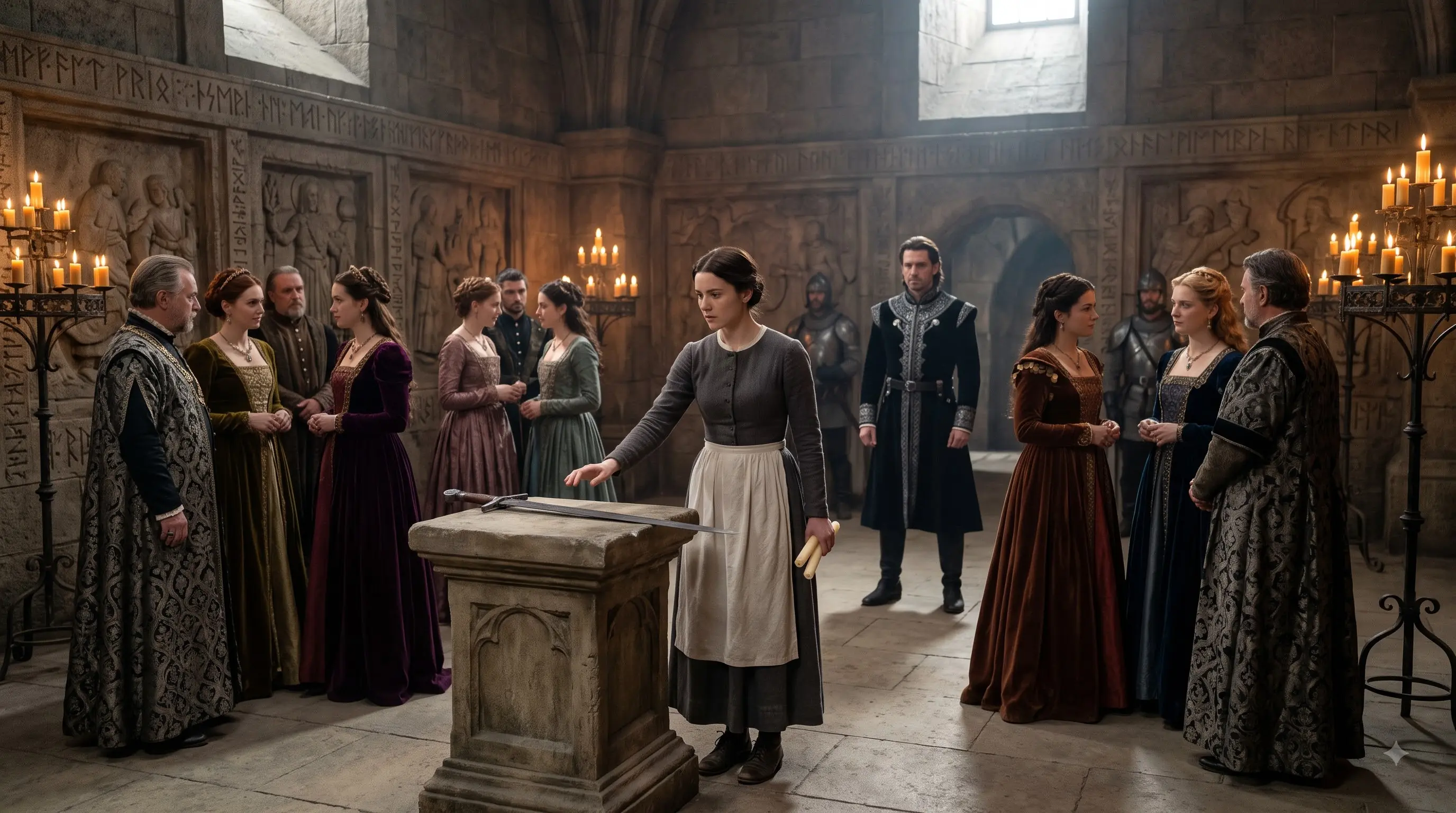
Beneath the throne room of Ardenmir Keep lay a chamber carved into bedrock before half the castle above it existed.
The Founding Vault.
At its center stood a stone plinth.
And on that plinth rested the oldest weapon in Veilthorne.
The Founding Blade.
The First Sword.
King’s Truth.
Blood-Waker.
Scholars disagreed about the name.
They disagreed about nearly everything else too.
What everyone agreed upon was the history.
Four centuries earlier, when Veilthorne had been a collection of feuding river territories rather than a kingdom, the sword had awakened in the hands of the man who became our first king.
Not metaphorically.
The records were very precise.
Light.
Moving runes.
A bloodline seal.
Then recognition by the river packs.
In the centuries since, every monarch had touched it during coronation.
Including me.
Nothing had happened.
Cold metal.
Old leather.
An impressively preserved sword.
That was all.
The law, however, still preserved the possibility that the blade might awaken again.
If it recognized founding blood, that recognition carried constitutional weight.
The old charter was unambiguous.
The blade could not appoint a spouse.
Could not override consent.
Could not manufacture noble authority where none existed.
But if it awakened for someone carrying one of the lost founding bloodlines, that recognition had to be investigated.
Edin included the blade in the Trial of Worth because tradition required it.
I considered that harmless.