The first warning did not come from a computer.
It came from the ground.
A deep vibration rolled beneath the muddy construction site outside Oak Hollow, Texas, strong enough to rattle coffee cups inside the temporary command trailer and send loose bolts dancing across the steel worktables. Then came the second warning, a long metallic groan from the Titan 9, OmniGrain Agrotech’s new $10 million grain-storage tower.
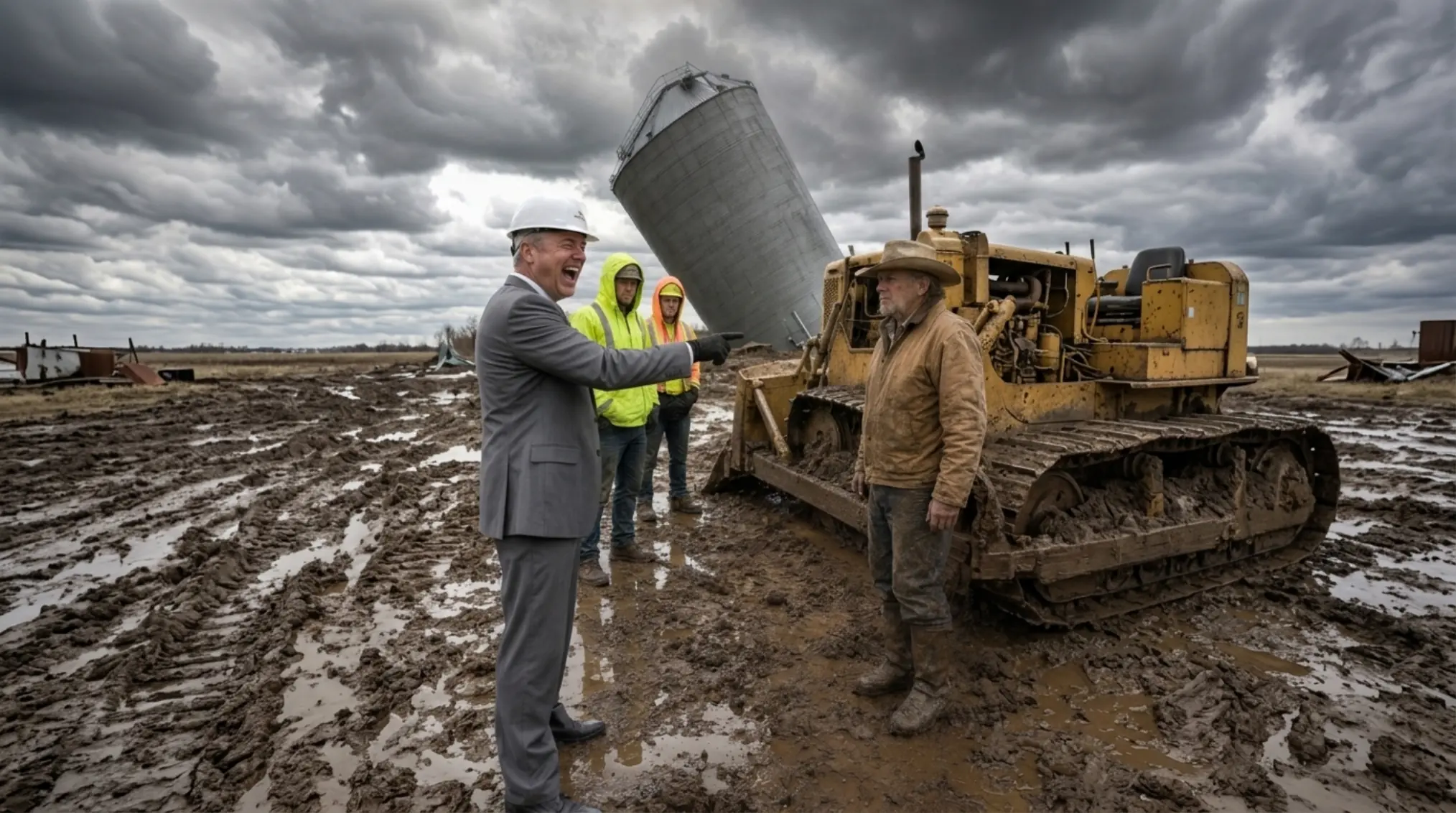
Nearly one hundred feet of corrugated steel stood above the valley.
Except it was no longer standing straight.
Loaded for the first time with roughly two thousand tons of winter wheat, the enormous silo had begun leaning toward the southern ridge.
Fifteen degrees.
That did not look catastrophic on a drawing.
In real life, it looked like a skyscraper beginning to fall.
Thirty homes sat below it.
And the man who had warned everyone six months earlier was now standing in the mud watching his prediction come true.
His name was Gideon Thorne.
Seventy-two years old.
Farmer.
Mechanic.
Equipment operator.
Born in Oak Hollow and raised on the same Texas soil OmniGrain’s engineers had declared perfectly stable.
Gideon wore a battered brown Stetson, a faded canvas jacket stained with years of grease, muddy work trousers, and boots that had walked those fields long before anyone from OmniGrain had heard of Oak Hollow.
Across the site stood Sterling Hayes, OmniGrain’s chief engineer.
Sterling was everything Gideon was not.
Gray tailored suit.
White hard hat.
Black gloves.
Two graduate engineering degrees.
A team of specialists.
And a laptop displaying more numbers than Gideon had seen on any tractor dashboard in his life.
Six months earlier, Sterling had stood before the Oak Hollow planning board and explained why Gideon’s concerns were outdated.
Gideon had warned about an underground aquifer.
He had warned that a layer of hard summer soil concealed unstable clay beneath it.
He had warned that when the ground became saturated, the site would behave differently than the surface tests suggested.
Sterling had smiled.
Then he had projected a digital soil map onto the wall.
“Mr. Thorne,” he had said, “our geotechnical models account for groundwater variation.”
Gideon had held his hat in both hands.
“You tested dirt during a dry month.”
“We tested the site according to professional standards.”
“That dirt lies when it’s dry.”
Several people had laughed.
Sterling had smiled wider.
“Perhaps you should leave structural engineering to engineers.”
Gideon had put his hat back on.
“Build whatever you want.”
Then he had pointed toward the southern ridge.
“Just remember there are families downhill.”
OmniGrain built Titan 9 anyway.
Now Sterling stood beneath gray Texas clouds watching the southern side of its concrete foundation sink nearly three feet into saturated mud.
The instruments were screaming.
Foundation pressure alarms.
Tilt warnings.
Load imbalance.
Hydraulic stress.
Everything Sterling’s system had been designed to measure was telling him the same thing Gideon had said months ago.
The ground was failing.
“Bring the lifting system!” Sterling shouted.
Flatbed trucks rolled onto the site carrying computerized hydraulic jacks powerful enough to raise bridge sections.
The plan was straightforward.
Steel plates would be placed beneath the sunken side of the foundation.
Hydraulic cylinders would lift the edge.
Computer synchronization would keep pressure evenly distributed.
Once the tower returned to vertical, engineers would stabilize the foundation permanently.
Sterling watched the setup with his confidence returning.
This was engineering.
This was controlled.
This was measurable.
Then the first jack began sinking.
“Pressure increase!” Sterling ordered.
The operators increased hydraulic force.
The tower did not rise.
The jack disappeared another six inches into the mud.
Water bubbled around its steel plate.
“Stop!”
Too late.
The second jack sank.
Then the third.
The pressure was not lifting Titan 9.
It was pushing the machinery deeper into the saturated clay.
A hydraulic seal failed with a violent pop.
Fluid sprayed across the work area.
An alarm sounded from Sterling’s laptop.
SYSTEM LOCKOUT.
Sterling stared at the message.
“No.”
Another metallic groan rolled through Titan 9.
Workers looked upward.
One of the enormous anchor connections shifted.
That was enough.
Men began backing away.
Then walking.
Then running.
Clipboards landed in mud.
Radios crackled.
Sterling shouted for everyone to remain organized, but nobody cared about organization anymore.
Two thousand tons of steel and wheat were leaning toward thirty homes.
Sterling turned toward his black SUV.
He had taken three steps when Gideon appeared beside it.
The old farmer leaned against the grille with his arms folded.
Sterling stopped.
“Move.”
Gideon did not.
“We’re evacuating.”
“Your tower?”
“The foundation is lost.”
Gideon looked toward Titan 9.
“How long?”
Sterling wiped rain from his forehead.
“Until what?”
“Until those anchor bolts stop holding.”
Sterling said nothing.
Gideon looked at the lean.
“Two hours, maybe less.”
Sterling stared at him.
Gideon continued.
“When it goes, it falls south.”
His finger moved toward the ridge.
“McCreedys first. Then the Millers.”
Sterling’s jaw tightened.
“We’re evacuating them.”
“Thirty houses.”
“We’re doing everything possible.”
Gideon looked toward the buried hydraulic jacks.
“No. You did everything your manual told you.”
Sterling stepped closer.
“You think this is funny?”
Gideon’s eyes hardened.
“There are children downhill. Nothing about this is funny.”
Sterling pointed toward the giant silo.
“There is no way to lift that structure now.”
“Then don’t lift it.”
Sterling blinked.
“What?”
Gideon pulled a folded diner napkin from his pocket.
He placed it on the hood of Sterling’s SUV.
Then he produced a pen.
Sterling stared.
“What are you doing?”
“Writing a contract.”
Gideon wrote slowly.
Emergency stabilization of Titan 9.
Independent contractor.
Successful stabilization fee:
$1.5 million.
He pushed the napkin toward Sterling.
The engineer read it.
Then laughed.
Not because it was funny.
Because fear had nowhere else to go.
“One and a half million dollars?”
Gideon nodded.
“You’re insane.”
“Probably.”
“My entire engineering team couldn’t stabilize it.”
“That’s your problem.”
Sterling pointed at him.
“You’re an old farmer with tractors.”
Gideon pushed the pen across the hood.
“Sign.”
“You cannot possibly fix this.”
“Then signing costs you nothing.”
Sterling stared at him.
That was the trap.
If Gideon failed, OmniGrain paid nothing.
If Gideon somehow succeeded, Sterling avoided watching Titan 9 roll into a residential neighborhood.
Sterling grabbed the pen.
His hand trembled as he signed.
Then he shoved it toward Gideon.
“You’re going to get yourself killed.”
Gideon folded the napkin.
“Get your people uphill.”
He turned away.
“Where are you going?”
“To get something that works.”
Half a mile from the construction site stood Gideon’s equipment barn.
It had belonged to his father.
Inside, beneath two heavy canvas tarps, sat a pair of 1958 Caterpillar D8 crawler tractors.
They were ugly.
Heavy.
Faded.
Their yellow paint had almost turned brown.
No GPS.
No laser guidance.
No electronic load monitoring.
No computer.
No climate-controlled cab.
No software.
But each machine was built around enormous diesel torque, steel tracks, heavy winches, and mechanical systems that Gideon could understand by sound alone.
He pulled away the first tarp.
Then the second.
At the rear of the barn rested another object.
A thirty-foot steel H-beam salvaged decades earlier from a dismantled railroad bridge.
Three tons of steel.
To Sterling, it would have looked like scrap.
To Gideon, it was an anchor.
A deadman.
Gideon did not intend to stand beneath Titan 9 and push upward.
The engineers had already demonstrated why that would fail.
The ground beneath the tower was compromised.
Every pound of vertical force drove their jacks deeper into mud.
Gideon intended to work from solid ground uphill.
He would pull.
He started the first D8.
The small pony motor coughed before spinning the main diesel.
Then the giant engine came alive with a deep mechanical roar.
Black exhaust rolled toward the barn roof.
The second machine followed.
The sound carried across Oak Hollow.
Back at Titan 9, Sterling heard it.
So did his engineers.
The old farmer returned slowly, both D8s crawling behind his flatbed loaded with cables, chains, pulley blocks, and the enormous H-beam.
One junior engineer laughed.
“What’s he going to do? Tow it?”
Sterling watched through narrowed eyes.
Gideon ignored everyone.
He positioned the D8s roughly two hundred yards uphill from the silo, where the earth had not been disturbed by construction.
Then he began digging.
Sterling walked closer.
“What the hell are you doing?”
Gideon kept working.
The blade cut into the soil.
“Thorne!”
No response.
Sterling pointed toward Titan 9.
“The tower is over there!”
Gideon finally stopped.
He climbed down.
Sterling approached laughing, several engineers behind him.
Gideon stood beside the battered machine.
Sterling slapped his clipboard onto a truck hood.
“Get that junk tractor out! Professionals built this site!”
Gideon kicked mud from his boot.
“Your professionals just buried ten million dollars in it.”
The younger engineers went quiet.
Sterling slammed his fist against the truck door.
“Touch that tower and you’ll answer for every ton that falls!”
Gideon climbed onto the D8.
He dropped the blade.
“Good.”
The diesel engine deepened.
“Then watch an old farmer pull your tower upright.”
Gideon turned away.
The D8 carved a trench nearly ten feet deep.
The work took time.
That frightened Sterling more than anything.
Every few minutes he looked toward Titan 9.
Fourteen point nine degrees.
Fifteen.
Fifteen point one.
The tower was still moving.
Gideon finally backed his truck toward the trench.
Using chains and the D8, he dragged the enormous H-beam into the hole.
Then he buried it beneath compacted earth.
Marcus Bell, one of Sterling’s younger engineers, watched with growing interest.
“He’s building a deadman.”
Sterling looked at him.
“A what?”
“Ground anchor.”
Marcus stepped closer.
“He’s not depending on the tractors to hold the whole load.”
Sterling’s expression changed.
“He’s using the hillside.”
Gideon connected heavy chains to the buried beam.
Then came the pulley system.
Large steel blocks.
Multiple cable passes.
Mechanical advantage.
Each additional section of cable multiplied the usable pulling force while reducing the speed of movement.
Gideon was not trying to overpower two thousand tons.
He only needed enough controlled horizontal force near the top of the structure to shift its center of gravity back toward the stable side.
Marcus understood.
“He’s using the tower itself as leverage.”
Sterling looked at him sharply.
Marcus continued.
“The foundation is still carrying most of the vertical load. He’s correcting the lean.”
“That cable will never hold.”
Marcus looked at the thick marine-grade line.
“It might.”
Gideon ran the main cable toward Titan 9.
Workers had already evacuated the immediate area.
He attached the distributed sling around a reinforced structural collar high enough on the tower to create leverage without tearing thin exterior panels apart.
Then he returned uphill.
The two Caterpillar D8s were chained in tandem.
Nearly sixty tons of steel.
He connected the winch system.
Checked every shackle.
Every cable.
Every anchor.
Then checked them again.
Sterling looked at his watch.
The tower groaned.
A crack widened across the foundation pad.
“Gideon!”
The old farmer climbed onto the lead Caterpillar.
Marcus moved toward Sterling.
“We need everyone behind the line.”
Sterling did not argue.
The engineers retreated.
Gideon pulled the winch lever.
Slack disappeared.
The enormous steel cable rose from the grass.
Straight.
Tight.
The D8 engines lowered into a heavy growl.
Nothing happened.
Sterling exhaled.
Then Gideon increased pressure.
The tracks dug into firm Texas soil.
The deadman anchor held.
The pulley system tightened.
The tower screamed.
Sterling raised his binoculars.
The digital inclinometer beside him displayed:
15.0°
Then:
14.8°
Marcus stared.
“It's moving.”
Sterling said nothing.
The D8 engines roared.
Black exhaust climbed into the cloudy sky.
The cable vibrated.
13.9°
12.4°
Someone behind Sterling whispered, “Impossible.”
Marcus answered without looking away.
“No.”
He watched Gideon’s system.
“It’s leverage.”
Titan 9 continued returning toward center.
Ten degrees.
Eight.
Six.
Mud sucked beneath the sunken foundation as horizontal force shifted the load.
Water rushed into spaces left by moving concrete.
Four degrees.
Sterling lowered his binoculars.
The laughter was gone.
Two degrees.
One.
Gideon eased the winch rather than jerking it.
The old farmer understood that the final movement mattered most.
Too much force could send the tower past center.
He watched the structure.
Listened to the diesel.
Felt tension through the machine.
Then stopped.
Sterling’s laptop flashed.
0.0°
Titan 9 stood straight.
Nobody celebrated immediately.
They simply stared.
The giant tower that had been leaning toward thirty homes now stood vertical against the gray Texas sky.
Gideon slowly released tension.
The cable relaxed.
The Caterpillars idled.
Marcus laughed once in disbelief.
Sterling did not.
He looked toward his buried hydraulic equipment.
Then toward Gideon’s faded D8s.
Then at the old farmer climbing down.
Sterling walked toward him.
“You knew that would work?”
Gideon wiped his hands on his jacket.
“I knew the dirt wouldn’t hold your jacks.”
“That isn’t what I asked.”
Gideon looked at Titan 9.
“I knew where the strong ground was.”
Sterling stared at him.
Six months earlier, Gideon had told him exactly that.
Sterling had laughed.
Now thirty homes were standing because Gideon understood the one variable Sterling’s models had underestimated.
The ground.
OmniGrain’s attorneys arrived the following morning.
Their lead lawyer studied Gideon’s diner napkin and nearly laughed.
“This is not a serious commercial agreement.”
Gideon leaned against his pickup.
“Your engineer signed it.”
“Under extraordinary circumstances.”
“Correct.”
“You demanded one and a half million dollars while a corporate asset was in danger.”
Gideon looked toward the houses below the ridge.
“I charged you to keep that corporate asset from landing on people.”
The lawyer’s smile faded.
He threatened litigation.
Gideon remained calm.
Then he mentioned the public planning hearing.
His warning about the aquifer.
The soil.
The unstable clay.
Sterling’s dismissal.
The ignored foundation alerts.
The evacuation.
And the abandoned laptop containing timestamps from every sensor warning.
“If you don’t like my napkin,” Gideon said, “we can let a courtroom decide how much all that is worth.”
The lawyer stopped talking.
Forty-eight hours later, the payment cleared.
$1.5 million.
Sterling Hayes was removed from the Titan 9 project.
The official company announcement described it as a “leadership restructuring.”
Oak Hollow residents used simpler words.
He was gone.
OmniGrain hired an independent geotechnical firm.
The new investigation confirmed that saturated subsurface clay and groundwater movement had significantly reduced bearing stability beneath part of Titan 9’s foundation.
Permanent stabilization required extensive reconstruction.
The tower did not reopen until months later.
This time, engineers drilled deeper.
They reinforced the soil.
They listened.
Especially when local people told them how the land behaved.
Gideon became wealthy overnight.
Almost nothing about his life changed.
He replaced the leaking roof on the local community church.
Three farming families quietly discovered that overdue debts had been paid by an anonymous donor.
Everyone knew who did it.
Nobody embarrassed Gideon by saying so.
He repaired the fence beside his western pasture.
Changed oil in both Caterpillars.
Sharpened tools.
Drank coffee at the Oak Hollow diner.
One afternoon Marcus Bell found him there.
The younger engineer sat across from him.
“I owe you an apology.”
Gideon looked up.
“For what?”
“I laughed when you started digging.”
“So did everybody.”
“I should’ve understood the deadman anchor sooner.”
Gideon stirred his coffee.
“You understood eventually.”
Marcus hesitated.
“Where did you learn that?”
“Railroad crews.”
“When?”
“Before you were born.”
Marcus smiled.
“I have a master’s degree in structural engineering.”
“Congratulations.”
Marcus laughed.
“That wasn’t the point.”
“I know.”
“I spent six years studying structures.”
Gideon nodded.
“Good.”
“And you fixed a problem our entire team couldn't.”
Gideon put down his spoon.
“No.”
Marcus waited.
“You boys knew steel.”
Gideon tapped one finger against the tabletop.
“I knew dirt.”
That answer stayed with Marcus.
Years later, when he became chief engineer on another agricultural project, his teams held technical reviews with geologists, contractors, equipment operators, farmers, and maintenance crews before finalizing foundations.
A young engineer once asked why.
Marcus told him about Titan 9.
Not the exaggerated version.
Not the story about an ignorant farmer defeating science.
Because Gideon never defeated science.
He used it.
Leverage.
Mechanical advantage.
Load distribution.
Soil behavior.
Center of gravity.
Anchor resistance.
Everything he did obeyed physics.
He simply understood those principles through fifty years of working with real machines on real ground rather than through equations alone.
There was room for both.
The disaster happened because one side had assumed there was not.
Years later, Titan 9 still stood outside Oak Hollow.
Drivers could see it from miles away.
Straight.
Silver.
Ordinary.
Most never knew how close it had come to falling.
Gideon preferred it that way.
On quiet afternoons he occasionally walked into his equipment barn and removed the tarp from one of the old Caterpillar D8s.
The yellow paint remained chipped.
The steel remained scarred.
The seat remained cracked.
He would check the fluids.
Start the pony motor.
Wake the diesel.
Let it idle.
Then shut it down and cover it again.
One evening Sterling Hayes drove through Oak Hollow.
He had taken a consulting position in another state.
His career never fully recovered.
At a gas station near the highway, he looked across the valley.
Titan 9 stood against the setting sky.
Straight.
Below it sat the homes Gideon had protected.
Sterling stayed there for several minutes.
Then drove away.
Gideon never knew Sterling had returned.
He was sitting on his porch drinking black coffee.
Behind his house, inside a corrugated steel barn, two old Caterpillars rested beneath canvas tarps.
They had no computers.
No digital screens.
No presentations explaining what they could do.
They did not need them.
Because when a $10 million tower leaned toward thirty homes and an entire engineering team ran out of answers, Gideon Thorne had remembered something Sterling Hayes had forgotten.
You do not always beat weight with more power.
Sometimes you change the direction of the force.
Sometimes you find solid ground.
Sometimes you bury an anchor.
And sometimes the oldest man standing in the mud is the only one who understands exactly what the earth beneath everyone’s feet is about to do.