At sixteen, Caleb Morris knew every low place, drainage ditch, and stubborn patch of soil on his family’s farm outside Bowling Green, Kentucky. He knew which pasture remained wet long after a storm, where the clay turned blue beneath the topsoil, and why his grandfather never drove heavy machinery beside the eastern fence after spring rain. Those details mattered to farmers, but they meant nothing to the engineers arriving in polished trucks with a two-hundred-million-dollar construction plan. To them, the Morris land was only another line on a survey map.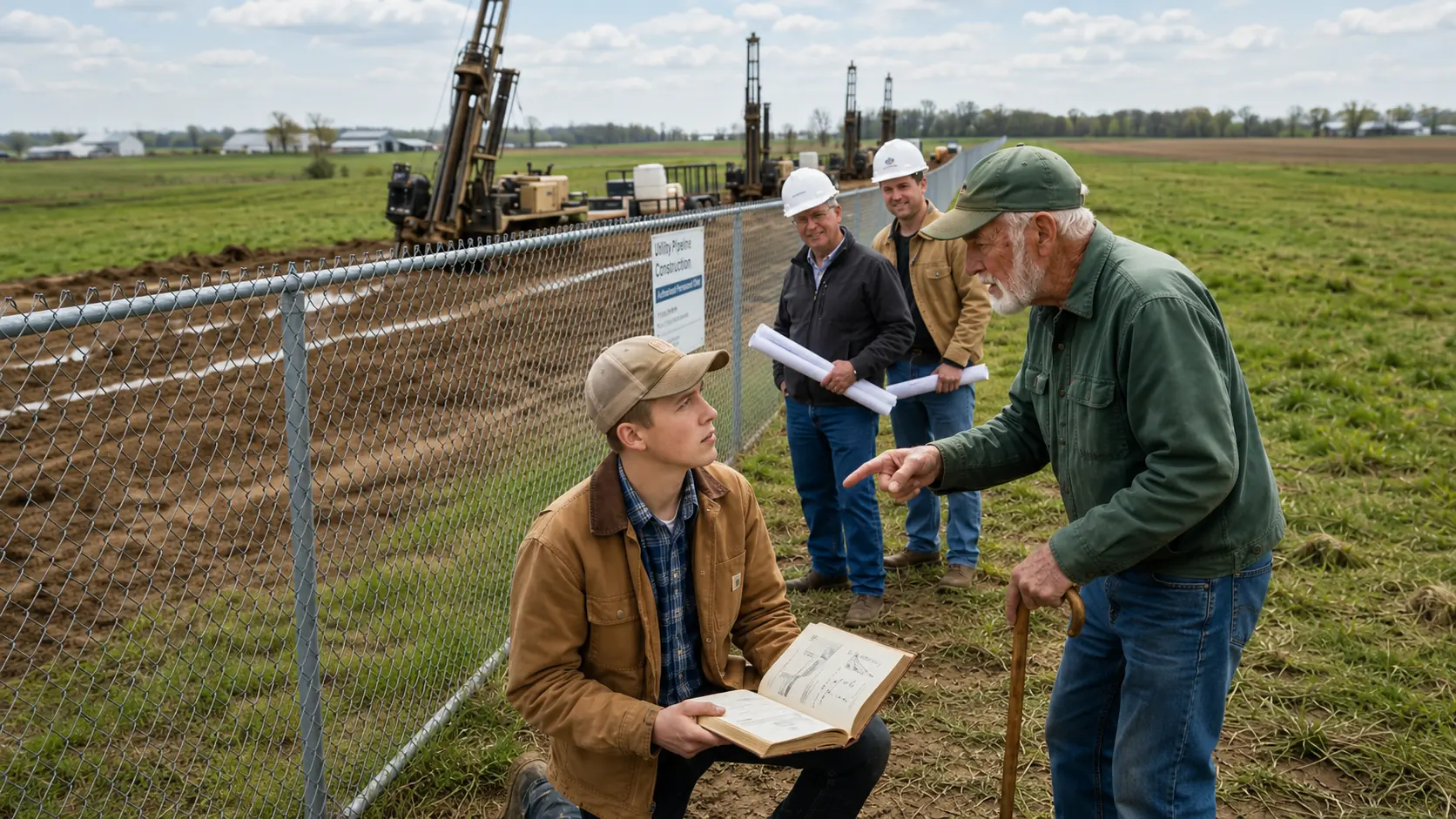
The project belonged to Meridian Energy Partners, a national company building a massive underground energy-storage facility beneath several hundred acres of former farmland. The company promised hundreds of temporary construction jobs, increased tax revenue, and enough stored power to support thousands of homes during peak demand. Newspaper articles described it as the most important infrastructure investment the county had seen in decades. Local officials praised it before construction even began.
Meridian purchased three neighboring farms and secured an easement through the eastern section of the Morris property. Caleb’s grandfather, Walter Morris, refused to sell the entire farm, but the family’s finances left him little choice about the narrow construction corridor. Walter was seventy-four, widowed, and still recovering from a hip injury that made every step painful. The easement money paid overdue medical bills and replaced the leaking roof over the dairy barn.
Caleb never trusted the project.
His concern was not political, nor did he oppose renewable energy. He simply knew the land beneath the proposed foundation did not behave like ordinary ground. Water rose there without rain, fence posts leaned within years of installation, and cattle avoided one strip during winter because their hooves sank into cold mud hidden beneath thin grass.
Walter knew why.
“There used to be a spring house near that fence,” he told Caleb. “Your great-grandfather filled it after the roof collapsed.”
“Where did the water go?”
“Underground. Water always finds another road.”
Meridian’s preliminary maps showed no spring. Their geotechnical report described the ground as stable clay over limestone, suitable for drilling, reinforced foundations, and underground storage chambers. According to the company, extensive soil testing had confirmed the location.
Caleb asked how many tests had been conducted near the old spring.
The company representative smiled as though speaking to a child.
“Enough.”
Construction began in early April.
Trucks tore through the eastern pasture, removing fences and flattening grass into a wide muddy corridor. Portable offices appeared beside the road, followed by excavators, concrete equipment, and a drilling rig nearly eight stories tall. Workers marked foundation points using bright flags and steel stakes.
Caleb watched from the remaining fence.
He wore a faded brown canvas jacket over a blue plaid shirt, dark jeans, and mud-covered boots. His schoolbooks remained inside his pickup because he had driven directly from class after hearing the first drilling rig had arrived. On the passenger seat lay an old county soil-survey manual he had found inside Walter’s machinery shed.
The book had been published in 1958.
Its pages included hand-drawn drainage patterns, soil classifications, and notes from agricultural inspectors who had studied the area before many modern roads existed. A blue pencil line crossed the Morris property near the exact place Meridian planned to install its heaviest equipment. Beside the line, someone had written, “Subsurface spring channel. Unstable during prolonged saturation.”
Caleb carried the book to the construction gate.
A security employee stopped him.
“This is private work property.”
“It’s still our farm.”
“Not inside the easement.”
“I need to speak with the site engineer.”
The guard examined his age, clothing, and old book.
“About what?”
“The drilling location.”
The man nearly laughed.
Caleb refused to leave.
After fifteen minutes, a junior engineer named Rachel Kim came to the gate. She was young, serious, and visibly busy, carrying a tablet beneath one arm. Unlike the security employee, she listened while Caleb explained the buried spring and showed her the county map.
Rachel studied the page.
“This is old.”
“The spring is older.”
“Our testing found groundwater, but nothing outside expected levels.”
“Did you test during a wet spring?”
“We modeled seasonal conditions.”
“That isn’t the same.”
Rachel looked toward the rig.
“Where exactly was the old spring house?”
Caleb pointed beyond the fence toward a shallow dip covered by construction soil.
“There.”
Rachel photographed the map and promised to compare it with the geotechnical report. Caleb believed someone had finally taken him seriously. He returned home and told Walter the company might review the site.
The next morning, lead engineer Charles Benton arrived at the Morris farmhouse.
Benton was fifty-two, tall, carefully dressed, and accustomed to controlling conversations. He wore a white hard hat even though he stood on Walter’s porch, far from active construction. Behind him waited two company attorneys and the county development director.
“We understand Caleb entered the work zone yesterday,” Benton said.
“He stood outside the gate,” Walter replied.
“He disrupted personnel with unsupported safety claims.”
Caleb stepped forward.
“I showed your engineer a county soil survey.”
Benton turned toward him.
“You showed her a farm manual from the nineteen-fifties.”
“It marks a buried spring.”
“Our site has been reviewed by licensed geologists, structural engineers, hydrologists, and state regulators. You are sixteen years old.”
“The water doesn’t care.”
One attorney suppressed a smile.
Benton did not.
“You are not to interfere with construction again. If you cross the easement boundary, security will remove you.”
Walter leaned on his cane.
“You came here to threaten my grandson because he showed you a map?”
“I came to protect a major public project from unnecessary delay.”
“Checking the ground would take one day.”
“Stopping the rig would cost nearly eighty thousand dollars per day.”
Walter looked toward the eastern field.
“Losing it will cost more.”
Benton placed a formal notice on the porch table and left.
Caleb expected Rachel to call, but she did not. His later messages went unanswered. Construction continued, and workers began drilling deep support shafts beside the old spring channel.
For the first week, nothing unusual happened.
The rig bored through upper soil and into denser layers beneath it. Trucks removed mud and drilling slurry while engineers monitored depth, pressure, and alignment. Benton visited the site daily, speaking confidently to reporters and county officials.
Then rain arrived.
It began as a light shower on Thursday evening and continued through Friday morning. By Saturday, nearly three inches had fallen across the county. Water collected in low fields, but Meridian’s pumps kept the work zone mostly clear.
Caleb walked the eastern fence after sunrise.
He noticed muddy water emerging from a place no puddle had existed the previous afternoon. It rose beside a newly installed support pad and flowed uphill for several feet before disappearing beneath gravel. That movement could only happen if pressure below the surface forced water upward.
He photographed it.
Walter joined him, leaning heavily on his cane.
“The spring is waking up,” the old man said.
Caleb called Rachel.
This time she answered.
He described the water and sent the photographs. Rachel remained silent for several seconds.
“I’ll inspect it.”
“Benton will stop you.”
“I’m still an engineer.”
An hour later, Rachel stood inside the construction zone with two technicians. They measured the emerging water, inserted monitoring rods, and discovered that one side of the support pad had dropped nearly half an inch.
Rachel ordered work paused around the pad.
Benton reversed her decision within twenty minutes.
He argued that minor settlement was expected during early construction and could be corrected by adding gravel. The rig resumed operation before noon. Rachel called Caleb privately and told him to preserve every photograph.
“Are we in danger?” he asked.
“I don’t know yet.”
“That isn’t reassuring.”
“It isn’t supposed to be.”
By Sunday morning, the rain had stopped.
The ground continued moving.
Caleb arrived at the fence carrying the old soil-survey book. Walter followed in his pickup because his hip prevented him from walking the entire distance. Inside the work zone, employees gathered around the drilling rig while Benton argued with Rachel near a temporary office.
The rig stood slightly crooked.
Its change in angle was subtle, but Caleb noticed because he had watched its vertical mast against the barn roof for days. The top now leaned several inches toward the eastern field.
He shouted through the fence.
“You need to move everyone away!”
Benton turned.
Security began walking toward Caleb.
Rachel looked at the rig again, then checked a digital level on her tablet.
“Charles,” she said, “the mast shifted.”
“We know.”
“How much?”
“Within correction limits.”
“The southwest pad is still dropping.”
Benton pointed toward a crew preparing hydraulic jacks.
“They’re stabilizing it.”
Caleb opened the survey book.
“The spring channel runs under that pad.”
Benton walked toward the fence with anger tightening his face.
“Move, boy. Your farm book means nothing.”
Caleb stepped closer.
“It shows a buried spring.”
“Talk again, and you’re gone.”
Walter climbed from the pickup and limped toward them.
“Touch him,” the old farmer said, pointing past Benton. “Your rig is sinking.”
A loud metallic crack cut through the argument.
One support leg dropped six inches.
The rig lurched sideways, throwing workers off balance. A steel platform struck the ground while cables snapped tight above it. Someone screamed for the power to be shut down.
Rachel ran toward the emergency panel.
Benton stared at the tilted structure as if refusing to understand what he saw. Mud surged around the failed support, carrying bubbles and pale clay to the surface. The ground beneath the rig had not merely softened.
It had opened.
Workers evacuated the immediate area while supervisors lowered the mast as far as the damaged system allowed. Hydraulic jacks sank into the saturated soil before they could lift the weight. Every attempt to stabilize one side increased pressure on the other.
The two-hundred-million-dollar project stopped within minutes.
By afternoon, the work zone had been sealed. County emergency officials arrived, followed by state safety inspectors and geotechnical consultants from Louisville. Meridian attempted to describe the event as routine equipment settlement, but aerial photographs showed a widening depression beneath the rig.
The story reached local news that evening.
A reporter interviewed Caleb at the farmhouse gate.
“Did you warn the company?”
“Yes.”
“How did you know?”
“My family knew the spring was there.”
“Are you an engineering student?”
“I’m in eleventh grade.”
The reporter looked surprised.
Caleb held up the old soil-survey book.
“But the land was studied before I was born.”
By Monday, the video had spread across Kentucky. Commentators praised the teenage farmer who noticed what professional engineers missed. Others accused Meridian of ignoring local knowledge to protect its schedule.
Benton released a statement claiming no verified warning had been submitted through official channels.
Rachel responded by forwarding the photographs and internal messages she had sent after speaking with Caleb. Her reports showed that Benton personally rejected additional subsurface testing because it might delay foundation work.
The company suspended him.
Forensic engineers began examining the site.
They discovered that the original soil borings had been placed at regular grid intervals, but none passed through the narrow spring channel. The modern geological model treated groundwater readings as isolated pockets rather than evidence of a connected underground flow.
The 1958 survey had been more accurate because its authors combined field measurements with decades of farmer observations. They had interviewed landowners, inspected seasonal wet spots, and mapped the spring while its old surface outlet still existed.
Meridian’s engineers had better instruments.
They had ignored better context.
The support pad had been installed over layers of old fill used to cover the collapsed spring house. Beneath that fill, water continued moving through loose gravel and fractured limestone. Heavy construction compressed the upper layer, while the rain increased underground pressure.
The result was a hidden cavity.
The drilling rig had begun falling into it.
Recovery crews spent three weeks dismantling the machine. Cranes positioned on reinforced mats removed the mast section by section. Even after the weight disappeared, the depression continued widening until it measured more than forty feet across.
Costs climbed rapidly.
Meridian paid for emergency crews, replacement equipment, environmental containment, engineering reviews, and construction delays. Contractors filed claims for idle time, while investors demanded to know why a teenager’s warning had been dismissed.
Benton blamed Rachel.
He claimed she had failed to communicate the seriousness of Caleb’s information. Rachel produced meeting notes showing she recommended test borings and groundwater monitoring before the rain. Benton had written one response across the top of her report.
“Unnecessary delay based on unverified local anecdote.”
That sentence ended his career at Meridian.
The company replaced him with Dr. Elena Ruiz, a geotechnical engineer known for rescuing troubled infrastructure projects. Elena’s first decision was to meet Caleb and Walter at their kitchen table.
She arrived without attorneys.
Caleb placed the old survey book beside his photographs and handwritten notes. Walter brought maps copied from farm records dating back to 1917. Together, they showed her where cattle avoided winter mud, where fence posts repeatedly leaned, and where the spring once supplied water to the farmhouse.
Elena listened for nearly two hours.
“You should’ve been included before construction,” she said.
Walter raised one eyebrow.
“We’re farmers.”
“You’re the people who know this ground.”
“That didn’t matter to Benton.”
“It matters now.”
Elena commissioned a new site investigation combining modern instruments with historical land records and local interviews. Engineers used electrical-resistivity imaging, deeper borings, and groundwater tracers to map the entire subsurface channel.
The buried spring was larger than anyone expected.
It crossed the main foundation zone and connected to several limestone fractures running beneath the planned storage chambers. Building according to the original design could have caused progressive settlement across the entire facility.
The rig’s failure had prevented something worse.
Meridian faced a choice.
It could abandon the project, relocate major structures, or redesign them around the unstable ground. Abandonment would cost tens of millions and trigger contract disputes. Relocation was possible but required purchasing more land.
Elena proposed a third option.
The spring channel would be preserved inside a protected drainage corridor. Major foundations would move to stable ground, while elevated service structures crossed the channel using deep supports anchored in competent rock. The water would be monitored rather than forced into pipes that might fail.
The redesign added forty-three million dollars.
It also saved the project.
Meridian’s board approved it after insurers refused to support the original plan. Construction resumed six months later under stricter oversight. Rachel became deputy site engineer and received authority to stop work without Benton’s former approval process.
Caleb returned to school.
For several weeks, classmates treated him like a celebrity. News crews requested interviews, engineering organizations invited him to speak, and one university offered him early admission if he maintained his grades.
Caleb declined most appearances.
The attention embarrassed him because he had not invented anything. He had simply opened an old book and believed what his family already knew.
Walter understood.
“People like heroes better than systems,” the old farmer said. “A hero lets everybody pretend the problem was one bad man.”
“Wasn’t Benton the problem?”
“He was part of it. The bigger problem was a company that believed a title made someone right before the ground proved otherwise.”
Caleb placed the survey book back inside its cabinet.
“What should I do with all this?”
“Learn more.”
“Engineering?”
“Maybe.”
“You always said we needed farmers.”
“We need engineers who listen to farmers too.”
One year later, construction reached the redesigned foundation stage. Meridian invited Walter and Caleb to a public ceremony marking the installation of the first deep support outside the spring corridor.
Walter refused to stand on the stage.
Caleb almost did the same, but Rachel convinced him to attend because county students had been invited to learn about soil science and engineering. He wore his brown chore jacket instead of a suit.
Elena addressed the crowd.
“This project nearly failed because we treated historical knowledge as inferior to modern data,” she said. “Good engineering does not begin by proving local people wrong. It begins by asking what they have already observed.”
She invited Caleb forward.
He carried the 1958 soil-survey book.
Instead of giving a prepared speech, he opened to the page showing the spring channel.
“This line saved the project,” he said. “But the line wasn’t magic. Someone walked this farm, watched water move, spoke to people, and wrote down what they learned. The mistake wasn’t that engineers lacked information. The mistake was deciding old information had no value.”
He looked toward the new drilling equipment positioned on stable ground.
“My grandfather says the land doesn’t care how expensive your plans are.”
Laughter moved through the crowd.
Walter smiled from beside the fence.
The completed facility opened two years later. Its final cost exceeded the original estimate, but it became safer and more resilient because of the redesign. The preserved spring corridor developed into a narrow wetland supporting grasses, birds, and amphibians that had disappeared when the old spring house was buried.
Meridian funded long-term monitoring and placed a small educational sign beside the corridor. It explained the site’s history and credited the Morris family’s records with identifying the underground water system.
Caleb hated the first version.
It called him “a remarkable young observer.”
He asked the company to replace those words.
The final sign read, “Local agricultural knowledge confirmed the presence of a historic spring channel.”
Walter approved.
By then, Caleb had graduated high school and accepted a scholarship to study agricultural and civil engineering at the University of Kentucky. He returned to the farm every weekend, helping Walter with cattle, fences, and machinery.
The project remained visible from the eastern pasture.
Its towers rose beyond the fence, but no structures covered the spring channel. Monitoring wells stood where the original rig had sunk, recording water pressure and ground movement.
One autumn afternoon, Caleb found Benton waiting beside the farmhouse.
The former engineer looked older, thinner, and stripped of the confidence Caleb remembered. He had lost his position, professional standing, and several consulting opportunities after the investigation.
Walter watched from the porch but allowed Caleb to speak first.
“What do you want?” Caleb asked.
“To apologize.”
Caleb said nothing.
Benton looked toward the distant project.
“I thought stopping construction would make me look weak.”
“You threatened to remove us.”
“I know.”
“You blamed Rachel.”
“I know that too.”
Caleb folded his arms.
“Are you sorry the rig sank, or sorry people found out you ignored us?”
Benton accepted the question without defending himself.
“Both.”
Walter stepped from the porch.
“Then you learned something expensive.”
Benton nodded.
“I did.”
The old farmer pointed toward the pasture.
“The spring was free.”
Benton left without asking for forgiveness.
Caleb watched his car disappear down the lane. He did not feel victorious. The sinking rig had nearly destroyed jobs, damaged land, and placed workers in danger. Being proven right did not erase what could have happened.
Walter rested one hand on his shoulder.
“You warned them.”
“They should’ve listened.”
“They will next time.”
“How do you know?”
“Because two hundred million dollars has a loud memory.”
That winter, Caleb began digitizing every farm record his family owned. He scanned soil maps, well notes, drainage sketches, planting journals, and handwritten weather observations. He added modern coordinates without replacing the original descriptions.
Beside the 1958 spring map, he wrote one sentence.
“Verified during Meridian construction failure.”
The old soil-survey book returned to the cabinet afterward, its worn pages protected in an archival cover. It no longer looked like an outdated farm manual.
It looked like what it had always been.
Evidence.
The engineers had arrived believing the farm was empty space waiting for their expertise. Caleb understood that land was never empty. It held water, memory, mistakes, and knowledge accumulated by people who watched it longer than any project schedule allowed.
The million-dollar rig had not sunk because a sixteen-year-old farmer wanted attention.
It sank because powerful adults believed listening to him was beneath them.