The first steel support dropped three inches at 9:17 on a Tuesday morning.
At first, the engineers blamed a faulty surveying instrument. Then a second foundation column shifted, the drilling rig tilted toward the eastern fence, and black water began pushing through cracks in ground that had been dry only hours earlier. Workers abandoned the machinery as mud swallowed the lower tracks of an excavator. At the edge of the construction site, sixteen-year-old Caleb Mercer stood with his grandfather’s drainage notebook open in his hands and watched the disaster he had warned them about finally rise to the surface.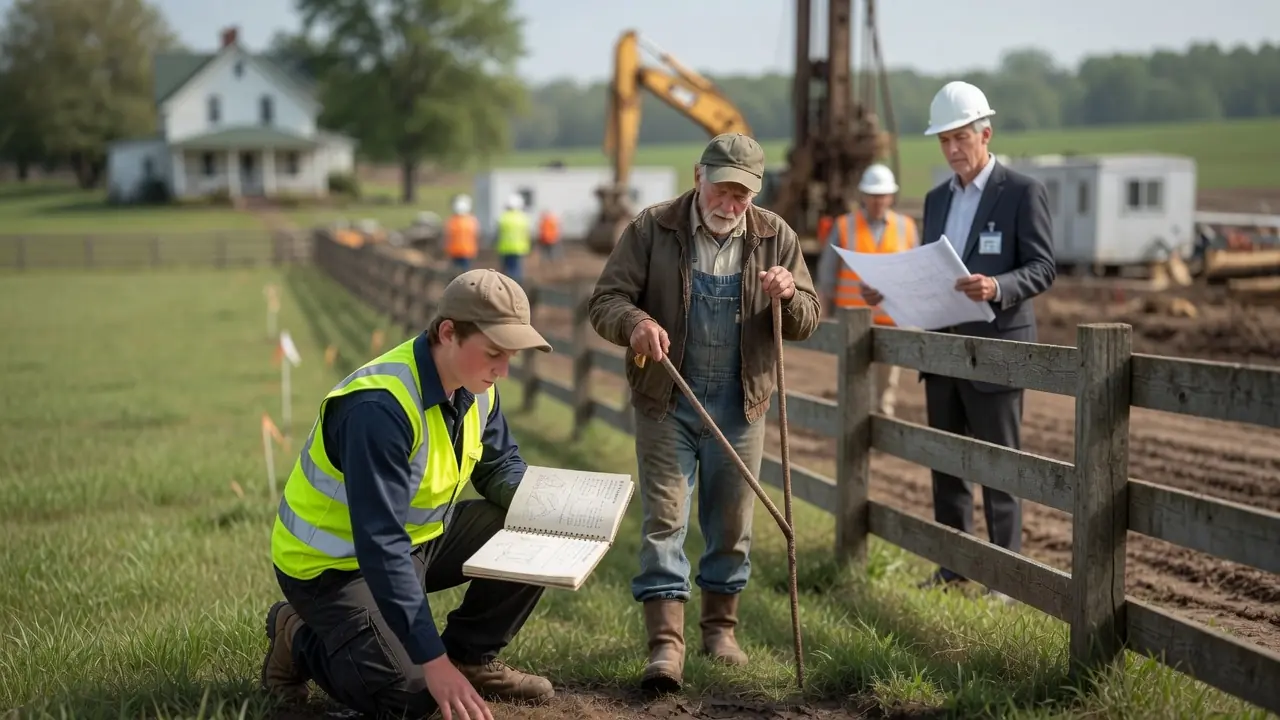
The project covered nearly eighty acres of former farmland outside Willow Creek, Iowa. Prairie Horizon Energy planned to build a two-hundred-million-dollar renewable power complex there, combining a battery-storage facility, a hydrogen-production plant, and a switching station connected to several nearby wind farms. Company executives promised hundreds of jobs, new tax revenue, and enough stored electricity to support several counties during periods of peak demand. Local politicians called it the beginning of a cleaner future.
Caleb called it the wrong field.
He had grown up on the adjoining Mercer farm, a modest cattle-and-corn operation that had belonged to his family for four generations. He was a handsome, strongly built teenager with short brown hair, clear hazel eyes, and a face that looked younger whenever he smiled. Most days, he wore a faded tan cap, a red-brown plaid shirt with the sleeves rolled above his forearms, old jeans, and work boots permanently marked by soil. Adults often mistook his quietness for uncertainty, but Caleb had spent more time studying that land than many of the engineers who arrived with university degrees and polished blueprints.
His grandfather, Amos Mercer, had taught him to read fields.
Amos never began with the crop. He began with the slope, the color of the soil, the direction grass leaned after rain, and the places where frost disappeared first in spring. For forty years, he repaired clay drainage tiles beneath farms throughout three counties, and he recorded every unusual line he found in a thick spiral notebook. Caleb inherited that notebook after Amos died, along with a steel soil probe and one sentence he remembered more clearly than anything else.
“Water follows old roads, even when people forget they exist.”
The energy company purchased the field from Caleb’s great-uncle after promising enough money to cover every debt attached to the property. Caleb’s father, Daniel, did not oppose the sale because the land was no longer part of their farm and Prairie Horizon had already secured county approval. Still, he asked Caleb to walk the boundary with him before construction began. They needed to mark fences, protect their cattle pasture, and confirm where the company planned to place its access road.
That was when Caleb saw the first mistake.
Bright orange stakes crossed a shallow depression running from the western hillside toward an old creek. The depression appeared insignificant during summer, nothing more than a strip of darker grass between two rises. Yet Caleb knew from his grandfather’s notebook that the area contained a network of clay drainage tiles laid almost seventy years earlier. Those lines collected seep water from the hill and carried it toward a buried outlet near the creek.
The company planned to install the heaviest battery foundations directly above them.
Caleb opened the notebook that evening and found a hand-drawn map labeled Bennett Bottom—1954. The old name belonged to a farmer who owned the field before the Mercers. Amos had sketched three main tile branches running from the hill, joining beneath the center of the property, then emptying into a stone-lined ditch. Beside the drawing, he had written a warning.
Deep seep under blue clay. Never block main outlet. Water pressure builds fast.
Caleb took the notebook to the temporary construction office the following morning.
Chief engineer Martin Hale met him beside a table covered in soil reports and digital surveys. Martin was fifty-two, tall and severe, with iron-gray hair, a dark suit beneath his orange safety vest, and polished shoes that had never touched mud without complaint. He had designed industrial facilities across the country and spoke with the certainty of a man whose expertise had rarely been questioned by anyone without similar credentials.
Caleb placed the notebook on the table.
“You’re building over an old tile junction,” he said. “The main line crosses beneath the battery foundations.”
Martin glanced at the yellowed pages. “Our geotechnical survey found no active drainage infrastructure.”
“The tiles are clay. Some are deeper than the usual farm lines.”
“We used ground-penetrating radar.”
“Clay tile packed with wet soil can disappear on radar.”
Martin looked at him more carefully. “How old are you?”
“Sixteen.”
“And what exactly is your experience in subsurface engineering?”
Caleb’s jaw tightened. “I’ve repaired these lines with my grandfather since I was nine.”
“That is not engineering.”
“No. It’s knowing this field.”
Martin closed the notebook and pushed it back. “We drilled seventeen test borings and collected soil samples across the site. Our consultants approved the foundation design.”
“Did you drill during spring seep?”
“We drilled when the schedule required.”
“That means August.”
Martin’s expression cooled. “Young man, this is a two-hundred-million-dollar project. We cannot redesign foundations because a teenager found an old farm sketch.”
Caleb picked up the notebook. “Then at least open the outlet before you drive the pilings.”
“The outlet does not appear in the county drainage records.”
“It was private work. My grandfather helped repair it.”
Martin turned toward his computer. “Thank you for your concern.”
The meeting was over.
Caleb returned twice over the next month. The second time, he brought photographs showing an unusually green strip of grass after two weeks without rain. The third time, he carried a section of old clay tile he found near the creek outlet, its interior still damp despite the dry weather.
Each time, Martin dismissed him.
One assistant engineer listened more carefully. Her name was Priya Shah, and she managed site drainage and environmental compliance. She studied the tile fragment and asked Caleb where he found it, but Martin interrupted before the conversation went further.
“We cannot halt mobilization every time a local resident produces an old pipe,” he said.
Caleb looked directly at him. “That pipe is carrying water from under your site.”
Martin gave a thin smile. “If your family understood the property so well, perhaps they should not have sold it.”
The comment reached deeper than Caleb expected.
His father had already endured criticism for allowing the sale, though the decision had not been his. Their relatives needed money, and the county threatened condemnation if negotiations failed. Caleb knew arguing about ownership would distract from the danger beneath the field.
He forced his voice to remain steady. “The land doesn’t care who signed the contract.”
Martin’s smile disappeared.
Construction accelerated through autumn. Workers stripped topsoil, leveled the central depression, and placed thousands of tons of compacted fill across the site. Pile-driving equipment hammered steel into the ground while concrete trucks arrived from before sunrise until late afternoon. Every impact traveled through the Mercer farmhouse windows half a mile away.
Caleb watched the changes from beyond the fence.
The company cut through several small drainage tiles during grading. Most appeared dry, so supervisors capped them with concrete or crushed them beneath fill. Caleb photographed each location from his side of the boundary and marked them on a copy of Amos’s map. He also measured the water level in the Mercer pasture ditch after storms.
The ditch began rising faster than usual.
In December, water appeared beside a fence post that had always stood on firm ground. During a week of freezing temperatures, a patch of soil near the construction access road remained soft and unfrozen. Caleb pushed his steel probe into it and felt the ground offer almost no resistance for several feet.
Trapped water was spreading beneath the compacted fill.
He emailed Priya directly.
This time, she responded.
I have reviewed your photographs. I agree additional investigation may be appropriate. I have forwarded them to the geotechnical lead.
Two days later, Martin called Daniel Mercer.
“Your son has been interfering with our project personnel,” he said.
Daniel stood beside the kitchen counter while Caleb listened from the doorway. “He sent photographs.”
“He is creating concern among staff based on unsupported assumptions.”
“Are the photographs false?”
“That is not the issue.”
“It sounds like the issue.”
Martin requested that Caleb remain away from the construction boundary. Daniel agreed that his son would not enter company property, but he refused to stop him from documenting conditions on Mercer land.
After the call, Daniel looked at Caleb.
“You may be right,” he said. “But being right won’t stop them unless you can prove it in a language they respect.”
Caleb opened the notebook. “Grandpa already proved it.”
“To farmers. Not to engineers.”
“What language do they respect?”
“Measurements.”
So Caleb began collecting them.
He installed simple observation pipes on the Mercer side of the fence with his father’s permission. Each pipe reached several feet into the soil and allowed him to measure shallow groundwater. He recorded levels after rain, during dry periods, and whenever construction crews drove new pilings. He photographed muddy discharge near the creek and used colored flags to mark where the ground stayed wet.
Priya quietly provided the location of the company’s official monitoring wells, information that was not secret but difficult to find. Caleb compared their positions with Amos’s tile map and immediately saw the problem.
The monitoring wells surrounded the old drainage network.
None stood above it.
The company’s instruments could report stable groundwater while pressure increased between them.
Caleb compiled his findings into a twelve-page report. He included dates, photographs, hand measurements, a traced version of Amos’s map, and a simple explanation of what he believed was happening. Heavy fill and pile driving had crushed the central clay-tile junction. Water from the western hill could no longer escape toward the creek, so it was spreading beneath the compacted site and softening the blue clay layer supporting the foundations.
He submitted the report to Martin, Priya, the county engineer, and Prairie Horizon’s regional office.
Martin replied with three sentences.
Your conclusions are not supported by licensed geotechnical analysis. Construction will continue according to the approved plan. Please refrain from distributing speculative claims that could damage the project.
Caleb read the message twice.
Then he printed it and placed it inside his grandfather’s notebook.
Winter snow covered the field, hiding the first surface signs of failure. Beneath the frozen crust, however, water continued collecting. The old tile line carried seep from the hill until it reached the crushed junction, where pressure forced it sideways through disturbed soil.
In late February, temperatures rose rapidly.
Snow melted across the western slope, sending more water into the buried system. The company’s temporary drainage ditches remained partly frozen, while the old clay tiles began moving water at their highest seasonal rate. With the outlet blocked, the center of the construction site became a sealed basin beneath layers of gravel, fill, and concrete.
Caleb walked the boundary on the first warm Saturday.
He found a narrow crack running parallel to the fence. Water pulsed from it each time heavy machinery crossed the site. Several survey stakes no longer stood vertically, and one section of the access road had developed a shallow wave.
He called Priya.
“You need to stop the pile driver.”
“I’ve requested a shutdown,” she said quietly. “Martin refused.”
“The ground is moving.”
“I know.”
“Then why are workers still there?”
“Because the settlement readings remain within the contractual tolerance.”
“They’re measuring the wrong places.”
“I told them that.”
A heavy impact sounded through the phone as the rig drove another pile.
Caleb watched muddy water jump from the crack.
“Someone is going to get hurt.”
The next Monday, Prairie Horizon hosted a press event at the site. County officials, investors, and reporters gathered beneath a white tent while executives celebrated the completion of the first battery foundation block. Martin presented diagrams showing how the project would store renewable energy and stabilize the regional electrical grid.
Caleb stood outside the fence with the notebook tucked beneath his arm.
Wade Collins, a neighboring farmer who had once mocked Caleb’s concern, joined him. Wade had delivered gravel to the site and noticed that trucks now sank deeper into the access road than they had weeks earlier.
“You still think it’s the tile?” Wade asked.
“I know it is.”
“Then why haven’t they dug it up?”
“Because that would mean admitting the foundation was designed without checking.”
Wade looked toward the tent. “Pride is expensive.”
Caleb nodded. “Not as expensive as what comes next.”
Three weeks later, the first support dropped.
A survey crew noticed that a steel column along the eastern battery pad stood almost three inches below its recorded elevation. Martin ordered the instrument recalibrated. Before the crew finished, a second column shifted.
Then the drilling rig tilted.
Workers shouted as one track sank into black mud that surged through gravel around it. An excavator attempted to pull the machine free, but the ground beneath its bucket collapsed into a water-filled cavity. Cracks opened across the compacted pad, releasing brown water under enough pressure to carry sand and clay with it.
Martin ran toward the survey team.
“Stop the drilling!”
Caleb arrived at the fence with his father moments later. He knelt beside the widening wet patch on their side and pushed his probe into the soil. It sank nearly five feet.
Priya rushed toward them wearing a white hard hat and mud-covered boots.
“The center foundation is settling unevenly,” she said. “We may have lost bearing strength beneath three pads.”
Martin followed with rolled blueprints in one hand. His polished shoes disappeared almost to the ankles in mud.
He saw Caleb holding the old notebook.
For the first time, Martin did not look annoyed.
He looked frightened.
Caleb lifted the hand-drawn map. “Why did you ignore my warning when this showed water running beneath your foundations?”
Martin’s pride survived one more moment. “Because sixteen-year-old farmers do not correct engineers managing two hundred million dollars.”
Caleb pointed toward the sinking rig. “Then explain why your columns are dropping while my grandfather’s tile line floods beneath them.”
Another crack opened near the drilling platform.
Martin turned toward the workers. “Evacuate the central pad. Shut down every machine.”
The site closed within fifteen minutes.
Independent investigators arrived the following day. They drilled new borings along the route Caleb had marked and found saturated soil exactly where Amos’s map predicted. Video inspection revealed crushed clay tile beneath the fill and a blocked outlet near the eastern creek bank.
The failure was worse than Caleb expected.
Trapped water had softened a deep layer of blue clay, reducing its ability to support the massive battery structures above. Several piles had shifted, while others remained stable, creating uneven stress across the foundations. Engineers warned that continuing construction could cause progressive settlement and structural failure.
The project was not destroyed.
But saving it would require removing major sections of completed work.
Initial estimates placed the repair cost above thirty-eight million dollars. The completion date moved back at least fourteen months. Investors demanded explanations, county officials requested hearings, and news stations began repeating the same question.
How had a sixteen-year-old farmer seen a danger that teams of engineers missed?
Martin attempted to describe the old drainage system as undocumented infrastructure no reasonable survey could have detected. Priya refused to support that statement. During the county hearing, she produced Caleb’s emails, photographs, and report.
“He identified the probable failure mechanism months before settlement occurred,” she testified. “The concern was not unavailable. It was dismissed.”
Martin sat motionless behind the company attorneys.
Caleb testified after her.
He wore a clean blue shirt but kept his worn farm boots. The hearing room was packed with reporters, engineers, farmers, and local residents who had once considered him a child interfering with adult work.
A county commissioner asked how he discovered the tile line.
“My grandfather mapped it.”
“Did you personally verify the entire network?”
“No, sir.”
“Then how could you be confident enough to challenge licensed professionals?”
Caleb looked toward Martin. “I wasn’t confident about every pipe. I was confident that water kept appearing where their reports said the ground was dry.”
The commissioner leaned forward. “What should the engineers have done?”
“Dug one trench.”
The room became quiet.
“One trench along the route I marked would have found the tile,” Caleb continued. “Or they could have installed a monitoring well over the depression instead of around it. They didn’t have to believe me. They only had to test the warning.”
That sentence appeared in newspapers across the state.
Prairie Horizon removed Martin from the project pending internal review. The investigation later concluded that he had followed minimum contractual requirements but failed to respond appropriately to credible site-specific evidence. His professional license was not revoked, but the incident became attached to every future job he sought.
Priya became interim chief engineer.
Her first decision was to hire a drainage specialist familiar with agricultural tile systems. Her second was to invite Caleb and Daniel Mercer to every site-water meeting. Caleb received no authority over engineering decisions, but his field knowledge was documented and taken seriously.
The repair plan combined modern drainage wells with the restoration of the old outlet route. Crews excavated the crushed junction, redirected hillside seep around the foundation area, and installed pressure-monitoring equipment beneath the rebuilt pads. Damaged foundations were removed, unstable soil was treated, and new piles were driven to deeper bearing layers.
The work lasted more than a year.
During that time, Caleb continued attending high school, feeding cattle before sunrise, and helping his father after class. Reporters repeatedly asked whether he considered himself a genius. He disliked the word.
“My grandfather knew the land,” he told them. “I listened to him.”
Prairie Horizon offered Caleb a scholarship for civil or agricultural engineering. At first, he refused because the offer sounded too much like payment for embarrassment. Priya rewrote the agreement so it was administered independently by Iowa State University, with no requirement that Caleb work for the company later.
He accepted.
Martin visited the Mercer farm once before leaving Iowa.
Caleb found him standing beside the pasture fence, looking toward the construction site. Without his hard hat and expensive suit, Martin appeared older than fifty-two.
“I owe you an apology,” he said.
Caleb waited.
“I treated your age as evidence that your observation had no value.”
“You treated farming like it wasn’t knowledge.”
Martin nodded slowly. “That too.”
Caleb looked toward the hill where spring water still followed the route Amos had drawn. “You knew more about foundations than I did.”
“And you knew more about that field than I did.”
“Both could have mattered.”
“Yes.”
Martin glanced toward the old notebook in Caleb’s hand. “Will you become an engineer?”
“Maybe.”
“You should.”
“Only if I remember to listen before something sinks.”
Martin accepted the answer.
The energy project finally opened twenty months behind schedule. Its first day of operation attracted fewer politicians than the original groundbreaking, but more farmers attended. A restored section of clay tile was displayed inside the facility’s entrance beside a copy of Amos Mercer’s map.
The plaque beneath it read:
Local knowledge identified the risk that redesigned this project. Engineering begins with evidence, wherever it comes from.
Caleb stood beside his father during the opening. He was seventeen by then, taller, broader through the shoulders, and preparing to graduate. Priya joined them after the ceremony and handed Caleb a small metal box.
Inside was the first clay tile section recovered from beneath the failed foundation.
“We thought it belonged with your grandfather’s notebook,” she said.
Caleb ran one thumb across the worn surface.
“It almost destroyed your project.”
“No,” Priya replied. “Ignoring it almost destroyed the project.”
The distinction mattered.
Years later, Caleb would remember the sinking rig, the shouting workers, and the mud rising through expensive gravel. But the moment that stayed with him most clearly happened months earlier in the temporary office, when Martin pushed the notebook back across the table and said a teenager could not correct engineers managing two hundred million dollars.
The project did not fail because engineers lacked intelligence.
It failed because certainty had made them stop investigating.
Caleb eventually studied agricultural and geotechnical engineering, combining modern analysis with the field-reading skills Amos had taught him. He worked on farms, bridges, wind projects, and flood-control systems across the Midwest. Before approving any design, he spoke with the people who had watched the land through droughts, freezes, and spring floods.
Some warnings proved wrong.
He tested them anyway.
Whenever young technicians hesitated to challenge senior engineers, Caleb showed them the old clay tile on his office shelf. He told them about a field everyone had surveyed but nobody had truly read.
The two-hundred-million-dollar facility continued operating for decades. Its foundations remained stable after the redesigned drainage system carried hillside water safely around them. Every spring, monitoring wells recorded the same seasonal rise Amos had mapped by hand seventy years earlier.
The water had never been mysterious.
It had followed its old road exactly as Caleb warned.
The only real surprise was how much money had to sink before anyone finally listened.