The combine looked as though the earth had tried to swallow it.
Its enormous green body leaned sideways into a muddy drainage ditch at the edge of a soybean field in Shelby County, Iowa. One rear wheel had disappeared almost completely beneath the dark soil, while the cab hung at an angle that made every man standing nearby instinctively keep his distance.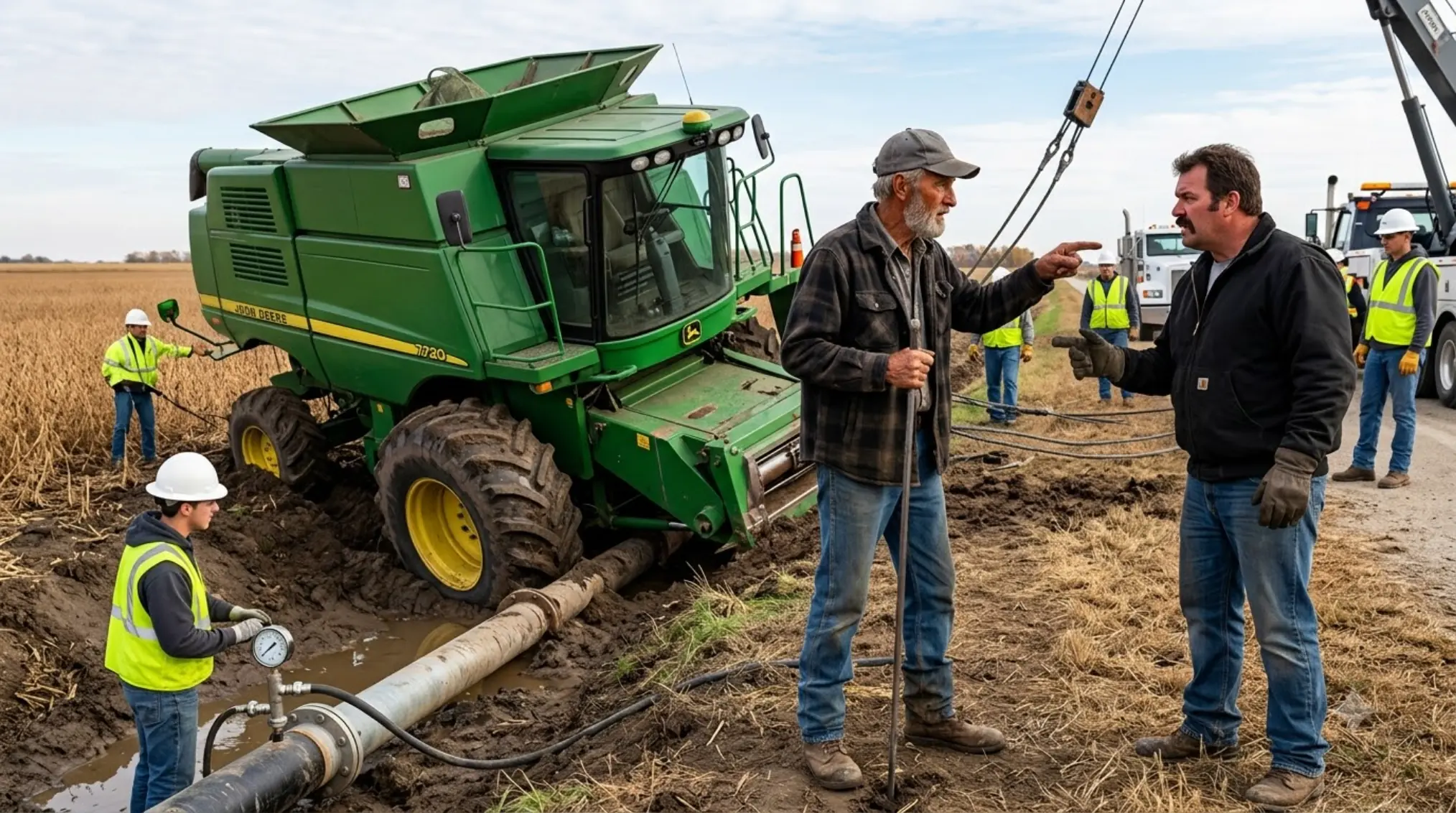
Two heavy recovery trucks idled on the field road.
Hydraulic pumps hummed.
Steel cables stretched toward the stranded machine.
Workers in reflective jackets moved around the site with the hurried concentration of people who knew the problem was becoming more dangerous by the minute.
The machine itself was worth nearly $400,000.
But that was not what worried the engineers most.
Directly beneath the ditch ran a major irrigation pipeline feeding thousands of surrounding acres.
If the combine shifted another few feet and crushed the line, the accident would stop being a machinery problem.
It would become a regional agricultural disaster.
Samuel Whitaker knew none of that when he first saw the flashing amber lights.
He had simply been driving home.
It was October 1986, harvest season in Iowa, and the northwest wind carried the dry scent of cut soybeans across fields painted brown and gold. Samuel's aging Ford pickup rattled along the gravel road with a small load of grain in the bed.
At sixty-eight, he had spent most of his life on roads exactly like this.
His shoulders had curved slightly with age, but he still stood over six feet tall. Years beneath the Midwestern sun had darkened and hardened his skin. A thick gray beard covered his jaw, and deep lines ran around eyes that had spent decades watching weather, animals, crops, machinery, and people.
Most people in Shelby County knew Samuel.
They knew him as a quiet farmer.
Not a mechanic.
Not an engineer.
Not a businessman.
Just a man who had farmed long enough that seasons had taught him what books could not.
Samuel slowed his pickup.
Several trucks were clustered around the field.
He saw cranes.
Service vehicles.
Workers.
Then he saw the combine.
He pulled over.
The moment he stepped from the cab, the wind caught his faded flannel jacket.
Samuel walked toward the crowd.
Nobody noticed him at first.
That was fine with him.
He stopped perhaps fifty feet from the ditch and studied the machine.
Workers were preparing another recovery attempt.
A broad-shouldered man in his early forties stood beside one of the service trucks giving instructions. His white hard hat and clipped tone identified him as someone in charge.
Samuel recognized him after a moment.
Robert Keller.
Field operations manager for Midwest Grain Company.
Robert had a reputation for competence.
He believed in careful planning, modern machinery, engineering data, and solving problems quickly.
Today, none of those things appeared to be helping.
A younger man stood near him with a clipboard covered in drawings.
Wire-rimmed glasses.
Company jacket.
Nervous eyes.
Ethan Brooks.
One of Midwest Grain's agricultural engineers.
Samuel watched Ethan repeatedly check measurements and compare them with the ditch.
The young man looked exhausted.
Another man was arguing with one of the recovery operators.
Curtis Vaughn.
A forty-six-year-old heavy-equipment contractor.
Curtis had a thick mustache, a heavy build, and the hard confidence of someone who had moved things far larger than this combine.
He pointed toward the hydraulic lifting system.
"Bring the plate farther under the rear frame."
Ethan shook his head.
"The soil isn't carrying the load."
Curtis snapped back, "Then increase the spread."
Robert stepped between them.
"We don't have all afternoon."
Samuel's attention moved away from the men.
He looked at the ditch.
Then the pipeline markers.
Then the slope.
Then the wet soil squeezed upward around the buried wheel.
The workers were focused on the combine.
Samuel was not.
A recovery crew activated the hydraulic system.
The pumps grew louder.
One of the steel support plates took weight.
For a second, the combine appeared to rise.
Several men leaned forward.
Then the plate sank.
Fast.
Mud rolled over its edge.
The combine shifted another fraction toward the ditch.
Someone shouted.
"Stop!"
The pumps shut down.
Silence followed.
Ethan hurried toward a pipeline monitoring point and checked the reading.
His expression tightened.
Robert pulled off one glove and rubbed his forehead.
Curtis cursed beneath his breath.
Samuel looked at the ground.
Something about it bothered him.
Not the mud itself.
The way everyone was reacting to it.
They were trying to make unstable ground behave like stable ground.
And suddenly Samuel was twelve years old again.
The memory arrived so clearly that for a moment the expensive combine vanished.
He saw another field.
Another trapped machine.
Another group of men arguing over how to pull it free.
It was the spring of 1942.
Rain had soaked Shelby County for days.
Samuel's father, Walter Whitaker, had taken him to help a neighbor whose tractor was buried nearly to the axles in a flooded field.
By the time they arrived, several men had already tried chains.
Horses.
Two tractors together.
Every attempt buried the stuck machine deeper.
Samuel remembered being impatient.
His father walked the field instead of helping.
Once.
Twice.
Then again.
"Dad," Samuel had finally asked, "aren't you going to help?"
Walter smiled.
"I am helping."
Samuel had looked at the trapped tractor.
"We haven't done anything."
Walter knelt.
He pressed one hand into the soil.
"That's because you're looking at the tractor."
Samuel frowned.
"What else am I supposed to look at?"
Walter pointed toward a small rise of ground almost a hundred feet away.
"Never start with what's stuck."
Then he said the sentence Samuel would remember for the rest of his life.
"Start with what's solid."
Walter eventually found a limestone layer beneath that higher ground.
He drove heavy anchors into it.
Then he rigged chains and pulleys so the pulling force came from something that could actually hold it.
The other farmers laughed.
Until the tractor moved.
Slowly.
Steadily.
Without burying itself deeper.
Samuel blinked.
The memory faded.
He was back in 1986.
The combine was still leaning above the pipeline.
The rescue crew was preparing another attempt.
Samuel watched Curtis direct a worker toward the hydraulic rig.
Something inside him hardened.
He stepped forward.
"Stop."
Nobody reacted.
Samuel raised his voice.
"Stop that pull."
Several heads turned.
Curtis looked toward him.
"Who the hell are you?"
"Samuel Whitaker."
Curtis waited.
Samuel added nothing.
Robert approached.
"You work with the recovery company?"
"No."
"You an engineer?"
"No."
Curtis laughed.
"Then get clear of the equipment."
Samuel looked at the ditch.
"You're loading the wrong ground."
Curtis stared at him.
"We've moved equipment twice the size of this."
Samuel nodded.
"Probably have."
"Then move."
Samuel remained still.
Ethan looked between them.
Robert's patience was nearly gone.
"What exactly do you think is happening?"
Samuel pointed toward the hydraulic plates.
"Every time you put force there, the soil underneath gives."
"We know that," Ethan said.
Samuel nodded again.
"Then why keep asking it to hold?"
Curtis stepped closer.
"Because that's where the machine is."
Samuel looked him directly in the eyes.
"That's the problem."
Curtis let out a disbelieving laugh.
"The machine is the problem."
"No."
Samuel pointed toward the ground.
"The problem is where you're standing."
Curtis slapped his gloves against the side of the recovery truck.
"Move, old man. We're pulling that combine out now."
Samuel picked up a long steel soil-probing rod from the back of his truck.
He drove the end into the soft earth beside the ditch.
It sank.
He pulled it out.
Moved ten feet.
Pushed again.
It sank deeply.
Another ten feet.
Still soft.
Curtis folded his arms.
"You planning to dig it out with that stick?"
A few workers laughed.
Samuel ignored them.
He kept walking toward the field road.
Probe.
Soft.
Probe.
Soft.
Then the rod struck something.
Samuel stopped.
He pushed harder.
The rod would not go farther.
He moved several feet left.
Again.
Solid.
Several feet right.
Solid.
Ethan had followed him.
"What did you hit?"
Samuel pulled the rod out.
"Probably limestone."
Ethan crouched and inspected the location.
"How do you know?"
"I've farmed around here sixty years."
That answer did not satisfy the engineer.
Samuel knew it wouldn't.
"Bring one of your survey rods."
Ethan did.
He drove it downward.
The stake stopped.
He tried a second position.
Same result.
His expression changed.
"Robert!"
The field manager walked over.