In the late summer of 1981, a tractor-and-implement auction filled a gravel yard outside Harlan County, Nebraska, with rows of old iron and men who believed experience belonged only to them. Tractors, balers, plows, hay rakes, and disc harrows stood beneath a white sun while diesel smoke drifted through air that smelled of cut hay and cold coffee. Dust clung to boots, shirt collars, and the folded bills farmers carried inside their pockets.
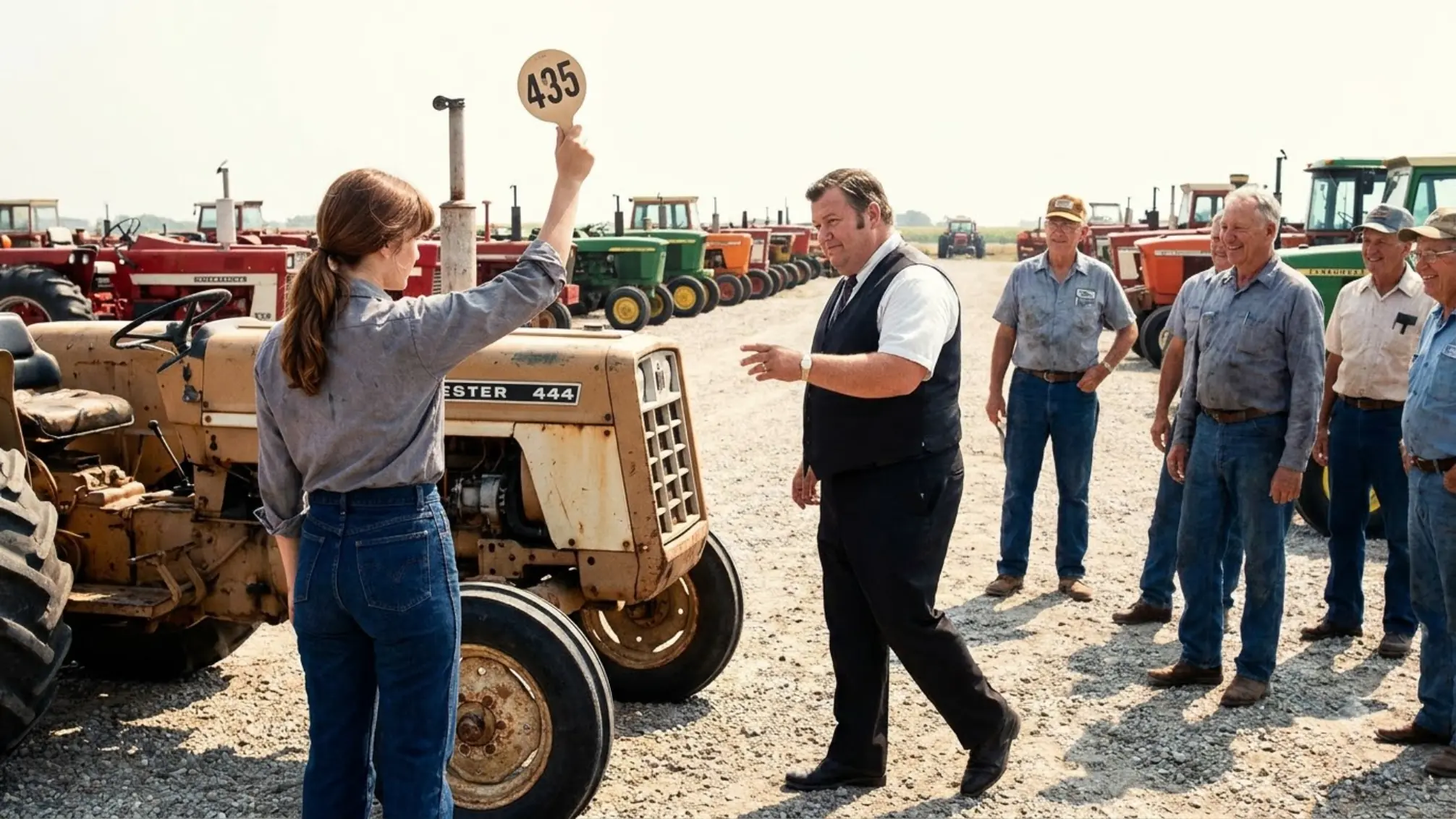
Nineteen-year-old Emily Dawson stood near the rear of the crowd with bidder number seventy-two in one hand.
Her long chestnut hair was tied into a low ponytail, and her faded gray work shirt was tucked into dark blue jeans worn pale at the knees. Dust covered her leather boots, but nothing about her posture suggested uncertainty. She had spent the morning moving slowly between the machines, checking serial plates, castings, hydraulic lines, and welds while older buyers glanced at her as though she were someone’s daughter waiting to be taken home.
Emily was waiting for one tractor.
It sat near the end of the fourth row: a faded tan International Harvester 444 with cracked tires, a dented hood, and enough dust across its engine to hide the original paint. The auction catalog described it as non-running, hydraulics untested, condition unknown.
Most bidders saw a tired machine that had been sitting too long.
Emily saw a tractor her father had once described from memory.
The auction manager, Curtis Vane, climbed onto a wooden platform beside the tractor and lifted his microphone. Curtis was forty-eight, heavy through the chest, with slick dark hair and a dark vest stretched tightly over his white shirt. He had spent twenty-five years selling equipment and considered himself an expert on both machinery and people.
He looked toward the tractor and grinned.
“All right, gentlemen, here’s one for the man with too much space behind his barn.”
Several farmers laughed.
Curtis continued. “International 444. Seller says it ran when parked, though nobody remembers when that was. No battery. Rear tires are tired. Hydraulics haven’t been tested, and I wouldn’t plan your harvest around it.”
The first bid came from a parts dealer.
“One hundred dollars.”
Another man offered one-fifty.
Curtis pushed for two hundred, then two-fifty. The crowd lost interest almost immediately. Men turned toward the newer tractors farther down the row, saving their money for machines that looked safer.
Emily raised her paddle.
“Three hundred.”
Curtis stopped speaking.
He looked over the crowd until he found her.
Then he laughed into the microphone.
“Looks like your daddy sent a little girl to play farmer.”
The men around her turned and laughed with him.
Emily kept the paddle raised.
Curtis pointed toward the tractor. “Sweetheart, this isn’t a county-fair ride. That machine needs someone who knows what he’s buying.”
Emily stepped closer to the platform.
“Then sell it to the highest bidder and stop worrying about whether I embarrass you.”
The laughter shifted.
Curtis’s smile tightened.
A stocky farmer named Dale Brenner stood near the tractor wearing a red cap and blue overalls. He owned nearly nine hundred acres east of town and enjoyed speaking loudly whenever younger farmers were nearby.
“I’ll give three-fifty,” Dale called.
Emily raised her paddle again.
“Four hundred.”
Dale looked her up and down. “Your father know you’re spending his money?”
“It isn’t his.”
“Then you’ll learn faster when you lose it.”
“Four-fifty,” Emily said.
Curtis accepted the bid but kept watching her.
Dale offered five hundred.
Emily said five-fifty.
The pace accelerated. Dale was no longer bidding because he wanted the tractor. He wanted the crowd to watch Emily surrender.
At seven hundred dollars, the parts dealer disappeared.
At eight hundred, Curtis warned that the tractor was sold without guarantees.
Emily nodded.
At nine hundred, Dale hesitated.
Curtis looked toward him. “Nine-fifty?”
Dale stared at Emily.
She met his eyes calmly.
He could have walked away. Instead, he said, “Nine-fifty.”
“One thousand,” Emily replied immediately.
The crowd murmured.
That was too much for a dead tractor with questionable tires. Curtis even lowered the microphone for a second.
Dale leaned toward her. “You’re about to buy a one-ton lawn ornament.”
Emily raised the paddle again before he could continue. “One thousand fifty.”
“You just bid against yourself,” Curtis snapped.
“No,” Emily said. “I’m paying you fifty dollars to stop talking.”
Several men laughed at him this time.
Curtis’s face reddened.
He looked toward Dale, but the farmer in the red cap shook his head. His pride had limits once his own money became involved.
Curtis struck his gavel against the wooden rail.
“Sold for one thousand fifty dollars to bidder seventy-two.”
Emily lowered her paddle.
Dale folded his arms. “Congratulations. You own the ugliest mistake in Nebraska.”
Emily walked toward the tractor.
Curtis climbed down from the platform and stepped into her path.
“Payment trailer is on the other side of the yard.”
“I know.”
“Then where are you going?”
“To inspect what I bought.”
“You already inspected it.”
“Not closely enough.”
Curtis moved with her, irritated by the attention gathering around them. Dale followed, as did several farmers who sensed the auction had paused for something better than bidding.
Emily stopped beside the tractor’s left rear wheel.
She crouched and reached beneath the fender, wiping dirt from a small rectangular plate bolted near the hydraulic housing. The plate carried a dealership stamp, a service date, and three letters almost hidden beneath grease.
Curtis leaned over her shoulder.
“What are you looking at?”
Emily read the letters silently.
Then she smiled.
Dale noticed.
“What?”
She stood.
“You really don’t know what this is.”
“It’s a 444,” Curtis said. “Anyone with eyes knows that.”
Emily opened the side panel.
Beneath the grime sat an auxiliary hydraulic pump with lines routed toward a reinforced control block behind the seat. The installation looked factory-clean, but the components were unlike the standard hydraulic layout used on most tractors of that model.
Dale shrugged. “Someone added a pump.”
“No,” Emily said. “A dealer added it under a regional testing program.”
Curtis laughed again. “Now she’s inventing history.”
Emily pointed toward the stamped plate.
“Prairie Implement, Grand Island. August 1967. Experimental high-flow package, unit number six.”
The older farmers moved closer.
One man removed his glasses and bent toward the plate.
Curtis waved him away. “A stamped piece of metal doesn’t make it valuable.”
“Not by itself,” Emily replied.
She reached beneath the seat and pulled at a narrow rusted latch. It resisted, then released with a metallic snap.
A shallow compartment opened beneath the seat frame.
Inside rested a grease-stained envelope wrapped in waxed cloth.
Nobody laughed now.
Emily removed it carefully.
The paper inside had survived because the envelope had remained sealed. Across the top appeared the name of the dealership, followed by a typed description of a hydraulic field-evaluation package designed to operate demanding implements at lower engine speed.
There were maintenance notes, pressure readings, and the signature of the original dealer technician.
At the bottom, someone had written:
Return unit after evaluation unless farmer accepts purchase agreement.
Dale took off his red cap.
“What does that mean?”
“It means this wasn’t an ordinary tractor,” Emily said. “It was one of a small number fitted with a high-flow hydraulic system for field testing.”
Curtis recovered first.
“Even if that paperwork is real, the tractor doesn’t run.”
Emily looked toward him. “Who said it doesn’t?”
“The seller.”
“The catalog says non-running. That can mean nobody tried correctly.”
Curtis crossed his arms. “Five men looked at it yesterday.”
“Did any of them open the fuel shutoff?”
Silence.
Emily pointed beneath the tank.
The normal fuel valve was open, but a second narrow lever sat behind the sediment bowl, nearly invisible beneath dirt. Someone had wired it into the dealer-installed system as an additional safety shutoff.
Dale stepped closer. “That little thing?”
“The primary valve feeds the bowl,” Emily said. “The second one feeds the carburetor. It’s closed.”
Curtis scoffed. “There’s no battery.”
“It has a hand-crank fitting.”
“You’re going to break your wrist.”
Emily ignored him.
She checked the oil, opened both fuel valves, and removed a small hand crank secured behind the rear wheel. The original owner had stored it there beneath two leather straps.
The men formed a loose circle.
Emily set the throttle, adjusted the choke, and fitted the crank into the front shaft.
Curtis stepped toward her.
“You’re not starting equipment in the middle of an auction.”
“It belongs to me now.”
“You haven’t paid.”
“My number is registered. You have my deposit.”
“That engine could throw a rod.”
Emily faced him.
“You afraid the tractor might make you look stupid?”
His jaw tightened.
“Start it,” Dale said.
Curtis turned toward him.
Dale folded his arms. “You mocked her in front of everyone. Let her prove it.”
Curtis glanced at the growing crowd.
Refusing would look worse than allowing it.
He stepped back.
Emily pulled the crank slowly through one compression stroke, then another. She stopped, adjusted the choke, and listened.
Her father had taught her never to attack a machine with force when patience would reveal more.
She repositioned the crank.
The first hard pull produced a cough.
Several men jumped.
Emily adjusted the throttle by half an inch.
The second pull produced two cylinders firing unevenly.
The third brought the engine alive.
The International coughed gray smoke into the hot afternoon air, shook against its tires, and settled into a low mechanical rhythm. Dust vibrated from the hood. Men who had been laughing moments earlier now leaned forward as though the tractor had spoken directly to them.
Emily walked beside the engine and listened.
No knock.
No grinding.
Oil pressure rose on the gauge.
She adjusted the choke until the idle smoothed.
Dale stared at the running machine.
Curtis said nothing.
Emily climbed onto the seat and placed one hand on the hydraulic lever. A heavy disc harrow sat behind the tractor, connected by two hoses but resting flat on the gravel.
The auction crew had attached it earlier only to move both items into line.
Emily engaged the auxiliary pump.
The hydraulic system responded instantly.
The harrow rose from the ground with no hesitation.
The crowd moved backward as its full weight lifted cleanly into the air.
Emily lowered it, raised it again, then held it steady.
A mechanic near the rear of the crowd whistled.
“That pump is strong.”
“Stronger than standard,” another said.
Curtis looked toward the paperwork in Emily’s hand.
“How did you know?”
She shut down the tractor.
The sudden silence felt larger than the engine noise.
“My father serviced one when he was an apprentice,” she said. “He told me about the hidden shutoff and the test package.”
Dale stared at her. “Who’s your father?”
“Thomas Dawson.”
Several older farmers recognized the name.
Thomas Dawson had operated a small repair shop near Alma for more than twenty years. He was respected because he fixed machinery other shops abandoned and charged farmers fairly during bad harvests.
Six months earlier, a grain-auger accident badly injured his right hand and damaged two vertebrae in his back. The injury ended his ability to perform heavy repair work.
Medical bills followed.
Then the bank sent notice that the Dawson farm loan had fallen behind.
Emily had spent the spring doing repair work for neighbors while caring for her father and maintaining their eighty acres. She came to the auction not for entertainment but because the family needed a tractor capable of running their hydraulic hay equipment.
Their current machine had failed.
A replacement would cost money they did not have.
The International was their last realistic chance.
Curtis looked less amused now.
“So you came because your father told you to buy it.”
“No.”
Emily folded the paperwork and returned it to the envelope.
“He told me to stay away from auctions until we were financially stable.”
Dale frowned. “Then why risk a thousand dollars?”
“Because the hydraulic pump alone is worth more than that, and the tractor can operate our baler without running the engine at full speed.”
“You were sure it would start?”
“No.”
“Then you gambled.”
Emily shook her head. “A gamble is paying without understanding the odds. I checked the engine oil, compression, coolant, and fuel system before bidding. The risk was calculated.”
Curtis looked toward the side plate.
“You knew all that before raising your paddle?”
“I knew enough.”
The auction manager’s embarrassment turned into anger.
“You made us look like fools.”
Emily stepped close enough that he had to lower his chin to meet her eyes.
“I raised a number. You chose to insult me.”
“You came here looking for attention.”
“I came looking for a tractor.”
Curtis pointed toward the crowd. “You think starting one old machine makes you a mechanic?”
“No. But missing two fuel valves makes you a poor auctioneer.”
A few men laughed.
Curtis stepped closer.
Dale placed one hand between them.
“That’s enough.”
Curtis looked at him. “You were laughing too.”
“I was.”
Dale turned toward Emily.
“And I was wrong.”
His admission quieted the nearest farmers.
Dale was not known for apologizing.
He put his cap back on.
“I thought you were bidding because you wanted to prove something.”
“I wanted the tractor.”
“What will you do with the test equipment?”
“Use it.”
“You could sell the pump.”
“And buy another tractor with an ordinary system that costs more to run.”
Dale nodded slowly.
“You thought past the purchase.”
“That’s usually how farming works.”
The auction resumed after a fifteen-minute delay, but attention remained on Emily’s tractor. Men who had ignored it returned to examine the hydraulic lines and service plate.
By the time Emily reached the payment trailer, three buyers had offered her money.
The first offered two thousand dollars.
The second offered thirty-five hundred.
A machinery collector offered six thousand for the tractor and paperwork.
Emily refused them all.
Curtis sat inside the trailer entering sales into a ledger. He did not look up when she placed the payment on the desk.
“One thousand fifty,” she said.
He counted the bills.
“You enjoy humiliating people?”
Emily waited until he finally faced her.
“No. I enjoy being left alone to conduct business.”
“You could have explained the tractor before bidding.”
“And helped everyone bid against me?”
His lips tightened.
“That isn’t how auctions work.”
“No,” she said. “It isn’t.”
Curtis handed over the receipt.
As she turned away, he spoke again.
“That package might fail under load.”
Emily stopped.
“Maybe.”
“The tractor could overheat.”
“Maybe.”
“And if it does?”
“I’ll repair it.”
“You?”
She looked over her shoulder.
“Yes, Curtis. Me.”
Emily’s neighbor, Frank Webb, helped haul the tractor home that evening. The International sat on his trailer as they traveled past wheat fields glowing beneath the setting sun.
Thomas Dawson waited beside the family barn in a wooden chair.
At fifty-one, he looked older than he had before the accident. His right hand remained stiff inside a support brace, and he used a cane whenever he walked farther than the house.
He stared at the tractor as Frank stopped the truck.
“You bought it.”
Emily climbed down.
“For one thousand fifty.”
Thomas closed his eyes briefly.
“That was nearly all the repair money.”
“It runs.”
“For now.”
“It has the test hydraulic package you told me about.”
His eyes opened.
“What?”
Emily removed the waxed envelope and placed the documents in his lap.
Thomas read the first page.
Then he looked toward the tractor again.
“Prairie Implement unit six.”
“You remember it?”
“I worked on unit four.”
“You said there were eight.”
“Eight were planned. I only knew three reached farms.”
Emily crouched beside him.
“This one has the secondary fuel shutoff.”
A faint smile appeared on Thomas’s face.
“Everybody missed it?”
“Everybody.”
“Did you?”
“Not after I found the service plate.”
Thomas looked at her for a long moment.
“You should not have risked the farm money.”
“I know.”
“You disobeyed me.”
“I know.”
“And you found exactly the machine we need.”
“Yes.”
He turned toward Frank.
“Help me stand.”
Emily offered her arm, but Thomas refused at first. Pride remained one of the few physical things the accident had not taken.
After struggling halfway upright, he accepted her help.
They walked toward the tractor together.
Thomas placed his good hand against the faded hood.
“You started it?”
“Three pulls.”
“Cold?”
“Yes.”
“Hydraulics?”
“Lifted a disc without hesitation.”
He nodded.
“Then let’s see what it does in a field.”
The following morning, they connected the International to the Dawson hay baler. Thomas sat in the shade while Emily checked every hose, fitting, and fluid level.
The tractor started on the second turn.
Emily drove into the south field.
At first, Thomas watched tensely. The baler demanded steady hydraulic pressure, and their previous tractor had struggled whenever the hay grew heavy.
The International maintained pressure without complaint.
Emily completed one row.
Then another.
By noon, twenty-eight bales stood across the field.
Thomas used his cane to walk toward her when she stopped.
“Well?”
Emily wiped sweat from her forehead.
“The pump runs cooler than our old one.”
“Engine?”
“Steady.”
“Fuel?”
“Better than expected.”
Thomas looked across the completed rows.
“You were right.”
Emily smiled. “You don’t have to sound disappointed.”
“I’m your father. It’s my responsibility to worry after you succeed.”
Within three weeks, the tractor completed the hay harvest. Lower fuel use and reliable hydraulics allowed Emily to finish custom baling work for three neighboring farms.
That income paid the family’s overdue loan installment.
By autumn, she had earned nearly four times what she spent at the auction.
But the larger change came from reputation.
Farmers who once viewed her as Thomas Dawson’s daughter began bringing repair questions directly to her. Some arrived embarrassed. Others pretended they had always respected her knowledge.
Emily treated each machine seriously.
She did not repeat Curtis’s insults.
She knew how humiliation felt and refused to build her own authority from it.
Dale Brenner visited the Dawson farm in October.
He removed his red cap when Thomas met him outside the barn.
“I came to see Emily.”
Thomas pointed toward the repair shed.
She was rebuilding the hydraulic control valve from an older combine.
Dale stood in the doorway.
“I have a tractor losing pressure when it gets hot.”
Emily did not look up. “What model?”
He told her.
“Pump noise?”
“Only after an hour.”
“Steering affected?”
“Yes.”
“Bring it Monday.”
Dale hesitated.
“You’ll work on it?”
“That’s what this shop does.”
“I was rough on you at the auction.”
“You were.”
“I’m sorry.”
Emily finally looked up.
“Apology accepted.”
He nodded, relieved.
Then she added, “I charge extra for red caps.”
Dale laughed.
“All right. I earned that.”
The next year, Emily attended the same auction as a registered equipment buyer and mechanic. Curtis remained manager, but his behavior had changed.
When she raised her paddle on an old mower, he accepted the bid without comment.
A man near the front shouted, “Somebody’s girl spending her father’s money again?”
Curtis looked directly at him.
“That girl started a tractor every man here missed last year. Bid against her or shut your mouth.”
Emily met Curtis’s eyes.
He gave one brief nod.
It was not friendship.
It was respect purchased through public failure.
The International remained on the Dawson farm for decades. Emily eventually restored the mechanical systems but refused to repaint the faded hood completely.
She preserved the rust around the dealership plate.
Beneath the seat, she kept a copy of the original field-test paperwork protected in a metal case. The first page became stained by fingerprints from years of people asking to see it.
Thomas recovered enough mobility to return to the shop, though he never regained full use of his right hand. He taught apprentices, handled estimates, and allowed Emily to perform the work he once believed only he could complete.
The sign outside changed from THOMAS DAWSON FARM REPAIR to DAWSON FAMILY EQUIPMENT.
Emily’s name appeared beneath his.
Years later, a journalist writing about women in agricultural repair asked Emily whether raising the paddle at nineteen had required courage.
She considered the question.
“No,” she said. “Courage came later.”
“What do you mean?”
“Raising the paddle took one second. Living with the purchase, repairing the tractor, finishing the harvest, and paying the loan—that was the real decision.”
“Did the laughter bother you?”
“Yes.”
“Why didn’t you lower the paddle?”
Emily looked toward the International parked beside the barn.
“Because engines don’t care who understands them.”
At the auction, every man had seen the same faded tractor.
They saw damaged paint, cracked tires, and a young woman they believed did not belong among serious buyers.
Emily saw the hidden valve, the service plate, the hydraulic lines, and an opportunity her family could not afford to lose.
The crowd stopped laughing when the tractor started.
But the engine’s first breath was not her true victory.
Her victory came later, one completed field at a time, when the machine they called worthless saved the farm they assumed she was too young to run.