By the second week of October, the apples on the ground had started to smell sweet.
Not fresh sweet.
Not the crisp, clean smell that filled the Carter packing shed when somebody sliced open a cold Honeycrisp straight from storage.
This was heavier.
Fermented.
Almost warm despite the cold weather.
Thousands of apples lay beneath the trees across the Carter family orchard in western Michigan, bruised and split open, their skins collapsing into wet grass.
Some had been knocked down during a windstorm at the end of September.
Some had been rejected by the picking crew because they were too small, misshapen, cracked, or damaged by insects.
Some had simply ripened faster than expected and fallen before anyone could reach them.
In a normal year, none of that would have been especially concerning.
Fallen fruit was part of growing apples.
The Carter family had procedures.
A tractor with a sweeper attachment would move through the rows, pushing damaged fruit into narrow windrows.
Workers would load the piles into a wagon.
The wagon would haul them away.
Then mowing, cleanup, and late-season orchard work would continue.
That was the normal system.
But October had not been normal.
It had rained on nine of the previous twelve days.
Not violent storms every time.
Sometimes only a cold steady drizzle that lasted eight hours.
Sometimes an inch overnight.
Sometimes enough rain to make the top few inches of soil soft and greasy before another system moved across Lake Michigan and started the whole thing again.
The Carter orchard sat on rolling ground about twenty miles from the lake, close enough that weather could change quickly and cold air settled strangely between blocks.
The lower rows were worst.
Every tractor pass pressed water out of the soil.
Tires sank.
Ruts deepened.
Once those ruts formed, they held even more rain.
Mark Carter tried one cleanup pass on a Tuesday afternoon.
The tractor made it forty-seven yards into the south block before the rear tires buried themselves almost to the rims.
He backed up.
The wheels spun.
Mud flew against the fenders.
His daughter Emily stood fifty feet away with her arms crossed.
Mark noticed her expression immediately.
“Don't.”
Emily smiled.
“I didn't say anything.”
“You were thinking something.”
“I was thinking the soil seems wet.”
Mark looked at the buried tractor.
“Thank you, Professor.”
He called their field foreman, Luis Mendoza, who brought another tractor and a chain.
Thirty minutes later, they had the machine out.
It left two trenches behind it.
Mark stood looking at them.
“That’s enough.”
Luis nodded.
“No more tractor until it dries.”
The problem was that the orchard did not care.
Apples kept falling.
Every morning there were more.
Fruit flies gathered over the worst piles.
Yellow jackets crawled into torn skins.
Mice appeared along the grassy edges.
A few deer started coming closer to the outer rows after dark.
The whole lower orchard smelled less like a farm and more like somebody had dumped the contents of a cider mill behind the barn and forgotten about it.
Most growers in the area were dealing with similar conditions.
At the regional coffee shop, where farmers stopped before sunrise, everyone had a theory.
Wait for the soil to freeze.
Bring in hand crews.
Rake the worst areas.
Spray around problem spots.
Mow what you can.
Pray for three dry days.
Mark Carter considered all of them.
His daughter considered something else.
On a cold Monday morning at 6:35, Emily backed a livestock trailer toward the entrance of the north orchard block.
Mark stood beside the packing shed holding a coffee mug.
Luis stood next to him.
Emily climbed out of the truck.
“Ready?”
Mark looked at the trailer.
Inside, five hundred laying hens made enough noise to sound like twice that number.
“No.”
Emily laughed.
“You agreed.”
“I agreed nine months ago when this seemed hypothetical.”
“You signed the trial plan.”
“I regret raising a daughter who keeps paperwork.”
“You taught me.”
“No, your grandfather taught you.”
That was true.
Emily walked to the back of the trailer.
The north block had already been harvested.
No market fruit remained on the trees except a few missed apples high in the canopy.
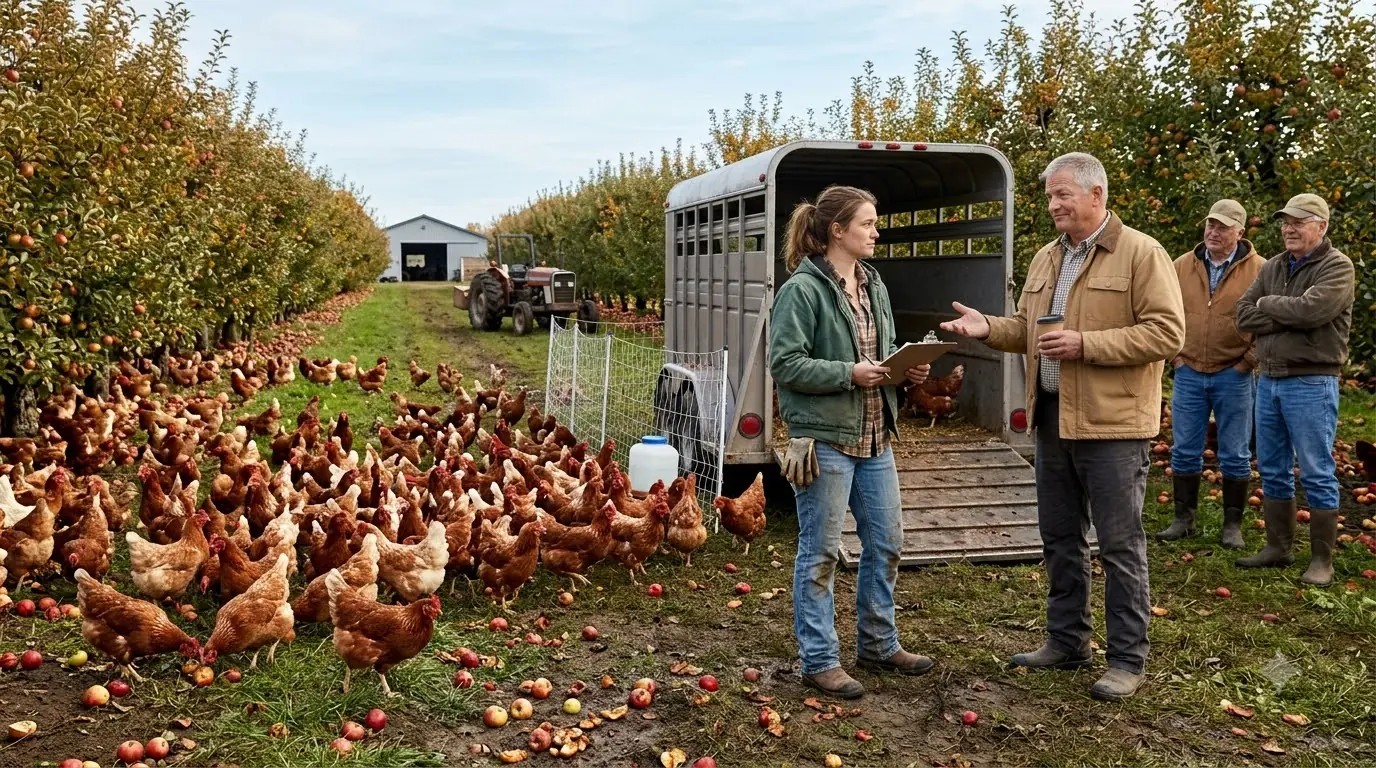
Temporary electric poultry fencing divided the twelve-acre trial area into smaller sections.
A mobile coop sat on skids near the first row.
Water tanks stood beside it.
Feeders were covered against rain.
Emily had marked sampling points with small flags.
Blue for soil moisture.
Yellow for fruit counts.
Red for ground-cover measurements.
Mark hated the flags.
“They make the orchard look like a crime scene.”
“It is a crime scene.”
“What crime?”
“Data deficiency.”
Luis laughed.
Mark stared at both of them.
“I remember when people respected me around here.”
Emily opened the trailer.
For two seconds, nothing happened.
Five hundred chickens stared toward daylight.
Then the first hen jumped down.
Another followed.
Then ten.
Then fifty.
Within seconds, the birds poured down the ramp in a noisy wave of brown, red, white, and black feathers.
Some ran directly into the grass.
Others stopped beneath the nearest apple tree.
A few remained suspiciously close to the trailer.
Emily watched carefully.
Then one hen discovered a split Gala.
She pecked once.
Twice.
A second bird joined.
Then three more.
Within a minute, the apple was surrounded.
The skin opened wider.
Pieces disappeared.
Insects underneath scattered.
The chickens chased them.
Soon the entire flock seemed to understand that the orchard floor contained food.
They spread outward.
Scratching.
Pecking.
Pulling at weeds.
Turning leaves.
Chasing beetles.
Breaking open softened fruit.
Luis whistled.
“Looks like they know the job.”
Emily shook her head.
“They don't know anything.”
Mark looked at her.
“Comforting.”
“They're just being chickens.”
That sentence would eventually become the most important one in the entire experiment.
The birds did not know they were part of an integrated agricultural system.
They did not know Emily had spent eight months planning their rotation.
They did not know she had built spreadsheets estimating feed displacement, manure distribution, cleanup labor, and fuel use.
They did not know half the county expected the project to fail.
They saw food.
Bugs.
Grass.
Space.
And they behaved accordingly.
People driving along Carter Road noticed almost immediately.
The north orchard was visible through a break in the windbreak.
One pickup slowed.
Then another.
By ten o’clock, a neighbor named Harold Jensen had stopped completely.
He parked along the road.
Walked toward the fence.
Stared.
Emily was carrying a water hose.
Harold called:
“Emily!”
She looked up.
“You lose something?”
“No.”
He pointed.
“Those chickens?”
“Yes.”
“You know they're in the orchard?”
Emily looked around dramatically.
“Oh no.”
Harold laughed.
“I’m serious.”
“So am I.”
“What are they doing?”
“Working.”
Harold stared another moment.
Then shook his head.
That afternoon, Mark received three phone calls.
The first was from a grower who thought the flock had escaped.
The second asked whether Emily had finally lost her mind.
The third was Ray Donnelly.
Ray did not ask anything.
He laughed for fifteen seconds.
Mark waited.
When Ray finally stopped:
“You done?”
“Not really.”
“Call back later.”
“You actually let her do it?”
“Twelve acres.”
“Five hundred birds?”
“Yes.”
“In your apples?”
“After harvest.”
“Mark.”
“What?”
“You know they make equipment for orchard sanitation.”
“I own most of it.”
“Then why are there chickens under your trees?”
Mark looked through the kitchen window.
Emily was outside dragging another roll of portable fencing.
“Because I made the mistake of asking my daughter to come home after college.”
Ray laughed again.
The truth was Mark had wanted Emily home more than he ever admitted.
The Carter orchard had been in the family since 1968.
Mark’s father, Samuel Carter, planted the first twenty acres after returning to Michigan from several years working construction in Detroit.
Samuel knew almost nothing about commercial apples when he began.
What he had was land.
A small loan.
A willingness to learn.
And a conviction that apple trees made more sense to him than concrete.
The early orchard was modest.
McIntosh.