The laughter began before Walter Grady finished paying for the geese.
He stood beside three stacked wire cages outside the Cedar County livestock auction with a battered ledger tucked under one arm. Twenty-two young geese crowded against the wire, hissing at boots, rattling their wings, and stretching their long necks toward every stranger who passed. Walter studied them with the careful attention most buyers reserved for breeding cattle or expensive machinery.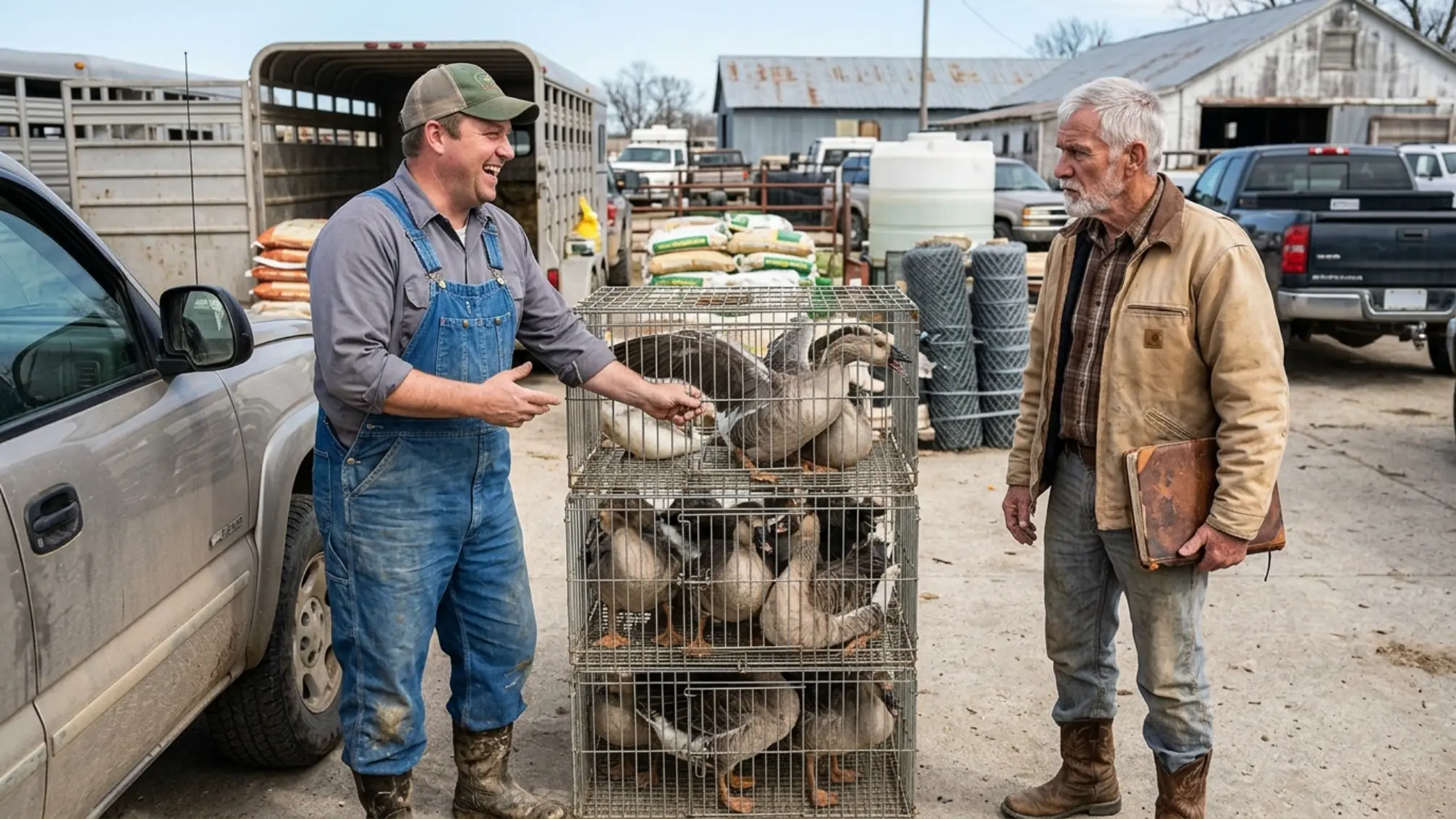
A large rancher named Travis Boone leaned against Walter’s pickup truck and laughed until his face turned red.
Travis was forty-three, heavy through the shoulders and waist, with a round face beneath a green farm cap. He wore faded blue overalls over a gray shirt, and his boots were clean enough to suggest someone else handled the worst work on his property. Several auction workers stopped loading feed sacks to listen when he pointed toward the cages.
Rancher (mockingly, pointing at the geese): “You bought birds to guard your ranch? Thieves will roast them before they sound an alarm.”
Old Farmer (coldly, gripping his ledger): “Dogs eat poisoned meat. Geese trust no one.”
Rancher (angrily, reaching toward the cage latch): “Load them onto my truck before you embarrass every farmer in this county.”
Old Farmer (fiercely, blocking his hand): “Touch one bird, and when they scream tonight, I’ll know whose men crossed my fence.”
The men nearby stopped laughing.
Travis’s smile remained, but something colder appeared behind it.
“You accusing me of something, Walter?”
“I am telling you to keep your hands off what I paid for.”
Travis looked at the old farmer’s weathered face and thin white beard. Walter was sixty-eight and moved with the stiffness of someone whose knees remembered every winter spent repairing fences in frozen mud. His tan canvas jacket had faded almost white at the shoulders, and the battered ledger against his side appeared older than some of the auction workers.
“You have been alone too long,” Travis said. “First you imagine thieves. Now you think birds are detectives.”
Walter opened the first cage and checked the latch before loading it into the trailer.
“I do not imagine missing fuel.”
“You probably forgot where you used it.”
“I do not imagine cut wire.”
“Deer tear fences.”
“I do not imagine a truck entering my north field every Thursday at 1:47 in the morning.”
Travis stopped smiling.
The change was small and lasted less than a second, but Walter saw it.
Then Travis shrugged and returned to his truck.
“Enjoy your army.”
Walter watched him drive away before closing the trailer gate.
The geese erupted into furious honking as the engine started.
Walter did not tell anyone why he had selected them.
Three weeks earlier, he had found his oldest dog, Red, unconscious beside the equipment shed. A piece of sausage lay near the fence, filled with crushed sleeping tablets. Red survived, but the veterinarian warned that a slightly larger dose would have killed him.
Someone had studied the farm closely enough to know where the dog slept.
Someone had also known when Walter would be away from the house.
The Grady farm stretched across 310 acres outside the small town of Mercy Creek, Missouri. Walter’s grandfather purchased the first eighty acres after returning from the First World War, and each generation added fields, barns, and pasture whenever money allowed.
The land was not wealthy land.
It contained rocky hills, a creek that flooded unpredictably, and soil requiring careful rotation. Walter raised cattle, soybeans, and enough corn to keep feed costs manageable. He had never owned the largest herd in the county, but he had survived drought, recession, injury, and the death of his wife without selling a single family acre.
That survival had recently become more difficult.
Diesel disappeared from storage tanks.
Copper wiring vanished from an unused milking barn.
New fence sections were cut cleanly and repaired so carefully that Walter noticed only because the knots were tied differently from his own.
The thieves rarely took enough to attract immediate attention.
They stole a little at a time.
Forty gallons of fuel.
Three rolls of wire.
Two sealed boxes of veterinary medicine.
A crate of machine bearings.
Then they began removing documents.
Walter kept tax receipts, cattle registrations, seed contracts, and land deeds inside a locked office in the main barn. One morning, the lock appeared untouched, but several folders had been returned in the wrong order.
Nothing obvious was missing.
That frightened him more than theft.
A burglar looking for valuables would have taken cash, equipment, or medicine. Whoever entered the office had searched paperwork and wanted Walter not to notice.
He installed two trail cameras.
The first disappeared.
The second recorded only a burst of white light at 1:47 a.m. before the image vanished into static.
Walter called the county sheriff.
Deputy Miles Kent walked the property, examined the sleeping dog, and wrote a short report. He suggested teenagers might be stealing fuel or wandering hunters might have damaged the fence.
“Teenagers do not reorganize land records,” Walter said.
Miles looked toward the barn. “Did you see anyone?”
“No.”
“Do you have usable video?”
“No.”
“Then I cannot arrest a ghost.”
Walter asked whether other farms had reported similar incidents.
Miles said no.
That was not true.
Walter learned it two days later when Ruth Mercer called from a neighboring dairy farm. Someone had removed the original promissory note connected to her late husband’s equipment loan. The bank retained a copy, but the version Ruth found in her records carried a different repayment date.
She assumed she had made a filing mistake.
Walter did not.
He began asking questions discreetly.
Farmer Daniel Price had discovered survey stakes moved along his southern boundary.
Widow Alice Wade received a foreclosure warning despite making every payment on time.
The Cooper brothers found tire tracks near a storage barn, but nothing seemed stolen until they realized three years of grain contracts had disappeared.
Every incident occurred between 1:30 and 2:00 in the morning.
Every property shared a financial connection to Heartland Rural Lending.
And every farmer involved had recently rejected an offer from Boone Agricultural Development, the company owned by Travis Boone.
Walter brought those details to Sheriff Nolan Creed.
The sheriff listened from behind a desk decorated with photographs of himself at charity dinners, hunting clubs, and cattlemen’s conferences. He was fifty-six, broad-faced, and known throughout Cedar County as a man who remembered names when votes were near.
He leaned back after Walter finished.
“Travis buys troubled farms,” Nolan said. “That does not make him a criminal.”
“He knows which farms are troubled before the owners do.”
“County records are public.”
“Loan balances are not.”
The sheriff folded his hands.
“You are making serious accusations without evidence.”
“That is why I asked you to investigate.”
“I cannot send deputies across the county because an old dog ate bad sausage.”
Walter studied him.
“Did Travis tell you to say that?”
Nolan’s expression hardened.
“You should go home.”
Walter left without arguing.
The following day, he attended the livestock auction and bought the geese.
His grandfather once kept geese near the farmhouse. Walter remembered them chasing delivery drivers, attacking a traveling salesman, and waking the family whenever anything unfamiliar entered the yard.
A dog could be bribed, distracted, or poisoned.
Geese reacted as a group.
They slept lightly.
They challenged movement, noise, unfamiliar silhouettes, and changes in routine.
Most importantly, no one in Cedar County considered them security.
Walter spent the afternoon building a fenced enclosure between the equipment barn and the feed shed. He placed water troughs, straw shelters, and grain pans beneath a roof extension. The geese could roam through the central yard during daylight and return to the enclosure at night.
Red watched from the porch, still recovering.
The geese disliked him immediately.
They disliked Walter too, though they tolerated the man holding their feed bucket.
His granddaughter Emily arrived from Kansas City that evening and found him repairing the enclosure while twenty-two geese shouted around his legs.
Emily Grady was twenty-seven, with brown hair tied beneath a baseball cap and the practical confidence of a woman who repaired agricultural drones for a living. She visited every second weekend, though Walter suspected she came more often since her grandmother’s death because she worried about him living alone.
She stopped beside the gate.
“Grandpa, why is your yard screaming?”
“Security system.”
Emily stared at the birds.
“You bought guard geese?”
Walter continued tightening the wire.
“They notice everything.”
“They also hate everything.”
“That saves training.”
She laughed until she saw his expression.
“What happened?”
Walter showed her the cut fences, missing camera mounts, and altered files. He explained the repeating time and the connection between the targeted farms.
Emily listened without interrupting.
Unlike the sheriff, she did not dismiss him because he lacked a clear image.
“You think someone is building foreclosure cases,” she said.
“I think someone is creating them.”
“And Boone buys the properties afterward.”
“Yes.”
“Why your farm?”
Walter looked toward the western pasture.
A natural-gas pipeline expansion had been proposed through the county. Most routes crossed Boone property or low-value timberland, but one private map leaked during a planning meeting showed a future compressor station positioned near Walter’s northern boundary.
If approved, the land surrounding it could become valuable for warehouses, maintenance facilities, and access roads.
Travis had offered Walter three times the agricultural value for eighty acres.
Walter refused.
The offer doubled.
He refused again.
A week later, the first fuel disappeared.
Emily removed a small case from her truck.
“I brought six motion sensors for a customer demonstration.”
“No cameras.”
“These are not cameras. They detect movement and send a timestamp.”
“Someone will find them.”
“Not if I bury the housings.”
They spent the next two hours installing sensors along the north fence, feed shed, equipment barn, and creek crossing. Emily linked them to a private receiver inside the farmhouse rather than the internet. If someone cut the phone line or blocked wireless signals, the local system would still log movement.
Walter introduced her to the geese.
They chased her across the yard.
By sunset, she hated them enough to trust them.
Walter began establishing a routine.
At seven every evening, he fed the geese and closed the outer pasture gate.
At nine, he checked the barns.
At ten, he turned off the porch light but remained awake in the dark kitchen.
For four nights, nothing happened.
On the fifth night, the geese screamed at 12:23.
Walter grabbed his shotgun and rushed outside, only to find a raccoon trapped against a feed barrel while twenty-two furious birds surrounded it.
Emily laughed when he told her.
The sixth alarm came at 3:10 when a deer crossed the yard.
The seventh occurred because wind knocked a metal bucket from the porch.
People in Mercy Creek heard about every false alarm.
Travis told the story inside the diner, describing Walter charging through his yard to arrest a raccoon. Several farmers laughed, though Ruth Mercer remained silent near the window.
When Walter entered, conversations quieted.
Travis raised his coffee cup.
“How is the army?”
“Better disciplined than your ranch hands.”
A few customers smiled.
Travis leaned back.
“You know people are worried about you.”
“Which people?”
“Friends.”
“Name one.”
The diner became quiet.
Travis set down his coffee.
“You stay awake all night waiting for criminals that do not exist. You accuse the sheriff. You buy birds. Maybe it is time Emily helped you sell.”
Walter stepped closer to the table.
“Interested in buying?”
“I might make a fair offer.”
“You already made six.”
“And you rejected every one.”
“Then stop asking.”
Travis smiled again.
“Eventually the bank will ask for you.”
Walter held his gaze.
“My bank account is current.”
“Today.”
The word lingered.
Walter left without ordering breakfast.
That afternoon, he called Heartland Rural Lending. The representative confirmed his mortgage payment had been received but said his loan was under an internal collateral review.
No one could explain why.
Walter requested the complete account history in writing.
The representative refused, citing system maintenance.
He drove directly to the local branch.
Branch manager Calvin Reese welcomed him with rehearsed concern. Calvin had managed agricultural loans in the county for fifteen years and attended the same hunting club as Travis Boone and Sheriff Creed.
“We are reviewing property values because of market uncertainty,” Calvin said.
“My payments are current.”
“Yes.”
“Then why is my land being appraised without notice?”
Calvin adjusted his tie.
“The agreement permits periodic valuation.”
“Who requested it?”
“The system.”
“Systems do not make requests. People do.”
Calvin smiled tightly.
“You should speak with your family about options. Boone Agricultural has helped several farmers avoid difficult foreclosure proceedings.”
“I am not in foreclosure.”
“Not yet.”
Walter heard Travis’s voice inside the same two words.
He returned home before sunset and found Emily waiting with sensor data.
Someone had approached the north fence the previous night at 1:42 a.m.
The person remained outside the sensor range for six minutes, then left.
“The geese never reacted,” she said.
“They did not cross.”
“They were watching.”
Walter looked toward the distant tree line.
“Or testing.”
The next three nights remained quiet.
Then Walter found a dead fox beside the feed shed.
No bite marks covered its body. No trap had caught it. Doctor Price, the local veterinarian, examined it and found poison in its stomach.
“Enough to kill three dogs,” she said.
“Would it kill geese?”
“If they ate the bait.”
Walter searched the yard.
He found pieces of grain bread scattered near the north fence, each soaked in a clear liquid.
The geese had not eaten them.
They preferred the feed pan near the barn and distrusted food placed outside their routine. Walter collected every piece with gloves and stored them in a sealed container.
He called Sheriff Creed again.
This time, the sheriff sent Deputy Miles Kent.
Miles photographed the bread and listened while Walter explained the sensor reading.
“You need to keep the birds locked up,” Miles said.
“They are safer roaming together.”
“You cannot stay awake forever.”
“I do not need forever.”
“What do you need?”
“The person who returns.”
Miles looked toward the geese.
“You truly think these birds will help?”
Walter watched one goose stretch its neck toward the deputy and hiss.
“They already refused the bait.”
Miles became serious.
He took the samples for laboratory testing and promised to contact Walter when results arrived. He also admitted that three additional farmers had reported altered financial records.
“Sheriff said those cases were unrelated,” he said.
“Do you believe him?”
Miles looked toward the road.
“I believe reports should have been compared sooner.”
That was the first honest answer Walter received from law enforcement.
At 1:47 the following Thursday morning, every goose on Grady Farm exploded into noise.
Walter woke before the receiver alarm sounded.
The honking was unlike the raccoon incident, the deer, or the falling bucket. This was continuous, violent, and moving rapidly from the north enclosure toward the feed shed.
Red began barking from inside the house.
Walter pulled on his boots, grabbed the shotgun, and called Emily.
“Stay on the line.”
“Do not go outside alone.”
“They are already inside the yard.”
“How many?”
Walter checked the sensor panel.
North fence.
Creek crossing.
Equipment barn.
Feed shed.
Four separate movements.
“At least three.”
He turned off the kitchen light and moved through the mudroom. The geese were gathered near the feed shed, wings spread, necks extended, surrounding a figure in dark clothing.
Another figure ran toward the equipment barn.
A third remained beside a pickup hidden beyond the fence.
Walter raised the shotgun.
Old Farmer (furiously, stepping from the porch): “Drop whatever you are carrying and get on the ground.”
The man near the feed shed spun.
A flashlight beam struck Walter’s face, followed by the sound of boots running across gravel.
The geese charged.
One bird caught the man’s trouser leg. Another struck his thigh with its wings. He stumbled over a water pan and fell hard against the ground.
The second intruder emerged from the equipment barn carrying a metal file box.
He saw Walter and reached beneath his coat.
Walter aimed the shotgun.
Old Farmer (coldly, bracing the stock against his shoulder): “Show me both hands before these birds become the kindest thing you meet tonight.”
The man froze.
Behind the fence, the hidden pickup started.
Emily’s voice came through Walter’s phone.
“I called Miles. He is three minutes away.”
The driver accelerated toward the creek road.
A fourth goose broke from the flock and ran after the truck, screaming so loudly that every dog within a mile began barking.
The captured man near the feed shed tried to stand.
The geese knocked him down again.
Walter almost admired their commitment.
Deputy Miles arrived without sirens. He blocked the creek road with his patrol vehicle, forcing the pickup into a drainage ditch. The driver fled on foot but was caught near the soybean field by a second deputy responding from the highway.
Within ten minutes, three men were handcuffed in Walter’s yard.
Two worked for Boone Agricultural Development.
The third was Deputy Carl Mason, a night-shift officer from Sheriff Creed’s department.
Walter recognized him as the figure carrying the file box.
Miles recognized him too.
“What are you doing here, Carl?”
Carl stared at the ground.
Miles opened the metal box.
Inside were Walter’s original farm deed, loan receipts, cattle contracts, and a blank quitclaim form bearing a forged signature nearly identical to Walter’s.
There was also a handheld scanner, two bank envelopes, and a folder marked NORTH CORRIDOR ACQUISITIONS.
Emily arrived thirty minutes later.
She photographed every document before anyone could remove it. Walter trusted Miles, but he no longer trusted the department controlling the evidence room.
Carl demanded to call Sheriff Creed.
Miles refused to let him use a private phone before investigators arrived.
“Sheriff will explain,” Carl said.
Walter looked at him.
“That is exactly what I am afraid of.”
The folder contained maps of eleven farms.
Each property lay along the proposed pipeline corridor.
Every owner had received unexplained loan warnings, altered records, or suspicious nighttime visits.
Red marks indicated fields already acquired by Boone Agricultural.
Yellow marks identified properties under financial pressure.
Walter’s farm was circled in black.
Beside it, someone had written:
Force default before state route decision.
Emily read the note twice.
“This was never about stealing fuel.”
Walter looked toward the north field.
“No. The theft made me appear disorganized. The papers would make me look delinquent.”
Carl refused to speak until an attorney arrived.
The two Boone employees talked within an hour.
They claimed Travis hired them to retrieve documents and place replacement records in the barn. He promised five thousand dollars each and said the sheriff’s department would keep patrols away from the road.
They had entered other farms using copied keys supplied by Calvin Reese at Heartland Rural Lending.
At 4:20 a.m., state investigators arrived.
Deputy Miles had contacted the Missouri Highway Patrol rather than Sheriff Creed. He explained that a county deputy had been caught inside a private barn with forged land documents and that the sheriff might be involved.
The state team separated every suspect.
They collected the poisoned bread, motion-sensor records, photographs, file box, scanner, and Walter’s recovered documents.
The geese continued shouting until sunrise.
One investigator finally asked whether someone could quiet them.
Walter spread grain inside the enclosure.
The flock entered at once.
The yard became silent.
By eight that morning, the county knew.
Travis arrived at the Grady farm in a black pickup with an attorney beside him. State vehicles blocked the driveway. He stepped out angrily and demanded the release of his employees.
Walter stood near the pasture fence.
Rancher (furious, pointing toward the investigators): “You turned a trespassing mistake into a conspiracy because those fools entered the wrong barn.”
Old Farmer (coldly, lifting the forged deed): “They entered the correct barn. They just expected me to sleep through it.”
Rancher (threateningly, stepping closer): “You keep pushing, and no bank in this county will lend you another dollar.”
Old Farmer (fiercely, nodding toward the geese): “At 1:47, your men brought me enough evidence to buy the bank’s silence back.”
Travis stopped several feet away.
His attorney whispered for him to leave.
He did not listen.
He claimed the acquisition folder had been stolen from his office and planted in Walter’s barn. He accused the Boone employees of acting independently. He denied knowing anything about Deputy Carl Mason or poisoned bait.
Then investigators showed him a text recovered from Carl’s phone.
Birds are a problem. Use bait before entry.
The message came from a number registered to Travis’s private ranch office.
He drove away without another word.
Sheriff Creed held a press conference that afternoon. He described Carl as a rogue deputy and insisted the department had no knowledge of the operation. He praised Miles for responding quickly and promised full cooperation.
The statement lasted until state investigators searched Carl’s house.
They found cash hidden beneath floorboards and audio recordings of conversations with the sheriff. Carl had recorded them as protection in case the scheme collapsed.
One recording captured Nolan Creed giving specific instructions.
“Keep reports separate. If farms compare notes, Boone’s finished.”
Another concerned Walter.
“The old man is stubborn. Make him look confused before the bank moves.”
The sheriff was arrested before midnight.
Heartland Rural Lending closed its Mercy Creek branch the next morning. Calvin Reese attempted to destroy customer files, but an employee had already copied the server after noticing late-payment dates being altered.
The banking scheme was simple, patient, and devastating.
Calvin identified farms carrying valuable land but limited cash reserves.
Travis selected properties along development routes.
His employees stole original documents, altered private records, and created evidence of mismanagement.
Calvin delayed payments inside the bank’s system, then issued default warnings.
Sheriff Creed treated complaints as confusion, family disputes, or poor bookkeeping.
Boone Agricultural arrived with an offer before foreclosure.
Farmers believed they had avoided disaster.
In reality, the disaster had been manufactured for them.
Seven properties had already been transferred.
Three elderly owners moved away after losing land that had been in their families for generations.
Ruth Mercer nearly signed away her dairy farm.
The Cooper brothers were scheduled for a foreclosure hearing within ten days.
Walter’s guard geese stopped the final document replacement before the bank could claim he had lost his original deed and repayment records.
The case expanded beyond Cedar County.
Federal banking investigators joined the state inquiry when evidence showed Heartland employees had altered insured loan records. Pipeline planners provided route documents proving Travis knew which properties would rise in value months before official announcements.
Someone inside the planning company had sold him confidential maps.
That employee was arrested too.
Travis’s attorney argued that purchasing distressed land was not illegal. Prosecutors agreed.
Then they showed the jury how Travis created the distress.
The trial began ten months after the geese sounded the alarm.
Walter testified on the fourth day.
Travis sat beside his attorneys wearing a dark suit rather than overalls. Without his green cap and public laughter, he looked smaller than Walter remembered from the auction.
The defense attorney approached the witness stand.
Defense Attorney (skeptically, holding up the ledger): “Mr. Grady, you began accusing my client before you possessed direct evidence, correct?”
Old Farmer (calmly, resting his hands on the rail): “I noticed a pattern.”
Defense Attorney (pressing, pacing before the jury): “You believed geese could identify criminals?”
Old Farmer (dryly, glancing toward Travis): “They identified three before your client’s lawyers identified one.”
Several jurors smiled.
The attorney became sharper.
Defense Attorney (angrily, raising his voice): “Is it not true that you personally disliked Mr. Boone because he repeatedly offered to purchase your property?”
Old Farmer (coldly, meeting his stare): “I disliked him because he tried to steal what I refused to sell.”
The prosecution played Carl’s recordings, displayed altered bank files, and presented the forged documents found inside Walter’s barn. Emily explained the sensor timestamps. Doctor Price testified that the bread near the geese contained a chemical dose strong enough to kill dogs and birds.
Deputy Miles described the arrests.
He also admitted that his department had ignored earlier warnings.
Sheriff Creed pleaded guilty before his own trial and testified against Travis in exchange for a reduced sentence. Calvin Reese did the same after federal prosecutors traced payments into accounts controlled by his wife.
Travis refused every deal.
He believed the jury would see him as a businessman surrounded by dishonest employees.
They saw the maps.
They saw the texts.
They heard his voice ordering that Walter be made to “look confused.”
The jury convicted him of conspiracy, fraud, attempted theft, witness intimidation, document forgery, and offenses connected to poisoning animals and corrupting public officials.
Boone Agricultural Development collapsed under restitution claims.
The seven farms acquired through fraudulent defaults were returned to their original owners whenever possible. Families who had sold equipment or moved away received compensation from seized assets.
Heartland Rural Lending paid penalties and funded an independent review of every agricultural loan processed through the county branch.
Calvin Reese lost his banking license permanently.
Sheriff Creed went to prison.
Deputy Carl Mason received a reduced sentence because his recordings exposed the full operation, though Walter never considered the man brave.
“Protection purchased after betrayal is not courage,” he told Emily.
Deputy Miles became interim sheriff after the county board removed Nolan. His first policy required all property and financial-crime complaints to be entered into a searchable shared system. Similar reports could no longer be isolated until no one recognized the pattern.
Walter kept the geese.
Their reputation spread farther than he expected.
Farm magazines published photographs of the flock patrolling the Grady yard. Television crews requested interviews. One security company offered to purchase the birds for an advertising campaign.
Walter refused.
“They are working,” he said.
The geese became less aggressive toward him over time, though they continued attacking delivery drivers, veterinarians, and anyone carrying a clipboard.
Emily installed a better gate and warning sign.
GUARD GEESE ON DUTY. ENTER AT YOUR OWN RISK.
Walter complained that the sign looked ridiculous.
She reminded him that ridiculous had worked.
The restored farms formed the Mercy Creek Agricultural Cooperative. Members shared legal resources, loan reviews, security equipment, and development information. No landowner would again face a suspicious default alone.
Ruth Mercer served as treasurer.
The Cooper brothers managed equipment sharing.
Walter attended meetings but refused leadership.
“You started this,” Ruth told him.
“The geese started it.”
“That is not true.”
“They make fewer speeches.”
Two years after the arrests, the pipeline route was finalized.
The compressor station moved three miles east because the original location depended on land transfers now under investigation. Walter’s north field remained pasture.
He never became rich from it.
That pleased him.
One summer afternoon, he returned to the Cedar County livestock auction. The same worker who sold him the geese recognized him near the feed cages.
“Looking for more guards?”
“No.”
“You could breed the ones you have.”
“I have enough noise.”
A familiar voice came from behind him.
Deputy Miles, now elected sheriff, stood holding two cups of coffee.
“Your security team received another complaint.”
Walter accepted one cup. “From whom?”
“Mail carrier.”
“He cuts across the yard.”
“He says the geese know his route.”
“They do.”
Miles shook his head.
“You realize everyone laughed at you.”
“I remember.”
“What made you so sure?”
Walter watched a new group of buyers enter the auction yard.
“I was not sure.”
“Then why geese?”
“Because everyone expected dogs, cameras, locks, and alarms. Travis had already planned around all of those.”
Miles looked toward the cages.
“So you chose something he would underestimate.”
Walter nodded.
“Men like Travis make the same mistake repeatedly. They confuse laughter with proof.”
That evening, Walter fed the flock as sunlight settled behind the equipment barn. Red, older now, slept safely on the porch. The recovered deed remained locked inside a fireproof safe, with digital copies held by Emily, the cooperative attorney, and the county recorder.
Walter no longer stayed awake every night.
At 1:47 a.m., he sometimes opened his eyes automatically.
Most nights, he heard nothing but insects, wind, and distant cattle.
Then one goose would mutter softly in the yard, answered by another.
Walter would smile and return to sleep.
The county remembered the story as the night a ridiculous flock of geese exposed a land-stealing conspiracy.
But Walter understood that the birds had not uncovered everything alone.
They sounded the alarm.
People still had to listen.
For months, farmers had reported missing records, altered loans, poisoned animals, and nighttime trucks. Authorities laughed, separated the complaints, and trusted powerful men over frightened landowners.
The geese changed the outcome because their screaming was too loud, too sudden, and too public to dismiss.
At exactly 1:47 in the morning, they surrounded the men inside Walter’s yard and refused to be silenced.
Everyone had laughed at his guard geese.
Then the birds caught the thieves that badges, banks, and powerful neighbors had worked so hard not to see.