The yellow loader was already moving when Clara Whitlock pulled behind Route 9 Farm Market. Its bucket rose slowly beneath four hundred stained burlap sacks, several split open enough for pale sprouted potatoes to tumble onto the concrete. Clara slammed her old pickup into park, jumped out, and ran toward the machine before the operator could dump the first load. “Stop. I’ll take every sack.”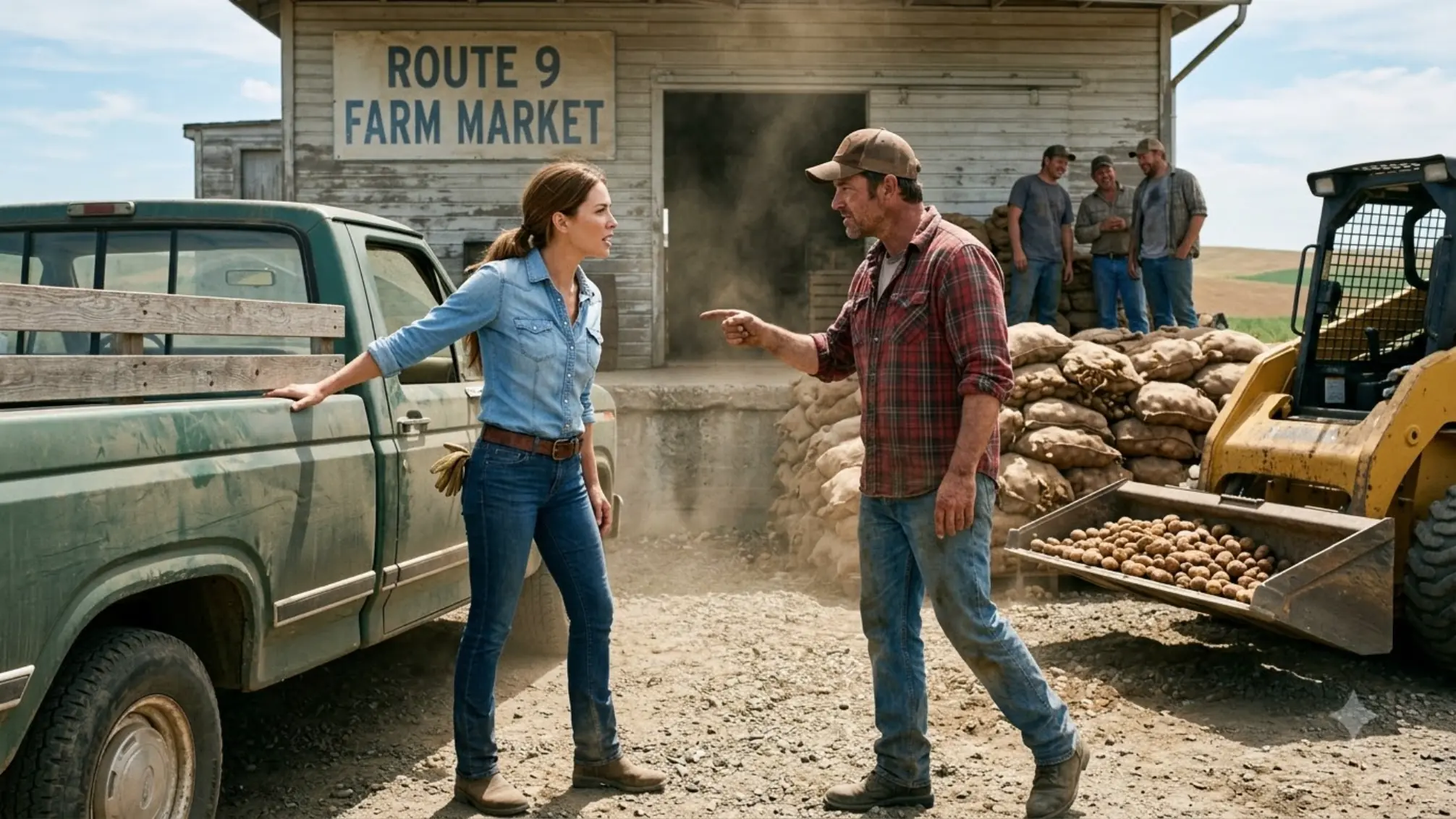
Deacon, the young loader operator, stared at her as though she had asked him to put the potatoes on the roof. Behind him, market manager Phil Gentry stepped through the loading door, wiping his hands on his apron while the sour smell of spoiled produce drifted across the lot. “Clara, there are four hundred sacks back here,” he said. “Some are sprouted, some are soft, and some are barely potatoes anymore.”
“I know what they are.” Clara stood beside her truck in a fitted light-blue denim shirt, dark jeans, brown work boots, and the determined expression half of Cedar County had learned not to underestimate even when they continued trying. “Once they’re on my truck, what they become is my problem.” Several dock workers had already abandoned their jobs long enough to watch.
One man laughed and called them hog food. Another asked whether Clara planned to plant crops or bury evidence. Then Garrett Pike, a neighboring farmer who had stopped for feed, walked around the corner and noticed the growing audience. He looked at the sacks, looked at Clara, and smiled in the particular way a man smiled when he believed someone else had arranged his entertainment for him.
“Your father couldn’t make that dead field grow with good seed,” Garrett said. “What makes you think this garbage will?” The laughter weakened slightly because everyone knew exactly which wound Garrett had chosen. Walter Whitlock had spent nearly twenty years trying to make North Ridge Field productive before dying three winters earlier.
Clara’s green eyes hardened. “Keep my father’s name out of your mouth and load the potatoes.” Garrett stepped closer, boots grinding against the dirty concrete. “You’re about to waste your money and prove this whole county right about you.”
Clara held his stare. “Then remember that sentence when you’re buying potatoes from my field this fall.” She turned away before he could answer and lowered the tailgate. Phil Gentry looked from Garrett to Clara, shook his head, and started helping her load.
The potatoes were heavier than healthy potatoes should have been. Moisture had collected in some of the sacks, and dark stains appeared across Clara’s truck bed as the piles grew higher. A few burst when they were lifted, spilling soft potatoes with white sprouts twisting from them like pale fingers.
Phil worked quietly beside her for nearly twenty minutes before saying, “You really have a plan?” Clara lifted another sack. “I have several possibilities.” He glanced toward the people still laughing at the edge of the loading dock. “That isn’t exactly the same thing.”
“No.” Clara wiped sweat from her forehead. “But it’s better than throwing them away.” Phil nodded slowly and kept loading. Before Clara pulled away, he leaned toward the open driver’s window and lowered his voice.
“Miller Creek farmers lost a lot of planting to standing water this spring.” Clara looked toward him. “How much?” Phil shrugged. “Enough that people will notice by fall if the rest of the season turns bad.”
Clara filed the information somewhere in the back of her mind and drove home. Behind her, someone shouted that she would need another truck once the smell became unbearable. She did not look in the mirror.
Whitlock Farm sat two miles from Route 9 at the end of a gravel road lined with old fence posts. The farmhouse had once been bright white but had faded beneath decades of weather, and the barn had turned from red to the brownish brick color old paint acquired when nobody had enough money or time to repaint it. Clara maintained everything herself with patches, reused boards, secondhand parts, and the stubborn philosophy that ugly repairs were still repairs.
She had forty chickens, six hogs, a vegetable plot, several hay acres, and enough regular customers at her roadside farm stand to keep the property barely solvent. Some months she made enough to set money aside. Other months the electricity bill and feed invoice seemed to arrive together just to remind her that optimism was not a recognized form of payment.
And then there was North Ridge Field.
Forty acres of heavy clay sat on the northern side of the farm like a challenge nobody had successfully answered. In wet springs, water collected in the low sections and stayed there long enough to drown roots. By summer, the same ground hardened so badly that cracks opened across the surface and a shovel sometimes bounced instead of penetrating.
The neighbors called it the Brick Field. Walter Whitlock had tried drainage tile, rotations, cover crops, deeper tillage, and nearly every low-cost soil remedy he could find. Some helped, but none transformed the field enough to justify the money he poured into it.
Clara had considered selling the acreage after his death. Garrett Pike had even mentioned buying it once, pretending he was only asking casually over a fence. She almost accepted because that money could have repaired the barn roof, replaced her dying tractor, and eliminated two years of accumulated farm debt.
But she could never bring herself to sign.
That evening, Clara worked beneath the barn lights sorting the potatoes. Her system became obvious after the first ten sacks. Potatoes with strong sprouts and reasonably firm flesh went into one pile, soft but not actively rotten potatoes went into another, and anything leaking, liquefied, or smelling beyond redemption went directly toward compost.
She kept numbers in the spiral notebook she always carried. By midnight, she had counted 286 sacks suitable for seed, 71 suitable for animal feed, and 43 completely lost to rot. It was better than she had expected, but doubt arrived when exhaustion did.
Clara sat on an overturned bucket and stared at the piles. Four hundred dollars was not much to prosperous farmers, but on Whitlock Farm it represented money she might later need for diesel, veterinary bills, fencing wire, or a broken pump. She opened one final sack and discovered gray-brown liquid where potatoes had once been.
Garrett’s voice returned to her.
That field beat a better farmer than you.
Clara tied the sack closed and shut off the lights.
She slept badly.
Three nights later she pulled down her father’s old farm journals. Walter had filled nine notebooks over nearly thirty years, recording rainfall, planting dates, machinery repairs, yields, pest problems, soil observations, and occasionally thoughts he probably never expected anyone else to read. Clara spent two hours searching before she found an entry about North Ridge.
I keep thinking about this field wrong, Walter had written eleven years earlier. I keep trying to force it to grow like normal ground when it isn’t normal ground yet. Clara leaned closer to the faded handwriting.
The next lines changed everything.
This field doesn’t need a miracle. It needs organic matter, patience, and something stubborn enough to grow before the soil is ready. I don’t have the money to bring in compost by the ton, and I’m not sure I have the years left to wait for it to build slowly. Maybe Clara will have the money or the years someday. Maybe she’ll figure out something I couldn’t.
Clara read the passage three times.
Then she opened her own notebook.
Dad knew what it needed. He just couldn’t afford enough material.
She looked toward the barn.
I have four hundred sacks of material.
The plan became clearer.
The best potatoes would become seed. The soft potatoes would reduce animal-feed expenses during a year when grain costs were climbing. The truly rotten potatoes would become compost, mixed with straw, chicken manure, dried leaves, and anything else the farm produced.
Nothing needed to be wasted.
Even failure could be separated into useful categories.
Over the next two weeks, Clara turned the barn into a cutting room. Sprouted potatoes were divided into pieces containing at least one strong eye and enough flesh to support early growth. She disinfected her knife regularly, discarded diseased sections, and spread the pieces on improvised drying racks.
By the end, she had more than eleven thousand seed pieces.
Freshly cut potatoes could rot quickly in wet ground, so Clara allowed the surfaces to cure. She dusted many with wood ash and left them several days beneath good ventilation until the cut surfaces toughened. Meanwhile, the feed-grade potatoes were cooked in outdoor kettles, mashed, and introduced gradually into the hog and chicken rations.
The savings appeared almost immediately.
Grain purchases dropped.
The hogs gained weight normally.
The chickens objected suspiciously for several days before deciding cooked potatoes were acceptable.
Clara wrote every number down.
The forty-three sacks of unusable potatoes went into compost bays behind the barn. She layered them with straw, chicken manure, and old leaves, then turned the piles regularly. Within days, steam rose from the center during cold mornings.
For Clara, that steam looked like money being created from garbage.
For everyone else, she was still the woman who bought rotten potatoes.
The Cedar County feed store reminded her of that the following Tuesday. Conversation changed the moment she walked inside, becoming quieter without actually stopping. Two farmers near the fertilizer aisle discussed her loudly enough that pretending they did not want her to hear would have insulted everyone’s intelligence.
Garrett appeared near the counter carrying chicken starter.
“Heard you’re really planting those things.”
“Yes.”
“In North Ridge?”
“Yes.”
Garrett laughed. “Your father fought that field for twenty years.”
Clara kept her eyes on Ronnie, the clerk pulling her feed order.
“He had good seed,” Garrett continued. “He had more machinery than you do. He knew that farm better than you ever will.”
That sentence reached her.
Clara turned slowly.
Garrett seemed satisfied.
“And the field still beat him,” he finished.
Clara lifted the feed invoice.
“We’ll see.”
“That’s all you’ve got?”
“For now.”
She paid and walked out.
The drive home was more difficult than the conversation. Clara could ignore people laughing at potatoes. She could not easily ignore Garrett turning her father’s failures into evidence against her own competence.
Walter had been a good farmer.
Better than she was in several areas.
That was true.
But his failure did not automatically require hers.
When Clara reached home, she sat inside her truck for a minute before going inside. Then she opened Walter’s journal again.
He had never written this field cannot be fixed.
He had written that it needed organic matter and patience.
Clara had both.
She chose six acres of North Ridge for the first experiment. It was the highest, driest section, gently sloped enough that water could move away rather than remaining trapped indefinitely. She created raised ridges about eight inches high, laid compost into selected rows, and planted the first seed pieces in late April.
For ten days she worked almost entirely alone.
Eleven thousand pieces disappeared beneath the soil.
Clara stood at the edge of the field after the final row and looked across the ridges. Nothing visible suggested what might happen next. It was simply brown ground hiding weeks of work.
Eight days later, rain arrived.
It fell for three days.
North Ridge behaved exactly as it always had.
Water accumulated between the ridges, first in shallow pools and then in long muddy channels. Clara walked through the rain wearing rubber boots and a hooded jacket, watching the water rise toward seed level.
By the third day, she knew she had a problem.
When the ground finally allowed digging, Clara checked several lower rows. She pulled up the first seed piece and felt it collapse between her fingers. Another was worse.
Rot.
She checked ten.
Then twenty.
By the time she finished surveying the lowest sections, Clara estimated she had lost nearly three thousand seed pieces.
Word reached Garrett faster than she imagined.
At the gas station several days later, he rolled down his truck window while Clara filled her tank. “Told you that field eats everything you put in it.”
She continued pumping fuel.
“Just like it ate every dollar your daddy ever put there.”
Clara tightened her hand around the nozzle.
She wanted to answer.
Instead, she finished fueling, replaced the nozzle, and drove home.
That evening she walked into North Ridge alone. The rows looked miserable in the fading light. Some sprouts had emerged, but the lowest section contained large gaps.
Clara knelt in mud and dug with her bare hand.
Another seed piece came apart.
For the first time, she seriously considered quitting.
She imagined calling Garrett about the forty acres. Sell the field, pay down debt, focus on what already worked. Nobody could call that irresponsible.
Her father had spent twenty years trying.
Maybe letting go would be wisdom rather than defeat.
Clara started to stand.
Then she saw something two rows over.
One green shoot.
Tiny.
Perhaps three inches tall.
It stood in a section where she had added extra compost and where the ridge happened to be slightly higher.
Clara stared.
One plant could not prove her plan worked.
But it proved something else.
The failures had not occurred everywhere equally.
Where drainage improved and organic matter was concentrated, more seed pieces survived.
That meant the field had given her information.
Clara walked back to the farmhouse and opened her notebook.
Higher ridges.
More drainage channels.
Concentrate compost directly under seed.
Mulch.
Plant the driest sections first.
At the bottom she wrote:
Three thousand lost.
Eight thousand remain.
Eight thousand chances.
The second planting looked completely different.
Clara raised ridges twelve to fourteen inches instead of eight. She cut channels angled to carry excess rainfall away from the rows and concentrated compost directly beneath each seed zone rather than spreading it thinly. Straw mulch covered the ridge surfaces to protect moisture levels later in summer.
A seventeen-year-old neighbor named Sam Daring appeared one Saturday asking whether Clara had work. She handed him a shovel and put him on drainage channels. Sam lasted six hours before admitting he had never worked so hard for money in his life.
“Want to quit?”
“No, ma’am.”
“Good.”
They continued.
By the end of May, the remaining eight thousand seed pieces were planted.
Then Clara waited.
Waiting on a farm was never passive. There were animals to feed, fencing to repair, vegetables to plant, equipment to maintain, eggs to deliver, invoices to pay, and weeds appearing everywhere they were least welcome.
Still, North Ridge occupied the edge of every thought.
Then green appeared.
Not one plant.
Rows.
Uneven in places, stronger in others, but unmistakably rows.
Clara walked through them early one morning and felt something catch in her chest.
This was no longer an experiment hiding underground.
It was a crop.
The next problem arrived in June.
Colorado potato beetles appeared beneath the leaves. Clara discovered clusters of orange eggs during her morning inspection, and within days larvae were spreading across several sections.
She could not afford a commercial treatment program across six acres.
So she tried chickens.
The first experiment was terrible.
Clara moved too many birds into too small an enclosure and left them too long. They ate beetles beautifully, then celebrated by scratching around several young potato plants and damaging roots.
Clara stood beside twelve injured plants and closed her eyes.
“Useful information,” she muttered.
The next enclosure was larger.
Fewer chickens.
Less time.
She supplemented their work by handpicking beetles into buckets of soapy water.
It was slow.
It was unpleasant.
It worked.
By July, the pest pressure was manageable.
The county’s broader agricultural situation was not.
Spring flooding along Miller Creek had destroyed significant acreage. Several commercial operations lacked enough replacement seed to replant, and the summer turned dry enough to stress what remained.
Potato prices began rising.
The Cedar County school district contacted suppliers early and discovered fall pricing would exceed its budget. The church food pantry saw donations fall. Millie’s Diner on Main Street began calculating whether it would need to raise menu prices.
Clara knew little of this.
She was still trying to determine whether North Ridge contained anything worth harvesting.
In early September, she carried a spading fork to the highest section and dug beneath the first mature plant.
One potato appeared.
Then another.
Then three more.
Clara sat back on her heels.
They were not enormous.
They did not need to be.
They were firm, clean-skinned, and real.
She moved to another plant.
More potatoes.
The amended, well-drained rows performed several times better than Walter’s old records had suggested the ground should.
The lower sections remained weaker.
Clara did not pretend otherwise.
North Ridge was not magically healed.
Six acres had simply begun changing.
Harvest took most of September.
Clara hired Sam again and borrowed lifting equipment for several days. Crate after crate emerged from the soil everyone had called dead.
When the final numbers were written into her notebook, Clara stared at them for a long time.
The field had produced enough to change Whitlock Farm’s year.
Her first stop was the feed store.
She paid the remaining spring balance in full.
Ronnie looked at the check.
“North Ridge?”
“North Ridge.”
He smiled.
“Good for you.”
Her second stop was Route 9 Farm Market.
Phil Gentry stood on the loading dock when Clara backed her truck toward him.
For several seconds, he simply looked at the crates.
Then he picked up one potato.
Turned it.
Examined the skin.
“These came from North Ridge?”
“Six acres.”
Phil looked toward her.
“This is good stock.”
“I know.”
He smiled.
“You've been waiting months to say that.”
“A little.”
He bought several crates.
Clara watched employees carry them through the same loading door beside which hundreds of rejected sacks had waited five months earlier.
The symmetry was satisfying.
But the next decisions mattered more.
Clara contacted the school district and offered a set quantity below the emergency regional price they had been quoted. She donated several hundred pounds to the church pantry and offered Millie’s Diner enough at a fair local price that the owner could avoid increasing menu costs during the fall.
Then she opened the Whitlock Farm stand.
A hand-painted sign read:
NORTH RIDGE POTATOES
Cars began turning into the gravel driveway.
First regular customers.
Then people she barely knew.
By Saturday, crates emptied almost as quickly as Clara could restock them.
A school district van arrived during the second week.
The woman driving loaded two large crates.
“These go into three hundred lunch trays tomorrow.”
Clara stood in the driveway after the van disappeared.
Three hundred children.
She thought about the rotten potatoes leaking through burlap sacks.
She thought about Garrett laughing.
She thought about three thousand seed pieces turning into slime after the first rain.
Then she looked toward North Ridge.
The field had not merely produced potatoes.
It had turned failure into food.
Garrett Pike arrived two Saturdays later.
Clara noticed his truck immediately.
Something in her chest tightened as he climbed out.
He approached the stand without his usual smirk.
“These really came off the Brick Field?”
“They did.”
Garrett picked up a potato.
“I heard you lost thousands after that spring rain.”
“Three thousand.”
“And replanted?”
“Changed the method first.”
He nodded slowly.
For once, Garrett seemed to be searching for words rather than waiting for his chance to use them.
“I laughed at you.”
Clara said nothing.
“At the market.”
She waited.
“And the gas station.”
“Yes.”
Garrett looked toward North Ridge.
“I said things about your father I shouldn't have said.”
Clara’s expression remained calm.
Garrett continued.
“I thought I understood what I was looking at. Rotten potatoes and bad ground.”
“You understood what you saw.”
He looked toward her.
“But not what it could become.”
Garrett nodded.
“That’s fair.”
Clara folded her arms.
Garrett looked down at the potato in his hand.
“What did you see?”
“A beginning.”
He was silent.
Then he bought two large sacks.
Clara suspected one would have fed his household for weeks.
Before leaving, Garrett stopped beside his truck.
“You expanding next year?”
“Yes.”
“How much?”
“Twelve acres if I can manage the drainage work.”
Garrett nodded toward North Ridge.
“I’ve got a tractor and a ditching attachment.”
Clara raised an eyebrow.
“If you want help next April.”
She watched him carefully.
“I might take you up on it.”
Garrett looked almost relieved.
“Good.”
He drove away.
That evening, Clara sat at the kitchen table with Walter’s journal beside hers.
She calculated every number.
The four hundred sacks had reduced animal-feed costs.
The rotten portion produced compost.
The viable potatoes produced seed.
Six treated acres generated a meaningful harvest.
The potatoes had helped a school, a food pantry, local businesses, her regular customers, and her own farm.
But Clara refused to write the sentence other people had already begun saying.
North Ridge is fixed.
It was not.
Thirty-four acres remained heavy, difficult clay.
Six acres had improved because she changed drainage, concentrated organic matter, mulched carefully, adjusted after failure, and paid attention.
That difference mattered.
She wrote:
This was never a miracle.
The first method failed.
The second worked better because the first taught me something.
Then another line:
Dad was right about patience.
Winter arrived.
Clara spent evenings planning.
She had more finished compost now because vegetable scraps, manure, straw, and rejected produce from Route 9 had accumulated throughout the year. Phil started calling whenever the market had produce it could no longer sell.
Soft onions.
Bruised apples.
Overripe squash.
Clara took almost everything.
Some fed animals.
Some entered compost.
Some became useful ingredients in ways she had never expected.
People began joking that Whitlock Farm could turn a broken boot into fertilizer if Clara had enough time.
This time, the joke carried admiration.
The school district placed an early request for next fall.
Millie’s Diner asked whether Clara could supply potatoes through winter if storage capacity improved.
The church pantry saved her a chair during Wednesday coffee.
None of those things made Clara feel victorious.
Victory sounded too finished.
North Ridge had taught her better.
The following April, Garrett Pike’s tractor rolled into Whitlock Farm.
Clara was already standing at the field edge marking twelve new acres.
Garrett climbed down.
“You’re serious about doubling it.”
“I was serious last year.”
“I know that now.”
She handed him a map showing the drainage layout.
Garrett studied it.
“You planned all this?”
“All winter.”
He looked across the field.
“Your dad would’ve liked this.”
Clara became quiet.
Garrett noticed immediately.
“I mean that respectfully.”
“I know.”
For several seconds they looked toward the ground Walter had never stopped trying to understand.
Then Clara said, “He would’ve changed half my plan.”
Garrett laughed.
“Probably.”
“And complained about the rest.”
“Definitely.”
Clara smiled.
Then she climbed onto the tractor.
They worked.
The next twelve acres were easier because Clara knew more.
Not easy.
Just easier.
She had drainage patterns recorded from the previous spring. Soil from the first six acres had already begun changing visibly, becoming darker and more crumbly where organic matter had accumulated.
Earthworms appeared in places where Clara could not remember seeing them before.
That pleased her almost as much as the potatoes.
Soil changed slowly.
That was the lesson.
People liked stories where dead fields became productive overnight.
Real ground did not care what stories people liked.
Real soil changed through repeated additions.
Roots.
Compost.
Drainage.
Organic matter.
Weather.
Mistakes.
Time.
The second harvest exceeded the first.
Not because Clara discovered magic.
Because she repeated what had worked and corrected what had not.
By the third year, North Ridge was no longer universally called the Brick Field.
People increasingly called it what Clara called it.
North Ridge.
A name instead of a verdict.
One autumn afternoon, Phil Gentry invited Clara behind Route 9 Market.
A new pile of rejected produce waited near the loading bay.
Not four hundred sacks this time.
Just several pallets of vegetables damaged during shipping.
Phil pointed toward them.
“Thought I’d call before Deacon started the loader.”
Clara smiled.
“Smart man.”
Deacon leaned out of the cab.
“Do I even bother asking?”
“No.”
“Figured.”
Garrett happened to be loading feed nearby.
He walked over.
“Careful, Phil.”
Phil looked at him.
“She buys your garbage, next thing you know she owns half the county.”
Clara stared at Garrett.
He raised both hands.
“Compliment.”
Everyone laughed.
Clara joined them.
She remembered that first afternoon when the laughter had felt different.
Sharper.
Designed to place her outside the circle.
Now she understood something she had not known then.
The laughter never determined anything.
Neither did praise.
The field responded only to what she actually did.
That truth became Clara’s protection against both ridicule and admiration.
When people called her foolish, the soil did not care.
When people eventually called her brilliant, the soil still did not care.
Water had to drain.
Roots needed oxygen.
Organic matter had to build.
Potatoes had to be planted correctly.
Beetles still needed removing.
Nature remained brutally fair in that way.
Several years later, Clara found Walter’s old journal while cleaning the farmhouse shelves.
She opened automatically to the North Ridge entry.
Maybe Clara will have both someday, the money or the years. Maybe she’ll figure something I couldn’t.
Clara sat down.
She had never become wealthy.
Not exactly.
Whitlock Farm was stable now.
That felt richer than wealth had once sounded.
But Walter had been right about the other thing.
She had years.
And she had used them.
Clara carried the journal outside.
North Ridge stretched before her in long rows.
Not all potatoes anymore.
She rotated crops now.
Cover crops restored soil between production years.
Some sections grew beans.
Others grew oats.
Another section rested beneath clover.
The field Walter had spent twenty years fighting had not been defeated.
Clara no longer thought of farming that way.
Ground was not an enemy.
It responded according to its condition.
Her father had tried forcing results from soil that needed rebuilding first.
Clara had been lucky enough to find four hundred sacks of material at exactly the moment she needed to understand the lesson he had already written.
A truck entered the driveway.
Clara recognized Garrett.
He climbed out carrying two coffees.
“Figured you were out here.”
She accepted one.
“You spying on me?”
“County habit.”
They stood beside the field.
Garrett looked at Walter’s journal.
“Still read that?”
“Sometimes.”
“What does it say?”
Clara handed it over.
He read the old North Ridge passage.
For a long moment, the man who once used Walter’s failure to embarrass Clara said nothing.
Finally, he closed the journal.
“He knew.”
“He knew part of it.”
“And you figured out the rest.”
Clara looked toward the rows.
“No.”
Garrett frowned.
“I’m still figuring it out.”
He smiled.
“That sounds like your father.”
Clara looked toward him.
This time, hearing those words did not hurt.
“I’ll take that.”
They drank their coffee.
Near the south end, school district workers loaded crates onto a truck. The district had become one of Whitlock Farm’s regular customers.
A separate pile waited for the church pantry.
Another order would leave for Millie’s Diner that afternoon.
Clara could trace all of it backward.
The customers.
The healthier soil.
The improved finances.
The compost.
The livestock feed savings.
The first successful rows.
The failed rows.
The rain.
The eleven thousand cut seed pieces.
The four hundred burlap sacks leaking potato juice across her truck bed.
She remembered Phil asking whether she was sure.
Her answer had been the most honest thing she said that entire season.
No.
But I’m doing it anyway.
That became Clara’s favorite part of the story when younger farmers eventually asked about North Ridge.
They expected certainty.
They expected her to say she knew those potatoes would work.
She always corrected them.
“I had an idea.”
“What if it failed?”
“It did.”
That surprised them.
“The first planting failed?”
“A third of it.”
“What did you do?”
“Figured out why.”
“And then?”
“Changed it.”
The answer disappointed anyone searching for a secret.
There was no secret.
Observe.
Try.
Fail accurately.
Adjust.
Continue.
Years later, North Ridge became one of Whitlock Farm’s strongest production areas.
Not because the clay disappeared.
The underlying soil remained heavy.
But years of organic matter improved its structure. Drainage reduced standing water, root channels helped aeration, rotations protected fertility, and compost arrived every season.
The impossible field became ordinary.
Clara considered that the greatest achievement.
A problem solved well enough eventually stopped looking miraculous.
It became work.
One September evening, Clara stood beside a fresh harvest while sunlight dropped across Cedar County. Workers loaded crates behind her, and machinery moved slowly along the rows.
Garrett approached carrying a potato.
“This one came out of the original six acres.”
“How can you tell?”
“I can’t.”
Clara laughed.
“Then why say it?”
“Sounds meaningful.”
“It sounds made up.”
Garrett shrugged.
“Stories need details.”
Clara took the potato from him.
“No.”
She looked across the field.
“They need truth.”
The truth was less dramatic than the version people preferred.
Clara Whitlock did not buy four hundred sacks of rotten potatoes and magically transform a dead field into paradise.
She bought four hundred sacks because she saw several possible uses.
Some potatoes truly were garbage.
Some became animal feed.
Some became compost.
Some became seed.
Thousands of seed pieces rotted.
Her first method failed badly.
She changed it.
The second method worked better.
She battled insects by hand because she lacked money.
The harvest was uneven.
Only six acres improved that first year.
Thirty-four remained waiting.
She kept going.
That was the truth.
And somehow it was better than the miracle.
Because miracles belonged to luck.
What Clara built belonged to persistence.
On the final page of Walter’s journal, Clara eventually added her own entry beneath his handwriting.
North Ridge produced again this year.
The soil is better.
Still heavy.
Still needs work.
Then she paused.
Below that, she wrote:
You were right, Dad.
It never needed a miracle.
It needed a beginning.
Clara closed the notebook.
Outside, trucks rolled down the gravel driveway carrying potatoes toward Cedar County kitchens.
Years earlier, everyone behind Route 9 Farm Market had looked at the same four hundred sacks and seen something finished.
Rotten.
Rejected.
Worthless.
Clara Whitlock looked at them and saw something different.
Not success.
Not certainty.
Possibility.
And sometimes possibility was enough.
Enough to load the truck.
Enough to endure the laughter.
Enough to lose three thousand plants and still put eight thousand more into the ground.
Enough to keep working a field everyone else had already declared dead.
Enough to turn waste into seed, seed into food, food into income, and income into another season.
The county eventually stopped laughing at Clara Whitlock.
But by then, she had learned the more important lesson.
She had never needed them to stop.
She only needed to keep planting.