The summer Della Pruitt turned eleven, she began hauling away things other farmers had discarded.
Every Saturday morning, she pedaled her bicycle along the dirt roads of Calloway County, Kentucky, stopping at the edges of fields where old equipment sat rusting in the grass. 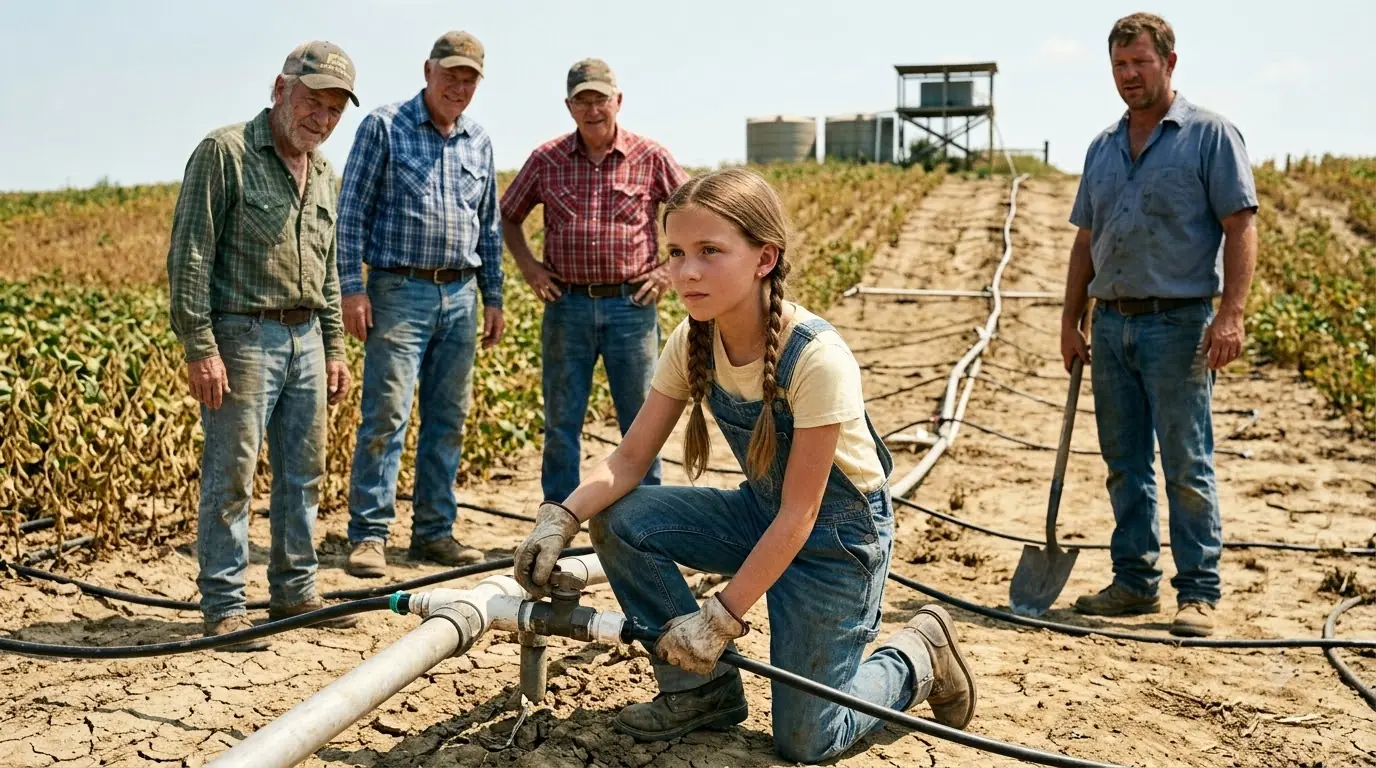
She was not looking for scrap metal to sell, and she was not building a fort.
She had one quiet purpose, but she was not telling anyone what it was.
Della knocked on farmhouse doors and asked politely if she could take the broken aluminum irrigation pipes lying beside barns, fences, and abandoned equipment sheds.
Farmer after farmer gave her the same answer.
“Sure, honey. Help yourself.”
Then they leaned against their porch railings and watched as the eleven-year-old wrestled long pieces of pipe into the wooden trailer her father had built for her bicycle.
Most of them chuckled.
It was not cruel laughter. It was the gentle, confused laughter that came from complete bafflement.
An eleven-year-old girl was collecting old irrigation pipes.
By the time August arrived, Della possessed more pipe than some working farms in the county. She had not explained herself to a single person.
Nobody knew what she was planning.
Not even her father.
But they were about to find out.
Calloway County sat in the western corner of Kentucky, where the land rolled gently toward the Tennessee River and summers often delivered more heat than anyone had requested.
It was the kind of place where families had farmed the same ground for four generations and were not embarrassed to say so.
Della was the middle of three children born to Harlan and June Pruitt, who worked approximately forty acres of river-bottom land.
Harlan grew corn and soybeans, along with tobacco during the years when the market price made it worthwhile. He was a methodical man, deliberate in speech and patient with nearly everything.
Drought was the exception.
Dry weather tested Harlan’s patience in a way nothing else could.
June maintained a kitchen garden of extraordinary ambition. She grew tomatoes, peppers, squash, and pole beans supported by hand-cut cedar stakes.
June had first placed seeds in Della’s hands when the girl was barely old enough to reach the soil without bending her knees.
Della’s grandmother, Opal, lived in a small bedroom off the back of the farmhouse.
At eighty-one, Opal spent most mornings at the kitchen table with a cup of black coffee and a stack of agricultural extension pamphlets she had collected since the 1960s.
She read them the way other people read novels.
Opal was the first person to notice that Della watched the fields differently from other children.
She did not simply look at the crops.
She watched the water.
Della noticed where rain pooled and where it ran away. She studied which areas of soil cracked first during dry weather and which remained dark longest after a storm.
The summer Calloway County entered its third consecutive year of below-average rainfall, Della began recognizing a problem the adults around her had learned to accept.
Her father’s soybeans were struggling in the upper fields, where the soil was sandier and water moved through it too quickly to provide lasting moisture.
The county extension agent, a steady-natured man named Clifton Barr, visited the farm twice to inspect the fields.
He offered the best advice he could.
“Irrigate more frequently,” he told Harlan. “You can also mulch around the plants to help the soil retain moisture.”
The recommendations were reasonable, but irrigating more often cost money and consumed diesel fuel.
The existing system also lacked enough pressure to push water efficiently toward the high ground. By the time the water traveled halfway across the field, the pressure had weakened considerably.
Della listened carefully to everything Clifton said.
She asked questions he was not accustomed to hearing from eleven-year-old children.
“If the pressure drops while the water is going uphill, what happens to the water that never reaches the top?”
Clifton paused before answering.
“It stops moving. Some of it remains inside the line.”
Della nodded slowly.
It was the way someone nodded after thinking about a problem for a long time and receiving the final piece needed to confirm an idea.
That conversation happened in May.
By June, Della was collecting pipes.
Della understood something most of the adults around her had never fully connected.
Water did not care about cost.
It cared about gravity.
The upper fields on the Pruitt farm stood approximately fourteen feet higher than the pond at the bottom of the property. The pond was a small, spring-fed basin that had never gone dry, even during the worst summers.
Fourteen feet of elevation separated the pond from the struggling fields.
Della had been reading Opal’s old extension pamphlets.
Through them, she learned about drip irrigation, a method that delivered water directly to plant roots through slow emitters rather than spraying it over the entire field.
A properly designed drip system could use significantly less water because little moisture was lost to evaporation, runoff, or unnecessary coverage of bare soil.
She also read about gravity-fed irrigation systems.
The designs were old, many dating from before electric pumps became common. Water stored at a higher elevation moved downhill through pipes, creating enough pressure to feed lower fields.
The pond on Harlan’s farm was below the damaged soybean field, so it could not provide gravity pressure for the upper rows.
However, another source existed.
Along the northern boundary of the property was a shallow seasonal draw where rainwater naturally collected after storms.
The water often remained there for days before soaking into the ground or evaporating.
That draw sat approximately nine feet above the problem field.
Nine feet of elevation, routed through the correct network of pipes, could produce enough pressure to irrigate a small section of soybeans without operating a single pump.
Della already had the pipes she needed to attempt it.
What she constructed that summer was not elegant.
It was a child’s version of an engineer’s design, assembled from mismatched PVC fittings, sections of aluminum lateral pipe her father had replaced three years earlier, and one roll of drip tape.
Della purchased the drip tape from the farm supply store in town using money she had earned by selling eggs.
She dug shallow trenches by hand.
Harlan watched from a distance during the first weekend.
He did not ask what she was building.
After observing for a while, he quietly retrieved a shovel and began helping her dig.
That was Harlan’s way.
Della’s older brother, Cass, believed the entire project was a waste of summer.
Her younger sister, Wren, thought it looked like a science experiment and stayed nearby, handing Della tools she did not always need.
The first attempt failed.
The connections near the collection basin were not tight enough. Water leaked from three separate joints before traveling ten yards down the slope.
Della shut the system down, removed each leaking connection, wrapped the fittings with plumber’s tape, and assembled them again.
Then she tried a second time.
The revised system produced enough pressure to reach the first row of soybeans, but barely.
Water emerged from the emitters in a thin, inconsistent trickle.
A few plants received moisture.
Most did not.
Della returned to Opal’s pamphlets.
She reread every section related to pressure, elevation, and water movement until she found a passage discussing pipe diameter and flow rate.
The width of the pipe affected not only the amount of water moving through the line but also how efficiently pressure equalized throughout the system.
Della realized the sections she had used for the main line were too narrow.
She needed a larger diameter near the collection point, followed by smaller sections where the main line divided into the drip lines.
For the next two weeks, Della negotiated with a retired farmer named Wendell Coe.
Wendell had a barn filled with old irrigation equipment from a commercial vegetable operation he had closed in 2009.
Della offered to trade several lengths of her smaller pipe for wider sections stored inside his barn.
Wendell agreed.
He did not ask her for additional money because, as he told her, he admired her stubbornness.
On the third attempt, the system worked.
By the middle of August, the soybeans inside the upper field were the healthiest plants on the entire farm.
Harlan noticed first.
He walked through the irrigated rows twice before speaking to anyone.
The soil beneath the plants was dark and moist. The soybean leaves were deep green, upright, and broad, displaying the posture of plants that were not under stress.
In the neighboring rows, where Della’s gravity-fed lines had not yet reached, the same variety of soybean appeared pale and had begun curling beneath the summer heat.
Harlan found his daughter near the top of the run.
She was lying flat against the dirt, adjusting an emitter that was not releasing water evenly.
He stood over her for a moment.
“How much water is this system using?” he finally asked.
Della sat up and gave him the number.
It was approximately forty percent of the amount Harlan’s conventional system used to irrigate an equivalent area.
He remained quiet for a long time.
Then he looked toward the other side of the farm.
“Do you want to extend it into the east field?”
Clifton Barr returned in September, this time in an official capacity.
He walked the entire system beside Della, asking questions and writing notes.
His posture was that of a man recalibrating what he believed he understood.
Clifton said he had never seen a gravity-fed drip network constructed from salvaged materials perform this well on a small family farm.
He asked whether he could bring an agricultural engineering student from Murray State University to examine the project the following spring.
Eventually, a reporter from the county newspaper visited too.
She wrote a feature about Della that appeared beneath the fold on the front page.
The headline described her as a young innovator.
Della found the word embarrassing.
By October, the story had traveled throughout Calloway County.
The farmers who had given Della their abandoned pipes, the same men who had chuckled from their porch railings, drove to the Pruitt farm to see the project for themselves.
They arrived expecting to be polite.
They were not prepared for what they found.
The upper field was a different color from nearly every other field in the county.
Neighboring rows had become thin and yellow after the long, dry summer.
Della’s soybeans were dense and deeply green.
Their canopy was so thick that it almost concealed the soil beneath them. The plants stood upright, heavy with pods, every leaf facing upward as though it had something to be proud of.
Several farmers walked between the rows without speaking.
One man selected a pod and split it open with his thumbnail.
He examined the beans inside for a long moment.
Then he looked toward the eleven-year-old girl standing at the edge of the field with dirt covering her boots.
“What did you do differently?” he asked.
Della showed them.
She explained the shallow draw, the difference in elevation, the wider main line, the smaller distribution lines, and the emitters running slowly beneath the plant canopy.
The system delivered moisture directly to the roots instead of losing it to evaporation or runoff.
It used the same rainwater those farmers had watched collect and disappear for years without considering it useful.
Della guided them through every junction and fitting.
She showed them every section of salvaged aluminum pipe that had once been destined for a scrap pile.
The laughter was gone.
In its place was something quieter.
It was something that took longer to arrive than laughter but lasted considerably longer.
Respect.
Several farmers asked whether Della would help them design similar systems before the following planting season.
She said she would.
The Japanese farmer and philosopher Masanobu Fukuoka once wrote that the ultimate goal of farming was not merely the cultivation of crops, but the cultivation and perfection of human beings.
Della Pruitt grew soybeans that summer.
They were exceptional soybeans, raised with less water on healthier soil, plants capable of enduring conditions that damaged fields managed by people with decades of experience.
But the soybeans were not the true harvest.
The harvest was harder to measure.
It was the patience of a child who watched water instead of focusing only on yields.
It was her willingness to ask for things other people considered worthless.
It was the discipline to fail twice, study the problem again, and rebuild without complaint.
Real agricultural knowledge did not always come from expensive equipment.
Often, it came from paying attention.
It came from understanding that something another person discarded might still contain value if someone was willing to discover its purpose.
Della was twelve years old the following summer.
She was already designing an expanded irrigation system for the east field.
Wendell Coe helped her calculate pipe sizes and flow rates.
Opal continued reading old agricultural pamphlets at the kitchen table with a cup of black coffee.
Harlan began saving sections of equipment he once would have thrown away, placing them in a corner of the barn where Della could inspect them.
Cass no longer called the project a waste of summer.
Wren still followed Della through the fields and handed her tools she did not always need.
Across Calloway County, pipes that had once rusted unnoticed at the edges of fields were carrying water again.
They were no longer growing weeds around scrap piles.
They were growing crops.