Emily Carter stood inside the Clatsop County assessor’s office holding a cashier’s check for exactly twelve dollars and seventeen cents. At twenty-four, she looked younger than most people who came there to purchase land, especially wearing a worn brown cowboy hat, faded jeans, muddy boots, and a canvas jacket over a dirt-stained white tank top. Across the counter, assessor Roger Peton studied her with the tired disbelief of a man watching someone voluntarily make a terrible decision. The nineteen-acre parcel she wanted was a flooded Oregon wetland with no road, no utilities, and no known agricultural value.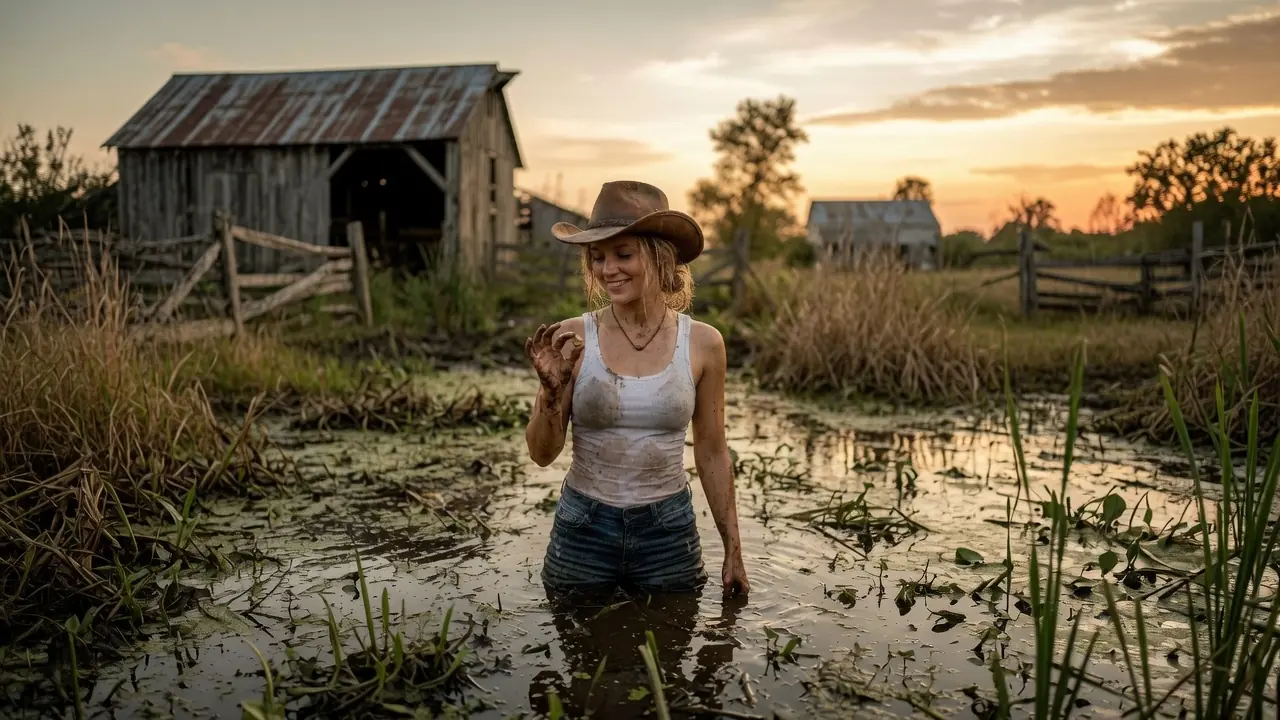
“You understand this is a swamp?” Roger asked.
“I’ve walked it.”
“It floods every spring.”
“I noticed.”
Roger tapped the parcel map with the chewed end of his pencil. “You can’t build a house there, run cattle there, or plant anything anyone would pay for.”
Emily placed the check on his desk. “Then twelve dollars sounds fair.”
The land had been tax delinquent for eight years. The county had offered it repeatedly, but no farmer, developer, or timber company wanted nineteen acres of black mud, cattails, mosquitoes, and seasonal water. Roger accepted the check, stamped the deed, and slid it across the desk without offering congratulations.
“It’s yours,” he said. “Try not to drown.”
Emily folded the deed carefully and placed it inside her jacket. When she walked outside, cold rain struck the brim of her cowboy hat and ran down the loose blonde strands around her face. She smiled anyway because Roger did not know the swamp was not the foolish purchase everyone assumed it was.
Four months earlier, Emily’s grandfather, Clayton Carter, had died after hiding the seriousness of his lung cancer until treatment could no longer help him. He left Emily an aging farmhouse, eight workable acres outside Vernonia, a barn with a failing roof, and seventy-three thousand dollars in debt. The mortgage was four payments behind, the well pump needed repairs, and the machinery looked as though it had survived several wars. Emily worked double shifts at the feed store, but the numbers still predicted foreclosure by summer.
She found Clayton’s notebook beneath a canvas tarp in the barn.
It was hidden inside a wooden box under a broken 1952 Farmall Cub. The leather cover had cracked with age, and the yellow pages smelled of oil, mildew, and tobacco. The earliest entry was dated April 9, 1968.
Bought the Nehalem tract today. Nineteen acres. Paid the back taxes. Nobody wanted it. Let them laugh.
Emily read the sentence twice.
She had never known her grandfather owned another property. The county had eventually reclaimed it after years of unpaid taxes, but his notebook showed he had spent decades studying the land before surrendering it. Page after page contained hand-drawn creek channels, gravel ridges, sediment notes, rainfall totals, and small marks labeled with dates.
One sentence appeared repeatedly in the margins.
Gold moves downstream. The trick is learning where it stops.
The next morning, Emily returned to the assessor’s office and requested the oldest available survey of the tract. Roger was absent, but a clerk brought her a brittle linen map created in 1891. In one corner, a surveyor had written that the original creek shifted after a major flood in 1889.
The abandoned channel ran directly through the parcel.
Emily placed a modern map beside the old survey. The current drainage ditch curved around the western edge, but the nineteenth-century channel crossed the center of the swamp before turning toward what had later become Clayton’s farm. If gold-bearing sediment had moved downstream before the diversion, heavier material might still be trapped in gravel bars beneath the mud.
That afternoon, she walked the property for the first time as a prospective buyer.
Water reached halfway up her boots in some areas. Cattails towered over her shoulders, rotting logs disappeared beneath duckweed, and every few steps released bubbles from black soil. She wore Clayton’s patched chest waders and carried his notebook inside a waterproof bag.
Three hundred yards from the county road, Emily found the first marked ridge.
It appeared as a shallow rise beneath reeds where two water paths once met. She dug with a short spade until the black mud changed into packed gravel mixed with smooth river stones. When she lifted one muddy handful toward the light, tiny yellow flecks flashed between her fingers.
She took a sample home in a mason jar.
The following day, Emily bought a plastic gold pan, a jeweler’s loupe, and several small vials from a hardware store. The clerk noticed her muddy clothes and asked whether she planned to try her luck at the state park. Emily told him she was testing soil from her own land.
He laughed. “Not much gold left around here.”
“We’ll see.”
She sat on the farmhouse steps with a five-gallon bucket of water and tried to imitate the panning technique she had studied. Her first attempt washed nearly everything over the edge. The second left too much clay, while the third ended with nothing she trusted.
On the fourth attempt, three tiny yellow specks remained at the bottom.
They did not float like mica or change color when she tilted the pan. They stayed low, bright, and heavy. Emily used a damp toothpick to move them into a vial.
By sunset, seven vials rested on the porch railing.
The amount was small, perhaps one-tenth of a gram, worth only a few dollars. But the sample had come from less than half a jar of soil. Emily owned nineteen acres filled with old channels Clayton had mapped for decades.
She returned to the county office the next morning and purchased the land.
News spread through Vernonia before she reached home.
The feed-store cashier asked whether Emily had bought “that mosquito pond.” A neighboring farmer offered to sell her an inflatable boat. Someone posted a photograph of her walking through the wetland in Clayton’s waders with the caption, LOCAL GIRL BUYS OREGON’S MOST EXPENSIVE MUD HOLE.
Roger Peton repeated the story at a diner.
According to him, the county had finally found someone naive enough to pay twelve dollars for land that should have been free. People laughed because Emily was young, in debt, and determined to farm after more experienced owners had already failed. She never corrected them.
Silence protected unfinished plans.
Emily purchased a used sluice box from a retired prospector named Ron Decker. He taught her how to classify gravel, set the water angle, capture fine gold, and clean the riffles without losing the smallest particles. He also warned her not to believe stories claiming every yellow speck would make her rich.
“Most gold is too fine to change anyone’s life,” Ron said.
Emily nodded. “I don’t need a miracle. I need enough to save the farm.”
For the next six weeks, she sampled the property systematically.
She divided the swamp into grids and recorded depth, soil color, gravel size, water flow, and recoverable gold from each bucket. Some areas produced nothing. Others held only a few bright grains, but three narrow bands yielded consistent color.
Those bands followed Clayton’s old creek maps.
The richest section curved through the northern half of the tract where a buried gravel channel lay beneath two feet of black mud. Emily worked slowly because the ground could swallow a boot or twist a knee without warning. She tested every step with a long pole and never entered the deepest area alone.
By early summer, she had recovered forty-two grams of gold.
At the current price, it was worth several thousand dollars—enough to make a mortgage payment and repair the well pump but not enough to eliminate the debt. Emily kept the gold in a sealed jar beneath the kitchen sink while she continued studying Clayton’s notebook.
Then she found an entry dated April 3, 1971.
Back channel paid fourteen ounces this month. Buried most near the split oak. The county does not need to know everything.
Fourteen ounces was not a handful of dust.
At modern prices, it represented tens of thousands of dollars. Clayton had known the swamp contained more than scattered traces. He had worked it quietly, probably during the wettest months when water flowed through the old channels.
Emily searched for the split oak.
The original tree had fallen years earlier, but its enormous stump remained near the eastern boundary. She used a metal detector around the roots until a strong signal sounded beneath three feet of wet clay.
The buried object was a rusted coffee can sealed with tar.
She carried it home before opening it.
Inside were twelve small leather pouches tied with waxed string. The first held forty-one grams of nuggets. The second held thirty-eight, and the third contained several pieces larger than anything Emily had recovered herself.
She stopped counting after the fifth pouch because her hands had begun shaking.
The full can contained nearly half a kilogram of gold.
Emily sat at the kitchen table until darkness covered the windows. Clayton had buried more than thirty thousand dollars beneath a dead tree and never mentioned it to anyone. The discovery could pay months of overdue bills, but the notebook suggested this was only one cache.
Its final entry gave her another clue.
Buried the last spring can near the old culvert. If she comes back, she’ll understand why.
Emily had no doubt Clayton meant her.
She spent the next several days cross-referencing his notes with topographic maps. Clayton used landmarks rather than coordinates: old fence lines, blackberry thickets, creek bends, stumps, stone piles, and structures that no longer existed. Emily marked seventeen possible cache locations, then narrowed them to nine.
The old culvert produced the second container.
It held rolls of quarters and a folded note.
If you found two, there are seven more. Do not stop now.
Emily laughed aloud for the first time in weeks.
Clayton had transformed the swamp into a treasure map that only someone patient enough to understand the land could follow. Each cache represented years of small recoveries, carefully hidden rather than deposited in banks that might question where the money came from.
The third container rested beneath an oak stump.
Inside were silver dollars, dimes, and another pouch of placer gold. The fourth was hidden beneath a removable floorboard in the old chicken coop. The fifth rested inside the stone foundation of the barn, while another tobacco tin was tucked into the rafters of an equipment shed.
Every location revealed Clayton’s logic.
He hid value in places connected to work: beneath the step he crossed each morning, behind the nesting boxes he cleaned, beside the gate he repaired, near the creek he studied. A stranger searching randomly might never find them.
By late June, Emily had recovered enough gold, silver, and cash to prevent foreclosure.
She sold only what was necessary, working through an established precious-metals dealer and reporting the income properly. After paying taxes, she brought the mortgage current, repaired the barn roof, and replaced several broken irrigation lines.
The farm finally had room to breathe.
Emily did not stop searching.
One structure remained unopened: a stone root cellar partially buried behind the farmhouse. Its wooden door had settled into the earth, and a rusted padlock filled the latch. Penetrating oil, bolt cutters, and careful prying accomplished nothing.
A week later, Emily visited the farm-supply store for fencing staples.
An older employee studied her name on the account and asked whether she was Clayton Carter’s granddaughter. When she confirmed it, he reached beneath the counter and produced a small brass key tied to baling twine.
“Your grandfather left this here in 1981,” the man said. “Told me to give it to the first Carter who came asking how to open an old lock.”
Emily drove home without stopping anywhere else.
The brass key entered the root-cellar padlock smoothly. One turn released a clean click, and the heavy door opened against years of packed soil. Stone steps descended into cool darkness.
Along the back wall stood seventeen mason jars.
Several were filled with Morgan and Peace silver dollars. Others contained rolled bills protected by wax paper, small gold nuggets, and old coins worth far more to collectors than their face value.
Emily sat on the bottom step and stared.
Clayton could have spent the money. He could have repaired the barn earlier, retired from farm work, or lived comfortably during his final years. Instead, he preserved nearly all of it.
Inside one jar was a folded piece of paper.
For Emily, when she is ready to stay.
Tears came before she finished reading.
Clayton had understood that leaving money directly might only postpone failure. The debts, land, and work could overwhelm someone who had not yet decided the farm mattered. Instead, he left clues designed to reward patience, observation, and commitment.
Emily had to choose the land before the land revealed its value.
The secret did not remain hidden forever.
A county employee noticed the deed transfer followed by several precious-metal transactions reported under Emily’s name. Roger Peton drove to the swamp one afternoon and found her knee-deep in mud beside the exposed gravel channel.
Emily wore the same worn brown cowboy hat, a dirt-streaked white tank top, and faded jeans beneath her waders. Her loose blonde hair clung to her neck, and black mud covered her hands up to the wrists.
In her palm rested a newly recovered nugget.
Roger’s eyes fixed on it.
“That swamp was county waste,” he said. “Anything valuable beneath it belongs to us.”
Emily closed her fingers around the gold. “Your office sold me the parcel and transferred all rights listed in the deed.”
Roger pulled a folded notice from his jacket and slapped it against her chest. “Hand over what you found, or I’ll void that twelve-dollar sale before sunset.”
Emily unfolded the document.
It was not a court order. It was an internal seizure recommendation written by Roger himself, alleging that she had concealed mineral value during the tax sale.
“You told me the land was worthless,” Emily said.
“Because you withheld information.”
“I asked for the historical surveys in your own office.”
“You knew there was gold.”
“I suspected there might be.”
Roger stepped closer. “That deed can disappear as quickly as it appeared.”
Emily held up Clayton’s notebook. “Then follow me to the creek bed and explain the forty-three dated entries your county ignored for fifty years.”
Roger reached for the book.
Emily pulled it away.
“You already tried to take the swamp back once,” she said. “You’re not getting it twice.”
The legal fight began the following week.
Roger convinced the county board to challenge the sale, claiming Emily had committed fraud by purchasing the parcel below market value while possessing special knowledge about possible minerals. Her attorney, Melissa Grant, responded with the tax-auction records.
The county had advertised the land repeatedly.
No minimum mineral valuation appeared in the documents. The deed transferred the property as-is, including subsurface rights, and county records already contained the 1891 survey identifying the abandoned creek channel.
Emily had hidden nothing the county had not possessed for more than a century.
At the hearing, Roger portrayed her as a manipulative young prospector who exploited public ignorance. Melissa placed the twelve-dollar cashier’s check, deed, auction notices, survey request, and assessor’s own signed transfer on the evidence table.
Then she asked Roger a simple question.
“Did you warn Ms. Carter that mineral rights were excluded?”
“No.”
“Did the deed exclude them?”
“No.”
“Did anyone else bid on the property?”
“No.”
“Did you personally describe the parcel as worthless?”
Roger hesitated. “I may have used that word.”
Melissa turned toward the judge. “The county regrets the sale only because Ms. Carter worked harder than it did.”
Clayton’s notebook became the strongest evidence.
It proved the deposits were not a sudden discovery Emily fabricated after the purchase. Her grandfather had documented the channels beginning decades earlier, while county maps independently confirmed the same terrain.
A geological consultant testified that Emily’s gold was placer material carried by historic water flow.
The county had owned the land after Clayton’s tax default but never investigated its history. It chose to sell rather than study it. The judge ruled that poor government research did not invalidate a lawful deed.
The sale remained valid.
Roger’s seizure notice had no legal authority.
The county board removed him from the case and opened an ethics review after learning he had contacted private mining companies before the hearing. His emails showed he hoped to reclaim the parcel and negotiate a commercial lease.
Emily had not been the one trying to exploit the land.
Roger had.
Once ownership was secure, Emily avoided turning the swamp into an industrial mine. Heavy equipment would destroy the channels, wetlands, and water movement that preserved the placer deposits. She worked small sections seasonally, restored disturbed areas, and hired an environmental consultant to design a low-impact recovery plan.
Gold saved the farm, but it did not replace farming.
Emily paid off Clayton’s remaining debt, repaired the house, rebuilt fences, and purchased six bred heifers from a nearby dairy operation. She planted cover crops, restored the old orchard, and converted part of the barn into a workshop.
The swamp became a protected private wetland.
She extracted only limited amounts each year and kept the location secret from tourists, trespassers, and amateur prospectors. Motion cameras and stronger gates appeared after two strangers entered with metal detectors.
Ron Decker helped her improve the sluice system.
He never asked for the exact recovery numbers. When Emily finally showed him one of Clayton’s maps, he smiled.
“Your grandfather understood rivers.”
“He understood waiting.”
“That’s harder.”
Years later, people in Vernonia stopped calling the parcel worthless.
Some claimed they had always suspected there was value beneath it. Others insisted Emily had simply been lucky, though none of them had purchased the land during the eight years it sat available.
Emily never argued.
Every spring, she returned to the old channel in Clayton’s patched waders. Her brown cowboy hat had softened from rain, and sunlight had lightened her blonde hair. She tested the gravel, recorded water levels, and recovered only what the land could surrender without being damaged.
The original twelve-dollar deed remained framed inside the farmhouse.
Beside it hung Roger Peton’s handwritten note from the day of the sale:
Seasonal swamp. No practical value.
Below both documents sat a single gold nugget resting inside a glass case.
Emily could have displayed the largest one she found. She chose the first, a small muddy piece pulled from the channel on the afternoon Roger tried to reclaim the land.
Visitors often asked how much the swamp eventually produced.
Emily never answered with a number.
She told them it produced enough to save the farm, preserve Clayton’s legacy, and teach her that value rarely announces itself before someone is willing to get dirty looking for it.
The county saw flooded weeds.
Roger saw a parcel worth less than lunch.
Everyone else saw a young woman making another desperate mistake beneath a worn cowboy hat.
Clayton had seen old water carrying gold.
And Emily was the only person willing to step into the mud and find where it stopped.