At six o’clock on a dry Nebraska morning, Mr. Henderson stepped onto his porch with a cup of coffee and discovered eight-year-old Maisie Callaway halfway inside his trash barrel. Her long golden-blonde hair hung in two braids over a faded red-and-cream plaid shirt, and the knees of her denim overalls were already dusty from walking across neighboring farms before breakfast. When Maisie finally stood, she was holding a cracked green garden hose that Henderson had thrown away the previous evening. He stared at the hose, then at the little girl, and laughed.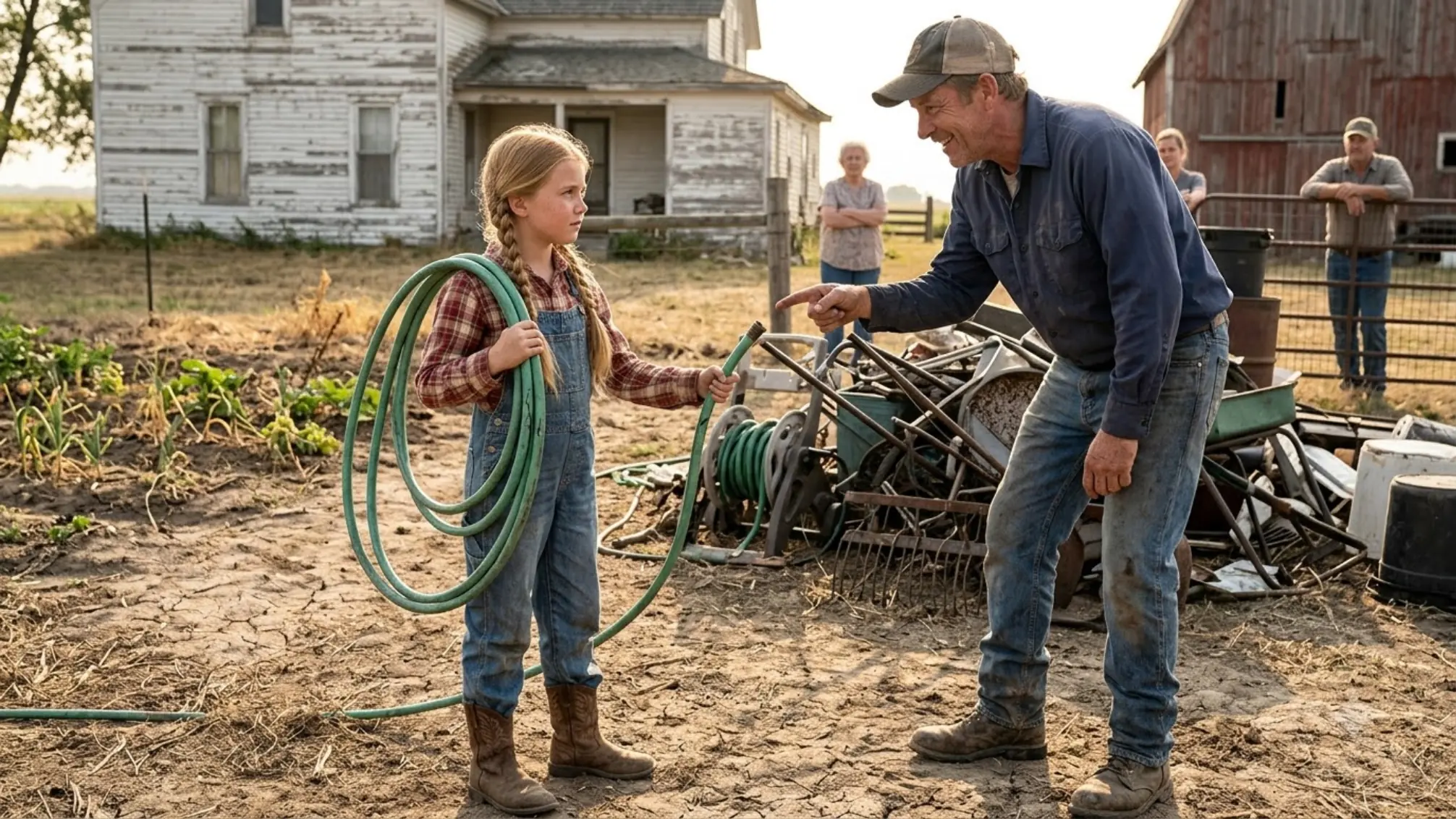
“That thing is split to pieces—drop my garbage before you make an even bigger fool of yourself.” Maisie wrapped the hose over one shoulder and met his eyes without flinching. “You threw it away. Now stop telling me what I can do with it.” Henderson stepped off the porch and pointed toward the long tear down the rubber. “That junk won’t save a single plant, little girl.”
Maisie tightened her grip. “Then come back at harvest and say it to my face.” For half a second, Henderson did not know what to say. Then he laughed louder, assuming the challenge was nothing more than a child’s stubbornness. Maisie turned away and walked down the dirt road with the useless hose bouncing against her back.
By the end of that week, eleven broken hoses lay behind the Callaway barn. Some were green, some black, and one had faded so badly in the sun that nobody remembered its original color. One had been run over by a tractor, another had split during winter, and several leaked from so many places that their owners considered them worthless. Maisie collected every one she could find.
Nobody understood why. She never carried glue, never asked for repair tape, and never hauled the hoses to the recycling depot ten minutes away. She did not turn them into decorations or toys, and she refused to explain herself whenever somebody asked. The more mysterious her project became, the more entertaining it seemed to everyone else.
Her sixteen-year-old brother Tucker cornered her near the chicken coop one afternoon. He was carrying a bucket of feed when he saw Maisie dragging another hose across the yard. “Everyone thinks you’ve lost your mind,” he told her. Maisie continued coiling the rubber without looking at him.
“Mrs. Pruitt says you’re becoming a strange little collector.” Tucker waited for a reaction. Maisie shrugged and answered, “Mrs. Pruitt talks more than her chickens.” Tucker laughed despite himself, but Maisie was already walking toward the barn.
By Sunday morning, the entire community seemed to know about the hoses. Three women whispered beside the coffee table after church, trying unsuccessfully to hide their amusement whenever Maisie passed. One mentioned the damaged hose Old Man Webber had thrown away after a tractor ran over it. Another wondered aloud what a child could possibly do with piles of cracked rubber.
Maisie heard every word. She had grown accustomed to adults speaking as if children became deaf whenever grown-ups lowered their voices. She did not defend herself because she did not yet know whether her idea would work. Talking would not make the experiment successful.
The Callaway farm sat on sixty acres of red Nebraska soil that summer, and nearly every acre was suffering. Rain had not fallen properly in almost a month, leaving the ground cracked into hard geometric pieces that crumbled beneath boots. By midmorning, tomato leaves curled inward against the heat, beans drooped, and squash vines looked exhausted before the day had even reached its hottest hours. The farm seemed to be conserving strength just like the people who depended on it.
Maisie’s father, Daniel Callaway, had inherited the property from his own father. He was not a man who panicked loudly when things went wrong; he simply became quieter. That summer he had become so quiet that his wife Renata could tell how bad the numbers were before he ever showed her the notebook. One night Daniel finally placed his pencil down on the kitchen table.
“If we lose the tomatoes, we lose the co-op contract,” he said. “Three years building that account, and one dry summer can erase it.” Renata looked over the household expenses again, searching for money that was not there. She mentioned that the Fletcher farm had installed commercial soaker hoses and reportedly reduced water use considerably.
Daniel rubbed both hands over his face. “Those systems cost money we don’t have.” He looked toward the dark window beyond which the fields disappeared into the night. “And by the time we get enough equipment delivered, half the vegetables could already be finished.” Across the table, Grandpa Earl continued eating slowly without joining the argument.
The old farmer had survived droughts before. He had watched markets collapse, machinery fail, and weather destroy plans people had spent entire seasons building. Rather than offer easy encouragement, he listened. His pale blue eyes occasionally moved toward the window facing the barn.
He had noticed Maisie working.
A month earlier, before the first broken hose ever appeared behind the barn, Maisie had been carrying water toward the chickens when something caught her attention near an old oak tree. A tiny crack in an aging irrigation line had allowed water to escape slowly onto the ground. The leak was no wider than a pencil, yet the patch of grass around it looked entirely different from the surrounding yard. It was thick, deep green, and soft beneath her fingers while almost everything else had faded toward yellow.
Maisie crouched beside the leak for several minutes. Water came out one drop at a time, disappearing directly into the earth rather than spraying through the air. Nearby sprinklers threw water in broad arcs that glittered beautifully in the sunlight, but much of that water seemed to vanish before reaching the roots. Some ran over the hard surface and collected where plants did not need it.
The little leak behaved differently.
Maisie began watching water everywhere. She noticed how quickly water poured from flower boxes when Renata watered too fast and how dry the soil became again soon afterward. She noticed morning dew gathering along spider webs and sliding toward leaves in patient drops instead of arriving in one dramatic flood. Eventually she asked Grandpa Earl a question over breakfast.
“Why does the grass beside the broken pipe look healthier than the grass beside the sprinkler?” Earl stopped with his coffee halfway to his mouth. He looked through the window at the patch she meant. “Because the sprinkler waters a lot of air along with the ground,” he said. “That little leak keeps feeding the roots.”
The sentence lodged itself in Maisie’s mind. She visited the small town library and borrowed gardening books old enough that their checkout cards contained dates from before she was born. Some pages used words she did not understand, but the diagrams made sense. They showed narrow lines delivering small amounts of water close to individual plants.
One picture showed drip irrigation.
Commercial systems used proper tubing, emitters, pressure regulators, connectors, filters, and carefully calculated spacing. Maisie did not have any of those things. What she did have was a farm surrounded by neighbors who threw away cracked garden hoses. The holes everyone considered defects suddenly looked useful.
That was when she started collecting them.
She was not trying to repair the hoses. That assumption was why everyone misunderstood her. A perfect garden hose carried water from one end to the other without losing anything. Maisie wanted something almost opposite: she wanted water to escape slowly from dozens of controlled places.
Behind the barn, she laid the hoses in long lines across the dirt. She examined every existing split, puncture, and worn section. Some holes were too large and would waste water immediately. Others were tiny enough that they might release exactly the slow dripping she wanted.
Maisie borrowed a sewing needle from Renata’s basket. Heating the tip carefully with Grandpa Earl nearby, she used it to create several additional small openings at measured intervals. She marked the spacing with chalk. She had no scientific instrument for calculating flow, so she used jars, time, observation, and stubborn patience.
The connectors caused the first major problem. The discarded hoses were different widths and ages, and several ends had been cut unevenly. Maisie wrapped joints with old inner-tube rubber, tape, wire, and pieces of fittings Earl had collected inside a toolbox over decades. The entire assembly looked less like irrigation equipment than something dragged out of a junk pile after a storm.
That description would soon become painfully accurate.
After three days of work, Maisie ran the first experimental line along a section of struggling tomato plants. She covered parts of it with grass clippings and dry mulch because one of her library books explained that covered soil retained moisture better. Her heart pounded when she attached the hose to the outdoor spigot. She slowly turned the handle.
For one beautiful second, nothing went wrong.
Then a connector exploded apart.
Water sprayed sideways into Maisie’s face while another joint separated farther down the row. Two hose sections twisted across the dirt like startled snakes, soaking one group of tomato plants while leaving the rest completely untouched. Within seconds Maisie was sitting in mud with wet hair, muddy overalls, and a broken system around her.
Tucker happened to walk past carrying chicken feed. He stopped and stared. “Well,” he said, “that’s one way to take a shower.” Normally Maisie would have thrown something at him.
She did not.
She looked at the hoses and felt something heavy settle inside her chest. The neighbors had laughed because they believed broken hoses were garbage. For the first time, she wondered whether they had been right.
At dinner that evening, mud remained behind her ears despite washing. Daniel noticed how little she ate, and Renata noticed how carefully she avoided looking toward the window. Even Tucker, who normally considered teasing his younger sister a responsibility, kept quiet. Grandpa Earl finally set down his fork.
“First irrigation system I ever made failed worse than whatever happened behind that barn today,” he said. Maisie looked up. Earl continued cutting his food as though telling a completely ordinary story. “Flooded half my father’s east field.”
“Really?” Maisie asked.
“He didn’t speak to me properly for a week.” Earl finally looked at her. “Second attempt worked well enough to save some corn. Third one worked better.”
Maisie stared at him.
Earl pointed his fork gently toward her. “Whatever you’re building, you don’t quit because the first version fails.” He paused. “You quit when you stop learning why it failed.”
Nobody asked Maisie to explain her project.
That mattered.
The next morning she returned behind the barn.
The second version was stronger. Maisie wrapped weak joints more tightly, supported hose connections with wire, and tested water pressure in short sections before connecting the entire system. When she opened the spigot, water finally traveled along most of the row without anything flying apart.
But three connectors leaked badly.
Water collected around the joints instead of reaching the far plants. Maisie crouched beside one leak for nearly an hour, touching the connection and trying to understand why pressure forced water through the gaps. By sunset she knew tape and wire alone would never solve the problem.
That evening she returned to the library books. One diagram showed two pieces of flexible tubing joined around a short rigid sleeve and held with clamps. Maisie stared at the illustration until the answer became obvious. The connection needed support from inside.
Grandpa Earl’s toolbox contained six old hose clamps and several short pieces of rigid pipe. He watched Maisie searching through the drawers but did not hand her anything until she asked. “Can I use these?” she said.
“What for?”
“A mistake.”
Earl smiled.
“Best reason I’ve heard all week.”
The third attempt took another four days. Maisie pushed short rigid sleeves inside the hose ends, tightened them with the rusted clamps, and rearranged the lines so sections with excessive damage stayed closer to the water source. She tested each connection separately. Only when every section survived did she reconnect the entire system.
Then she opened the spigot.
Water traveled through the hose.
Nothing burst.
Nothing jumped.
Nothing sprayed across the yard.
For several seconds Maisie thought perhaps no water was escaping at all. Then she knelt beside the tomato row. Small dark circles slowly appeared in the soil beneath the mulch.
Drop.
Another drop.
Then another.
The sound was almost nothing.
Maisie smiled so widely that her cheeks hurt.
She did not call the family immediately. She wanted proof beyond one successful morning. For two weeks she monitored the test row every day, changing pressure, cleaning blocked holes, adding mulch, and comparing the soil with nearby plants receiving ordinary watering.
The difference became impossible to ignore.
Soil surrounding Maisie’s drip line remained dark and cool several inches below the surface. Three feet away, uncovered dirt became pale and hard by afternoon. Tomato leaves along the experimental row slowly changed from tired yellow-green to deeper healthy color.
Stems thickened.
Flowers held.
Small fruit began growing.
Daniel noticed first.
One evening he walked down the rows after work and stopped so suddenly Renata nearly walked into him. He crouched beside a tomato plant, pressed his palm beneath the mulch, and found damp soil. Then he checked another.
And another.
“Renata.”
She heard something in his voice and hurried over.
“Look.”
They stood over Maisie’s patched line. Green hose disappeared beneath straw and reappeared between plants, joined by ugly pieces of clamps, pipe, rubber, and tape. It was not attractive.
It was working.
Renata called Maisie.
The little girl emerged from behind the barn holding another damaged hose. She stopped when she saw her parents standing in the tomato patch. Daniel lifted part of the line.
“You built this?”
Maisie nodded cautiously.
“With those broken hoses?”
“Yes.”
Daniel looked toward the thriving plants.
“How much water?”
“I don't know exactly.”
“Then tomorrow we measure.”
Maisie smiled.
That was the moment the experiment became a family project.
Daniel helped install barrels so they could measure water use more accurately. Renata kept notes on plant conditions, while Earl showed Maisie how to improve connections without doing the work for her. Tucker carried hoses, complained constantly, and secretly told every boy his age that his little sister might have invented something brilliant.
They compared water consumption against a conventionally watered section.
The homemade system used dramatically less water.
It also kept the root zone moist longer because mulch reduced evaporation.
Daniel never pretended the numbers were perfect. Pressure varied between hose sections, some holes clogged, and old rubber sometimes developed new cracks. Yet all those problems could be repaired using materials the family already possessed.
Most importantly, the crops responded.
Word reached Mr. Henderson.
He arrived one afternoon with his hands in his pockets and stood beside the fence studying the tomato rows. The little girl he had laughed at was moving along the lines checking moisture with her fingers. Henderson cleared his throat.
“That green section mine?”
Maisie looked toward the hose.
“Part of it.”
He walked closer.
“You actually used the split?”
“Yes.”
“I thought you'd patch it.”
“I needed the holes.”
Henderson stared at her.
For once, he had no joke ready.
Other neighbors began visiting. Mrs. Pruitt came pretending she was only bringing Renata a jar of preserves, then spent twenty minutes looking toward the garden. Old Man Webber walked an entire row and recognized his tractor-damaged hose among the lines.
Some people remained skeptical.
One green section could be luck.
A few healthy tomato plants did not prove much.
Harvest would decide.
The drought continued.
Week after week, the sun burned down across Nebraska fields while farmers bought expensive feed, reduced water use, and watched yields fall. The Callaway family extended Maisie’s lines across more vegetables using additional discarded hoses.
Not every line worked immediately.
One failed completely after a new crack opened.
Another delivered too much water near the beginning and almost nothing near the end.
Maisie rebuilt both.
The repeated failure stopped embarrassing her.
Each problem became information.
When pressure fell too quickly, she shortened the line.
When holes clogged, she learned to flush sections.
When exposed hoses heated badly in the sun, she covered them more thoroughly with mulch.
Her system became less like a child’s experiment every week.
Grandpa Earl sometimes sat beside the barn and watched.
He rarely corrected her directly.
Instead he asked questions.
“What happens if that connector moves?”
“What happens if the first plant gets twice as much water as the last?”
“What happens when dirt gets inside?”
Maisie hated some of his questions.
Usually because they revealed problems she had not considered.
But she always went looking for answers.
By late summer, the difference between Callaway crops and many neighboring fields had become undeniable. Tomato vines remained productive. Beans held better than expected. Squash and peppers survived conditions that had destroyed weaker plants nearby.
Daniel checked the co-op contract again.
For the first time in weeks, he stopped looking defeated.
“We might actually fill it.”
Renata corrected him.
“We're going to fill it.”
Harvest morning brought more people than the Callaways expected.
Trucks parked beside the road. Farmers leaned against fence posts. Women from church arrived carrying notebooks instead of gossip.
Mr. Henderson stood near the front.
Maisie noticed him immediately.
She remembered his challenge.
More accurately, she remembered hers.
Come back at harvest and say it to my face.
Daniel backed his truck toward the first rows. Tucker carried empty crates while Maisie started picking.
The first crate filled.
Then the second.
Then another.
Deep-red tomatoes rested heavily against one another. Beans came off plants thicker than anyone expected for such a dry season. Peppers were firm and bright, and squash vines that should have collapsed weeks earlier still produced.
The watching crowd gradually stopped talking.
By midday, the truck bed was full.
Daniel stood beside it looking almost stunned.
He counted the crates twice.
Then he opened the co-op sheet.
They had enough.
More than enough.
After one of the worst summers in recent memory, the Callaway family had met the contract that Daniel thought drought would destroy.
Mr. Henderson slowly walked toward the garden. He crouched beside a green hose emerging from beneath the mulch.
A long split ran through one side.
His split.
He touched it.
“I threw this out because it was useless.”
Maisie stood several feet away with mud under her fingernails.
“You didn't need it anymore.”
Henderson looked toward the crates.
“I don’t understand how something broken does all this.”
Mrs. Pruitt stood beside him.
“How?”
Everyone looked toward Maisie.
For months they had laughed because she refused to explain.
Now she did.
“A sprinkler throws water everywhere,” she said. “Some hits the plants, some hits air, some runs away.”
She lifted part of the hose.
“This puts a little water beside the roots.”
Henderson pointed toward the holes.
“You made those?”
“Some.”
“And the others?”
“They were already broken.”
A few people laughed softly.
Not at Maisie.
With her.
Old Man Webber shook his head.
“So you didn't fix the hoses.”
Maisie smiled.
“No.”
“You figured out how to use what was wrong with them.”
“Yes.”
Nobody laughed after that.
Within days, neighbors returned carrying their own discarded hoses. Henderson brought three. Mrs. Pruitt arrived with two and apologized for calling Maisie strange.
Maisie shrugged.
“I am strange.”
Mrs. Pruitt laughed.
“Maybe we need more strange people.”
Old Man Webber asked Maisie to help him build a line for his beans. She agreed on one condition.
“You do the work too.”
The elderly farmer pretended to be offended.
“You're bossy for eight.”
“You asked me.”
He smiled.
“Yes, ma’am.”
Saturday became an informal workshop behind the Callaway barn. Farmers brought damaged hoses, fittings, old clamps, tubing, buckets, and notebooks. Daniel helped calculate sections while Renata showed people how mulch improved moisture retention.
Maisie demonstrated how she tested holes.
She warned everyone that the homemade system was imperfect.
Old rubber could fail.
Connections needed inspection.
Water still had to be managed carefully.
The goal was not magic.
The goal was waste reduction.
Several farmers adapted the idea differently. Some used Maisie’s approach only on vegetable gardens. Others purchased proper connectors while reusing hose sections.
The Callaways eventually replaced parts of Maisie’s original system with better equipment after finances improved.
Maisie did not mind.
Her goal had never been proving broken hoses were superior to proper irrigation.
Her goal had been saving water with what they had.
The co-op contract survived.
That mattered most to Daniel.
When the payment arrived, he placed the check on the kitchen table.
Maisie looked at it.
“Is that good?”
Daniel laughed.
“Yes.”
“How good?”
“Good enough that your mother might stop staring at bills after midnight.”
Renata gave him a look.
Maisie smiled.
Then Daniel placed another envelope beside the check.
“What is that?”
“Your share.”
Maisie stared.
“I don't need money.”
“You worked.”
“But this is our farm.”
Daniel nodded.
“And work still counts.”
Inside was enough money to buy several brand-new irrigation lines.
Maisie thought for a while.
Then she asked, “Can I use some for books?”
Tucker nearly fell out of his chair laughing.
“You save the farm and buy books?”
Maisie frowned.
“I like books.”
Grandpa Earl nodded approvingly.
“Good investment.”
She bought several agricultural guides, a proper notebook, measuring tools, and a small water-pressure gauge she barely understood at first.
The remaining money stayed in savings.
By the following summer, Maisie’s project had become part of everyday farm life.
Nobody called the broken hoses garbage anymore.
That bothered Maisie slightly.
They had been garbage.
That was what made the lesson important.
If everyone had known they were valuable from the beginning, nothing interesting would have happened.
One evening she sat beside Grandpa Earl on a fence rail overlooking rows of green plants. The sky had finally brought rain that year, turning distant fields softer and fuller than the summer before.
Earl looked toward the irrigation lines.
“You know what saved the farm?”
Maisie pointed.
“The hoses.”
“No.”
She looked at him.
“The water?”
“Nope.”
Maisie frowned.
“What, then?”
Earl smiled.
“You noticed something.”
She waited.
“That little patch of green grass by the leaking pipe. Hundreds of people would've walked past it.”
Maisie looked toward the old oak.
Earl continued.
“You asked why.”
He tapped the fence rail.
“That question mattered more than every hose.”
Maisie thought about it.
“So asking questions saves farms?”
“Sometimes.”
“What else?”
“Trying.”
She nodded.
“And when it failed?”
“Trying again.”
Maisie smiled.
Earl looked toward her.
“That's the part people usually leave out when they tell stories later.”
“What part?”
“The mud.”
Maisie laughed.
“You'll hear people say you collected broken hoses and saved the vegetables. Sounds easy.”
“It wasn’t.”
“I know.”
He smiled.
“You know. That's enough.”
Years later, people around the county still remembered the drought summer when eight-year-old Maisie Callaway walked from farm to farm collecting broken garden hoses.
Some stories exaggerated what happened.
People claimed the system saved every crop on the farm.
It did not.
Some fields still suffered.
Others claimed Maisie invented drip irrigation.
She absolutely had not.
What she invented was a solution for her own family using materials everybody around her considered worthless.
That was enough.
The Callaway farm kept the original first section behind the barn long after it stopped carrying water.
The rubber dried further.
Tape peeled away.
Metal clamps rusted.
Tucker once suggested throwing it out.
Maisie stared at him.
He raised both hands.
“Bad joke.”
She smiled.
Years later, when visitors asked why an old broken green hose hung from a nail inside the barn, Daniel always told them to ask Maisie.
Her answer never changed.
“It reminds me that broken isn't always useless.”
Then she usually added something else.
“And if the first version sprays you in the face, build another one.”
Grandpa Earl liked that part best.
Mr. Henderson eventually installed proper drip irrigation across much of his vegetable plot. One morning he saw Maisie riding her bicycle past his house and waved her down.
“Hey, collector.”
She stopped.
He pointed toward his neat irrigation lines.
“Look.”
Maisie inspected them.
“Nice.”
“No leaks.”
“That seems boring.”
Henderson laughed.
He looked toward the old trash barrel where their argument had started.
“You remember that morning?”
“Yes.”
“I was pretty rude.”
“Yes.”
He stared at her.
“You don't make apologizing easy.”
“You're doing okay.”
Henderson smiled.
“I’m sorry.”
Maisie nodded.
“Okay.”
“That’s it?”
“What else?”
“I don't know.”
She started pedaling away.
Henderson called after her.
“You were right!”
Maisie turned her bicycle around just enough to look back.
“About what?”
“The hose.”
She smiled.
“No.”
Henderson frowned.
“The hose was still broken.”
She continued riding.
“What changed was what we used it for.”
That afternoon, the Nebraska wind moved across the Callaway fields while water traveled quietly through narrow irrigation lines beneath the mulch.
No dramatic spray rose into the air.
No wasteful arc glittered above the plants.
Just small drops disappearing into dark soil close to the roots.
Exactly where they were needed.
And behind the barn hung the cracked green hose everyone had once laughed at, a reminder that sometimes the difference between trash and possibility is simply one person willing to look twice.