The summer everyone else cleared rocks from their fields, one poor boy spent every afternoon carrying them back.
Neighbors stopped their trucks along the dirt road just to watch him do it.
He was a thin boy of about fourteen, hauling stones in a rusted wheelbarrow and stacking them in careful rows across ground that had nothing left to give. 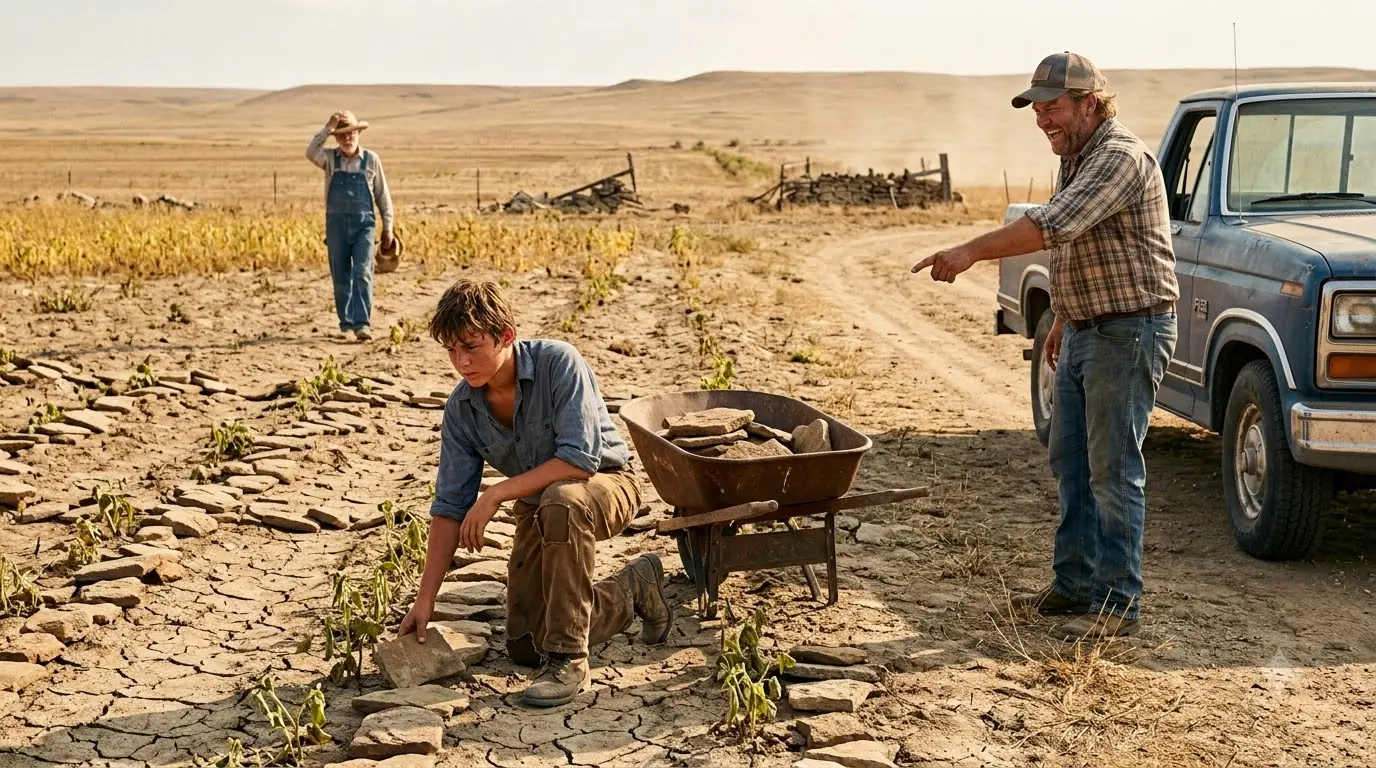
They shook their heads, laughed, and sometimes offered to help him correct what they assumed was a mistake.
He never answered them. He just kept walking, one stone at a time, toward a field that had not produced a decent harvest in three years.
Why was he doing it? Why did the whole town find it so funny, and what exactly did he think he was building?
Nobody knew. Not yet, not even his own father.
The town was called Millbrook Hollow, a place so small it did not appear on most maps, tucked between dry hills and a river that ran thinner every year. The soil had once been rich, dark, and soft, the kind farmers bragged about at the feed store.
The boy's name was Eli Barnett. His family's farm sat at the edge of town, four acres that had belonged to his grandfather and his grandfather before him.
His father, Thomas, worked from before sunrise until the light gave out, but no amount of work seemed to matter anymore. The corn came up thin and yellow, and the beans withered before they climbed the poles.
Some nights, Eli heard his parents talking quietly in the kitchen about numbers that did not add up, a bank that kept sending letters, and the possibility that they might have to sell.
His mother, Ruth, kept a small garden near the porch with tomatoes, a few herbs, and whatever else she could coax out of the ground. She never complained and hummed while she worked, even when the tomatoes came in small and cracked.
Eli often watched her from the porch steps, wondering how she stayed hopeful when everything around them seemed to be dying slowly in the heat.
It was his grandmother, Nana Vera, who noticed things nobody else did. She was old enough to remember a different Millbrook Hollow, one with taller corn, cooler summers, and streams that did not dry up by July.
She spent her mornings sitting on an overturned crate near the fence line, watching the land the way other people watched television. She did not say much, but when she spoke, people tended to listen, even if they pretended not to.
One evening, as the sun dropped low and orange over the hills, Eli found her by the driest corner of the field, running her fingers through the cracked soil.
"You feel that?" she asked without looking up. "The ground's screaming."
Eli crouched beside her. The dirt was still hot even though the sun had nearly set, and it crumbled like ash between his fingers.
"It's not holding anything," Nana Vera said.
"Not water, not coolness. It just bakes all day and forgets everything by morning."
Eli did not fully understand what she meant, not yet. But something about the way she said it stayed with him and turned over in his mind for days.
He started noticing things he had never paid attention to before. The old stone wall bordering the Hendersons' property had tumbled down and was half-buried, yet the grass beneath it was always a little greener, even in the worst heat.
Along the dry creek bed, the soil hidden beneath flat rocks stayed cool and damp long after the sun had scorched everything around it.
Eli began lifting stones just to look. Every time, the ground beneath was darker, moister, and alive with tiny insects that had no business surviving a Millbrook Hollow summer.
He did not have a word for what he was seeing. He only knew it meant something.
He mentioned it to his father one night at dinner, hesitant and half expecting to be dismissed. Thomas listened wearily, then shrugged.
"Rocks don't grow beans, Eli."
It was not unkind. It was simply exhaustion talking, because Thomas had no energy left for theories and needed a harvest, not an experiment.
Nana Vera, who missed nothing, caught Eli's eye across the table and gave the smallest nod. That was enough.
The next morning, before the heat set in, Eli began collecting stones. He carried them from the dry creek bed, the collapsed wall at the property line, and a pile the Hendersons had cleared from their own land years earlier and left in the weeds.
He laid them across a small section of the worst part of the field, no more than ten feet wide. He packed them close around the bases of a few struggling bean plants, copying the way moisture collected beneath the flat creek stones.
He did not tell anyone what he was hoping for because he barely understood it himself. He only knew, in the quiet and patient way that ran through him like a second heartbeat, that the land was trying to tell them something.
Perhaps those heavy, useless, laughed-at stones were the answer nobody else was willing to consider.
Word spread quickly in a town that small. A poor boy hauling rocks onto his family's dying field instead of hauling them away was too strange not to discuss.
Men at the feed store joked that the Barnett boy had finally lost his mind from the heat. Someone suggested he was building a fort, while another laughed that perhaps he planned to grow a rock garden because beans clearly were not working for his family.
Eli heard the laughter, and it stung more than he admitted. Still, every afternoon after his chores, he returned to the same ten-foot strip and kept working.
The first failure came within two weeks. He had stacked the stones too high and packed them too tightly, leaving no gaps for air or rain to reach the soil beneath.
When a rare thunderstorm rolled through, the water ran straight off the mound instead of soaking in. The plants drowned in runoff on one side and remained bone dry on the other, and two of his bean plants died within days.
He almost stopped there. He almost let the joke win.
Nana Vera found him sitting beside the ruined strip, staring at it in the fading light. She eased herself down beside him more slowly than she once had.
"You didn't fail," she said.
"You just found one way that doesn't work. That's not nothing, boy.
That's information."
She did not offer him a solution because she never did. She simply sat with him for a while, then went inside, leaving him alone with the problem and somehow more resolved than before.
He tried again with flatter stones, spaced with small gaps and layered instead of piled. The arrangement held moisture better, but the second failure came from a direction he had not expected.
Without any shade, the exposed soil between the stones baked so hard in the afternoon sun that it cracked worse than before. Whatever moisture the rocks trapped overnight was undone by noon.
After weeks of work, the strip looked barely different from the dead ground surrounding it.
By the third setback, something inside him wavered. A sudden hailstorm scattered half his careful arrangement, and a section of dark, promising soil dried out and crumbled to dust after he lost the will to rebuild it immediately.
He stopped going to the field for nearly a week. He told himself the idea had been foolish from the start and that the whole town had been right to laugh.
It was his mother who brought him back. She did not lecture him, but simply set a cup of cool water beside him on the porch one evening.
"Your grandmother tells me that corner of dirt looks better than it has in three years, even half-finished," Ruth said. She let the words settle before adding, "Seems like a strange thing to give up on."
Eli went back out the next morning. This time, he adjusted the spacing again, angled larger stones to cast a little shade across the gaps at midday, and left narrow channels for rain to funnel toward the roots instead of running away.
It was slow, careful work, the work of someone who had finally stopped guessing and started paying real attention.
The first payoff was small enough that only Eli noticed it. One bean plant in the center of the stone strip stood a shade greener than anything else on the farm.
A week later, there were three.
Then Thomas noticed. He paused mid-stride on his way to the barn and stared at the strip longer than he intended.
Earthworms appeared in soil that had not held a single worm in three summers. Birds began landing near the stones in the early morning, pecking at insects that had returned to earth cool and damp enough to sustain them.
Old Mr. Henderson, who had farmed longer than anyone in Millbrook Hollow, came by one evening under the excuse of borrowing a tool he did not need. He crouched at the edge of the strip for a long time, running the dark soil through his weathered fingers the way Nana Vera once had.
"Stone mulching," he muttered, almost to himself.
"I read about this years back. Never saw anybody actually try it."
He explained it plainly, the way old farmers do. The stones absorbed heat during the day and released it slowly at night, keeping the soil from swinging between scorching heat and sudden cold.
They blocked the sun from baking the earth directly, allowing moisture to remain instead of evaporating by noon. The gaps between properly placed stones channeled rain downward instead of allowing it to run off and disappear.
It was not magic. It was simple physics dressed in patience, a method farmers in dry climates had used for centuries and that Millbrook Hollow had forgotten during easier years.
Word of Mr. Henderson's visit spread faster than the joke ever had. By midsummer, a county agricultural extension officer drove out to see the field for himself.
He knelt in the dirt in his pressed shirt, took soil samples, and asked Eli question after question. The boy answered simply and honestly, without a trace of pride.
The officer left shaking his head, not in mockery this time, but in something closer to disbelief.
A local reporter came next with a notebook and camera. She photographed a fourteen-year-old boy standing in the greenest, healthiest strip of beans anyone in Millbrook Hollow had seen in years, surrounded on every side by cracked and defeated dirt.
That was the turning point for Thomas. The father who had spent the summer too exhausted to believe in rocks finally knelt in his son's strip, felt the cool soil beneath the surface, and made a decision.
Together, father and son spent the following weeks hauling stones from the creek bed, the old property line, and the ditches nobody else wanted. They widened the strip a little more every evening after the regular chores were finished.
What had started as ten feet of stubborn hope slowly grew into rows, then a quarter of the field, and then more. Every new section was built with everything Eli had learned from his failures.
Then came the moment nobody expected.
The same men who had laughed outside the feed store and joked about rock gardens and lost minds appeared at the fence line one by one. With their hats in their hands, they all asked Eli the same quiet question.
"Can you show us how you did it?"
There was no gloating in Eli's answer. He did not mention the jokes, the whispers, or the weeks when he had nearly given up.
He simply walked them along the rows and showed them where to place the flat stones, how to angle them, and how much space to leave between the gaps. He taught the people who had laughed at him with the same patience he had always carried and without a trace of resentment.
By harvest, the transformation covered nearly half the Barnett farm. Every stretch had been built one careful section at a time, in the same patient way it had begun.
The beans hung heavy and full, their deep green leaves shading soil that stayed dark and moist even in the punishing afternoon heat. The corn stood taller than it had in years, with tight husks and kernels made plump by a season's worth of stored moisture.
Golden late-summer light spilled across the field in long bands, catching on dew that had no business existing in a place that had forgotten what dew felt like. Neighbors walked the rows in near silence, running their hands over stalks and leaves as if they needed to touch the harvest to believe it.
Nana Vera stood at the fence line with the quiet satisfaction of someone who had heard the ground scream and had finally watched it answer with a harvest.
Thomas stood beside his son in the field that evening and said nothing for a long while. Then he rested one hand on Eli's shoulder, a gesture that meant more from a tired and worn-down father than any speech could have.
What Eli had really planted that summer was not only beans and corn. He had planted proof that the answers people overlook are often lying directly in front of them, dismissed as worthless because nobody bothered to look closely.
He had not been the smartest person in Millbrook Hollow. He had simply been the most patient, willing to fail three times, endure laughter, and keep watching the land long after everyone else had stopped paying attention.
Sometimes the things the world calls useless are only waiting for someone humble enough to see them differently.