Officer Dennis Kilroy laughed the moment Zariah Benton walked through the courtroom doors.
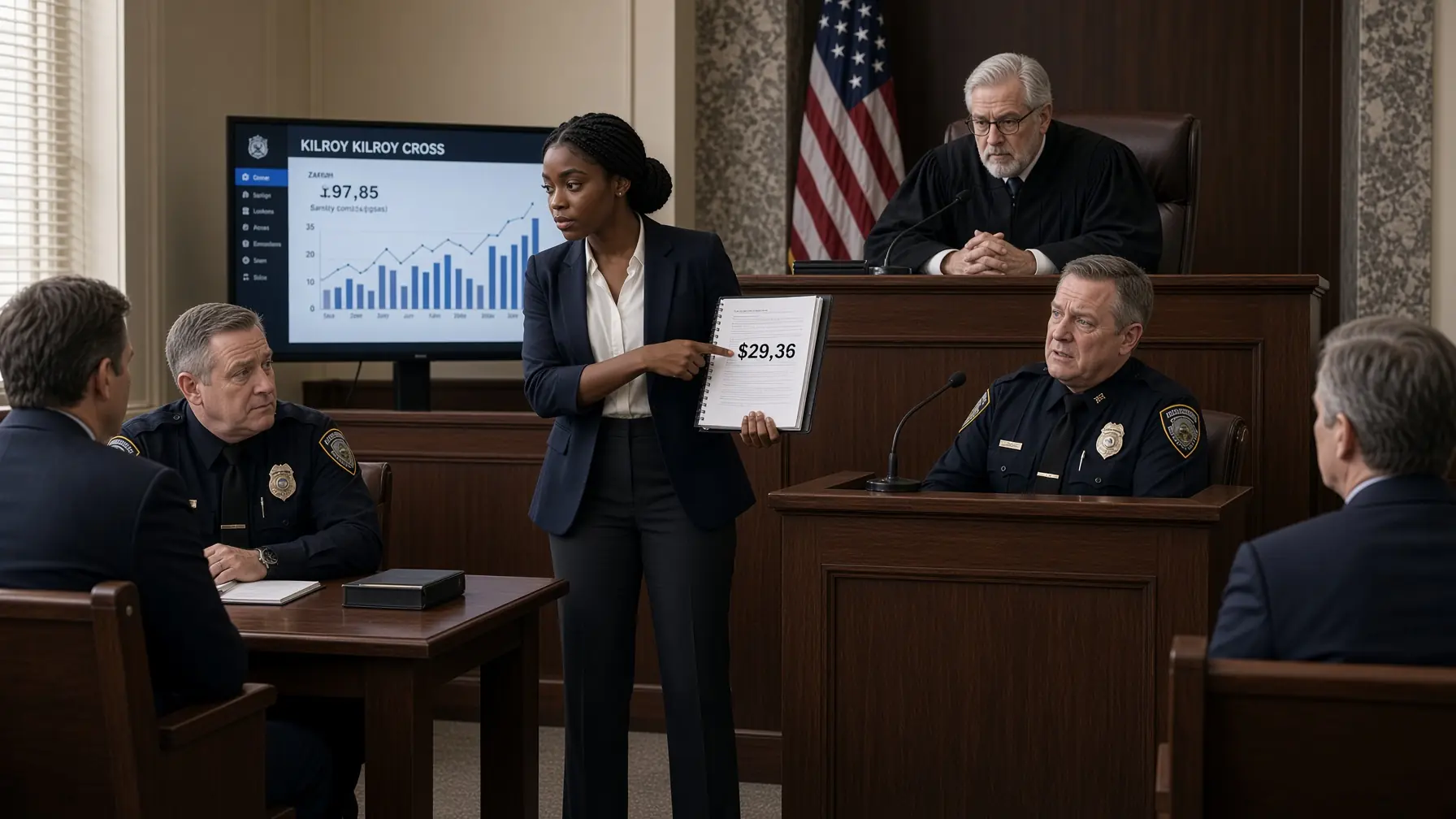
Not a quiet smile.
Not the kind of polite amusement a person could deny later.
He leaned back in the witness chair, looked at the nineteen-year-old Black woman carrying a thick tabbed binder beneath one arm, and laughed loudly enough for the first two rows of the gallery to hear him.
“Somebody lose the debate club?”
A few people chuckled.
Zariah heard them.
She kept walking.
Black Converse sneakers.
Charcoal slacks.
Secondhand navy blazer with the sleeves rolled neatly to her elbows.
Long box braids gathered into a low bun.
No briefcase.
No designer laptop.
No attempt to dress ten years older than she was.
Just a binder.
Very thick.
Very organized.
And marked across the front in black block letters:
DENNIS KILROY — CROSS
Kilroy saw that too.
His smile widened.
That morning he believed the binder was theater.
By lunch, he would understand why every tab had his name on it.
Zariah reached the defense table at exactly 8:57 a.m.
Three minutes early.
Timing mattered.
It mattered because Dennis Kilroy had built an entire criminal case around two minutes and thirty-three seconds he believed nobody could account for.
Zariah intended to account for every one of them.
A gray-haired lawyer seated beside her looked up.
“Excuse me, miss.”
Zariah placed the binder on the table.
“Yes?”
“This section is for counsel.”
“I know.”
He glanced at her sneakers.
Then at the binder.
Then toward the public gallery, apparently wondering whether she had wandered through the wrong gate.
“I’m counsel for the defense team.”
His eyebrows rose.
“You're handling the witness?”
“Yes.”
He lowered his voice.
“You're the student advocate?”
“Yes.”
That explained some of his confusion.
Not all.
Zariah Benton was nineteen years old.
She was not yet a fully licensed attorney.
She was a second-year law student participating under the state’s certified student-practice rule, which permitted qualifying law students to appear in court under direct supervision of a licensed attorney.
Her supervising lawyer, senior public defender Elena Marquez, sat three feet away.
Marquez had signed every filing.
Reviewed every exhibit.
And could take over the examination at any moment.
She had no intention of doing so.
Zariah had earned this cross.
She had spent three weeks building it.
Kilroy apparently did not know any of that.
He leaned toward the court officer beside him.
“Seriously?”
Then, louder:
“What is this, debate club?”
More laughter.
Zariah sat down.
Opened her binder.
Clicked her pen once.
And wrote four words beneath Kilroy’s name.
Laughs before being asked.
Marquez glanced over.
“You okay?”
Zariah nodded.
“Better than he is.”
That was the only response she gave.
At nineteen, Zariah was used to people assuming a mistake had occurred.
She had finished high school early.
Completed much of college through accelerated programs.
Entered law school at seventeen.
By nineteen, she had completed enough supervised coursework and clinical training to qualify for limited courtroom practice.
None of that made her experienced.
This would be only her third live cross-examination.
She knew exactly how unusual that was.
She also knew being unusual did not make her unprepared.
Judge Harold Lennox entered at 9:03.
Everyone stood.
Lennox was sixty-seven, silver-bearded and famously impatient with theatrics.
He had been on the bench twenty-two years.
He liked short arguments.
Clean evidence.
Lawyers who knew where their exhibits were.
Zariah liked him immediately.
Not because he was friendly.
He wasn't.
Because he respected preparation more than appearances.
At least she hoped he did.
“Be seated.”
The room settled.
The case before him was State v. Darius Cole.
Darius sat at the defense table wearing a white shirt and dark tie borrowed from his older brother.
Twenty-six years old.
Electrician.
No prior convictions.
He had been stopped six weeks earlier near Parker Road by Officer Dennis Kilroy.
What should have been a traffic citation became an arrest.
Kilroy claimed Darius rolled through a stop sign.
Then became “immediately argumentative.”
Then refused repeated commands to keep his hands visible.
Then made what Kilroy described as “a sudden aggressive movement” when ordered from the vehicle.
Darius was eventually charged with resisting an officer and misdemeanor assault after Kilroy alleged Darius shoved his arm during the struggle.
Darius told a completely different story.
He said he stopped.
Kept both hands visible.
Asked why he had been pulled over.
Kilroy became angry.
Ordered him to retrieve registration from the glove box.
Then shouted at him for reaching.
Opened the door.
Pulled him out.
And later wrote a report claiming Darius had created the confrontation.
Normally—
one story against another.