At 5:47 in the morning, in Atlanta in November, Thomas O’Shea, a seventeen-year-old boy fresh off his overnight cleaning shift, almost walked past the young woman sitting on the bench outside the emergency room.
She had a hospital bracelet on her wrist, no shoes on her feet, and grip-dot socks pressed against the cold concrete.
Her eyes had the flat stillness of someone who had run out of next moves.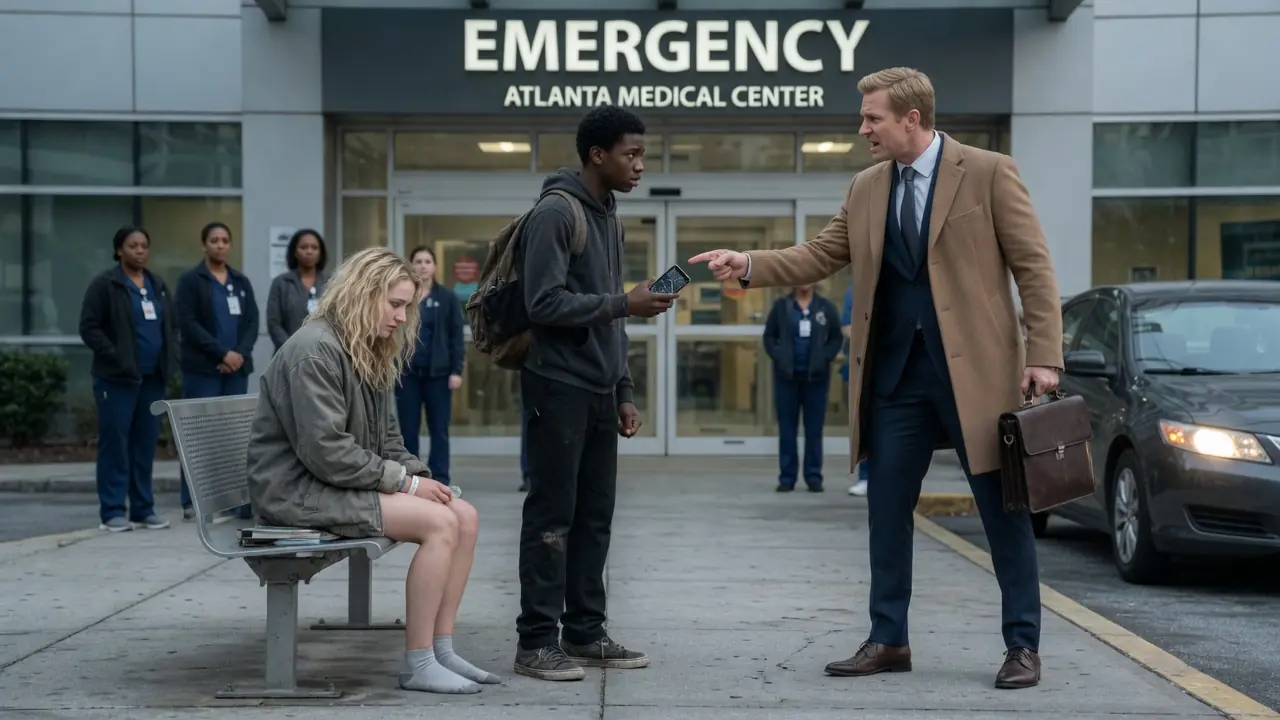
Thomas had eleven dollars in his pocket and four seconds to decide.
He did not know the young woman was the missing daughter of one of America’s wealthiest billionaires.
The morning had begun the way every morning began for Thomas O’Shea, with the slow, careful folding of a vest in the supply closet on the east wing of Emory University Hospital.
The kind of folding that meant nothing to anyone watching, but mattered to him because his mother had taught him a long time ago that the small things you did when no one was looking were the things that built the kind of man you eventually became.
He was seventeen.
He carried himself like someone older, but anyone who looked closely at the backpack slung over his shoulder, the canvas one with a frayed strap and a textbook for AP United States History wedged into the side pocket, would have seen the boy he still was.
Senior year at a public high school in Decatur, Georgia.
Six classes a day, four nights a week of overnight cleaning at the hospital from 11:00 at night to 5:00 in the morning, a special minor work permit signed by the state, and a letter of vouching from his pastor folded into the file at the human resources office.
The pastor had written that Thomas was the kind of young man you trusted with a key, and the hospital had read it and believed it.
His mother, Angela, had worked at a nursing facility for twenty-one years, and the dietary aide uniform she came home in every evening smelled like soup, floor wax, and the specific tired smell of women who had been on their feet since before sunrise.
She had raised him by herself in a one-bedroom apartment in East Atlanta with a window that looked out at a parking lot and a heater that worked when it felt like working.
The man who had been his father had made choices, she had told him once when he was twelve and asked with the directness of a boy who needed an answer.
The details of those choices were less important, she had said, than the fact that Thomas was here and healthy and loved, and that those three things were enough to build on.
He had taken the answer.
He had set it down the way she set things down.
And he had moved on.
She had been sick the year before. Not the kind of sick that goes away on its own, but the kind that put her in the chair at the infusion center every other Friday for six months and left a stack of bills on the kitchen counter that Thomas, on the nights he came home from his shift, would sort by due date with a calm that surprised even him.
The treatment had worked.
The bills had not gone away.
So he had taken every dollar he earned at the hospital and split it three ways in his head.
A piece for the bills. A piece for the small monthly transfer he sent to his aunt Claudette in Jackson, Mississippi, who had a hip replacement on her ledger and a roof that needed work before the next rainy season. And a piece for himself, which was the smallest piece and usually came down to bus fare, lunch money, and not much else.
He had a folder at home with a Georgia State University logo on it.
Inside was a printed page of admissions requirements for the healthcare administration program.
He had not told anyone about the folder. Not his mother, who had enough on her counter already, and not the boys at school, who would have meant well and would have asked questions Thomas did not yet have answers to.
The tuition was a number he was still walking around.
He did not believe in giving up on numbers.
He believed in walking around them until he found the door.
This morning was a Tuesday, the kind of Tuesday Atlanta produced in November, which was not the cruel cold of places farther north, but a real cold, the kind that worked its way through a hooded sweatshirt if you stood still long enough.
Thomas had not stood still.
He had pushed his cart back to the supply closet, logged out his cleaning materials, folded the vest over the hook where it lived, and taken the stairwell down three flights because a body that did not move was a body that stopped working, and Thomas did not have time to stop working.
He pushed through the exit door on the ground level.
He took three steps onto the concrete walkway.
And then he stopped.
She was sitting on the bench.
The bench existed for the specific reason that people sometimes came out of emergency rooms with nowhere to go next and needed a place to sit while they figured it out.
Thomas had walked past it most mornings without thinking about it.
This morning was not most mornings.
She was in her early twenties. White. A hospital bracelet still circled her left wrist, the white paper kind they put on you when you were admitted. She had no shoes. She was wearing the socks they handed out on the wards, the ones with rubber grip dots on the bottom, designed for walking on linoleum floors, not concrete at six in the morning in November in Atlanta.
Her hair was loose and tangled in a way that said it had not been touched by a brush in some time. The jacket she had on was hospital issue, the kind they gave to patients who left with nothing of their own to leave in.
She was not crying.
That was the part that landed in Thomas first.
She was looking at the middle distance with the specific expression of someone who had run out of the next move and was sitting very still while she waited for one to appear.
He stood there for a moment with his backpack over one shoulder and the cold doing what cold did.
He could have kept walking.
The bus stop was on the corner.
The bus would be there in nine minutes.
He had a long Tuesday ahead of him. First period started at 7:45, his mother would be waking up to get ready for her own shift, and he had not slept yet and would not sleep until the early afternoon between school and his evening homework.
There was a version of this morning where he kept walking and went home and did not carry the weight of having seen what he had just seen.
He did not take that version.
He walked over to the bench.
He did not sit yet. He stopped a respectful distance away first, because every woman ran an automatic assessment when a stranger spoke to her at six in the morning, and Thomas had been raised by a woman who had taught him that the assessment was a real thing and that you did not crowd a person while she was running it.
“You okay?” he asked.
She turned her head.
The assessment ran behind her eyes for a second, the way Thomas had been told to expect, and then something in it settled. She did not seem to find anything to be afraid of in him, which was its own small relief.
“I don’t have anywhere to go,” she said.
It came out flat, not for effect, just as a statement of fact delivered by someone who had moved past the point of softening it.
Thomas sat down on the other end of the bench. Not close. Close enough to be in the same conversation, far enough to be respectful of what the bench was for.
“When did they discharge you?” he asked.
“You got a phone?”
She shook her head.
She did not elaborate.
He did not press her.
He understood, even without anyone teaching him to understand, that there were questions you did not ask people on benches at six in the morning. You asked the questions that moved them toward a next step. The other questions could wait.
He looked at her hospital bracelet.
The name on it was small, printed in the way hospital bracelets always were. He could have read it if he had leaned closer, but he did not lean.
It was none of his business yet.
She looked at her hands instead of at him.
Her hands were red from the cold.
“I can sit here a minute,” she said. “I just need to figure out what to do.”
“Okay,” Thomas answered. “I can sit here a minute, too.”
He had eleven dollars in his pocket.
He knew because he had counted it the night before, the way he counted it every night before his shift, lining up what was left of the week against what the week still needed from him.
Eleven dollars was lunch money for the rest of the school week with a careful margin.
Eleven dollars was the difference between bringing a sandwich from home on Friday and going hungry until he got home.
He did not think about this for very long.
He thought about it the way you think about whether to put on a jacket when you can already feel the cold. Quickly. Without ceremony. And then you put on the jacket because the cold is real, and the question was never really a question.
He took out his phone.
It was a prepaid model, two years old, the screen cracked in the lower left corner in a way that he had learned to read around.
He pulled up the contact for a women’s shelter on Edgewood Avenue.
He had not put the number there because he had ever needed it himself. He had put it there because three months earlier, a woman from his mother’s church had stood up during the announcements and asked the congregation to save the number on the chance that someone might one day pass it on.
Thomas had saved it without thinking twice.
He had not used it since.
He had also not forgotten it was there.
He stepped a few feet away from the bench so that the young woman would not have to listen to him talk about her.
He called.
Someone answered on the third ring.
He explained the situation in four sentences. He listened. He answered the questions the voice on the other end asked him.
Yes, she was sitting outside the emergency room at Emory.
Yes, she had just been discharged.
No, she did not have a phone or shoes.
Yes, he could put her in a cab if they had a bed.
The voice told him they had a bed and that someone would be waiting at the door.
He thanked her.
He hung up.
He walked back to the bench.
“There’s a shelter on Edgewood,” he told her. “They have a bed for you. I’m going to get you a cab. They’ll be waiting at the door.”
She looked up at him.
The flat thing in her eyes shifted, not into hope exactly, but into something less heavy than what had been there a minute earlier. It looked like the weight of one decision being lifted off the much larger pile of decisions she had been sitting under.
“You don’t know me,” she said.
“No,” Thomas answered.
“Why would you?”
“You need it,” he said. “That’s the whole thing.”
He opened the ride-share app on his phone.
The fare to Edgewood at this hour came up at ten dollars and seventy-two cents, plus a small tip he had already decided to round up to eleven.
He tapped the confirmation.
The car was four minutes away.
He sat back down on the bench.
He did not say anything else for those four minutes, and neither did she. The cold sat between them not as a third person, but as a kind of agreement, the way silence can be an agreement when two people understand that words are not what the moment is asking for.
The car pulled up.
A small sedan, the ride-share sticker on the back windshield.
Thomas walked to the passenger side. He told the driver the address. He told the driver that the woman in the back was going to the front door of the shelter and that he wanted to make sure the driver understood that.
The driver, a man in his fifties with a thermos of coffee in the cup holder, nodded once and said he understood.
Thomas opened the back door and held it.
She stood up from the bench.
She walked the short distance to the car in her grip-dot socks.
She got in.
She looked back at him through the window for a moment.
He gave her a small nod.
He closed the door.
The car pulled away.
Thomas stood on the concrete in front of the emergency room entrance in the November cold and watched it go until the taillights turned at the corner and disappeared.
Eleven dollars, a four-second decision, and a pair of hospital socks with grip dots on the bottom.
He did not know what he had just set into motion.
He shifted the backpack on his shoulder.
He turned toward the bus stop on the corner and began the walk home because the morning was waiting, and his mother would be making coffee soon, and there was a Tuesday between him and the next time he would think about the woman on the bench.
He thought as he walked that it would probably be a long time before he thought about her again.
He was wrong.
It was three days before he saw her again.
He had not gone looking.
He had gone about his Tuesday, and his Wednesday, and his Thursday, and on Friday morning, when he pushed through the same exit door at the same time he always did, she was standing a few feet from the bench.
Not sitting on it.
Standing near it like she was waiting for something but was not sure she had the right to be there.
She had shoes now, real ones, not new, but not hospital socks.
Her hair was pulled back.
She was wearing a hooded sweatshirt that had to have come from the shelter clothing bin because it was the wrong size for her.
She looked less like someone at the end of something and more like someone at the very tentative beginning of something else.
“You came back,” Thomas said.
“I wanted to say thank you,” she answered. “In person. The shelter told me you called ahead so they’d have a bed ready.”
He nodded.
She looked at him for a second longer than was easy.
“Who does that?” she said.
It was less a question than a statement she did not know how to put down.
“You needed it,” Thomas told her. “That’s the whole thing.”
A long beat sat between them while she gathered something.
“I have a question,” she finally said. “And you can say no.”
“Okay.”
“Is there somewhere nearby I can get breakfast? The shelter meal isn’t until 7:30, and I wanted to ask you while I was here if you knew somewhere that wasn’t too expensive.”
Thomas had twelve dollars in his pocket, a five and a handful of singles from a tip a patient’s son had pressed into his hand the night before.
He had a bus pass.
He had nothing scheduled before he needed to sleep, since his first class did not start until 8:30.
“There’s a place two blocks that way,” he told her. “I was going past it anyway.”
He was not going past it.
It was two blocks in the opposite direction of his bus stop.
He did not correct himself, and she did not ask.
They walked to the diner.
It was the kind of place that had been on the block for thirty years and intended to stay. Vinyl booths, laminated menus, coffee that arrived automatically and kept arriving.
The waitress was a woman named Doreen who had been working the early shift for as long as the diner had been there and who had a way of looking at the people in her booths like she already knew which ones were going to need refills before they did.
She brought two cups before Thomas and the young woman had finished settling in.
Thomas ordered toast.
She ordered scrambled eggs and looked at the menu three times in the way people look at things when they are calculating in their heads and trying not to look like they are calculating.
He paid for both without making it a discussion.
When she started to say something, he said, “It’s Friday. Friday’s a good day to buy breakfast.”
It made no sense, and they both knew it.
She laughed for the first time since he had met her, a small sound that changed something in the air between them.
That was the first real conversation.
Her name was Claire.
She was twenty-two.
She was from Connecticut.
There had been family things, and she did not want to talk about the family things, and Thomas did not push.
She was trying to get her CNA, certified nursing assistant, because she had wanted to be in health care for as long as she could remember, and because it was the first step she could see clearly from where she was standing.
She had the study materials.
She did not have a consistent quiet place to read them because the shelter, good as it was, was a shared space.
“How old are you?” she asked at some point in the middle of a sentence about her own studying, as if it had just occurred to her that the question mattered.
“Seventeen,” Thomas said.
She set her fork down.
“Seventeen?”
“Senior year.”
“You’re seventeen, and you put me in a cab on Tuesday, and you’re sitting across from me on Friday buying me eggs?”
“I’m seventeen,” he answered. “And I made a decision about a cab on Tuesday. The age and the decision don’t have much to do with each other.”
She looked at him with an expression he could not yet read.
“You’re young,” she said.
“I’m young,” he agreed. “I’m not small. That’s different.”
She thought about that for the rest of the meal.
He told her without making it a thing that his mother kept the apartment quiet on weekend mornings and that the kitchen table sat empty between 8:00 and noon on Saturdays and Sundays.
Claire was welcome to come and study there if she wanted.
He said it the way Angela said things, without ceremony, as if it were a fact Claire could take or leave.
That night, he told his mother about Claire over the small dinner they shared on Fridays before he went to bed.
Angela listened the way she listened: completely, with her cup of tea in both hands.
When he finished, she set the tea down.
“Bring her to lunch Sunday,” she said. “I want to see the girl my son has been buying eggs for.”
He brought Claire to lunch that Sunday.
Angela had made roast chicken and rice and a salad with the cucumbers cut the careful way she always cut them.
She did not ask Claire where she came from.
She asked Claire what she liked to put on her toast and whether she preferred sweet tea or unsweet.
By the end of the meal, Claire was helping her dry the dishes, and Angela was telling her the small practical things you only learn from being in long-term care for twenty years. Which side of an elderly patient you should approach when you were going to help her sit up. What a CNA’s job actually looked like at 3:00 in the morning when the call light went on.
Claire came back the next Saturday.
And the Saturday after that.
She sat at the kitchen table with her study guide open and a notebook full of careful handwriting, and Thomas, when he was home, sometimes sat across from her with his calculus textbook.
He borrowed a blood pressure cuff from a nurse at the hospital named Patricia and spent two Saturday afternoons walking Claire through the procedure until it became automatic, the way procedures became automatic when you did them enough times that your hands took over from your mind.
It was not a friendship he was building in any deliberate way.
He was simply the person who was there consistently, because the bus stop near the hospital was also near the shelter on Edgewood, and it cost nothing to ask how someone was doing when you passed her on the way to the bus.
The registration fee for the CNA certification exam was eighty-five dollars.
Claire sat across from Thomas at the diner on a Thursday morning in mid-December and told him this with the expression of someone delivering information they had been dreading and could no longer delay.
She had sixty-two dollars saved.
She was twenty-three dollars short, and the registration deadline was in five days.
The diner was quiet around them.
The coffee was hot.
Outside, Atlanta was doing what it did in December: gray, bright, cold enough to matter, the holiday lights on the street lamps already in their second week and beginning to feel like part of the architecture.
Thomas picked up his coffee cup.
He looked out the window.
There was a silence between them that Claire was trying to fill and Thomas was letting sit while he ran the math in his head that he already knew the answer to.
Twenty-three dollars.
He had it.
He had it because he had picked up an extra shift at Thanksgiving when nobody else wanted to work, and the hospital had paid time and a half, and he had not yet allocated that money to the bills folder.
Twenty-three dollars was two days of lunch and one round-trip bus fare to a college visit he had been planning to make in January.
It was a real number to him.
It was the kind of number that, if he gave it away, he would feel for the next two weeks.
But here was the part that broke something in the room.
Before Thomas could speak, Claire looked down at her coffee and said very quietly, “I’m sorry. I shouldn’t have told you. It’s not your problem. I don’t know why I keep—”
Then her voice did the thing voices do when a person has been holding something together for a long time and is suddenly aware, in the middle of a sentence, of exactly how long and exactly how tired they are.
It did not break.
It just thinned like paper held up to the light.
“I just feel stupid,” she said. “I feel stupid that I can’t figure this out. I feel stupid that I’m telling you this in a diner. I feel stupid that you’re seventeen and I’m twenty-two and I am sitting here about to ask a high school kid for twenty-three dollars.”
“The number is twenty-three. I can’t—”
She pressed her lips together.
She looked at the window.
Thomas set his coffee cup down.
He did not rush the next moment.
He understood that the thing happening right now was not about twenty-three dollars.
It was about a young woman who had spent months trying to become someone who did not need to ask and who had just discovered in a vinyl booth in a diner in Atlanta that the need had found her anyway.
“Claire,” he said.
She looked at him.
“There’s nothing stupid about being twenty-three dollars short of something that matters,” he told her. “There’s nothing stupid about telling somebody. The stupid thing would be to need it and not say anything and miss the deadline and lose the eight weeks of work you have put into this. And for the record, you didn’t ask me. You told me. There’s a difference.”
She was very still.
“I have twenty-three dollars,” he continued. “I’m not lending you money. I want to be clear about that. I’m putting a deposit on something.”
“A deposit on what?” Claire asked.
“On the day you’re going to be the one on the other side of this moment. The day somebody else is going to be twenty-three dollars short of something they have worked for, and you’re going to know better than almost anyone in any room you’ll ever walk into exactly what to do. You’ll know because you remember sitting in this booth. That day is coming. I want a piece of it in advance.”
She looked at him for a very long time.
She looked at this seventeen-year-old boy across from her in his hooded sweatshirt with a frayed cuff, who had a calculus textbook in his backpack and a folder at home he had not yet told her about, and who was talking to her like he had thought through this answer somewhere between his mother’s kitchen and this booth.
“Why do you keep doing this?” she said.
Not suspicious.
Just the question of someone who had been let down enough times that sustained kindness had become something she did not have a category for.
Thomas thought about it.
He thought about Angela.
He thought about Aunt Claudette in Jackson, who got a small check every month from a teenager she had only ever met twice.
He thought about the bench four weeks ago, and the cab, and the eleven dollars, and the grip-dot socks.
“Because somebody has to start it,” he said. “And once it’s started, it’s hard to stop.”
She nodded.
She did not say anything for a minute.
Then she picked up her coffee cup and set it back down.
“Okay,” she said quietly.
“Okay,” Thomas answered.
He paid the twenty-three dollars online before they left the diner.
He used the public computer at the front of the library on the way home because his data plan would not handle a credit card payment, and he did not want to wait until he got back to his apartment.
He typed in his debit card number from memory the way he had learned to type a few numbers from memory because his card was old enough that the numbers were starting to wear off the front.
He confirmed the payment.
He closed the browser.
He walked back out into the December afternoon and caught his bus.
Claire took the CNA exam on a Saturday morning in mid-January.
She passed on her first attempt with a score in the top fifteen percent of her testing cohort.
She called Thomas from outside the testing center while he was on the bus home from the Friday night shift he had pulled the day before.
He saw her name on the screen.
Claire. No last name, because she still had not told him her last name.
He answered.
“Hey,” he said.
“Thomas?”
“Yeah.”
“I passed.”
She did not say anything else for a moment.
He did not either.
He listened to her breathing on the other end of the line, the breathing of a person who had just sat down outside a testing center on a January morning and was looking at a piece of paper that had her name on it and a score, and who had spent eight months not being able to imagine a piece of paper like that ever existing in her life.
“I know,” he said.
“You don’t know.”
“Tell me.”
And she did.
A thousand miles north of the diner where Thomas had bought a young woman eggs and explained the difference between asking and telling, a man named Richard Whitmore was sitting in the study of his house in Greenwich, Connecticut, reading a report for the third time.
The study had been his wife’s first.
Catherine had picked the rug. Catherine had chosen the wall color, a green that the decorator had called library green and that she had called, with the wry smile that was the thing Richard had loved about her most, the only green that doesn’t apologize.
Catherine had been gone for fourteen months now.
The rug was the same.
The walls were the same.
Everything about the room was the same, and everything about the room felt to Richard like a museum exhibit of a life that had stopped while he had kept moving.
He was sixty-three years old.
He had founded Whitmore Health Holdings thirty-five years earlier with a small inheritance from his father and a willingness to do the unglamorous work of healthcare infrastructure, the systems behind hospitals, not the hospitals themselves.
He had grown it slowly and then quickly, and now Whitmore Health Holdings had its fingerprints on forty-seven hospital facilities across the southeastern United States.
Most people did not know the company’s name.
They knew the names on the buildings.
They did not know who owned the buildings.
Among the forty-seven facilities was the Emory University Hospital campus in Atlanta.
He had never set foot in it.
He had no operational reason to.
He had signed the holding company paperwork in a conference room in Manhattan four years earlier and had never thought about the building again.
That was the building where a young man named Thomas O’Shea cleaned floors on the overnight shift.
Richard did not know that.
He had not known that for the entire eight months that his daughter Claire had been missing.
Claire had walked out of the house in Greenwich on a Wednesday morning in June with a small backpack, a credit card she had thrown into a trash can at LaGuardia within an hour of leaving, and a note on the kitchen counter that said:
I love you. I cannot do this anymore. Don’t look for me. I’m not in danger. I just need to find out who I am without you.
She had signed it with her first name.
The note was the last thing Richard had touched of his daughter’s for the next eight months.
He had read it so many times that the corner where his thumb sat had gone soft.
Catherine had died of a stroke fourteen months earlier.
Claire had been twenty-one then.
The two of them had been the kind of mother and daughter who finished each other’s sentences and disagreed at high volume about politics over dinner.
When Catherine died, Claire stopped finishing sentences for a while.
She spent several months trying to keep going, then a stretch of time in a treatment program Richard had agreed to pay for and had visited only once because he had not known how to sit in a room with his daughter and his own grief at the same time.
The program had helped.
The grief had not gone away.
The hollowness she had described to her counselor, the feeling that her whole life had been built on someone else’s foundation and that she did not know who she was without the foundation, none of that had gone away.
So she had left.
She had refused her trust fund.
She had refused the Whitmore name on any document she signed after the airport.
She had become, somewhere in the country, a person Richard did not know how to find.
He had hired Stephen Hayes.
Stephen Hayes was a private investigator in Manhattan recommended to Richard by a lawyer who specialized in family matters that the family wanted handled without making the papers.
He had taken the case eight months ago.
He had checked in every two weeks. He had asked the right questions and not the wrong ones. He had cost Richard a significant amount of money, and Richard had paid every invoice without reading it because reading it would have meant calculating what his daughter’s absence was worth in dollars, and he could not do that and stay sane.
The report had come back on a Tuesday in February.
Forty-seven pages, hand delivered in a brown envelope.
Richard had read it once quickly, the way you read something you have been waiting eight months for.
He had read it a second time slowly, with a pen in his hand to underline the things he could not lose.
He was reading it a third time now in the green study where Catherine had once written letters at the desk by the window.
Claire was in Atlanta.
She had a bed at a women’s shelter on Edgewood Avenue.
She had earned her CNA certification three weeks earlier with a score that put her in the top fifteen percent of her cohort.
She had been hired at a long-term care facility in Marietta and had started her first shift four days ago.
She was alive.
She was healthy.
She had built, in eight months and entirely without him, the first piece of a life that was hers.
Those were the facts.
Those were the facts Richard had paid for.
He could have stopped reading at page twelve.
He did not stop.
Stephen Hayes had been thorough in all the ways his clients required, which meant that the file did not stop at facts. It included observation. It included context. It included the people in Claire’s life during those eight months.
And one of those people, according to the file, was the reason Claire was still alive.
Page thirty-one.
Caretaker Thomas O’Shea, seventeen years old. High school senior. Public school in Decatur, Georgia. Overnight cleaning, Emory University Hospital. Black. Single-parent household. Mother employed at a long-term care facility, twenty-one years. Father absent. Pastor’s vouching letter on file at hospital human resources.
Richard read the line three times.
Seventeen.
A boy the age of his sister’s youngest son.
A boy who, if Richard had ever met him under any other circumstance, he would have walked past in a hallway without thinking about him for more than half a second.
A boy who, while Richard had been writing checks to family foundations, standing on hospital ribbon-cutting stages, and giving the keynote at a Georgia healthcare gala that had taken place, he now realized, within thirty miles of the bench where this boy had sat down next to his daughter, had done the thing that no money, no foundation, no plaque had managed to do in eight months.
The file continued.
Stephen Hayes had documented it in the careful prose of a man who knew his client needed every word.
The bench.
The cab.
The eleven dollars.
The phone call to the shelter.
The diner two blocks in the wrong direction.
The mother’s kitchen on weekend mornings.
The blood pressure cuff.
The twenty-three dollars.
And then on page thirty-three, the sentence.
“There’s a day coming when you’re going to be the person on the other side of this moment, and you’ll know better than almost anyone exactly what to do.”
Richard read that sentence three times.
He set the file down on the desk.
He picked it up again.
He read it a fourth time.
He read it the way a man reads something that he should have written himself decades earlier to a daughter he had loved without ever knowing how to love properly.
He stood up from the desk.
He did not call his lawyer.
He did not call his assistant.
He did not call the head of his foundation, who would have wanted to know what was happening and would have wanted to prepare a press strategy in advance of any decision that was about to be made.
He went upstairs.
He packed a single small suitcase.
He came back down.
He told the housekeeper, Marlene, who had worked for him for nineteen years and who had loved Catherine in her own quiet way, that he was driving to Atlanta and he was not sure when he would be back.
Marlene looked at him for a moment, and then she nodded the way a person nods when they have wanted to say something for a long time and finally know they will not have to.
“Drive carefully, Mr. Whitmore,” she said.
He told her he would.
He drove himself.
He had not driven himself anywhere of consequence in nine years.
He had a man named Dennis who drove him, a quiet former police officer who had been with him long enough that Richard considered him a friend, although he had never used that word out loud.
He did not call Dennis.
He understood without being able to explain it to himself that the act of being driven would make this trip into a different kind of trip than it needed to be.
He needed his hands on the wheel for this one.
He needed the eleven hours of road, the rest stops, the slow narrowing of the interstate as it moved south and the country changed around him.
He drove through the afternoon and into the evening and through the night.
He stopped twice, once in Virginia for gas and a bad sandwich, once in South Carolina to sleep in his car for ninety minutes in a truck stop parking lot because his hands had begun to shake on the wheel, and he understood that some things did not get easier if you tried to push through them.
He woke up at 4:00 in the morning to a sky the color of cold steel and got back on the road.
He arrived at the Emory University Hospital campus at 5:15 on a Tuesday morning in February.
He parked in the visitor lot.
He turned off the engine.
He sat in the car.
He looked through the windshield at the building.
He had seen photographs of it in board materials. He had approved facility improvements for it in a budget meeting two years earlier.
He had never in his life walked into it.
The building was his in the technical paperwork sense that buildings could be a person’s.
And the building was completely not his in every sense that actually mattered.
A young man was about to walk out of one of those doors.
Richard had timed his arrival for it.
The file had been specific.
The shift ended at 5:47.
The exit door on the ground level.
The bench where it had all begun.
Richard sat in the car.
He did not move for forty minutes.
It was not that he did not know what to do.
He had known what to do since page thirty-one.
It was that he needed to understand before he stepped out of the car who he was going to be when he did.
Whether he was about to walk across this parking lot as the man who had read a file and made a financial decision.
Whether he was about to walk across this parking lot as the father of a girl who had decided he was not safe to come home to.
Whether he was about to walk across this parking lot as a man who had spent thirty-five years building hospital infrastructure and had managed in all that time to build nothing as real as what a seventeen-year-old high school senior had built with eleven dollars and a four-second decision on a bench three months ago.
He had thought, on the long stretches of interstate through the Carolinas, that maybe the truth was a combination of all three.
The truth he understood now in the parking lot was that none of those three had earned him the right to be here yet.
The boy he was about to meet had done for his daughter what he should have done and had not done.
The boy was seventeen years old.
The boy had not finished high school.
The boy had less money in his bank account, almost certainly, than Richard spent on a single dinner.
And the boy had become, by his actions, more of a father to Claire in three months than Richard had been to her in twenty-two years.
That was the sentence he could not get past.
He sat with it for forty minutes because there was no way to get past it.
It was the floor of the room.
You did not get past the floor.
You stood on it.
He stood on it.
At 5:47 on a Tuesday morning in February, Richard Whitmore opened the door of his car and stepped out into the Atlanta cold.
The cold did what the cold always did at 5:47 in February in Atlanta. It took the breath out of you and gave it back in a smaller shape than it had been before.
Thomas pushed through the exit door with his backpack over his shoulder and his hooded sweatshirt zipped to the chin.
His calculus quiz was first period.
He had reviewed the formulas in the supply closet in the last ten minutes of his shift.
He had a Tuesday ahead of him, and he was already counting the hours until he could put his head down on his pillow.
He saw the man before he saw the car.
The man was standing a few feet from the bench. He was older, in his sixties, the kind of man whose face had been handsome for a long time and had recently been through something that showed.
He was wearing a coat that did not belong in this parking lot at this hour, an expensive coat that fit him the way coats fit men who had spent decades being measured.
His hands were out of his pockets and held slightly away from his sides.
It was a deliberate posture.
Thomas recognized it, even without being able to name it, as the posture of a person who knew he had to be visible and unthreatening to a stranger at six in the morning.
Thomas stopped.
His body did the assessment first.
Older. White. Alone. Not standing between Thomas and the bus stop. Not approaching. Hands visible. The car parked thirty feet away, a luxury sedan with a Connecticut plate.
The man’s eyes were on him, and they were not the eyes of a person who had come to do harm.
They were the eyes of a person who had come for something he did not yet know how to ask for.
The man took a slow step forward and stopped.
He did not come closer than that.
“Your name is Thomas O’Shea,” he said.
It was not a question.
Thomas adjusted the strap of his backpack.
He did not answer yet.
“My name is Richard Whitmore,” the man went on.
He spoke evenly, the way a person speaks when he has rehearsed sentences on an interstate for eleven hours.
“The young woman you have been caring for these past three months, Claire, is my daughter. I have been looking for her for eight months, and I drove here this morning not to take her home, but to meet the person who has been more of a father to her than I have.”
The sentence sat there in the cold between them.
The hospital hummed somewhere behind Thomas.
The morning shift was arriving. A pair of headlights swung through the lot and parked. The day was about to begin in every direction that did not include this bench.
Thomas held the older man’s gaze for a long moment.
He could have said many things. He could have said that he had not known. He could have said that he had a quiz in less than two hours. He could have said that nothing about this was his to decide.
What he said instead was, “Did Claire send you?”
“No,” Richard answered.
“Does she know you’re here?”
“No.”
Thomas looked at him.
He understood all at once that the older man was telling the truth.
He understood it because the older man had not used the word father first. He had said, “The person who has been more of a father to her than I have,” which was a sentence a man only said if he had stood in a parking lot for forty minutes thinking about whether he had the right to say it.
“There’s a diner two blocks that way,” Thomas said. “Coffee’s good. I was going past it anyway.”
He was not going past it.
It was two blocks in the opposite direction of his bus stop.
Richard did not know that, and Thomas did not say.
“Okay,” Richard answered.
They walked.
The diner was the same diner.
Same vinyl booths, same laminated menus, same coffee that arrived automatically.
Doreen looked up from the counter when Thomas came through the door, adjusted her read of the table when she saw the older man in the expensive coat beside him, and brought two cups without asking.
She did not linger.
Thomas wrapped both hands around his cup.
“You read something?” he said.
It was the same tone he had used with Claire on the first morning at this booth three months earlier.
“I read a forty-seven-page report about my daughter,” Richard answered. “And about you.”
“What was in it?”
Richard had thought in the car that he would not know how to answer this question when it came.
He discovered, sitting across from a seventeen-year-old in a vinyl booth, that he knew exactly how to answer it.
He told the truth.
He told it the way the boy across from him had been telling truths for three months, without ornament and without the elaborate contextualizing that men of Richard’s age and position tended to reach for.
He spoke about Catherine, about a daughter who had stopped finishing sentences, about a note on a kitchen counter, and eight months of not knowing, about a brown envelope and a green study, and page thirty-one, and a sentence on page thirty-three.
Thomas listened the way Angela had taught him, completely, with both hands on the cup, without rushing his face to a verdict his words were not ready to deliver.
When Richard finished, the booth was quiet for a moment that was not awkward.
Outside the window, a city bus pulled up to the corner stop, and the boy who had been waiting for it climbed on, and the bus pulled away again.
“You built hospitals,” Thomas said.
“I built the systems that run them,” Richard corrected.
“That campus out there.” Thomas tilted his head toward the window. “Part of it is yours.”
“Yes.”
“And I clean the floors in it.”
“I know.”
Thomas turned his cup once on its saucer.
“My mother told me when I was twelve that the man who would have been my father made choices. She didn’t call him a villain. She said he made choices. I’ve thought about that sentence for five years. The part I have figured out is that the choices weren’t really about him. They were about what he believed he didn’t have to do. That’s worse than evil in some ways, because evil at least has to look at itself in the mirror once in a while. The other thing doesn’t.”
Richard set his coffee cup down slowly.
He did not interrupt.
“I’m telling you this,” Thomas continued, “because you came eleven hours in a car to a parking lot to stand near a bench, and that means you’ve looked in the mirror at least once. So I’m going to answer your question even though you haven’t asked it yet.”
“What question?” Richard asked.
“How you can repay me.”
Richard’s hands went still on the table.
“You don’t repay me,” Thomas told him. “There is nothing to repay. I bought a girl a cab and some eggs and gave her twenty-three dollars and a place to study on Saturdays. My mother did the cooking. A nurse loaned me a cuff. The shelter on Edgewood had a bed when I called. None of that is a bill. It’s just people doing what people do when nobody else is doing it.”
“But you want something,” Richard said.
Not as an accusation.
As an observation.
“Yes,” Thomas agreed. “I want something. But not from you. From Claire. Before anything else happens, you have to ask her. The choice is hers. If she wants to see you, I’ll help her set it up. If she doesn’t, you turn the car around and you drive eleven hours back and you write her a letter once a month and you wait. Because for eight months, she has been building back the right to choose her own life. I’m not letting anyone take that from her. Not even her father. Especially not her father.”
Richard looked at him for a long moment.
The boy across from him was seventeen years old, in a hooded sweatshirt that had been washed too many times, with a backpack on the seat next to him that had a calculus textbook sticking out of the side pocket.
The boy across from him had just laid down the only condition that mattered, and he had laid it down with the calm of a man three times his age, and he had laid it down without flinching from the answer it might bring.
“Okay,” Richard said.
The word came out smaller than he had meant it to.
“Okay,” Thomas answered.
“Will you tell her I came?”
“I’ll tell her. I won’t tell her what to do about it.”
“That’s fair.”
Thomas finished his coffee.
He glanced at the clock on the wall.
He had thirty-four minutes to get to first period.
“I have to get to class,” he said.
“Yes. You should sleep before you drive anywhere else.”
The corner of Richard’s mouth almost moved.
“I will.”
Thomas slid out of the booth.
He shouldered his backpack.
He looked at Richard one more time, and then he said the thing that surprised him as he said it because he had not known he was going to say it.
“I’m sorry about your wife.”
The older man’s face did something he was not ready for.
He nodded.
He did not trust his voice for a second.
Then he found it.
“Thank you, Thomas.”
Thomas walked out of the diner.
He told Claire that afternoon.
He did not call her.
He went to the long-term care facility in Marietta on the bus after school because it felt like the kind of thing you said to a person in person if you could.
She met him in the small staff break room on her break, wearing scrubs with her last name on the tag for the first time in Thomas’s memory.
Whitmore.
Printed in the clinical font of nursing badges.
He told her exactly what had happened in the order it had happened.
He did not give her his opinion.
He did not tell her what he thought she should do.
She was quiet for a long time after he finished.
“He drove himself,” she said.
“He drove himself.”
“He sat in the parking lot for forty minutes. That’s what he told me.”
She nodded once.
He understood that the silence was the silence of a person trying to decide whether something was real and that the deciding was not a thing he could help with.
She took three days.
On the third evening, she called him.
She had decided.
She would meet her father. Not at the Greenwich house. Not at his office. But at a coffee shop on Ponce de Leon in the middle of the afternoon, in public, where she could leave if she needed to.
Thomas helped her set it up.
He did not go with her.
He sat on the bus on the way home from school that afternoon and did not look at his phone.
He understood that this part was not his.
She told him about it later in pieces.
There had not been a Hollywood reunion.
There had been a man in a coat too nice for the room and a woman in scrubs who had come straight from her shift.
There had been more apology than tears, and the apology had been the first thing her father had said, and the second thing, and the third.
He had said, in Claire’s telling, “I did not come to take you. I came to apologize and to listen if you will let me.”
And Claire, who had not cried in front of her father since the day of Catherine’s funeral, had cried.
Two weeks after that, Richard called Thomas.
He asked if Thomas and his mother would come to his office in Buckhead on a Saturday afternoon. He said he had something to propose and he wanted Angela in the room because anything he proposed concerned a family, not a person.
They went.
Angela wore the dress she had worn to Thomas’s award ceremony in October.
Thomas wore a button-down shirt his mother had ironed twice.
The office had a view of the Atlanta skyline that made the city look like a thing somebody had built on purpose.
Richard proposed a four-year scholarship to Georgia State University’s healthcare administration program beginning the August after Thomas’s high school graduation in June.
He proposed a paid summer internship at Whitmore Health Holdings every summer of those four years.
He laid the offer on the table the way a man lays a contract on a table when he expects the other person to read it.
Angela sat next to her son with both hands in her lap.
She had decided on the drive over that this was her son’s decision and that she would be a presence in the room and not a voice in it.
Thomas took his time.
He looked at the paper.
He looked at the man across the desk.
“Three conditions,” he said.
“Tell me.”
“One, this is not a gift. It’s not your guilt money for Claire. It’s an opportunity I have to earn. If my grades drop or my internship reviews come back poorly, the scholarship stops at the end of that semester. We write that into the agreement now.”
“Done.”
“Two, Claire never has to know about this. Not from you, not from me. Whatever happens between you and her, this is separate. I am not a chip in your reconciliation.”
“Done.”
“Three.”
Thomas reached into his backpack.
He pulled out a small white envelope and set it on the desk between them.
“Claire paid me back the twenty-three dollars on her first paycheck. I kept the bills. I want to start a fund at my high school with them. Twenty-three dollars for kids who are twenty-three dollars short of something. An SAT registration, an exam fee, a deposit on a program. Small money. I’ll call it the Bench Fund.”
Angela’s hands did not move in her lap, but the corner of her mouth did.
Richard looked at the envelope on his desk for a long time.
He looked at the seventeen-year-old across from him, who had walked into the office of a man worth more money than several small countries and had set down twenty-three dollars and called it the beginning of a fund.
“That is exactly why I am proposing this to you,” Richard said. “And the fund, I will match every dollar you put into it for as long as it exists. Today and ten years from now and after I am gone if it is still running. Write that in, too.”
It got written in.
Four years later, on a Tuesday morning in February, Thomas O’Shea walked down the third-floor hallway of Emory University Hospital in a navy suit and a name badge that said Trainee, Healthcare Administration.
He was twenty-one.
He passed the supply closet on the east wing where, for one year of his life, he had folded a vest at the end of every shift.
He did not need to look in.
He knew what was inside.
A nurse was leaning over the bed of an elderly patient down the hall, adjusting the pillow under the woman’s shoulder with the careful patience that only came from doing it ten thousand times.
The nurse looked up.
It was Claire.
She was twenty-six now, the day-shift charge nurse on this floor.
The last name on her badge said Whitmore, and the name was hers in a way it had not been when she had first put it on because she had earned every shift written next to it.
She smiled at him.
He smiled back.
They were going to have lunch in three hours.
Outside the building, on the bench in front of the emergency room entrance, a high school junior was waiting for his mother to finish her shift in environmental services.
He had a backpack at his feet.
Inside it was a registration confirmation for an SAT exam he had not been sure he could afford to take.
He did not know who Thomas O’Shea was.
He only knew that there was a fund at his high school called the Bench Fund that had paid for his exam, and that the graduate who had started the fund had asked only one thing of every recipient: that they pass it forward when the time came.
He did not know what that meant yet.
He would.
Eleven dollars and a four-second decision on a bench at 5:47 in the morning in November in Atlanta had not stopped moving.
It had not stopped moving for a reason that had nothing to do with money and everything to do with what a seventeen-year-old had understood in the four seconds it had taken him to sit down.
You do not get to choose where the story ends.
You only get to choose what you do with the part you are in.
He had chosen.
So had a man in a parking lot in Connecticut.
So had a young woman in scrubs in a coffee shop on Ponce de Leon.
So had a high school junior on a bench who did not yet know he had chosen anything at all.
The story kept moving.
It did not stop.