Caleb Miller stood inside a muddy goat pen holding a cracked pumpkin against his chest while three hungry goats pulled leaves from his hands. Beyond the fence, several neighbors gathered near the Miller’s Farm produce stand, laughing at the crooked zucchini, split tomatoes, bruised apples, and wilted lettuce piled inside the feeding trough. Caleb was thirty-three, strikingly handsome, with short tousled brown hair, light stubble along a sharp jaw, intense hazel eyes, broad shoulders, and the lean athletic build of a man who worked outdoors every day. His worn brown plaid shirt was rolled to his elbows, his faded jeans were stained with mud, and his boots had sunk several inches into the wet Oregon ground.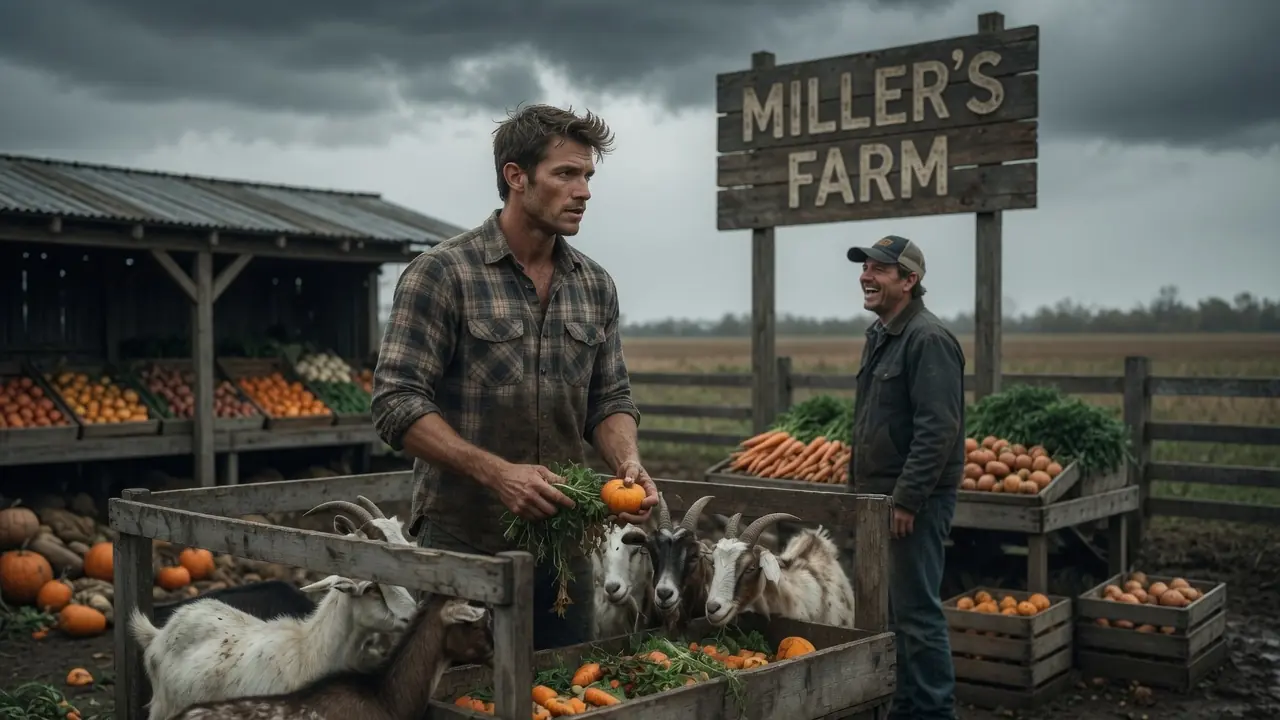
Logan Pierce, the owner of a larger farm down the road, leaned against the fence and pointed at the goats.
“You’re feeding garbage to livestock now?” he mocked. “Is Miller’s Farm really that broke?”
Caleb dropped the pumpkin into the trough. The goats immediately tore into it.
“Call it garbage,” Caleb replied. “I call it food I don’t have to buy twice.”
Logan laughed louder. “This mud pit is dying, and you’re pretending rotten vegetables will save it.”
Caleb looked toward the tired fields beyond the barn. “Then stay and watch, Logan. What you’re laughing at today is exactly what’s going to keep this farm alive.”
A year earlier, Caleb would not have believed his own words.
Miller’s Farm covered twelve acres outside a small town in western Oregon. It was not the kind of farm that appeared on magazine covers. There was no luxury farmhouse, no polished gift shop, and no expensive machinery lined up for photographs.
There was one weathered barn, two greenhouses, an old tractor that leaked hydraulic fluid, a packing shed with a cooler that complained whenever the temperature climbed, and a hand-painted sign near the road. Caleb grew lettuce, carrots, pumpkins, beans, herbs, onions, tomatoes, squash, and whatever else looked promising when he studied seed catalogs during winter.
From the road, the farm appeared productive.
The truth was more complicated.
Fuel prices had risen. Fertilizer cost more each season. Compost deliveries had become expensive, and repairs arrived faster than profits. A broken irrigation pump had recently consumed nearly all the money Caleb had saved for greenhouse improvements.
The greatest problem, however, was the produce nobody purchased.
Customers wanted straight carrots, firm tomatoes, bright lettuce, round pumpkins, and zucchini small enough to fit neatly inside reusable shopping bags. They ignored vegetables that were bent, bruised, split, oversized, wilted, or shaped differently from the ones displayed in supermarkets.
The ugly produce was still edible.
It simply had no market.
Every Saturday afternoon, Caleb returned from the farmers market with several half-filled crates. Lettuce that looked fresh at sunrise had softened by closing time. Tomatoes split after sudden rain. Pumpkins grew with flattened sides. Carrots forked when they reached hard soil.
Caleb donated whatever local shelters could accept. He gave some to neighbors and composted the rest. But the compost pile often became too wet because it contained too much soft vegetable material and not enough dry carbon.
The pile smelled sour.
Flies gathered around it.
Then Caleb bought bagged fertilizer and commercial compost to restore nutrients to the same fields that had produced the discarded vegetables. Every time he unloaded another expensive pallet, the contradiction bothered him.
He was paying to remove nutrients from one place and paying again to return them somewhere else.
Caleb kept a notebook inside his truck. His grandfather had carried one during the years when Miller’s Farm still supported cattle, chickens, pigs, and three generations of family members.
Memory, his grandfather once explained, was too forgiving.
A notebook was not.
At the end of one difficult month, Caleb opened the notebook and reviewed the numbers. He had discarded more than fourteen hundred pounds of unsold produce. Three days later, he had purchased two pallets of compost and several bags of supplemental fertilizer.
The farm was bleeding money from both directions.
Caleb wrote one question beneath the figures:
How can waste become part of the system instead of the end of it?
The answer appeared unexpectedly at Wilks Farm and Garden.
Caleb had driven there for mineral mix, fencing clips, and a replacement handle for a shovel he had broken while trying to remove a large rock. Near the counter, a tired woman named Laura Bennett was explaining that she needed to sell her goats.
Her mother had recently undergone hip surgery. Laura also worked a full-time job and raised two children. She could no longer milk twice daily, repair fences, and keep eleven energetic goats from destroying the hay barn.
“They’re good animals,” Laura said. “Eight does, one wether, and two young ones. I’ll sell them cheaply if someone takes the whole group.”
Caleb stopped examining the fence clips.
“What breeds?”
Laura looked at him. “Mostly Nubian and Alpine crosses.”
“Could they eat vegetable trimmings?”
“They can eat some vegetables,” she replied. “But goats aren’t garbage disposals.”
Caleb nodded. “That isn’t what I’m asking.”
Laura studied him more carefully.
Caleb explained the unsold produce, rising fertilizer costs, tired soil, and the compost system that never seemed balanced. He wondered whether goats could consume carefully sorted vegetable scraps, produce milk, clear cover crops, and provide manure for improved compost.
The man behind the counter grinned. “You’re planning to save a vegetable farm with goats?”
“I’m planning to stop throwing useful things away.”
Laura invited him to see the herd that evening.
The goats stood inside a paddock behind her barn, climbing onto wooden spools, pushing one another away from the hay rack, and shouting at Laura’s truck as though she had been absent for several years instead of twenty minutes.
One brown doe with a white stripe down her face walked directly toward Caleb and pulled at his jacket pocket.
“That’s Maple,” Laura said. “She considers pockets a personal challenge.”
Another goat climbed onto a feed tub for no obvious reason. The two young ones bounced sideways and collided before continuing as if the impact had been intentional.
Caleb watched them for nearly an hour.
They were loud, stubborn, curious, and constantly testing their surroundings. They also represented milk, manure, vegetation control, and a possible destination for produce that had nowhere else to go.
“How much for all eleven?”
Laura named a price lower than he expected but higher than he wanted to spend.
Caleb bought them anyway.
By Saturday morning, nearly everyone at the farmers market had heard.
Logan Pierce asked whether Caleb planned to open a petting zoo. The bread vendor suggested training goats to operate the cash register when vegetable sales declined.
People laughed.
Caleb laughed with them because explaining an unfinished idea usually invited people to crush it before it had enough structure to survive.
The goats arrived the following week in a borrowed livestock trailer.
Loading them required forty minutes.
Unloading them required less than five.
One young goat escaped immediately, circled the truck, jumped onto a stack of harvest crates, and stared down proudly at Caleb. He caught her with grain and named her Cricket before he could stop himself.
That evening, he wrote:
Day one. Goats arrived. Existing fencing useless. Confidence questionable.
Caleb refused to release them directly into his vegetable fields. He understood that an animal did not become useful simply because someone had a clever plan.
A system required boundaries.
He converted one equipment bay into a shelter, built raised sleeping platforms, repaired gates, installed water tanks, and constructed a small milking area. Then he created three clearly marked produce stations.
The first was safe goat feed.
It contained carrot tops, beet greens, cabbage leaves, clean lettuce, pumpkins, pea vines, apple drops, squash, and sunflower heads.
The second was compost only.
That pile received produce that was too old, moldy, slimy, or unsuitable for livestock.
The third was trash.
Caleb wanted the final category to remain as small as possible, but he refused to risk the goats’ health simply to claim that nothing was wasted.
He called the county agricultural extension office and asked how quickly he could introduce vegetables into their diet. A livestock specialist warned him to move slowly, maintain hay and mineral access, avoid sudden dietary changes, and treat produce as part of a balanced ration rather than a complete feed.
“Goats will taste almost anything,” she told him. “That does not mean everything is safe.”
Caleb wrote down every instruction.
The first week was chaos.
The goats shouted before sunrise even when food was already waiting. Maple learned to open one gate latch within three days. Cricket climbed onto the tractor hood and refused to come down until Caleb offered apple slices.
One white doe pushed her head through a cattle panel and then panicked because she could not pull it back. Caleb folded her long ears carefully and guided her through while she screamed as though he had caused the entire situation.
Milking was worse.
Three goats stood calmly.
Two kicked the bucket.
One placed her hoof directly inside the milk pail and looked genuinely surprised by what happened next. Caleb saved less milk than he spilled during the first week.
He also discovered strong preferences.
The goats loved carrot tops and pumpkins. They fought over cabbage leaves. They considered zucchini acceptable but uninspiring. They ate wilted lettuce enthusiastically one day and rejected it the next.
Every evening, Caleb recorded the results.
Produce fed: ninety pounds. Milk saved: one and a half gallons. Buckets kicked over: two. Escapes: one. Regrets: temporary.
By the third week, the routine began working.
The goats received hay first, followed by measured quantities of suitable produce. Caleb cleaned bedding daily and moved the mixture of straw, manure, and leftover plant material into a new compost bay.
The dry bedding balanced the moisture from vegetable scraps. Manure added nitrogen. Chipped branches and leaves improved airflow.
For the first time, Caleb’s compost heated evenly.
Instead of smelling sour, the pile smelled earthy.
He began turning it according to temperature rather than whenever he remembered. That simple change transformed the pile from an unpleasant disposal area into a controlled biological process.
The goats received their first field assignment after the early pea harvest.
Caleb fenced a narrow section containing spent vines, chickweed, and cover-crop growth. He allowed the goats inside for a limited time and watched carefully.
They attacked the vines immediately.
Some plants were trampled. Several stems remained untouched, and every goat attempted to occupy the same corner despite having plenty of space. The work was imperfect, but within two days the top growth had been reduced considerably.
Caleb moved them before they damaged the soil.
He recorded what worked and changed the fencing plan for the next rotation.
That became his method.
Small sections.
Short grazing periods.
Frequent movement.
Long recovery.
He did not expect the goats to understand his farm. He only expected them to behave like goats while he directed that behavior toward useful work.
By the fourth week, the pile of unsold produce behind the packing shed had shrunk.
Market leftovers were sorted immediately. Safe material became feed over the following days. Questionable produce entered compost. Very little reached the trash container.
The first real evidence appeared inside a test garden.
Caleb divided one bed in half. He amended one side with his cured goat-bedding compost and treated the other side using his usual purchased product.
Then he planted lettuce and radishes.
The difference was not miraculous.
It was better than that.
It was measurable.
The soil containing farm-made compost held moisture longer during windy afternoons. It crumbled more easily in Caleb’s hand, and the lettuce remained steadier during temperature changes. Radishes emerged more uniformly.
Caleb photographed both sides and wrote down the observations.
He refused to exaggerate. Farming had taught him that early success could be as misleading as early failure.
At the market, the first new income came from goat milk.
Caleb studied local laws before selling anything. He established a legal herd-share arrangement and supplied extra milk to a soap maker named Rebecca Lane.
Two weeks later, Rebecca returned with several bars wrapped in brown paper.
The label read:
Handcrafted Goat Milk Soap — Made With Milk From Miller’s Farm
Caleb stared at it.
He had seen the farm’s name on boxes of lettuce, pumpkin signs, and invoices. This felt different.
Vegetable scraps fed goats.
Goats produced milk.
Milk became soap.
Goat bedding and manure became compost.
Compost fed vegetables.
For the first time, Miller’s Farm was beginning to function like a circle instead of a straight line ending at a waste pile.
People around town slowly changed their questions.
Logan stopped calling the goats pets and asked whether they could control blackberry growth. The honey vendor wanted to know whether cured goat compost would help his wife’s flower beds.
A teacher requested a farm visit so her students could learn about what she called the “recycling goats.”
Caleb disliked the phrase, but he understood why children remembered it.
The largest public change happened after Halloween.
Miller’s Farm usually had dozens of unsold pumpkins left after the season. That year, customers asked whether they could bring their used pumpkins back for the goats.
Caleb established strict rules.
No candles.
No paint.
No glitter.
No mold.
Clean pumpkins only.
Families began arriving with jack-o’-lanterns. Children gathered by the fence while Maple ate the face from a pumpkin that still had one triangular eye.
Cricket pushed her head completely inside another pumpkin and ran backward into the fence. A little boy laughed so hard he fell into a hay bale.
Photographs spread online.
The same people who had mocked Caleb for feeding “trash” to livestock now drove to the farm specifically to participate.
Caleb expanded carefully.
He sold finished compost in small bags, added seasonal farm tours, increased soap production with Rebecca, and began offering goat-milk caramel through a licensed local kitchen.
None of the income streams was enormous alone.
Together, they changed the farm’s financial position.
Feed costs declined because produce replaced part of the purchased ration without compromising nutrition. Compost expenses fell. Soil structure improved, reducing irrigation demand in several beds.
Customers stayed longer at the farm stand and purchased more because they came to see the goats.
The system still created problems.
Three days of heavy rain turned the goat yard into deep mud. Caleb spent money on drainage and gravel. One compost batch went sour after he added too many wet scraps.
Milk production dropped during winter.
A neighbor complained about odor during an unusually warm week. Caleb inspected the system and admitted the neighbor was correct. He had allowed bedding to remain too long before cleaning.
The goats had not eliminated work.
They had made the work more connected.
Near the end of winter, Caleb sat at his kitchen table surrounded by receipts, feed invoices, market records, fertilizer bills, and his old notebook.
He calculated the numbers several times.
The farm had discarded seventy percent less usable produce. Purchased compost and fertilizer costs had fallen significantly. Milk, soap, compost, tours, and seasonal events produced enough additional revenue to cover the goats’ annual care and part of the greenhouse loan.
Vegetable yields had also improved in beds receiving the mature compost.
Miller’s Farm was not suddenly wealthy.
It was stable.
For Caleb, stability felt like a miracle earned through mud, mistakes, and careful records.
He wrote beneath the totals:
Waste is only waste when it has nowhere useful to go.
The next season brought more customers and better soil. Caleb added a permanent composting structure, improved the milking room, and expanded rotational grazing into overgrown field edges.
Miller’s Farm began purchasing suitable produce rejects from two neighboring farms at a low price. Their owners saved disposal costs, while Caleb gained additional feed and compost material.
One afternoon, Logan Pierce arrived with a truck carrying bruised squash and damaged pumpkins.
Caleb watched him park beside the goat pen.
“I heard you’re taking surplus produce,” Logan said.
“I take suitable feed. Not garbage.”
Logan glanced toward the goats. “You know what I meant.”
“I remember exactly what you meant.”
Logan’s jaw tightened. “Are you taking the load or not?”
Caleb inspected the produce and rejected several moldy crates. The remaining material was safe.
“I’ll take this portion.”
Logan stared at the farm stand, where customers purchased vegetables, soap, compost, and goat-milk products. A school group gathered near the barn, and two employees loaded orders into a delivery van.
“You really built all this from leftovers?”
“No,” Caleb replied. “I built it by paying attention to what the leftovers could do.”
Logan looked embarrassed. “I suppose I was wrong.”
Caleb lifted a split pumpkin from the truck. “You were loud. That isn’t always the same as being right.”
By the third year, Miller’s Farm crossed six figures in total annual sales for the first time in its history. Vegetables remained the core business, but the farm no longer depended on one narrow revenue stream.
The improved soil produced stronger crops.
The goats generated milk, manure, farm experiences, and public attention. Compost sales grew among gardeners who wanted locally produced organic matter.
Caleb hired two full-time employees and several seasonal workers.
He repaired the old cooler, replaced failing greenhouse plastic, and finally purchased a reliable used tractor. He also paid off the irrigation-pump repair that had once made him question whether the farm could survive another season.
During the autumn harvest festival, Logan returned with several farmers who had once laughed beside the fence.
They stood near the original goat pen while Caleb carried pumpkin pieces toward the trough. He still looked exactly like the man they remembered—short tousled brown hair, rough stubble along his jaw, sharp hazel eyes, rolled plaid sleeves, muddy jeans, and the strong, lean frame built by years of farm work.
But Miller’s Farm no longer looked like a dying mud pit.
Rows of healthy vegetables stretched behind the barn. Steam rose from managed compost bays. Customers crowded the stand, and a delivery van waited beside cases of soap and preserved products.
Logan pointed toward the trough.
“I still think it looks like trash.”
Caleb tossed the pumpkin inside. Maple and Cricket immediately pushed forward.
“Then you still haven’t learned how to look.”
A young girl standing nearby watched Maple chew a cabbage leaf.
“That goat is eating garbage,” she said.
Caleb leaned against the fence. “It looks like garbage to us.”
“What is it to her?”
“Food.”
The girl pointed toward the compost bays. “And after that?”
Caleb looked toward the vegetable rows waiting for the next planting.
“Next year’s soil.”
She frowned thoughtfully. “So it becomes vegetables again?”
“That’s the idea.”
Maple burped loudly.
The girl burst into laughter.
Caleb laughed with her.
He had not saved Miller’s Farm through one brilliant invention. He saved it by building small connections.
A bruised apple fed an animal.
An animal produced milk and manure.
Manure mixed with bedding and plant material became compost.
Compost restored the soil.
Healthy soil produced vegetables.
Some vegetables were sold.
Others returned to the goats.
Each part supported another.
The farm did not become perfect. Goats still escaped. Fences still broke. Weather ruined plans, equipment failed, and customers occasionally wanted tomatoes when only lettuce was ready.
But Caleb no longer looked at every imperfect result as a loss.
He asked where it belonged next.
People had laughed because they saw a handsome young farmer standing in mud while goats ate vegetables nobody wanted.
They believed he was desperate.
They were partly right.
Desperation had forced him to reconsider habits everyone else accepted. It made him question why a farm should purchase nutrients while throwing nutrients away.
It pushed him toward the loudest, most stubborn animals he had ever owned.
The goats did not perform a miracle.
They simply became part of a system Caleb was disciplined enough to build around them.
Years later, the original photograph of Caleb feeding cracked pumpkins to goats still hung inside the farm stand. Someone had taken it on the afternoon Logan publicly mocked him.
Caleb stood in the foreground, serious and exhausted, while three neighbors laughed behind the fence.
Under the framed photograph, Caleb placed a small brass plaque.
THE DAY EVERYONE THOUGHT MILLER’S FARM WAS FINISHED
Beneath that line was another.
IT WAS ACTUALLY THE DAY IT STARTED AGAIN.