“Look at this dump, old man,” Richard Caldwell said, pointing at the leaning barn as if the whole county had gathered just to admire his cruelty. His polished black shoes sank slightly into the dry dirt of Walter Hayes’s farm, and the irritation on his face deepened, as though even the dust had insulted him. Behind him stood three men from the county board, two curious neighbors, and a young reporter from the Mason Ridge Gazette who had been invited by Richard himself. Walter stood alone in his faded brown coat and battered hat, his white beard moving slightly in the wind, his eyes fixed not on Richard’s finger but on the rusted chain around the barn doors.
The barn had stood on that land for almost ninety years, older than most families in Mason Ridge and quieter than all of them. Its roof sagged in one corner, the boards had turned gray from rain and sun, and the hinges groaned whenever the wind pushed against them at night. To strangers, it looked abandoned. To Richard Caldwell, whose white stone mansion rose on the hill beyond the pasture, it looked like a stain on the view he had paid millions to enjoy.
“You hear me, Walter?” Richard continued, stepping closer with a cruel smile. “This rotten thing is embarrassing the whole road. People drive past my estate and the first thing they see is your collapsing junk pile.” He turned slightly so the county men could hear every word. “I’ve tried being patient, but there comes a time when a man’s pride becomes a public nuisance.”
Walter did not answer right away. He looked past Richard at the barn, at the boards his father had nailed before Walter was born, at the little upper window where barn owls had nested when he was a boy. His hands, rough and scarred from years of farming, tightened around the chain. Then he looked back at Richard with a calmness that made the younger man’s smile falter for half a second.
“Funny,” Walter said quietly, “how men with the biggest houses always seem scared of the smallest old barns.”
A few of the neighbors shifted uncomfortably. Richard’s face hardened. He had expected Walter to mumble, apologize, or maybe shuffle away in embarrassment. Instead, the old farmer stood there like a fence post sunk too deep to be moved by weather or money.
Richard Caldwell had moved to Mason Ridge eight years earlier after selling a real estate company in Atlanta. He bought the old Pennington property, tore down the farmhouse, and built a mansion with tall glass windows, imported stone, a private tennis court, and a driveway lined with young maple trees. He liked telling people he had brought class to the ridge. What he never said aloud, though everyone knew it, was that he hated living next to Walter Hayes.
Walter’s farm was the last working piece of land along that stretch of road. The other farms had been sold, divided, renamed, and fenced into estates with decorative horses no one rode. Walter still had muddy boots by the porch, a small garden behind the kitchen, a few head of cattle, and that old barn standing stubbornly against the sky. Every time Richard hosted guests on his terrace, someone eventually looked across the field and asked about the leaning structure below.
At first, Richard had tried polite pressure. He offered to buy the barn and the two acres around it, claiming he wanted to “restore the road’s beauty.” Walter refused. Then Richard offered more money, enough to replace Walter’s roof, fix his porch, and pay his property taxes for years. Walter still refused, saying only that the barn was not for sale.
After that, Richard stopped pretending to be friendly. He filed complaints about safety. He called the barn a hazard, an eyesore, and a threat to property values. He complained to the county office, to the historical society, to anyone who would listen long enough to nod. When that failed, he began mocking Walter in public.
At Millie’s Diner, Richard once said loudly that Walter’s barn looked like something waiting for a stiff breeze to finish the job. At church, he joked that the building was so old even ghosts had moved out. At a county fundraiser, he called Walter “the curator of rotten wood,” and several people laughed because laughing at rich men’s jokes felt safer than disagreeing with them. Walter heard about every insult, and he answered none of them.
The truth was that Walter had grown used to being underestimated. After his wife, Clara, passed away eleven years earlier, people started treating him as if grief had emptied his mind. They spoke louder when they talked to him, explained things he already knew, and assumed his silence meant confusion. They did not know that silence had always been Walter’s way of protecting what mattered.
Every evening after sunset, Walter walked from his little farmhouse to the barn with a lantern in one hand and a key in the other. Neighbors had seen him do it for years. Some joked that he was talking to raccoons. Others whispered that he had gone strange after Clara’s death and spent his nights wandering among broken tools.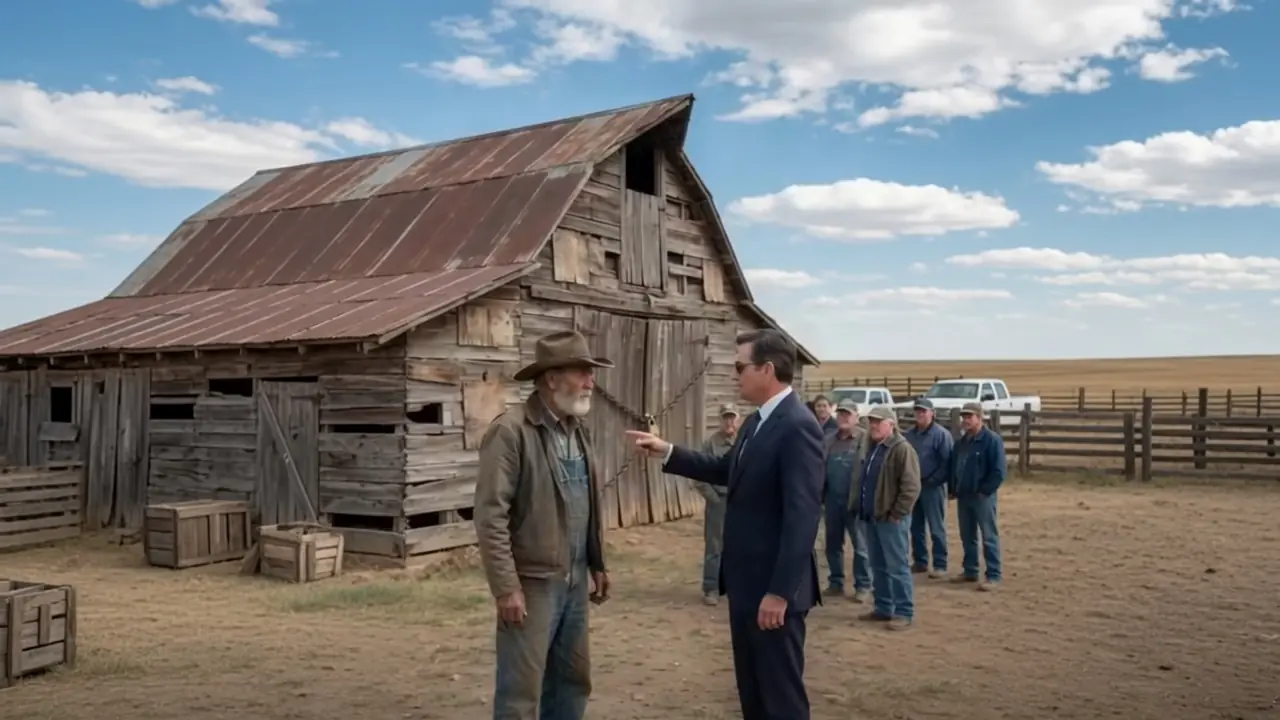
But inside the barn, behind the faded boards and chained doors, Walter kept a world no one in Mason Ridge had ever imagined. Rows of antique tractors sat beneath canvas covers, each one cleaned, restored, oiled, and preserved with a devotion almost religious. There were rare Farmalls with perfect red paint, early John Deere models with hand-crank starters, a gray Ferguson that had once changed the way small farms worked, and several prototypes so rare that only a handful of experts even knew they still existed. Along the back wall stood shelves of parts, manuals, photographs, letters, and handwritten notebooks that told the story of American farming one machine at a time.
Walter had not built the collection for money. He had built it because of his father. Samuel Hayes had been a mechanic before he became a farmer, the kind of man who could hear an engine cough and know which bolt had loosened. During the hard years after the war, farmers from three counties brought dead tractors to Samuel, and he brought them back to life when no dealership would touch them. Walter grew up holding flashlights, sorting bolts, wiping grease from his hands, and listening to his father talk about machines as if they were old horses with memories.
When Samuel died, Walter inherited not just the farm but the first six tractors in the barn. Over the decades, he added more. Some came from widows who could not bear to send their husbands’ machines to scrap. Some came from auctions where Walter stood quietly in the back until everyone else stopped bidding. A few came from abandoned fields, pulled from weeds, rebuilt piece by piece through long winters.
Clara had helped him catalog every machine. She wrote notes in neat blue ink and pasted photographs into albums. She could identify a tractor by the shape of its grille faster than most men at the feed store. On rainy nights, she and Walter sat inside the barn with coffee in tin cups, listening to rain hit the metal roof while she said, “One day, people will understand what you saved here.”
Walter always smiled and told her, “Maybe. But it’s enough that we understand.”
After Clara died, the barn became more than a collection. It became the last room in the world where Walter still felt her beside him. Her notes remained in the ledger. Her scarf still hung on a nail near the workbench. Her handwriting labeled drawers of bolts, belts, gauges, and carburetors.
That was why Walter never sold the barn to Richard Caldwell. It was not stubbornness. It was memory. It was history. It was love preserved under canvas and dust.
But Richard knew none of this, and if he had known, he would not have cared.
On the morning of the confrontation, Richard arrived with papers tucked under his arm and confidence shining on his face. He had convinced two county board members to inspect the barn, claiming it posed a danger to children and passersby. He had brought the Gazette reporter because humiliation worked better when printed. He had even called several neighbors, pretending to be concerned about “community standards.”
Walter watched them come from his porch. He had been expecting something like this for months. Richard had grown bolder since a storm tore a strip of tin from the barn roof in March. Walter had repaired the inside structure immediately, but he left the outer boards untouched because disguises were sometimes useful. A barn that looked worthless attracted fewer thieves.
Richard stopped ten feet from Walter and smiled like a man already giving a victory speech. “This ends today,” he said. “Either you agree to have it demolished, or the county will condemn it.” He lifted the papers slightly. “I’ve spoken to the right people.”
Walter looked at the county men. One of them, Tom Blevins, avoided his eyes. The other, Marshall Pike, studied the barn as if trying to seem official. The reporter, a young woman named Amy Ross, held her phone and notepad, uncertain whether she was witnessing a legal matter or a public shaming.
“You bring all these folks to look at my barn?” Walter asked.
Richard laughed. “No, Walter. I brought them to look at your problem.”
Walter’s jaw tightened, but his voice stayed low. “My problem has been standing longer than your mansion, Richard.”
Richard stepped closer and pointed toward the roof. “Your problem is rotten wood, rusted tin, and an old man too proud to admit he can’t take care of his property anymore.” He turned toward Amy. “Write that down if you want the truth.”
Amy lowered her eyes to the notepad but did not write.
Walter looked at Richard’s finger, then at Richard’s face. “You always talk loud when you don’t know what you’re standing in front of.”
Richard smirked. “I know exactly what I’m standing in front of. A dump.”
The word hung in the air. A light wind moved through the dry grass. Somewhere behind the barn, a cow lowed softly, indifferent to human arrogance.
Walter slowly reached into his coat pocket and touched the old brass key. For years, he had protected the barn by keeping people out. Today, he understood that the only way to protect it now was to let someone worthy see inside. Richard had brought a reporter and county men to shame him. Walter had brought someone else.
A black sedan appeared at the end of the dirt lane, moving slowly past the pasture fence. Richard turned with irritation, clearly annoyed that someone had arrived without his permission. The car stopped near the group, and a tall man in his sixties stepped out, wearing a tweed jacket, dusty brown shoes, and round glasses. He carried a leather satchel and looked at the barn with immediate interest.
“Mr. Hayes?” the man called.
Walter nodded. “Dr. Everett Lane.”
Richard frowned. “Who is this?”
Dr. Lane walked forward and shook Walter’s hand with both of his. “Thank you for inviting me. I came as soon as I saw the photographs you mailed.” His eyes moved to the barn doors. “Are they inside?”
Walter gave a small nod. “Every one of them.”
Richard scoffed. “Walter, what game are you playing?”
Dr. Lane turned toward him. “And you are?”
“Richard Caldwell,” he said sharply. “I live on the neighboring estate. We’re here on county business.”
“Ah,” Dr. Lane said, in a tone that suggested Richard had become less interesting. “Then you may want to stay.”
Richard’s face tightened. “Why would I want to stay?”
Walter looked directly at him. “Because you came all this way to see a dump.”
The neighbors went still. Richard’s mouth opened slightly, but before he could answer, Walter turned toward the barn. He unwrapped the rusted chain from the handles, link by link, the metal scraping against old wood. Every sound seemed louder than it should have been. Even Richard stopped talking.
Walter slid the brass key into the heavy lock. For a moment, his hand paused. He thought of Clara standing beside him, smiling in the glow of the lantern. Then he turned the key.
The lock clicked open.
Walter pulled the doors apart, and the smell of old wood, clean oil, and preserved machinery drifted into the morning air. At first, the crowd saw only darkness. Then Dr. Lane stepped forward, lifted his flashlight, and the beam landed on the first row of tractors. Red paint gleamed under canvas edges. Green wheels lined the floor in perfect order. Brass plates, polished gauges, and restored steel caught the light like treasure.
Dr. Lane stopped breathing for a second.
“My God,” he whispered.
Richard stood frozen, his expression caught between confusion and disbelief. He had expected broken furniture, moldy hay, and maybe a rusted plow. Instead, the barn opened like a secret museum. Walter walked inside slowly and pulled two cords near the workbench. Overhead lights blinked, hummed, and then filled the barn with a warm glow.
The full collection appeared.
There were more than forty tractors arranged in careful rows, each with a placard handwritten by Clara and sealed behind glass. There were engines mounted on stands, early steel wheels, restored seed drills, rare belt pulleys, and a wall of photographs showing the machines at work across generations. Along one side, glass cases held original manuals, letters from manufacturers, dealership tags, and farm journals dating back to the 1920s. The falling barn was not falling inside at all. Its beams had been reinforced, its floor sealed, its roof braced from within, and its hidden interior preserved with better care than Richard’s mansion garage.
Dr. Lane moved forward like a man entering a cathedral. His hands trembled as he stopped beside a dark green tractor near the center row. “Is this the Whitcomb experimental orchard tractor?” he asked, his voice barely above a whisper.
Walter nodded. “Only one I know that still runs.”
Dr. Lane turned to stare at him. “There were supposed to be only three built.”
“Four,” Walter said. “This one never made the company papers. My father repaired it in 1949 after the factory man abandoned it behind a dealership.”
Dr. Lane’s face changed completely. He looked younger suddenly, alive with astonishment. “Mr. Hayes, do you understand what this is?”
Walter’s eyes moved across the machines. “I know what every one of them is.”
Richard stepped inside, his polished shoes now walking across the clean wooden floor he had called rotten. His face had gone pale, but pride forced him to speak. “Old tractors,” he said, trying to sound unimpressed. “So what? Collectors keep all kinds of things.”
Dr. Lane turned slowly. “Mr. Caldwell, this is not a hobby collection. This is one of the most complete privately preserved agricultural machinery archives I have ever seen.” He pointed toward the back wall. “Those journals alone could rewrite regional farming history.”
Amy Ross finally began writing.
Richard looked around, searching for something to criticize. “This building is still an eyesore from outside.”
Walter walked to the nearest tractor and rested one hand on its wheel. “The outside kept men like you from wanting what was inside.”
The words struck harder than a shout. One neighbor covered his mouth. Tom Blevins shifted again, now visibly ashamed. Richard looked at Walter as if seeing him for the first time, not as an old farmer beside his estate, but as a man who had outsmarted him for years without raising his voice.
Dr. Lane moved from tractor to tractor, naming models, dates, and manufacturers with growing disbelief. “This Farmall F-20 still has original decals. That Allis-Chalmers is an early orchard configuration. Those steel lugs are nearly impossible to find intact.” He stopped at a small gray machine near the rear. “And this Ferguson… Mr. Hayes, this serial number places it in the first production run.”
Walter nodded once. “Clara liked that one best.”
“Clara?” Amy asked softly.
“My wife,” Walter said. “She cataloged most of this.” He opened a glass case and lifted a blue notebook with careful hands. “Her handwriting. Every repair, every part, every story we could save.”
Amy looked at the notebook, then at Walter’s face, and her expression softened. She had arrived expecting a dispute about a dangerous barn. Now she understood she was standing inside a hidden lifetime. She took a photograph of the notebook but did not use flash.
Richard’s voice returned, harsher because it had less ground beneath it. “This doesn’t change the fact that the exterior violates community appearance standards.”
Walter turned toward him. “Community appearance standards?” he repeated. “You mean your view.”
Richard’s jaw clenched. “The road matters.”
“So does history,” Dr. Lane said sharply.
Richard gave him a cold look. “History doesn’t excuse neglect.”
Dr. Lane stepped closer, no longer polite. “Neglect? Mr. Caldwell, this barn has a reinforced internal frame, humidity control vents hidden behind the upper slats, a sealed floor, and one of the finest preservation systems I have seen outside a professional museum.” He pointed at the beams. “You judged the skin and missed the bones.”
Walter’s eyes stayed on Richard. “That’s a habit with him.”
The county men heard it, and neither one defended Richard. Marshall Pike walked to one of the support beams and ran a hand over the new bracing hidden behind old planks. “Walter, you did all this work yourself?”
“Some,” Walter said. “Had help with the roof trusses years back. Paid cash. Kept receipts.”
Richard turned sharply. “Receipts?”
Walter walked to a metal cabinet, opened a drawer, and pulled out a folder thick with papers. He handed it to Marshall. “Structural repairs. Electrical inspection. Insurance appraisal. Pest control. Fire suppression system installed five years ago.”
Richard’s confidence drained piece by piece. He had built his entire complaint on the idea that Walter was negligent, confused, and poor. But Walter had prepared for this day with the patience of a man who knew arrogance always came knocking eventually. The barn was not unsafe. It was disguised.
Dr. Lane looked at Walter with deep respect. “Why keep this hidden for so long?”
Walter’s hand moved to Clara’s scarf hanging near the workbench. “Because people don’t always love history. Sometimes they just price it, steal it, or turn it into a sign by the highway.” His voice grew quieter. “Clara and I wanted it safe until we knew what should happen next.”
“And do you know now?” Amy asked.
Walter looked around the barn. His eyes rested on the tractors, the ledgers, the photographs, and the empty chair beside the workbench where Clara used to sit. “I think today helped me decide.”
Richard straightened, sensing an opportunity. “If this is worth so much, you should sell it and demolish the structure. Build something proper. I know people who can arrange private buyers.”
Walter laughed once, dry and humorless. “Of course you do.”
Richard stepped toward him. “Don’t be foolish. A collection like this could bring millions. You could move somewhere comfortable, hire care, stop living like this.”
Walter’s expression hardened. “Living like what?”
Richard hesitated, but cruelty had always been easier for him than wisdom. “Like a lonely old man guarding rust.”
The barn went silent.
Walter stepped closer to Richard, not fast, not loud, but with a weight that made everyone watch. “That rust fed families before your money had a name,” he said. “Those machines carried men through drought, debt, war, and harvest. My father saved them from scrap. My wife wrote down their stories. I spent my life keeping them alive because people like you only know the price of land after someone else has loved it.”
Richard swallowed, but Walter was not finished.
“You called this place a dump,” Walter said, his voice low and sharp. “You laughed at my barn in diners, churches, and county rooms. You told people I was too old to know what I had.” He pointed toward the open doors. “Now look inside, Richard. Look hard. This is what was standing beside you all those years while you mistook shine for worth.”
Dr. Lane’s eyes lowered in respect. Amy’s pen stopped moving. Even the neighbors seemed to understand that they were no longer watching a property dispute. They were watching a man reclaim his dignity.
Richard tried to recover one final time. “You still can’t expect the county to let the exterior remain like that.”
Marshall Pike closed the folder and looked at him. “Actually, the county may have a different concern now.”
Richard frowned. “What does that mean?”
Tom Blevins cleared his throat. “If Dr. Lane confirms historical significance, this barn may qualify for preservation status.”
Richard stared at him. “Preservation status?”
Dr. Lane nodded. “I will be making that recommendation immediately.” He turned toward Amy. “And I suspect the state agricultural museum will want to partner with Mr. Hayes, if he is willing.”
Richard’s face twisted. “Partner?”
Walter’s voice was calm. “Not sell.”
Dr. Lane smiled slightly. “No. Preserve, document, and honor.”
Amy looked at Walter. “Mr. Hayes, may I ask what you want people to understand when they read this story?”
Walter did not answer quickly. He walked to the first tractor his father had ever owned, a faded red machine with carefully polished metal and worn pedals. He placed one hand on the seat. For a moment, everyone in the barn disappeared, and he was a boy again, holding a wrench while his father taught him that a machine was only dead when a man stopped listening.
Then he looked back. “I want them to understand that old things aren’t worthless just because they’re quiet,” he said. “Old barns. Old machines. Old farmers. Sometimes what looks worn out is the only thing still holding the truth together.”
Amy wrote it down with tears in her eyes.
The article came out two days later. The headline filled the front page of the Mason Ridge Gazette: “Falling Barn Reveals Rare Agricultural Treasure Hidden for Decades.” Amy’s story did not mock Walter. It honored him. She wrote about Samuel Hayes, Clara’s notebooks, the tractors saved from scrap, and the wealthy neighbor who had tried to force the barn down without knowing what stood inside.
By sunrise, calls began coming in. The state agricultural museum contacted Walter before breakfast. A university professor asked permission to study Clara’s catalogs. A collector from Iowa offered a large sum for just one tractor, and Walter politely refused before the man finished speaking. By noon, reporters from larger papers were parked along the dirt lane.
Richard Caldwell did not leave his mansion that day. His name was not printed as cruelly as it could have been, but everyone in Mason Ridge knew who the article meant when it described “a neighboring landowner who had long dismissed the barn as a public nuisance.” At Millie’s Diner, people stopped laughing at Richard’s jokes before he even made them. At church, the pastor preached about judging by appearances, and half the room looked at the floor.
A week later, the county board held a special meeting. Walter arrived in his old coat, carrying Clara’s blue notebook in a cloth bag. Richard arrived in a navy suit, looking stiff, angry, and smaller than usual. Dr. Lane presented photographs, records, appraisals, and a preservation recommendation that left no room for argument.
“This is not merely a private collection,” Dr. Lane told the board. “It is a living archive of regional agricultural development. The barn itself is part of that story. Its outer appearance reflects the original farm structure, while its interior demonstrates extraordinary private preservation.”
Richard stood to object. “No one is denying the man collected machines. But must the rest of us live beside decay in the name of nostalgia?”
Walter slowly rose from his seat.
The room quieted.
“You keep calling it decay,” Walter said, looking straight at Richard. “But decay is what happens when people forget what built the ground under their feet. This barn didn’t rot Mason Ridge. It remembers Mason Ridge.”
No one spoke for several seconds.
The board voted unanimously to grant the barn protected historical status, pending state approval. Richard walked out before the meeting ended. Walter stayed behind, not to celebrate, but to shake Dr. Lane’s hand and thank Amy for telling the story right.
Over the next months, the barn changed without losing itself. Volunteers came from the local high school to help clean the grounds. Retired farmers brought photographs and stories of tractors they had used as boys. The state museum helped install safer lighting, better climate control, and a small visitor path through the collection. Walter insisted that Clara’s handwriting remain on every placard.
He also insisted the barn exterior not be made too pretty. “Fix what needs fixing,” he told the restoration crew. “But don’t make it look like it never worked for a living.”
They listened.
By autumn, the Hayes Agricultural Heritage Barn opened for its first public weekend. Cars lined the road from morning until late afternoon. Children stared wide-eyed at machines taller than they were. Old farmers ran their hands over steering wheels and grew quiet with memory. Mothers read Clara’s notes aloud to their sons and daughters.
Walter stood near the entrance, uncomfortable with praise but patient with questions. People who had laughed at him came through the doors with lowered eyes. Some apologized directly. Others simply removed their hats, looked around, and said, “I never knew.” Walter accepted both with the same quiet nod.
Near closing time, Richard Caldwell appeared.
He came alone, without a suit jacket, without reporters, without his usual crowd. Walter saw him standing outside the barn doors, looking at the building he had tried to erase. For a long moment, Richard did not enter. Then he stepped inside.
The visitors had mostly gone. Dr. Lane was speaking with a university student near the back. Amy Ross was taking notes for a follow-up article. Walter stood beside Clara’s favorite Ferguson tractor, watching Richard approach.
Richard stopped several feet away. His face no longer carried the same sharp arrogance, though pride still struggled in his jaw. “I didn’t come to cause trouble,” he said.
Walter waited.
Richard looked around the barn, really looked this time. His eyes moved over the machines, the photographs, the handwritten histories, and the people reading them with respect. “I was wrong about the barn,” he said finally.
Walter’s voice was steady. “Yes, you were.”
Richard swallowed. “And about you.”
Walter did not soften quickly. “Yes.”
Richard lowered his eyes. “I thought value looked a certain way.”
Walter looked at the old machines glowing under the barn lights. “Most people do.”
For a while, neither man spoke. Outside, the sunset stretched over Mason Ridge, turning the fields bronze and soft. The mansion on the hill caught the light in its windows, but for once, it did not seem like the most important thing on the road.
Richard cleared his throat. “I owe you an apology.”
Walter looked at him, and behind the old farmer’s tired eyes was not victory, but something heavier and cleaner. “You owe this place respect,” he said. “Start there.”
Richard nodded slowly. “All right.”
Walter reached into the glass case and opened Clara’s blue notebook to a page with a photograph of the barn from 1953. Samuel Hayes stood in front of it, one hand on a tractor, Walter as a boy beside him. Clara had written beneath the picture: “Some buildings hold more than hay. Some hold the proof that ordinary people mattered.”
Walter turned the notebook so Richard could read it.
Richard stared at the words for a long time. His mouth tightened, not with anger now, but with shame. “Your wife wrote that?”
Walter nodded. “She saw things before most of us did.”
Richard looked again at the barn, and this time he did not see a dump. He saw hands. He saw years. He saw a life he had mocked because it had not dressed itself in marble.
The next spring, the state officially recognized the Hayes barn as a historic agricultural site. A modest sign was placed near the road, wooden and simple because Walter refused anything flashy. It read: Hayes Heritage Barn, Preserving the Machines and Memories of American Farming. Beneath that, in smaller letters, were Clara’s words: Ordinary people mattered.
Walter still came to the barn every evening after sunset. Only now, he no longer locked the doors because he was afraid people would laugh. He locked them because treasures deserved care. Sometimes he sat beside Clara’s scarf with a cup of coffee and listened to the quiet engines cooling in the dark.
One evening, Amy Ross found him there while writing another piece. She asked if he ever regretted keeping the collection hidden so long.
Walter smiled faintly. “No,” he said. “Some seeds grow better underground until the right season.”
She looked at the rows of tractors. “And is this the right season?”
Walter looked through the open barn doors at the road where people once slowed down to laugh and now slowed down to read the sign. He thought of Richard’s cruel finger pointing at rotten boards. He thought of Dr. Lane standing speechless in the doorway. He thought of Clara’s steady handwriting, still teaching strangers what dignity looked like.
“Yes,” Walter said softly. “I believe it is.”
By the end of that year, school buses began visiting the barn. Children learned how farming changed, how machines saved labor, how families survived hard seasons, and how history was sometimes hidden in places people were too proud to enter. Walter showed them how to turn a hand crank, how to read tire marks, and how to listen when an old engine had something to say. He never raised his voice, but every child listened.
And every time someone asked why the outside of the barn still looked old, Walter gave the same answer.
“Because it earned every wrinkle.”
Years later, when people told the story of Walter Hayes, they did not begin with the rich man on the hill. They began with the old farmer who stood in front of a falling barn while everyone mocked him. They told how he unlocked the doors, let the light in, and revealed a treasure Mason Ridge had been too blind to see. And they always remembered the sentence that silenced Richard Caldwell in front of the whole county.
“You laughed at this barn because your money never taught you how to see value.”
The barn still stood after that. Stronger than ever. Not because it had never been weathered, but because someone had loved it enough to preserve what mattered inside.