The first wheelbarrow of stones reached the Barnett field shortly after sunrise.
Eli Barnett pushed it through the dust with both hands clenched around the rusted handles, his thin shoulders shaking beneath the weight. Each turn of the wheel produced a painful squeal that carried across the dry farmland outside Millbrook Hollow. By the time he reached the center of the field, sweat had soaked through his faded shirt, though the morning was barely warm.
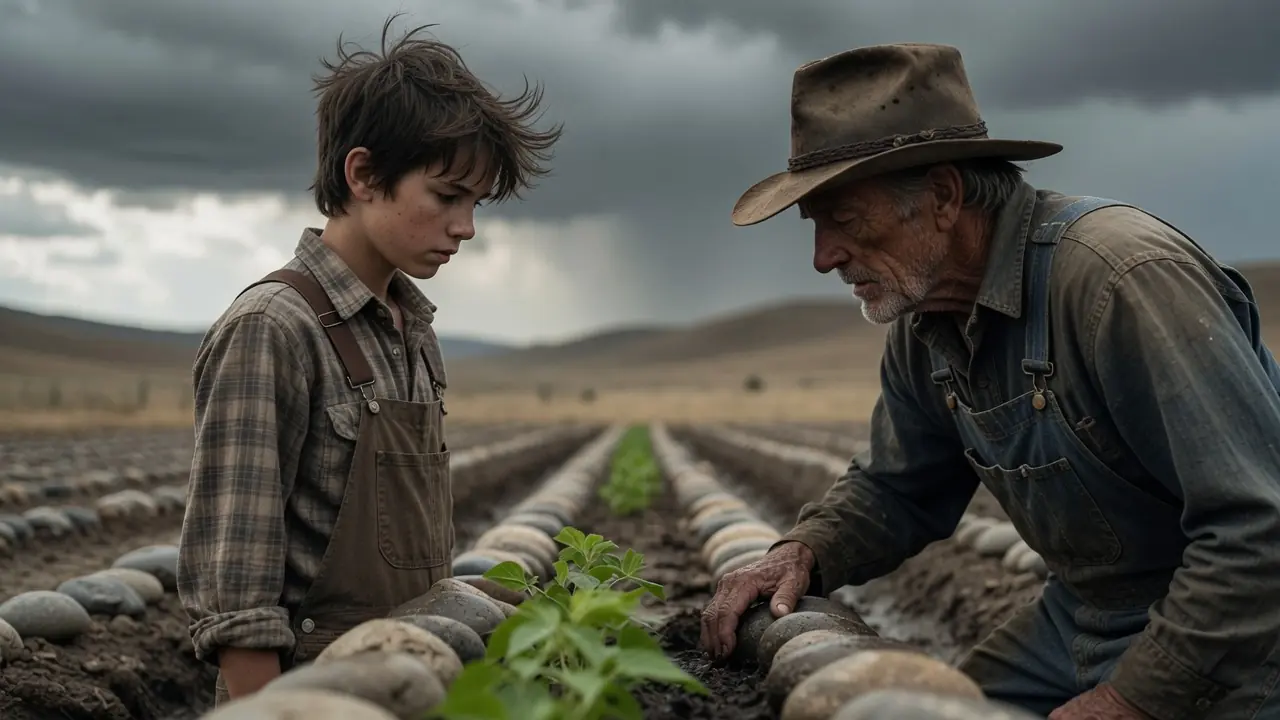
He tipped the stones onto the cracked soil.
The noise attracted Walter Briggs, who was driving past in his pickup truck. Walter slowed beside the fence, lowered his window, and stared at the boy unloading rocks onto land that desperately needed to be cleared. Two other farmers sat beside him, both returning from the feed store.
Walter stopped the truck.
“Why bury your father’s last field under useless rocks?”
Eli wiped his forehead with his sleeve.
“Because they hold the water your pride ignored.”
Walter laughed.
“You’re just a poor boy playing farmer.”
Eli pointed toward the cracked earth.
“Then kneel down when the shoots come—the field will prove you wrong.”
The men inside the truck laughed harder.
Walter shook his head, shifted into gear, and drove away, leaving a long cloud of dust behind him. Eli waited until the sound disappeared before looking down at the stones. His answer had sounded confident, but he had no proof that any shoots would come.
The Barnett farm had not produced a good harvest in three years.
Four acres of corn, beans, and vegetables had once supported the family, though never comfortably. Eli’s grandfather had purchased the land before the paved road reached Millbrook Hollow, and his father, Thomas, had inherited it with an old tractor, a leaning barn, and enough debt to make every season dangerous. In good years, hard work kept them alive.
The recent years had not been good.
Rain clouds gathered above the hills but often disappeared before reaching the valley. When storms finally came, the hardened soil rejected the water, sending it rushing through the ditches instead of absorbing it. Corn emerged thin and yellow, while bean vines withered before reaching the first wire.
Thomas worked from darkness until darkness.
He repaired fences, sold equipment, took night shifts at a grain warehouse, and planted again whenever failure left enough seed. Yet every month another white envelope arrived from the bank. Thomas placed each one inside the kitchen drawer without opening it in front of the children.
Eli knew what they contained.
One evening, he heard his parents speaking in the kitchen after they believed he was asleep. His mother, Ruth, asked how much time remained. Thomas answered that the bank would begin foreclosure after harvest if they failed to make two payments.
“There may not be a harvest,” Ruth whispered.
Thomas did not answer for a long time.
“We could sell before they take it.”
“And go where?”
“I don’t know.”
Eli stood behind the hallway wall, holding his breath. The farm was more than a house and four acres. His grandfather’s initials remained carved into the barn door, and his mother had planted roses beside the porch using cuttings from her wedding bouquet.
His grandmother, Vera, lived in a small room behind the kitchen.
She was seventy-nine and walked with a bent back, but her eyes missed very little. Vera had watched Millbrook Hollow change from green farmland into a valley of dust and empty barns. She remembered streams that ran through August and summers when corn leaves remained broad and dark.
One evening, she found Eli standing near the driest corner of the field.
Vera lowered herself onto an overturned crate and pushed her fingers into the cracked soil. She held the dirt in her palm, letting it crumble between her fingers. The last pieces blew away before reaching the ground.
“This field is screaming,” she said.
Eli crouched beside her.
“What is it saying?”
“That it has forgotten how to hold anything.”
He picked up another handful.
“It needs more rain.”
“Rain cannot help ground that sends it away.”
Vera pointed toward the remains of an old stone wall near the property boundary. Most of it had collapsed years earlier, leaving flat rocks scattered beneath weeds. Around those stones, the grass was greener than anywhere else nearby.
“Look closer,” she said.
Eli lifted one of the rocks.
The soil beneath it was dark.
It felt cool against his fingertips, and a small beetle disappeared into a narrow hole. The surrounding ground was dry enough to break like pottery, yet beneath the stone there was still moisture.
Eli lifted another.
The same thing appeared beneath it.
For the next several days, he began observing every stone he passed. Beneath flat rocks along the creek bed, the earth remained damp long after the creek itself dried. Small roots gathered in the cooler soil, and insects survived where sunlight could not strike directly.
Eli told his father during dinner.
“What if stones could protect the ground?” he asked.
Thomas looked up from his plate.
“Protect it from what?”
“The sun. Maybe they could hold moisture.”
“Rocks don’t grow beans, Eli.”
“I know, but the soil underneath them—”
“We need to remove stones from fields, not bring more in.”
Thomas’s voice was not cruel.
It was exhausted.
He had spent the afternoon replacing a tractor belt with money intended for the electric bill. The family needed certainty, and Eli was offering an idea based on beetles beneath creek rocks.
Vera met Eli’s eyes from across the table.
She gave him a small nod.
The following morning, Eli borrowed the rusted wheelbarrow and walked toward the dry creek. He selected flat stones rather than round ones, loading them until the wheel nearly collapsed under the weight. Then he pushed them toward a narrow strip of beans in the worst section of the field.
He placed the rocks around the plants.
At first, he packed them tightly, believing more coverage would provide greater protection. The stones formed a thick layer over the soil, leaving only the bean stems visible. From a distance, the strip looked like a graveyard.
Walter Briggs saw it two days later.
By evening, everyone at the feed store knew.
People said Thomas Barnett’s boy had been driven mad by heat. One farmer claimed Eli was building a road through the middle of the crops. Another suggested the family could sell painted rocks after the farm failed.
Even children repeated the jokes.
When Eli entered the general store, two boys his age followed him between the aisles, dropping pebbles behind him and asking whether he wanted more crops. Eli bought nails for his father and walked out without answering. He kept his head down until he reached the road.
The laughter hurt more than he admitted.
Still, he returned to the field every afternoon.
The first storm arrived nearly two weeks later.
Thunder rolled over the valley, and rain struck the farmhouse roof with enough force to awaken everyone before dawn. Eli pulled on his boots and ran outside, expecting the stones to capture the water. Instead, the rain flowed across their smooth surfaces and rushed toward one end of the strip.
Water drowned three plants.
The soil beneath the center remained almost dry because the tightly packed rocks prevented rain from reaching it. By afternoon, two bean stalks had collapsed. The third turned yellow within days.
Walter stopped his truck beside the fence.
“How’s your rock harvest?”
Eli said nothing.
After Walter left, he sat beside the ruined plants until darkness covered the field. He wanted to throw every stone back into the creek. His father had been right, and the entire town would soon know it.
Vera found him there.
She lowered herself carefully beside him.
“I killed them,” Eli said.
“You watered them badly.”
“That sounds the same.”
“No.”
Vera lifted one of the stones.
“You discovered that water needs somewhere to enter.”
“I discovered that Walter was right.”
“Walter has spent sixty years repeating what other farmers taught him. You spent two weeks learning something nobody showed you.”
Eli stared at the dead plants.
“It failed.”
“You found one way that does not work.”
She placed the stone in his hand.
“That is information.”
The next morning, Eli began again.
He removed every rock and chose flatter pieces. This time, he left narrow gaps between them so rain could reach the soil. He also created small channels leading toward the roots.
For several days, the new arrangement appeared better.
The ground remained moist through the morning. Yet by late afternoon, sunlight struck the open gaps directly, heating the exposed soil until cracks formed between the stones. The little moisture he preserved overnight disappeared before evening.
The second experiment failed more slowly.
That made it more painful.
Eli adjusted the spacing again, but a hailstorm scattered the smallest stones and damaged the remaining plants. The section he had worked on for nearly a month looked worse than the rest of the field. He stopped collecting rocks.
For six days, the wheelbarrow remained beside the barn.
Eli completed his normal chores and avoided the far corner of the property. When Walter’s truck passed, Eli entered the barn so he would not be seen. He told himself he no longer cared.
His mother knew better.
Ruth found him sitting on the porch one evening. She placed a glass of cool water beside him and looked toward the unfinished stone strip. The setting sun reflected from the rocks, making them shine against the brown soil.
“Your grandmother says the dirt beneath those stones is better than it was last year.”
“It didn’t save the beans.”
“No.”
“Then it doesn’t matter.”
Ruth sat beside him.
“When you were five, you tried to build a chicken coop.”
Eli remembered the crooked wooden structure.
“It fell over.”
“Three times.”
“The chickens escaped.”
“One slept in my laundry basket.”
Despite himself, Eli smiled.
“You rebuilt it.”
“Grandpa helped.”
“Only after you showed him why it kept falling.”
Ruth looked at the field.
“Maybe this is the part where you discover why it keeps falling.”
The next morning, Eli returned to the creek.
He studied the natural arrangement of stones more carefully. The largest rocks did not lie completely flat. Their edges rose slightly, creating narrow spaces where water entered and sunlight reached only at certain hours.
Eli copied that pattern.
He angled the stones so their highest sides faced the afternoon sun, casting small areas of shade over the exposed soil. He carved shallow channels to direct rain toward the roots and left enough space for air to circulate.
The work became slower.
One row required nearly an entire afternoon. Eli measured gaps with his fingers and moved the same stone several times before accepting its position. People passing on the road continued laughing, though fewer stopped.
Three weeks passed without rain.
Yet something changed.
Eli lifted a stone one morning and found the soil damp. Not wet, but darker and softer than the ground beyond the row. A small earthworm twisted beneath the surface.
He called Vera.
She came with Ruth, leaning heavily on her cane. Eli moved another rock, revealing more dark soil. Vera touched it and smiled.
“The ground remembers,” she said.
Eli planted six bean seeds.
He watered them using half a bucket because the family could spare no more. Then he waited. Days passed, and nothing appeared.
On the seventh morning, a small green curve pushed through the earth.
Eli stared at it until his knees hurt from crouching.
A second shoot appeared two days later. Then a third. Their leaves opened beneath the narrow shade created by the stones.
Thomas noticed them while repairing the fence.
He stopped walking.
Eli expected him to dismiss the plants as luck, but Thomas entered the row and crouched beside the stones. He placed one hand on the soil.
“This is cool,” he said.
Eli nodded.
“Even in the afternoon.”
Thomas lifted a rock.
“How much water did you use?”
“Half a bucket three weeks ago.”
Thomas looked toward the dry field around them.
The remaining bean plants had required water every two days and were still dying. Eli’s six shoots remained green. Thomas stayed there for several minutes without speaking.
That evening, he asked Eli to explain the arrangement.
For the first time, Thomas listened without interrupting.
Eli showed him how tightly packed stones rejected rain, how flat gaps overheated, and how angled rocks created shade while directing water toward roots. He explained every failure, expecting his father to become disappointed.
Instead, Thomas asked questions.
“How far apart should the channels be?”
“I’m not sure.”
“What happens when weeds grow between them?”
“I don’t know yet.”
Thomas nodded.
“Then we test it.”
The following morning, father and son took the wheelbarrow to the creek.
Their work attracted attention.
Walter Briggs parked beside the fence again. He watched Thomas unload stones and laughed with less confidence than before.
“You joining the boy’s rock business?”
Thomas wiped sweat from his neck.
“I’m joining my son.”
Walter looked toward the green bean shoots.
“Six plants don’t make a harvest.”
“No,” Thomas said. “But they’re six more than you have in that corner of your field.”
Walter drove away without answering.
Within a month, the stone-covered section expanded to one-quarter acre. Thomas planted beans, squash, and two experimental rows of corn. Ruth added tomato plants near the edges where smaller stones protected shallow roots.
The difference became impossible to ignore.
Plants within the stone rows grew darker and stronger. Weeds still appeared, but fewer survived beneath the partial covering. After a brief rainfall, moisture remained in the protected soil for days.
Old Mr. Henderson visited under the excuse of returning a wrench.
He crouched beside the stones and studied the arrangement. Henderson had farmed longer than anyone in Millbrook Hollow and rarely admitted surprise. After nearly twenty minutes, he picked up a handful of soil.
“Stone mulching,” he murmured.
Eli looked at him.
“You’ve seen it before?”
“Only in books.”
Henderson explained that farmers in dry regions had used stone layers for centuries. The rocks reduced evaporation, limited temperature changes, guided rainfall, and sometimes gathered condensation beneath their cooler surfaces. The method required correct spacing, or it could cause exactly the failures Eli experienced.
“You figured this out yourself?” Henderson asked.
“The creek showed me.”
Henderson smiled.
“That is how farming used to be learned.”
Word of his visit spread across town.
The laughter weakened.
A county agricultural extension officer arrived the following week. He took soil samples from beneath the stones and from the open field. The protected soil contained almost three times as much moisture.
A local reporter came next.
She photographed Eli standing beside the first row of beans. He tried to hide the patched knees of his trousers, but she asked him not to. She said the picture should show the truth.
Her story appeared under the headline: FOURTEEN-YEAR-OLD FARMER USES STONES TO FIGHT DROUGHT.
People began driving past for different reasons.
They no longer came only to laugh.
Some stopped at the fence and watched. Others asked Thomas whether the method could work on larger fields. Thomas always directed them to Eli.
The most important test came in August.
A severe storm crossed Millbrook Hollow after weeks of heat. Rain fell so quickly that water rushed over roads and filled drainage ditches within minutes. Open fields lost loose soil in muddy streams.
The Barnett stones slowed the water.
Their channels guided it beneath the rows, allowing the earth to absorb it instead of washing away. By morning, the plants stood wet but unharmed.
Walter’s lower cornfield lost nearly an acre of topsoil.
He arrived at the Barnett farm the following evening.
This time, he came without his truck or companions. His hat rested between his hands as he approached Eli near the fence. The boy continued adjusting a stone until Walter spoke.
“My field washed out.”
Eli looked toward him.
“I heard.”
Walter stared at the green rows.
“How did you stop the water?”
“The stones slow it down.”
Walter stepped closer.
“You said they hold water.”
“They hold some beneath them and guide the rest into the soil.”
Walter’s eyes settled on the plants.
“I laughed at you.”
“Yes.”
“I said you were playing farmer.”
Eli waited.
Walter removed his hat completely.
“Can you show me?”
Thomas stood near the barn, watching. He expected Eli to remind Walter of every cruel word. Part of him wanted his son to do it.
Eli picked up a flat stone.
“Angle the high edge toward the strongest afternoon sun.”
Walter crouched beside him.
Eli showed him the spacing, channels, and mistakes to avoid. He explained the first failed strip and the drowned plants. Walter listened like a student.
Other farmers arrived during the following days.
Some apologized.
Others avoided mentioning the jokes and simply asked questions. Eli taught all of them without deciding who deserved help.
By September, stones covered nearly half the Barnett farm.
The corn stood taller than Thomas’s shoulders. Bean pods hung heavy beneath broad leaves, and tomatoes grew large enough that Ruth carried them to the house two at a time. The soil remained cool even during the hottest afternoon.
The bank representative visited three weeks before harvest.
He had come prepared to discuss foreclosure.
Thomas led him through the rows.
After reviewing projected sales and the extension officer’s report, the bank granted the family an additional season. By harvest, the Barnetts earned enough to make both overdue payments.
They did not become wealthy.
The tractor still leaked oil, the barn roof still needed repair, and Eli continued wearing patched clothes. But the land remained theirs.
On the final harvest evening, the entire family stood near the first stone strip.
Vera leaned against the fence, watching neighbors carry baskets through fields they had once considered dead. Ruth placed her hand over Thomas’s, while Eli examined the original six bean plants.
Thomas rested one hand on his son’s shoulder.
“I should have listened sooner.”
“You were tired.”
“That doesn’t make you less right.”
Eli looked across the farm.
“I was wrong three times first.”
Thomas smiled.
“Then you were right the fourth time.”
Walter approached carrying a wooden crate filled with corn from the section Eli helped him rebuild. He placed it near Vera and looked at the boy.
“My field produced enough to save seed for next year.”
Eli nodded.
Walter shifted uncomfortably.
“I owe you.”
“No.”
“I mocked you in front of everyone.”
“You asked me to teach you.”
“That doesn’t erase it.”
Eli looked toward the rows of stones glowing beneath the late sunlight.
“Then teach someone else before you laugh at them.”
Walter lowered his head.
“I will.”
The following spring, Millbrook Hollow looked different.
Stone rows appeared across several farms, shaped according to each field’s slope and soil. The county funded additional research, and Eli worked beside agricultural experts who treated his observations seriously. They improved the method without pretending they had invented it.
Eli continued attending school.
He still pushed the rusted wheelbarrow, though Thomas eventually repaired its wheel. When reporters asked whether he planned to become famous, Eli said he wanted to understand soil.
Vera kept the first stone he had placed.
She washed it and set it on the porch beside her chair. Visitors sometimes asked why she displayed an ordinary rock.
She always gave the same answer.
“Because ordinary things can save you when pride stops deciding what has value.”
The people of Millbrook Hollow remembered the summer as the year a poor boy filled his family’s farm with stones. At first, they believed they were witnessing desperation, foolishness, or a child’s refusal to accept reality.
They were wrong.
Eli was not ignoring reality.
He was paying closer attention to it than anyone else.
The stones had been lying beside their fields for generations. Every farmer had stepped over them, removed them, or cursed them without asking what happened beneath their surfaces.
Eli asked.
He failed.
He asked again.
And when the supposedly dead land finally turned green, the harvest proved something larger than the value of stone mulch.
The world often calls an idea useless before it understands it.
Sometimes the difference between failure and discovery is simply one person patient enough to keep looking after everyone else has started laughing.