The woman sitting on the curb was worth nearly $800 million, but she could not remember her own name.
Seventeen-year-old Jamal Washington had thirty-seven dollars to his name and three days to help his mother make rent.
The last thing he needed was to get involved with a confused stranger in downtown Chicago, especially when he was already late for the college fair that might be his only real shot at a different future.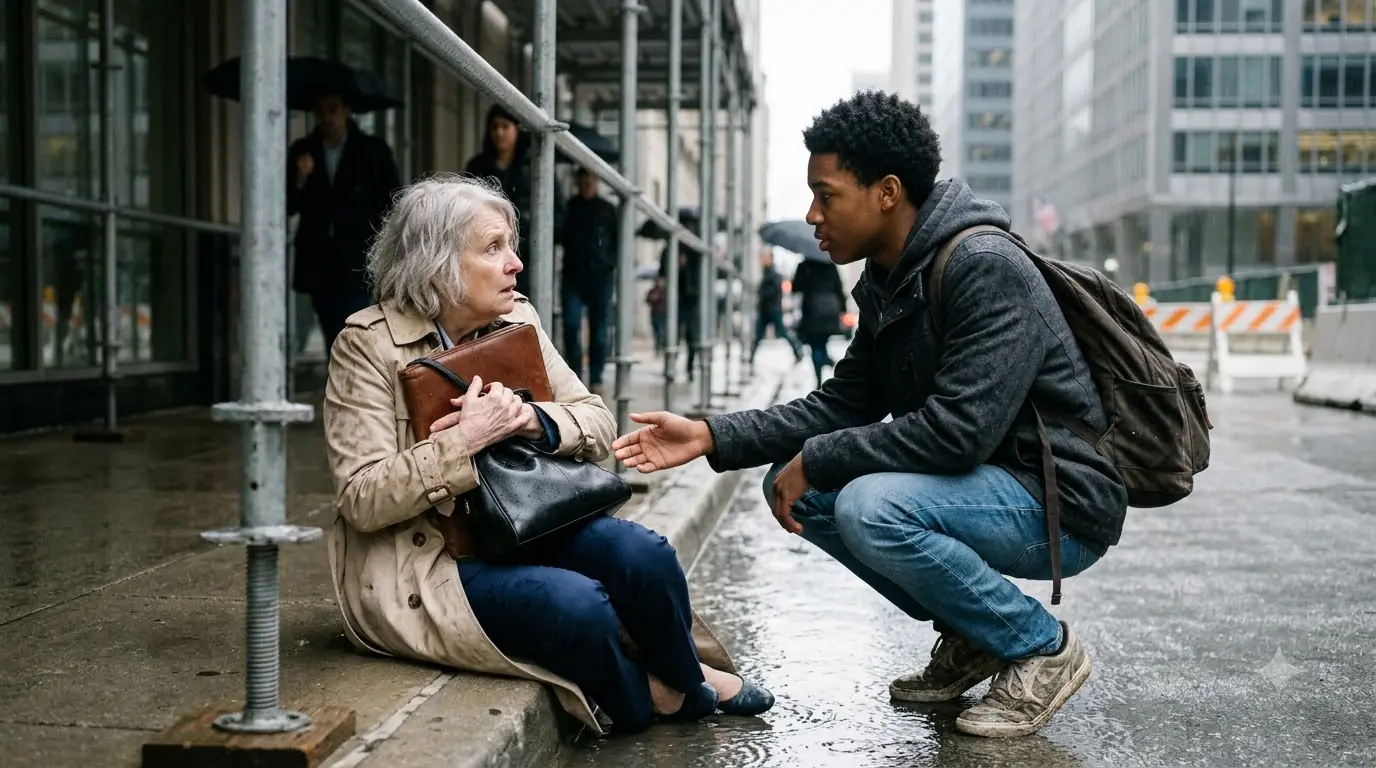
But something about her stopped him cold.
She was clutching a leather portfolio as if her life depended on it. Rain soaked through a coat that probably cost more than his family made in six months, while business executives in expensive suits stepped around her as though she were invisible.
Jamal slowed.
“Ma’am, are you okay?”
She looked up at him with frightened eyes.
“I... I’m supposed to be somewhere important,” she whispered. “But I can’t remember where.”
Neither of them understood it yet, but that moment was about to change both of their lives.
If Jamal had known what that Tuesday would bring, he might have stayed in bed.
At 5:30 that morning, his phone buzzed with the same nightmare that had been haunting his family for weeks.
The landlord called again. Need $400 by Friday or we’re out.
The message from his mother hit harder than his alarm clock ever could.
Jamal stared at the cracked ceiling of their one-bedroom apartment, doing math that never seemed to add up. His part-time job at Rodriguez Auto Repair paid twelve dollars an hour when there was work. Twenty hours a week if he was lucky. Forty if miracles were real.
His younger sister, Maya, slept on the pullout couch three feet away. Her acceptance letter to a nursing program was taped above her pillow like a prayer. Tuition was due in three weeks.
Nursing had been Maya’s dream since she was eight years old, watching their mother come home exhausted from double shifts at the hospital.
“Someone’s got to take care of people, baby,” their mother always said. “Might as well be us.”
But dreams cost money.
Money the Washington family did not have.
Jamal rolled quietly from his mattress on the floor, careful not to wake Maya. The apartment seemed smaller every day. One bedroom, one bathroom, and a kitchen barely large enough for two people to stand side by side.
The radiator clanked as though it were dying, which it probably was. Their neighbor’s television bled through walls so thin they might as well have been cardboard.
In the kitchen, Jamal made two pieces of toast and divided them three ways.
Breakfast for him and Maya. Their mother had already left.
She had started her hospital shift at four that morning because Tuesdays were when they prepared surgical instruments, and somebody had to be there early.
Walking to school, Jamal passed the coffee shop where he had applied for another job the previous month.
Through the window, he saw the manager who had told him, “We’ll call you,” with the kind of smile that meant he should not expect his phone to ring.
Three other places had given him the same polite rejection.
Too young.
Not enough experience.
Not the right fit.
The right fit, as if poverty were a choice.
At school, Jamal’s stomach growled through first-period history.
By lunch, he was dizzy with hunger, but he split his sandwich with his friend Devon anyway. Devon’s mother had lost her factory job the previous week after fifteen years of work.
“Man, you barely got enough for yourself,” Devon protested.
Jamal shrugged.
“We both got to eat, right?”
Kindness came automatically to him. He had learned it from watching his mother somehow always find room for one more person at their dinner table, even when dinner was ramen noodles with hot sauce added just to make it taste like something.
After school, Jamal took two buses to Rodriguez Auto Repair.
Miguel Rodriguez paid him twelve dollars an hour to learn skills Jamal believed might actually matter someday.
That afternoon, they were rebuilding a transmission on a 2007 Honda Civic. The engine bay was cramped and greasy, nothing like the sleek cars Jamal sketched in the margins of his notebooks.
“You got good hands, kid,” Miguel said, watching him work. “Natural mechanic. But you’re always thinking too big-picture. Focus on what’s right in front of you.”
Miguel did not understand that Jamal could not stop thinking about the big picture.
He had to.
Because if he focused only on what was directly in front of him, the overdue rent, the hunger, his mother’s exhausted face, Maya’s tuition, he would drown in it.
Instead, Jamal dreamed about designing cars working families could actually afford.
Reliable engines that did not fail every six months.
Efficient systems that did not eat grocery money.
Vehicles built for people like his mother, who drove a fifteen-year-old Corolla with more than two hundred thousand miles and quietly prayed every morning that it would start.
During a break, Miguel caught Jamal watching videos about automotive engineering.
“College-boy dreams,” Miguel teased, but not cruelly. “Just remember, dreams don’t pay rent.”
Jamal smiled and put his phone away.
He knew.
He knew better than anyone.
By eight that evening, he was home helping Maya with calculus while their mother worked another late shift.
Maya was brilliant. Straight A’s. Acceptance letters. More potential than anyone Jamal knew.
But potential did not cover tuition.
“I could take a gap year,” Maya said quietly, eraser shavings scattered across her homework. “Work full-time. Save some money.”
“No.”
Jamal’s answer came immediately.
“You’re going to college. We’ll figure it out.”
But lying on his floor mattress later that night, Jamal had no idea how.
He stared at his cracked phone screen, scrolling through classmates’ social media posts. Spring-break trips. New cars. College acceptance parties with elaborate cakes that probably cost more than his family’s weekly grocery budget.
He did not feel jealous exactly.
Mostly, he felt tired.
Tired of rotating the same three shirts to school.
Tired of declining invitations because he could not afford pizza or a movie.
Tired of being grateful for hand-me-downs while other students complained about getting the wrong color phone.
But quitting was not part of how Sharon Washington had raised her children.
She taught them that character mattered more than circumstances.
That doing the right thing still counted when no one was watching.
Even when doing the right thing did not pay bills or fill an empty refrigerator.
Tuesday morning brought unexpected rain.
By the time Jamal reached downtown Chicago for the college fair, his only jacket was soaked through.
The fair was technically a school requirement for his AP English class, but to Jamal it was much more than that. It was an opportunity to speak face to face with admissions counselors who might otherwise see only a GPA, an address, and a financial-aid application.
He checked his reflection in a storefront window.
Wrinkled shirt.
Wet hair.
Scuffed shoes.
The college representatives would be polished and professional. They would be accustomed to students arriving with parents in cars, not teenagers stepping off city buses with rainwater dripping from their sleeves.
“Fake it till you make it,” Jamal whispered.
It was his mother’s favorite phrase.
He had no idea how true it would become that day.
The scene that stopped him was one most people seemed determined not to see.
Near Chicago’s financial district, an elderly woman sat on the curb between two towering office buildings.
She looked completely out of place.
Her silver hair was disheveled. Makeup had streaked faintly beneath her eyes. Yet everything she wore suggested enormous wealth.
Tailored designer suit.
Italian leather shoes.
A luxury handbag clutched tightly against her lap.
The rain had intensified, creating a gray curtain between her and the stream of professionals rushing along the sidewalk.
Steam rose from a nearby manhole, mixing the smell of wet concrete with expensive coffee drifting from a café twenty feet away.
She sat beneath construction scaffolding that provided only partial shelter.
And everyone kept walking.
A man in a perfectly tailored suit stepped around her without pausing, phone pressed to his ear.
“The Hartwell merger needs to close by noon,” he barked.
A woman in designer heels noticed the older woman, frowned, and accelerated as though confusion might be contagious.
Two security guards from the nearby office lobby were arguing while pointing toward her.
Neither seemed eager to get involved.
Not their responsibility.
Someone else’s problem.
Always someone else’s problem.
Jamal slowed.
He was already running about twenty minutes late for the college fair.
His guidance counselor had emphasized that first impressions mattered. The most popular university booths became crowded early, and the chance to have an actual conversation with an admissions representative could disappear quickly.
Northwestern.
The University of Illinois.
Community colleges with engineering-transfer programs.
They were all inside that convention hall meeting students who had shown up on time.
Students who looked prepared.
Students who looked like they belonged.
Jamal looked back at the woman.
She might be mentally ill.
She might be confused.
She might be dangerous.
All the warnings his mother had given him about downtown strangers surfaced at once.
But then the woman looked around with desperate uncertainty.
Something in the expression reminded Jamal of his grandmother near the end of her life.
Proud but lost.
Trying desperately to maintain dignity while the world moved too quickly around her.
Jamal stopped.
“Excuse me, ma’am.”
He kept his voice gentle.
Nonthreatening.
He crouched to her eye level, ignoring the puddle soaking through his already damp jeans.
Up close, he noticed details everyone else seemed to have missed.
Her hands were shaking, not merely from cold, but from fear.
The leather portfolio against her chest was expensive but worn, as though she had carried it for years.
This was not someone seeking attention.
“Are you okay?”
“I’m... I’m supposed to be somewhere,” she said, her voice barely audible over the traffic. “But I can’t remember where. Or how I got here.”
Her eyes moved from face to face in the crowd.
“Everyone keeps walking past like I’m invisible.”
“You’re not invisible,” Jamal said firmly. “What’s your name?”
She hesitated.
Her fingers pressed against her temple as though she might physically force the memory back into place.
“Ellen,” she whispered. “I think. Yes. Ellen. Ellen Crawford.”
She said the name uncertainly, testing it.
A gust of wind sent rain beneath the scaffolding.
Ellen tried to stand.
Her knees wobbled.
Jamal caught her by the elbow before she could lose her balance.
“Easy. When’s the last time you ate something?”
She did not answer.
That was answer enough.
A bus pulled to the curb nearby, exhaust mixing with the rain.
Ellen began coughing, the harsh sound leaving her struggling for breath.
“I need to get inside,” she managed. “But I don’t... I can’t remember where I belong.”
Jamal checked his phone.
10:15 a.m.
The college fair had started fifteen minutes earlier.
He could still make it if he left immediately.
He could still reach the Northwestern booth.
He could still introduce himself.
He could still try to prove that Jamal Washington was more than an address from a poor Chicago neighborhood.
But Ellen was shivering.
Her breathing had become shallow.
The confusion in her eyes was worsening.
She kept patting her purse as though searching for something she could not remember.
Jamal stood and offered his arm.
“Come on. Let’s get you somewhere warm and figure this out.”
She looked up with such gratitude that something in his chest tightened.
How long had she been sitting there?
How many people had walked around her without a second glance?
As they started toward the café, Ellen suddenly stopped.
She looked directly at Jamal.
For a brief moment, the fog in her expression disappeared.
Her eyes became sharp.
Intelligent.
Completely focused.
“You have kind eyes,” she said with startling certainty. “Just like my grandson would have had.”
Then the confusion returned.
Jamal noticed the portfolio again.
A logo was embossed in gold across the leather.
Crawford Industries.
The name meant nothing to him.
Just another corporation in a city full of them.
He also failed to notice how tightly Ellen held the portfolio after mentioning her grandson, or how her free hand instinctively reached into the pocket of her coat and touched something small and silver before withdrawing again.
Some moments change everything.
This was one of them.
Security cameras from three nearby buildings would later record Jamal guiding Ellen through the door of Cornerstone Café.
It was the kind of upscale downtown place where one cup of coffee cost more than Jamal usually spent on lunch.
The hostess looked at them immediately.
A soaked teenager.
A confused elderly woman.
Neither matched the café’s usual clientele.
“Table for two, please,” Jamal said. “Somewhere quiet.”
He spoke as though he belonged there.
It was confidence learned from years of watching his mother handle dismissive receptionists and complicated hospital offices without ever allowing anyone to make her feel smaller than she was.
The hostess hesitated, then led them to a booth in a quiet corner.
Jamal ordered hot tea and a blueberry muffin for Ellen.
The cost consumed most of the lunch money he had brought.
He did not hesitate.
Ellen wrapped both hands around the ceramic cup.
Gradually, color returned to her face.
“Better?” Jamal asked.
She nodded.
“You’re very kind.”
Jamal texted his guidance counselor.
Running late. Family emergency. Will be there soon.
The lie came easily.
Somehow, helping Ellen already felt more important.
While she sipped her tea, Jamal gently examined the leather portfolio with her permission.
The silver clasp was heavy and expensive.
Inside were architectural plans for an enormous development project.
Financial documents contained numbers with more zeros than Jamal had ever seen outside textbooks.
Business cards carried names of law firms he recognized from billboards across the city.
Every page bore the same logo.
Crawford Industries.
“Ellen, do you recognize these?”
She stared at the papers as though they had been written in another language.
“A meeting,” she whispered. “There was supposed to be a meeting. Very important.”
Her concentration sharpened for a moment.
“Something about children. Schools.”
Inside her purse, Jamal found a new smartphone with a gold case.
It was locked.
The screen kept illuminating with incoming calls.
Boardroom.
Security.
David Assistant.
“Looks like people are trying to find you,” Jamal said.
Ellen looked at the phone as though it frightened her.
Jamal pulled out his own cracked device.
His weak data connection took forever to load the search.
Crawford Industries Chicago.
The first results appeared.
Major development company.
Billions in assets.
Large-scale real estate projects.
Affordable housing initiative.
Then the CEO’s photograph loaded.
Jamal stared.
A polished woman in her early seventies stood at a groundbreaking ceremony, silver hair perfectly styled, smiling confidently beside city officials.
Ellen Crawford.
He slowly turned the screen toward the woman sitting across from him.
“Does this look like you?”
Ellen stared at the image.
Recognition and confusion battled across her face.
“That’s... that’s me.”
She touched her wet hair self-consciously.
“But I look so together.”
“Ma’am,” Jamal said carefully, “I think you might be having some kind of medical episode. Memory problems, confusion. We should probably get you checked by a doctor.”
Ellen suddenly grabbed his wrist.
“No hospitals.”
The fear in her voice was immediate.
“They’ll think I’m... they’ll say I can’t.”
Her breathing quickened again.
“The project. Today’s vote decides everything. Thousands of families need those apartments.”
Jamal slowed the conversation down.
One question at a time.
With patience, he began assembling fragments.
Ellen Crawford was supposed to present the final proposal for an $800 million affordable housing development to the city council at noon.
Without her signature and testimony, the project could collapse.
If the deal failed, the land would likely be sold for luxury development instead.
Two thousand four hundred affordable homes would disappear before they were ever built.
Jamal picked up Ellen’s phone.
He tapped the incoming number labeled David Assistant.
A frantic male voice answered.
“This is Ellen Crawford’s phone,” Jamal said. “She’s safe, but she needs help.”
The relief from the other end was immediate.
“We’ve had security looking everywhere. The board meeting started an hour ago, and Mrs. Crawford never arrived. The council members are threatening to postpone the vote.”
“She’s having some kind of memory problem,” Jamal explained. “She’s awake and talking, but she’s confused.”
“Where are you?”
Jamal gave him the café address.
David Chang arrived in a company car less than ten minutes later.
He was a kind-faced man in his thirties, and the worry around his eyes made it obvious this was more than an employment obligation.
He rushed into the café.
“Mrs. Crawford. Thank God.”
He slid into the booth beside her.
Ellen looked at him helplessly.
“I don’t think I can do this, David. I can’t remember the numbers. The talking points.”
Jamal looked at the papers spread across the table.
“What if I help?”
Both of them stared at him.
Jamal swallowed.
“I’ve been reading the documents while we waited.”
He pointed toward the proposal.
“The project creates homes for twenty-four hundred families, around eight hundred construction jobs, on-site child care, and a medical clinic. The financing uses municipal bonds and private investment at about 3.2 percent.”
Ellen’s eyes widened.
“You understood all of that?”
Jamal nodded.
“My mom’s a single parent. We’ve lived in bad housing most of my life. A project like this isn’t just business. It’s hope.”
Something changed in Ellen’s face.
His words seemed to anchor her.
To remind her why the project existed.
Why she had built Crawford Industries from nothing four decades earlier.
David drove them to City Hall in a company Mercedes.
The leather seats and climate control were a sharp contrast to the buses Jamal normally took across Chicago.
For fifteen minutes, Jamal reviewed the proposal with Ellen.
He read key numbers aloud.
Asked simple questions.
Repeated the most important facts.
His natural ability to explain things helped Ellen regain her focus.
“You built this company from nothing,” he reminded her. “You know this project. The information is still there. Trust yourself.”
With every block, Ellen seemed stronger.
By the time the Mercedes stopped in front of City Hall’s limestone steps, she was sitting straighter.
Her speech was clearer.
Details were returning.
At the entrance, she stopped.
She took Jamal’s hands in both of hers.
“I don’t know why you helped me,” she said, tears threatening. “But you didn’t just save me. You saved this project. If this passes, twenty-four hundred families will have homes because you chose not to walk away.”
Jamal shifted awkwardly.
“Just doing what’s right.”
David escorted Ellen through the doors.
Jamal remained outside.
Only then did he look at his phone.
Seventeen missed calls from his guidance counselor.
The college fair had ended an hour earlier.
His mother had texted asking why he was not in school.
The consequences of his decision finally settled over him.
He had missed it.
The opportunity he had been counting on.
His chance to speak directly with admissions counselors and prove that someone from his circumstances still belonged in an engineering program.
But as Jamal looked up at the massive columns of City Hall and watched Ellen disappear behind doors leading to decisions that could affect thousands of families, he knew something else.
He would make the same choice again.
Some moments mattered more than personal advancement.
Some decisions revealed who you were when no reward was guaranteed.
Forty-five minutes later, the City Hall doors opened.
Ellen emerged with David and several board members.
She looked almost completely transformed.
Her hair had been fixed.
Her posture was confident.
She was speaking animatedly about construction timelines and neighborhood impact.
The vote had passed unanimously.
The affordable housing project was approved.
Twenty-four hundred families would have homes.
When Ellen saw Jamal still waiting, emotion flooded her face.
“Because of you, thousands of families will have a future,” she said. “How can I possibly repay that?”
She opened a leather-bound checkbook.
Jamal immediately stepped back.
“I don’t want money.”
She stopped writing.
“I helped because it was the right thing to do. Not because I wanted a reward.”
For once, Ellen Crawford looked genuinely surprised.
In her world, almost everything came with a price.
Most people wanted something.
Money.
Connections.
Influence.
She slowly closed the checkbook.
David watched with growing interest.
“Most people would have called emergency services and moved on,” he said. “Or ignored her completely. You stayed. You listened. You cared enough to understand what was happening.”
Jamal shifted uncomfortably.
“Anyone would’ve done it.”
“No,” Ellen said quietly. “They wouldn’t have.”
She glanced toward the crowded sidewalk.
“And they didn’t.”
Then Ellen reached into her portfolio.
She removed a business card.
It was not hers.
The stock was thick, expensive, and slightly worn from being handled many times.
Ellen looked at it for several seconds before holding it toward Jamal.
“This belonged to someone very special to me,” she said softly. “Someone who would have liked you.”
Jamal accepted it.
Jonathan Crawford
Automotive Design Engineer
Crawford Innovation Labs
Ellen placed something else into his palm.
A small silver keychain shaped like a wrench.
The initials JC were engraved along the side.
“Jonathan was my grandson,” Ellen explained. “He died in a car accident three years ago. He was brilliant. He wanted to design safer, more efficient vehicles for ordinary families, not just wealthy buyers.”
Her eyes studied Jamal intensely.
“He always said the future of automotive engineering wasn’t about making cars faster or flashier. It was about making transportation accessible to working families.”
Jamal looked down at the keychain.
Ellen continued.
“He had plans for affordable electric cars. Safety systems. Designs that could reduce operating costs for families who couldn’t afford constant repairs.”
She paused.
“You have his eyes.”
Jamal looked up.
“Kind, but determined. And when you explained that housing project to me...”
She shook her head.
“It was like hearing Jonathan talk. The same belief that engineering and business should solve real problems.”
David approached.
“Mrs. Crawford, the board is waiting for the celebration lunch.”
Ellen nodded but remained focused on Jamal.
“What do you plan to do after high school?”
“College, hopefully. Maybe automotive engineering.”
For the first time, Jamal allowed himself to say the dream aloud without immediately minimizing it.
“I work at an auto shop now. I like figuring out how things work and how to make them better. But college is expensive, and my family...”
He stopped.
Ellen understood the unfinished sentence.
“Jonathan went to MIT,” she said. “Full scholarship.”
She spoke almost casually.
“He always believed the best engineers came from backgrounds where they understood real problems, not merely theoretical ones.”
Her gaze held Jamal’s.
“I wonder what he would think of your potential.”
As Ellen moved toward the waiting Mercedes, she stopped once more.
“Keep the card and keychain, Jamal.”
He closed his fingers around them.
“Sometimes the most important things arrive when we least expect them.”
David waited until Ellen had entered the car before turning privately to Jamal.
“Mrs. Crawford doesn’t usually share Jonathan’s belongings.”
Jamal looked toward the silver wrench in his hand.
“In three years, you’re the first person she’s given anything of his to.”
“What does that mean?”
David gave him a small smile.
“I think it means something important.”
Before Jamal could ask another question, David hurried toward the Mercedes.
Alone on the City Hall steps, Jamal studied the business card.
The address belonged to an industrial complex across Chicago, somewhere he had never been.
The keychain felt strangely substantial in his palm.
Not heavy exactly.
Important.
Jonathan’s photograph on the card showed a confident young man with intelligent eyes.
Jamal could not explain why, but he felt as though he was supposed to understand something.
Something still just beyond reach.
He had no idea that Ellen Crawford was already making calls from the back seat of her Mercedes.
Three phone calls that afternoon would set off a chain reaction Jamal never saw coming.
“Sarah, it’s Ellen Crawford.”
Rain streaked across the tinted windows while Chicago blurred past outside.
Ellen had called Dr. Sarah Mitchell, connected to MIT’s automotive engineering program.
“Yes, I know it’s been three years since we last discussed Jonathan’s scholarship fund,” Ellen said. “I think I found someone.”
She imagined Jamal holding the silver wrench.
The wonder on his face reminded her painfully of Jonathan.
“A young man with real potential. Natural problem solver. Understands social impact. Comes from exactly the kind of background Jonathan cared about. He sees cars as solutions, not status symbols.”
At Crawford Industries headquarters, Ellen’s executive assistant, Rachel Kim, received unusual instructions.
“Pull together everything we have on community scholarship programs, automotive partnerships, and the Jonathan Crawford Memorial Fund,” Ellen said.
Rachel started taking notes.
“And I want background research on Jamal Washington. Discreetly. I want to understand his situation before we do anything.”
Within hours, Rachel assembled a detailed file.
Jamal’s academic record.
A 3.4 GPA despite working nearly twenty hours a week.
Recommendations from teachers.
A glowing statement from Miguel Rodriguez describing Jamal as the most naturally gifted young mechanic he had encountered in fifteen years.
His family circumstances.
Single mother working long hospital shifts.
Younger sister with strong academic potential.
Financial pressures that would have overwhelmed many households.
But the character references affected Ellen most.
Teachers described Jamal as the student who helped classmates without being asked.
A youth-center coordinator noted that Jamal volunteered on Saturdays teaching younger students basic vehicle maintenance.
“He makes them believe they can fix anything,” the report said.
That evening, Ellen visited Crawford Innovation Labs.
Jonathan’s former workspace had been preserved almost exactly as he left it three years earlier.
Blueprints for affordable electric vehicles covered the walls.
His designs emphasized reliability and low-cost manufacturing rather than luxury.
The desk still held sketches of safety improvements and efficiency concepts.
Ellen ran her fingertips across one unfinished drawing.
“You would have loved mentoring someone like Jamal,” she whispered. “He has your heart.”
She called a private meeting with Dr. Michael Torres, head of Crawford’s automotive research division.
“I want to restart the Jonathan Crawford Fellowship Program.”
Torres stared at her.
“Full funding,” Ellen continued. “Tuition. Living expenses. Summer internships. Guaranteed placement after graduation. But I want the program structured differently this time. More practical experience. More real-world work.”
Torres pulled several old files from storage.
“Jonathan originally designed it that way,” he said. “A four-year program integrating university study with part-time laboratory work. Students would graduate with both the degree and professional experience.”
He hesitated.
“It’s been dormant since Jonathan died.”
“I know.”
Ellen looked around the office.
“Maybe honoring him means finally using it.”
By evening, the machinery was moving.
MIT materials.
Crawford Innovation Labs.
Scholarship documentation.
A possible internship.
Everything would be presented as an opportunity Jamal still needed to earn.
Ellen did not want pity involved.
She did not want Jamal to believe one good act had purchased his future.
She wanted doors opened.
Jamal would still have to walk through them.
Sitting alone in Jonathan’s office, Ellen picked up a photograph from his MIT graduation.
“I think you would have liked him, sweetheart.”
Outside, the Chicago skyline glittered.
Across the city, Jamal knew nothing.
Three days after the City Hall incident, he was elbow-deep in an engine rebuild at Rodriguez Auto Repair when his phone rang.
A 617 area code.
Boston.
He nearly ignored it.
Then he answered.
“Jamal Washington?”
The voice was female, professional and confident.
“Yes?”
“This is Dr. Sarah Mitchell from MIT. Do you have a moment?”
Jamal stepped away from the engine and wiped grease from his coveralls.
Miguel looked up from across the shop.
“I think you have the wrong person,” Jamal said carefully. “I haven’t applied to MIT.”
Dr. Mitchell laughed warmly.
“No. But someone has nominated you for a special fellowship opportunity.”
Miguel drifted closer.
Jamal covered the phone.
“She said MIT.”
Miguel’s eyes widened.
Dr. Mitchell continued.
“The nomination includes very strong evidence of your mechanical aptitude, academic performance, work ethic, and character. We would like to invite you to participate in a special interview process. Travel expenses would be covered.”
Jamal stared at the floor.
“I don’t understand.”
“Before any campus visit, we’d like you to tour Crawford Innovation Labs in Chicago. MIT is developing a partnership involving hands-on automotive research.”
Crawford.
The name hit him immediately.
“Crawford? Like Ellen Crawford?”
There was a careful pause.
“I’m not sure I understand the connection,” Dr. Mitchell replied diplomatically.
Her tone suggested otherwise.
The following week, Jamal took the train to Crawford Innovation Labs.
The complex seemed built from glass, steel, and money.
Nothing about it resembled Rodriguez Auto Repair.
The lobby displayed enormous photographs of experimental cars, electric drivetrains, hybrid systems, and safety technologies that looked like science fiction to Jamal.
Dr. Michael Torres met him personally.
“We’re glad you came.”
He shook Jamal’s hand.
“I think you’ll find our approach to automotive engineering interesting.”
They moved through hallways lined with patents.
Jamal kept noticing the same name.
J. Crawford.
Again.
Again.
Again.
“Whoever J. Crawford was,” Jamal said, “he was incredible.”
Torres stopped at a door near the end of the hall.
“This was our lead design engineer’s workspace.”
He unlocked it.
“He died three years ago, but his vision still shapes much of what we do.”
Jamal stepped inside.
And froze.
The room looked like his imagination had become physical.
Blueprints covered the walls.
Not supercars.
Not luxury machines.
Practical vehicles.
Affordable electric sedans.
Safety systems designed for families.
Fuel-efficiency concepts meant to save working people hundreds of dollars.
Cars priced for people like his mother.
On the desk stood a framed photograph.
Jamal moved closer.
The young man in the picture had dark skin, intelligent eyes, and a lean build.
There was something almost familiar about him.
The plaque beneath the frame read:
Jonathan Crawford
Lead Design Engineer
Jamal’s hand moved instinctively toward his pocket.
He pulled out Ellen’s silver wrench keychain.
Dr. Torres stared.
“Where did you get that?”
“Ellen Crawford gave it to me.”
Jamal placed it carefully on the desk.
“I helped her downtown a few days ago when she got confused. She said it belonged to her grandson.”
Torres’s expression changed completely.
“You’re him.”
“What?”
“You’re the young man who found Mrs. Crawford.”
It was not a question.
Jamal looked at the photograph.
“Jonathan Crawford. Ellen Crawford.”
Understanding began to unfold.
“They’re related.”
“Jonathan was her grandson,” Torres said. “One of the brightest engineers I ever worked with. He wanted to transform affordable transportation.”
He sat down.
“He died before launching a fellowship program he had designed for students who understood real-world problems.”
Torres gestured around the office.
“Mrs. Crawford has been searching for the right person to restart it ever since.”
Jamal felt dizzy.
“The MIT call. This tour. All of this.”
He looked around.
“Is it because I helped her?”
“Not just because you helped her.”
Torres leaned forward.
“Because of how you helped her. Why you helped her. What you demonstrated while doing it.”
Jamal remained silent.
“Mrs. Crawford told us about a seventeen-year-old who stayed with her when everyone else walked past. A young man who understood an eight-hundred-million-dollar housing proposal after reading it for less than an hour. Someone who refused payment even though he clearly needed money.”
A voice came from the doorway.
“And someone who reminded me of Jonathan.”
Jamal turned.
Ellen Crawford stood there.
She looked nothing like the frightened woman from the curb.
Her silver hair was immaculate.
Her business suit was perfectly tailored.
Her posture carried the confidence of someone accustomed to commanding boardrooms.
But her eyes were the same.
Warm.
Sharp.
Watching him with unmistakable affection.
“Hello, Jamal.”
She looked toward the keychain.
“I believe you have something that belongs here.”
Jamal stared at her.
The business card.
The wrench.
The MIT call.
Jonathan.
Crawford Industries.
“You’re not just Ellen Crawford.”
A faint smile appeared.
“You’re the Ellen Crawford.”
She nodded.
“And you’re not just any teenager who stopped to help someone.”
Jamal looked around Jonathan’s office again.
“The confusion that day was real?”
“Completely,” Ellen said. “A medication reaction. I became disoriented and frightened.”
Her expression softened.
“But meeting you was real too.”
Jamal was still trying to understand.
“So what happens now?”
Ellen took a breath.
“Now you get an opportunity.”
She stepped into the room.
“The Jonathan Crawford Memorial Fellowship. Full scholarship support to MIT, assuming you complete the required admissions process. Summer internships here. Practical research. A chance to help bring Jonathan’s designs to life.”
Jamal could barely breathe.
“And after graduation?”
“A position here, if you still want it.”
He looked from Ellen to Torres.
“I don’t understand why me.”
Ellen smiled.
“Because kindness recognizes kindness.”
She glanced toward Jonathan’s photograph.
“And because Jonathan always believed the best engineers came from places where real problems weren’t theoretical.”
Her voice became softer.
“You understand those problems.”
A short time later, Ellen led Jamal into an executive conference room.
Floor-to-ceiling windows overlooked Chicago.
From one side of the room, Jamal could almost identify the part of downtown where he had found Ellen sitting in the rain.
Legal documents had been arranged across a polished table.
“The Jonathan Crawford Memorial Fellowship,” Ellen said.
She pushed a folder toward him.
“Full tuition. Room and board. Two thousand dollars a month for living expenses. Paid summer placements here at Crawford Innovation Labs. And upon graduation, a job offer with a starting salary of one hundred twenty thousand dollars.”
Jamal’s hands shook as he turned the pages.
Over four years, the total investment exceeded four hundred thousand dollars.
More money than his family had ever seen.
More money than they had imagined.
“Mrs. Crawford...”
Ellen raised one hand.
“There’s more.”
Jamal looked up.
“Your sister Maya has excellent academic records. The Crawford Foundation is prepared to fund her nursing education.”
Jamal stared.
“Your mother will also receive a ten-thousand-dollar family support grant while both of you are studying.”
“You looked into my family?”
“Yes.”
Ellen made no apology for it.
“Because success doesn’t happen in isolation. Helping you succeed while leaving everyone you love drowning financially would not be real support.”
She tapped Maya’s academic profile.
“Your sister earned her opportunity. Strong grades. Volunteer work. Clear commitment to nursing.”
Then she looked at Jamal.
“And your mother has spent long enough sacrificing.”
Dr. Torres leaned forward.
“This fellowship isn’t a gift without expectations.”
Jamal focused on him.
“You’ll work twenty hours a week when your academic schedule permits. You’ll collaborate on real projects. Present research. Meet professional standards.”
He paused.
“We expect excellence because we think you’re capable of it.”
Ellen activated a large screen.
Detailed engineering schematics appeared.
Project Horizon.
An affordable electric vehicle platform designed for working families.
Target purchase price below twenty-five thousand dollars.
Three-hundred-mile range.
Long service life.
Minimal maintenance.
“Jonathan designed much of the foundation,” Ellen said. “We have not been able to finish it.”
Jamal moved toward the display.
His mind immediately engaged.
Battery placement.
Weight distribution.
Regenerative braking.
Modular components.
Simplified manufacturing.
This was not a dream car for wealthy collectors.
It was transportation built around survival.
“Imagine your mother driving to work in something that costs a fraction of what she spends keeping her Corolla alive,” Ellen said.
Jamal’s expression changed.
“Imagine every family like yours having reliable transportation without carrying overwhelming debt.”
Jamal thought of breakdowns.
Repair bills.
His mother stranded after hospital shifts.
Neighbors deciding whether to fix a car or pay rent.
Suddenly, the fellowship stopped feeling like an escape from his old life.
It felt like a chance to solve the problems that had defined it.
Torres opened another folder.
“You would also receive professional mentorship from our senior engineers.”
Jamal listened carefully.
“No meaningless busy work,” Torres continued. “Actual development.”
Ellen walked toward the windows.
“And access to professional networks. Industry conferences. Manufacturers. Investors interested in responsible technology.”
She turned.
“You would graduate with more than a degree. You’d leave with the ability to build.”
Her eyes drifted toward Jonathan’s photograph.
“Wealth can make people forget what problems actually feel like. Jonathan understood that. He believed people who had lived with broken systems often designed better solutions.”
Ellen placed another photograph on the table.
Jonathan at seventeen.
Grease on his hands.
Working on an old Honda Civic in a garage.
“This was the summer before MIT,” she explained. “He was trying to improve fuel efficiency using whatever tools he could find.”
Jamal stared.
“Self-taught?”
“In many ways.”
Torres explained the timeline.
The academic process.
Placement exams.
Housing.
Course registration.
The summer internship that could replace Jamal’s auto-shop job.
“Same commitment,” Torres said. “Better resources.”
Jamal looked around.
Three days earlier he had been worried about making rent.
Now people were discussing MIT, engineering research, and a career he had barely allowed himself to imagine.
“I keep thinking I’m going to wake up.”
Ellen sat across from him.
“Life-changing moments rarely announce themselves.”
She smiled.
“Sometimes they look like an ordinary Tuesday when you decide whether to walk past someone or stop.”
Torres slid a pen across the table.
“What do you say?”
Before Jamal touched it, Ellen added one final detail.
“Your family will be supported. And Miguel’s shop will receive a grant for an equipment upgrade.”
Jamal looked up.
“Miguel?”
“He invested in you before anyone knew your name,” Ellen said. “That matters.”
Jamal picked up the pen.
Then placed it down again.
“Mrs. Crawford, I need to ask you something.”
“Of course.”
“Is this actually real?”
His voice became quieter.
“Because if I sign this and somebody comes back tomorrow and says there was some mistake...”
Ellen reached across the table.
She placed her hand over his.
“Jamal, this is the most real thing I’ve done in three years.”
His eyes met hers.
“You did more than help me downtown. You reminded me why Jonathan believed people were worth investing in.”
She squeezed his hand gently.
“This isn’t charity. It’s an investment in the future he wanted.”
Jamal picked up the pen again.
His hands trembled as he signed.
The pen felt impossibly heavy.
As though his entire future existed at its tip.
Ellen witnessed the signature.
Then she picked up her phone.
“Maya? This is Ellen Crawford. Is your mother with you? I have some news about Jamal that is going to change quite a few things.”
Six months later, the effects of that rainy Tuesday were spreading far beyond one Chicago street corner.
At MIT, Jamal thrived in engineering courses.
His practical experience gave him an unusual advantage over classmates who understood theory but had rarely worked inside an engine bay.
When Professor Williams assigned a project on efficiency, Jamal approached the problem with ideas learned from years at Rodriguez Auto Repair.
His solution improved performance significantly.
Professor Williams wrote in his evaluation:
“Exceptional problem-solving ability. Approaches complex systems with an intuitive understanding rare in first-year students. Consistently connects theoretical concepts with real-world applications.”
During winter break, Jamal returned to Crawford Innovation Labs instead of taking time off.
He spent the break working on Project Horizon.
His first major contribution involved the battery-cooling system.
Using principles he had learned while repairing automotive air-conditioning systems during brutal Chicago summers, Jamal proposed a redesign that improved efficiency while reducing manufacturing cost.
Senior engineers who had studied the problem for months crowded around a whiteboard while Jamal explained the concept.
Dr. Torres stared at the calculations.
“Where did you learn to think about cooling like this?”
Jamal smiled.
“Fixing broken AC systems in July.”
Torres laughed.
“Same principles?”
“Different application.”
The impact extended to Jamal’s family.
Maya continued progressing toward her nursing career with the support of the Crawford Foundation and eventually graduated with honors.
She accepted a position at the same hospital where their mother had spent years working exhausting shifts.
Local news covered the milestone.
The Washington family, once calculating whether they could afford food and rent in the same week, now stood together at Maya’s graduation ceremony.
Their mother, Sharon, no longer prayed every morning that an aging car would start.
Through one of Crawford’s transportation partnerships, she gained access to reliable transportation.
She returned to school as well, pursuing additional certification in hospital management.
Financial stress no longer consumed every waking hour.
For the first time in years, Sharon had space to think about goals she had buried beneath survival.
A Chicago newspaper eventually published a feature about Jamal.
From Auto Shop to MIT: Chicago Teen’s Act of Kindness Opens Door to Engineering Future.
Photographs showed Jamal working inside Crawford Innovation Labs.
Maya in nursing attire.
Sharon smiling with both children.
But the most important section of the story described what Crawford Industries had built afterward.
Ellen expanded the Jonathan Crawford Fellowship.
The original scholarship was becoming something larger.
At the Detroit Auto Show during Jamal’s second year, he presented research on affordable electric-vehicle infrastructure.
Executives from several major automotive companies attended.
Jamal proposed neighborhood charging systems that relied on existing electrical infrastructure rather than expensive luxury installations.
The presentation received a standing ovation.
Afterward, an investor handed him a business card.
“When you graduate, call me,” the man said. “We’re funding the next generation of automotive entrepreneurs who actually want to solve problems.”
Back in Chicago, Rodriguez Auto Repair had changed too.
The grant Ellen arranged allowed Miguel to expand from two service bays to six.
New lifts.
Modern diagnostic systems.
Electric-vehicle equipment.
Miguel began training twelve young people from the neighborhood.
He named the initiative the Jamal Washington Apprentice Program.
Several students later received Crawford Foundation support for technical education.
“Jamal showed us that fixing cars can be about more than making money,” Miguel told a local reporter. “It can be about building futures.”
Jamal’s old high school became another part of the network.
MIT and Crawford Industries created an engineering pipeline program offering mentorship, laboratory exposure, and summer opportunities for students from Jamal’s neighborhood.
Enrollment in advanced math and science classes surged.
Students who once thought engineering belonged only to wealthy families started staying after school to work in a newly funded automotive laboratory.
Kids who used to skip class now argued over motor efficiency and battery design.
Project Horizon continued moving toward production.
By Jamal’s third year in the program, the first vehicles rolled from the manufacturing line.
Affordable electric cars.
A target price around twenty-three thousand dollars.
More than three hundred miles of range.
Long warranties.
Designed to be maintained without crushing repair bills.
Preorders exceeded fifty thousand units in the first month.
Most buyers were working families who had never considered an electric vehicle financially realistic.
The waiting list stretched for months.
Researchers began studying what some called the Crawford Effect.
The idea was simple.
What happened when institutions invested not merely in perfect résumés, but in people who demonstrated talent, resilience, and character?
One university study estimated that every dollar placed into education and opportunity programs created several times that amount in community value through employment, higher education, entrepreneurship, and reduced financial instability.
Jamal was invited to speak at national STEM events about expanding access to engineering.
One presentation, titled “Solving Real Problems for Real People,” spread widely online.
Young people across the country wrote that they had never imagined engineering could belong to someone from their neighborhood.
One teenager from Detroit wrote:
“I never thought engineering was for people like me until I heard Jamal’s story.”
The Jonathan Crawford Fellowship continued expanding.
What began with Jamal became a national program.
Dozens of students from low-income backgrounds entered engineering, medicine, social work, and other fields with Crawford Foundation support.
They called themselves Jonathan’s Legacy.
Every year, they met at Crawford Industries headquarters.
Jonathan’s photograph remained in the center of the gathering.
Not as an image of a life that ended too early, but as a reminder of what one vision could continue building through others.
Jamal’s neighborhood changed too.
Unemployment fell.
Graduation rates improved.
New businesses appeared.
Outside developers became interested in the area, but Ellen pushed for community investment requirements designed to help longtime residents remain rather than simply being priced out.
Her philosophy became simple.
Invest in character.
Give talent room to grow.
Make sure success spreads beyond the person who first receives the opportunity.
All of it traced back to one teenager choosing kindness over convenience on a rainy Tuesday morning.
Five years after that day, Jamal found himself standing near the same downtown corner.
It was Tuesday again.
Light rain drifted across Chicago.
Jamal Washington was twenty-two now, fresh from MIT and preparing to begin his full-time role as a lead design engineer at Crawford Innovation Labs.
He wore a suit that actually fit.
Under one arm were blueprints connected to the next generation of Project Horizon vehicles.
The morning felt strangely familiar.
The rain.
The rushing businesspeople.
The same financial district.
The same corner where his entire future had changed because a frightened woman needed someone to notice her.
Jamal stopped.
A small bronze plaque had been installed nearby.
Jonathan Crawford Memorial Corner
Where Kindness Meets Opportunity
He smiled.
Then he saw her.
A teenage girl sat near the curb.
Maybe sixteen.
Soaked.
Shivering.
A college application had gone soft from the rain in her hands.
Her clothes were clean but worn, the careful presentation of someone doing everything possible with limited resources.
She looked overwhelmed.
Lost.
Almost exactly the way Ellen had looked five years earlier.
Jamal approached without hesitation.
“Hey. You okay?”
The girl looked up.
Tears mixed with rainwater on her cheeks.
“I had a college interview this morning,” she said. “Northwestern nursing program. But the bus broke down.”
She looked at the ruined papers.
“I walked twelve blocks. By the time I arrived, they told me I’d missed the interview window.”
Jamal’s chest tightened.
This could have been Maya.
This could have been him.
This could have been any number of young people whose futures turned on circumstances they did not control.
“What’s your name?”
“Aaliyah.”
She wiped her face.
“Aaliyah Johnson.”
Jamal took out his phone.
He scrolled through his contacts.
“Dr. Martinez? This is Jamal Washington.”
A pause.
“Yes. Ellen’s Jamal.”
He smiled faintly.
“I’ve got somebody I think you should meet.”
He explained what had happened.
The bus.
The rain.
The missed interview.
The dream of nursing.
Within minutes, arrangements were made for Aaliyah to receive another interview later that afternoon.
While they waited for transportation, Jamal told her about the Crawford Foundation.
About his sister.
About MIT.
About what happened on that same corner five years earlier.
He handed her a business card.
Jamal Washington
Lead Design Engineer
Crawford Industries
“Sometimes the universe puts the right person in the right place at the right moment,” he said, repeating words Ellen had once told him. “Your moment might be closer than you think.”
Something changed in Aaliyah’s eyes.
Despair gave way to cautious hope.
A familiar car pulled to the curb.
The rear window lowered.
Ellen Crawford sat inside.
Now seventy-seven, still sharp, still unmistakably herself.
She looked from Jamal to Aaliyah.
“Need a ride to Northwestern?”
Aaliyah stared at her.
Ellen smiled.
“I happen to know a few people there.”
Jamal shook his head, laughing.
As the car pulled away, Ellen caught his eye in the mirror.
She winked.
The cycle continued.
Kindness creating opportunity.
Opportunity creating more kindness.
That evening, Ellen called Jamal at his apartment.
“Aaliyah impressed everyone,” she said. “They’re working on a full scholarship package. She wants to specialize in trauma nursing.”
Jamal smiled.
Of course she did.
Later, entering Crawford Innovation Labs, Jamal stopped in front of the fellowship display.
Dozens of photographs covered the wall.
Students whose lives had changed through the program.
At the center remained Jonathan Crawford’s graduation photograph.
Around him were the people carrying forward the work he had never lived long enough to finish.
A newer photograph showed the first graduating group of Crawford Fellows.
Jamal stood near the center.
Below the display was an inscription:
“Kindness is the engineering principle that builds better futures.”
The fellowship continued growing.
More students.
More communities.
More institutions adopting the idea that character and talent could exist in places traditional systems often overlooked.
The program became a model for companies that wanted community investment to mean more than charity.
Jamal understood why it worked.
Because nobody had rescued him by lowering expectations.
Ellen had opened a door and expected him to become worthy of walking through it.
He had done the same for others.
The corner where Ellen once sat alone in the rain became known for stories of people stopping to help.
A missed bus.
A lost wallet.
A frightened student.
A confused elderly neighbor.
Not every act led to an MIT scholarship or an eight-hundred-million-dollar development.
Most never made the news.
That was not the point.
The point was that people began noticing each other.
Jamal’s story proved that extraordinary turning points often begin disguised as ordinary inconveniences.
A confused woman on a curb.
A teenager running late.
A choice between continuing toward your own opportunity and stopping for someone who might need you more.
Five years earlier, Jamal Washington had only thirty-seven dollars, an overdue rent crisis, a soaked jacket, and a college fair he desperately wanted to attend.
He had no idea Ellen Crawford was wealthy.
He did not know about Jonathan.
He did not know about MIT.
Project Horizon did not exist in his life.
The fellowship was not waiting in his imagination.
All Jamal knew was that a frightened woman was sitting in the rain while everyone else walked past.
So he stopped.
That decision did not magically solve his life.
What it revealed was the kind of person he had already become through years of watching his mother serve others, sharing food when he was hungry, helping classmates, learning from Miguel, and believing that doing the right thing still mattered even when nobody rewarded it.
Ellen did not create Jamal’s character.
She recognized it.
Opportunity did not give him his talent.
It gave his talent somewhere to go.
And Jamal never forgot the difference.
Years later, whenever students asked him how everything began, he never started with MIT.
He never started with Crawford Industries.
He never started with Project Horizon.
He told them about the rain.
The college fair.
The woman on the curb.
And the moment he almost kept walking.
Because that was the part that mattered.
Everything that followed began with a choice no one had forced him to make.
He could have hurried past.
He could have told himself someone else would help.
He could have protected his own opportunity.
Instead, he stopped.
And in doing so, Jamal Washington discovered something he would spend the rest of his life proving.
The future is not always built in laboratories, classrooms, or boardrooms.
Sometimes it begins on a wet Chicago sidewalk when one person decides that another human being will not remain invisible.