The woman sitting on the curb was worth $800 million, but she could not remember her own name.
Seventeen-year-old Jamal Washington had $37 to his name and three days to help his mother make rent, so the last thing he needed was to get involved with a confused stranger in downtown Chicago, especially when he was already late for a college fair that might be his only shot at a better future.
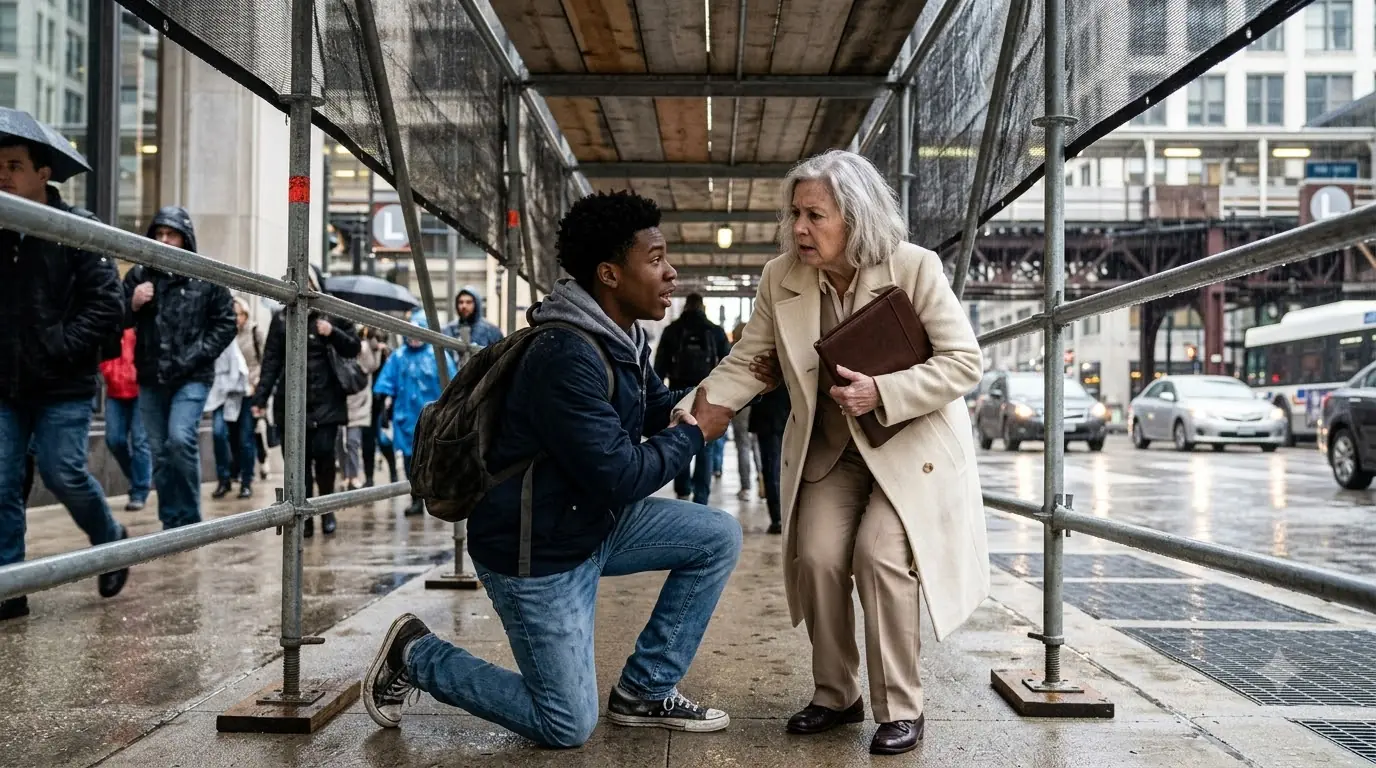
Something about her stopped him cold. She was clutching a leather portfolio as if her life depended on it, rain soaking through a coat that probably cost more than his family made in six months while business executives in thousand-dollar suits stepped around her like she was invisible.
“Ma’am, are you okay?” Jamal asked.
She looked up at him with frightened eyes. “I’m supposed to be somewhere important, but I can’t remember where.”
If Jamal had known what that Tuesday would bring, he might have stayed in bed. At 5:30 that morning, his phone had buzzed with the same nightmare that had been haunting his family for weeks.
The landlord called again. Need $400 by Friday or we’re out.
The text from his mother hit harder than his alarm clock ever could. Jamal stared at the cracked ceiling of their one-bedroom apartment, doing math that never added up.
His part-time job at the auto shop paid $12 an hour when there was work. Twenty hours a week if he was lucky, forty if miracles were real.
His younger sister, Maya, slept on the pullout couch three feet away. Her acceptance letter to community college was taped above her pillow like a prayer.
She wanted to enter a nursing program, a dream she had carried since she was eight years old, watching their mother come home exhausted from double shifts at the hospital. “Someone’s got to take care of people, baby.”
“Might as well be us,” their mother always said. But dreams cost money they did not have.
Jamal rolled off his floor mattress quietly, careful not to wake Maya. The apartment felt smaller every day.
One bedroom, one bathroom, a kitchen barely big enough for two people to stand, a radiator that clanked like it was dying, and walls so thin the neighbors’ television might as well have been in their living room. In the kitchen, Jamal made two pieces of toast and divided them among three people.
Their mother was already gone, having started her shift at 4:00 a.m. because Tuesday mornings were when the surgical instruments had to be prepared early. Walking to school, Jamal passed the coffee shop where he had applied the month before.
Through the window, he saw the manager who had told him, “We’ll call you,” with the kind of smile that meant he should not hold his breath. Three other places had given him the same polite rejection.
Too young, no experience, not the right fit, as though poverty were a choice and fitting in had anything to do with how hard someone was willing to work. At school, Jamal’s stomach growled through first-period history.
By lunch, he was dizzy with hunger, but he split his sandwich with Devon anyway. Devon’s mother had lost her job the week before after fifteen years at the same factory.
“Man, you barely got enough for yourself,” Devon protested. Jamal only shrugged.
“We both got to eat, right?” That kind of generosity was automatic, something he had learned from watching his mother always find room for one more person at their dinner table.
Even when dinner was ramen noodles with hot sauce just to make it taste like something, nobody left their home hungry if she could help it. After school, Jamal took two buses to Rodriguez Auto Repair.
Miguel paid him under the table, $12 an hour, to learn skills that might actually matter one day. That afternoon, they were rebuilding the transmission on a 2007 Honda Civic.
The engine bay was cramped and greasy, nothing like the sleek cars Jamal sketched in the margins of his notebooks. “You got good hands, kid,” Miguel said, watching him work.
“Natural mechanic.” “But you’re thinking too big-picture.”
“Focus on what’s right in front of you.” Miguel did not understand that Jamal could not stop thinking about the big picture.
If he focused only on what was right in front of him—bills, hunger, his mother’s exhausted face—he would drown in it. Instead, Jamal dreamed about designing cars that working families could actually afford.
Reliable engines that did not break down every six months, fuel-efficient systems that did not eat grocery money, and vehicles built for people like his mother, who drove a fifteen-year-old Corolla with 200,000 miles and prayed it would start every morning. Miguel once caught him watching automotive engineering videos during a break.
“College-boy dreams,” he teased, not unkindly. “Just remember, dreams don’t pay rent.”
Jamal knew that better than anyone. Home by 8:00 p.m., he helped Maya with calculus while their mother worked another night shift.
Maya was brilliant, a straight-A student accepted to three nursing programs, but only one offered meaningful financial aid. Even that left the family short.
“I could take a gap year,” Maya said quietly, eraser shavings scattered across her homework. “Work full-time, save up money.”
“No,” Jamal said firmly. “You’re going to college.”
“We’ll figure it out.” Lying on his floor mattress later that night, Jamal was not sure how.
He stared at the cracked screen of his phone and scrolled past classmates posting spring-break trips to Florida, new cars for sweet sixteen, and college acceptance parties with cakes that probably cost more than his family’s weekly grocery budget. He did not feel jealous exactly, only tired.
Tired of wearing the same three shirts, tired of declining invitations because he could not afford movies or pizza, and tired of being grateful for hand-me-downs while other kids complained about getting the wrong color iPhone. Quitting was not in his vocabulary.
His mother had raised him to believe that character mattered more than circumstances and that doing the right thing still counted even when nobody was watching. Tuesday morning brought unexpected rain, soaking through Jamal’s only jacket before he had walked two blocks.
By the time he reached downtown Chicago for the college fair, a requirement tied to his AP English class, he was drenched and painfully aware of how he looked. He checked his reflection in a store window: wrinkled shirt, damp hair, scuffed shoes.
The college representatives would be polished and professional, used to students who arrived in cars instead of on buses. “Fake it till you make it,” he whispered to himself.
It was his mother’s mantra, repeated every morning like a prayer. What Jamal did not know was that this Tuesday would prove her right in ways he never imagined.
The scene that stopped him was one most people would pretend not to see. Walking past the Morrison Financial District, he noticed an elderly white woman sitting on the curb between two towering office buildings.
She looked completely out of place. Her silver hair was disheveled, mascara smudged down her cheeks, but her clothes spoke of wealth: a Chanel suit, Italian leather shoes, and a Hermès purse clutched tightly in her lap.
The rain had intensified, creating a curtain between her and the stream of business professionals hurrying past. Steam rose from manholes, mixing the smell of wet concrete with expensive coffee from a lobby café twenty feet away.
She sat under a construction scaffold that offered partial shelter, but she was still getting soaked. Everyone was pretending she did not exist.
A man in a $3,000 suit sidestepped her with his phone pressed to his ear, barking about the Hartwell merger needing to close by noon without glancing down. A woman in designer heels noticed the stranger, frowned with obvious discomfort, and quickened her pace as though confusion might be contagious.
Two security guards from the nearby lobby argued about who should handle the situation, each insisting it was not their responsibility. Jamal slowed, torn.
He was already twenty minutes late for the college fair, and his guidance counselor had emphasized how crucial first impressions were with admissions officers. His wet clothes were not helping his confidence.
The woman could be homeless, mentally ill, or dangerous, all the things his mother warned him to be careful about in the city. But the way she looked around desperately reminded him of his grandmother before she passed, proud but confused, trying to maintain dignity while the world moved too quickly around her.
Jamal could not keep walking. “Excuse me, ma’am,” he said gently.
He crouched to her eye level, ignoring the puddle soaking through his already damp jeans. Up close, he noticed details other people had missed.
Her hands were shaking, not from cold but from genuine fear. Her leather portfolio was expensive but worn, the kind of thing carried for years rather than purchased for appearances.
“I’m supposed to be somewhere,” she said, barely audible over traffic. “But I can’t remember where or how I got here.”
Her eyes darted across the passing crowd, searching for something familiar. “Everyone keeps walking past like I’m invisible.”
“You’re not invisible,” Jamal said firmly. “What’s your name?”
She hesitated and pressed her fingers to her temple as if trying to squeeze a memory into place. “Ellen, I think.”
“Yes.” “Ellen.”
“Ellen Crawford.” The name came out uncertainly, as if she were testing how it sounded.
A gust of wind blew rain under the scaffold and soaked both of them. Ellen tried to stand, but she wobbled.
Jamal caught her elbow and steadied her against a concrete pillar. “Whoa, easy,” he said.
“When’s the last time you ate something?” Her silence was answer enough.
A city bus pulled up at the nearby stop, exhaust mixing with the rain while Ellen started coughing hard. “I need to get inside,” she managed.
“But I don’t know where I belong.” Jamal checked his phone.
It was 10:15 a.m., and the college fair had started fifteen minutes earlier. Northwestern, the University of Illinois, and several community colleges were all there, meeting students who had arrived on time and looked the part.
This might be his only chance to speak with admissions counselors face-to-face and prove he was more than his circumstances. Ellen was shivering now, and her confusion seemed worse.
She kept patting her purse as though she were searching for something but could not remember what. “Come on,” Jamal said, standing and offering his arm.
“Let’s get you somewhere warm and figure this out.” She looked at him with such gratitude that it hurt.
Jamal wondered how long she had been sitting there and how many people had walked past without a second glance. As they started toward the nearest café, Ellen suddenly stopped and looked directly at him.
For one brief second, her eyes cleared completely—sharp, intelligent, focused. “You have kind eyes,” she said with startling certainty.
“Just like my grandson would have had.” Then the confusion returned like fog rolling in.
Jamal noticed the gold logo embossed on her portfolio: Crawford Industries. The name meant nothing to him.