At 4:37 on a rainy Thursday afternoon, Elias Thorne entered the first-class cabin of Horizon Atlantic Flight 27 without an assistant, bodyguard, or announcement.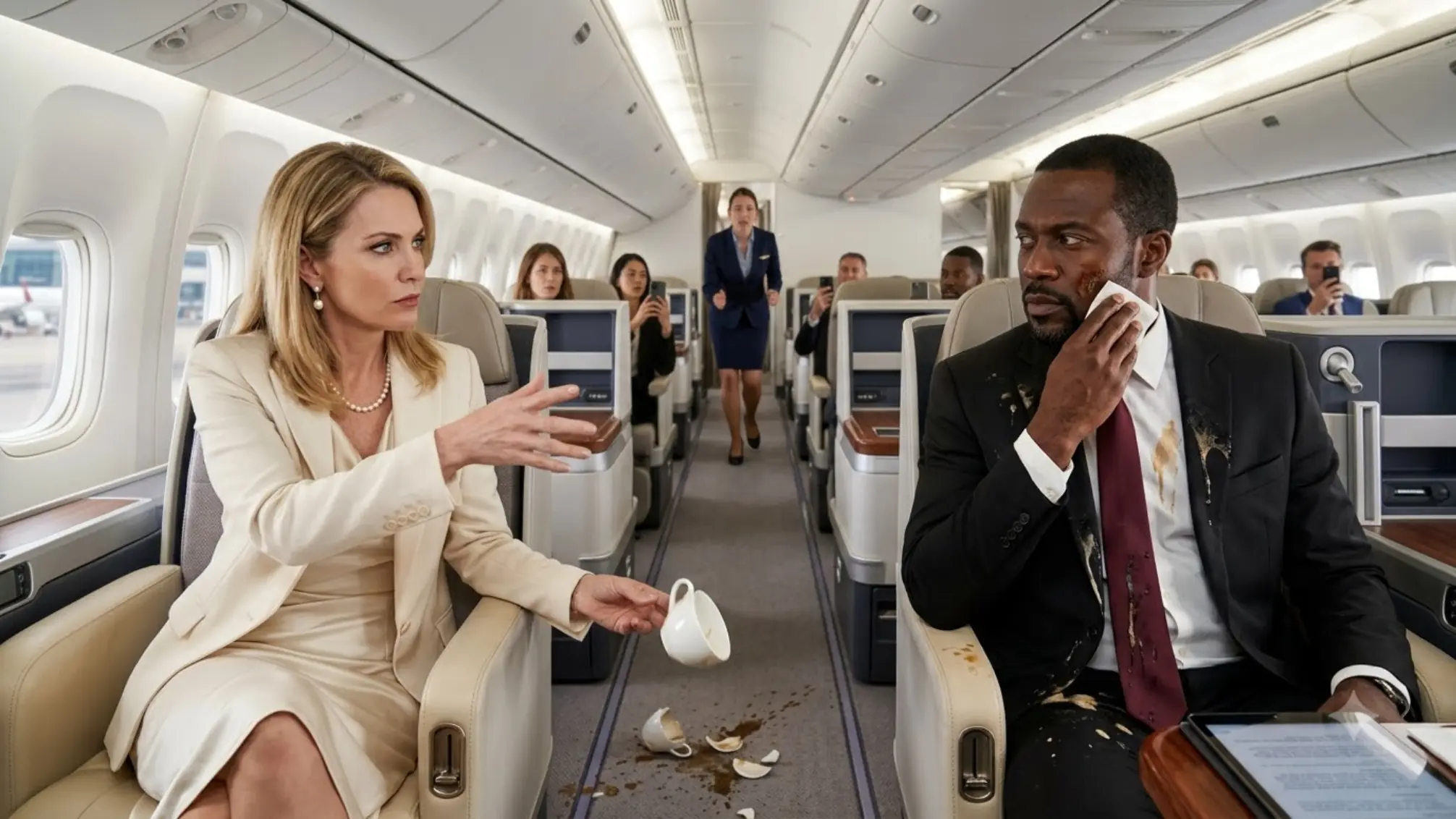
The forty-six-year-old Black American executive wore a tailored black suit, a white shirt, and a burgundy tie. His closely cut hair and neatly shaped beard gave him a disciplined appearance, while the tiredness behind his dark eyes revealed that he had spent most of the previous night reviewing confidential documents. He carried a slim leather briefcase and a tablet containing information only six people inside Horizon Crest Aviation Group were authorized to see.
None of the passengers recognized him immediately.
That was intentional.
Elias had founded Horizon Crest eighteen years earlier with three leased regional aircraft and a payroll he could barely afford. The company now controlled two international airlines, a cargo network, an aircraft-maintenance division, and airport-service contracts across North America and Europe. His face appeared in annual reports and financial publications, but he avoided advertising campaigns and rarely attended public ceremonies.
To most travelers, he looked like a successful businessman.
To the woman seated across the aisle, he looked like someone who did not belong.
Sarah Montgomery occupied Seat 2B as if the aircraft had been built around her. She was forty-eight, blonde, polished, and dressed in an ivory blazer over a cream silk dress. Pearls rested around her neck, a gold bracelet circled one wrist, and her perfume carried across the aisle before she spoke.
She watched Elias place his briefcase beneath the seat.
Her eyes moved from his face to his suit, then to the small silver pin on his lapel. The pin displayed Horizon Crest’s winged compass emblem, but Sarah assumed it was a souvenir or an imitation. She had spent years around executives and believed she could measure rank through watches, luggage, companions, and the speed with which employees rushed to greet someone.
No employee rushed to greet Elias.
He preferred it that way.
Flight attendant Amelia Grant approached with a tray of predeparture drinks. She was a thirty-four-year-old Black American woman with ten years of international service and a reputation for remaining calm when wealthy passengers confused luxury with authority. She offered Elias water, juice, or cappuccino.
“Water is fine, thank you,” he said.
Sarah ordered a caramel cappuccino with extra foam.
Amelia nodded and continued down the aisle.
Sarah leaned toward Elias after the attendant left.
“Are you sure this is your seat?”
Elias looked at the number above him.
“Two-A.”
“I can see the number,” she replied. “I asked whether it was yours.”
“It is.”
Her smile was thin.
“These cabins have become remarkably flexible about upgrades.”
Elias opened his tablet.
“I would not know.”
Sarah waited for him to explain himself. When he did not, she adjusted her bracelet and looked toward the passengers behind them. Several wore business suits, and one man was already speaking into his phone about a London transaction.
The cabin crew closed the overhead compartments.
Rain tapped lightly against the windows.
Amelia returned with Sarah’s cappuccino and placed it carefully on the side table. The cup was porcelain rather than plastic, part of Horizon Atlantic’s recently introduced premium service. Steam rose through the foam.
Sarah took one sip.
She did not appear to enjoy it.
Elias continued reviewing a report concerning consulting payments made through Horizon Crest’s European operations. The name Daniel Montgomery appeared repeatedly across invoices, travel authorizations, and security exceptions. Daniel was a senior external consultant who had advised the airline on government relations, airport expansion, and regulatory negotiations.
His contracts had once seemed ordinary.
The most recent records did not.
More than fourteen million dollars had moved through three consulting companies sharing the same mailing address. Several payments were approved for work that had never been performed. Private aircraft had been authorized under Daniel’s credentials, yet passenger records had been deleted after departure.
Elias had boarded Flight 27 because Daniel was supposed to meet an unknown associate in London.
The consultant’s reservation had been canceled two hours earlier.
Sarah’s had not.
Elias glanced across the aisle.
She was watching him again.
This time, her expression contained more than contempt.
It contained recognition.
Sarah lifted the cappuccino and looked toward the front galley. Amelia was helping another passenger, while the senior purser was speaking with the cockpit crew. Sarah turned back toward Elias.
“You have been staring at me,” she said.
“I have been reading.”
“Do not pretend.”
Elias lowered the tablet.
“Is there something you need?”
Her mouth tightened.
“You could begin by showing a little respect.”
“I have not spoken disrespectfully to you.”
“You are sitting there as if you own the aircraft.”
Elias looked around the cabin.
“I am sitting in the seat assigned to me.”
A passenger behind Sarah raised his eyes from a newspaper.
Sarah noticed.
She wanted the cabin to notice more.
She leaned across the aisle, holding the hot cup near Elias’s chest.
“You people are always so proud when someone lets you into a room you could never build.”
Amelia turned from the galley.
“Ma’am, please keep the cup on the table while we prepare for departure.”
Sarah ignored her.
Elias watched the cup.
“Place it down.”
The calm instruction angered her more than shouting would have.
She expected fear, apology, or embarrassment. Elias offered none of them. His refusal to become smaller in front of her felt, in Sarah’s mind, like a public challenge.
Her fingers tightened around the handle.
She threw the cappuccino.
The cup left her hand with enough force to cross the aisle and strike Elias near the shoulder. Hot coffee and foam spread across his cheek, collar, shirt, and jacket. The porcelain cup struck the edge of his seat, broke against the aisle, and scattered fragments across the carpet.
A passenger screamed.
Amelia rushed forward.
The cabin became completely silent.
Elias closed his eyes for one second as heat spread across his skin. He did not leap from the seat. He did not reach toward Sarah or shout.
He removed a folded white handkerchief from his pocket.
Coffee ran from his jaw onto his tie as he pressed the cloth gently against his cheek. The front of his suit had turned dark, and foam clung to one lapel. The skin near his ear was red, but he remained composed.
Sarah leaned back.
There was satisfaction in her expression.
Executive Wife (sneering, tossing the empty cup aside): “Clean yourself up. First class already looks cheap enough with someone like you sitting here.”
Black CEO (coldly, wiping the hot coffee from his face): “You threw boiling coffee at a stranger because you decided his skin made him inferior.”
Executive Wife (mockingly, crossing her legs): “My husband advises this airline, so one call will have you dragged off before departure.”
Black CEO (dangerously calm, lifting his phone): “Make the call. Then tell your husband the CEO he defrauded is sitting in front of you.”
Sarah’s smile disappeared.
Amelia stopped beside Elias.
“Sir, are you injured?”
“My cheek needs cool water.”
“I will bring it immediately.”
Sarah pointed at him.
“Do not serve him. Remove him.”
Amelia looked at the broken cup, Elias’s stained clothing, and the passengers holding up phones.
“Ma’am, you threw a hot drink at another passenger.”
“He threatened me.”
The man seated behind Sarah spoke without lowering his phone.
“He did not.”
A woman across the cabin added, “He barely spoke to you.”
Sarah turned toward them.
“You do not understand what happened.”
“We recorded what happened,” the man replied.
The senior purser, Claire Donnelly, entered from the front galley. She was a fifty-two-year-old white American woman with nearly three decades of airline experience. Her professional expression remained controlled, but her eyes widened when she saw Elias.
Unlike Sarah, Claire recognized him.
She had attended an employee leadership ceremony two years earlier where Elias presented her with an award for managing a medical emergency over the Atlantic. His appearance was less formal today, and coffee covered half his suit, but there was no mistaking him.
“Mr. Thorne,” she said.
Sarah turned sharply.
Claire moved closer to Elias.
“I am contacting airport medical services and security.”
“Keep every passenger seated,” Elias said. “No one leaves the aircraft until the recordings and service records are preserved.”
Claire nodded immediately.
“Yes, sir.”
Sarah stared between them.
“You know him?”
Claire looked at her.
“He is Elias Thorne.”
The name moved through the cabin in whispers.
A man near the window searched it on his phone. Another passenger lowered her device and looked at Elias with sudden recognition. Within seconds, photographs of him standing beside aircraft, government officials, and Horizon Crest’s board appeared across several screens.
Sarah’s face tightened.
“That proves nothing.”
Elias unlocked his phone.
“You said your husband advises this airline.”
“He does more than advise it.”
“What exactly does Daniel do?”
Sarah’s hand moved toward her necklace.
“He handles sensitive corporate matters.”
“Such as private aircraft authorizations?”
Her eyes flickered.
“Those matters are confidential.”
“They are confidential because the passengers were removed from the records.”
Sarah looked toward the front cabin door.
The aircraft remained attached to the boarding bridge.
Elias noticed the direction of her gaze.
He selected a number and placed the call on speaker.
A man answered after one ring.
“Executive operations.”
“This is Elias Thorne.”
The voice changed immediately.
“Mr. Thorne.”
“Place Flight 27 under an operational hold. Suspend departure clearance, preserve all cabin recordings, and prevent edits to passenger, cargo, catering, maintenance, and security data.”
“Yes, sir.”
“Notify airport law enforcement and Horizon Crest internal investigations. No member of the Montgomery consulting team is to access company systems.”
Sarah stood.
Claire stepped between her and the aisle.
“Please remain seated.”
“I am leaving this aircraft.”
“The door is secured.”
Sarah’s voice rose.
“You cannot hold me here.”
Elias ended the call.
“You committed an assault in front of witnesses.”
“It was coffee.”
“It was hot enough to injure someone.”
“You provoked me.”
“By sitting in my assigned seat?”
Sarah looked toward the passengers recording her.
“This is being misunderstood.”
Amelia returned with a cool cloth and a small medical kit. She knelt beside Elias and examined the side of his face.
“The skin is irritated, but it does not appear severe,” she said. “We should still have medical personnel evaluate it.”
“Thank you.”
Sarah laughed bitterly.
“He is performing for all of you.”
Elias pressed the cool cloth against his cheek.
“No. I am waiting for you to explain why Daniel canceled his reservation after learning I was on this flight.”
Sarah froze.
Only her fingers moved.
They tightened around the strand of pearls.
“I do not manage my husband’s schedule.”
“Your ticket was purchased through one of his consulting companies.”
“That is normal.”
“The company does not have an active contract.”
Sarah looked toward Claire.
“This conversation involves private business. Remove the passengers from the cabin.”
Claire did not move.
Elias opened the confidential file on his tablet.
Daniel Montgomery’s primary consulting firm was called Northstar Strategic Advisory. The company had received legitimate payments for years. Sixteen months earlier, Daniel created two additional businesses named Northstar Global Logistics and Montgomery Aviation Services.
The names were similar enough to avoid immediate attention.
Invoices were divided among them.
Payments below mandatory audit thresholds moved through each company before reaching accounts in Luxembourg, Cyprus, and the Cayman Islands. Several transfers matched the dates of unauthorized private flights.
Elias turned the screen toward Sarah.
“Do you recognize these companies?”
She barely looked.
“No.”
“One purchased your ticket.”
“My husband’s staff handles travel.”
“Another owns the apartment where you stayed in Paris last month.”
Her lips parted.
“You have been investigating me?”
“I have been investigating missing company money.”
The man behind Sarah continued recording.
Her attention moved toward him.
“Turn that off.”
“No.”
“I will sue you.”
“For recording a public confrontation on an aircraft?”
“This is a private cabin.”
Elias spoke before the argument could grow.
“Keep recording.”
Sarah looked at him with open hatred.
“You think being rich makes you untouchable?”
“No.”
“You think being the CEO makes you more important than everyone here?”
“No.”
“Then what makes you believe you can order people around?”
Elias lowered the cloth.
“The responsibility attached to the decisions I make.”
She pointed toward his stained jacket.
“You looked at me as though I were already guilty.”
“I looked at you because your ticket was connected to a company under investigation.”
“You planned this.”
“I planned to observe a possible meeting in London. You turned it into something else.”
Claire received a message through the cabin communication system. She read it, then approached Elias.
“Airport security is at the boarding bridge. Internal investigations is two minutes away.”
Sarah stepped into the aisle.
“No one is taking my phone.”
Claire raised one hand.
“Please sit down.”
Sarah moved toward the front galley.
Amelia blocked the narrow passage.
The passengers behind them reacted with a mixture of fear and fascination. Some lowered their phones, while others continued recording from safer angles.
Sarah reached into her handbag.
Claire’s expression changed.
“Keep your hands visible.”
Sarah pulled out a second phone.
It was smaller than her primary device and protected by a thick black case. She pressed the side button repeatedly, trying to shut it down.
Elias stood.
“Do not alter anything on that device.”
“You have no authority over my property.”
“Security will determine that.”
She tried to move around Amelia.
The flight attendant did not touch her, but the aisle was too narrow to pass.
Sarah looked toward the cockpit.
For the first time, fear replaced arrogance.
“It was not supposed to happen like this.”
Elias heard her.
“What was supposed to happen?”
She closed her mouth.
The cabin door opened.
Two airport law-enforcement officers entered, followed by Horizon Crest’s director of internal investigations, Naomi Reyes. Naomi was a forty-four-year-old Latina American former federal investigator who had led fraud and security cases for the company for six years.
She saw Elias’s stained clothing.
“What happened?”
Claire pointed toward Sarah.
“She threw a hot drink at Mr. Thorne. Multiple passengers recorded it.”
Sarah lifted her chin.
“He threatened me.”
Naomi looked at the phones surrounding them.
“We will review the recordings.”
One officer asked Sarah to sit.
She refused.
“I need to speak with my husband.”
Naomi’s eyes moved toward the second phone.
“Place both devices on the seat.”
“No.”
“Mrs. Montgomery, the aircraft is under a security preservation order. We have reason to believe that device may contain company information connected to an active investigation.”
Sarah pressed the power button again.
The screen flashed.
A deletion progress bar appeared.
Elias saw it.
“So that was the performance.”
She looked at him.
“You do not know anything.”
“You threw the coffee to create a disturbance.”
“That is absurd.”
“You wanted me removed from the aircraft or distracted long enough to erase whatever Daniel placed on that phone.”
Sarah’s breathing changed.
She looked around the cabin and realized every passenger had heard him.
The arrogance drained from her posture.
Naomi stepped closer.
“Give me the phone.”
Sarah held it against her chest.
One of the officers repeated the instruction.
When she still refused, they carefully took the device and placed it inside an evidence pouch that blocked wireless signals. The deletion bar had stopped at twelve percent.
Naomi handed the pouch to another investigator waiting outside.
Sarah sat slowly.
The pearls at her neck trembled.
Elias returned to his seat.
“Where is Daniel?”
“I do not know.”
“You traveled to the airport together.”
“We arrived separately.”
“Your vehicle entered the executive terminal with him inside.”
Sarah looked toward Naomi.
“That is illegal surveillance.”
“The terminal records vehicles entering secure property,” Naomi replied.
Elias watched Sarah’s face.
“You expected him to board.”
“He changed his mind.”
“Why?”
She said nothing.
Naomi opened a folder.
“Daniel’s company credentials were used thirty minutes ago to access the aircraft’s electronic cargo manifest.”
Claire looked toward the rear of the plane.
“This flight is not carrying unusual cargo.”
“That is what the manifest currently says,” Naomi replied. “The earlier version included a diplomatic equipment case registered to a company that does not exist.”
Sarah closed her eyes.
Elias understood the scale of the problem.
The fraudulent consulting payments were only one part of the operation. Daniel had used his access to arrange private transportation for unregistered cargo. First, he relied on charter aircraft. Now he was attempting to place something aboard a scheduled passenger flight.
“What was in the case?” Elias asked.
Naomi shook her head.
“It was removed from the manifest but may still be in the loading area.”
Elias looked toward Claire.
“Evacuate the baggage teams from the aircraft perimeter. No one opens the case until the proper unit arrives.”
Claire immediately contacted ground operations.
Sarah rose halfway from her seat.
“You cannot do that.”
Naomi looked at her.
“Why not?”
Sarah appeared to realize the mistake.
She sat again.
Elias leaned forward.
“What did Daniel tell you was inside?”
“Nothing.”
“You just objected to keeping people away from it.”
“I objected to panic.”
“No one mentioned danger.”
The entire cabin became silent again.
Sarah looked toward the window.
Rain moved in thin lines across the glass, blurring the lights of service vehicles below. Ground workers were retreating from the aircraft while airport security vehicles approached the cargo area.
Her confidence had depended on the belief that Daniel could repair any mistake.
Now he was gone.
The small phone had been seized.
Every passenger had recorded her attack.
Sarah’s shoulders lowered.
“He said the case contained documents,” she whispered.
“What kind of documents?” Naomi asked.
“Contract files.”
“Why use a false diplomatic registration?”
“He said clients needed privacy.”
Elias studied her.
“You knew the money came from Horizon Crest.”
Sarah shook her head.
“I knew Daniel had separate businesses.”
“You stayed in properties owned by them.”
“He told me they were investments.”
“You traveled on aircraft paid for through false invoices.”
“He said executives approved everything.”
“Did he name the executives?”
Sarah looked at Elias.
“He used your name.”
Elias was not surprised.
Fraud often survived because the people involved claimed someone more powerful had already authorized it. Daniel had used the CEO’s name as a shield, knowing most employees would not risk challenging an instruction supposedly connected to the top office.
Naomi received another call.
She stepped toward the galley, listened, and returned.
“The cargo case has been located.”
Sarah’s face tightened.
“What is inside?”
“It has not been opened. The registration number matches a case transported on five previous Horizon flights.”
Elias opened the investigation file.
The earlier private flights had originated in New York, Brussels, Dubai, and Geneva. Each was followed by a consulting payment between six hundred thousand and two million dollars.
“This was never only about money,” he said.
Naomi nodded.
“We believe Daniel sold unauthorized transportation access.”
Sarah covered her mouth.
Passengers who had treated the confrontation as an ugly personal dispute now understood that the aircraft itself might be connected to a larger criminal operation.
Claire addressed the cabin.
“For everyone’s safety, please remain seated. The aircraft is secure, and airport authorities are handling the situation.”
A passenger asked whether they were in danger.
“No immediate danger has been identified,” Claire replied. “Please stay calm.”
Sarah looked toward Elias.
“You cannot tell them what Daniel did.”
“I have not decided what Daniel did. Evidence will decide that.”
“He will be destroyed.”
“If the records are accurate, he destroyed himself.”
“You do not understand him.”
“I understand fourteen million dollars are missing.”
“He said the airline owed him.”
“Why?”
“Because he built relationships you depended on.”
Elias’s expression remained controlled.
“Daniel was paid more than four million dollars in legitimate consulting fees.”
“He believed you never respected him.”
“So he stole?”
Sarah looked away.
Naomi sat across from her.
“Mrs. Montgomery, helping us now matters.”
Sarah laughed without humor.
“You mean saving myself.”
“It could also protect employees who were pressured into following false instructions.”
Sarah looked toward Amelia.
The flight attendant had remained near Elias throughout the incident, first treating his face and later protecting the aisle. Her calm professionalism stood in painful contrast to Sarah’s behavior.
“I did not know about the cargo,” Sarah said.
Naomi waited.
“I knew about the companies. I knew some invoices were not accurate.”
“How much did you know?”
“Daniel said the money covered unofficial government work.”
“Did he provide evidence?”
“No.”
“Did you ask?”
Sarah’s voice became bitter.
“I enjoyed the apartments, the travel, and the jewelry. I did not ask questions that might end them.”
Elias said nothing.
Her honesty was ugly, but it was honesty.
The second phone contained encrypted messages between Sarah and Daniel. Technicians recovered them before the deletion command progressed further. Some messages discussed invoices and travel, while others referred to “cases,” “special boarding,” and “silent handling.”
One message sent that morning mentioned Elias by name.
Thorne is on 27. Make noise if necessary. I need ten minutes.
Sarah read the recovered message after Naomi showed it to her.
Her hands began shaking.
“He told me to embarrass you,” she said.
“Why coffee?”
“He said a public confrontation would force the crew to remove one of us.”
“You expected me to be removed.”
“Yes.”
“Because of my race?”
Sarah’s eyes filled, but Elias did not soften the question.
“You knew the airline would likely treat me as the threat if you acted frightened.”
She nodded.
The answer hurt several people in the cabin more than shouting would have.
Amelia turned away briefly.
Elias looked around at the passengers who had watched Sarah attempt to use prejudice as a weapon. Some appeared ashamed that they had remained silent during the first insults.
“You did not simply lose your temper,” he said. “You planned to make my identity work against me.”
Sarah lowered her eyes.
“Yes.”
Daniel never reached London.
Airport officers found him inside a restricted parking facility preparing to leave in a vehicle registered to Northstar Global Logistics. He carried two passports, cash, and a laptop containing copies of Horizon Crest’s internal security procedures.
The cargo case did not contain a weapon.
It contained proprietary aerospace components, encrypted navigation devices, and restricted technical documents belonging to several manufacturers. Daniel had created a transportation network for corporate theft, moving valuable equipment through airline channels disguised as diplomatic or consulting material.
Several airport contractors had accepted payments to ignore inconsistencies.
Two Horizon managers had approved unusual access requests without proper verification.
The investigation spread across four countries.
Flight 27 remained at the gate for six hours. Passengers were transferred to another aircraft after investigators completed interviews and collected copies of their recordings. Horizon Crest provided hotels, replacement travel, and full refunds.
Elias refused special treatment.
He waited in the airport medical office with the other witnesses while a nurse examined the irritation on his face. The injury would heal, but his suit could not be saved.
Amelia brought him a clean company jacket.
“I am sorry this happened aboard one of our aircraft,” she said.
“You did not cause it.”
“I should have intervened when she first began speaking to you.”
“You responded when the danger became clear.”
Amelia looked unconvinced.
Elias understood.
“Use the discomfort,” he said. “Make sure the next employee recognizes the warning sooner.”
She nodded.
Sarah was arrested on charges related to assault, evidence destruction, conspiracy, and obstruction. Her cooperation later reduced some of the penalties, but it did not erase the public attack or her role in Daniel’s scheme.
Daniel faced far more serious charges.
Financial investigators traced more than thirty million dollars through his companies. The cargo operation had transported stolen technology, confidential prototypes, and restricted documents. Several clients were arrested, and participating contractors lost their security clearances.
Two Horizon executives resigned.
Another was convicted after records showed that he accepted payments to approve private aircraft access.
Elias ordered an independent review of the entire company.
The board worried that publishing the failures would damage Horizon Crest’s reputation. Elias disagreed.
“Secrecy created the problem,” he said. “More secrecy will not repair it.”
The company disclosed the fraud, compensated affected partners, strengthened cargo verification, and established a protected reporting system for employees. No executive could authorize private transportation without independent review.
Consultant payments required proof of completed work.
Flight crews received additional authority to stop discriminatory harassment before it escalated.
Amelia helped design that training.
Eight months later, Elias testified during Daniel’s trial.
The defense attorney attempted to portray the investigation as a personal response to the cappuccino incident.
“You were angry,” the lawyer said.
“Yes.”
“You wanted revenge.”
“No.”
“You froze an international flight because your suit was stained.”
“I froze the flight because operational records were being erased.”
“You ordered an investigation after Mrs. Montgomery insulted you.”
“The investigation had begun before I boarded.”
The lawyer approached the witness stand.
“Would any of this have happened if Sarah Montgomery had simply left you alone?”
Elias looked toward Daniel.
“The fraud would still have happened. The difference is that it might have remained hidden longer.”
Daniel was convicted of fraud, conspiracy, theft of protected technology, and multiple transportation violations. His companies were dissolved, and their assets were used to repay Horizon Crest and several affected manufacturers.
Sarah testified against him.
She admitted that she had participated because she wanted to preserve her lifestyle and believed Daniel’s connections protected them. She also admitted that she selected Elias for humiliation because she expected the cabin to believe a wealthy white woman before a Black man.
The admission became one of the most discussed moments of the trial.
Afterward, journalists often described the case as the story of a woman who threw coffee at the wrong Black passenger.
Elias rejected that description.
“She was wrong before she learned my name,” he said during a company meeting. “My title did not create my dignity. It only prevented her from controlling the outcome as easily as she expected.”
A year after Flight 27, Horizon Crest opened a new ethics and security training center at Kennedy Airport.
Elias attended the opening without announcing himself.
Inside one classroom, new flight attendants watched the cabin recording. The video stopped before the coffee was thrown, and the instructor asked what warning signs they saw.
One trainee mentioned Sarah’s repeated questions about Elias’s seat.
Another noticed her attention toward the galley and cockpit.
A third identified the racial comments and the crew’s initial hesitation.
Amelia stood near the back.
She met Elias’s eyes and nodded.
The lesson was no longer about recognizing a CEO.
It was about recognizing misconduct before power revealed who mattered.
Later that afternoon, Elias boarded another Horizon Atlantic flight.
He wore a dark gray suit and carried the familiar leather briefcase. A young attendant greeted him without recognizing him and directed him politely toward his seat.
Elias thanked her.
He sat beside the window, opened his tablet, and ordered water.
Across the aisle, passengers spoke quietly as the cabin prepared for departure. No one stared at him, questioned his seat, or measured his right to be there.
The aircraft left the gate on time.
As New York disappeared beneath the clouds, Elias looked at his reflection in the window.
Sarah had thrown the cappuccino because she believed public humiliation would make him powerless. She expected prejudice, status, and her husband’s connections to control the cabin before the truth could reach the door.
Instead, the broken cup exposed the missing money.
The spilled coffee revealed the hidden phone.
And the insult designed to remove a Black man from first class brought an international fraud operation into full view.
Sarah believed she had chosen the easiest passenger to shame.
She had actually chosen the one man with the authority, evidence, and patience to keep the aircraft at the gate until every secret came off with it.