At sunrise behind the Wren family farm in southern Louisiana, sixteen-year-old Elsie Wren stood across the muddy dumping road while another Callaway Sugar Refining truck raised its steel bed. A steaming mixture of crushed sugarcane fiber and dark mill sludge slid toward the growing mountain beside her family’s poisoned pasture. The sweet, fermented smell coated her throat, flies swarmed above the drainage ditch, and the yellow grass near the fence bent beneath a haze of warm vapor. Hal Brennan, the factory manager, walked toward her with a clipboard pressed against his chest and the confidence of a man who had never expected a farmer’s daughter to block his operation.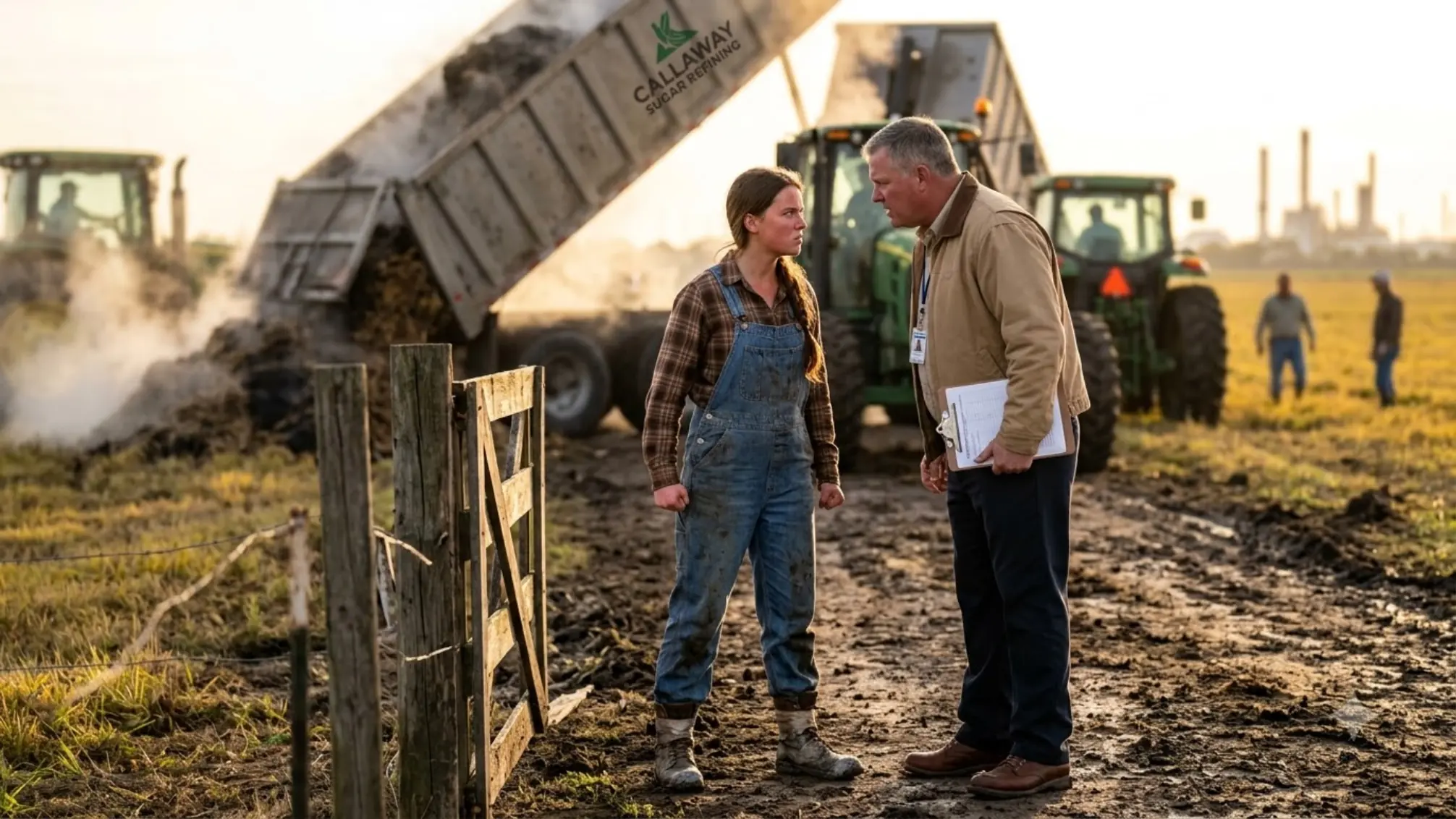
“Move away,” the factory manager ordered. “This company has dumped here for six years.”
“And you’ve poisoned our best soil for every one of them,” the farm girl replied, pointing toward the dying field.
“Block another truck, and I’ll have your family arrested.”
Elsie clenched her muddy fists. “Come through that fence—then watch your waste become the thing that destroys your excuse.”
The truck engine continued rumbling behind Hal, but the driver did not release the next load. Elsie’s father stood near the barn, uncertain whether to pull his daughter away or finally stand beside her. For six years, Arthur Wren had written letters, attended county meetings, and requested inspections that never came. Each complaint ended beneath polite words about permits, byproducts, temporary storage, and operational necessity.
Callaway Sugar Refining had begun using the neighboring property when Elsie was ten. The company initially promised that the dumping would last only one season while a modern processing facility was completed. One season became one year, then three, and eventually six. The black piles grew taller while the Wren farm’s most productive soil turned weak and sour.
The eighty-acre farm had belonged to Elsie’s grandfather before it passed to Arthur. The old man once called the lower pasture the good bottom because the soil there had been so rich that sweet corn reached a grown man’s chest by midsummer. Before the refinery expanded, the drainage ditch carried clear rainwater toward the river, cattle grazed close to the southern fence, and earthworms appeared beneath nearly every shovel of dark soil. By the time Elsie turned sixteen, the corn grew thin, the ditch smelled fermented, and even weeds struggled near the dumping ground.
Hal stopped a few feet from the fence. He wore polished work boots that had never sunk deeply enough into the Wren soil to understand what was happening beneath them. His expression was not openly cruel; it was worse than cruelty because it carried complete indifference. To him, the dying field represented an inconvenience smaller than the cost of moving the company’s waste somewhere else.
“This land is not part of your property,” Hal said.
“The runoff crosses our fence.”
“Our environmental reports show no regulated contamination.”
“My mother can taste it in the well water.”
“That is not scientific evidence.”
Elsie stepped closer. “Neither is pretending the dead corn grew itself.”
Hal lifted the clipboard as though the papers attached to it could overpower the field behind her. The factory held county permits, disposal records, and agreements written by lawyers whose offices were hundreds of miles from the smell. The Wren family possessed photographs, failed crops, and years of unanswered complaints. Hal knew which kind of evidence usually won.
“If you obstruct company vehicles again, law enforcement will be notified,” he warned.
Arthur finally approached from the barn. “She heard you.”
Elsie looked at her father. His shoulders had lowered in the years since the dumping began, and something inside his voice always sounded tired when he spoke about the refinery. He had entered Callaway’s offices three times. The first visit made him furious, the second made him quiet, and after the third, he stopped telling the family what had been said.
Hal signaled the driver to continue. Elsie moved away only after her father placed one hand on her shoulder. The tailgate opened, and another load crashed onto the pile. Steam rolled over the fence, covering the family’s pasture with the smell of sweetness turning rotten.
“You cannot fight every truck,” Arthur said after Hal left.
“Then we fight what they’re carrying.”
Her father looked toward the black mountain. “We already tried.”
“No,” Elsie answered. “We tried to make them care.”
That afternoon, she walked the southern fence alone. The newest waste remained wet and hot, but the oldest section had collapsed beneath years of rain, sunlight, and neglect. Grass appeared around its edge, something Elsie had never noticed near the fresher piles. She followed the green growth until she found a volunteer tomato plant rising from partially decomposed cane fiber.
The plant should not have survived there. Instead, it stood taller and darker than any tomato in her mother’s garden, its thick stems bowed beneath heavy red fruit. Nothing else grew well within that part of the pasture. Elsie crouched beside it for nearly an hour, examining the soil beneath its roots.
The material did not smell like fresh factory waste. It smelled closer to damp forest earth. The cane fibers crumbled between her fingers rather than sticking together in sour clumps. For the first time in six years, Elsie looked at the dumping ground and felt curiosity instead of helplessness.
She carried one tomato home and cut it open at the kitchen table. Her mother, Rose, refused to eat it until Elsie explained where it had grown. Arthur turned the fruit slowly in one calloused hand, studying its deep red color. He said it was probably a fortunate accident and warned her not to build hope from one plant.
Elsie did not argue. The next afternoon, she rode her bicycle to the county library and asked Mrs. Penhalligan for every book available on composting, soil biology, and agricultural waste. The librarian brought three books immediately, found four more in storage, and began setting aside university extension pamphlets whenever new ones arrived.
Night after night, Elsie read at the kitchen table after finishing her chores. She learned that sugarcane bagasse—the crushed fiber left after juice extraction—contained enormous amounts of carbon. Dumped raw, it decomposed slowly, pulled nitrogen from surrounding soil, trapped water, blocked drainage, and created acidic conditions that damaged roots. The books described nearly every problem the Wren family had watched spread through its lower field.
Yet the same material could become valuable if decomposition was controlled. Mixed with nitrogen-rich manure, exposed to oxygen, kept at the correct moisture level, and turned regularly, bagasse could transform into stable humus. The destructive pile behind the farm was not useless. It was unfinished.
Compost required balance. Bagasse contained far too much carbon and too little nitrogen, creating a ratio close to one hundred fifty parts carbon for every single part nitrogen. Productive compost needed something closer to thirty parts carbon for every part nitrogen. The factory had created a problem by concentrating one ingredient and abandoning the biological process that could complete it.
Elsie read about thermophilic bacteria that heated compost above one hundred thirty degrees, destroying weed seeds and harmful organisms. She learned the difference between aerobic decomposition, which smelled earthy, and anaerobic rot, which produced the sour odor that had haunted her family for years. Most importantly, she learned that compost was not simply dead matter breaking apart.
It was alive.
Elsie began her first experiment in October behind the old equipment shed, where neither Hal nor passing trucks could see her. She laid coarse branches on the ground to create airflow, then hauled wheelbarrows of aged bagasse from the edge of the dumping area. Every trip left her shoulders burning and her taped boots coated with black residue. She mixed the cane fiber with fresh chicken manure, native soil from the woods, and enough water to make the pile feel like a wrung-out sponge.
For eight days, nothing happened. Elsie pressed her hand against the pile every morning and felt only damp coldness. She worried that the books had simplified something too complicated for her to reproduce. On the ninth day, warmth rose through the outer layer.
By the eleventh day, the center was almost too hot to touch.
Elsie inserted an old steel rod, left it inside for one minute, and pulled it out. Heat traveled through the metal into her palm. She stood behind the equipment shed in the cold morning air and laughed because the pile was working.
Her first success did not last. A hard November freeze covered the outer layer in ice and slowed the microorganisms inside. Elsie wrapped the pile in straw, then stole an old tarp from the barn and covered it before adding another layer of insulation. Every five days, she turned the material with a pitchfork, moving the cold exterior toward the hot center.
The work tore open her gloves and split the skin across her knuckles. When snow soaked the pile in December, the interior lost oxygen and turned anaerobic. The odor that escaped when Elsie opened it nearly made her vomit.
She considered abandoning the experiment. Instead, she spread the pile apart, added dry bagasse, rebuilt the layers, and began again. Failure had changed the conditions, not the possibility.
Students at school learned what she was doing after a classmate saw her pushing a wheelbarrow filled with chicken manure. For two weeks, they called her the manure girl. Someone wrote the name across her locker in black marker. Elsie left it there.
Mr. Halloran, the agriculture teacher, noticed the soil biology book beside her lunch tray. The following morning, he placed a battered copy of An Agricultural Testament on her desk. Its cover was held together with tape and several pages contained handwritten notes from decades of previous readers.
“You building something?” he asked.
“Maybe.”
“If you need barn space, mine stays dry.”
Elsie thanked him but declined. The waste had damaged her family’s land, and she wanted the answer to rise from that same ground.
By February, three compost piles stood behind the shed at different stages of decomposition. The newest still showed recognizable cane fiber. The second remained hot and required regular turning. The oldest had cooled into dark, soft material that crumbled through Elsie’s fingers.
She brought a coffee can filled with finished compost into the kitchen and placed it before her parents. Arthur lifted a handful, smelled it, and let it fall slowly back into the container. It carried no trace of sour cane waste or manure.
“What is it?” Rose asked.
“Fertilizer,” Elsie said. “From the refinery’s garbage.”
Arthur stared toward the window, where the top of the black dumping pile remained visible beyond the barn. For six years, he had seen only the thing destroying his farm. His daughter had found a possible resource hidden inside it.
In April, Elsie selected a quarter-acre test plot near the farmhouse. The soil was sandy, exhausted, and too weak to support anything except weeds during the previous two seasons. She spread finished compost across the ground, worked it into the top layer, and planted sweet corn, pole beans, and three tomato varieties.
The remainder of the farm received no compost. Elsie wanted a clear comparison rather than a hopeful guess. She measured growth weekly, recorded rainfall, and photographed the plants from the same position every Sunday.
By early June, the difference was impossible to ignore. Corn in the treated plot reached Elsie’s waist while plants in untreated soil remained below her knees. Bean vines grew beyond their supports and had to be tied twice. Tomato plants produced dark leaves and thick stems resembling the volunteer plant that started the experiment.
Pete Doheny, a neighboring farmer who once told Rose that refinery dumping was simply how things worked now, stopped at the fence one afternoon. He watched Elsie harvest beans from the test plot while his own field struggled across the road. After twenty minutes, he finally asked what she had applied.
“Fertilizer I made.”
“Bought from where?”
“I didn’t buy it.”
Elsie pointed toward the black cane piles. Pete removed his cap, stared at the dumping ground, and walked away without another word. Three farmers visited before the month ended.
Mr. Halloran arrived in September with a professional soil-testing kit. He collected samples from the treated plot, the untreated lower field, and the dumping ground. The following weekend, he returned with laboratory results and sat at the Wren kitchen table for nearly two hours.
The treated plot contained almost three times the organic matter of the surrounding farm. Its water-holding capacity had increased, soil structure had improved, and microbial activity exceeded anything he had recorded during twenty-three years of teaching agriculture. Elsie’s compost provided slow-release nitrogen, phosphorus, potassium, trace minerals, and living organisms capable of rebuilding depleted soil.
“You understand what you’ve done?” Mr. Halloran asked.
Elsie looked at the numbers. “I finished what the factory started.”
Arthur smiled for the first time in months.
The news moved through the county faster than the family expected. Farmers began asking for small amounts to test in their own fields. Mrs. Penhalligan contacted a university extension agent, who requested photographs and samples. The agriculture department asked Elsie to document her process.
Callaway Sugar Refining noticed when farmers stopped calling the dumping ground worthless.
A company representative arrived in October wearing a clean suit and carrying a clipboard. He introduced himself as Thomas Reddick from regional operations and asked whether the Wren family would discuss the material stored behind its farm. Elsie stood in the doorway and remembered every speech she had imagined delivering to the company.
None felt necessary anymore.
“You can speak to my father,” she said. “He’s in the barn.”
The meeting lasted nearly three hours. Thomas explained that the refinery paid significant transportation and disposal costs for the bagasse. If Elsie’s process could convert it into commercial fertilizer, the company might reduce expenses and create a new product. He offered a modest consulting payment and proposed a supervised pilot project.
Arthur asked what would happen to the damaged field. Thomas said the company could clear the dumping ground and contribute equipment to help process the old material. Elsie refused to discuss any partnership until Callaway acknowledged that years of raw dumping had damaged the Wren farm.
Thomas did not have authority to make that admission.
“Then you don’t have authority to use my process,” Elsie said.
Hal Brennan returned two days later. He arrived in the same tan jacket he wore during the confrontation at the fence, but this time no trucks waited behind him. Arthur, Rose, Elsie, Mr. Halloran, and two neighboring farmers stood inside the barn when he entered.
Hal placed several documents on a workbench. “The company will fund soil testing, clear the dumping site, restore drainage, and provide machinery for the composting pilot.”
“What about the damage?” Elsie asked.
“We are willing to acknowledge that storage practices contributed to poor drainage and soil depletion.”
“Contributed?”
Hal’s jaw tightened. “Your family also experienced weather variation and ordinary agricultural decline.”
Elsie pushed the soil reports toward him. “The field closest to your dumping ground has the worst acidity, lowest nitrogen availability, and weakest microbial activity. The damage decreases with distance from the pile.”
“Our lawyers chose the language.”
“Then send the lawyers to turn your waste every Sunday.”
Pete Doheny covered a smile with one hand.
Hal looked around the barn and realized the balance had changed. Six years earlier, the Wrens had stood alone against the county’s largest employer. Now farmers wanted Elsie’s fertilizer, teachers possessed laboratory data, and university researchers had requested access to her work. The material Callaway paid to discard had acquired value only because the quiet girl beside its dumping ground understood it better than the company did.
“What wording do you want?” Hal asked.
Elsie answered without hesitation. “Callaway’s disposal of untreated cane waste damaged the Wren farm’s drainage and soil quality.”
Hal stared at her.
“That is the truth,” Arthur said.
The manager finally nodded. “I’ll take it back to the legal department.”
Three weeks later, the company signed the revised agreement.
The dumping stopped. Callaway cleared the freshest piles from the fence line, rebuilt the drainage channel, and supplied a mechanical windrow turner that accomplished in minutes what had taken Elsie hours with a pitchfork. The company funded a controlled composting site on unused refinery land under Elsie’s supervision.
At first, factory engineers treated the sixteen-year-old as a symbol rather than an expert. They asked her to stand beside equipment for photographs while attempting to redesign her process without consulting her. The first large pile overheated because they added too much nitrogen, then turned sour after excess water reduced airflow.
Elsie ordered the pile opened and rebuilt.
One engineer objected. “Our formula was calculated professionally.”
“Your formula is drowning.”
“The moisture is within our range.”
Elsie squeezed a handful. Water ran between her fingers. “Compost doesn’t read your spreadsheet.”
Hal watched the exchange without intervening. Months earlier, he might have removed Elsie from the site. Now he told the crew to follow her instructions.
The rebuilt pile heated correctly within four days.
The university sent a graduate student named Sarah Kim to study the windrows. Sarah measured temperature, carbon ratios, microbial populations, and nutrient release. Her data confirmed what Elsie had learned through observation: aging the bagasse before mixing reduced acidity, native woodland soil provided useful microbes, and turning schedules needed adjustment based on moisture rather than fixed calendar dates.
Farmers tested the finished compost across the county. Corn yields improved without the sudden growth and later weakness associated with heavy synthetic nitrogen. Sandy fields held water longer during hot weeks. Several vegetable growers reported stronger roots and fewer disease problems.
Callaway began packaging the fertilizer under a regional agricultural brand. Elsie refused their first proposed name because it mentioned only the refinery. The final bags carried both names: Callaway-Wren Living Soil Compost.
Her family received a percentage from every sale.
Money did not repair the lower pasture immediately. The soil required four years of compost, cover crops, improved drainage, and patient work before its health returned. Elsie treated one section each season, measuring organic matter and watching earthworms gradually reappear beneath her shovel.
By the time she was twenty-three, the good bottom had become darker and richer than it had been during her childhood. Sweet corn once again reached chest height. The drainage ditch ran clear, the well water lost its sour taste, and cattle returned to grazing near the southern fence.
The refinery remained open. Hal Brennan kept his position, though he never again dismissed a farmer’s observation as unscientific without examining it first. Callaway’s waste-management program became more profitable than its former dumping practice and was copied by two neighboring sugar mills.
Elsie did not describe the outcome as forgiveness. The company changed because ignoring her became more expensive than listening. Yet the change still mattered because fewer fields would be poisoned, fewer families would face black piles beside their homes, and material once treated as useless would return to the soil in a form that helped it live.
One evening, Elsie stood near the location where the original waste mountain had risen. Swallows crossed the pasture in the fading light, and rows of healthy corn moved beneath the river breeze. Her father joined her carrying the framed magazine article that had hung above the kitchen sink for years.
The headline called her the teenager who transformed factory waste into agricultural gold.
“I always hated that title,” Elsie said.
“Why?”
“I didn’t make gold.”
Arthur looked across the restored soil. “No. You made something useful.”
Elsie knelt and lifted a handful of dark earth. It smelled like rain, roots, and living things working below the surface. The soil did not erase what had happened, but it held evidence that damaged ground could recover when someone stopped calling the problem permanent.
Callaway Sugar Refining had dumped crushed cane behind the Wren farm for six years because the company believed waste remained worthless after leaving its machines. Elsie proved the material still contained carbon, minerals, and biological possibility. What it lacked was not value.
It lacked understanding.
The same had been true of the girl standing beside it. County officials ignored her because she was young. Factory managers threatened her because she lacked power. Students mocked her because she worked with manure and rotting cane.
She never defeated them by shouting louder.
She kept reading, measuring, turning the pile, rebuilding after failure, and allowing the results to become impossible to dismiss. By the time the powerful people finally listened, Elsie had already transformed the thing they used to poison her family’s farm into the richest fertilizer in the county.
The land had not lied.
It had only been waiting for someone patient enough to understand what it was saying.