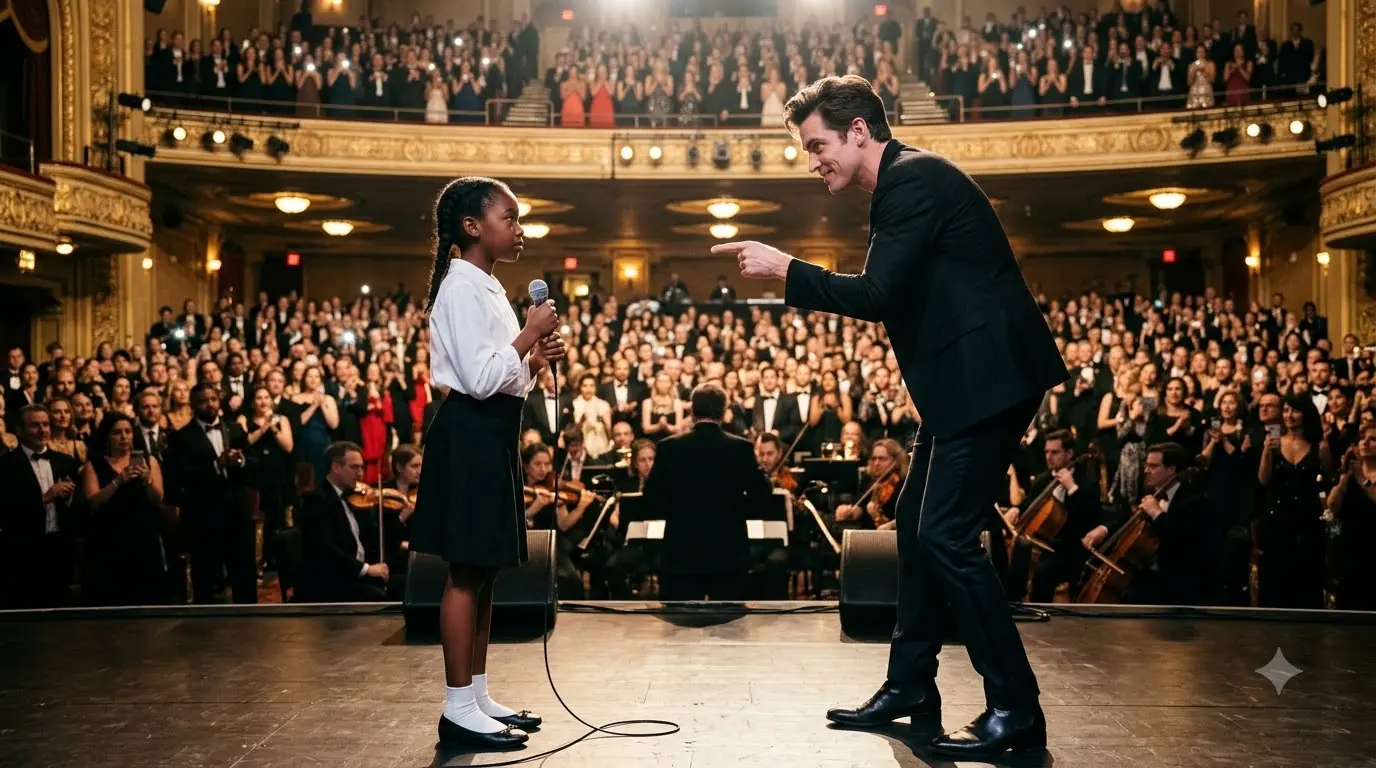
 Her hands began to tremble. “I’m sorry, sir. I didn’t mean—”
“Save it.” Chase took hold of her shoulder and pulled her into the spotlight. “Let’s see if you can actually sing or if you’re just taking up space.”
He snapped his fingers toward the band. “Give her ‘Higher Ground.’”
The musicians exchanged uncertain looks. Everyone in the theater knew the song. It was the one that had helped make Chase Hendricks a superstar, the one with the impossible whistle-register C6 that had become his signature. The note had helped sell millions of records, fill arenas, and build a public image worth more than most people in the room would earn in a lifetime.
Chase leaned close to Zara. His microphone was off.
Hers was not.
“Fail quietly, kid,” he whispered.
The audience held its breath.
What Zara did next would not simply prove him wrong. It would pull at a thread that had been hidden for fifteen years, and once that thread came loose, everything Chase had built around it would begin to unravel.
Four hours earlier, Zara had stood in the same theater with her stomach tied in knots.
She lived in Compton with her mother and two younger brothers in a two-bedroom apartment where the heater only worked reliably in one room. Her mother was a nurse at County General who worked night shifts and slept during the day in broken three-hour stretches. Zara often made macaroni and cheese for her brothers, helped with homework, reminded them to brush their teeth, and tried not to wake their mother before she had to return to the hospital.
Money was always the question in the Williams home.
“Can we afford it?”
“Not this month.”
“Maybe next year.”
Zara had been singing since she was five, standing in the second row of the New Hope Baptist Church choir every Sunday. By seven, the choir director, Ms. Johnson, had pulled Zara’s mother aside after service.
“Your daughter has perfect pitch,” Ms. Johnson had said. “One in thousands of people can identify notes without a reference tone. She hears things most of us don’t.”
Zara’s mother had smiled, proud but exhausted. “What do we do with that?”
“Training would help. Berklee someday. Juilliard. A serious vocal program.” Ms. Johnson paused. “But that takes money.”
Money they did not have.
So Zara sang at church. She sang in the choir at Jefferson Elementary, where the music budget had been cut three years in a row. She sang quietly in her bedroom at night, teaching herself vocal runs from videos on her mother’s old phone.
Her range was unusual. She could move from a D3 chest voice into a clear, ringing upper register and sometimes reach notes around G6. Those high tones sounded almost like glass bells or wind chimes.
Zara did not know how rare that was.
She only knew that singing felt natural.
When Jefferson Elementary received a letter saying the school had been selected for Chase Hendricks’s annual charity gala, the entire music department erupted. Twenty choir students would sing background vocals on a real professional stage, in front of cameras, with major artists and donors in the audience.
Zara’s mother bought her a new white blouse from a discount store. She kept the tags attached until that morning in case the family needed to return it.
Chase Hendricks was famous for galas like this. Every year he chose a different city, raised money for underfunded schools, posed for photographs with children, and spoke publicly about giving back. The press called him generous. Sponsors called him inspirational.
His brand was built around being the voice of a generation.
Four platinum albums.
Two Grammys.
Major endorsement deals.
And at the center of it all was “Higher Ground,” the song famous for the soaring C6 that fans called impossible.
During soundcheck that afternoon, Zara heard something that did not make sense.
The choir had been waiting backstage and had been told to remain quiet while Chase rehearsed. Zara wandered closer to the wings because she wanted to see the stage before the audience arrived.
Chase began the bridge of “Higher Ground.”
His voice was good. Trained. Polished. Expensive sounding.
But when he reached for the famous high note, his voice broke around A5, noticeably below where the note was supposed to be.
He stopped.
“Bring the track up in that section,” he snapped toward the sound engineer. “I need more support.”
The engineer made an adjustment.
Chase tried the passage again.
This time the C6 sounded perfect.
Too perfect.
Zara froze.
She had perfect pitch, but that was not the only thing she noticed. The note had a different texture. It did not blend naturally with the sound coming from Chase’s throat. There was a slight processed shimmer around it, and the pitch sat on top of the mix instead of inside it.
It sounded recorded.
Zara stood in the shadows of the wing, confused.
She said nothing.
Who would believe an eleven-year-old girl from Compton over a man who had sold millions of records?
But now, hours later, Chase had pulled her into the spotlight in front of five hundred people and nearly two million viewers.
And Zara understood something she had not understood during soundcheck.
He knew she had been standing in the wings.
He knew she had heard him miss the note.
This was not about giving her an opportunity.
It was about making her look foolish before she could ever tell anyone what she had heard.
The band began playing.
The opening chords of “Higher Ground” filled the theater.
Zara’s mouth went dry.
“I don’t think I can,” she said.
“Sure you can, sweetheart,” Chase replied loudly enough for the audience. “Just follow the music.”
The song was not easy. The verse was comfortable enough, but the bridge climbed relentlessly toward the high note that had made Chase famous.
Chase stepped back, giving Zara room to fail.
“Whenever you’re ready.”
Zara took a breath.
Her grandmother’s words came back to her from that morning.
“If somebody tries to make you small, baby, you stand tall.”
Zara opened her mouth.
Then stopped.
“Mr. Hendricks?”
Her voice was small, but the microphone carried it throughout the theater.
Chase’s smile tightened. “Yes?”
“Can you turn off the backing track?”
The room went quiet.
Chase blinked.
“What?”
“The backing track. Can you turn it off? I want to sing it for real.”
Confused murmurs spread through the audience.
Chase’s smile froze.
“The track is part of the arrangement, sweetheart.”
“But you sang it without the track at soundcheck,” Zara said. Her heart was pounding. “You sang it alone.”
The murmurs grew louder.
“Soundcheck is different from performance.”
“Then can you sing it first?”
Chase stared at her.
Zara swallowed. “Show me how you do it without the track.”
Three seconds of silence felt like thirty.
Then Chase laughed sharply.
“You want me to audition for you?”
“No, sir. I want to learn from you.”
She paused.
“Can you hit the note without the track?”
The theater reacted instantly. Gasps. Nervous laughter. A few voices whispering.
Chase’s face flushed.
“Of course I can. I’ve been singing that note for fifteen years.”
“Then show me.”
His mouth opened.
Closed.
His hand flexed at his side.
“Fine.”
He turned toward the sound booth.
“Kill the backing track.”
The sound engineer hesitated.
“Do it.”
A control was changed.
The arrangement suddenly felt thinner and more exposed.
Chase raised his microphone.
He began the song.
At first, he sounded excellent. Years of professional training carried him through the verse with confidence. His breath was controlled. His lower register was solid. The audience began to relax.
Perhaps this really was a misunderstanding.
Perhaps Zara had heard something wrong.
Then the bridge began.
The melody climbed.
E4.
G4.
B4.
Chase followed cleanly.
Then D5.
E5.
A5.
His neck tightened. His shoulders lifted slightly.
And then he reached for the C6.
His voice cracked around A-sharp 5, well below the target.
The sound splintered.
Chase stopped.
He coughed, then forced a laugh.
“Sorry, folks. Dry throat.”
His smile did not reach his eyes.
“That’s why performers use tracks sometimes—to protect the voice during long shows.”
Zara looked at him.
“You didn’t hit it.”
Chase turned slowly.
“I told you my voice is tired.”
“But on your album, the note is perfect every time,” Zara said. Her voice was gaining strength now. “And in the live videos I watched, it sounds exactly the same every time.”
Phones began appearing throughout the audience.
“What are you trying to say?” Chase asked.
“I have perfect pitch.”
Zara looked toward the crowd, then back at Chase.
“The note on the album is C6. About 1046.5 hertz. What you just sang was around A-sharp 5, about 932 hertz.”
Someone in the audience whispered, “Is she right?”
Chase’s face reddened.
“Listen, little girl—”
“And the voice on the album doesn’t sound like yours,” Zara continued.
The words were coming faster now.
“It sounds like a woman.”
The theater shifted.
Zara’s hands were still trembling, but she did not stop.
“I looked at your album credits. It says Sophia Mitchell under additional vocals.”
The crowd exploded into whispers.
Chase stepped closer.
“You need to stop talking.”
“Why?” Zara asked.
For the first time since he had pulled her onto the stage, she no longer sounded frightened.
“Because I’m telling the truth?”
“You’re eleven years old. You don’t understand professional production.”
“I understand what I heard at soundcheck.”
Zara looked toward the cameras.
“That high note isn’t your live voice. It’s on a track.”
Chase reached for her arm and tried to guide her offstage.
“We’re done here.”
Before he could move her, another voice came from the wings.
“Actually, she’s right.”
Every head turned.
Chase’s sound engineer stepped onto the stage.
His face was pale.
“I’ve been your engineer for five years, Chase.”
Chase released Zara.
The engineer continued.
“At every show, I’ve triggered that backing vocal in the bridge.”
The theater went completely silent.
“You’ve never sung that C6 live. Not once.”
Chase stared at him.
“You’re fired.”
“I know.”
The engineer swallowed.
“But she’s eleven years old, and she’s braver than I’ve been for five years.”
Five hundred people held their breath.
Two million watched online.
Chase stood frozen.
“This is ridiculous,” he said. His voice shook. “You’re going to believe a kid over me? I have two Grammys. I’ve sold millions of records.”
“Then prove her wrong!” someone shouted.
Another voice followed.
“Sing the note!”
Chase’s face turned pale.
“I just did.”
“No, you didn’t!” someone yelled. “You cracked.”
The audience was turning.
Chase looked at Zara.
“Fine.”
His voice was low.
“You think you’re so smart? You sing it.”
The theater went quiet again.
“No preparation. No warm-up. No second chance.”
Zara’s hands began trembling harder.
This was the moment.
If she failed, Chase would use it to dismiss everything she had said.
From the choir risers, Ms. Johnson called out.
“You can do this, baby. Sing like you do at church.”
Zara closed her eyes.
She inhaled slowly, letting the breath settle deep instead of high in her chest.
She remembered church rehearsals, Ms. Johnson tapping rhythms on a music stand, her grandmother humming gospel melodies while cooking, the hundreds of nights she had sung quietly so she would not wake her brothers.
Then Zara opened her eyes.
She nodded to the band.
The musicians started again.
“Higher Ground.”
For the second time that night.
But everything was different now.
Zara began softly.
The first verse sat comfortably inside her range. Her tone was clear but restrained. She focused less on impressing anyone and more on telling the story in the song.
Some people exchanged glances.
She was good.
But nothing impossible yet.
Then the pre-chorus began.
Her voice opened.
Power came without strain.
There was something raw in the sound that Chase’s polished performance had lacked. Zara was not protecting a brand or recreating a studio take.
She was singing.
The melody climbed.
D5.
E5.
F5.
Her voice followed effortlessly.
Chase shifted his weight.
The bridge arrived.
G5.
A5.
B5.
Zara moved cleanly into whistle register.
Then she reached C6.
The note came out clear.
No crack.
No track.
No trick.
A pure tone rang through the Orpheum like a bell.
She held it for four seconds.
Someone in the front row gasped.
Zara kept going.
D6.
E6.
F6.
Higher than the recording had ever gone.
Her face remained calm, almost peaceful, as though those notes were not terrifying heights but familiar rooms she had visited many times alone.
Then she brought the run back down.
F6.
C6.
A5.
F5.
Each transition was clean.
She completed the bridge and moved into the final chorus.
Now her voice was fully open.
No fear.
No shrinking.
When the final word faded, nobody moved for one heartbeat.
Then the theater erupted.
All five hundred people rose.
Applause thundered through the building.
Some guests were crying.
The Jefferson Elementary choir jumped and screamed.
Ms. Johnson covered her mouth with both hands.
The livestream exploded with comments and shares.
Within thirty seconds, tens of thousands of people had reposted clips.
Within minutes, Zara Williams was trending.
Zara stood beneath the lights, breathing hard, still unsure what had happened.
Chase looked gray.
Yolanda Carter, a legendary R&B singer seated near the front, stood slowly.
She was crying.
“That,” Yolanda said, “is one of the best performances I have ever heard from a child.”
She pointed toward Zara.
“Baby, you didn’t just hit that note. You owned it.”
The applause grew even louder.
Marcus Webb, another judge on the gala panel, rose next.
He was a Black music producer who had spent thirty years working with major recording artists.
He shook his head.
“I need to say something.”
The theater quieted.
“I was part of the team that mixed the original album.”
Chase turned toward him.
Marcus continued.
“Zara is right.”
The room froze.
“The voice on the high passage is Sophia Mitchell, a session singer from Atlanta.”
A wave of gasps moved through the audience.
“She was paid two thousand dollars and signed an NDA. Her contribution was buried under ‘additional vocals.’”
Chase tried to speak.
Marcus kept going.
“I stayed quiet because that is how this industry works. You protect the star. You protect the investment. You protect the machine.”
He looked toward Zara.
“But I’m done protecting lies when an eleven-year-old has more courage than I’ve shown in thirty years.”
The theater exploded again.
Journalists typed furiously.
Audience members shouted questions.
Cameras abandoned their fixed positions.
Chase finally found his voice.
“This is insane. You’re destroying my career over a backing track. Everybody uses them.”
Yolanda shot back.
“Using support is not the same as presenting another singer’s voice as your signature live performance.”
Chase looked around for support.
His band members avoided his eyes.
His manager had already moved to the side of the stage and was speaking urgently into a phone.
Chase turned back to Zara.
His voice dropped.
“You’re going to regret this.”
Her microphone caught every word.
“You and your little school and your teacher. I’ll make sure this industry wants nothing to do with you.”
The threat hung in the air.
Ms. Johnson started to rise.
Zara spoke first.
“I’m eleven.”
Her voice was steady.
“I don’t work in the industry. I sing because I love singing.”
She looked straight at Chase.
“You can’t take that away from me.”
A pause.
“But maybe somebody should take away the lies.”
The theater went silent.
Then one person began clapping slowly.
Another joined.
Then another.
Within seconds, the entire room was applauding again.
Not for Chase Hendricks.
For the child who had refused to pretend.
Chase looked at the cameras, at the judges, at the audience, and then walked offstage.
The moment he disappeared into the wings, the theater erupted.
People checked their phones.
“Look at social media,” someone shouted. “He’s already trending.”
The phrases changed by the minute.
Chase Hendricks exposed.
Backing-track scandal.
Session singer controversy.
Within minutes, major entertainment sites were posting articles.
Sponsors announced they were reviewing their relationship with Chase.
Zara stood in the middle of the chaos and felt something strange.
Not pride.
Not triumph.
Just the quiet certainty that she had told the truth.
Security spent the next twenty minutes clearing the theater.
Backstage, Zara sat in a folding chair with Ms. Johnson’s arm around her shoulders while adults moved around them in urgent clusters. Event organizers, attorneys, managers, technicians, publicists—everyone seemed to be talking at once.
Nobody knew what to say to Zara.
Her mother had called three times from County General.
She could not leave her shift.
“Baby, what happened? Are you okay?”
“I’m fine, Mama. Ms. Johnson is here.”
Zara did not know whether she was fine.
Nearly midnight, the choir students had all gone home. The stage crew was dismantling equipment when a man in his fifties arrived in an expensive suit carrying a leather briefcase.
He introduced himself as Robert Craft.
“I represent Mr. Hendricks.”
Ms. Johnson immediately tightened her arm around Zara.
“She is eleven years old. Her mother needs to be present before you question her.”
“Of course,” Craft replied smoothly. “I’m not here to interrogate anyone. I’m here to resolve an unfortunate misunderstanding.”
“There is no misunderstanding,” Ms. Johnson said. “Your client used a recorded voice for a note he publicly presented as his own live performance.”
Craft’s smile remained fixed.
“The music industry is complicated. Artists use support tracks, studio enhancement, and layered vocals every day.”
Zara looked at him.
“He still lied.”
Craft turned toward her.
“You misunderstood professional production, sweetheart. Unfortunately, your statements have caused Mr. Hendricks substantial harm.”
He opened his briefcase.
“His sponsors are reviewing contracts. Tour dates are at risk. Millions of dollars are involved.”
Ms. Johnson’s eyes narrowed.
“Are you threatening an eleven-year-old?”
“Not at all.”
Craft removed a document.
“We’re offering a solution.”
Ms. Johnson read it.
Her face hardened line by line.
“This says Zara made false accusations.”
“It clarifies the misunderstanding.”
“It says she was seeking attention.”
“It allows everyone to move on.”
Craft placed another page on top.
“In exchange, Mr. Hendricks will not pursue legal action. He will also fund a fifty-thousand-dollar music scholarship for Zara.”
Zara’s breath caught.
Fifty thousand dollars.
That was serious training.
Berklee.
Juilliard.
Possibility.
For a child who had spent her life hearing “maybe next year,” fifty thousand dollars sounded like a door opening.
Ms. Johnson looked at Craft.
“And if she refuses?”
His smile disappeared.
“Mr. Hendricks will pursue defamation claims against Zara, the school, and potentially Ms. Johnson for failure to supervise.”
He paused.
“Jefferson Elementary has also been informed that Mr. Hendricks’s planned five-hundred-thousand-dollar donation to its music program is now under review.”
Zara felt the room tilt.
Craft looked directly at her.
“Sign the statement, accept the scholarship, and everyone moves forward.”
He leaned back.
“Or refuse, and your family may face legal expenses you cannot afford while your school loses funding.”
Zara stared at the signature line.
She thought about her mother working double shifts.
Her brothers needing shoes.
The school instruments held together with tape.
The fifty thousand dollars.
Then she thought about the note.
About the recording.
About the truth.
“No.”
Craft blinked.
“Excuse me?”
“I’m not signing it.”
“Zara—” Ms. Johnson began.
“I didn’t lie.”
Zara stood.
“He did.”
Her hands were shaking, but she looked Craft directly in the eye.
“I’m not going to say I lied because he has money and I don’t.”
“Young lady, you may not understand the consequences.”
“I understand you’re trying to scare me.”
Craft closed his briefcase.
“Then we’ll see you in court.”
At the door, he turned back.
“By tomorrow, stories about your family will be everywhere. When it becomes painful, remember that you were offered a way out.”
Then he left.
Ms. Johnson pulled Zara close.
“Baby, are you sure? That scholarship…”
“I don’t want his money,” Zara whispered.
But when they walked into the cold Los Angeles night, she could not stop shaking.
She had refused fifty thousand dollars.
She had put her school’s funding at risk.
She had made an enemy of one of the most powerful men in the music business.
And for the first time, Zara wondered whether telling the truth was going to cost more than she could survive.
She slept three hours.
At six in the morning, her phone began buzzing nonstop.
Her mother was already sitting at the kitchen table with a laptop open.
Her face was pale.
“Baby, don’t go online today.”
Zara had already unlocked her phone.
Thousands of notifications.
The first thing she saw was a photograph of their apartment building.
Peeling paint.
Broken security gate.
Overflowing trash bins.
A caption suggested that Zara’s family was desperate for money and had invented the accusation for attention.
The next post contained her mother’s work schedule.
Another discussed her salary.
Another showed an old school photograph and mocked the fact that Zara qualified for free lunch.
Comments followed.
Ungrateful kid.
Attention seeker.
Her family is looking for a payday.
Others were worse, filled with prejudice and contempt.
“These people,” one comment said, “always want something.”
Zara’s stomach twisted.
Then came messages from unknown numbers.
Threats.
Insults.
Ms. Johnson called.
“Do not come to school. Reporters are outside. The principal wants to meet later.”
Zara lowered the phone.
“Reporters?”
Her mother nodded.
By 7:15 a.m., the situation changed.
A woman named Sophia Mitchell posted a video.
She was in her thirties, a Black session singer sitting in a recording studio with gold records on the wall behind her.
“My name is Sophia Mitchell,” she began. “And I am the voice Chase Hendricks has been selling as his own on those high notes for fifteen years.”
Zara’s mother grabbed her hand.
Sophia continued.
“That little girl told the truth last night.”
She held up a contract.
“I sang the whistle-register notes on ‘Higher Ground’ and four other songs. I was paid two thousand dollars per song and required to sign an NDA. My name was buried in the credits.”
Sophia’s eyes filled.
“I stayed silent because I needed the work.”
She took a breath.
“But I will not stay silent while an eleven-year-old gets attacked for telling the truth I was too afraid to tell.”
The video had been online eight minutes.
Already fifty thousand views.
Within an hour, more than two million.
By late morning, seven additional session singers came forward.
Contracts.
Emails.
Recording records.
Each confirmed some version of Zara’s accusation.
By noon, the story had changed.
No longer rumor.
Evidence.
But Chase Hendricks did not retreat.
That afternoon, his legal team filed a ten-million-dollar defamation lawsuit.
Not only against Zara.
Against Sophia Mitchell.
Against Marcus Webb.
Against Jefferson Elementary School.
Ten million dollars.
At three in the afternoon, papers were delivered to the Williams apartment.
Zara’s mother stared at them.
“We don’t have money for a lawyer.”
Her hands shook.
“We barely have money for anything.”
The lawsuit seemed designed less to win quickly than to frighten everyone involved into silence.
And the public-relations counterattack continued.
By four o’clock, gossip sites were publishing stories claiming Zara’s mother had coached her daughter to confront Chase for money.
One story quoted supposed former neighbors saying the family had a history of “looking for handouts.”
None of it was true.
All of it was published.
By five, angry Chase Hendricks fans gathered outside Jefferson Elementary.
Signs appeared.
LIARS.
LEAVE CHASE ALONE.
The principal called an emergency meeting.
Zara sat beside her mother in his office while Ms. Johnson stood near the wall.
The principal looked exhausted.
“I’m sorry,” he said, “but the board is considering suspending Zara pending investigation.”
“Investigation of what?” Zara’s mother demanded. “She told the truth.”
“The board is concerned about safety, legal exposure, and the attention around the school.”
He rubbed his forehead.
“We have reporters outside, protesters, frightened parents. Chase Hendricks’s attorneys are threatening the district.”
“She was at a school-sanctioned event,” Ms. Johnson said. “She didn’t create this.”
“That means the school may still be held responsible for what occurred.”
Zara looked at him.
“So I’m being suspended because I told the truth?”
The principal’s face tightened.
“You’re being considered for suspension because the district does not believe it can afford the fight.”
The words landed heavily.
“I’m sorry, Zara.”
They left through a back entrance to avoid cameras.
At home, the apartment phone rang constantly.
Reporters.
Threatening callers.
Someone pretending to be from child protective services.
The boys were frightened.
They did not understand why strangers were outside their building or why their sister was on television.
That night, Zara’s mother sat on the edge of the bed.
“Baby, I have to ask you something.”
Zara looked up.
“If you could take it back, would you?”
Zara thought about the scholarship.
The lawsuit.
The school.
The threats.
The people outside.
“No,” she said finally.
“I wouldn’t take it back.”
Her mother closed her eyes.
A tear slipped down her cheek.
“Then we fight.”
She squeezed Zara’s hand.
“I don’t know how yet, but we fight.”
At midnight, Zara lay awake beside her brothers, listening to them breathe.
She imagined Chase in a mansion somewhere in the Hollywood Hills, protected by lawyers, money, and people whose jobs depended on keeping him powerful.
She thought about how easy it would have been to sign the statement.
Take the scholarship.
Say she had misunderstood.
Then she thought about Sophia.
Fifteen years of silence.
Marcus Webb.
Three decades of silence.
The seven other singers who had now come forward.
They were afraid too.
But they had spoken.
Zara closed her eyes.
She did not know that the next morning would bring the first thing she had not expected since the nightmare began.
Help.
The knock came at seven.
Zara’s mother opened the door cautiously.
A professionally dressed woman in her forties stood outside holding a briefcase.
“Mrs. Williams?”
“Yes?”
“My name is Diana Carter. I’m an entertainment attorney. I would like to represent your daughter.”
Zara’s mother blinked.
“We can’t afford—”
“Pro bono.”
Silence.
“No charge.”
Diana continued.
“Sophia Mitchell retained our firm. When we learned that Chase Hendricks sued an eleven-year-old child, three partners volunteered to help.”
She raised the briefcase slightly.
“May I come in?”
Within an hour, the kitchen table was covered with legal pads, printed statements, screenshots, contracts, and court filings.
Diana worked quickly.
“Chase’s defamation case is weak,” she said. “Defamation requires false statements. We now have multiple witnesses and records indicating Zara’s central claims are true.”
Zara’s mother looked worried.
“So what do we do?”
“We defend aggressively.”
Diana tapped the complaint.
“And we examine counterclaims—fraud, false advertising, consumer claims, possibly a class action involving ticket holders who paid for live performances under misleading representations.”
A knock interrupted them.
Ms. Johnson entered with Marcus Webb.
“I wanted to see how she was doing,” Marcus said.
He sat across from Zara.
Up close, he looked exhausted.
Chase’s lawyers were attacking him too.
“I’ve been in this industry thirty years,” Marcus said. “I’ve watched powerful people crush careers.”
He pulled out his phone.
“But I’ve also watched movements start.”
The screen was filled with messages from artists.
One major singer wrote: Protect that child. Listen to her truth.
Other performers offered legal support, public statements, or money for the school.
“You are not alone,” Marcus told Zara.
At nine, another knock came.
Rachel Goldstein from 60 Minutes stood outside.
“I want to investigate the entire story,” Rachel said. “Chase’s recordings. The credit practices. The NDAs. The people who knew.”
Zara’s mother crossed her arms.
“Why?”
Rachel looked toward Zara.
“Because I have a daughter about her age.”
Her voice softened.
“And if somebody tried to silence her for telling the truth, I would hope somebody with resources stepped forward.”
By noon, the Williams apartment was crowded.
Diana’s paralegal arrived with documents.
Two industry contacts offered sworn statements.
Ms. Johnson coordinated teachers who wanted to publicly support Zara.
Then Sophia Mitchell came.
She was not what Zara expected.
On camera, Sophia looked polished and fearless.
In person, she looked tired.
Human.
Scared.
She sat beside Zara and took her hand.
“I was twenty-three when I signed the NDA,” Sophia said. “I needed the money. I needed the credit. When they buried my name, I told myself it was just business.”
She looked down.
“I told myself that for fifteen years.”
Then she looked at Zara.
“Until I watched an eleven-year-old refuse to tell that lie for even one night.”
Zara swallowed.
“I’m scared.”
Sophia nodded.
“Me too.”
She squeezed Zara’s hand.
“But we’re scared together now.”
“That’s different.”
By evening, major outlets had shifted their coverage.
The New York Times began reporting on hidden session vocals and uncredited performers.
Rolling Stone investigated Chase’s catalog.
Billboard examined how widespread undisclosed replacement vocals were in major-label releases.
The story was no longer only about Zara.
It was about musicians whose voices had been used while their names disappeared.
About people who had signed contracts they barely understood because they needed work.
About stars who became brands while other performers became footnotes.
Jefferson Elementary’s principal called that night.
“The board voted.”
Zara’s mother held her breath.
“Zara is not being suspended.”
Zara exhaled.
“We are also declining Chase Hendricks’s donation.”
The principal paused.
“We will not accept money conditioned on silencing one of our students.”
Hours later, parents and community members created an online fundraiser to replace the threatened music donation.
The original goal was fifty thousand dollars.
Within six hours, the campaign had passed three hundred thousand.
Zara sat on the couch watching messages scroll.
Teachers.
Parents.
Musicians.
Children her age.
One message said, “I’m a session musician in Nashville. I’ve watched my work disappear behind famous names for twenty years. Zara made me call my lawyer today and ask about my credits.”
Her mother read it aloud and started crying.
Marcus had been right.
The story was becoming larger than one lawsuit.
Zara Williams was eleven years old and barely four feet seven inches tall, but she had become the center of a conversation because she had done one of the simplest and hardest things a person can do.
She had refused to lie.
The courtroom was smaller than Zara expected.
Los Angeles Superior Court, Department 23.
Wood-paneled walls.
Fluorescent lights humming overhead.
About thirty people filled the gallery, mostly reporters and supporters who had lined up before dawn.
Chase Hendricks sat at the plaintiff’s table with five lawyers in expensive suits.
He wore a navy blazer and an expression of wounded dignity.
Zara sat at the defense table between her mother and Diana Carter.
Her feet did not reach the floor.
She wore the same white blouse from the gala.
It was still the nicest thing she owned.
The hearing was not the full trial.
Chase’s attorneys wanted a preliminary injunction preventing Zara, Sophia, and Marcus from repeating statements they called defamatory.
Judge Patricia Moreno entered.
She was in her sixties and had spent two decades on the bench.
She looked at Chase’s legal team.
Then at Zara.
“Mr. Craft,” she said, “you are asking this court to restrain the speech of an eleven-year-old child.”
“Your Honor, the defendant’s age does not negate the damage caused by false statements.”
Judge Moreno looked over her glasses.
“Were they false?”
Craft hesitated.
“The statements were presented with malicious intent and without proper industry context.”
Diana stood.
“Your Honor, may I respond?”
“Briefly.”
Diana approached with a tablet.
“We would like to enter the unedited gala footage.”
The courtroom watched.
Chase pulling Zara onto the stage.
The challenge.
The request to remove the backing track.
His failed attempt at the high note.
Zara singing it cleanly.
The engineer’s admission.
The threat Chase made afterward.
When the video ended, nobody spoke for several seconds.
Diana turned toward the judge.
“The plaintiff did not bring this child into court because she invented a story.”
She gestured toward Chase.
“He brought her here because the truth embarrassed him and cost him money.”
Diana returned to counsel table.
“That is not defamation. That is consequence.”
Judge Moreno looked toward Robert Craft.
“Do you have evidence that Miss Williams’s central factual statements were false?”
“Your Honor, vocal support is a common industry practice.”
“That is not my question.”
Judge Moreno’s voice sharpened.
“Did she lie about who performed the note?”
Craft shifted.
“We believe the characterization was misleading.”
“Yes or no?”
Silence.
Finally, Craft said, “We dispute the implication of fraud.”
Judge Moreno made a note.
“Ms. Carter?”
“Yes, Your Honor.”
“Do you have evidence supporting Miss Williams’s statement?”
“We do.”
Diana called Sophia Mitchell.
Sophia took the stand and was sworn in.
Diana walked her through the contracts.
The recording sessions.
The nondisclosure agreements.
The payments.
Emails instructing her not to publicly claim the vocal passage.
“Miss Mitchell,” Diana asked, “when you heard Zara say that Mr. Hendricks could not sing the recorded high note live, what did you think?”
Sophia took a breath.
“Finally.”
“Finally what?”
“Somebody said it out loud.”
“Was Zara correct?”
“Yes.”
“Completely?”
“Yes.”
Diana sat.
Craft began to rise for cross-examination.
Judge Moreno held up a hand.
“I have enough for the purpose of this motion.”
She looked directly toward Chase.
“Mr. Hendricks, your attorneys are asking this court to stop people from saying you cannot perform the signature note live.”
Chase’s face tightened.
Judge Moreno leaned forward.
“So I am going to ask you something simple. Can you, right now, sing the note in question?”
Chase went pale.
“Your Honor, I don’t see how that is relevant.”
“It is extremely relevant. You are asking this court to silence people who say you cannot hit that note. Prove them wrong.”
The courtroom held its breath.
Chase looked at his lawyers, then at the judge, then at Zara.
“I—my voice isn’t warmed up. I can’t just perform on demand.”
Judge Moreno studied him.
“You performed on demand for paying audiences for fifteen years. Yet today, when you are asking this court to restrain an eleven-year-old’s speech, you decline the most obvious opportunity to challenge her claim.”
Craft rose.
“Your Honor—”
“I’m speaking, counselor.”
He sat.
Chase opened his mouth, then closed it. No sound came out.
Judge Moreno made a note.
“That tells me enough for this hearing.”
She looked down at the filings.
“The request for a preliminary injunction is denied.”
A wave of relief passed through Zara’s side of the room.
Judge Moreno continued.
“I am also ordering briefing on sanctions related to whether this application was filed primarily to suppress substantially supported speech.”
She looked directly at Chase.
“You do not get to use the court as a tool for silencing a child merely because her words were costly to you.”
Then she turned to Zara.
“Miss Williams, this court is not deciding the entire case today.”
Zara nodded.
“But you are not being ordered to stop telling your story.”
The gavel came down.
Reporters surged toward the exits.
Zara’s mother wrapped both arms around her.
Ms. Johnson touched her shoulder.
Sophia cried quietly.
Outside the courthouse, Rachel Goldstein waited with her 60 Minutes crew.
“Zara, how do you feel?”
Zara took a long breath.
“Like I can breathe again.”
That night, 60 Minutes aired its investigation.
Eighteen million people watched.
The episode showed contracts from session singers.
Audio analysis.
Studio records.
Musicians describing years of invisible work.
It showed Chase defending the production system and rejecting the accusation that he had intentionally deceived fans.
It also showed him refusing to demonstrate the note during Rachel’s interview.
Then the program cut to Zara in her family’s small apartment.
She explained perfect pitch.
How she had heard the digital difference at soundcheck.
Why she had spoken.
“I wasn’t trying to ruin him,” Zara said.
She looked down at her hands.
“I was telling what I heard.”
Then she looked back at the camera.
“I didn’t know telling the truth could become this dangerous.”
By the end of the broadcast, Chase’s remaining major sponsors withdrew.
His label ended its relationship with him.
A planned Las Vegas residency was canceled.
The Recording Academy announced a review of his awards and submissions.
Three months later, Chase filed for bankruptcy protection.
The consumer class action eventually settled.
Thousands of ticket holders received refunds totaling roughly twenty-three million dollars.
Property was sold to satisfy debts and settlement obligations.
His two Grammys were later revoked after the Academy concluded the submissions materially misrepresented featured vocal performances.
Chase attempted a comeback six months later.
He called the tour Unplugged and Unfiltered.
Eight small venues.
Everything live.
No hidden tracks.
Ticket sales reached only a fraction of capacity.
Reviews were harsh.
One critic wrote that stripped of studio support, Chase had a competent but ordinary tenor voice and a much smaller range than his recordings had suggested.
After the third date, the remaining shows were canceled.
Eventually, Chase began teaching online music-business courses and making promotional content that attracted little attention.
But Zara’s story was never really about Chase’s fall.
It was about what rose after the truth came out.
Zara received five major-label offers.
Her mother declined every one.
“She’s eleven,” she told reporters. “She needs to be a child first.”
Instead, Zara eventually signed a carefully structured agreement with an independent label owned by Black musicians.
The contract contained unusual protections.
No album obligation until age sixteen.
Creative control.
Ownership of her masters.
Independent legal review.
And fifteen percent of certain earnings directed into a fund Zara helped create.
Unbreakable Voices.
The fund supported young singers from low-income families with scholarships, vocal instruction, music theory, and legal education about contracts, credits, and ownership.
Fifty scholarships were awarded in the first year.
Two hundred by year three.
Zara recorded only one single at first.
“My Own Voice.”
She wrote it with Sophia Mitchell.
The song was about telling the truth when silence would be easier.
About learning to say no.
About discovering that a voice matters even when powerful people wish it did not.
The single went gold in six weeks.
The music video showed Zara singing in the places where her real voice had developed.
New Hope Baptist Church.
Jefferson Elementary.
Her family’s apartment.
At the end, fifty Unbreakable Voices scholarship recipients joined her.
Different races.
Different neighborhoods.
Different stories.
Every performer named.
Every singer credited.
The industry began changing.
California passed Assembly Bill 2847, quickly nicknamed Zara’s Law. It required clear disclosure when advertised live performances relied materially on prerecorded lead vocals, and violations could be treated as consumer fraud. Within eighteen months, twelve other states adopted similar laws or closely related disclosure rules.
The Recording Academy overhauled credit requirements. Submissions now required detailed documentation identifying every vocalist whose performance materially appeared on a recording. Vague labels such as “additional vocals” could no longer hide the identity of the person singing a signature passage.
Spotify, Apple Music, and other major streaming services expanded credits tabs so listeners could more easily see session singers, instrumentalists, producers, and other contributors. Performers who had spent years buried in paperwork suddenly had names attached to the work millions of people already knew.
Session musicians also organized. A new union and advocacy coalition reached roughly two thousand members in its first year. It negotiated for minimum standards, proper credit, royalty participation, contract review, and legal protection. Forty-seven artists voluntarily updated older liner notes to acknowledge performers who had previously gone unnamed.
The change was not immediate, and it was not perfect. But transparency became the new currency.
Sophia Mitchell’s career changed completely.
After fifteen years in the shadows, she was finally photographed for magazine covers under her own name.
She released an album.
And when she later won a Grammy for her own work, she stood at the microphone with tears in her eyes.
“I was afraid to speak for fifteen years,” Sophia said. “An eleven-year-old showed me what courage looks like.”
She looked toward Zara in the audience.
“This belongs to every voice that was used and never named.”
Marcus Webb started a production company focused on transparent credits and contract protections for new talent.
“I spent years protecting the star,” he said. “Now I protect the record of who actually made the music.”
Jefferson Elementary’s music program became one of the best funded in the district.
Community fundraising eventually passed eight hundred thousand dollars.
The school hired two additional teachers.
Every student had access to instruments.
Scholarships were created in Ms. Johnson’s name.
Ms. Johnson received offers from more prestigious schools.
She declined them.
“My kids are here,” she said. “I’m staying.”
One year after the gala, Zara performed at the Grammy Awards.
She was twelve.
Still attending regular school.
Still sharing a bedroom with her brothers.
Still singing at church.
She walked onto the stage in a simple dress.
No elaborate production.
No dancers.
No spectacle.
Sophia sat at a piano.
Zara sang “My Own Voice.”
At the end, she sustained a clean C6 that rang through the arena.
Eighteen thousand people stood.
Not because the note was impossible.
Because it was honest.
The image from the original gala remained famous.
Chase Hendricks pointing toward a small Black girl in a plain school uniform and calling her onto a stage where he expected her to fail.
He thought he was teaching her where she belonged.
Instead, the moment became a lesson about who gets believed, who gets credited, and what happens when someone refuses to shrink for the comfort of a powerful person.
Eighteen months after the gala, Zara was thirteen.
She still lived in the same Compton apartment.
Still shared a room.
Still rode the bus.
She had not become a luxury-brand child star.
Her mother had made sure of that.
But the world around her had changed.
Session singers who had spent years invisible now saw their names attached to songs.
Young performers received more legal education.
Audiences asked harder questions about what “live” meant.
And children who watched Zara’s story understood that age and size did not decide whether the truth mattered.
Zara had not simply hit a note Chase could not reach.
She had touched something the industry could no longer ignore.
A truth more important than the C6 itself.
Being small does not mean being silent.
Power does not make a lie true.
And money does not erase the value of a voice.
Chase had tried money.
Threats.
Lawyers.
Public pressure.
He learned the limit of all four.
You cannot easily silence someone who has decided the truth is worth the cost of speaking.
Zara remained, in many ways, just a kid who loved to sing.
She did homework.
Argued with her brothers.
Forgot where she put her shoes.
Sang too loudly while washing dishes.
Sometimes she seemed embarrassed when adults told her she had changed the industry.
She did not see herself as a movement.
She saw herself as Zara.
A girl who heard a false note.
Asked a question.
And refused to say she had imagined the answer.
That was the real courage at the center of her story.
Not the high note.
Not the livestream.
Not the courtroom.
Not the headlines.
It was the word no.
No to the lie.
No to the scholarship offered in exchange for silence.
No to the threat that her school would suffer if she refused.
No to the lawsuit meant to make truth too expensive.
And finally, no to the belief that a child should stay quiet simply because the adults in the room had more money, more fame, and better lawyers.
Zara Williams had walked into the Orpheum Theater as one of twenty background singers from an underfunded elementary school.
She walked out as the person who forced an entire industry to listen.
Not because she shouted the loudest.
Because when her moment came, she sang in her own voice.“You there—the girl in the back with the plain school uniform. Come up here.”
Chase Hendricks’s voice cut through the Orpheum Theater. Five hundred guests turned toward the choir risers, and nearly two million viewers watched the livestream. Zara Williams was eleven years old, and suddenly every face in the room seemed pointed directly at her.
Her hands began to tremble. “I’m sorry, sir. I didn’t mean—”
“Save it.” Chase took hold of her shoulder and pulled her into the spotlight. “Let’s see if you can actually sing or if you’re just taking up space.”
He snapped his fingers toward the band. “Give her ‘Higher Ground.’”
The musicians exchanged uncertain looks. Everyone in the theater knew the song. It was the one that had helped make Chase Hendricks a superstar, the one with the impossible whistle-register C6 that had become his signature. The note had helped sell millions of records, fill arenas, and build a public image worth more than most people in the room would earn in a lifetime.
Chase leaned close to Zara. His microphone was off.
Hers was not.
“Fail quietly, kid,” he whispered.
The audience held its breath.
What Zara did next would not simply prove him wrong. It would pull at a thread that had been hidden for fifteen years, and once that thread came loose, everything Chase had built around it would begin to unravel.
Four hours earlier, Zara had stood in the same theater with her stomach tied in knots.
She lived in Compton with her mother and two younger brothers in a two-bedroom apartment where the heater only worked reliably in one room. Her mother was a nurse at County General who worked night shifts and slept during the day in broken three-hour stretches. Zara often made macaroni and cheese for her brothers, helped with homework, reminded them to brush their teeth, and tried not to wake their mother before she had to return to the hospital.
Money was always the question in the Williams home.
“Can we afford it?”
“Not this month.”
“Maybe next year.”
Zara had been singing since she was five, standing in the second row of the New Hope Baptist Church choir every Sunday. By seven, the choir director, Ms. Johnson, had pulled Zara’s mother aside after service.
“Your daughter has perfect pitch,” Ms. Johnson had said. “One in thousands of people can identify notes without a reference tone. She hears things most of us don’t.”
Zara’s mother had smiled, proud but exhausted. “What do we do with that?”
“Training would help. Berklee someday. Juilliard. A serious vocal program.” Ms. Johnson paused. “But that takes money.”
Money they did not have.
So Zara sang at church. She sang in the choir at Jefferson Elementary, where the music budget had been cut three years in a row. She sang quietly in her bedroom at night, teaching herself vocal runs from videos on her mother’s old phone.
Her range was unusual. She could move from a D3 chest voice into a clear, ringing upper register and sometimes reach notes around G6. Those high tones sounded almost like glass bells or wind chimes.
Zara did not know how rare that was.
She only knew that singing felt natural.
When Jefferson Elementary received a letter saying the school had been selected for Chase Hendricks’s annual charity gala, the entire music department erupted. Twenty choir students would sing background vocals on a real professional stage, in front of cameras, with major artists and donors in the audience.
Zara’s mother bought her a new white blouse from a discount store. She kept the tags attached until that morning in case the family needed to return it.
Chase Hendricks was famous for galas like this. Every year he chose a different city, raised money for underfunded schools, posed for photographs with children, and spoke publicly about giving back. The press called him generous. Sponsors called him inspirational.
His brand was built around being the voice of a generation.
Four platinum albums.
Two Grammys.
Major endorsement deals.
And at the center of it all was “Higher Ground,” the song famous for the soaring C6 that fans called impossible.
During soundcheck that afternoon, Zara heard something that did not make sense.
The choir had been waiting backstage and had been told to remain quiet while Chase rehearsed. Zara wandered closer to the wings because she wanted to see the stage before the audience arrived.
Chase began the bridge of “Higher Ground.”
His voice was good. Trained. Polished. Expensive sounding.
But when he reached for the famous high note, his voice broke around A5, noticeably below where the note was supposed to be.
He stopped.
“Bring the track up in that section,” he snapped toward the sound engineer. “I need more support.”
The engineer made an adjustment.
Chase tried the passage again.
This time the C6 sounded perfect.
Too perfect.
Zara froze.
She had perfect pitch, but that was not the only thing she noticed. The note had a different texture. It did not blend naturally with the sound coming from Chase’s throat. There was a slight processed shimmer around it, and the pitch sat on top of the mix instead of inside it.
It sounded recorded.
Zara stood in the shadows of the wing, confused.
She said nothing.
Who would believe an eleven-year-old girl from Compton over a man who had sold millions of records?
But now, hours later, Chase had pulled her into the spotlight in front of five hundred people and nearly two million viewers.
And Zara understood something she had not understood during soundcheck.
He knew she had been standing in the wings.
He knew she had heard him miss the note.
This was not about giving her an opportunity.
It was about making her look foolish before she could ever tell anyone what she had heard.
The band began playing.
The opening chords of “Higher Ground” filled the theater.
Zara’s mouth went dry.
“I don’t think I can,” she said.
“Sure you can, sweetheart,” Chase replied loudly enough for the audience. “Just follow the music.”
The song was not easy. The verse was comfortable enough, but the bridge climbed relentlessly toward the high note that had made Chase famous.
Chase stepped back, giving Zara room to fail.
“Whenever you’re ready.”
Zara took a breath.
Her grandmother’s words came back to her from that morning.
“If somebody tries to make you small, baby, you stand tall.”
Zara opened her mouth.
Then stopped.
“Mr. Hendricks?”
Her voice was small, but the microphone carried it throughout the theater.
Chase’s smile tightened. “Yes?”
“Can you turn off the backing track?”
The room went quiet.
Chase blinked.
“What?”
“The backing track. Can you turn it off? I want to sing it for real.”
Confused murmurs spread through the audience.
Chase’s smile froze.
“The track is part of the arrangement, sweetheart.”
“But you sang it without the track at soundcheck,” Zara said. Her heart was pounding. “You sang it alone.”
The murmurs grew louder.
“Soundcheck is different from performance.”
“Then can you sing it first?”
Chase stared at her.
Zara swallowed. “Show me how you do it without the track.”
Three seconds of silence felt like thirty.
Then Chase laughed sharply.
“You want me to audition for you?”
“No, sir. I want to learn from you.”
She paused.
“Can you hit the note without the track?”
The theater reacted instantly. Gasps. Nervous laughter. A few voices whispering.
Chase’s face flushed.
“Of course I can. I’ve been singing that note for fifteen years.”
“Then show me.”
His mouth opened.
Closed.
His hand flexed at his side.
“Fine.”
He turned toward the sound booth.
“Kill the backing track.”
The sound engineer hesitated.
“Do it.”
A control was changed.
The arrangement suddenly felt thinner and more exposed.
Chase raised his microphone.
He began the song.
At first, he sounded excellent. Years of professional training carried him through the verse with confidence. His breath was controlled. His lower register was solid. The audience began to relax.
Perhaps this really was a misunderstanding.
Perhaps Zara had heard something wrong.
Then the bridge began.
The melody climbed.
E4.
G4.
B4.
Chase followed cleanly.
Then D5.
E5.
A5.
His neck tightened. His shoulders lifted slightly.
And then he reached for the C6.
His voice cracked around A-sharp 5, well below the target.
The sound splintered.
Chase stopped.
He coughed, then forced a laugh.
“Sorry, folks. Dry throat.”
His smile did not reach his eyes.
“That’s why performers use tracks sometimes—to protect the voice during long shows.”
Zara looked at him.
“You didn’t hit it.”
Chase turned slowly.
“I told you my voice is tired.”
“But on your album, the note is perfect every time,” Zara said. Her voice was gaining strength now. “And in the live videos I watched, it sounds exactly the same every time.”
Phones began appearing throughout the audience.
“What are you trying to say?” Chase asked.
“I have perfect pitch.”
Zara looked toward the crowd, then back at Chase.
“The note on the album is C6. About 1046.5 hertz. What you just sang was around A-sharp 5, about 932 hertz.”
Someone in the audience whispered, “Is she right?”
Chase’s face reddened.
“Listen, little girl—”
“And the voice on the album doesn’t sound like yours,” Zara continued.
The words were coming faster now.
“It sounds like a woman.”
The theater shifted.
Zara’s hands were still trembling, but she did not stop.
“I looked at your album credits. It says Sophia Mitchell under additional vocals.”
The crowd exploded into whispers.
Chase stepped closer.
“You need to stop talking.”
“Why?” Zara asked.
For the first time since he had pulled her onto the stage, she no longer sounded frightened.
“Because I’m telling the truth?”
“You’re eleven years old. You don’t understand professional production.”
“I understand what I heard at soundcheck.”
Zara looked toward the cameras.
“That high note isn’t your live voice. It’s on a track.”
Chase reached for her arm and tried to guide her offstage.
“We’re done here.”
Before he could move her, another voice came from the wings.
“Actually, she’s right.”
Every head turned.
Chase’s sound engineer stepped onto the stage.
His face was pale.
“I’ve been your engineer for five years, Chase.”
Chase released Zara.
The engineer continued.
“At every show, I’ve triggered that backing vocal in the bridge.”
The theater went completely silent.
“You’ve never sung that C6 live. Not once.”
Chase stared at him.
“You’re fired.”
“I know.”
The engineer swallowed.
“But she’s eleven years old, and she’s braver than I’ve been for five years.”
Five hundred people held their breath.
Two million watched online.
Chase stood frozen.
“This is ridiculous,” he said. His voice shook. “You’re going to believe a kid over me? I have two Grammys. I’ve sold millions of records.”
“Then prove her wrong!” someone shouted.
Another voice followed.
“Sing the note!”
Chase’s face turned pale.
“I just did.”
“No, you didn’t!” someone yelled. “You cracked.”
The audience was turning.
Chase looked at Zara.
“Fine.”
His voice was low.
“You think you’re so smart? You sing it.”
The theater went quiet again.
“No preparation. No warm-up. No second chance.”
Zara’s hands began trembling harder.
This was the moment.
If she failed, Chase would use it to dismiss everything she had said.
From the choir risers, Ms. Johnson called out.
“You can do this, baby. Sing like you do at church.”
Zara closed her eyes.
She inhaled slowly, letting the breath settle deep instead of high in her chest.
She remembered church rehearsals, Ms. Johnson tapping rhythms on a music stand, her grandmother humming gospel melodies while cooking, the hundreds of nights she had sung quietly so she would not wake her brothers.
Then Zara opened her eyes.
She nodded to the band.
The musicians started again.
“Higher Ground.”
For the second time that night.
But everything was different now.
Zara began softly.
The first verse sat comfortably inside her range. Her tone was clear but restrained. She focused less on impressing anyone and more on telling the story in the song.
Some people exchanged glances.
She was good.
But nothing impossible yet.
Then the pre-chorus began.
Her voice opened.
Power came without strain.
There was something raw in the sound that Chase’s polished performance had lacked. Zara was not protecting a brand or recreating a studio take.
She was singing.
The melody climbed.
D5.
E5.
F5.
Her voice followed effortlessly.
Chase shifted his weight.
The bridge arrived.
G5.
A5.
B5.
Zara moved cleanly into whistle register.
Then she reached C6.
The note came out clear.
No crack.
No track.
No trick.
A pure tone rang through the Orpheum like a bell.
She held it for four seconds.
Someone in the front row gasped.
Zara kept going.
D6.
E6.
F6.
Higher than the recording had ever gone.
Her face remained calm, almost peaceful, as though those notes were not terrifying heights but familiar rooms she had visited many times alone.
Then she brought the run back down.
F6.
C6.
A5.
F5.
Each transition was clean.
She completed the bridge and moved into the final chorus.
Now her voice was fully open.
No fear.
No shrinking.
When the final word faded, nobody moved for one heartbeat.
Then the theater erupted.
All five hundred people rose.
Applause thundered through the building.
Some guests were crying.
The Jefferson Elementary choir jumped and screamed.
Ms. Johnson covered her mouth with both hands.
The livestream exploded with comments and shares.
Within thirty seconds, tens of thousands of people had reposted clips.
Within minutes, Zara Williams was trending.
Zara stood beneath the lights, breathing hard, still unsure what had happened.
Chase looked gray.
Yolanda Carter, a legendary R&B singer seated near the front, stood slowly.
She was crying.
“That,” Yolanda said, “is one of the best performances I have ever heard from a child.”
She pointed toward Zara.
“Baby, you didn’t just hit that note. You owned it.”
The applause grew even louder.
Marcus Webb, another judge on the gala panel, rose next.
He was a Black music producer who had spent thirty years working with major recording artists.
He shook his head.
“I need to say something.”
The theater quieted.
“I was part of the team that mixed the original album.”
Chase turned toward him.
Marcus continued.
“Zara is right.”
The room froze.
“The voice on the high passage is Sophia Mitchell, a session singer from Atlanta.”
A wave of gasps moved through the audience.
“She was paid two thousand dollars and signed an NDA. Her contribution was buried under ‘additional vocals.’”
Chase tried to speak.
Marcus kept going.
“I stayed quiet because that is how this industry works. You protect the star. You protect the investment. You protect the machine.”
He looked toward Zara.
“But I’m done protecting lies when an eleven-year-old has more courage than I’ve shown in thirty years.”
The theater exploded again.
Journalists typed furiously.
Audience members shouted questions.
Cameras abandoned their fixed positions.
Chase finally found his voice.
“This is insane. You’re destroying my career over a backing track. Everybody uses them.”
Yolanda shot back.
“Using support is not the same as presenting another singer’s voice as your signature live performance.”
Chase looked around for support.
His band members avoided his eyes.
His manager had already moved to the side of the stage and was speaking urgently into a phone.
Chase turned back to Zara.
His voice dropped.
“You’re going to regret this.”
Her microphone caught every word.
“You and your little school and your teacher. I’ll make sure this industry wants nothing to do with you.”
The threat hung in the air.
Ms. Johnson started to rise.
Zara spoke first.
“I’m eleven.”
Her voice was steady.
“I don’t work in the industry. I sing because I love singing.”
She looked straight at Chase.
“You can’t take that away from me.”
A pause.
“But maybe somebody should take away the lies.”
The theater went silent.
Then one person began clapping slowly.
Another joined.
Then another.
Within seconds, the entire room was applauding again.
Not for Chase Hendricks.
For the child who had refused to pretend.
Chase looked at the cameras, at the judges, at the audience, and then walked offstage.
The moment he disappeared into the wings, the theater erupted.
People checked their phones.
“Look at social media,” someone shouted. “He’s already trending.”
The phrases changed by the minute.
Chase Hendricks exposed.
Backing-track scandal.
Session singer controversy.
Within minutes, major entertainment sites were posting articles.
Sponsors announced they were reviewing their relationship with Chase.
Zara stood in the middle of the chaos and felt something strange.
Not pride.
Not triumph.
Just the quiet certainty that she had told the truth.
Security spent the next twenty minutes clearing the theater.
Backstage, Zara sat in a folding chair with Ms. Johnson’s arm around her shoulders while adults moved around them in urgent clusters. Event organizers, attorneys, managers, technicians, publicists—everyone seemed to be talking at once.
Nobody knew what to say to Zara.
Her mother had called three times from County General.
She could not leave her shift.
“Baby, what happened? Are you okay?”
“I’m fine, Mama. Ms. Johnson is here.”
Zara did not know whether she was fine.
Nearly midnight, the choir students had all gone home. The stage crew was dismantling equipment when a man in his fifties arrived in an expensive suit carrying a leather briefcase.
He introduced himself as Robert Craft.
“I represent Mr. Hendricks.”
Ms. Johnson immediately tightened her arm around Zara.
“She is eleven years old. Her mother needs to be present before you question her.”
“Of course,” Craft replied smoothly. “I’m not here to interrogate anyone. I’m here to resolve an unfortunate misunderstanding.”
“There is no misunderstanding,” Ms. Johnson said. “Your client used a recorded voice for a note he publicly presented as his own live performance.”
Craft’s smile remained fixed.
“The music industry is complicated. Artists use support tracks, studio enhancement, and layered vocals every day.”
Zara looked at him.
“He still lied.”
Craft turned toward her.
“You misunderstood professional production, sweetheart. Unfortunately, your statements have caused Mr. Hendricks substantial harm.”
He opened his briefcase.
“His sponsors are reviewing contracts. Tour dates are at risk. Millions of dollars are involved.”
Ms. Johnson’s eyes narrowed.
“Are you threatening an eleven-year-old?”
“Not at all.”
Craft removed a document.
“We’re offering a solution.”
Ms. Johnson read it.
Her face hardened line by line.
“This says Zara made false accusations.”
“It clarifies the misunderstanding.”
“It says she was seeking attention.”
“It allows everyone to move on.”
Craft placed another page on top.
“In exchange, Mr. Hendricks will not pursue legal action. He will also fund a fifty-thousand-dollar music scholarship for Zara.”
Zara’s breath caught.
Fifty thousand dollars.
That was serious training.
Berklee.
Juilliard.
Possibility.
For a child who had spent her life hearing “maybe next year,” fifty thousand dollars sounded like a door opening.
Ms. Johnson looked at Craft.
“And if she refuses?”
His smile disappeared.
“Mr. Hendricks will pursue defamation claims against Zara, the school, and potentially Ms. Johnson for failure to supervise.”
He paused.
“Jefferson Elementary has also been informed that Mr. Hendricks’s planned five-hundred-thousand-dollar donation to its music program is now under review.”
Zara felt the room tilt.
Craft looked directly at her.
“Sign the statement, accept the scholarship, and everyone moves forward.”
He leaned back.
“Or refuse, and your family may face legal expenses you cannot afford while your school loses funding.”
Zara stared at the signature line.
She thought about her mother working double shifts.
Her brothers needing shoes.
The school instruments held together with tape.
The fifty thousand dollars.
Then she thought about the note.
About the recording.
About the truth.
“No.”
Craft blinked.
“Excuse me?”
“I’m not signing it.”
“Zara—” Ms. Johnson began.
“I didn’t lie.”
Zara stood.
“He did.”
Her hands were shaking, but she looked Craft directly in the eye.
“I’m not going to say I lied because he has money and I don’t.”
“Young lady, you may not understand the consequences.”
“I understand you’re trying to scare me.”
Craft closed his briefcase.
“Then we’ll see you in court.”
At the door, he turned back.
“By tomorrow, stories about your family will be everywhere. When it becomes painful, remember that you were offered a way out.”
Then he left.
Ms. Johnson pulled Zara close.
“Baby, are you sure? That scholarship…”
“I don’t want his money,” Zara whispered.
But when they walked into the cold Los Angeles night, she could not stop shaking.
She had refused fifty thousand dollars.
She had put her school’s funding at risk.
She had made an enemy of one of the most powerful men in the music business.
And for the first time, Zara wondered whether telling the truth was going to cost more than she could survive.
She slept three hours.
At six in the morning, her phone began buzzing nonstop.
Her mother was already sitting at the kitchen table with a laptop open.
Her face was pale.
“Baby, don’t go online today.”
Zara had already unlocked her phone.
Thousands of notifications.
The first thing she saw was a photograph of their apartment building.
Peeling paint.
Broken security gate.
Overflowing trash bins.
A caption suggested that Zara’s family was desperate for money and had invented the accusation for attention.
The next post contained her mother’s work schedule.
Another discussed her salary.
Another showed an old school photograph and mocked the fact that Zara qualified for free lunch.
Comments followed.
Ungrateful kid.
Attention seeker.
Her family is looking for a payday.
Others were worse, filled with prejudice and contempt.
“These people,” one comment said, “always want something.”
Zara’s stomach twisted.
Then came messages from unknown numbers.
Threats.
Insults.
Ms. Johnson called.
“Do not come to school. Reporters are outside. The principal wants to meet later.”
Zara lowered the phone.
“Reporters?”
Her mother nodded.
By 7:15 a.m., the situation changed.
A woman named Sophia Mitchell posted a video.
She was in her thirties, a Black session singer sitting in a recording studio with gold records on the wall behind her.
“My name is Sophia Mitchell,” she began. “And I am the voice Chase Hendricks has been selling as his own on those high notes for fifteen years.”
Zara’s mother grabbed her hand.
Sophia continued.
“That little girl told the truth last night.”
She held up a contract.
“I sang the whistle-register notes on ‘Higher Ground’ and four other songs. I was paid two thousand dollars per song and required to sign an NDA. My name was buried in the credits.”
Sophia’s eyes filled.
“I stayed silent because I needed the work.”
She took a breath.
“But I will not stay silent while an eleven-year-old gets attacked for telling the truth I was too afraid to tell.”
The video had been online eight minutes.
Already fifty thousand views.
Within an hour, more than two million.
By late morning, seven additional session singers came forward.
Contracts.
Emails.
Recording records.
Each confirmed some version of Zara’s accusation.
By noon, the story had changed.
No longer rumor.
Evidence.
But Chase Hendricks did not retreat.
That afternoon, his legal team filed a ten-million-dollar defamation lawsuit.
Not only against Zara.
Against Sophia Mitchell.
Against Marcus Webb.
Against Jefferson Elementary School.
Ten million dollars.
At three in the afternoon, papers were delivered to the Williams apartment.
Zara’s mother stared at them.
“We don’t have money for a lawyer.”
Her hands shook.
“We barely have money for anything.”
The lawsuit seemed designed less to win quickly than to frighten everyone involved into silence.
And the public-relations counterattack continued.
By four o’clock, gossip sites were publishing stories claiming Zara’s mother had coached her daughter to confront Chase for money.
One story quoted supposed former neighbors saying the family had a history of “looking for handouts.”
None of it was true.
All of it was published.
By five, angry Chase Hendricks fans gathered outside Jefferson Elementary.
Signs appeared.
LIARS.
LEAVE CHASE ALONE.
The principal called an emergency meeting.
Zara sat beside her mother in his office while Ms. Johnson stood near the wall.
The principal looked exhausted.
“I’m sorry,” he said, “but the board is considering suspending Zara pending investigation.”
“Investigation of what?” Zara’s mother demanded. “She told the truth.”
“The board is concerned about safety, legal exposure, and the attention around the school.”
He rubbed his forehead.
“We have reporters outside, protesters, frightened parents. Chase Hendricks’s attorneys are threatening the district.”
“She was at a school-sanctioned event,” Ms. Johnson said. “She didn’t create this.”
“That means the school may still be held responsible for what occurred.”
Zara looked at him.
“So I’m being suspended because I told the truth?”
The principal’s face tightened.
“You’re being considered for suspension because the district does not believe it can afford the fight.”
The words landed heavily.
“I’m sorry, Zara.”
They left through a back entrance to avoid cameras.
At home, the apartment phone rang constantly.
Reporters.
Threatening callers.
Someone pretending to be from child protective services.
The boys were frightened.
They did not understand why strangers were outside their building or why their sister was on television.
That night, Zara’s mother sat on the edge of the bed.
“Baby, I have to ask you something.”
Zara looked up.
“If you could take it back, would you?”
Zara thought about the scholarship.
The lawsuit.
The school.
The threats.
The people outside.
“No,” she said finally.
“I wouldn’t take it back.”
Her mother closed her eyes.
A tear slipped down her cheek.
“Then we fight.”
She squeezed Zara’s hand.
“I don’t know how yet, but we fight.”
At midnight, Zara lay awake beside her brothers, listening to them breathe.
She imagined Chase in a mansion somewhere in the Hollywood Hills, protected by lawyers, money, and people whose jobs depended on keeping him powerful.
She thought about how easy it would have been to sign the statement.
Take the scholarship.
Say she had misunderstood.
Then she thought about Sophia.
Fifteen years of silence.
Marcus Webb.
Three decades of silence.
The seven other singers who had now come forward.
They were afraid too.
But they had spoken.
Zara closed her eyes.
She did not know that the next morning would bring the first thing she had not expected since the nightmare began.
Help.
The knock came at seven.
Zara’s mother opened the door cautiously.
A professionally dressed woman in her forties stood outside holding a briefcase.
“Mrs. Williams?”
“Yes?”
“My name is Diana Carter. I’m an entertainment attorney. I would like to represent your daughter.”
Zara’s mother blinked.
“We can’t afford—”
“Pro bono.”
Silence.
“No charge.”
Diana continued.
“Sophia Mitchell retained our firm. When we learned that Chase Hendricks sued an eleven-year-old child, three partners volunteered to help.”
She raised the briefcase slightly.
“May I come in?”
Within an hour, the kitchen table was covered with legal pads, printed statements, screenshots, contracts, and court filings.
Diana worked quickly.
“Chase’s defamation case is weak,” she said. “Defamation requires false statements. We now have multiple witnesses and records indicating Zara’s central claims are true.”
Zara’s mother looked worried.
“So what do we do?”
“We defend aggressively.”
Diana tapped the complaint.
“And we examine counterclaims—fraud, false advertising, consumer claims, possibly a class action involving ticket holders who paid for live performances under misleading representations.”
A knock interrupted them.
Ms. Johnson entered with Marcus Webb.
“I wanted to see how she was doing,” Marcus said.
He sat across from Zara.
Up close, he looked exhausted.
Chase’s lawyers were attacking him too.
“I’ve been in this industry thirty years,” Marcus said. “I’ve watched powerful people crush careers.”
He pulled out his phone.
“But I’ve also watched movements start.”
The screen was filled with messages from artists.
One major singer wrote: Protect that child. Listen to her truth.
Other performers offered legal support, public statements, or money for the school.
“You are not alone,” Marcus told Zara.
At nine, another knock came.
Rachel Goldstein from 60 Minutes stood outside.
“I want to investigate the entire story,” Rachel said. “Chase’s recordings. The credit practices. The NDAs. The people who knew.”
Zara’s mother crossed her arms.
“Why?”
Rachel looked toward Zara.
“Because I have a daughter about her age.”
Her voice softened.
“And if somebody tried to silence her for telling the truth, I would hope somebody with resources stepped forward.”
By noon, the Williams apartment was crowded.
Diana’s paralegal arrived with documents.
Two industry contacts offered sworn statements.
Ms. Johnson coordinated teachers who wanted to publicly support Zara.
Then Sophia Mitchell came.
She was not what Zara expected.
On camera, Sophia looked polished and fearless.
In person, she looked tired.
Human.
Scared.
She sat beside Zara and took her hand.
“I was twenty-three when I signed the NDA,” Sophia said. “I needed the money. I needed the credit. When they buried my name, I told myself it was just business.”
She looked down.
“I told myself that for fifteen years.”
Then she looked at Zara.
“Until I watched an eleven-year-old refuse to tell that lie for even one night.”
Zara swallowed.
“I’m scared.”
Sophia nodded.
“Me too.”
She squeezed Zara’s hand.
“But we’re scared together now.”
“That’s different.”
By evening, major outlets had shifted their coverage.
The New York Times began reporting on hidden session vocals and uncredited performers.
Rolling Stone investigated Chase’s catalog.
Billboard examined how widespread undisclosed replacement vocals were in major-label releases.
The story was no longer only about Zara.
It was about musicians whose voices had been used while their names disappeared.
About people who had signed contracts they barely understood because they needed work.
About stars who became brands while other performers became footnotes.
Jefferson Elementary’s principal called that night.
“The board voted.”
Zara’s mother held her breath.
“Zara is not being suspended.”
Zara exhaled.
“We are also declining Chase Hendricks’s donation.”
The principal paused.
“We will not accept money conditioned on silencing one of our students.”
Hours later, parents and community members created an online fundraiser to replace the threatened music donation.
The original goal was fifty thousand dollars.
Within six hours, the campaign had passed three hundred thousand.
Zara sat on the couch watching messages scroll.
Teachers.
Parents.
Musicians.
Children her age.
One message said, “I’m a session musician in Nashville. I’ve watched my work disappear behind famous names for twenty years. Zara made me call my lawyer today and ask about my credits.”
Her mother read it aloud and started crying.
Marcus had been right.
The story was becoming larger than one lawsuit.
Zara Williams was eleven years old and barely four feet seven inches tall, but she had become the center of a conversation because she had done one of the simplest and hardest things a person can do.
She had refused to lie.
The courtroom was smaller than Zara expected.
Los Angeles Superior Court, Department 23.
Wood-paneled walls.
Fluorescent lights humming overhead.
About thirty people filled the gallery, mostly reporters and supporters who had lined up before dawn.
Chase Hendricks sat at the plaintiff’s table with five lawyers in expensive suits.
He wore a navy blazer and an expression of wounded dignity.
Zara sat at the defense table between her mother and Diana Carter.
Her feet did not reach the floor.
She wore the same white blouse from the gala.
It was still the nicest thing she owned.
The hearing was not the full trial.
Chase’s attorneys wanted a preliminary injunction preventing Zara, Sophia, and Marcus from repeating statements they called defamatory.
Judge Patricia Moreno entered.
She was in her sixties and had spent two decades on the bench.
She looked at Chase’s legal team.
Then at Zara.
“Mr. Craft,” she said, “you are asking this court to restrain the speech of an eleven-year-old child.”
“Your Honor, the defendant’s age does not negate the damage caused by false statements.”
Judge Moreno looked over her glasses.
“Were they false?”
Craft hesitated.
“The statements were presented with malicious intent and without proper industry context.”
Diana stood.
“Your Honor, may I respond?”
“Briefly.”
Diana approached with a tablet.
“We would like to enter the unedited gala footage.”
The courtroom watched.
Chase pulling Zara onto the stage.
The challenge.
The request to remove the backing track.
His failed attempt at the high note.
Zara singing it cleanly.
The engineer’s admission.
The threat Chase made afterward.
When the video ended, nobody spoke for several seconds.
Diana turned toward the judge.
“The plaintiff did not bring this child into court because she invented a story.”
She gestured toward Chase.
“He brought her here because the truth embarrassed him and cost him money.”
Diana returned to counsel table.
“That is not defamation. That is consequence.”
Judge Moreno looked toward Robert Craft.
“Do you have evidence that Miss Williams’s central factual statements were false?”
“Your Honor, vocal support is a common industry practice.”
“That is not my question.”
Judge Moreno’s voice sharpened.
“Did she lie about who performed the note?”
Craft shifted.
“We believe the characterization was misleading.”
“Yes or no?”
Silence.
Finally, Craft said, “We dispute the implication of fraud.”
Judge Moreno made a note.
“Ms. Carter?”
“Yes, Your Honor.”
“Do you have evidence supporting Miss Williams’s statement?”
“We do.”
Diana called Sophia Mitchell.
Sophia took the stand and was sworn in.
Diana walked her through the contracts.
The recording sessions.
The nondisclosure agreements.
The payments.
Emails instructing her not to publicly claim the vocal passage.
“Miss Mitchell,” Diana asked, “when you heard Zara say that Mr. Hendricks could not sing the recorded high note live, what did you think?”
Sophia took a breath.
“Finally.”
“Finally what?”
“Somebody said it out loud.”
“Was Zara correct?”
“Yes.”
“Completely?”
“Yes.”
Diana sat.
Craft began to rise for cross-examination.
Judge Moreno held up a hand.
“I have enough for the purpose of this motion.”
She looked directly toward Chase.
“Mr. Hendricks, your attorneys are asking this court to stop people from saying you cannot perform the signature note live.”
Chase’s face tightened.
Judge Moreno leaned forward.
“So I am going to ask you something simple. Can you, right now, sing the note in question?”
Chase went pale.
“Your Honor, I don’t see how that is relevant.”
“It is extremely relevant. You are asking this court to silence people who say you cannot hit that note. Prove them wrong.”
The courtroom held its breath.
Chase looked at his lawyers, then at the judge, then at Zara.
“I—my voice isn’t warmed up. I can’t just perform on demand.”
Judge Moreno studied him.
“You performed on demand for paying audiences for fifteen years. Yet today, when you are asking this court to restrain an eleven-year-old’s speech, you decline the most obvious opportunity to challenge her claim.”
Craft rose.
“Your Honor—”
“I’m speaking, counselor.”
He sat.
Chase opened his mouth, then closed it. No sound came out.
Judge Moreno made a note.
“That tells me enough for this hearing.”
She looked down at the filings.
“The request for a preliminary injunction is denied.”
A wave of relief passed through Zara’s side of the room.
Judge Moreno continued.
“I am also ordering briefing on sanctions related to whether this application was filed primarily to suppress substantially supported speech.”
She looked directly at Chase.
“You do not get to use the court as a tool for silencing a child merely because her words were costly to you.”
Then she turned to Zara.
“Miss Williams, this court is not deciding the entire case today.”
Zara nodded.
“But you are not being ordered to stop telling your story.”
The gavel came down.
Reporters surged toward the exits.
Zara’s mother wrapped both arms around her.
Ms. Johnson touched her shoulder.
Sophia cried quietly.
Outside the courthouse, Rachel Goldstein waited with her 60 Minutes crew.
“Zara, how do you feel?”
Zara took a long breath.
“Like I can breathe again.”
That night, 60 Minutes aired its investigation.
Eighteen million people watched.
The episode showed contracts from session singers.
Audio analysis.
Studio records.
Musicians describing years of invisible work.
It showed Chase defending the production system and rejecting the accusation that he had intentionally deceived fans.
It also showed him refusing to demonstrate the note during Rachel’s interview.
Then the program cut to Zara in her family’s small apartment.
She explained perfect pitch.
How she had heard the digital difference at soundcheck.
Why she had spoken.
“I wasn’t trying to ruin him,” Zara said.
She looked down at her hands.
“I was telling what I heard.”
Then she looked back at the camera.
“I didn’t know telling the truth could become this dangerous.”
By the end of the broadcast, Chase’s remaining major sponsors withdrew.
His label ended its relationship with him.
A planned Las Vegas residency was canceled.
The Recording Academy announced a review of his awards and submissions.
Three months later, Chase filed for bankruptcy protection.
The consumer class action eventually settled.
Thousands of ticket holders received refunds totaling roughly twenty-three million dollars.
Property was sold to satisfy debts and settlement obligations.
His two Grammys were later revoked after the Academy concluded the submissions materially misrepresented featured vocal performances.
Chase attempted a comeback six months later.
He called the tour Unplugged and Unfiltered.
Eight small venues.
Everything live.
No hidden tracks.
Ticket sales reached only a fraction of capacity.
Reviews were harsh.
One critic wrote that stripped of studio support, Chase had a competent but ordinary tenor voice and a much smaller range than his recordings had suggested.
After the third date, the remaining shows were canceled.
Eventually, Chase began teaching online music-business courses and making promotional content that attracted little attention.
But Zara’s story was never really about Chase’s fall.
It was about what rose after the truth came out.
Zara received five major-label offers.
Her mother declined every one.
“She’s eleven,” she told reporters. “She needs to be a child first.”
Instead, Zara eventually signed a carefully structured agreement with an independent label owned by Black musicians.
The contract contained unusual protections.
No album obligation until age sixteen.
Creative control.
Ownership of her masters.
Independent legal review.
And fifteen percent of certain earnings directed into a fund Zara helped create.
Unbreakable Voices.
The fund supported young singers from low-income families with scholarships, vocal instruction, music theory, and legal education about contracts, credits, and ownership.
Fifty scholarships were awarded in the first year.
Two hundred by year three.
Zara recorded only one single at first.
“My Own Voice.”
She wrote it with Sophia Mitchell.
The song was about telling the truth when silence would be easier.
About learning to say no.
About discovering that a voice matters even when powerful people wish it did not.
The single went gold in six weeks.
The music video showed Zara singing in the places where her real voice had developed.
New Hope Baptist Church.
Jefferson Elementary.
Her family’s apartment.
At the end, fifty Unbreakable Voices scholarship recipients joined her.
Different races.
Different neighborhoods.
Different stories.
Every performer named.
Every singer credited.
The industry began changing.
California passed Assembly Bill 2847, quickly nicknamed Zara’s Law. It required clear disclosure when advertised live performances relied materially on prerecorded lead vocals, and violations could be treated as consumer fraud. Within eighteen months, twelve other states adopted similar laws or closely related disclosure rules.
The Recording Academy overhauled credit requirements. Submissions now required detailed documentation identifying every vocalist whose performance materially appeared on a recording. Vague labels such as “additional vocals” could no longer hide the identity of the person singing a signature passage.
Spotify, Apple Music, and other major streaming services expanded credits tabs so listeners could more easily see session singers, instrumentalists, producers, and other contributors. Performers who had spent years buried in paperwork suddenly had names attached to the work millions of people already knew.
Session musicians also organized. A new union and advocacy coalition reached roughly two thousand members in its first year. It negotiated for minimum standards, proper credit, royalty participation, contract review, and legal protection. Forty-seven artists voluntarily updated older liner notes to acknowledge performers who had previously gone unnamed.
The change was not immediate, and it was not perfect. But transparency became the new currency.
Sophia Mitchell’s career changed completely.
After fifteen years in the shadows, she was finally photographed for magazine covers under her own name.
She released an album.
And when she later won a Grammy for her own work, she stood at the microphone with tears in her eyes.
“I was afraid to speak for fifteen years,” Sophia said. “An eleven-year-old showed me what courage looks like.”
She looked toward Zara in the audience.
“This belongs to every voice that was used and never named.”
Marcus Webb started a production company focused on transparent credits and contract protections for new talent.
“I spent years protecting the star,” he said. “Now I protect the record of who actually made the music.”
Jefferson Elementary’s music program became one of the best funded in the district.
Community fundraising eventually passed eight hundred thousand dollars.
The school hired two additional teachers.
Every student had access to instruments.
Scholarships were created in Ms. Johnson’s name.
Ms. Johnson received offers from more prestigious schools.
She declined them.
“My kids are here,” she said. “I’m staying.”
One year after the gala, Zara performed at the Grammy Awards.
She was twelve.
Still attending regular school.
Still sharing a bedroom with her brothers.
Still singing at church.
She walked onto the stage in a simple dress.
No elaborate production.
No dancers.
No spectacle.
Sophia sat at a piano.
Zara sang “My Own Voice.”
At the end, she sustained a clean C6 that rang through the arena.
Eighteen thousand people stood.
Not because the note was impossible.
Because it was honest.
The image from the original gala remained famous.
Chase Hendricks pointing toward a small Black girl in a plain school uniform and calling her onto a stage where he expected her to fail.
He thought he was teaching her where she belonged.
Instead, the moment became a lesson about who gets believed, who gets credited, and what happens when someone refuses to shrink for the comfort of a powerful person.
Eighteen months after the gala, Zara was thirteen.
She still lived in the same Compton apartment.
Still shared a room.
Still rode the bus.
She had not become a luxury-brand child star.
Her mother had made sure of that.
But the world around her had changed.
Session singers who had spent years invisible now saw their names attached to songs.
Young performers received more legal education.
Audiences asked harder questions about what “live” meant.
And children who watched Zara’s story understood that age and size did not decide whether the truth mattered.
Zara had not simply hit a note Chase could not reach.
She had touched something the industry could no longer ignore.
A truth more important than the C6 itself.
Being small does not mean being silent.
Power does not make a lie true.
And money does not erase the value of a voice.
Chase had tried money.
Threats.
Lawyers.
Public pressure.
He learned the limit of all four.
You cannot easily silence someone who has decided the truth is worth the cost of speaking.
Zara remained, in many ways, just a kid who loved to sing.
She did homework.
Argued with her brothers.
Forgot where she put her shoes.
Sang too loudly while washing dishes.
Sometimes she seemed embarrassed when adults told her she had changed the industry.
She did not see herself as a movement.
She saw herself as Zara.
A girl who heard a false note.
Asked a question.
And refused to say she had imagined the answer.
That was the real courage at the center of her story.
Not the high note.
Not the livestream.
Not the courtroom.
Not the headlines.
It was the word no.
No to the lie.
No to the scholarship offered in exchange for silence.
No to the threat that her school would suffer if she refused.
No to the lawsuit meant to make truth too expensive.
And finally, no to the belief that a child should stay quiet simply because the adults in the room had more money, more fame, and better lawyers.
Zara Williams had walked into the Orpheum Theater as one of twenty background singers from an underfunded elementary school.
She walked out as the person who forced an entire industry to listen.
Not because she shouted the loudest.
Because when her moment came, she sang in her own voice.