The old farmer laughed so loudly that two men repairing a hay wagon behind the barn turned to watch. Thirteen-year-old Micah Turner did not react. He tightened the rope around the rusted pipe on his wooden cart, checked the bicycle chain, and began pushing the heavy load toward the dirt road. Behind him, Earl Sturgis called out that the broken pump was still available whenever Micah wanted to collect more useless metal.
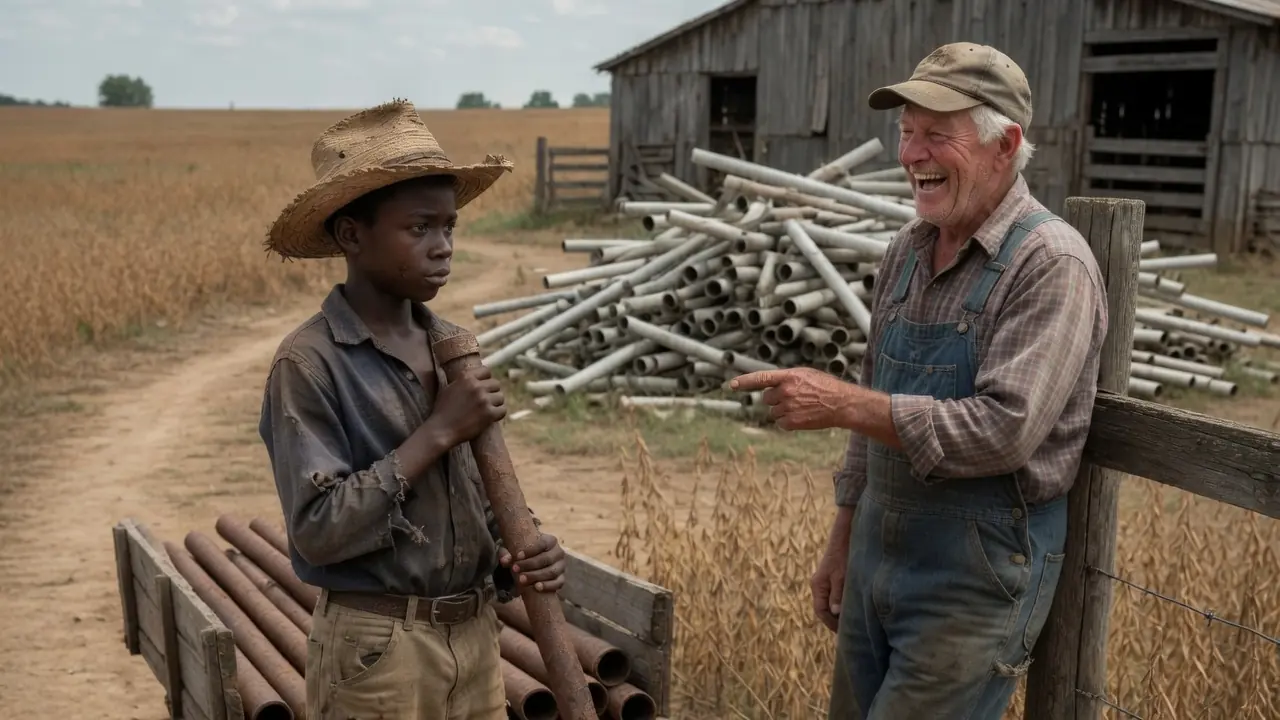
Micah lifted one hand without looking back.
The pipe was not useless.
None of it was.
During the previous six weeks, Micah had collected nearly two hundred feet of discarded aluminum tubing, cracked PVC lines, bent connectors, old valves, and drip hoses that farmers throughout West Tennessee had thrown behind barns or left rusting beside fences. Most of the adults believed he planned to sell the metal for scrap. Others thought he was building some kind of fort.
Micah never corrected them.
His plan sounded too large to explain while it still existed only inside a soft-covered school notebook. He had drawn the same field dozens of times, marking every slope, ditch, dry row, and low place where rainwater gathered after a storm. Across the center of each page, one sentence appeared in heavy pencil.
Water does not need to be pushed if it has somewhere lower to go.
Micah’s family farm sat along the Hatchie River on forty acres held by the Turners for four generations. His great-grandfather had purchased the first ten acres after decades of working land owned by other men. Each generation added a little more and protected it through droughts, floods, weak harvests, and years when the bank seemed closer than the next rainfall.
By the summer Micah turned thirteen, the farm had survived almost everything except time without water.
The third drought in four years had burned the upper soybean field into pale, curling rows. The family’s electric pump could pull water from the lower pond, but it lacked enough pressure to carry it all the way uphill. Every attempt wasted fuel and sent most of the water leaking from old joints before it reached the struggling plants.
Micah’s father, Odell Turner, had already spent more than the farm could afford on replacement parts. He worked from before sunrise until after dark, yet the numbers on the kitchen table continued moving in the wrong direction. Diesel costs climbed, soybean prices fell, and a loan payment waited at the end of the season.
Nobody discussed losing the farm in front of Micah.
They did not need to.
He heard his parents whispering after midnight. He saw his mother, Karen, stretch one chicken across three meals. He noticed when Odell stopped repairing the roof and began placing buckets beneath the leaks instead.
Micah also saw the envelope from the bank hidden beneath a stack of seed catalogs.
His older brother Reuben believed the only solution was another pump. At sixteen, Reuben was strong, confident, and naturally skilled with engines. Odell trusted him with the tractor, the combine, and every mechanical repair important enough to save the harvest.
Micah was trusted with chickens.
He collected eggs before school, cleaned the coop, and kept the small amount of money he earned inside a coffee can beneath a loose floorboard. He did not resent the work, but every time Odell called Reuben into the equipment shed, Micah felt as if the farm were choosing which son belonged to its future.
One afternoon, Odell asked for a seven-eighths-inch wrench while working beneath the combine. Micah handed him a three-quarter-inch wrench by mistake. His father glanced at it, sighed, and called for Reuben without saying anything cruel.
That silence hurt more than shouting would have.
Micah walked back to the porch and opened one of his grandmother’s agricultural pamphlets. He read the same paragraph four times without understanding it because his ears were still burning. From the shed came the sound of Odell praising Reuben for bringing the correct tool.
Micah promised himself he would never again bring the wrong answer to anyone.
His grandmother Eunice was the only person who noticed how carefully he watched the land. At eighty-one, she moved slowly but remembered every season the farm had survived. She kept forty years of agricultural extension pamphlets stacked beside the kitchen window and treated them as though they contained family history.
That summer, she began leaving particular pamphlets on top.
One explained gravity-fed irrigation.
Another described spring collection basins.
A third showed how drip lines delivered water directly to plant roots while losing far less to evaporation than overhead sprinklers.
Micah read them before sunrise while the rest of the house slept.
The idea began with a shallow draw above the northern field. Everyone considered it a muddy depression that filled after storms and dried later. Micah noticed something different.
Even during the worst drought, grass at the bottom remained green.
One morning, he carried a shovel into the draw and dug until the soil changed from dusty brown to dark clay. Water slowly gathered in the hole. By evening, it stood several inches deep despite the cloudless sky.
A hidden seep fed the draw from beneath.
More importantly, the seep sat nine feet higher than the dying soybean field.
Nine feet was not much, but it was enough.
Micah measured the drop using string, fence posts, and a carpenter’s level borrowed from the barn. He calculated how much water the seep released each hour and how much the soybeans needed if delivered slowly at the roots. The numbers were rough, but they proved the idea could work.
He did not need a stronger pump.
He needed a wide collection line at the top, smaller branches below, and drip tape running beside the plants.
The problem was pipe.
New irrigation equipment cost more than the Turner family could pay. Micah’s egg money could buy only one roll of drip tape, leaving him hundreds of feet short of the main line. That was why he began riding from farm to farm with a wooden cart attached to his bicycle.
He asked politely for anything people had thrown away.
The responses were nearly identical.
“Take all you can carry.”
“Cleaning my junk pile for free?”
“Want the broken pump too?”
Farmers leaned on porch rails and watched the skinny Black boy wrestle heavy pipe into his cart. Their laughter was usually more amused than cruel, but Micah heard the judgment underneath it. To them, he was a child dragging home failures abandoned by men with decades of experience.
Micah saw materials.
A pipe cracked in one place could be cut and used somewhere else. Bent aluminum could be straightened. Corroded fittings could be cleaned, resealed, or replaced with parts salvaged from another line.
Every piece had one section still capable of carrying water.
By August, the pile behind the Turner barn had grown large enough that Odell finally asked what he intended to do.
“Water the upper field,” Micah said.
“With that?”
“With gravity.”
Odell looked toward the dry slope. “Water doesn’t climb hills.”
“I’m not making it climb.”
“Son, that draw has been sitting there since before your great-grandfather cleared this land. If it could water the field, somebody would have done it.”
“Maybe somebody almost did.”
Odell’s expression changed so quickly Micah wondered whether he had imagined it.
“Stay out of the draw after dark,” his father said. “Snakes move through there.”
He walked away without asking another question.
Micah began digging alone.
Before sunrise, he cut shallow trenches from the seep toward the field. After supper, he returned with a lantern and worked until his palms blistered. He fitted narrow PVC sections together, wrapping each joint with old tape and sealing gaps with adhesive purchased from the farm store.
His eight-year-old sister Nella followed him whenever she could. She carried small tools, guarded the new drip tape, and asked questions faster than he could answer them.
“Will the water know where to go?”
“It follows the pipe.”
“What if it gets lost?”
“It can’t.”
“What if you get lost?”
“I know where the house is.”
Nella accepted that logic and continued helping.
Their mother brought cold water but did not interfere. Reuben mocked the mismatched pipe and said it looked like a skeleton assembled from three different animals. Micah ignored him.
Odell watched from a distance.
On the fourth evening, Micah found his father standing at the end of the trench with a shovel. Odell did not apologize for doubting him or ask how the system worked. He simply began digging the next section.
They worked side by side until darkness covered the field.
For Micah, that silent help felt like being invited into the equipment shed at last.
The first test happened before dawn three days later. Micah opened the valve at the collection basin while Nella sat nearby in her nightgown, hugging her knees. Water entered the pipe with a low rushing sound.
For four seconds, everything worked.
The first joint burst apart.
Water sprayed across the trench, followed by a second leak ten feet downhill and another near the field. The pressure disappeared before reaching the drip tape.
Micah stood in muddy water watching an entire summer escape into the ground.
Odell observed from the hill without speaking.
Nella approached carefully. “Is it broken?”
Micah wanted to say yes. The truth felt heavy enough to crush the word from him. He had imagined water reaching the final row and his father finally seeing that books, observation, and patience could matter as much as knowing the correct wrench.
Instead, his system had failed before reaching the first plant.
Micah crouched beside the loose connection.
“No,” he said. “It’s showing me where it’s weak.”
He collected every clamp he owned and repaired the joints one by one. He added rubber strips cut from an old inner tube and wrapped each fitting twice. Two days later, he tested the line again.
The joints held.
Water reached the drip tape, but only the first few openings released anything. The flow weakened along the row until the final emitters remained completely dry.
Another failure.
Micah spent that night reading the pamphlets beneath a kerosene lamp. Near midnight, he found a diagram explaining friction loss. His main pipe was too narrow. Water spent most of its pressure forcing its way through the first section, leaving nothing for the far rows.
He needed wider pipe near the collection basin.
The only farmer he knew with discarded commercial irrigation lines was Earl Sturgis, the man who had offered him the broken pump.
Micah rode back the following morning.
Earl stood on the porch as the boy approached. “Come for the pump?”
“I need the four-inch aluminum line behind your barn.”
“That pipe is older than you.”
“The lower sections are still good.”
“What are you building?”
This time, Micah explained everything.
He described the seep, the nine-foot fall, the collector basin, the failed joints, and the pressure loss caused by his narrow main line. He showed Earl the notebook and pointed to the design for stepping the pipe diameter down gradually.
The amusement left the old farmer’s face.
“Say the part about the diameter again.”
Micah repeated it.
Earl studied him for several seconds before walking toward the barn. “Took me three seasons and an engineer from Nashville to learn that lesson.”
He helped Micah load the wider pipe into the cart.
When Micah offered his egg money, Earl shook his head.
“My price is seeing whether you were right.”
“Come at sunrise tomorrow.”
“You’re that certain?”
“No,” Micah admitted. “But I’m ready to find out.”
They rebuilt the system before sunset.
Odell cut and shaped the aluminum while Micah calculated the lengths. Reuben joined after watching for nearly an hour, though he claimed he only wanted to prevent them from ruining a useful saw. Karen packed the soil around the pipe, and Nella carried fittings from the barn.
For the first time, the entire Turner family worked from Micah’s design.
Rain fell during the night.
It was not enough to end the drought, but it filled the draw and strengthened the hidden seep. At dawn, water stood dark and patient inside the collection basin.
Earl arrived in his pickup along with two farmers who had heard about the challenge. More vehicles followed. By the time Micah reached the valve, nearly twenty people stood at the edge of the field.
Some had given him pipe.
Most had laughed.
Micah saw doubt on their faces and remembered his final words to Earl.
Your junk will water every row without a pump.
He opened the valve.
Water entered the wide pipe and traveled downhill. The repaired joints held. Nothing leaked into the trench.
At the first row, the drip tape darkened.
A bead of water appeared from the first emitter and sank into the soil. A second followed. One by one, the openings began releasing slow, even drops.
Micah walked along the row.
Every emitter worked.
He reached the far end where the previous test had failed. The last opening remained dry for several seconds, and someone behind him cleared his throat.
Micah waited.
A clear bead swelled against the black tape.
It fell beside the final soybean plant.
Nobody laughed.
Odell removed his cap and stared across the field as though the land had spoken directly to him. Earl crouched beside the pipe and pressed one hand against it.
“No pump,” he murmured.
“No electricity,” Micah said.
“How much water?”
“Less than half of what the old sprinkler used.”
Earl rose slowly. “Boy, you did exactly what you said.”
Micah looked toward his father.
Odell’s eyes were wet, though his voice remained steady.
“Let it run.”
For the next two weeks, the upper field changed color.
Soybean leaves that had been pale and curled began opening. The soil beneath them remained dark long after nearby rows dried. Roots grew deeper, and new pods appeared along the stems.
The system did not flood the plants or spray water into the air. It released only what each row needed.
Farmers began visiting without being invited.
They walked beside the pipes, examined the joints, and measured the height difference from the draw to the field. Men who had spent forty years farming asked Micah how he calculated flow and where he found the seep.
Micah never mocked them.
He showed them everything.
Wade Kessler, the county extension agent, arrived with a clipboard and spent three hours inspecting the system. He measured the water use, crop response, and pressure at the far end of each line.
“This should not work as well as it does,” he said.
Micah shrugged. “The water doesn’t know that.”
The sentence appeared in the county newspaper the following week.
A photograph showed Micah standing beside the collector basin in his straw hat and patched farm clothes. The headline called him a young agricultural innovator. Karen framed the article before Micah could hide it.
The greatest change did not happen in the newspaper.
It happened when Odell found Micah repairing an emitter one evening.
His father crouched beside him and touched the moist soil. Across the boundary, untreated soybeans stood yellow and thin. On Micah’s side, the plants were green and heavy with pods.
“How far could you extend this?” Odell asked.
“With another collector tank, maybe the east field.”
“Could you draw it for me?”
Micah looked up.
Odell had never asked for his opinion about the farm before.
“I already did.”
He retrieved the notebook and opened it to a page labeled East Field Expansion. Odell studied every line carefully.
“You planned this before the first section worked?”
“I planned it before anybody gave me pipe.”
His father closed the notebook.
“I was wrong about you.”
Micah looked toward the field because he did not know how to answer.
Odell placed one hand behind his neck. “You were never the boy who didn’t understand tools. I was the man who didn’t understand what kind of tool you were becoming.”
That evening, Eunice revealed why Odell had resisted the idea.
Forty years earlier, Micah’s grandfather had discovered the same seep. He attempted to build a gravity-fed line but used weak joints that failed during the first public test. Neighboring farmers laughed, and his pride could not survive trying again.
He removed the pipe and filled the trench.
Odell had been thirteen when he watched his father bury the project.
“He wasn’t afraid you would fail,” Eunice told Micah. “He was afraid you would feel what his father felt.”
“Why did you keep the pamphlets?”
“Because your grandfather was right. He stopped one repair too soon.”
Micah looked down at the pages covered with his own notes. Beside them, faint pencil writing from decades earlier marked the same slope and the same nine-foot drop.
His invention was not completely new.
It was an unfinished family idea waiting for someone stubborn enough to continue.
By harvest, the upper field produced the strongest soybean yield on the Turner farm. While neighboring farms lost large portions of their crops, Micah’s irrigated rows carried full pods despite using less water.
The increased income covered the loan payment.
More importantly, the family kept the land.
Earl Sturgis returned with another truckload of old equipment and parked beside the barn. This time, he did not call it junk.
“I brought you material for the east field,” he said.
Reuben climbed into the truck bed and began unloading. When Micah reached for a wrench, his brother placed the correct size in his hand before he could ask.
“You need help?” Reuben said.
Micah smiled. “You know anything about irrigation?”
“No.”
“Good. I’ll teach you.”
By spring, farms across the county had installed variations of Micah’s gravity system. Some collected water from springs, others from elevated tanks or rain-fed ponds. Not every design worked immediately, but farmers had learned the lesson Micah discovered beside his first leaking joint.
Failure did not always mean an idea was wrong.
Sometimes it only pointed toward the weak place.
Micah’s family expanded the system across twenty acres. The county extension office invited him to demonstrate it for agricultural students, and a university offered him a summer place in an engineering program.
He accepted, but he continued wearing the straw hat from the photograph.
Years later, people remembered the green field and the water flowing without a pump. They remembered the skinny Black farm boy dragging discarded pipes behind his bicycle while grown men laughed from their porches.
What they rarely remembered was how many times the system failed before sunrise.
Micah remembered.
He kept the first broken connector above his workbench as a reminder that the field was not saved by one brilliant idea. It was saved by observation, old knowledge, patient repairs, and a child who refused to confuse embarrassment with defeat.
The farmers had given Micah what they believed was garbage.
He gave it back as water.
And on land that generations of adults had accepted as impossible to irrigate, the final row stayed green because a thirteen-year-old boy understood something simple.
Water had never needed to climb the hill.
Everyone else only needed to stop laughing long enough to watch it fall.