Steam curled around Emma Brooks’s boots as she drove the shovel deeper into the mountain of hardwood chips. The dry surface split apart, exposing a thick vein of dark material underneath, black and crumbly enough to hold together in her gloved palm. Three men standing beside the dump truck stopped laughing when they saw earthworms twisting through what they had called waste. Harold Jenkins, the sixty-one-year-old sawmill owner pointing at Emma from below, looked as if she had uncovered buried money instead of soil.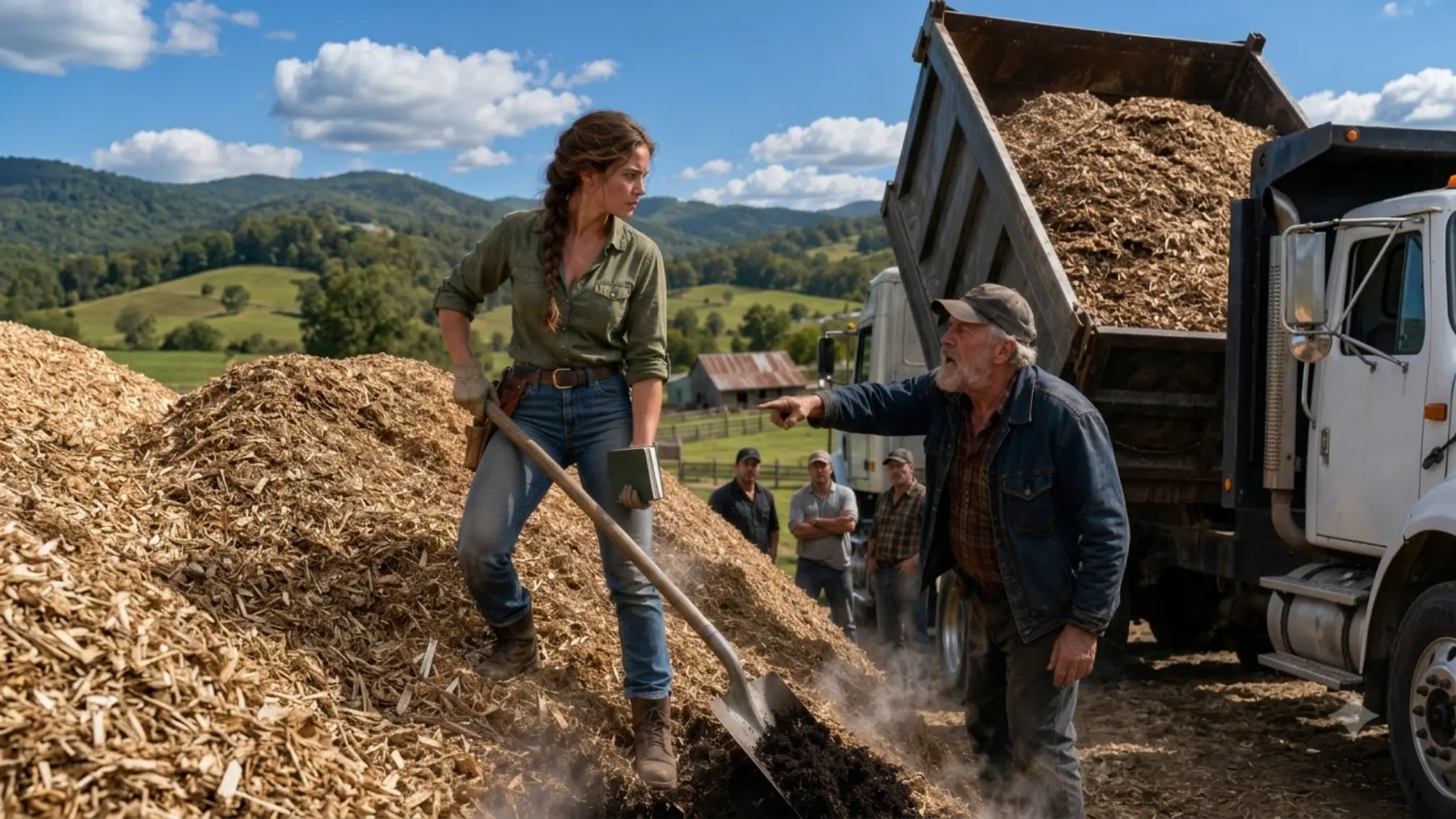
Emma was twenty years old and had inherited forty-eight exhausted acres in the foothills of western North Carolina. Her grandfather had raised cattle there until the pasture became compacted, eroded, and thin enough for rainwater to run across it without soaking in. After he died, several neighbors advised Emma to lease the land to a larger operation or sell it before the taxes swallowed what little value remained. She moved into the leaning farmhouse instead, carrying two suitcases, a pair of work boots, and a dark-green notebook.
The farm looked peaceful from the gravel road, but Emma recognized the silence of land that had stopped producing. The vegetable plot yielded small carrots and bitter greens. Grass grew sparsely across the southern pasture, leaving red clay exposed between weak clumps. Even the creek along the property line turned brown after heavy rain because nothing remained to hold the bank together.
Emma knew almost nothing about restoring soil.
She began by observing.
Every morning she dug test holes, measured moisture, and wrote down the color and texture of each field. She counted earthworms after rain and found almost none. She sent samples to the county extension office, which confirmed what the farm had already shown her: low organic matter, heavy compaction, poor water retention, and serious erosion.
The report recommended several expensive treatments.
Emma could not afford any of them.
Harold Jenkins arrived three weeks later in a faded mill truck. His family sawmill operated two miles down the valley, cutting oak, maple, hickory, and cherry into flooring, furniture boards, and construction lumber. The process left behind enormous volumes of sawdust and wood chips, and county disposal fees had recently increased.
Harold removed his cap while explaining the problem.
“I heard your southern pasture is empty,” he said. “I need somewhere temporary to unload chips while I negotiate with another hauler.”
“How temporary?”
“Two or three weeks.”
“How much material?”
“Maybe six truckloads.”
Emma looked across the damaged pasture. “Bring it.”
Harold hesitated. “You understand this is waste.”
“I understand you pay to remove it.”
“That doesn’t mean it has value.”
“It means you haven’t found the value.”
He laughed because he thought she was joking.
The first truck arrived Friday morning.
Fresh hardwood chips poured from the raised trailer in a pale-gold avalanche. By noon, a mound taller than Emma’s pickup stood in the pasture, steaming lightly where moisture and heat gathered inside. The drivers expected her to complain about the smell or the size.
Instead, Emma climbed onto the pile with a thermometer.
The center measured one hundred and twenty-six degrees.
She wrote the number in her notebook.
The second truck arrived the following week, then the third. Harold stopped calling ahead because Emma never refused a load. By the end of the month, four towering piles covered the empty pasture.
Children riding the school bus named the property Wood Chip Mountain.
Adults used less friendly names.
Ben Carter, who raised cattle on the neighboring farm, leaned over the fence one evening while Emma tested the newest pile.
“You building the county’s largest mulch heap?”
“I’m watching it.”
“For what?”
“Change.”
“It’s wood.”
“It used to be a tree. That means it already changed once.”
Ben laughed. “Your grandfather would’ve set fire to that mess.”
“My grandfather’s soil washed into the creek.”
The smile left his face.
Emma pushed the thermometer deeper into the chips and recorded another reading.
Heat fascinated her. The piles warmed without fire, powered by organisms too small to see. When rain fell, steam rose before sunrise. White threads appeared beneath the damp surface, spreading across pieces of maple and oak like delicate roots.
Emma drew them in her notebook.
She did not yet know they were fungal mycelium.
She only knew that something alive was moving through the wood.
At the Saturday farmers market, Emma showed the drawing to Dr. Eleanor Price, a retired soil microbiologist who had spent forty years teaching at universities and advising growers. Eleanor was seventy-two, sharp-eyed, and famous for answering questions with other questions.
“Why does a forest have rich soil?” Eleanor asked.
“Leaves fall.”
“And then?”
“They break down.”
“What breaks them?”
Emma considered the white threads. “Fungi?”
Eleanor handed back the notebook. “Now ask what fungi need.”
Emma returned home and built four experimental piles.
One remained exposed to full sunlight. Another sat beneath a tarp. She mixed the third with manure and old hay, while the fourth contained wood chips alone. Every day she measured temperature, moisture, smell, texture, and visible fungal growth.
Most of the experiments failed.
The covered pile compacted and turned sour because it lacked oxygen. The exposed pile dried so quickly that fungal growth vanished within two weeks. Another heated beyond one hundred and sixty degrees, killing the network Emma had been trying to encourage.
She wrote down every mistake.
Pile Two: Too wet, no air, rotten odor.
Pile Four: Too dry. White threads disappeared on Day Twelve.
Pile Five: Excessive heat. Turn sooner.
Harold saw the failed piles during his next delivery.
“I told you this would rot.”
Emma plunged her hand into the cool outer layer. “Rotting is uncontrolled. I’m learning control.”
“You’re learning how to waste time.”
“You pay people to bury this.”
“That is normal disposal.”
“Normal doesn’t mean intelligent.”
Harold shook his head. “One day you’ll wake up and realize stubbornness isn’t a business plan.”
Emma looked toward his overloaded truck. “Neither is paying to throw away inventory.”
He drove off muttering.
Emma continued.
She collected coffee grounds from the town diner, manure from Ben’s cattle pens, spoiled hay from a horse farm, and leaves from the county maintenance crew. She experimented with different ratios, turning the piles by hand until blisters opened beneath her gloves.
Eleanor visited once a month but never gave direct instructions.
When one pile smelled sour, she asked what a fallen log smelled like beneath forest leaves.
When another dried out, she asked where mushrooms appeared after rain.
When Emma complained that decomposition moved too slowly, Eleanor pointed toward an oak tree and asked how long the forest had been practicing.
Emma stopped demanding quick answers.
She began imitating natural systems instead.
She shaded the piles with old barn roofing, added nitrogen-rich material between layers of chips, and maintained enough moisture that a squeezed handful felt damp without dripping. She created channels for airflow and monitored temperatures twice daily.
The white fungal threads returned.
This time, they spread deeper.
Months passed.
Emma’s neighbors still saw mountains of waste. She saw thermal cycles, fungal succession, water retention, and changing texture. The chips softened, darkened, and gradually lost their sharp edges.
Her first finished batch looked promising but performed poorly.
She spread it across part of the vegetable plot and planted carrots, lettuce, and beans. The carrots remained thin, and the lettuce yellowed. Ben visited during harvest and lifted one undersized carrot.
“This is what two hundred truckloads accomplished?”
“Sixteen truckloads.”
“Even worse.”
“The material isn’t mature enough.”
“You always have another explanation.”
“That’s how experiments work.”
“That’s how excuses work too.”
Emma took the carrot from his hand. “Come back next year.”
Ben walked away smiling.
Emma returned to her notebook.
She discovered that fresh wood decomposition temporarily locked up nitrogen near the soil surface. Instead of abandoning the process, she changed it. Future batches matured longer, received more manure, and were tested in small plots before field application.
Nearly a year after the first delivery, Emma opened one of the older piles.
The shovel sank through the surface easily.
Underneath lay material that no longer resembled wood chips. It was dark, earthy, moist, and filled with fungal strands and earthworms. The smell reminded Emma of the forest floor behind her grandfather’s barn after autumn rain.
She carried a bucket to the most damaged corner of the vegetable field.
Six weeks later, she dug into the soil.
It crumbled between her fingers instead of breaking into hard chunks. The moisture from a storm three days earlier remained several inches below the surface. Fourteen earthworms appeared in a single shovel of dirt.
Emma sat back on her heels.
For the first time since moving to the farm, she allowed herself to believe she had found an answer.
She recorded the result.
Field Three: Soil darker. Water retained seventy-two hours. Fourteen worms per shovel. Highest count yet.
Eleanor read the entry without smiling.
“You look disappointed,” Emma said.
“I’m waiting to see whether one success makes you careless.”
“It won’t.”
“Good. Then it may become useful.”
The following summer brought drought.
Rain disappeared for six weeks, temperatures climbed, and pastures across the valley turned brown. Ben’s cattle crowded near the fence searching for grass that still held moisture.
Emma’s restored field remained green.
The composted wood had improved the soil’s ability to absorb and hold water. Her vegetables continued producing with limited irrigation, while young fruit trees survived without visible stress.
Ben stopped at the fence after sunset.
He did not make a joke.
“How much would it cost to treat one pasture?”
Emma looked at the brittle grass behind him. “I don’t know yet.”
“Can you find out?”
“I can test five acres.”
“I need twenty.”
“You need proof before twenty.”
Ben nodded slowly. “However long it takes.”
Emma opened her notebook. “Then we begin with soil samples.”
News moved through the valley after Ben’s test plot stayed greener than the rest of his property. Other farmers asked questions. The county extension agent visited, skeptical at first, then returned with additional testing equipment.
The results supported what Emma had observed.
Organic matter increased. Compaction decreased. Water infiltration improved. Beneficial fungal activity rose sharply.
Harold Jenkins arrived during the testing.
He had expected Emma to demand an end to the deliveries after nearly two years. Instead, she approached him carrying a clipboard.
“I need your drivers to separate the chips.”
Harold stared at her. “Separate them how?”
“By species whenever possible. Oak decomposes slower than maple. Sawdust should stay apart from larger chips. Bark needs its own load.”
“You’re giving instructions to my mill?”
“I’m improving the material.”
“It’s garbage.”
“Then sorting it shouldn’t bother you.”
“It slows production.”
“So does loading trucks for the landfill.”
Harold glanced toward the restored field. “You’re selling this now?”
“Not yet.”
“But you’re treating Ben Carter’s pasture.”
“He’s paying for labor and testing.”
“How much?”
Emma named the price.
Harold’s eyebrows rose. “For rotted wood?”
“For restored soil.”
He examined the dark material in her hand.
“What happens if I stop delivering?”
“I contact the other sawmill across the county.”
His expression sharpened. “They use pine.”
“They also produce hardwood twice a month.”
“You’ve spoken to them?”
“I build backups before I need them.”
Harold had underestimated her again.
He agreed to separate the loads.
Emma created Mountain Soil Works that autumn.
The name came from customers who had stopped calling the piles Wood Chip Mountain as a joke. She sold small bags of finished compost at the farmers market, each marked with batch dates, wood species, and recommended uses.
The first customers were gardeners.
Then came orchards, nurseries, and small farms.
Emma refused to sell unfinished material. Every batch passed moisture, temperature, maturity, and plant-growth tests. When demand exceeded supply, she created a waiting list rather than rushing production.
Harold visited more often.
He began keeping records of wood species and delivery dates because Emma required them. The sawmill saved thousands of dollars in disposal costs, though he still refused to describe the arrangement as a partnership.
Then county inspectors arrived.
Someone had reported that Emma was operating an illegal waste dump.
Three vehicles entered the property one Tuesday morning. Harold followed them in his truck, appearing more anxious than Emma had ever seen him.
The lead inspector examined the mountains of chips.
“You receive industrial waste?”
“I receive clean, untreated hardwood material.”
“Do you possess a waste-handling permit?”
“I operate a composting and soil-products business.”
“That distinction requires documentation.”
Emma opened a metal cabinet inside the barn.
She produced delivery records, source declarations, temperature logs, moisture readings, processing schedules, laboratory tests, sales receipts, and contracts. Every pile carried a numbered sign linked to a corresponding page in her notebooks.
The inspector spent four hours reviewing the property.
Finally, he approached Harold.
“Your mill classified this material as waste?”
“Yes.”
“Then you remain responsible for verifying that no treated lumber or contaminants enter these loads.”
Harold’s face tightened. “We don’t process treated wood.”
“Document it.”
He pointed toward Emma. “She asked me to separate everything. I thought she was being difficult.”
The inspector looked at the organized piles. “She is why neither of you is receiving a violation today.”
After the officials left, Harold rounded on Emma.
“You knew this could happen.”
“I knew someone would eventually challenge us.”
“You should have warned me.”
“I asked for records. You called them unnecessary.”
“You made my mill look careless.”
“No. Your lack of records made your mill look careless.”
Harold stepped closer. “I can end these deliveries tomorrow.”
Emma held his stare. “Then I’ll invoice you for the soil products created from the twelve hundred tons already delivered.”
“You cannot invoice me for my own waste.”
“You surrendered ownership under our disposal agreement.”
His face changed. “What agreement?”
“The one you signed after your insurer demanded it.”
Harold remembered.
Emma continued, “You signed the material over to me upon delivery. That includes all finished products.”
“You planned this.”
“I read contracts.”
Harold looked across the dark rows of maturing compost and finally understood that the quiet young woman he had treated as a convenient dumping solution now controlled something valuable.
He left without ending the deliveries.
Mountain Soil Works expanded slowly.
Emma hired two local women who needed flexible work and trained them to monitor piles, test maturity, and prepare custom soil blends. She restored the old barn instead of building an expensive facility, turning the lower floor into a screening and bagging area.
The business never made her suddenly wealthy.
It made the farm stable.
That mattered more.
Then a second drought struck the region, worse than the first. Wells dropped, gardens failed, and cattle farmers purchased emergency hay at crushing prices. Fields treated with Emma’s compost held moisture longer and recovered faster after limited rain.
Orders doubled.
Ben asked her to restore the rest of his acreage. Three orchard owners signed multi-year contracts. The county school district purchased soil for raised-bed gardens, and children who once laughed from the bus now visited the farm to study decomposition.
Emma made them put their hands into the finished material.
“What does healthy soil feel like?” she asked.
“Soft,” one child answered.
“Alive,” said another.
Emma nodded. “Remember that before someone convinces you dirt is empty.”
Harold stood behind the group listening.
The sawmill’s position had changed too.
A regional lumber company wanted to purchase Jenkins Family Sawmill, but environmental consultants discovered rising disposal costs in the financial records. The buyer demanded proof that the mill possessed a long-term solution for its wood residuals.
Harold drove to Emma’s farm holding a contract.
She found him beside the oldest compost row.
“I need a ten-year agreement,” he said.
“You currently renew annually.”
“The buyer wants stability.”
Emma continued screening soil. “That sounds like your problem.”
“They may withdraw.”
“You once threatened to have my farm condemned.”
“I was angry.”
“You also called this garbage.”
“I was wrong.”
Emma set down the screen.
Harold extended the contract. “Ten years of exclusive material supply. No disposal fee.”
“No.”
He blinked. “That is better than our current arrangement.”
“For you.”
“What do you want?”
“Your mill pays for delivery.”
“We already deliver.”
“You charge the cost against disposal savings.”
Harold said nothing.
“You also install covered storage so rain doesn’t contaminate sawdust loads. You provide species records, contamination guarantees, and advance notice before production changes.”
“That will cost thousands.”
“Landfill fees will cost more.”
He clenched the contract. “Anything else?”
“Mountain Soil Works receives fifteen percent of your verified disposal savings above the current baseline.”
Harold laughed once in disbelief. “You want me to pay you for taking chips?”
“You want a contract proving your mill no longer has a waste problem.”
“You’re holding the sale hostage.”
“No. I’m pricing the value you finally noticed.”
Harold stared at the young woman who once stood alone on a steaming pile while his drivers laughed. She was still wearing the same style of work shirt and carrying the same green notebook, but nothing else about the balance of power remained unchanged.
“Ten percent,” he said.
“Fifteen.”
“Twelve.”
“Fourteen, and your mill funds soil-restoration workshops for local farmers.”
He extended his hand.
“Done.”
The agreement secured the mill sale and guaranteed Emma a stable supply of hardwood material. Newspapers described it as an innovative circular agricultural partnership, though Emma disliked language that made patience sound newly invented.
Forests had always recycled wood.
She had merely paid attention.
Five years after the first truck climbed the gravel road, the farm was almost unrecognizable. The old pasture held organized compost rows, thriving orchards, vegetable beds, and wildflower strips alive with insects.
The creek ran clearer.
Roots stabilized the banks that once collapsed after storms. Soil once the color of weak coffee had become dark enough to stain Emma’s gloves black.
Mountain Soil Works employed twelve people and served farms across three counties. Emma still refused to expand faster than the biological process allowed. Customers sometimes offered more money for immediate delivery, but she never sold material before it was ready.
“Nature doesn’t rush because your purchase order says urgent,” she told them.
Eleanor Price visited the farm on Emma’s twenty-fifth birthday.
They stood beside the first pile, now only a low mound beneath young maple trees.
“You answered my question,” Eleanor said.
“Which one?”
“What feeds on wood.”
Emma smiled. “Everything, eventually.”
Eleanor nodded toward the thriving fields. “And what did the wood feed?”
“The soil.”
“What did the soil feed?”
Emma looked at the workers, trees, gardens, cattle pastures, and restored creek.
“The valley.”
Harold arrived later that afternoon with a framed copy of their ten-year contract.
Emma studied it.
“Why frame this?”
“Because it saved my mill.”
She looked toward the original green notebook inside her office window. “The contract didn’t save it.”
“What did?”
“The thing you were paying to bury.”
Harold laughed quietly, this time at himself.
Years earlier, he had threatened to stop the deliveries and let lawyers take Emma’s farm. Now his mill paid Mountain Soil Works for guaranteed access to her system.
The drivers no longer dumped random loads.
They delivered sorted raw material with records attached.
Neighbors no longer called the property Wood Chip Mountain.
They called when their soil stopped holding water.
Emma kept Harold’s original warning written on the inside cover of her first notebook:
Stubbornness isn’t a business plan.
Beneath it, she added her own answer:
No—but observation, testing, patience, and contracts are.
The sawmill had left mountains of chips on her farm because nobody wanted them.
Emma saw unfinished forest.
She did not turn garbage into gold through luck. She failed repeatedly, recorded what went wrong, learned the rules already operating beneath every woodland floor, and built a system strong enough to turn disposal costs into living soil.
The men beside the dump truck once believed she was standing on a mountain of waste.
She was standing on the future of the entire valley.