The words drifted across the freshly turned Tennessee field while twenty mules stood in a patient line behind Clara Birch. Their hooves had carved a dark path through soil that had swallowed every wagon, plow, and machine brought near it for almost thirty years. At the far end of that path, half hidden by mist, an old stone marker leaned beside a mound of earth no one in Carver’s Mill remembered seeing before.
Bank President Silas Mercer watched Clara fold the mud-stained survey against her gray work dress. She was twenty-seven, strikingly beautiful despite the dirt along her cheek and the damp strands of chestnut hair escaping beneath her wide brown hat. Her dark-green eyes held none of the panic Silas expected from a woman whose property was scheduled to be sold within three hours.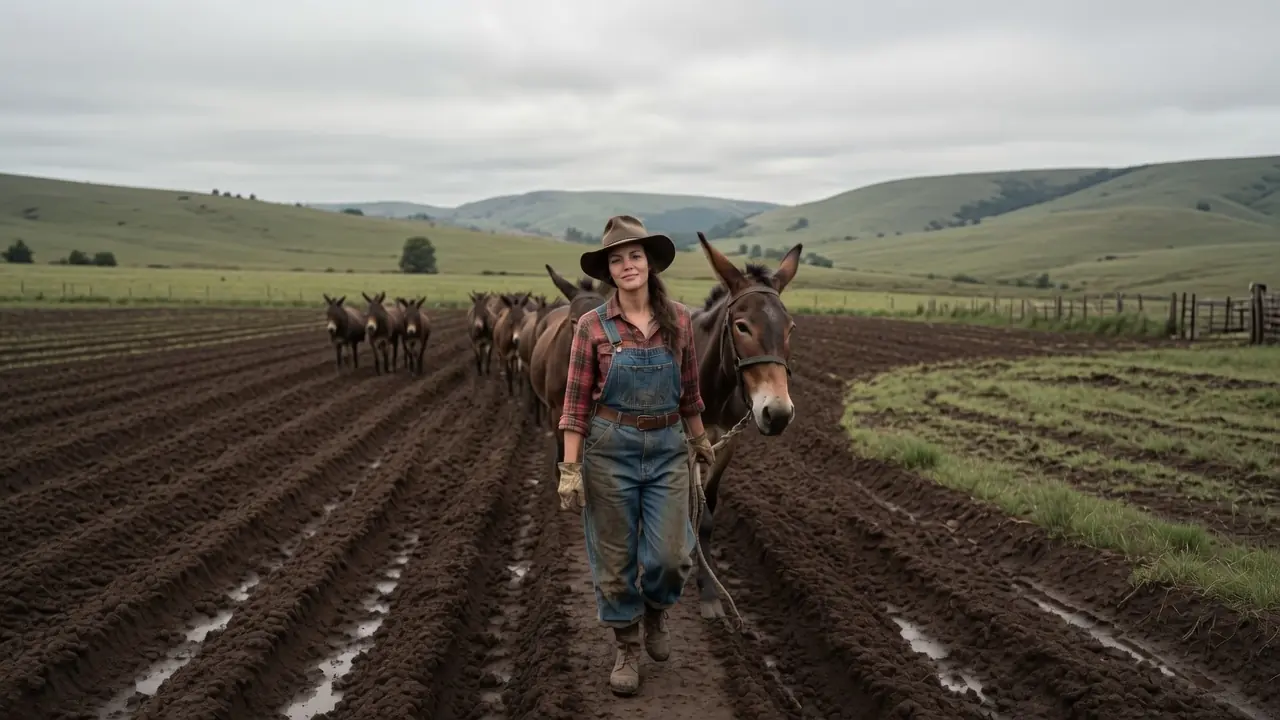
The auction tables were already being arranged beside the farmhouse. Buyers had arrived from three counties to purchase her land, equipment, livestock, and anything else the bank could legally claim. Silas had spent months telling them the Birch property was exhausted, poorly managed, and burdened by debt too large for a young widow to understand.
Clara had heard every rumor. She knew men at the feed store said beauty had helped her marry the farm but could not help her keep it. She also knew Silas had personally encouraged those rumors whenever someone questioned why the bank had doubled her debt after her husband’s death.
Thomas Birch had died eighteen months earlier after being thrown from his horse on the northern ridge. The county doctor ruled it an accident, though Clara never understood why an experienced rider had left the main road during a storm. Thomas’s saddle was found near a washed-out ravine, but his body had been recovered almost half a mile away.
Silas Mercer attended the funeral and stood beside Clara longer than anyone else. He told her the bank would show patience while she learned to manage the estate. Two weeks later, he produced a loan amendment bearing Thomas’s signature and claimed the entire farm had been pledged as security for a debt Clara had never seen.
The original loan covered only the farmhouse, the upper fields, and forty acres of timber. The amendment added the western bottomland, an unused stretch of rich soil separated from the farm by marsh, steep ridges, and an abandoned road. Thomas had once told Clara that his grandfather refused to mortgage that land under any circumstances.
When Clara asked Silas to see the original amendment, he permitted her to inspect it through the bank’s glass counter. Thomas’s signature appeared convincing, but the date was five days after the storm in which he died. Silas claimed the date recorded when the document was filed, not when it was signed.
The bank’s copy contained no witnesses. The county deed book contained no amendment at all. Yet Silas insisted that a private memorandum signed by a borrower was sufficient when supported by the bank’s internal records.
Clara consulted the only attorney in Carver’s Mill. He reviewed the bank papers, avoided her eyes, and advised her to sell voluntarily before legal fees consumed what little equity remained. She later learned the attorney’s office rent was paid to a company owned by Silas’s brother.
The debt grew each month. Inspection costs appeared without inspectors visiting, interest was recalculated, and penalties were added for payments Clara had made on time. By spring, Silas declared the farm in default and scheduled a public auction for the end of September.
Clara could have surrendered. Several neighboring farmers offered to purchase small portions and allow her to remain in the farmhouse as a tenant. Silas himself offered a settlement in which she would keep ten acres if she signed away every claim to the western bottomland.
His interest in land everyone called worthless troubled her more than the foreclosure.
The western field stretched beneath the foothills where the Birch family had lived for four generations. Dark soil lay under reeds, thorn brush, and standing water, but no horse could cross the old approach without sinking to its knees. Tractors had been tried twice, and both required teams of horses to pull them free.
Clara’s father-in-law once told her the land had not always been wet. A road had passed through it before a flood changed the creek, and tenant families had grown corn there when he was a boy. After the flood, the road vanished from new county maps, and the field slowly became known as useless ground.
Thomas had searched for the road before his death. He returned from the western ridge one evening with mud to his waist and a torn scrap of survey cloth in his pocket. He told Clara someone had moved the boundary stones, but he refused to explain until he could prove it.
Three days later, he died.
Clara found the scrap inside his winter coat after Silas announced the auction. It showed only a curved line, the words “Old Mercer Road,” and a symbol representing a stone well. The handwriting belonged to a surveyor named Jonathan Hale, who disappeared from county records twenty-seven years earlier.
No current map included an Old Mercer Road. Silas claimed it had never existed.
Clara began visiting elderly residents who remembered the western farms before the flood. Most offered vague stories, but an eighty-two-year-old former midwife named Ruth Bell remembered wagons traveling through the Birch bottomland toward a settlement called Mill Crossing. She also remembered a surveyor arguing with Silas’s father, Elias Mercer, shortly before the road vanished from official maps.
“Jonathan Hale said the bank was stealing land one line at a time,” Ruth told Clara. “Then he disappeared, and people learned not to repeat his name.”
Ruth believed Hale had hidden his final survey somewhere along the abandoned road. She warned Clara that Thomas had asked similar questions shortly before his death. Whatever he found had frightened him enough to begin sleeping with a rifle beside the bed.
Clara could not reach the place where the road supposedly began. The mud defeated horses, and the narrow slope made heavy equipment useless. Then the Kendrick family announced it was selling twenty mules after purchasing two new tractors.
Nobody wanted the remaining animals. Some were old, some untrained, and others had gained reputations for refusing commands. The rendering buyer from Knoxville offered little, so Clara purchased all twenty for less than Silas expected her to spend on one good horse.
Carver’s Mill laughed for a week. Farmers said she had answered foreclosure by feeding twenty worthless animals. Silas told the auctioneer her recklessness proved the bank had acted responsibly in removing the property from her control.
Clara did not take the mules into the bottomland immediately. She spent two months learning them, repairing harnesses, and teaching the younger animals to follow the older ones. A tall black mule she called Mercy became the leader because she tested uncertain ground before shifting her full weight forward.
The others trusted Mercy. When she stopped, they stopped. When she stepped onto a narrow strip of earth and remained calm, the line followed.
Clara began at the western fence with four animals and no wagon. She allowed Mercy to choose between the visible slope and a brush-covered strip that curved toward the bottom. The mule ignored the slope and pressed her hoof into the brush.
Beneath tangled roots lay flat stones.
Clara cleared ten feet by hand and discovered two parallel rows of stone buried beneath decades of growth. It was not a natural ridge. It was the foundation of a road.
The mules advanced carefully, their hooves identifying firm places hidden beneath reeds and shallow water. Clara marked each safe step with stakes, then returned with axes and saws. Over six weeks, she widened the path enough for an empty forecart.
The old road did not follow the line shown on the current county map. It curved around the marsh, crossed the Birch bottomland, and continued toward land Silas Mercer had acquired through foreclosure years earlier. Someone had redrawn property boundaries after the road disappeared.
Clara found the first survey marker beneath a fallen sycamore. It carried the Birch family symbol on one side and the letters J.H. on the other. The location placed nearly thirty acres of land claimed by Mercer Holdings inside the original Birch property.
She brought the stone to the county clerk. He refused to record it without a complete survey and advised her not to accuse the bank of fraud based on an old rock. Silas arrived at the clerk’s office before Clara returned home.
That evening, two men entered her barn and cut three harness sets. Mercy began kicking her stall before they reached the remaining leather, and the noise woke Clara. The men escaped, but one dropped a brass match safe engraved with the initials of Silas’s foreman.
Sheriff Abram Cole called the evidence interesting but insufficient. Silas claimed dozens of such match safes had been given to employees as Christmas gifts. He suggested Clara had found one earlier and placed it in the barn to create sympathy.
Clara stopped reporting each threat and began documenting everything privately. She photographed tracks, wrote dates in Thomas’s farm journal, and stored copies with Ruth Bell. Every act of intimidation confirmed the road contained more than a boundary disagreement.
As the mules opened the route, the western field began to reveal its past. They uncovered sections of old fence, a collapsed stone culvert, and iron rings once used to secure wagons. Near the creek bend, Mercy refused to move forward.
Clara walked around her and found the ground slightly raised beneath waist-high weeds. A rusted chain emerged from the soil. At the end of it lay a surveyor’s transit wrapped in rotten canvas.
The instrument carried Jonathan Hale’s name.
Beneath the transit was a sealed tin cylinder. Inside lay a hand-drawn survey showing the original county road, the Birch boundaries, and twelve parcels seized by Elias Mercer’s bank after the flood. Red marks indicated that Mercer had ordered the drainage culverts blocked before claiming the land had become unproductive.
The flood had damaged the creek, but the bank had worsened the damage deliberately. Farmers who could no longer plant their fields defaulted on loans, allowing Elias to purchase the property at auction. Afterward, he redirected the water and restored several parcels for his own use.
The survey also marked a location at the end of the old road with a single word: Witness.
Clara followed the mules farther west. The road climbed onto firmer ground, passed through Mercer-owned timber, and ended near a circle of limestone where the earth had sunk unevenly. Mercy stopped again and lowered her head toward one stone.
Carved into it were Jonathan Hale’s initials.
Clara did not dig immediately. She contacted Sheriff Cole and insisted he witness the site before anyone disturbed it. Cole arrived reluctantly, accompanied by the county doctor and two laborers.
They uncovered a shallow grave.
The remains belonged to an adult man buried with a survey chain, a silver pocket watch, and a leather document case. The watch was engraved with Jonathan Hale’s full name. A fractured section at the back of the skull suggested he had not left the county voluntarily.
Inside the document case were water-damaged notes accusing Elias Mercer of bribing county officials, altering maps, and arranging the destruction of culverts. One final page stated that Hale intended to testify before a state land commission.
The testimony never occurred.
Silas learned about the grave before sunset. The following morning, he moved Clara’s foreclosure auction forward by twelve days, claiming the farm faced immediate financial deterioration. If the bank gained possession, it could challenge her right to access the grave and control movement across the disputed land.
Clara filed for an injunction, but the judge said the old murder investigation did not automatically invalidate a modern debt. She still needed proof connecting the forged amendment and manipulated account to Silas himself.
That proof came from Thomas.
While studying Hale’s survey, Clara noticed the symbol for the stone well matched the mark on the cloth Thomas carried before his death. The well stood near the northern ridge where his horse had been found.
Clara took Mercy and three mules along the restored road to the well. A stone near its base had been loosened recently compared with the others. Behind it she found an oilskin packet containing Thomas’s notebook.
Thomas had discovered Hale’s original road and grave months before Clara did. He also learned that Silas had forged loan amendments against several farms whose lost boundaries could be traced through Hale’s survey. Thomas planned to deliver the evidence to state investigators.
His final entry named Silas Mercer and the bank foreman.
Thomas wrote that the two men had followed him from the courthouse and threatened to kill him if he returned to the western ridge. The entry ended with a sentence that made Clara sit beside the well until sunset.
If anything happens to me, the horse did not throw me.
The notebook included a copy of the forged amendment before Silas added the filing date. It also contained a statement from the bank cashier admitting Silas ordered him to create fees and penalties designed to force the Birch farm into default.
Clara brought the notebook to Sheriff Cole. This time, he sent a deputy to guard the western road and obtained warrants for the bank’s internal ledgers. The investigation began quietly, but Silas still controlled the auction schedule.
On the morning of the sale, buyers gathered outside the farmhouse while Clara remained in the western field. Silas told them she had fled and that the bank would take possession without resistance.
Then the mules appeared.
Mercy led nineteen animals across the restored road, pulling a wagon carrying Hale’s survey, Thomas’s notebook, the recovered transit, and the stone marker. Clara walked beside them in her gray dress, mud-coated boots, and broad hat.
She stopped in the turned field where Silas could see the old road cutting clearly through land he claimed had never contained one. The line of mules stretched behind her like living proof that the route remained passable.
“You know ground better than men do,” Clara whispered while stroking Mercy’s neck.
Silas rode to the field’s edge and sneered at the animals. “Then ask them where you’ll sleep after I auction this farm at noon.”
Clara raised Hale’s buried survey. “They found the road your father erased from the county map.”
Silas turned pale. “Then pray they didn’t reach the grave at the end of it.”
The crowd heard him.
No one had told Silas where the grave was located. The sheriff’s report described only human remains on disputed property, and the site had been guarded since its discovery. His response revealed knowledge he could not reasonably possess unless the Mercer family had known about Hale’s burial.
Sheriff Cole stepped from behind the wagon. “How did you know the road ended at the grave?”
Silas tried to correct himself, claiming he had heard rumors. Clara opened Thomas’s notebook and handed it to the sheriff. The bank cashier, standing among the auction witnesses, saw his own signed statement inside.
The man broke.
He admitted Silas had ordered him to inflate Clara’s debt and forge the amendment. He also confessed that Silas’s foreman followed Thomas on the night he died. Silas had wanted the notebook, but Thomas hid it before their confrontation.
The foreman struck Thomas near the ravine and moved his body to create the appearance of a riding accident. Silas then used Thomas’s death to seize the farm before Clara discovered what her husband had found.
Silas attempted to mount his horse. Two deputies blocked him.
The auctioneer removed his hat and folded the sale papers. By noon, the tables had been cleared away, the bank records were under guard, and Silas Mercer sat inside the county jail.
The state investigation lasted nearly two years. Hale’s survey restored boundaries to nine families and exposed fraudulent foreclosures stretching back to Elias Mercer’s presidency. Some land could not be returned, but the Mercer estate was sold to compensate descendants of the affected farmers.
Silas was convicted of fraud, forgery, conspiracy, and involvement in Thomas’s death. His foreman testified against him and received a reduced sentence. The judge declared every lien against the Birch property invalid.
Clara kept the farm.
She repaired the blocked culverts, reopened drainage channels shown on Hale’s map, and planted the western field for the first time in decades. The soil produced nearly twice the yield of the exhausted upper acreage during its first full season.
She did not replace the mules with a tractor when the profits arrived. Machines worked the flat sections, but Mercy and the others remained essential along the restored road and uneven bottomland. They had found a path no engine could feel beneath its wheels.
Three years after the auction, Clara erected a stone marker at Jonathan Hale’s grave. It identified him as a surveyor who refused to redraw truth for powerful men. Beside it, she placed a smaller plaque bearing Thomas Birch’s final words.
The horse did not throw me.
Mercy lived into old age on the Birch farm. Clara stopped working her regularly after the mule’s seventeenth year, though Mercy continued walking to the western gate each morning as if inspecting the road she had rediscovered.
Visitors often asked Clara how she knew the mules would find it.
“I didn’t,” she answered. “I only knew they would refuse ground that lied to them.”
The old Mercer Road appeared again on every county map printed after the trial. It ran through the Birch field, crossed the creek, and ended at a grave that had once been hidden by mud, altered records, and fear.
Men had erased the road because they believed time would make their version permanent.
The mules simply placed their feet where the truth could still hold their weight.