Claire Holt pushed the ignition button before the dealership mechanic could grab her wrist again. The weathered red tractor shuddered beside the barn, coughed once, and released a heavy knock that made the man smile with satisfaction. He had already condemned the engine, written a replacement estimate for eighteen thousand dollars, and convinced the bank that the Holt farm possessed no usable machinery. In his mind, the machine’s final failure would prove that a twenty-four-year-old woman with grease on her hands had no business questioning him.
Claire did not release the button.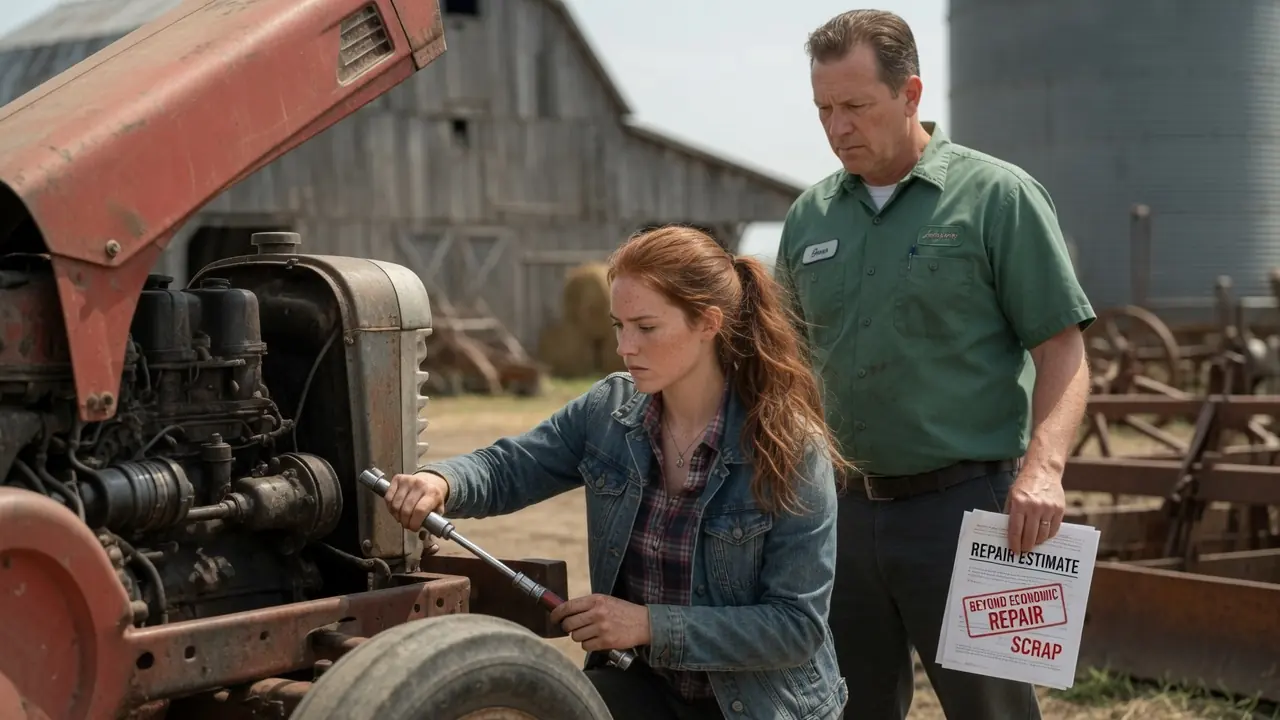
Fuel moved through the freshly bled lines. The engine turned again, stumbled, then caught with a deep uneven roar that shook dust from the tractor’s hood. Claire adjusted the throttle, listened for three seconds, and reached toward the second injector line.
The knocking disappeared.
The engine settled into a steady rhythm that rolled across the farmyard and reached the men waiting beside the dealership truck. Birds lifted from the barn roof, cattle raised their heads behind the fence, and Claire’s father appeared in the farmhouse doorway with one hand gripping his cane. The mechanic, Wade Mercer, stared at the tractor as though it had risen from a grave he personally sealed.
Claire stepped down from the wheel.
In her palm rested the cracked injector nozzle she had removed less than twenty minutes earlier. The metal carried a narrow split along its side, almost invisible beneath the fuel residue. That defect had caused the violent hammering Wade described as a destroyed connecting rod.
“The crankshaft is fine,” Claire said. “The bearings are fine. The engine needed one injector and a cleaned fuel line.”
Wade’s face reddened. “That sound could return under load.”
“Then we’ll test it under load.”
“You are not qualified to test anything.”
Claire wiped her hand across her work pants. “You billed my father twelve hundred dollars for a teardown you never performed.”
Wade glanced toward the two dealership employees who had accompanied him. Neither met his eyes. One held the clipboard containing the inspection report, while the other stood beside a flatbed prepared to remove the tractor before the bank’s equipment seizure began.
Wade reached for the document.
Claire took it first.
The report claimed that Mercer Agricultural Service removed the oil pan, inspected the crankshaft, and found metal fragments from a failed bearing. Claire had spent the previous night beneath the tractor and discovered something he did not expect her to understand. Every factory bolt around the oil pan still carried an unbroken line of red inspection paint applied during an old restoration.
No wrench had touched them in years.
“You forged the inspection,” Claire said.
Wade stepped closer. “Be careful what you accuse me of.”
“You said you opened the engine.”
“I inspected it through the access plate.”
“There is no access plate on this model.”
The younger dealership employee looked toward Wade. Claire saw uncertainty cross his face, followed by the realization that he had delivered a seizure truck based on a report describing a component the tractor did not possess.
Wade lowered his voice. “Your family owes the bank two hundred and thirty thousand dollars. Whether this tractor runs for five minutes changes nothing.”
“It changes the value of the collateral.”
“One old tractor cannot save six hundred acres.”
“No,” Claire replied. “But your forged report might.”
Six months earlier, Claire had returned to Holt Farm after completing an agricultural engineering program in Des Moines. She expected to spend one season helping her father modernize the irrigation system before accepting a position with a machinery manufacturer. Instead, she arrived to find her family operation close to collapse.
A late frost destroyed most of the corn. Feed prices rose, cattle prices fell, and her father, Daniel Holt, suffered a stroke while repairing fencing during a storm. Medical bills consumed their remaining savings, leaving the farm dependent on a renewal from Prairie County Bank.
The renewal should have been routine.
The Holts owned valuable land, maintained modest debt, and possessed equipment sufficient to plant another season. Then bank vice president Martin Coyle ordered an outside appraisal from Mercer Agricultural Service.
Wade inspected the farm for less than an hour.
He declared the red tractor’s engine destroyed, valued the combine at half its market price, and described the irrigation pump as unsafe. His report reduced the farm’s equipment value by nearly seventy thousand dollars. With the collateral suddenly insufficient, the bank refused to renew the loan and scheduled foreclosure proceedings.
Claire asked Wade to show her the damaged bearing.
He told her the engine was not safe for a woman to touch.
Her father accepted the diagnosis because he had known Wade for twenty years. Daniel was proud, exhausted, and still learning to walk without dragging his left foot. He believed resisting the bank would only increase legal costs.
Claire believed the tractor was telling a different story.
She had grown up on the machine, sitting beside her father while he explained the sound of fuel starvation, worn valves, and loose rocker arms. At twelve, she rebuilt a carburetor. At sixteen, she repaired a hydraulic pump after a dealership quoted more than the tractor was worth.
She had heard failed bearings before.
The knock in the red tractor was too sharp, too irregular, and too dependent on throttle position. A broken internal component would not disappear when she loosened one injector line.
Claire spent three nights reading service manuals and testing the fuel system. On the fourth night, she removed the injectors and found the split nozzle. A compatible replacement cost eighty-seven dollars at an independent parts shop.
Wade arrived the next morning expecting to collect the tractor.
Instead, he found Claire rebuilding it.
Now the machine idled beside them while the bank’s seizure papers remained unsigned. Daniel crossed the yard slowly, leaning on his cane but keeping his back straight.
“You told me the engine was ruined,” he said.
Wade folded his arms. “The girl got lucky.”
“My daughter has a name.”
“She installed a used part and started an unloaded engine. That does not make my report fraudulent.”
Claire connected the tractor to a heavy grain wagon parked beside the barn. The wagon contained nearly twelve tons of stored wheat that could not be sold because the farm’s delivery truck had been repossessed two weeks earlier.
Wade watched her attach the drawbar.
“What are you doing?”
“Testing it under load.”
“If you damage that tractor, the bank will hold you responsible.”
Claire climbed into the seat. “Tell them to add it to the forged estimate.”
She eased the tractor forward. The hitch tightened, the rear tires pressed into the soil, and the grain wagon began moving. Claire drove across the yard, up the inclined lane beside the north field, and returned without losing power.
The engine never knocked.
When she stopped beside the dealership truck, the younger employee had removed his company badge. He handed Claire the clipboard.
“My name is Luke Sanders,” he said. “I never inspected this tractor. Wade told me to sign the collection receipt after he finished the appraisal.”
Wade turned on him. “Get in the truck.”
Luke remained where he stood. “He also told me not to photograph the serial numbers.”
Claire looked down at the report. The tractor’s serial number contained two transposed digits, but the engine number matched a different machine listed in the farm inventory.
Their newer combine.
Wade had declared the tractor engine destroyed using the combine’s identification number. It could be dismissed as a clerical error, except the same number appeared on the bank’s seizure schedule beside an estimated resale value far below market price.
Claire understood the scheme.
“You weren’t going to scrap the tractor,” she said. “You were going to sell it as part of the combine package.”
Wade’s expression hardened.
Mercer Agricultural Service also operated a used-equipment auction yard. When financially distressed farms surrendered machinery, Wade’s company transported, inspected, and sold it on behalf of Prairie County Bank.
A low appraisal benefited both sides.
The bank could claim insufficient collateral and accelerate foreclosure. Wade could acquire functioning equipment cheaply, correct the “mistakes” privately, and resell the machines at full value.
Claire held up the report. “How many farms did you value this way?”
“Enough,” Wade said quietly. “Move aside.”
He stepped toward the tractor.
Daniel placed his cane across the path.
Wade looked at the older farmer with contempt. “You can barely stand.”
“I don’t need to stand long.”
One of the dealership employees started recording with his phone. Wade noticed the camera and stopped before pushing Daniel aside.
He pointed at Claire instead. “You think a running tractor gives you power? The foreclosure hearing is Monday. Your father signed the loan, the bank called it, and none of your theories change the numbers.”
Claire folded the appraisal and slipped it into her jacket. “Then you won’t mind explaining them.”
Wade laughed. “To whom?”
A black sedan turned into the farm lane.
Rebecca Sloan, a state banking investigator, stepped from the passenger side. Claire had contacted her three days earlier after finding the untouched inspection paint. Rebecca originally agreed only to review the report, but Luke’s recorded statement and the tractor test gave her reason to preserve evidence immediately.
Wade’s confidence weakened.
Rebecca approached without introducing herself to him. She photographed the tractor serial plate, the engine number, the unbroken bolts, and the cracked injector in Claire’s hand.
Then she requested Wade’s complete appraisal file.
“It’s at the office,” he said.
“Call someone and have it secured.”
“I need to speak with my attorney.”
“You may. Do not alter, destroy, or transfer any document connected to Holt Farm or Prairie County Bank.”
Wade looked toward the road as if considering leaving. Rebecca’s partner moved beside his truck and photographed its plate.
Claire stood between the red tractor and her father.
For the first time in months, the bank’s deadline no longer felt like an approaching execution. It felt like something that could be challenged.
The investigation began with one tractor and spread through Prairie County within forty-eight hours. Rebecca compared Mercer Agricultural Service reports against auction records, resale prices, and bank foreclosure files.
The same pattern appeared repeatedly.
Wade appraised functioning equipment as damaged, obsolete, or unsafe. Prairie County Bank then reduced the collateral value and demanded additional security. Farmers who could not provide it lost their loans, machinery, and eventually their land.
Within weeks, Wade’s auction company resold many of the machines for three or four times their appraised value.
Several pieces never reached public auction.
They were transferred directly to corporations connected to Martin Coyle’s brother-in-law. Those corporations purchased farmland after foreclosure and leased it to large agricultural operators.
Holt Farm was especially valuable because a renewable-energy developer planned to build a transmission corridor across the western acreage. The project had not been publicly announced, but Coyle had received internal maps through a bank client.
The six hundred acres were worth far more than Daniel knew.
The red tractor was never the real target.
It was the final tool needed to make the farm appear financially weaker than it was.
Claire spent the weekend assembling evidence for Monday’s hearing. Luke provided text messages showing Wade instructed employees to omit photographs, switch serial numbers, and describe minor repairs as catastrophic failures. Another former mechanic admitted Wade ordered him to pour metal shavings into oil pans before bank representatives arrived.
Daniel listened from the kitchen table, his hands wrapped around a coffee cup.
“I trusted these men,” he said.
“You trusted people who wanted that trust to remain unquestioned,” Claire replied.
“I almost let them take your mother’s farm.”
Claire sat beside him. Her mother had died when Claire was fourteen, but her name remained on the original deed. Every field, fence, and barn carried evidence of the life her parents built together.
“They haven’t taken it yet.”
Daniel looked toward the yard, where the red tractor remained connected to the loaded wagon. “I told you to accept Wade’s report.”
“You were trying to protect me from another fight.”
“I was trying to make surrender sound responsible.”
Claire placed her hand over his. “Then come to court and help me make fighting sound responsible.”
The county courthouse was packed Monday morning. Farmers filled every bench, some carrying appraisal reports issued by Mercer Agricultural Service. Others brought photographs of tractors, combines, and planters declared worthless before appearing at Wade’s auctions in working condition.
Martin Coyle sat beside the bank’s attorney.
Wade sat two rows behind him.
Both men avoided looking at each other.
The bank’s attorney argued that Daniel Holt had defaulted and that the appraisal dispute did not erase the unpaid balance. Claire’s attorney agreed the debt existed but requested an emergency suspension because the bank relied on fraudulent values and concealed its financial relationship with the appraiser.
Rebecca testified first.
She presented the switched serial numbers, untouched engine bolts, auction transfers, and messages between Wade and Coyle. One message sent three days before the appraisal read:
Push Holt under the line. We need the western acres before the corridor becomes public.
Coyle claimed the message referred to collateral requirements.
Then Claire’s attorney displayed the transmission map attached to his email.
The courtroom erupted in murmurs.
Wade attempted to distance himself from the bank. He said Coyle pressured him, threatened to end their contract, and controlled which farms were targeted.
Coyle immediately accused Wade of running the auction scheme independently.
Their partnership collapsed in less than ten minutes.
Claire was called to the stand.
The bank’s attorney tried to portray her as an inexperienced daughter emotionally attached to old machinery. He asked whether she held a professional mechanic’s license.
“No.”
“Have you ever worked for an authorized dealership?”
“No.”
“Then why should this court accept your diagnosis over Mr. Mercer’s?”
Claire placed the cracked injector on the evidence table.
“Because my diagnosis made the engine run.”
A photograph appeared on the courtroom monitor showing the unbroken paint across the oil-pan bolts.
“Mr. Mercer claimed he removed this pan,” Claire continued. “He did not. He claimed the tractor contained metal from a failed rod bearing, but he submitted no sample, photograph, or laboratory result. He also identified the engine using a number belonging to our combine.”
The attorney stepped closer. “You are suggesting every error was intentional.”
“No. I’m saying the errors all made our farm cheaper for the people trying to buy it.”
The judge suspended foreclosure, froze Mercer Agricultural Service’s bank accounts, and prohibited Prairie County Bank from selling any seized farm equipment until the investigation ended.
The decision saved Holt Farm for the moment.
The criminal case saved much more.
Twenty-three farmers joined the complaint. Investigators uncovered eleven fraudulent foreclosures, thirty-seven manipulated equipment reports, and more than four million dollars in hidden resale profits.
Wade accepted a plea agreement after Luke and two former mechanics agreed to testify. Coyle faced charges for bank fraud, conspiracy, and misuse of confidential information. The bank’s board removed its senior management and established a restitution fund under state supervision.
Several farms could not be returned because the land had already been sold and developed.
Others were restored.
A widow named Margaret Ellis recovered the combine her husband lost the year before his death. Two brothers regained a forty-acre parcel attached to their family dairy. Daniel Holt’s loan was recalculated using accurate equipment values and extended under independent oversight.
The red tractor remained on the farm.
Claire did not leave for the machinery manufacturer.
Instead, she transformed the empty west barn into Holt Engine and Farm Repair. Luke became her first employee after completing an ethics and certification program. Former mechanics from Wade’s dealership joined later, bringing experience but accepting one rule Claire painted above the service counter:
Show the owner what failed before selling what replaces it.
The business grew quickly.
Farmers brought engines condemned by dealerships, irrigation pumps written off as useless, and tractors abandoned after repair estimates exceeded their value. Claire could not save every machine, and she never promised miracles.
She promised diagnosis before judgment.
Sometimes the repair cost more than replacement. Sometimes the block was cracked, the transmission was ruined, or the machine truly had reached its end. In those cases, Claire explained why and returned every removed part.
Her honesty became worth more than advertising.
Two years later, Holt Engine and Farm Repair serviced equipment across three counties. Claire purchased damaged power units at auction, rebuilt them, and sold them with complete inspection histories. The profits allowed the family to reduce its debt and install efficient irrigation without surrendering control of the land.
The transmission company eventually approached the Holts openly.
Claire negotiated an easement that protected the best fields, required environmental safeguards, and provided enough income to place the farm in a family trust. Daniel signed the agreement with a steadier hand than he had possessed since the stroke.
Holt Farm became debt-free before Claire turned twenty-eight.
On the anniversary of the day the tractor started, she drove it into town for the county agricultural fair. The red paint remained faded, and one fender still carried the dent her father made backing into a grain bin fifteen years earlier.
Claire refused to restore it.
She parked beside a display explaining how fraudulent appraisals had affected local farms. Beneath the open engine hood sat the original cracked injector.
Wade Mercer attended the fair after completing part of his sentence. He looked older, thinner, and stripped of the dealership shirt that once made his opinions sound official.
He stopped several feet from Claire.
“You built a business from one mistake,” he said.
Claire shook her head. “You made more than one.”
“You know what I mean.”
“No. I built it from asking you to prove what you claimed.”
Wade looked toward the crowd gathered near her repair demonstration. “People act like you saved the county.”
“I fixed a tractor.”
“You ruined my name.”
Claire wiped her hands on a cloth. “You attached your name to every false report.”
He stared at the injector beneath the glass. “I didn’t expect you to find that.”
“That was the problem.”
“You think you’re better than every mechanic who missed it?”
“No. I think anyone can miss a fault. Honest mechanics go back and look again.”
Wade lowered his eyes.
Claire did not forgive him for Daniel’s fear, the families displaced, or the years stolen from farmers who believed his reports. Forgiveness could not be demanded simply because the guilty person had lost power.
But she understood why the story mattered beyond punishment.
Wade had not failed because Claire possessed magical knowledge. He failed because he decided she could not know anything worth hearing before she touched the engine.
That arrogance blinded him to the cracked injector.
It also blinded him to the woman standing beside it.
Daniel joined Claire near the tractor, walking without his cane for short distances now. He rested one hand on the faded hood and listened to the engine idle.
“Still sounds good,” he said.
“She needs a valve adjustment before harvest.”
“You always find something.”
“That’s the job.”
He smiled. “Your mother would have been proud.”
Claire looked across the fairgrounds toward the families whose farms had survived. Children climbed onto old tractors, mechanics compared repair notes, and farmers who once accepted every official estimate now asked questions before signing anything.
The cracked injector had cost less than one hundred dollars.
Its real value could not be measured in parts.
It saved one tractor, exposed a dealership, stopped a foreclosure network, and gave a young woman the proof she needed to trust what she had spent her whole life learning.
Claire closed the engine hood and climbed onto the seat.
Before driving away, she looked at the words painted above the fair entrance:
Built for Today. Ready for Tomorrow.
The men who tried to steal Holt Farm believed tomorrow belonged only to people wealthy enough to control it.
Claire started the tractor and smiled as the old engine answered.
Tomorrow, she had learned, often belonged to the person willing to open what everyone else had already declared dead.