Most of the stalls in Madison Hale’s barn were empty when the first tanker arrived. The weathered red building had once held eighty milk cows, but disease, falling prices, and her father’s medical debts had reduced the herd to seventeen animals by the time Madison inherited the farm outside Green Bay, Wisconsin. At twenty-nine, she possessed more determination than money and more overdue notices than working equipment. The dairy company representative who offered to dump its rejected milk on her property arrived during the worst week of her life.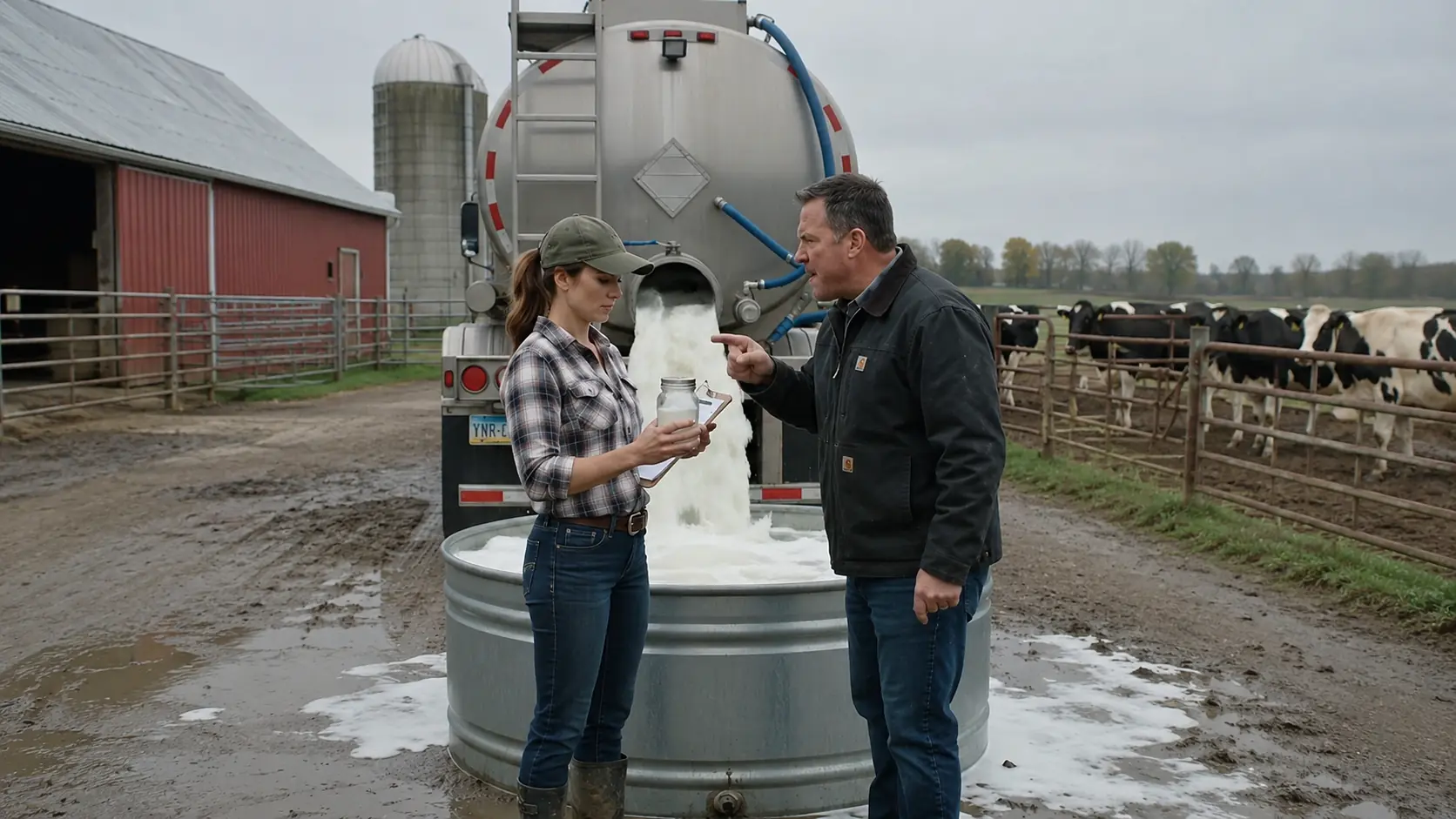
Curtis Vane stepped from a black company pickup wearing polished boots that had never crossed a muddy field. He introduced himself as regional operations manager for North Valley Dairy and explained that the company occasionally needed emergency disposal sites for spoiled or rejected milk. Madison’s farm already contained an abandoned concrete manure lagoon that could be lined and converted into a temporary holding basin. North Valley would pay her six hundred dollars for every tanker she accepted.
Madison studied the contract twice.
“What happens to the milk after it enters the basin?”
“It breaks down naturally.”
“That much milk can destroy soil and groundwater.”
“We have environmental approval.”
Curtis opened a folder containing permits, laboratory reports, and a letter carrying what appeared to be the state agriculture department’s seal. Everything looked official, and six hundred dollars per delivery could keep electricity running through the winter. Madison signed only after adding a clause allowing her to test any load entering the property.
Curtis smiled.
“Test all you want.”
The first tanker came three days later.
Nearly six thousand gallons of white liquid rushed from the stainless-steel trailer into the lined holding tank. The driver handed Madison a disposal receipt identifying the load as spoiled raw milk contaminated during refrigeration failure. Madison collected a sample, labeled it, and stored it in an old laboratory refrigerator her father had once used for mastitis testing.
Two tankers arrived the following week.
Then three.
By the end of the month, North Valley had dumped more milk on Hale Farm than Madison’s remaining cows could produce in a year. The money paid the mortgage, replaced the failed barn heater, and allowed Madison to purchase feed before prices increased. She hated depending on waste, but the arrangement kept the farm alive.
Her younger brother, Eli, questioned it during a Sunday dinner.
“That milk doesn’t smell spoiled.”
“Not every rejected load smells bad.”
“It looks cleaner than what we ship.”
Madison cut into her potatoes without answering.
Eli was twenty-four and worked nights repairing refrigeration units. He had returned to the farm after their father’s death but refused to call himself a farmer. He had watched their parents struggle for too many years and believed the land demanded more than it returned.
“What do the tests show?” he asked.
“High bacteria in some loads. Others are normal.”
“Normal enough to sell?”
“Normal enough to make me wonder.”
Madison began keeping two sets of records. One set contained the receipts North Valley supplied, while the other included her own dates, photographs, sample numbers, temperatures, and observations. She wrote down the time every tanker entered and left. She recorded license plates, driver names, volumes, weather conditions, and which loads carried sour odors.
A pattern appeared after four months.
Tankers labeled as refrigeration failures often arrived at the correct cold temperature. Loads identified as antibiotic-contaminated repeatedly tested negative using the screening kits Madison purchased from a veterinary supplier. Milk allegedly rejected for high bacteria sometimes remained stable longer than fresh milk from her own bulk tank. North Valley was not merely exaggerating the condition of occasional loads.
Many of the tankers carried perfectly usable milk.
Madison called Curtis.
“I want the original laboratory reports for every load.”
“You already receive disposal certificates.”
“Those are summaries.”
“That’s all the contract requires.”
“My contract allows independent testing.”
“Then test it.”
“I did.”
The silence on the line lasted only a second.
Curtis’s voice returned colder.
“Madison, you’re being paid to provide land, not investigate our operation.”
“I’m being paid to accept spoiled milk.”
“And that is what you’re receiving.”
She looked at the jar on her desk. The milk inside had been delivered six days earlier and remained free of the separation or odor expected from the defect listed on its receipt.
“Then you won’t mind sending the reports.”
Curtis disconnected.
Madison could have ended the arrangement. She considered doing exactly that, but the farm still depended on the payments. More importantly, terminating the contract would remove her access to whatever North Valley was doing. She continued accepting tankers while pretending Curtis’s explanation had satisfied her.
Instead of pouring every load into the lagoon, she installed a small sampling valve before the discharge line. Eli helped her route a controlled portion into sealed food-grade drums stored inside a refrigerated shed. Each sample received a number linked to the tanker records, and Madison sent random containers to independent laboratories under the name of a newly formed agricultural consulting business.
The reports confirmed her suspicions.
Much of the milk met ordinary quality standards.
Some had slightly elevated bacterial counts but remained suitable for industrial processing. Other loads were fresh enough for pasteurization. Only a small percentage matched the serious contamination described in North Valley’s disposal paperwork.
Eli read the reports beside the kitchen sink.
“They’re dumping good milk.”
“Not just dumping it.”
Madison placed two public records requests on the table.
North Valley had received millions of dollars through a state-administered surplus management program. The payments compensated processors that removed excess milk from the commercial market during periods of severe oversupply. To qualify, the company had to document that each load was destroyed or converted into approved nonfood products.
“They’re getting paid twice,” Eli said.
“Possibly three times.”
Madison showed him hauling invoices indicating that North Valley charged several dairy cooperatives for transporting rejected milk. Farmers believed they were paying the company to destroy contaminated product. North Valley then collected government surplus payments by declaring the same milk unmarketable and delivered it to Hale Farm for six hundred dollars per tanker.
“What’s the third payment?”
Madison pointed toward the lagoon.
“Environmental disposal credits.”
The company claimed it was paying licensed facilities to process waste responsibly. Yet Hale Farm was not licensed for industrial dairy disposal, despite the documents Curtis had shown her. The permit number belonged to a treatment facility forty miles away.
Eli stared at her.
“That seal on the approval letter?”
“Copied.”
“You need to call the state.”
“I need proof they can’t explain away.”
Madison had already learned how powerful companies survived accusations. They blamed clerical errors, isolated employees, and confused farmers. A handful of laboratory reports might prove the milk was usable, but North Valley could claim samples were mislabeled or contaminated after delivery. She needed records connecting specific tankers, specific invoices, specific subsidy claims, and specific people.
So she waited.
For eighteen months, the tankers continued arriving.
North Valley paid Hale Farm more than one hundred thousand dollars during that period. Madison used only what was necessary to prevent foreclosure. The remainder stayed untouched in a separate account because she suspected the company might eventually demand its return.
Meanwhile, she searched for a lawful way to use the material already dumped onto her property. Allowing thousands of gallons of nutrient-rich liquid to decompose created odor, runoff risk, and methane emissions. Madison contacted Dr. Priya Raman, an agricultural engineer at the University of Wisconsin, without revealing North Valley’s identity.
Priya inspected the lagoon and shook her head.
“This was never designed for milk.”
“Can it be converted?”
“Into an anaerobic digestion system, perhaps. But not cheaply.”
“What would the digester produce?”
“Biogas, heat, and nutrient-rich digestate. The energy could power part of the farm.”
Madison showed her two years of volume records.
Priya stared at the figures.
“You received this much?”
“And it’s still coming.”
“Why would anyone discard these volumes at one farm?”
“That’s what I’m trying to understand.”
Using grant money available for farm waste-energy research, Madison and Priya constructed a small pilot digester beside the holding tank. The system captured methane released during decomposition and used it to heat water in the milking barn. Later, a generator produced enough electricity to operate lights, ventilation fans, and refrigeration during peak hours.
Hale Farm’s utility bills dropped.
Madison added a greenhouse heated by recovered energy, allowing her to grow herbs and lettuce through the Wisconsin winter. The digested material underwent additional treatment and testing before being used as fertilizer on nonfood trial plots. Nothing entered the market until regulators approved the process.
North Valley noticed the construction.
Curtis arrived without calling.
He stood near the new generator while Madison cleaned a filter.
“What is this?”
“A waste system.”
“Our contract doesn’t give you ownership of the material.”
“The contract says you surrender it for disposal.”
“You cannot profit from our product.”
“You called it spoiled waste.”
Curtis’s face tightened.
“That doesn’t give you the right to develop commercial technology with it.”
“I’m preventing the environmental damage your false permit would’ve caused.”
He took one step closer.
“Be careful how you speak to me.”
Madison straightened.
“Be careful what you leave on my land.”
Curtis left after photographing the equipment. Two days later, North Valley’s attorneys sent Madison a letter accusing her of unauthorized use of proprietary dairy material. The wording revealed something useful: the company repeatedly called the dumped milk “recoverable commercial product.”
Madison copied the phrase and placed the letter in her evidence file.
The next tanker arrived on schedule.
By the second anniversary of the first delivery, Hale Farm looked completely different. Madison had rebuilt forty stalls and increased her herd to thirty-two cows without taking on new debt. The greenhouse supplied several local restaurants, and the pilot digester generated more electricity than the farm needed during certain months. Madison sold the excess power back to the rural cooperative under a small renewable-energy agreement.
North Valley executives believed she had become successful because of their disposal payments.
They did not know she was documenting them.
The confrontation came on a bright October morning. Curtis arrived beside the largest tanker Madison had ever seen, carrying nearly eight thousand gallons. He brought a revised contract increasing her payment but eliminating her right to test incoming loads. It also required Madison to surrender all existing samples and records related to North Valley.
She refused.
Curtis placed the papers on the hood of his truck.
“You’ve had a generous arrangement for two years.”
“You mean your company has.”
“We kept this farm alive.”
“You used this farm to hide your numbers.”
His eyes narrowed.
“I don’t know what you think you found.”
Madison lifted a glass jar containing milk collected from the tanker before discharge.
“This load is listed as antibiotic-contaminated.”
“It is.”
“The rapid test is negative.”
“Those farm kits aren’t reliable.”
“The independent lab is waiting for this sample.”
Curtis reached for the jar.
“Give me that sample.”
Madison stepped directly into his path.
“Explain the destruction payments.”
Milk thundered from the open tanker valve behind them, striking the galvanized holding tank hard enough to send white spray over the rim. Curtis glanced toward the driver, who immediately shut the cab door and pretended not to hear. Cows gathered behind the fence while Madison held the jar against her chest and the clipboard beneath her other arm.
“You have no idea what you’re accusing us of,” Curtis said.
“I have two years of load records.”
“You signed confidentiality agreements.”
“I signed an agreement to receive spoiled milk. Your own lawyers called it recoverable product.”
Curtis moved closer until only a few inches separated them.
“Keep pushing, and I’ll bury this farm under lawsuits.”
Madison did not step back.
“I’ll bury this farm.”
She raised the clipboard.
“Try it. The inspectors are here.”
Three state vehicles turned onto the gravel lane.
Curtis’s expression changed before he looked behind him. A Wisconsin agriculture department truck entered first, followed by vehicles from the environmental protection division and the state financial crimes bureau. Behind them came an unmarked federal car carrying investigators assigned to agricultural subsidy fraud.
Curtis reached again for the clipboard.
Madison pulled it away.
“Touch my records, and they’ll add witness intimidation.”
“You planned this.”
“I documented what you did.”
Inspectors surrounded the tanker before the driver could close the valve. They collected samples directly from the discharge line, photographed the paperwork, and secured the electronic delivery system. One investigator asked Curtis to remain where he stood while another read the tanker’s identification number into a recorder.
Curtis tried to regain control.
“This farmer has been stealing our milk and operating an unauthorized processing system.”
Priya emerged from the equipment shed carrying the pilot project’s approval documents.
“The system operates under a university research permit,” she said. “Every gallon received has been measured, and every by-product has been tested.”
Curtis turned toward Madison.
“You brought outsiders onto company business.”
“You brought company fraud onto private land.”
Investigators spent eleven hours at Hale Farm.
They copied Madison’s logs, collected her preserved samples, and compared tanker identification numbers with North Valley’s subsidy applications. The first thirty records already showed impossible contradictions. Loads listed as destroyed at a licensed treatment facility had been photographed entering Hale Farm on the same date and time.
Other documents were worse.
North Valley had claimed some tankers contained more milk than their physical capacity allowed. In several cases, the same load had been reported destroyed twice under different program numbers. Payments from farmer cooperatives, environmental disposal reimbursements, and state surplus subsidies all pointed toward the same tanker movements.
Madison’s detailed records connected them.
Curtis was not arrested that day. He left after investigators took his phone and company laptop, but the confidence in his walk had disappeared. North Valley suspended deliveries immediately and sent Madison notice that her contract was terminated for cause.
She placed the letter beside every other document.
Within one week, North Valley filed a lawsuit demanding return of all samples and repayment of every dollar Hale Farm received. The company accused Madison of breaching confidentiality, misusing discarded product, and damaging its reputation through false reports.
Madison’s attorney responded with the company’s own disposal records.
If the milk had been worthless waste, North Valley had no commercial ownership claim. If it remained valuable product, the destruction certifications were false. The company could not maintain both positions without exposing itself.
The lawsuit was withdrawn after twelve days.
The state investigation expanded to four North Valley facilities. Search warrants uncovered internal emails instructing managers to increase “documented destruction volume” during months when milk prices fell. Employees were told to classify safe product as contaminated whenever government reimbursement exceeded the profit available through ordinary processing.
Curtis had signed dozens of those instructions.
One email mentioned Hale Farm directly.
Use the widow’s place. She needs the money and won’t ask questions.
Madison read the sentence inside a prosecutor’s office and felt anger move through her more sharply than humiliation. Curtis had not selected her farm because it offered the best disposal site. He selected it because he saw a young woman with empty stalls, inherited debt, and no powerful family behind her.
He believed desperation had made her harmless.
Investigators discovered North Valley had treated other struggling farms the same way. Some accepted whey, spoiled cream, or rejected milk under contracts containing copied permit numbers. Several properties suffered groundwater damage, and their owners had been threatened with lawsuits when they complained.
Madison contacted every affected farmer she could find.
Together, they formed a cooperative legal group and shared records. Her laboratory procedures became the model used to verify whether additional loads had been falsely classified. Priya’s research team helped inspect waste sites and design emergency containment plans where runoff threatened wells.
The criminal case took fourteen months.
North Valley’s chief financial officer agreed to cooperate after prosecutors presented emails linking subsidy claims to company accounts. He admitted that executives had created the dumping operation to manipulate milk supply and claim reimbursements from multiple sources. Curtis supervised the regional sites, altered quality reports, and targeted farms least likely to challenge the company.
In court, Curtis’s attorney portrayed Madison as an opportunist who had accepted payments for two years before reporting concerns. The defense argued that she profited from the arrangement, built an energy system using company property, and acted only when North Valley tried to revise the contract.
Madison answered calmly.
“I kept the money separate.”
Bank records showed that nearly seventy thousand dollars remained untouched. She had preserved it because she expected the origin would eventually be questioned. Every farm improvement she made came from milk sales, greenhouse revenue, energy savings, and legitimate grants.
“Why continue accepting deliveries?” the attorney asked.
“Because ending them would’ve ended the evidence.”
“You allowed alleged environmental damage.”
“I built containment, contacted a university engineer, and reported the operation once I could prove specific subsidy claims were false.”
“You believe you outsmarted an entire corporation?”
Madison looked toward Curtis.
“No. I believed records would outlast threats.”
Curtis pleaded guilty before the jury received the case. North Valley agreed to repay more than eighteen million dollars in improperly obtained subsidies and disposal credits. Additional settlements funded groundwater testing, soil restoration, and compensation for the farms used as hidden dumping sites.
Several executives received prison sentences.
Curtis received one after investigators proved he had ordered laboratory reports altered and had threatened at least three landowners. At sentencing, he avoided looking toward Madison until the judge asked whether he wished to address those harmed by his actions.
He turned then.
“You destroyed a company that employed four hundred people.”
Madison stood behind the prosecutor’s table.
“No. You used four hundred workers as cover while you destroyed everyone beneath you.”
The company did not disappear completely. A court-approved restructuring transferred two processing plants to a producer-owned cooperative. Local dairy farmers gained representation on the new board, independent laboratories reviewed rejected loads, and disposal records became publicly auditable.
Madison refused an executive position.
She wanted to remain on her farm.
The recovered settlement money allowed Hale Farm to expand the digester, but Madison did not build it around a constant stream of discarded milk. She designed a diversified system using ordinary manure, crop residue, spoiled feed, and limited dairy by-products received through transparent contracts. The farm generated electricity, greenhouse heat, and treated fertilizer without depending on illegal waste.
Priya helped license the design for smaller dairy operations.
Madison insisted the system remain affordable.
Within three years, twenty-seven family farms across Wisconsin used versions of the Hale digester. The technology reduced disposal costs and provided emergency power during winter outages. Farmers who once saw waste only as a liability began treating it as a resource, provided it was handled honestly and safely.
Eli returned to the farm full-time.
He managed refrigeration, generator maintenance, and the electrical system while Madison oversaw the herd and business records. They rebuilt every empty stall but did not rush to fill them. Madison had learned that growth without control could become another form of dependence.
One autumn morning, a new stainless-steel tanker entered the yard.
For a moment, Madison remembered the first truck and the desperation that had made six hundred dollars feel like rescue. This tanker carried whey from the producer-owned cooperative under a legal energy-recovery agreement. The load had complete test results, a traceable source, and a volume matched to the digester’s capacity.
The young driver handed Madison the paperwork.
“You want to sample it?”
“Yes.”
“The lab already cleared it.”
“I know.”
Madison filled a glass jar, checked the temperature, and compared the identification number with the manifest. The driver waited without complaint because the cooperative’s new rules required farmers to verify every delivery independently.
Eli watched from the barn doorway.
“You still don’t trust tankers?”
“I trust evidence.”
“What do you trust people for?”
Madison sealed the jar.
“Giving me reasons to check twice.”
The tanker released its load into a closed intake system rather than an overflowing tank. No milk flooded the soil, no false destruction receipt changed hands, and no manager stood nearby assuming the farm woman would remain silent.
Inside the restored barn, forty-six cows occupied clean stalls. The others remained deliberately empty, leaving room for calves, sick animals, and whatever future Madison chose without pressure from a bank or corporation. Above the office door hung the old clipboard containing the first two years of tanker records.
Madison never framed the settlement check.
She framed the records.
They reminded her that Hale Farm had not survived because someone powerful offered help. It survived because she questioned the price attached to that help, preserved every uncomfortable fact, and refused to let fear erase what she knew.
Curtis had seen empty stalls and assumed emptiness meant weakness.
He had been wrong.
The empty stalls gave Madison room to rebuild carefully. The dying farm gave her a reason to study every gallon. The milk North Valley dumped to hide its fraud became the evidence that exposed the company and the fuel that helped create something cleaner in its place.
Two years earlier, Curtis had believed he could bury Hale Farm beneath discarded milk.
Instead, every tanker had delivered another piece of the case that buried him.