The gravel yard outside Harold Brenneman’s farmhouse had never held so many people at once. More than two hundred farmers, dealers, neighbors, and old friends had gathered beneath a flat November sky in southern Iowa, their boots grinding against cold gravel while six carefully washed John Deere tractors stood in a perfect green line beside the machine shed. For forty-three years, those machines had been part of Harold’s identity almost as much as the land itself. Now, at seventy-two, he was selling nearly everything because a heart attack the previous spring had finally forced him to admit that the farm could no longer depend on him.
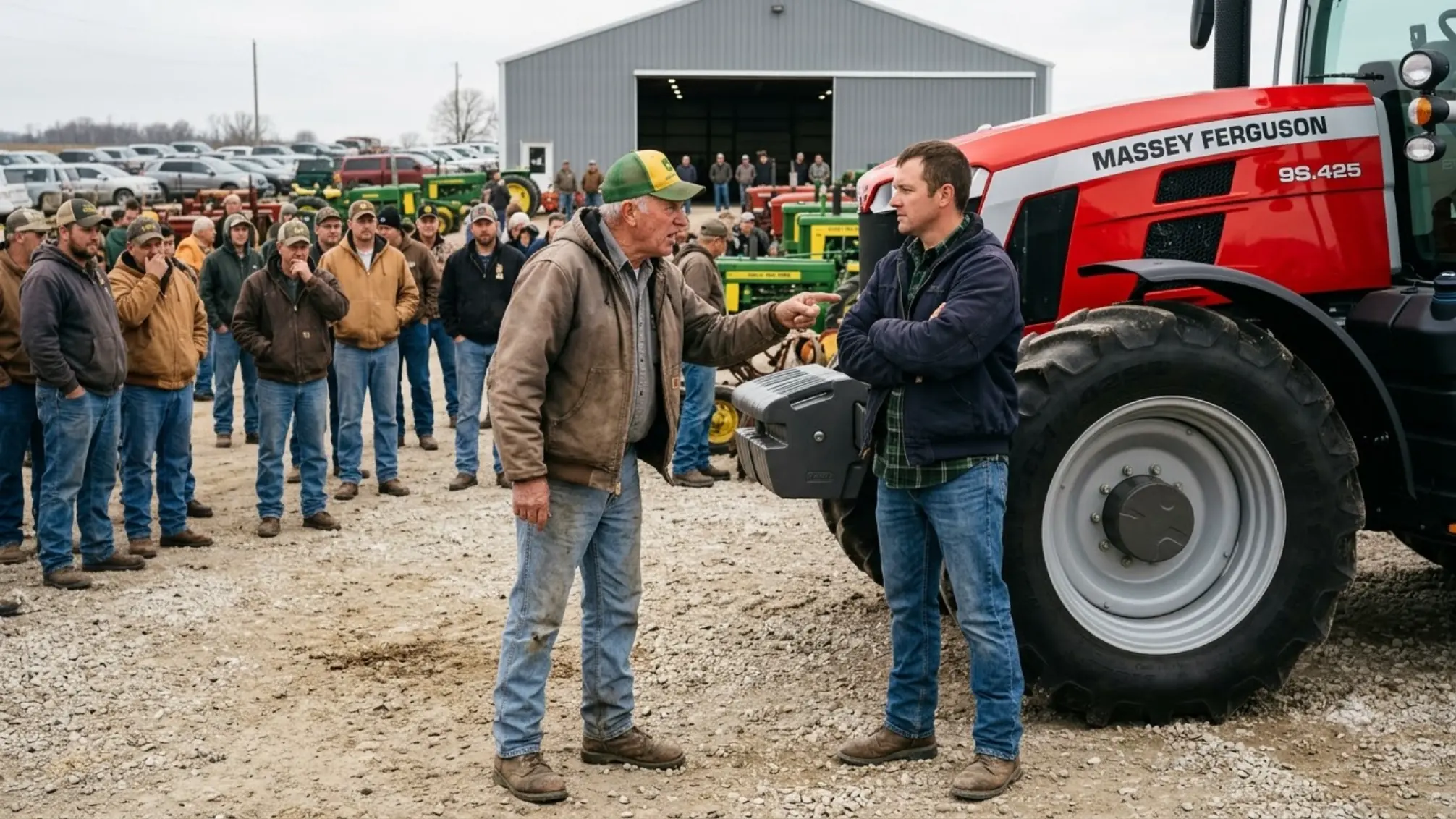
His forty-six-year-old son stood twenty feet away from the auction trailer with his hands buried inside a dark work jacket. Nathan had worked beside his father since he was fourteen, planting corn before sunrise, fixing equipment after midnight, and learning every rule Harold believed kept a farm alive. One of those rules had never been written down because it seemed too obvious to require words. Brennemans ran green equipment.
The auctioneer started with smaller implements before moving toward the tractors. Harold’s old 4440, purchased by his father in 1979, brought $31,500 despite more than eleven thousand hours on the meter. The 5075E followed, then the 6155M and 7290R, each selling strong enough to produce approving nods from the crowd. Harold barely smiled, but every successful bid seemed to reassure him that the machines he had maintained for decades were leaving with their reputation intact.
The 8370R brought $173,000.
Then came the crown jewel.
The massive tracked 9620R had cost nearly half a million dollars new and carried every technology package Harold could justify when he bought it in 2019. Two thousand hours later, it still looked almost showroom clean. The bidding climbed past $300,000 before a Nebraska dealer finally won it for $347,000.
The crowd applauded.
Harold removed his cap, wiped his forehead, and replaced it carefully.
“That,” one neighbor told him, “is how you retire properly.”
Harold nodded.
For one brief moment, he felt something close to peace.
Then the auctioneer pointed toward the far end of the equipment row.
Partially hidden behind a grain cart stood a tractor Harold had never owned, never requested, and never wanted on his property.
Bright red.
A Massey Ferguson MF 9S.425.
The local dealer had brought the demo unit that morning hoping the crowd might produce a buyer. Harold had already told him he was wasting his time.
This was Deere country.
The auctioneer explained the specifications, warranty, CVT transmission, fuel-efficiency claims, and four hundred demo hours.
“Let’s open at two hundred fifty thousand.”
Nothing.
A few farmers smiled.
Someone quietly joked that they had come to buy tractors, not experiment.
The auctioneer tried again.
“Two twenty-five?”
A hand rose near the back.
Harold’s head snapped sideways.
Nathan’s hand remained in the air.
For several seconds, even the auctioneer appeared surprised.
Then instinct took over.
“I’ve got two twenty-five! Who gives me two thirty?”
Nothing.
Harold stared at his son.
“Two thirty?”
Still nothing.
“Going once at two twenty-five.”
Nathan did not lower his hand.
“Going twice.”
Harold’s face hardened.
“Sold! Two hundred twenty-five thousand dollars!”
The gavel struck.
A few people clapped uncertainly.
Nathan lowered his hand.
Harold turned and walked toward the house without looking at anyone.
Half an hour later, most of the crowd had gone. Nathan finished the financing paperwork and found his father sitting rigidly on the porch steps. The red tractor remained visible across the yard behind them, glowing against the row where the Deere equipment had stood that morning.
“We need to talk,” Nathan said.
Harold did not look up.
“No, we don’t.”
“Dad.”
“You bought that thing at my retirement sale.”
“It’s a good machine.”
Harold stood.
“It’s not a Deere.”
“I’m aware.”
Harold stepped directly in front of him.
His voice rose.
“You bought that red piece of iron at my retirement sale just to spit on forty years of my work?”
Nathan’s jaw tightened.
“No. I bought the tractor your pride was too expensive to consider.”
Harold pointed at his chest.
“You made me look like a fool in front of every farmer in this county.”
Nathan took one step closer.
“Then blame the numbers, Dad, because I’m done going broke just to protect your damn colors.”
The words hit harder than Nathan intended.
Harold went completely still.
For a second, Nathan considered apologizing.
Then his father spoke.
“You think forty years taught me nothing?”
“That’s not what I said.”
“You think because you’ve got spreadsheets and dealer brochures, you know better than the man who built this place?”
Nathan breathed slowly.
“You taught me to look at operating cost. You taught me not to borrow money for pride. You taught me that every acre has to pay its own way.”
Harold stared at him.
Nathan pointed toward the red tractor.
“I’m doing exactly what you taught me.”
Harold’s face twisted.
“No. You’re replacing it.”
He walked inside and shut the door.
Nathan stood alone in the yard.
The following Tuesday, the Massey Ferguson arrived at Nathan’s operation three miles east.
He parked it beside the used John Deere 7210R he had purchased three years earlier. The difference was impossible to ignore. One represented everything his father had taught him to trust. The other represented the first major farming decision Nathan had ever made without Harold’s approval.
For two days, Nathan studied the machine.
He read the operator’s manual.
Calibrated GPS.
Configured the CVT.
Checked hydraulic settings.
Ran diagnostics.
On Thursday, he hooked it to a twelve-row Kinze planter and moved into a 160-acre field needing late cover-crop seeding.
The tractor settled into work immediately.
No hesitation.
No warning lights.
No fighting the transmission.
Nathan watched fuel consumption carefully.
By sunset, he had completed eighty acres while burning noticeably less diesel than the larger Deere equipment he had previously used for similar work.
He shut down the engine and remained sitting in the cab.
His phone rested beside him.
For almost a minute, he considered calling Harold.
He did not.
News traveled anyway.
Three days later, neighbor Carl Dietrich walked into Nathan’s shop without knocking.
Carl was sixty-four and had run John Deere equipment for four decades. He and Harold had traded labor during harvest, shared tools, and drunk coffee together every Sunday morning for thirty years. If anyone understood Harold’s anger, it was Carl.
“Heard you bought a red tractor.”
Nathan kept working.
“Apparently southern Iowa has developed telecommunications.”
Carl ignored the joke.
“Your dad isn’t talking to you.”
“I noticed.”
“You understand what you did?”
Nathan finally looked at him.
“I bought equipment.”
“You bought something that wasn’t Deere at his retirement auction.”
“Yes.”
“That’s different.”
Nathan wiped grease from his hands.
“Why?”
“Because everybody there knew what that equipment meant to your father.”
Nathan nodded.
“I know exactly what it meant.”
“Then why?”
“Because reputation doesn’t pay fuel bills.”
Carl’s expression hardened.
“Your father built something.”
“And now I have to keep it alive.”
“You’re acting like everything he did was wrong.”
“No.”
Nathan stepped closer.
“I’m acting like what worked for forty years doesn’t automatically work for the next forty.”
Carl shook his head.
“That Massey breaks down, don’t come crying.”
Nathan smiled without humor.
“I’ll remember that.”
Winter passed.
Harold did not call.
Nathan’s mother occasionally attempted diplomacy, but every conversation ended the same way.
“He’ll come around.”
Nathan stopped answering.
Instead, he worked.
The MF 9S hauled bales, cleared snow, pulled equipment through frozen ground, and started reliably through Iowa cold. Nathan tracked fuel use on a spreadsheet. Compared with the larger Deere machines his father had operated, the difference repeatedly landed near twenty percent.
The numbers were not emotional.
That helped.
By early May, wet weather had put planting two weeks behind.
Every hour mattered.
Nathan hooked the Massey to a sixteen-row Kinze planter and moved into the western field.
The tractor pulled smoothly at 5.2 miles per hour.
By darkness, 140 acres were planted.
His father’s 9620R had once covered slightly more ground in the same field, but it had burned dramatically more fuel doing it.
Nathan calculated the difference.
Then calculated it again.
Across twelve hundred acres, the savings mattered.
By the end of planting season, he had saved approximately $4,200 in fuel alone.
No service calls.
No major downtime.
No emissions-system interruptions.
Then Carl Dietrich called at six one morning.
Nathan was drinking coffee.
“I need a favor.”
Nathan smiled.
“What broke?”
Carl remained silent.
Nathan sat up.
“Seriously?”
“My 8370R.”
“What happened?”
“DEF code. Limp mode. Dealer says Thursday.”
Nathan looked out the kitchen window.
“How much corn left?”
“One hundred twenty acres.”
Nathan already knew the answer.
Carl hesitated.
“Could I use your 7210?”
“Too small for your planter.”
Silence.
Nathan waited.
Finally Carl said it.
“What about the Massey?”
Nathan nearly laughed.
“You want my red tractor?”
“I want corn in the ground.”
Nathan smiled.
“I’ll bring it over this afternoon.”
Carl operated the MF 9S for four days.
When he returned it Saturday morning, he climbed from the cab and stood quietly beside the tractor.
Nathan continued greasing his planter.
“Well?”
Carl looked at the machine.
“That’s a hell of a tractor.”
Nathan stopped working.
“Careful. Harold might hear you.”
“I’m serious.”
Carl pointed toward the cab.
“That transmission is smoother than my Deere. Fuel usage is better. No codes. Nothing.”
Nathan crossed his arms.
“You sound disappointed.”
“I am.”
“Why?”
“Because I’ve spent forty years telling everybody red tractors were second-rate.”
Nathan laughed.
Carl did not.
“I might have been wrong.”
That mattered more than Nathan admitted.
Summer hay season arrived.
Nathan’s custom operation covered eighteen hundred acres across four farms. Long days, narrow weather windows, constant equipment changes. It was exactly the kind of work where breakdowns turned profit into expense quickly.
The Massey ran fourteen-hour days.
It pulled balers.
Tedders.
Rakes.
Heavy wagons.
By August, Nathan had finished the same workload two days faster than the previous summer while spending roughly $2,800 less on fuel.
Still no meaningful service calls.
His spreadsheet became impossible to dismiss.
Fuel savings.
Maintenance savings.
Downtime avoided.
Nathan printed the document.
Then folded it into his glove compartment.
He did not show Harold.
September brought the county fair.
The Massey dealer asked Nathan to display the MF 9S at his booth and answer questions from other farmers.
Nathan agreed reluctantly.
By noon, farmers surrounded the tractor.
“How’s fuel?”
“Better than anything I’ve run.”
“Transmission?”
“Smooth.”
“Service?”
“Haven’t needed much.”
“Would you buy it again?”
Nathan answered without hesitation.
“Yes.”
Carl appeared at the edge of the crowd.
After everyone dispersed, he walked closer.
“You’re turning into a salesman.”
“I’m answering questions.”
“You’re making Deere look expensive.”
Nathan grinned.
“That’s not difficult.”
Carl looked around before lowering his voice.
“I’m thinking about buying one.”
Nathan stopped smiling.
“What?”
“My Deere’s been back to the dealer three times since spring.”
“You serious?”
Carl stared at the MF 9S.
“I’m tired of paying for loyalty.”
Nathan understood that sentence better than anyone.
At three that afternoon, Harold arrived at the fair with Nathan’s mother.
Nathan saw him from fifty yards away.
Harold stopped at the John Deere exhibit first.
Talked to sales representatives.
Walked around a new 8R.
Then continued through livestock barns and food stands.
On the way toward the parking lot, he reached the Massey booth.
Harold stopped.
For thirty seconds, father and son remained separated by the crowd.
Nathan said nothing.
Harold’s wife quietly touched his arm.
Harold shook his head.
Then walked away.
Nathan watched.
He had wanted his father to approach.
More than that, he had wanted Harold to ask one simple question.
How is it running?
But pride was a hard crop to kill.
Harvest arrived in October.
The MF 9S worked grain-cart duty behind Nathan’s combine, hauling corn relentlessly between the field and bins.
Across hundreds of acres, the tractor remained reliable.
Meanwhile, Carl mentioned that Harold was having continuing emissions-system trouble with one of the remaining machines he still used.
Nathan did not celebrate.
He understood too well what downtime cost.
By the end of the year, Nathan’s spreadsheet showed something extraordinary.
Approximately $14,800 saved in fuel.
Another $6,100 avoided in service and downtime expenses.
More than $20,000 in one season.
Nathan printed the spreadsheet.
This time he drove west.
Harold was inside his shop repairing a planter unit when Nathan walked in.
“I need to talk.”
“I’m busy.”
Nathan placed the paper on the workbench.
“This won’t take long.”
Harold glanced at it.
“What?”
“One year.”
Harold finally looked at him.
Nathan pointed.
“Every gallon. Every service cost. Every hour of downtime.”
Harold did not touch the paper.
“Why?”
“Because you keep thinking I bought that tractor to embarrass you.”
Harold’s jaw tightened.
“I don’t care what that tractor did.”
“It saved twenty thousand dollars.”
Harold stopped.
Nathan saw it.
“What?”
“Twenty thousand.”
Harold picked up the spreadsheet.
His eyes moved slowly down the columns.
Nathan waited.
When Harold finished, he placed the paper down.
“So you saved money.”
Nathan almost exploded.
“Dad, this isn’t twenty dollars.”
“I can read.”
“It’s enough to cover seed. Enough to reduce the tractor note. Enough to keep margin in a year when fertilizer prices ate half of it.”
Harold looked away.
Nathan lowered his voice.
“I didn’t buy that machine to insult you.”
“You did it in front of everyone.”
“Because that’s when it was available.”
“You made me look stupid.”
Nathan shook his head.
“No. I made a decision.”
Harold turned back.
“A decision that told everybody forty years of what I believed meant nothing.”
Nathan stared.
Then understood.
This had never truly been about tractors.
“Dad.”
Harold remained silent.
“You think I rejected you.”
No answer.
Nathan continued.
“I didn’t.”
Harold looked toward the shop floor.
Nathan stepped closer.
“You taught me everything I know about farming.”
“Apparently not equipment.”
“Especially equipment.”
Harold looked up.
“You always told me not to buy a machine because the neighbor owned one. You told me to calculate cost per acre. You told me downtime kills farms faster than bad yields.”
Nathan tapped the spreadsheet.
“I listened.”
Harold’s eyes returned to the numbers.
“You taught me to make this decision.”
The shop became quiet.
Finally Harold folded the sheet.
“I’m not ready to forgive you.”
Nathan nodded.
“I know.”
Harold handed it back.
“But I’m not going to stay mad forever.”
That was enough.
Spring came again.
Carl Dietrich bought a Massey Ferguson MF 8S.
Another farmer followed.
Then another.
Men who had run Deere their entire lives began calling Nathan for opinions.
Nathan never pushed.
He simply told them the truth.
Some still preferred green.
Others switched.
Nathan discovered that good farmers cared less about color once operating statements entered the conversation.
Harold slowly returned to Nathan’s life.
A nod at the co-op.
A brief conversation after church.
Five minutes beside a grain bin.
Nothing dramatic.
Then, nearly two years after the auction, Nathan’s phone rang.
Harold.
“You busy?”
“Not really.”
“Come over.”
Nathan found him sitting on the porch.
They remained silent for almost a minute.
Then Harold spoke.
“I was wrong.”
Nathan looked at him.
“What?”
Harold stared toward the fields.
“You made a good decision.”
Nathan said nothing.
“I should’ve said that a year ago.”
“You don’t have to.”
“Yes.”
Harold finally looked at him.
“I do.”
Nathan’s throat tightened.
Harold rubbed his weathered hands together.
“I thought my reputation was Deere.”
He shook his head.
“It wasn’t.”
Nathan waited.
“My reputation was taking care of equipment. Paying bills. Keeping the ground productive.”
Nathan nodded.
Harold continued.
“I confused the tool with the work.”
Neither spoke.
Then Harold smiled faintly.
“You proved me wrong.”
Nathan returned the smile.
“You taught me how.”
Harold looked toward him.
“I’m proud of you.”
Nathan looked away quickly.
“Thanks, Dad.”
Harold stood.
“Your mother made dinner.”
As they entered the house, Harold stopped.
“One thing.”
Nathan turned.
“If you ever buy another tractor at my retirement auction, we’re fighting.”
Nathan laughed.
“You only get one retirement.”
“Good.”
A year later, Nathan sat inside the MF 9S.425 pulling a chisel plow through a 180-acre field beneath an orange November sunset.
The tractor had more than two thousand hours now.
Still no major breakdown.
Still working.
More than forty thousand dollars in estimated operating savings over two years.
His phone buzzed.
A message from Harold.
Still running that red tractor?
Nathan smiled.
He typed:
Every day.
Thirty seconds later, Harold answered.
Good.
Nathan placed the phone beside him and looked across the dark soil rolling behind the implement.
Forty years of loyalty had not disappeared.
It had simply changed meaning.
Harold had spent his life believing loyalty meant staying with the equipment that built the farm.
Nathan had learned something different.
Real loyalty meant protecting the farm itself.
The brand could change.
The color could change.
The technology could change.
But the responsibility remained exactly the same.
Keep the land productive.
Keep the bills paid.
Make decisions that allow another generation to inherit something worth working.
The Massey Ferguson continued across the field, red paint glowing beneath the setting sun.
Nathan thought about the auction.
The furious argument.
The silence between father and son.
Then the spreadsheet that finally said what pride could not.
He smiled.
The tractor had never destroyed forty years of his father’s legacy.
It proved Harold’s lessons had survived them.