The steel digging bar struck something beneath the harvested cornfield with a sound no stone should have made. Eli Mercer stopped, lifted the bar, and drove it down again. The impact rang through the cold November air like a hammer against a church bell, sending a vibration into his gloved hands. Ten minutes later, he scraped away the last layer of black Iowa soil and uncovered the curved arm of a massive iron anchor.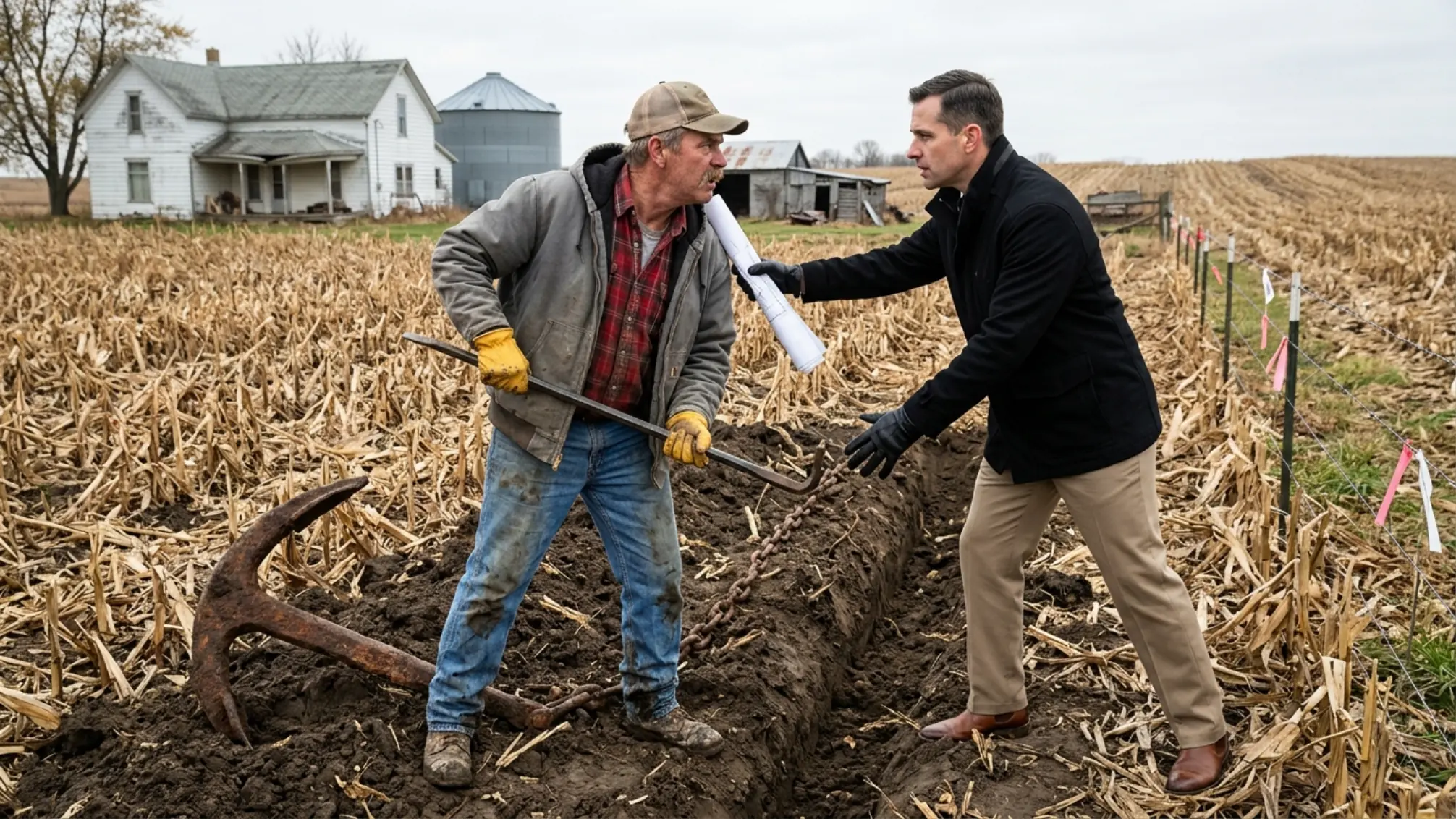
It lay almost four feet beneath the field his family had planted for generations. Rust covered its flukes, but its shape was unmistakable, and a thick chain remained attached to the shank. The links disappeared eastward beneath the dead corn stalks, pointing toward a wooded hollow that had never held more than rainwater during Eli’s lifetime.
A black SUV stopped beside the fence before he could uncover the second fluke.
Victor Hale climbed out wearing polished boots and an expensive field coat that had never touched honest mud. The forty-seven-year-old land developer had spent six months pressuring Eli to sell the eastern portion of the farm for a distribution complex. Now he crossed the fence without permission, carrying a rolled survey map beneath one arm.
For one revealing second, Victor looked afraid.
Not confused. Not irritated.
Afraid.
Then his polished expression returned. He smoothed the front of his coat and glanced toward the farmhouse, where Eli’s granddaughter, twelve-year-old Nora, stood on the porch holding her phone. Victor noticed her recording and immediately released the chain.
“This is a misunderstanding,” he said. “The eastern tract was included in the option agreement your brother signed.”
“My brother owns the north eighty.”
“The county records show overlapping rights along this boundary.”
“My fence has stood here since 1910.”
“Fences are not deeds.”
“Neither are maps you paid someone to redraw.”
Victor stepped closer. “You should be careful about making accusations.”
Eli leaned on the steel bar. “You should be careful about trespassing.”
The developer studied the exposed anchor again. Mud streaked the ancient iron, and one side carried a faint stamped symbol resembling a crown above the letter M.
Victor recognized it.
Eli saw that too.
“You’ve seen this mark before,” he said.
“I’ve seen old marine equipment.”
“Where?”
Victor looked toward the buried chain. “Scrap yards. Museums. Places where useless relics belong.”
He turned and walked back toward his SUV.
At the fence, he stopped without facing Eli.
“Cover the hole before someone gets hurt.”
Then he drove away.
Nora ran across the yard as soon as the vehicle disappeared down the gravel road. Her brown ponytail bounced behind her red farm jacket, and she nearly slipped climbing through the fence.
“Grandpa, was he threatening you?”
“He was trying.”
She pointed at the anchor. “How is that under our corn?”
“That is a very good question.”
“Are there ships in Iowa?”
“Not usually beneath cornfields.”
Nora crouched near the chain. “Mom says this land used to be closer to the river before the flood channels changed.”
“Your mother says many things.”
“She has a history degree.”
“She reminds me regularly.”
Eli’s daughter, Rebecca Mercer, arrived twenty minutes later. At thirty-six, she possessed her father’s gray eyes and her late mother’s refusal to accept weak explanations. She taught American history at the county high school and had spent years organizing old photographs, property records, and family letters that Eli considered clutter until the day they became useful.
She walked once around the anchor without speaking.
Then she looked toward the wooded hollow.
“Show me Granddad’s map.”
They returned to the farmhouse, leaving orange flags around the excavation. Eli retrieved an old metal document box from the bedroom closet. Inside were tax receipts, faded photographs, and a hand-drawn farm map prepared by his grandfather, Amos Mercer, in 1938.
The eastern hollow was clearly labeled Morrow Cove.
A narrow blue line connected it to the Cedar River, which now flowed nearly three miles away. Beside the cove, Amos had drawn a tiny anchor and written two words:
Follow chain.
Rebecca stared at the note.
“You never showed me this.”
“I thought it was one of his stories.”
“What story?”
Eli sat at the kitchen table. “Granddad said a river packet was trapped here after the flood of 1878. Water rose across the entire valley, then changed course when it receded. The ship couldn’t return to the main channel.”
“What happened to it?”
“He claimed farmers stripped the upper decks for lumber. The hull sank into the mud. Over time, the cove filled and became pasture.”
Rebecca looked toward the window. “And you thought he invented that?”
“He also claimed he once shook hands with Jesse James.”
“Did he?”
“He was six years old when James died.”
Nora placed the hand-drawn map beside a modern county survey. “Morrow Cove isn’t on this one.”
“It disappeared from maps after the flood-control project in 1966,” Rebecca said. “At least, I’ve never seen it on anything later.”
Eli opened the survey Victor had shoved against him. Hale Meridian Development’s proposed access road crossed the exact location of the old cove.
The company wanted to build a warehouse complex on three neighboring farms and connect it to the highway. Eli’s eastern acreage formed the only direct route. When he refused to sell, Victor persuaded Eli’s younger brother, Dean, to sign an option agreement involving the adjacent north eighty.
Now the company claimed that a narrow corridor across Eli’s land had been transferred decades earlier with Dean’s parcel.
Eli had assumed it was an aggressive boundary dispute.
The anchor suggested something larger.
Rebecca touched the crowned M stamped into the iron. “M could stand for Morrow.”
“Or manufacturer.”
“Victor knew what it meant.”
Nora enlarged the video on her phone. The moment Victor saw the symbol, his face tightened before he turned away.
Rebecca replayed it three times.
“He absolutely recognized it.”
Eli closed the document box. “Then tomorrow, we pull the chain.”
They began at sunrise with Eli’s tractor, a spool of heavy cable, and a borrowed metal detector. The buried chain ran almost perfectly east. Every six feet, they dug down and exposed another rusted link before marking the line with stakes.
By noon, the trail had crossed nearly half the field.
At two, the county sheriff arrived.
Sheriff Paul Denning was Eli’s age and had known him since high school. He climbed from his cruiser carrying a folded complaint.
“Hale Meridian says you’re disturbing property under active development review.”
Eli pointed around him. “Do you see their property?”
“I see your field.”
“Then we’re finished.”
Paul did not leave. “Victor also claims there may be hazardous material associated with the metal.”
“It’s an anchor, not a bomb.”
“He says old vessels carried fuel and chemicals.”
“In 1878?”
Paul scratched his cheek. “I didn’t say it made sense.”
Rebecca showed him the family map and the video of Victor recognizing the stamp. Paul watched silently.
“You should file a formal trespass complaint,” he said.
“I intend to.”
“And stop digging until the state archaeologist examines it.”
Eli’s face hardened. “Victor asked you to shut us down.”
“No. The county attorney did, after Victor called three commissioners.”
“That was fast.”
“That is why I’m telling you to protect yourself. If this is historic, digging without supervision could let them accuse you of destroying evidence.”
Eli looked toward the marked chain stretching into the hollow.
“How long before an archaeologist comes?”
“Maybe a week.”
Victor’s bulldozers were scheduled to begin grading the neighboring property in four days.
Eli knew what could happen in a week.
That night, someone entered the field.
Nora’s dog began barking shortly after midnight. Eli turned on the yard lights and saw two figures near the anchor hole. One carried a fuel can. The other swung a sledgehammer against the exposed iron.
Eli fired a shotgun into the air.
The figures ran toward an unmarked pickup parked along the county road. Rebecca called the sheriff while Nora recorded the truck disappearing into darkness.
By morning, the anchor’s stamped symbol had been badly damaged.
But not destroyed.
Rebecca had already photographed it.
A wet trail led from the fuel can to a pile of corn stalks, showing that someone intended to burn the excavation and possibly the field around it.
Paul examined the footprints and tire tracks.
“This is no longer a boundary disagreement,” he said.
Eli looked toward Victor’s development site, where excavators waited behind temporary fencing. “It never was.”
The state archaeologist arrived that afternoon instead of the following week. Dr. Helen Alvarez stepped from a university van carrying surveying equipment and more enthusiasm than the cold weather justified.
She examined the anchor for less than five minutes before identifying it as a mid-nineteenth-century river anchor.
Then she studied the damaged stamp.
“The crown and M belonged to the Morrow Packet Company,” she said. “They operated passenger and freight vessels on several Midwestern rivers from 1851 until 1882.”
Rebecca unfolded Amos’s map. “Could one have been trapped here?”
Helen examined the terrain. “Absolutely. Before levees and modern drainage, rivers created temporary channels, oxbows, and coves that could disappear after one major flood.”
“What does the chain lead to?” Nora asked.
“Possibly a mooring point.”
“Or the ship?”
Helen smiled. “Possibly.”
The archaeologist contacted the state historic preservation office and obtained emergency permission for a controlled survey. Ground-penetrating radar arrived the next morning.
Victor arrived with two attorneys.
“You have no authorization to bring this equipment across the disputed corridor,” he told Eli.
Helen held up a state order. “The site is temporarily protected pending archaeological evaluation.”
Victor’s jaw tightened. “Based on one piece of abandoned metal?”
“Based on an anchor associated with a documented nineteenth-century shipping company, a buried chain, and historic evidence of a vanished waterway.”
One attorney whispered into Victor’s ear.
Eli stepped closer. “Still think it belongs in a scrap yard?”
Victor ignored him.
The radar team followed the chain into the wooded hollow. Beneath six feet of soil and compacted sediment, the screen revealed a long curved structure almost one hundred twenty feet in length.
Helen stared at the image.
“That is a hull.”
Nora grabbed her mother’s arm.
Rebecca whispered, “The Morrow ship.”
Further scans revealed metal concentrations inside the buried vessel and a second chain extending from its stern toward the southern edge of the hollow. The entire area matched the outline of Morrow Cove on Amos Mercer’s map.
Victor left before the survey ended.
The discovery became county news by evening.
Reporters arrived. Neighbors gathered at the fence. People who had mocked Amos Mercer’s old story now repeated it as though they had always believed him.
Dean Mercer arrived after dark.
Eli’s younger brother looked exhausted. He carried a thick envelope bearing Hale Meridian’s logo.
“I need to tell you something,” Dean said.
Eli let him into the kitchen but did not offer coffee.
Dean placed the envelope on the table. Inside were copies of title documents, environmental reports, and a private survey conducted for Hale Meridian two years earlier.
The company had known about the buried cove before approaching either brother.
Their survey showed the vessel, the old river channel, and a broad area of wetland soil beneath the fields. Building there would require federal review, historical assessment, and expensive environmental mitigation.
Instead of reporting it, the company hired a consultant to classify the hollow as ordinary agricultural drainage.
“They told me the corridor belonged with my parcel,” Dean said. “Victor offered enough money to pay every debt I have.”
“So you signed away land you knew might be mine?”
“I believed their survey.”
“You believed their check.”
Dean lowered his eyes. “Yes.”
Rebecca opened the environmental report. Several pages had been removed, but the index still listed a section titled Historic Navigable Channel and Potential Wreck Site.
“Hale Meridian erased the cove because it would stop the project,” she said.
Dean nodded. “Victor said if the old channel became public, federal agencies might claim jurisdiction. He said the project would die.”
Eli stared at his brother. “Why come here now?”
“Because last night Victor told me they were moving an excavator into the hollow before the state finished its order.”
Rebecca stood. “To destroy the ship.”
Dean pushed the envelope toward them. “The crew starts at four tomorrow morning.”
Sheriff Denning positioned deputies around the farm before midnight.
At three forty-seven, two excavators approached without lights from the neighboring development property. A pickup followed carrying Victor and the same operations supervisor visible in Nora’s recording from the night of the attempted fire.
Deputies blocked the access road.
Victor stepped from the pickup shouting that he possessed legal authority to protect company property. Paul ordered him to the ground after one excavator continued moving toward the protected hollow.
The operator stopped only when another patrol vehicle crossed his path.
Inside Victor’s truck, deputies found bolt cutters, fuel, forged utility permits, and a printed plan showing where to dig through the buried hull.
Victor was arrested for violating the preservation order, attempted destruction of protected evidence, trespass, and conspiracy to commit arson. The operations supervisor eventually admitted that Victor had ordered the nighttime attack on the anchor.
The development project stopped immediately.
Excavation of the ship began the following spring under a temporary shelter. Removing it entirely would have destroyed the waterlogged wood, so archaeologists exposed only selected portions.
The vessel’s name appeared beneath layers of mud along the bow:
MORROW BELLE
Inside the captain’s cabin, researchers found a corroded iron safe. Its contents had survived inside sealed metal boxes—passenger records, shipping contracts, navigational charts, and a handwritten journal describing the flood of 1878.
The final pages told how the Morrow Belle became trapped when the river abandoned its channel. Local farmers rescued thirty-two passengers using wagons and ropes.
One rescuer was Eli’s great-great-grandfather.
The journal also contained a map of the cove and a legal agreement signed by surrounding landowners. Morrow Cove had been designated a shared refuge and public access point because it provided water during drought and shelter during floods.
The agreement had never been formally dissolved.
Hale Meridian could not legally build across it.
The company’s hidden reports, forged boundary documents, and attempts to destroy evidence triggered state and federal investigations. Victor Hale eventually pleaded guilty to fraud, evidence tampering, and conspiracy. Several county officials who accepted campaign donations in exchange for approving the altered surveys resigned.
Dean lost most of the money from his option agreement and nearly lost his farm.
Eli did not rescue him immediately.
For months, the brothers barely spoke.
Then Dean appeared one morning with fence posts in his truck.
“I know this doesn’t repair what I did,” he said.
“No.”
“I thought money would save my land.”
“You nearly sold mine to get it.”
“I know.”
Eli handed him a post driver.
“Start at the south corner.”
They worked without speaking until sunset.
It was not forgiveness, but it was labor moving in the correct direction.
The state purchased a conservation easement covering Morrow Cove while allowing the Mercers to continue farming the surrounding ground. A small museum and observation shelter were built near the excavation. Visitors could see part of the Morrow Belle’s hull, the recovered anchor, and the chain that led from the cornfield to a waterway missing from modern memory.
Nora insisted that Amos Mercer’s 1938 map be displayed beside the official archaeological survey.
Beneath it, the museum placed his handwritten instruction:
Follow chain.
Eli visited the exhibit alone on the first anniversary of the discovery. He stood before the anchor, now cleaned and stabilized, and examined the damaged Morrow crown Victor’s men had tried to destroy.
Rebecca approached quietly.
“You were right not to bury it.”
“I almost did.”
“When?”
“The first day. Before Victor arrived.” Eli placed one hand against the display railing. “I thought uncovering it would delay planting. I was tired, cold, and angry at the field.”
“What changed your mind?”
“He told me to cover it.”
Rebecca smiled. “So stubbornness saved history.”
“Do not tell Nora that. She already considers stubbornness a virtue.”
Outside, the former cornfield sloped toward the restored outline of Morrow Cove. Engineers had reopened a narrow wetland channel, allowing seasonal water to return without flooding the productive acreage.
Birds gathered where warehouses had been planned.
Children walked along a boardwalk above the buried ship.
The land did not become useless because its history had been discovered. It became more valuable in a way Victor Hale had never understood.
Eli had spent his life measuring fields by yield, rainfall, and soil. The anchor taught him that land also carried memory beneath the plow line—forgotten rivers, vanished roads, broken promises, and truths powerful men preferred to erase.
Victor had seen the buried ship as an obstacle.
Amos had seen it as a story worth marking.
Eli finally understood why his grandfather drew the anchor and wrote those two words instead of explaining everything.
Some truths could not be handed to the next generation as conclusions.
They had to be uncovered link by link.
And once Eli began pulling, the chain did more than lead him toward a forgotten cove.
It dragged an entire lie into the light.