“Your father left this farm to the wrong child—those worthless sunflowers will bury you.”
Harold Vance threw the rejection report onto the dusty floor of the equipment shed, making sure the farmers gathered outside could see the papers scatter around Leota Pruitt’s boots. At thirty-one, Leota was younger than nearly every landowner in Ness County and the only woman who regularly walked into the cooperative office without a husband beside her. Her long chestnut hair rested in two braids beneath a brown ranch hat, and her red-and-black plaid shirt still carried black streaks from the machine she had spent four months rebuilding.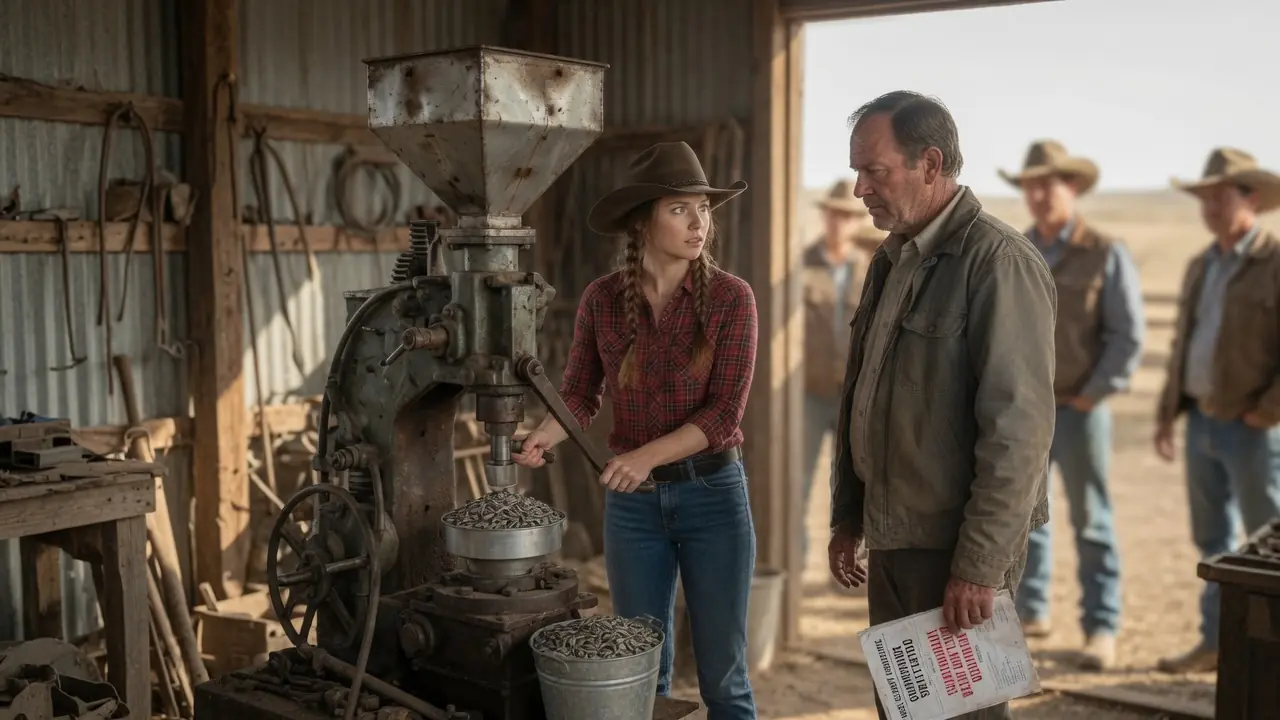
Leota placed one hand on the oil press switch. “My father left it to the only person smart enough to prove you wrong.”
Harold looked past her at the battered cast-iron machine. Its feed hopper carried a fresh welding seam, its motor had once powered a broken grain auger, and the silver discharge cone had been shaped by Leota herself on her late father’s metal lathe. To Harold, it looked like an expensive piece of scrap being held together by stubbornness.
“When that broken press fails,” he said, “I’ll buy your land for pennies.”
Leota’s green eyes remained fixed on him as she pushed the switch. “Then watch the oil flow—and watch your offer become worthless.”
The electric motor groaned before settling into a steady hum. A leather belt turned the shaft, and the rebuilt screw began pulling sunflower seeds through the press barrel. Several men leaned closer, expecting smoke, sparks, or the violent snap of a seized machine tearing itself apart.
For several seconds, nothing appeared.
Harold’s smile widened.
Then a thin golden stream emerged beneath the discharge cone.
It flowed down the metal trough and into a clean steel container Leota had positioned below it. The oil was pale, clear, and fragrant, carrying the faint scent of roasted seeds even though no heat had been added. The farmers at the entrance stopped whispering.
Harold’s smile vanished.
Leota watched the stream grow steadier. She had imagined that moment countless times while working alone in her father’s shop, but she did not celebrate. Instead, she studied the flow, checked the temperature gauge, and adjusted the pressure cone by half a turn.
Only after the oil continued running perfectly did she look at Harold.
“You were saying something about pennies?”
Four years earlier, no one in Ness County would have believed sixty acres of sunflowers could decide the future of the Pruitt farm.
Most farmers planted wheat, milo, or sorghum because those were the crops the local cooperative knew how to buy. The co-op provided seed, arranged storage, organized transportation, and posted the prices farmers were expected to accept. Harold Vance had managed its operations for almost fifteen years, and many people treated his opinion as though it were an official law of agriculture.
Leota’s father, Clarence Pruitt, had never trusted that kind of dependence.
“The moment another man controls your tools, your debt, and your buyer,” he once told her, “he controls what you are allowed to call a good harvest.”
Clarence had taught Leota to drive a tractor before she was tall enough to reach the pedals comfortably. By fourteen, she could weld a cracked plow frame, replace a bearing, and use the old metal lathe inside his workshop. He never made a speech about teaching a daughter work usually reserved for sons; he simply handed her tools because she was the child who stayed beside him and paid attention.
Her three older brothers eventually left the farm. One joined an aircraft factory in Wichita, another became a schoolteacher, and the third married into a hardware business in Dodge City. Leota had planned to study agricultural science, but her mother became ill during her first year of college, forcing her to return home.
She never went back.
When Clarence died in 1965, he left Leota 240 acres, an aging collection of equipment, his workshop, and a farm without a mortgage. Some relatives assumed one of her brothers would return and manage the property. When Leota announced that she intended to farm it herself, several men offered to purchase the land before she “made an emotional mistake.”
Harold Vance was among them.
He visited three weeks after the funeral wearing polished boots that had never touched a muddy field. He told Leota that farming alone would overwhelm her and offered a price far below the land’s actual value. He described it as a favor to the Pruitt family.
Leota declined without arguing.
Harold returned six months later with a slightly higher offer. She declined again.
After that, his concern transformed into contempt.
For three years, Leota continued planting wheat and milo exactly as her father had. The crops paid the taxes and kept food on the table, but the southwest corner of the farm remained a problem. Its sandy soil lost moisture quickly, and wheat often failed there before reaching its full height.
The county extension office recommended converting the sixty acres into grazing ground. Harold said she should sell that portion to a neighboring cattle rancher before it lowered the value of the rest of her property.
Leota listened to everyone and followed none of their advice.
Instead, she drove nearly ninety miles to a university library and spent two Saturdays reading agricultural reports. She studied crops grown on dry plains, compared rainfall requirements, and copied information into a spiral notebook. Sunflowers appeared repeatedly in studies of light soil and drought-resistant farming.
The crop had deep roots, tolerated heat, and produced seeds rich in oil.
The local co-op had no established market for them.
That was not the same as saying no market existed.
Leota ordered enough seed to plant six acres in 1968. She told no one what she intended to do because she did not need the county watching an experiment before she understood it herself. When the sunflowers emerged, their tall green stalks attracted attention immediately.
Harold stopped his truck beside the field one afternoon.
“You planting decorations now?”
“I’m testing a crop.”
“There’s no buyer within a hundred miles.”
“Then I’ll look farther than a hundred miles.”
Harold laughed. “Pretty flowers don’t make a farmer.”
“No,” Leota answered. “Harvests do.”
That first crop survived a summer that damaged much of the county’s wheat. Leota harvested the seeds, weighed them, calculated production per acre, and mailed samples to a university laboratory. The yield was modest, but the oil content exceeded what she had expected.
She planted twelve acres the following year and twenty-four the year after that.
Every season produced more information.
Leota learned how far apart the rows should be, which areas held moisture longest, and how late she could plant without reducing oil quality. She also began contacting buyers. Natural food stores in Lawrence and Wichita expressed interest in locally produced cold-pressed sunflower oil, but none wanted unprocessed seeds.
The money was not in selling the crop.
It was in transforming it.
Unfortunately, a commercial oil press cost more than Leota was willing to remove from the savings account her father had left behind. She refused to borrow for machinery because Clarence had spent his life warning her that debt turned every dry season into someone else’s opportunity.
For eighteen months, she searched equipment advertisements and farm auctions.
Then she saw the French oil expeller.
It sat behind several rusted plows at a liquidation sale outside Ness City. The machine had been built during the 1940s, but years of neglect had left its shaft frozen. Its hopper was cracked, its drive belt was missing, and the adjustable discharge cone had disappeared.
The auctioneer called it a seed-processing machine in unknown condition.
A scrap dealer offered twenty dollars.
Leota bid twenty-five.
The scrap dealer raised his bid to thirty.
Leota offered forty-five.
No one challenged her.
By sunset, the machine was sitting on a flatbed trailer headed toward her farm. Her brother-in-law Dale helped transport it, laughing almost the entire drive.
“You just paid money for an iron coffin,” he said.
“I bought a press.”
“It doesn’t move.”
“It will.”
“It’s missing parts.”
“I’ll make them.”
“What are you going to press?”
“Sunflower seeds.”
Dale stared at the empty road before bursting into laughter again.
By Sunday, half the county had heard that Leota Pruitt bought a broken oil press for a crop no one wanted. People repeated the story at church, the feed store, and the cooperative office. With every retelling, the price of the machine increased and Leota’s supposed foolishness became more exaggerated.
Harold enjoyed the story more than anyone.
He began calling her “Sunflower Leota” whenever she entered the co-op.
The nickname was meant as an insult.
Leota treated it like a brand.
For the first two weeks, she did not repair anything. She dismantled the machine, cleaned every surface, measured each worn component, and searched for information about its original design. The manufacturer no longer existed, but she located a technical manual through an interlibrary loan.
The missing discharge cone was the most difficult problem. It controlled the pressure inside the barrel, determining how much oil could be extracted without overheating the seed. A badly shaped cone would produce poor yields or jam the entire machine.
Leota spent three evenings turning a replacement from steel on Clarence’s lathe.
Her first attempt had the wrong angle.
She placed the failed piece on the workbench, reviewed her measurements, and began again.
The second cone fit perfectly.
She welded the cracked hopper, rebuilt the motor mount, replaced the bearings, and designed a screen to remove stones and field debris from the seeds. She repurposed a motor from a damaged grain auger and bought only the parts she could not fabricate.
The entire rebuild cost less than one-eighth of a new machine.
While Leota worked, her sunflower crop grew across all sixty acres.
Their yellow heads turned toward the Kansas sun, covering the field with a brilliance unlike anything else in the county. Travelers stopped along the road to take photographs. Children asked their parents to drive past the Pruitt farm.
Harold saw only a field he could not sell through his cooperative.
Two weeks before harvest, he sent Leota an official letter refusing to accept or store her crop. The report described the sunflowers as an experimental planting with no reliable commercial value. It also warned that using the land for unapproved oilseed production could affect her access to certain co-op services.
Leota drove to Harold’s office with the report folded beneath her arm.
“You cannot tell me what I grow on land I own.”
“I can tell you what the co-op will support.”
“I didn’t ask for support.”
“You’ll need our storage bins after harvest.”
“No, I won’t.”
Harold leaned back. “And where will you take sixty acres of seed?”
“Across my yard.”
He frowned. “To that broken press?”
“To my working press.”
“You have not produced one gallon of oil.”
“Not yet.”
Harold lowered his voice. “Sell me the southwest sixty. I’ll give you enough to recover what you wasted on this experiment.”
Leota rose from the chair. “You still think the ground is worthless.”
“It is.”
“Then why do you want it?”
Harold did not answer.
Leota invited local farmers to the first full test of the rebuilt machine. She also invited Harold because she wanted the man who had signed the rejection report to witness the result personally.
Before the demonstration, she cleaned one hundred pounds of sunflower seed and placed it inside sealed containers. She checked the motor three times, inspected the belt, and tested the emergency cutoff.
Still, the night before the demonstration, she barely slept.
If the press failed publicly, Harold would control the story before she could repair it. Buyers might withdraw their interest, and farmers would remember the failure far longer than they remembered the years of preparation behind it.
Leota entered the shed before sunrise and stood beside the machine her father would never see.
“I hope I understood what you were trying to teach me,” she whispered.
By afternoon, more than twenty people had gathered.
Harold arrived carrying the co-op report.
The confrontation ended with the oil flowing into Leota’s steel container and Harold staring at the golden stream as though it had personally betrayed him.
Leota collected several gallons during the demonstration. She filtered the oil through fine cloth and poured it into clear glass bottles. The next morning, she drove samples to buyers in Wichita and Lawrence.
The Lawrence natural food cooperative placed an order for fifty gallons.
A Wichita retailer ordered thirty.
A restaurant owner who tasted the oil on fresh bread requested twenty gallons immediately and asked whether Leota could guarantee monthly delivery.
She signed her first contracts before winter.
Harold responded by telling people the orders were temporary. He claimed natural food stores were a passing fashion and warned farmers that Leota’s customers would disappear as soon as they found a cheaper supplier.
Instead, her list of buyers grew.
The oil tasted richer than refined products sold through large distributors. Because Leota controlled the crop, pressing temperature, and filtration, every batch remained consistent. Restaurants began mentioning Pruitt Farm Sunflower Oil on their menus.
Within three years, the sixty acres earned more than the farm’s larger wheat fields.
Leota purchased bottles directly from a manufacturer, designed a simple yellow label, and converted part of the equipment shed into a clean processing room. She kept every receipt, every batch number, and every customer letter in carefully labeled folders.
She also saved almost everything she earned.
Then the agricultural economy changed.
Commodity prices fell. Interest rates climbed. Farmers who had borrowed heavily during prosperous years struggled to make payments. Machinery dealers reclaimed tractors, banks foreclosed on land, and auctions became common across the county.
The cooperative suffered as well.
Harold had approved the construction of new storage bins using borrowed money because he believed grain production would continue rising. When prices declined, the co-op collected less revenue while its debt payments increased.
Harold visited Leota’s farm in the autumn of 1983.
Twelve years had passed since the first oil demonstration. Leota now pressed seed from 180 acres because several neighboring farmers grew sunflowers under contract for her. A second oil press operated beside the original French machine, which she still maintained carefully.
Harold removed his hat when he entered the processing shed.
“The co-op may be interested in representing your oil.”
Leota continued checking the filter gauge. “You rejected the crop.”
“That was years ago.”
“You called the land worthless.”
“Markets change.”
“The market was there. You refused to look for it.”
Harold cleared his throat. “We could distribute every gallon you produce.”
“You could not sell my seeds when I needed you.”
“We understand the product now.”
Leota finally faced him. “No, Harold. You understand the profit now.”
He shifted uncomfortably. “The co-op needs new revenue.”
“So did my farm when you tried to buy it for pennies.”
“We could offer favorable terms.”
“I already have buyers.”
“Name your price.”
Leota looked past him toward the original press. The machine the county had laughed at was running smoothly, releasing another stream of golden oil.
“My price is independence.”
Harold left without a contract.
Three months later, the co-op announced that it would sell two parcels of land it had acquired through unpaid loans. One parcel bordered Leota’s sunflower field and contained the same sandy soil Harold had once dismissed.
The auction drew farmers, bankers, and investors from Wichita.
Harold stood near the front, no longer carrying the confidence he once displayed inside his office. The cooperative needed the sale proceeds to satisfy its lenders. Everyone in the room understood that the land would probably sell below its former value.
Leota waited until the bidding slowed.
Then she raised her number.
An investor challenged her twice.
Leota continued.
When the auctioneer finally struck the podium and declared the property sold, the room became silent.
Leota had purchased 240 acres in cash.
Dale, the brother-in-law who once laughed while transporting the broken press, stood near the back. He removed his cap and stared at her as though seeing her clearly for the first time.
Harold approached after the auction.
“You planned this all those years ago?”
“No.”
“You knew the co-op would fail?”
“I never wanted it to fail.”
“Then how did you know when to buy?”
Leota folded the purchase papers. “I kept my costs low, found my own customers, and saved during the good years.”
Harold looked toward the farmers leaving the building. “People think you defeated me.”
“This was never about defeating you.”
“You embarrassed me in front of the entire county.”
“You did that when you decided a crop, a machine, and a woman were worthless before understanding any of them.”
Leota walked past him without waiting for a response.
The following spring, the land Harold once controlled became a field of sunflowers.
Their yellow heads stretched farther than Leota could see from the equipment shed. Several local farmers now earned stable income supplying seeds to her processing business. She paid them fixed contract prices that protected them from the worst commodity swings.
She never became the wealthiest person in Kansas.
She became something more valuable to the people around her: proof that a small farm could survive without surrendering every decision to a bank, a cooperative, or a distant buyer.
Years later, young farmers visited Leota’s workshop to study the original press. By then, its welded hopper had been repaired more than once, and the motor had been replaced, but the discharge cone she shaped on her father’s lathe still controlled the pressure.
Leota always told them the same thing.
“The machine was never the miracle. The market was never the miracle. The miracle was refusing to let someone else’s limited imagination become the limit of my land.”
She eventually trained her niece Carol to manage the oil business. Like Clarence before her, Leota did not teach through long speeches. She stood beside Carol, demonstrated each step, and made her repeat it until she understood not only what to do, but why it worked.
On the thirtieth anniversary of the first pressing, the county agricultural board honored Leota at its annual meeting.
Harold Vance attended.
He had retired years earlier and looked smaller without the authority of the cooperative behind him. After the ceremony, he approached Leota near the coffee table.
“I was wrong about you,” he said.
Leota studied his face. She had waited decades to hear those words, yet they brought less satisfaction than she once imagined.
“You were wrong about more than me.”
“The sunflowers?”
“The soil. The machine. The customers. Every farmer you told to stop looking beyond what the co-op already understood.”
Harold nodded slowly. “I suppose I thought experience meant I already knew the answers.”
Leota glanced across the room at Carol speaking with a group of young growers.
“Experience should teach you which questions you haven’t asked.”
Harold extended his hand.
Leota accepted it.
She did not forgive the humiliation because he deserved relief. She released it because she no longer needed his failure to validate her success.
When Leota returned home that evening, she entered the old workshop and switched on the light above Clarence’s lathe. His tools still hung along the wall, though their handles had been worn smooth by another generation of hands.
On a shelf rested Harold’s original rejection report.
Across the front, in faded black letters, it described her sixty acres as commercially unviable.
Beside it sat the first glass bottle of sunflower oil she had ever pressed.
Leota looked at both objects for a moment before closing the cabinet.
The report represented what other people had seen.
The bottle represented what she had known.
Outside, hundreds of acres of sunflowers moved gently beneath the Kansas sky. Their roots reached deep into ground that experts once called too dry, too light, and too unreliable to matter.
The county had been correct about one thing.
The land could not reliably produce what everyone else was already growing.
It had simply been waiting for a farmer brave enough to ask what it was meant to produce instead.